

Environmental Testing Equipment Market Report
First published: 12 October 2024 | Last updated: 25 May 2026 | Report Code: environmental-testing-equipment
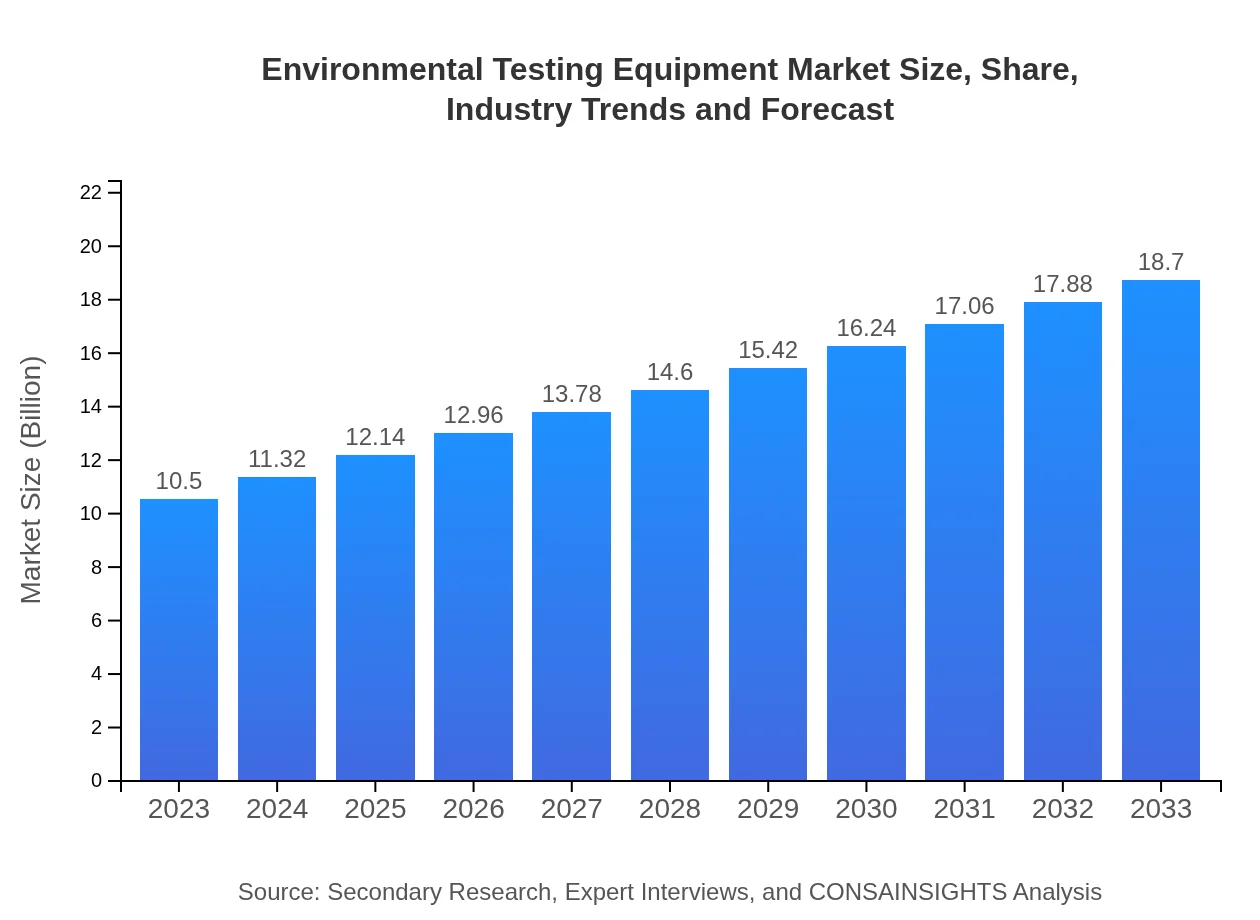
Environmental Testing Equipment Market — USD 10.5 billion in 2023, Growing to USD 18.70B by 2033 at 5.8% CAGR
This report provides a comprehensive analysis of the Environmental Testing Equipment market, focusing on key trends, growth factors, and future demands from 2023 to 2033. Insights include market size, segmentation, regional analysis, and forecasted growth patterns.
Key Takeaways
- Global market expands from $10.50 Billion in 2023 to $18.70 Billion in 2033 at a 5.8% CAGR.
- North America is largest regional market, while no single fastest-growing region is stated because regional CAGR differences remain within 0.15 percentage points.
- Regional growth is distributed across Europe ($2.65B to $4.73B) and Asia Pacific ($2.07B to $3.69B), reflecting regulatory and industrial demand.
- Top manufacturers identified include Thermo Fisher Scientific, Agilent Technologies, and Horiba Ltd., driving product development and service expansion.
- Key product categories include gas analyzers, water testing, and soil testing equipment, with automation and digital integration shaping adoption.
Environmental Testing Equipment Market Report — Executive Summary
North America remains largest market by forecast-period value, while no single fastest-growing region is stated because top regional growth rates are separated by less than 0.15 percentage points. This report examines the Environmental Testing Equipment market through 2023 to 2033, documenting growth from $10.50 Billion to $18.70 Billion at a 5.8% CAGR. Regulatory tightening, rising environmental monitoring needs, and industrial expansion are primary growth drivers. Technological adoption—visible in automated testing and digital data capture—supports improved throughput and accuracy. The analysis covers product segments such as gas analyzers, water and soil testing instruments, and deployment modes including manual and automated approaches. Regional breakdowns present North America as the largest market, with detailed figures for Europe, Asia Pacific, Latin America, and Middle East & Africa. Competitive profiling highlights Thermo Fisher Scientific, Agilent Technologies, and Horiba Ltd. Research relies on interviews with industry experts and company disclosures to map trends, market structure, and adoption patterns for stakeholders seeking procurement, investment, or product development insights.
Key Growth Drivers
- Stricter environmental regulations increasing routine monitoring and compliance testing demand.
- Industrialization and urbanization expanding the need for continuous air, water, and soil quality assessment.
- Advances in automation and digital sensors enhancing testing speed, reliability, and remote data access.
- Investment by major vendors in product innovation and service capabilities to meet laboratory and field requirements.
| Metric | Value |
|---|---|
| Study Period | 2023 - 2033 |
| 2023 Market Size | $10.50 Billion |
| CAGR (2023-2033) | 5.8% |
| 2033 Market Size | $18.70 Billion |
| Top Companies | Thermo Fisher Scientific, Agilent Technologies, Horiba Ltd. |
| Published Date | 12 October 2024 |
| Last Modified Date | 25 May 2026 |
Environmental Testing Equipment Market Overview
Customize Environmental Testing Equipment Market Report market research report
- ✔ Get in-depth analysis of Environmental Testing Equipment market size, growth, and forecasts.
- ✔ Understand Environmental Testing Equipment's regional dynamics and industry-specific trends.
- ✔ Identify potential applications, end-user demand, and growth segments in Environmental Testing Equipment
What is the Market Size & CAGR of Environmental Testing Equipment Market Report market in 2023?
Environmental Testing Equipment Industry Analysis
Environmental Testing Equipment Market Segmentation and Scope
Tell us your focus area and get a customized research report.
Environmental Testing Equipment Market Report Market Analysis Report by Region
Europe Environmental Testing Equipment Market Report:
Europe grows from $2.65 Billion in 2023 to $4.73 Billion in 2033. 65 Billion in 2023 to $4.73 Billion in 2033, supported by stringent environmental standards, investment in monitoring infrastructure, and widespread use of water, air and soil testing solutions.Asia Pacific Environmental Testing Equipment Market Report:
Asia Pacific grows from $2.07 Billion in 2023 to $3.69 Billion in 2033. 07 Billion in 2023 to $3.69 Billion in 2033, driven by industrialization, urbanization, and rising regulatory focus that increase demand for portable and laboratory-grade testing equipment.North America Environmental Testing Equipment Market Report:
North America is largest regional market, rising from $4.04 Billion in 2023 to $7.19 Billion in 2033. This expansion reflects regulatory enforcement, extensive industrial monitoring requirements, and significant procurement by public and private laboratories.South America Environmental Testing Equipment Market Report:
Latin America grows from $0.66 Billion in 2023 to $1.18 Billion in 2033. 66 Billion in 2023 to $1.18 Billion in 2033 as regional monitoring needs and compliance initiatives encourage adoption of water, soil and air testing instruments.Middle East & Africa Environmental Testing Equipment Market Report:
Middle East and Africa grows from $1.08 Billion in 2023 to $1.92 Billion in 2033. 08 Billion in 2023 to $1.92 Billion in 2033, with growth supported by infrastructure development, environmental monitoring programs, and expanding laboratory capabilities.Tell us your focus area and get a customized research report.
Research Methodology
Environmental Testing Equipment Market Analysis By Product
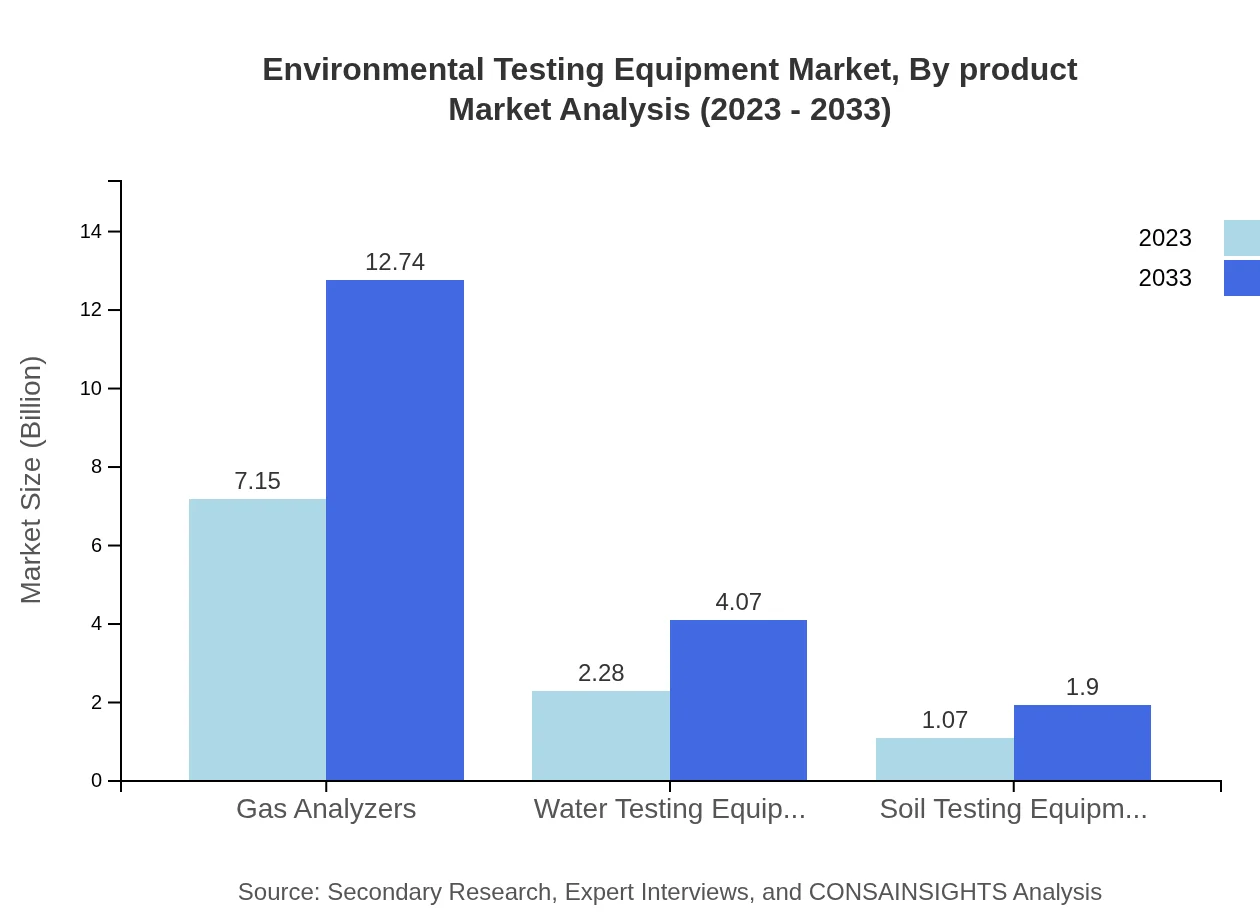
The Environmental Testing Equipment market is segmented into various product types, including gas analyzers, water testing equipment, and soil testing equipment. Gas analyzers lead the market with a size of $7.15 billion in 2023, growing to $12.74 billion by 2033, making up 68.11% of the share. Water testing equipment holds a market size of $2.28 billion in 2023, expected to reach $4.07 billion by 2033, capturing 21.74% of the market share. Soil testing equipment, with a size of $1.07 billion in 2023, is projected to grow to $1.90 billion by 2033.
Environmental Testing Equipment Market Analysis By Application
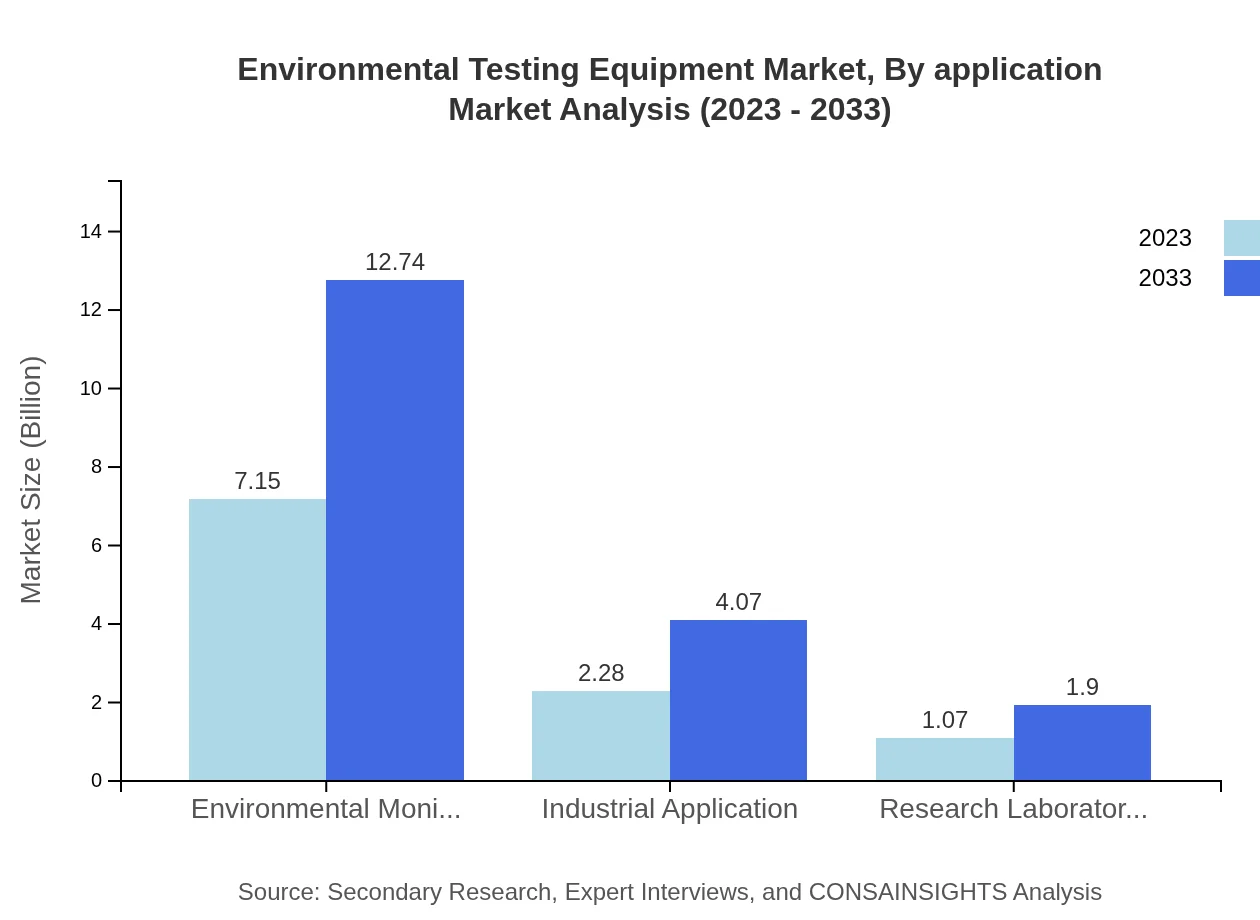
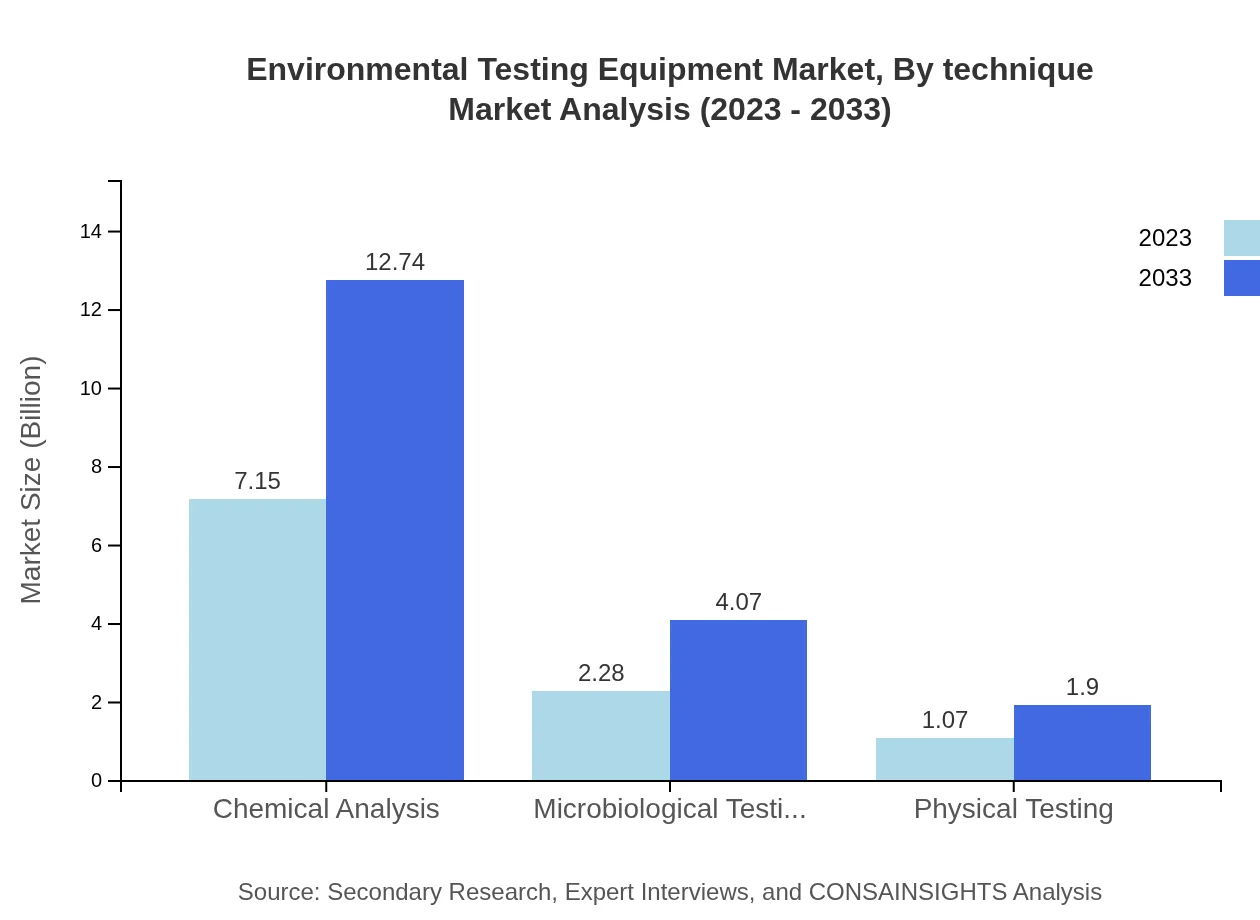
Key application areas include chemical analysis, microbiological testing, and physical testing. Chemical analysis is the leading segment with a market size of $7.15 billion in 2023 and expected to reach $12.74 billion by 2033, reinforcing its 68.11% market share. Microbiological testing follows with $2.28 billion in 2023, projected at $4.07 billion by 2033, maintaining a 21.74% share. Physical testing represents a niche area anticipated to grow from $1.07 billion to $1.90 billion over the same period.
Environmental Testing Equipment Market Analysis By End User
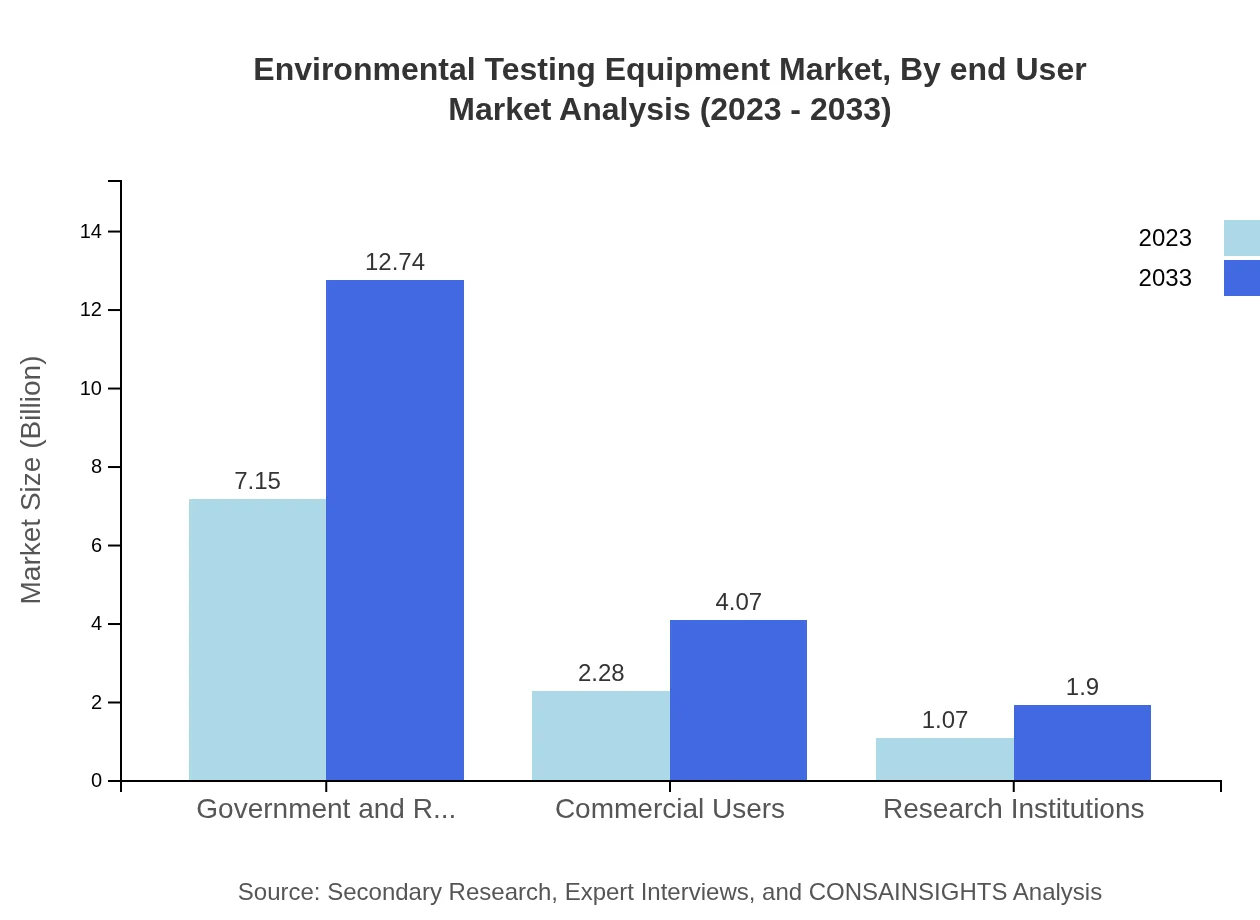
End-users of Environmental Testing Equipment include government and regulatory agencies, commercial users, and research institutions. Government agencies dominate the sector, with a size of $7.15 billion in 2023 and a projection to $12.74 billion by 2033, holding a significant 68.11% market share. Commercial users account for a size of $2.28 billion in 2023 and are expected to reach $4.07 billion by 2033, translating to a 21.74% share. Research institutions contribute with a market size of $1.07 billion in 2023 and an anticipated growth to $1.90 billion.
Environmental Testing Equipment Market Analysis By Technique
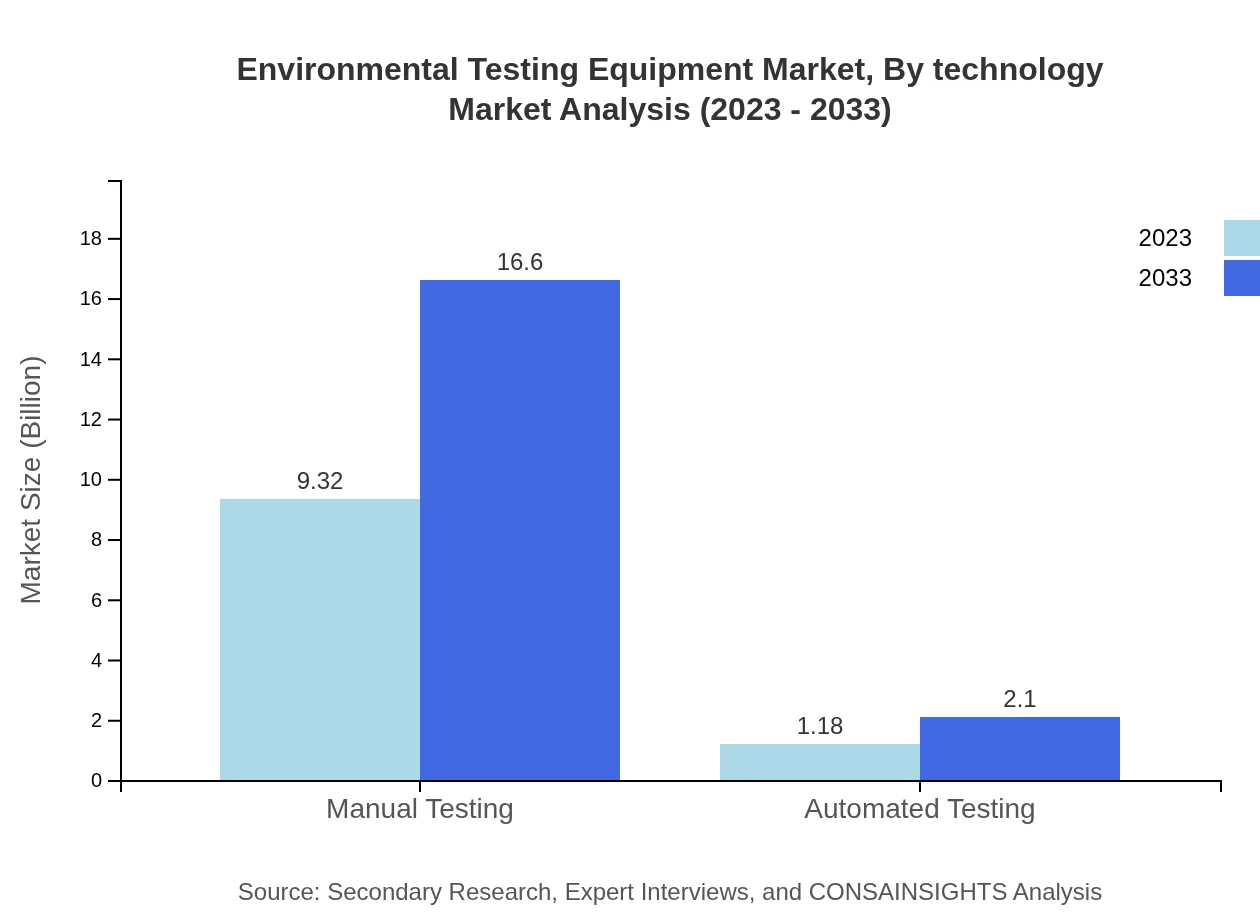
This segment includes manual testing and automated testing techniques. Manual testing remains dominant with a market size of $9.32 billion in 2023, projected to grow to $16.60 billion by 2033, capturing 88.77% of the market share. Automated testing, while smaller in scale, shows growth potential from $1.18 billion to $2.10 billion, representing an 11.23% share as industries invest in technology to enhance efficiency.
Environmental Testing Equipment Market Analysis By Technology
Emerging technologies in environmental testing include advanced sensors, cloud-based data analysis, and automation. Innovations lead to higher efficiency and improved data accuracy, with sensors enhancing real-time monitoring capabilities. The shift towards automated solutions reflects a broader commitment to efficiency and precision in testing protocols, with the market projected to grow significantly over the forecast period.
Environmental Testing Equipment Market Trends and Future Forecast
Tell us your focus area and get a customized research report.
Global Market Leaders and Top Companies in Environmental Testing Equipment Industry
Thermo Fisher Scientific:
A leading provider of scientific instruments and laboratory equipment, Thermo Fisher offers advanced environmental testing solutions that help organizations meet regulatory standards and ensure public safety.Agilent Technologies:
Agilent is renowned for its innovative technologies in analytical instruments, including solutions for environmental testing, helping industries conduct comprehensive environmental assessments efficiently.Horiba Ltd.:
Horiba specializes in measurement and analysis equipment, providing sophisticated environmental testing instruments that ensure compliance with environmental regulations globally.We're grateful to work with incredible clients.









FAQs
What is the current market size of the Environmental Testing Equipment Market Report?
The market size in 2023 is $10.50 Billion, based on the reported value for that year.
How big will the market be in 2033?
The market is projected to reach $18.70 Billion by 2033 according to the forecast figures provided.
What is the CAGR for the forecast period?
The forecast period 2023 to 2033 carries an expected compound annual growth rate of 5.8% as stated in the report data.
Who are the top companies in this market?
Top companies named in the report include Thermo Fisher Scientific, Agilent Technologies, and Horiba Ltd.
What are the primary product segments covered?
Primary product groupings listed include gas analyzers, water testing equipment, and soil testing equipment among other testing categories.
Is there a single fastest Growing region in the Environmental Testing Equipment Market Report market?
No single fastest-growing region is stated for the Environmental Testing Equipment Market Report market because the top regional implied CAGR values are within 0.15 percentage points of each other, making the ranking too close to call reliably.
Which regions are reported with specific values?
Regions with specified 2023 and 2033 values include Europe, Asia Pacific, Latin America, North America, and Middle East and Africa.
What is the forecast period for the report?
The timeframe covered by the forecast is 2023 to 2033, aligning the reported market and regional projections.
How are technological trends described in the report?
The report emphasizes automation and digital integration in testing equipment, improving efficiency, accuracy, and data handling for field and laboratory applications.
What methodology was used to prepare the report?
The study uses primary interviews, secondary company sources, data triangulation, and expert-led trend validation to compile and verify findings.