

Microservices In Healthcare Market Report
First published: 14 October 2024 | Last updated: 25 May 2026 | Report Code: microservices-in-healthcare
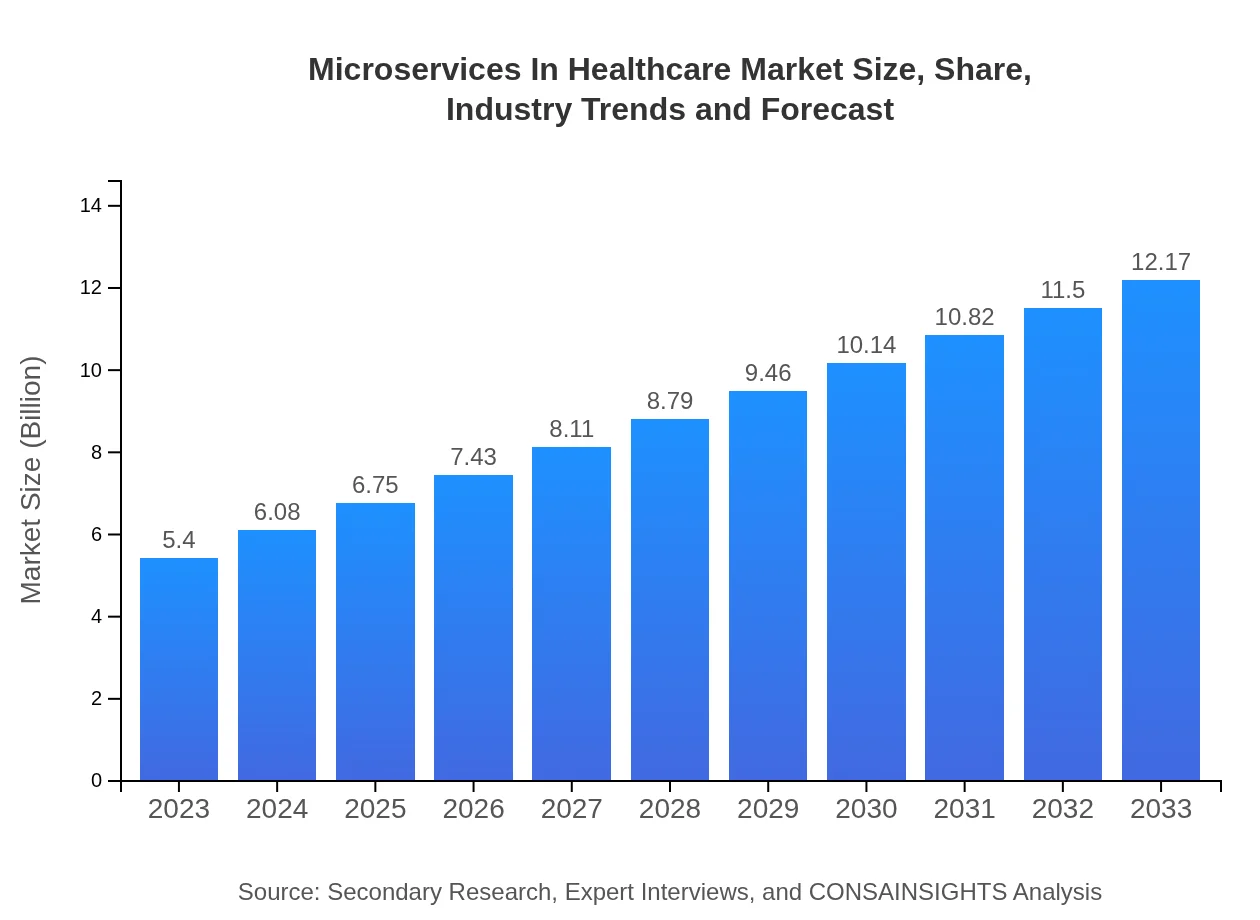
Microservices In Healthcare Market — USD $5.4 Billion in 2023, Growing to USD 12.17null by 2033 at 8.2% CAGR
This report presents an in-depth analysis of the Microservices in Healthcare market, including market size, trends, regional insights, and forecasts from 2023 to 2033, aimed at equipping stakeholders with data-driven insights for strategic decision-making.
Key Takeaways
- Global market projected to rise from $5.40 Billion in 2023 to $12.17 Billion by 2033 at an 8.2% CAGR.
- North America is largest regional market, while no single fastest-growing region is stated because regional CAGR differences remain within 0.15 percentage points.
- Europe and Asia Pacific show notable expansion, with Europe moving from $1.71 Billion to $3.85 Billion and Asia Pacific from $0.95 Billion to $2.14 Billion.
- Major technology providers active in this space include IBM, Microsoft, Amazon Web Services (AWS), Google Cloud, and Cerner Corporation.
- Key adoption factors include cloud migration, data analytics integration, and modular architectures enabling faster development and deployment.
Microservices In Healthcare Market Report — Executive Summary
North America remains largest market by forecast-period value, while no single fastest-growing region is stated because top regional growth rates are separated by less than 0.15 percentage points. This report examines the Microservices In Healthcare market through a lens of technological transition and health IT modernization. Market expansion to $12.17 Billion by 2033 reflects ongoing moves toward modular, cloud-compatible systems that allow independent deployment and scaling. Drivers include increased cloud adoption, integration of analytics and AI capabilities, and the need for interoperable platforms that support diverse health workflows. The landscape features platforms, tools, and services across deployment options such as on-premises, cloud, and hybrid models, and end users ranging from hospitals and physician practices to payers and research laboratories. Regional breakdowns highlight North America as the largest market, with steady growth also evident in Europe, Asia Pacific, Middle East and Africa, and Latin America. Leading technology firms and specialist healthcare vendors are active across product and service portfolios, focusing on API-led integrations, containerization, and DevOps practices. The report synthesizes primary interviews and secondary sources to present validated market insights and strategic implications for stakeholders planning investments or product development.
Key Growth Drivers
- Rising cloud adoption in healthcare infrastructure enabling microservices deployment and scalability.
- Demand for interoperable systems and API integration to support data exchange across care settings.
- Need for rapid development cycles and resilient architectures driven by agile and DevOps practices.
- Growing use of analytics and machine learning that rely on modular services for data processing and model deployment.
- Healthcare organizations’ push for digital transformation to improve patient experience and operational efficiency.
| Metric | Value |
|---|---|
| Study Period | 2023 - 2033 |
| 2023 Market Size | $5.40 Billion |
| CAGR (2023-2033) | 8.2% |
| 2033 Market Size | $12.17 Billion |
| Top Companies | IBM, Microsoft, Amazon Web Services (AWS), Google Cloud, Cerner Corporation |
| Published Date | 14 October 2024 |
| Last Modified Date | 25 May 2026 |
Microservices In Healthcare Market Overview
Customize Microservices In Healthcare Market Report market research report
- ✔ Get in-depth analysis of Microservices In Healthcare market size, growth, and forecasts.
- ✔ Understand Microservices In Healthcare's regional dynamics and industry-specific trends.
- ✔ Identify potential applications, end-user demand, and growth segments in Microservices In Healthcare
What is the Market Size & CAGR of Microservices In Healthcare Market Report market in 2023?
Microservices In Healthcare Industry Analysis
Microservices In Healthcare Market Segmentation and Scope
Tell us your focus area and get a customized research report.
Microservices In Healthcare Market Report Market Analysis Report by Region
Europe Microservices In Healthcare Market Report:
Europe grows from $1.71 Billion in 2023 to $3.85 Billion in 2033. Regional drivers include regulatory emphasis on interoperability, adoption of cloud services in healthcare institutions, and increased deployment of analytics-driven solutions across care providers.Asia Pacific Microservices In Healthcare Market Report:
Asia Pacific grows from $0.95 Billion in 2023 to $2.14 Billion in 2033. Growth is shaped by rising digital health initiatives, expanding cloud infrastructure, and ongoing implementation of modular architectures to support telemedicine and clinical workflow improvements.North America Microservices In Healthcare Market Report:
North America is largest regional market, rising from $2.01 Billion in 2023 to $4.52 Billion in 2033. This expansion reflects strong investment in health IT modernization, cloud migration, and vendor activity from major providers supporting API-led integrations and containerized deployments.South America Microservices In Healthcare Market Report:
Latin America grows from $0.09 Billion in 2023 to $0.2 Billion in 2033. Market advancement is linked to gradual digital transformation efforts, increasing interest in scalable cloud-based healthcare solutions, and adoption of services that enable interoperability and analytics.Middle East & Africa Microservices In Healthcare Market Report:
Middle East and Africa grows from $0.64 Billion in 2023 to $1.45 Billion in 2033. Expansion is driven by investments in health IT, adoption of cloud and hybrid models, and initiatives to modernize systems for better data exchange and resilient service delivery.Tell us your focus area and get a customized research report.
Research Methodology
Microservices In Healthcare Market Analysis By Product
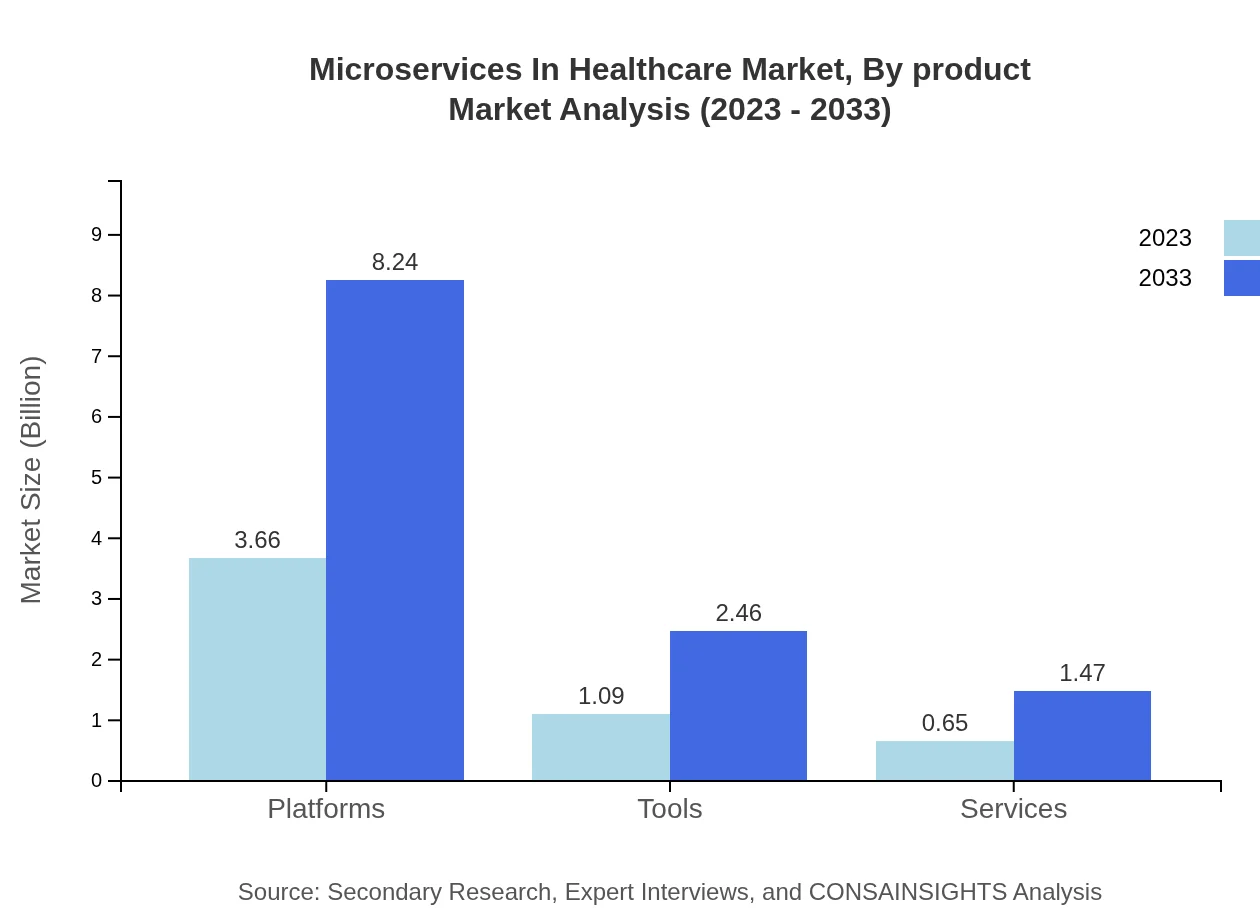
In 2023, the Platforms segment leads the Microservices in Healthcare market with a valuation of $3.66 billion, expected to grow to $8.24 billion by 2033. The Tools and Services segments follow, valued at $1.09 billion and $0.65 billion respectively. Hospitals represent the major end-user in this segment, with anticipated growth aligning with the increasing demand for integrated and patient-focused care.
Microservices In Healthcare Market Analysis By Application
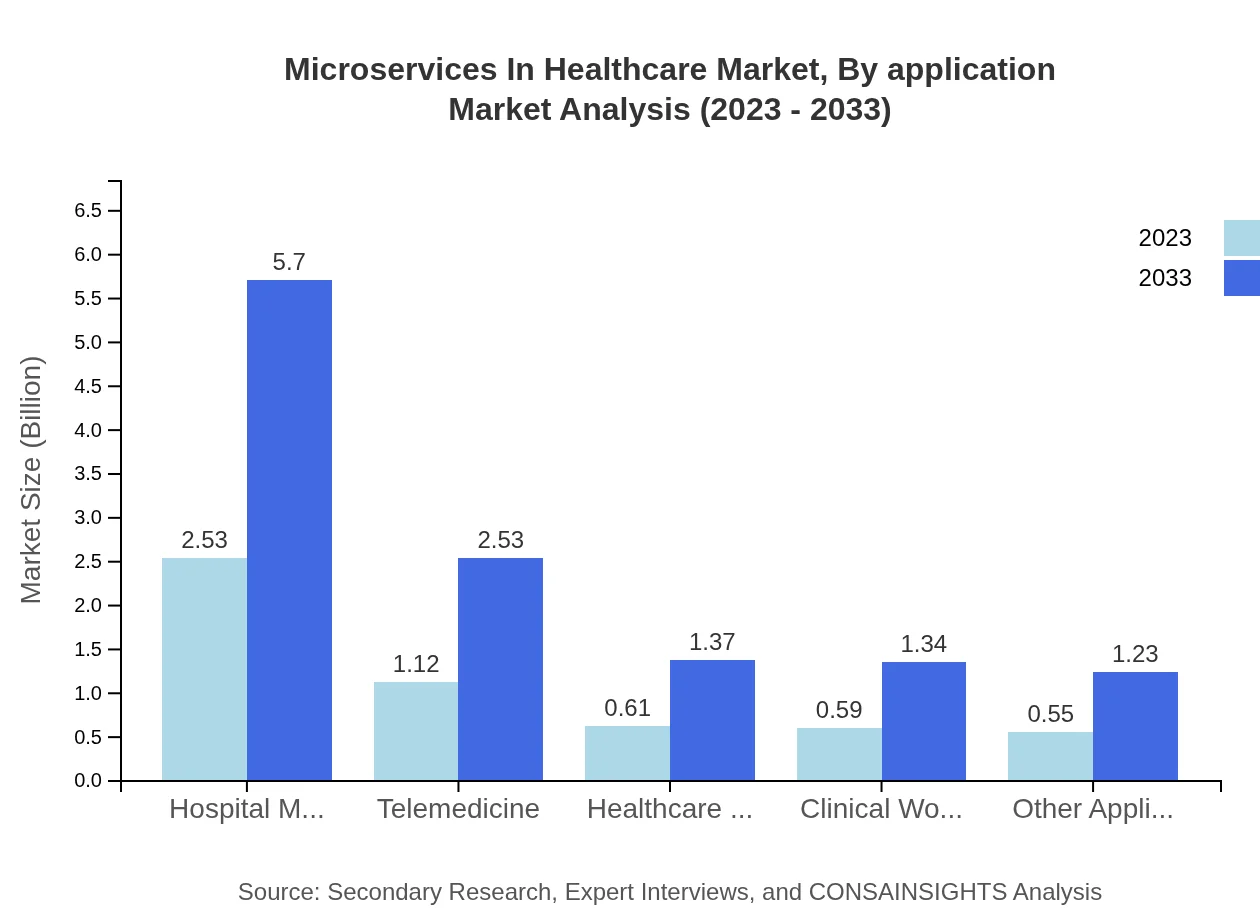
Application areas in the Microservices in Healthcare market include hospitals, physician practices, healthcare payers, pharmaceutical companies, and research laboratories. As of 2023, hospitals dominate this segment, accounting for approximately $2.53 billion. By 2033, this segment is expected to grow to $5.70 billion, reflecting the surge in demand for efficient management and care solutions in hospital systems.
Microservices In Healthcare Market Analysis By Deployment Mode
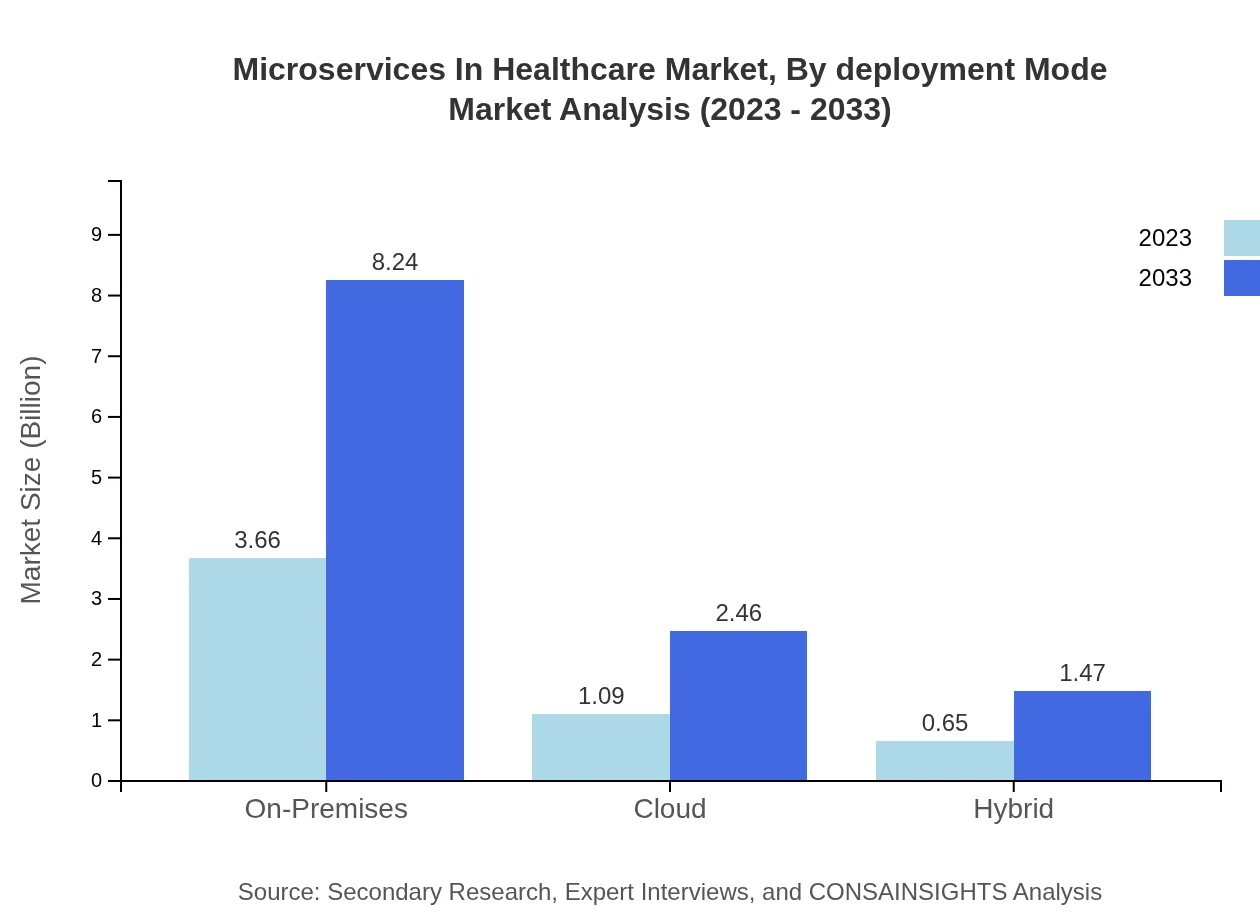
The deployment mode of Microservices splits primarily into On-Premises, Cloud, and Hybrid. The On-Premises deployment accounted for $3.66 billion in 2023, with expectations to reach $8.24 billion by 2033. The Cloud segment, currently valued at $1.09 billion, is projected to grow steadily as healthcare organizations move towards adopting cloud solutions, indicating a marked shift in deployment strategies.
Microservices In Healthcare Market Analysis By End User
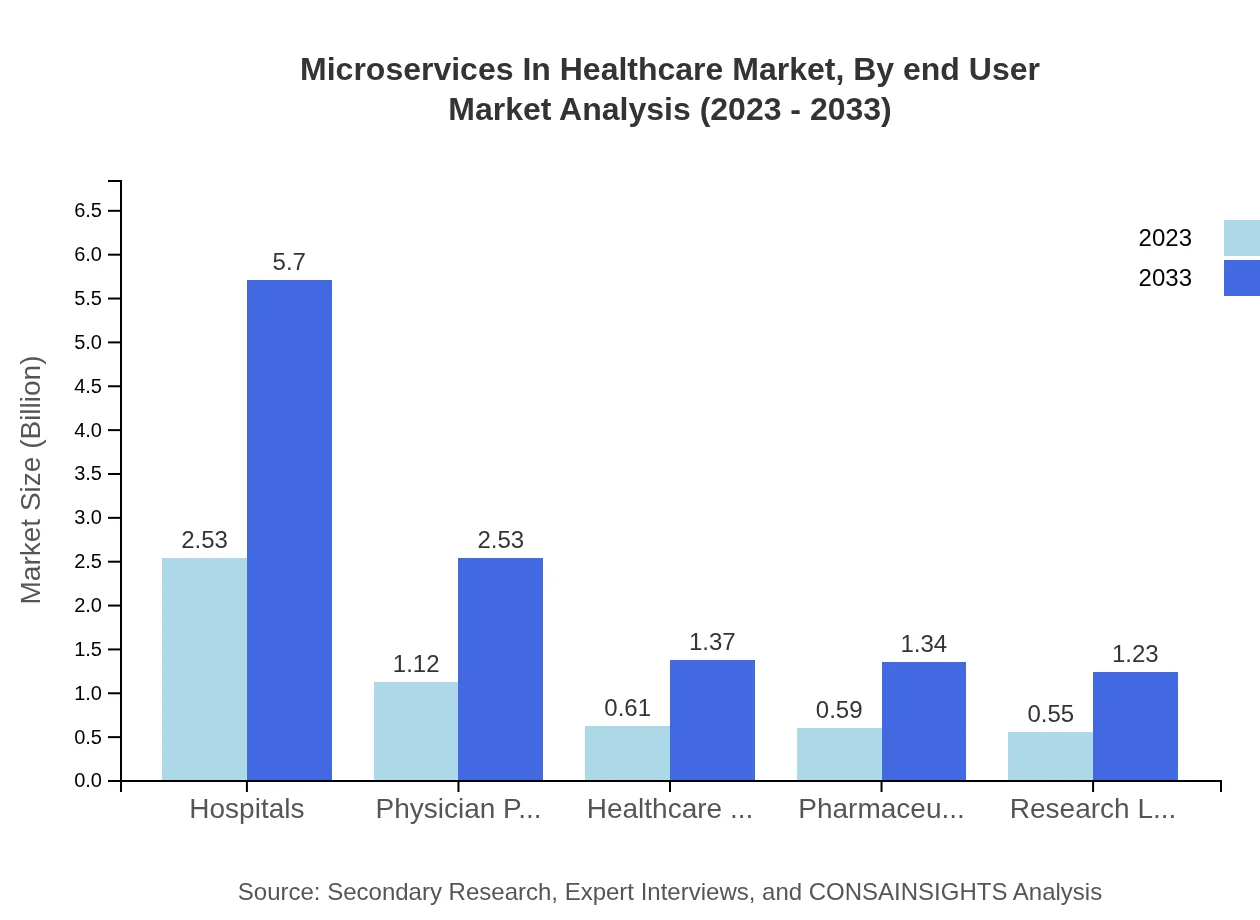
End users of microservices in healthcare include hospitals, healthcare payers, pharmaceutical companies, physician practices, and research laboratories. The hospitals segment is the largest, with a projected market size of $5.70 billion by 2033. The growth trend indicates a shift towards integrated healthcare delivery models facilitated by microservices architecture.
Microservices In Healthcare Market Analysis By Technology
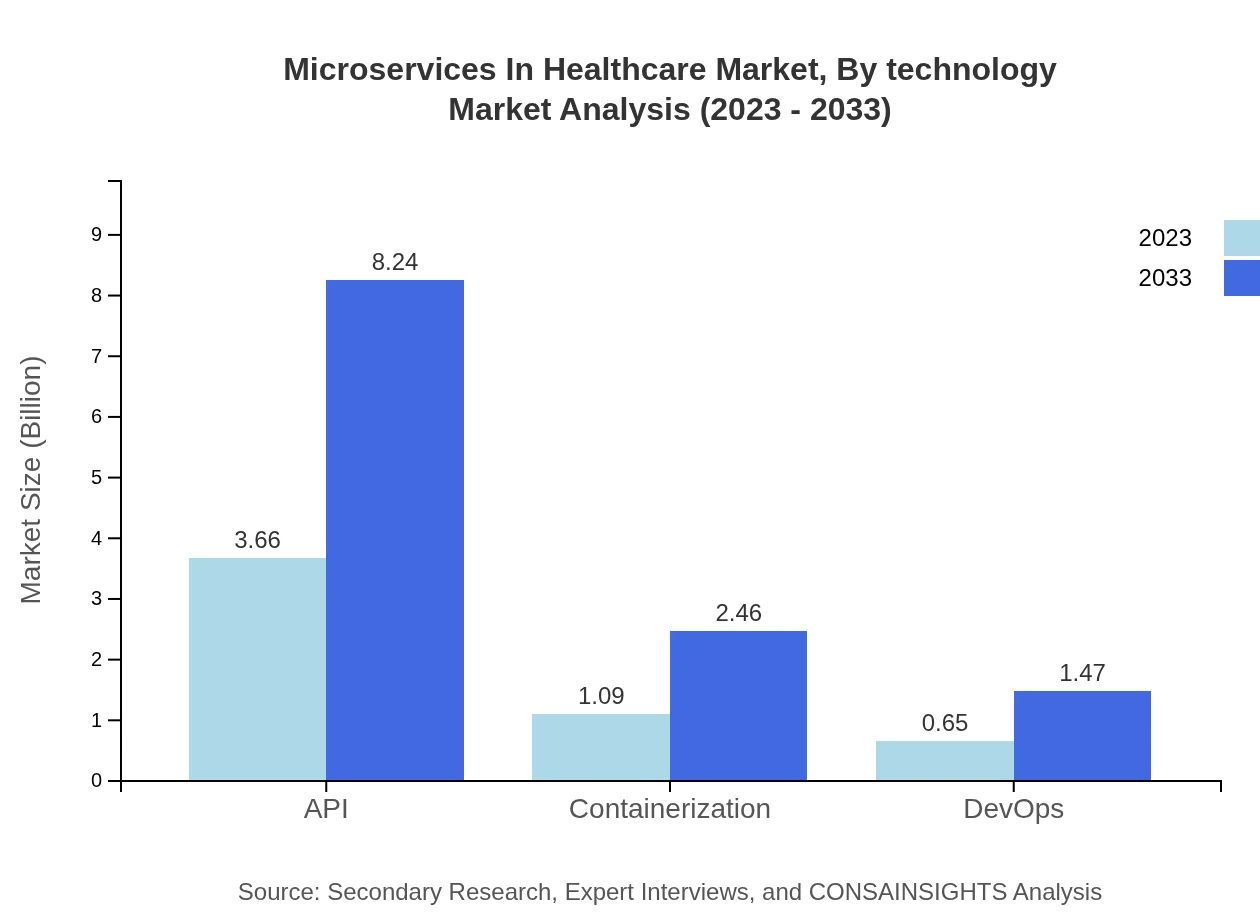
Technology segments include API, Containerization, DevOps, and various innovative technologies. The API technology is a significant contributor, valued at $3.66 billion in 2023, anticipating long-term growth driven by the need for system interoperability and integration across healthcare platforms.
Microservices In Healthcare Market Trends and Future Forecast
Tell us your focus area and get a customized research report.
Global Market Leaders and Top Companies in Microservices In Healthcare Industry
IBM:
IBM offers an array of healthcare-focused microservices solutions, facilitating interoperability and data exchange to improve patient outcomes and streamline healthcare operations.Microsoft:
With its Azure cloud services, Microsoft provides healthcare organizations with scalable and secure microservices deployments, enhancing their digital health initiatives.Amazon Web Services (AWS):
AWS delivers a suite of microservices solutions tailored for healthcare delivery, enabling rapid deployment and innovation in patient care solutions.Google Cloud:
Google Cloud offers microservices infrastructure that supports healthcare analytics and data management, embedding AI capabilities to drive better healthcare insights.Cerner Corporation:
Cerner specializes in health IT solutions and employs microservices architecture to optimize electronic health record systems that empower healthcare providers.We're grateful to work with incredible clients.









FAQs
What is the current market size of the Microservices In Healthcare Market Report market?
The market size in 2023 is $5.40 Billion, as stated in the report data. This figure represents the baseline for the forecast through 2033.
How big will the market be in 2033?
By 2033 the market is projected to reach $12.17 Billion according to the provided forecast figures covering 2023 to 2033.
What is CAGR for the forecast period?
The compound annual growth rate for 2023 to 2033 is 8.2%, reflecting the projected expansion from $5.40 Billion to $12.17 Billion.
Is there a single fastest Growing region in the Microservices In Healthcare Market Report market?
No single fastest-growing region is stated for the Microservices In Healthcare Market Report market because the top regional implied CAGR values are within 0.15 percentage points of each other, making the ranking too close to call reliably.
Which vendors are listed as key players in the market?
Top companies named include IBM, Microsoft, Amazon Web Services (AWS), Google Cloud, and Cerner Corporation, representing major cloud and healthcare technology providers.
What are common deployment modes mentioned?
Deployment options cited include On-Premises, Cloud, and Hybrid models, reflecting diverse infrastructure preferences among healthcare organizations.
How do microservices support healthcare applications?
Microservices enable modular development and independent scaling of functions such as hospital management, telemedicine, and analytics, improving resilience and update cycles.
Who are primary end users for these solutions?
End users include Hospitals, Physician Practices, Healthcare Payers, Pharmaceutical Companies, and Research Laboratories as specified in the segmentation details.