
Reports >
Life Sciences
>
3d Cell Culture Market Report

3d Cell Culture Market Report
First published: 21 October 2024 | Last updated: 25 May 2026 | Report Code: 3d-cell-culture
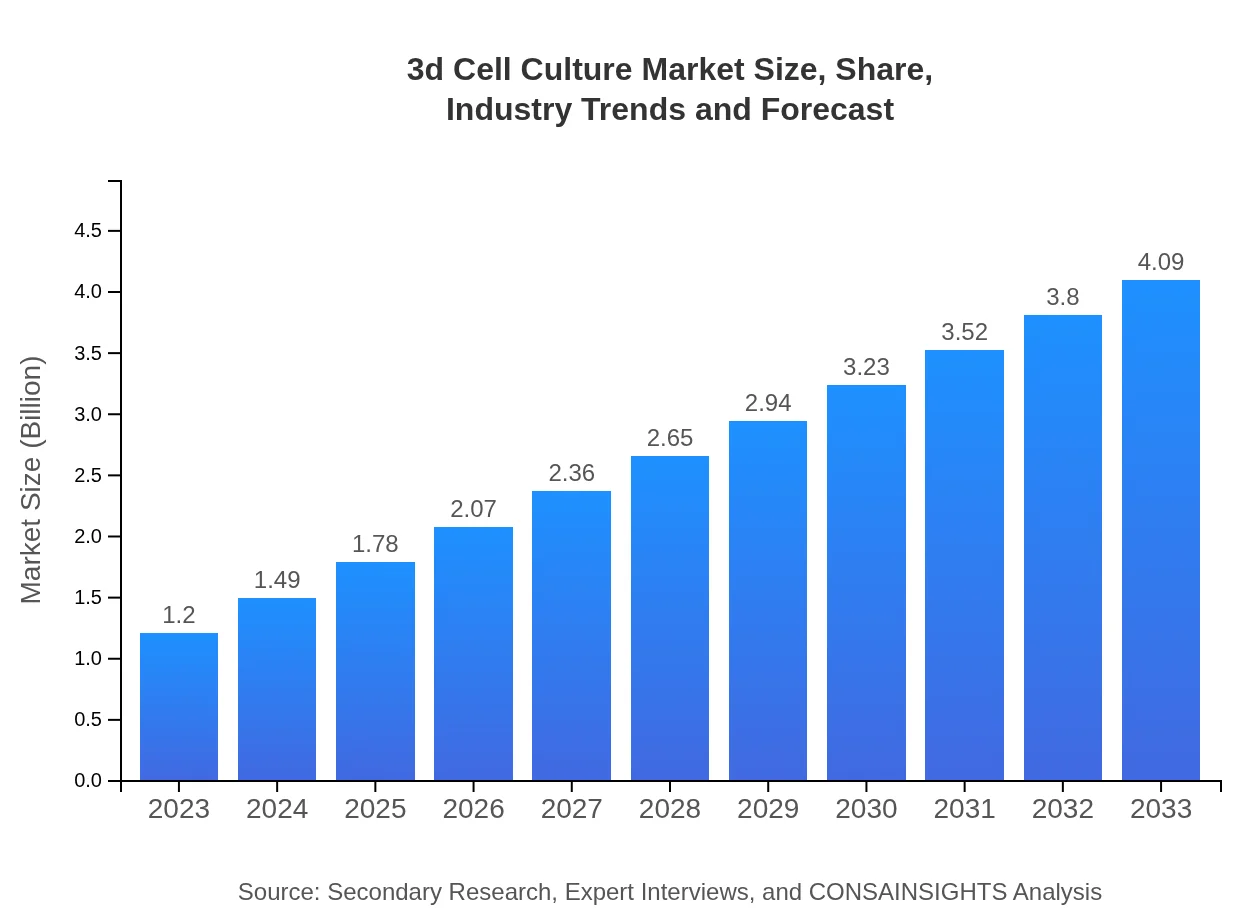
3d Cell Culture Market — USD 1.2 billion in 2023, Growing to USD 4.09B by 2033 at 12.5% CAGR
This report provides an extensive analysis of the 3D Cell Culture market from 2023 to 2033, covering market trends, size forecasts, regional insights, and an overview of key players in the industry.
Key Takeaways
- Market value increases from $1.20 Billion (2023) to $4.09 Billion (2033) with a 12.5% CAGR across 2023 to 2033.
- North America is largest regional market, while no single fastest-growing region is stated because regional CAGR differences remain within 0.15 percentage points.
- Europe expands from $0.37 Billion to $1.26 Billion over the forecast period, reflecting sustained research investment.
- Adoption spans scaffolds, bioreactors, media and reagents across pharmaceutical and research institute end users.
- Top companies include Lonza Group, Corning Incorporated, Thermo Fischer Scientific, Merck KGaA and others driving product and service development.
3d Cell Culture Market Report — Executive Summary
North America remains largest market by forecast-period value, while no single fastest-growing region is stated because top regional growth rates are separated by less than 0.15 percentage points. The 3d Cell Culture Market Report examines adoption of three-dimensional cell systems across pharmaceuticals, academic research and cosmetics testing. Market size grows from $1.20 Billion in 2023 to $4.09 Billion in 2033 at a 12.5% CAGR for 2023 to 2033, underpinned by higher research expenditure and the need for more physiologically relevant models for drug discovery and toxicology studies. Key product categories include scaffolds, bioreactors and media and reagents; technologies feature spheroid culture, hanging drop and 3D bioprinting. End users span pharmaceutical companies, research institutes and cosmetics firms. Regional profiles highlight North America as the largest market, while regional market region is Not specified per policy. The landscape profiles established suppliers such as Lonza Group, Corning Incorporated, Thermo Fischer Scientific and Merck KGaA alongside specialized providers, and discusses collaborations between academia and industry that accelerate application development.
Key Growth Drivers
- Rising investment in life-sciences research and development increasing demand for predictive in vitro models.
- Need for improved drug discovery and toxicity testing drives uptake of 3D systems over 2D cultures.
- Advances in bioprinting and scaffold technologies expanding viable applications in regenerative medicine.
- Greater collaboration between academic institutions and biotech firms accelerating product refinement and validation.
| Metric | Value |
|---|---|
| Study Period | 2023 - 2033 |
| 2023 Market Size | $1.20 Billion |
| CAGR (2023-2033) | 12.5% |
| 2033 Market Size | $4.09 Billion |
| Top Companies | Lonza Group, Corning Incorporated, Thermo Fischer Scientific, Merck KGaA, 3D Biotek, STEMCELL Technologies, Bio-Rad Laboratories, MatTek Corporation, InSphero AG, Organovo Holdings, BICO, Advanced BioMatrix, nano3D Biosciences, Emulate, Greiner Bio‑One |
| Published Date | 21 October 2024 |
| Last Modified Date | 25 May 2026 |
3D Cell Culture Market Overview
Customize 3d Cell Culture Market Report market research report
- ✔ Get in-depth analysis of 3d Cell Culture market size, growth, and forecasts.
- ✔ Understand 3d Cell Culture's regional dynamics and industry-specific trends.
- ✔ Identify potential applications, end-user demand, and growth segments in 3d Cell Culture
What is the Market Size & CAGR of 3d Cell Culture Market Report market in 2023?
3D Cell Culture Industry Analysis
3D Cell Culture Market Segmentation and Scope
Tell us your focus area and get a customized research report.
3d Cell Culture Market Report Market Analysis Report by Region
Europe 3d Cell Culture Market Report:
Europe grows from $0.37 Billion in 2023 to $1.26 Billion in 2033. 37 Billion in 2023 to $1.26 Billion in 2033, supported by sustained public and private research funding, increasing use of advanced 3D technologies in drug discovery and collaborations between academic and industry players.Asia Pacific 3d Cell Culture Market Report:
Asia Pacific grows from $0.22 Billion in 2023 to $0.76 Billion in 2033. 22 Billion in 2023 to $0.76 Billion in 2033, driven by rising research investment, expanding biotechnology capabilities, and growing interest from pharmaceutical and regenerative medicine stakeholders in the region.North America 3d Cell Culture Market Report:
North America is largest regional market, rising from $0.43 Billion in 2023 to $1.46 Billion in 2033. This trajectory reflects concentrated life-sciences R&D activity, strong presence of instrument and reagent suppliers, and high adoption rates across pharmaceutical companies and research institutes.South America 3d Cell Culture Market Report:
Latin America grows from $0.09 Billion in 2023 to $0.31 Billion in 2033. 09 Billion in 2023 to $0.31 Billion in 2033, reflecting gradual uptake of 3D cell culture methods as research infrastructure and biopharma activities develop across key markets.Middle East & Africa 3d Cell Culture Market Report:
Middle East and Africa grows from $0.09 Billion in 2023 to $0.3 Billion in 2033. 09 Billion in 2023 to $0.3 Billion in 2033, supported by emerging research initiatives and expanding collaborations that advance adoption of more predictive in vitro models.Tell us your focus area and get a customized research report.
Research Methodology
3d Cell Culture Market Analysis By Product
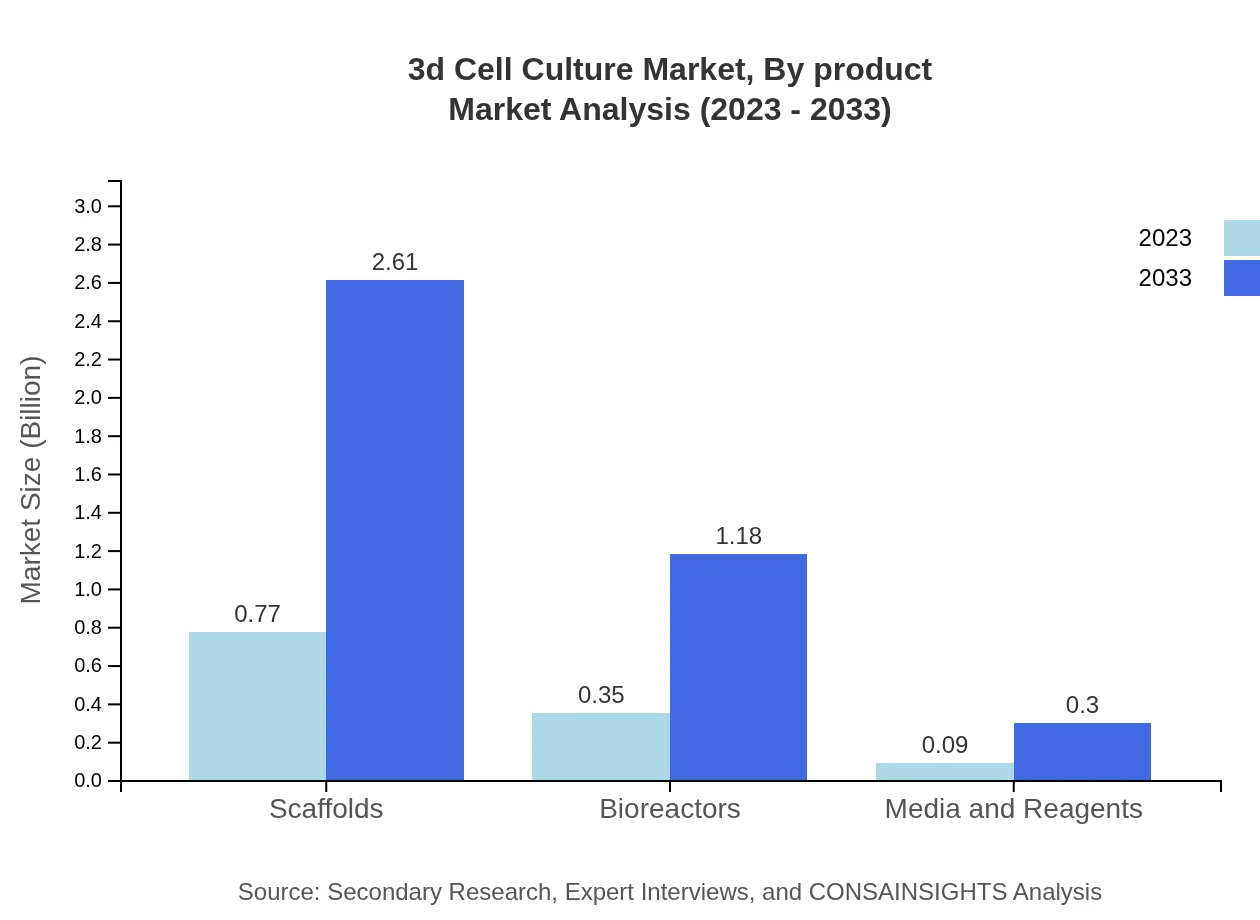
The market is equivalently divided among products such as scaffolds, bioreactors, and media & reagents. Scaffolds constitute the largest market share at 63.82% in 2023, expanding to 63.82% by 2033. Bioreactors contribute significantly, leveraging advances in bioprocess technology to enhance yield and productivity.
3d Cell Culture Market Analysis By Application
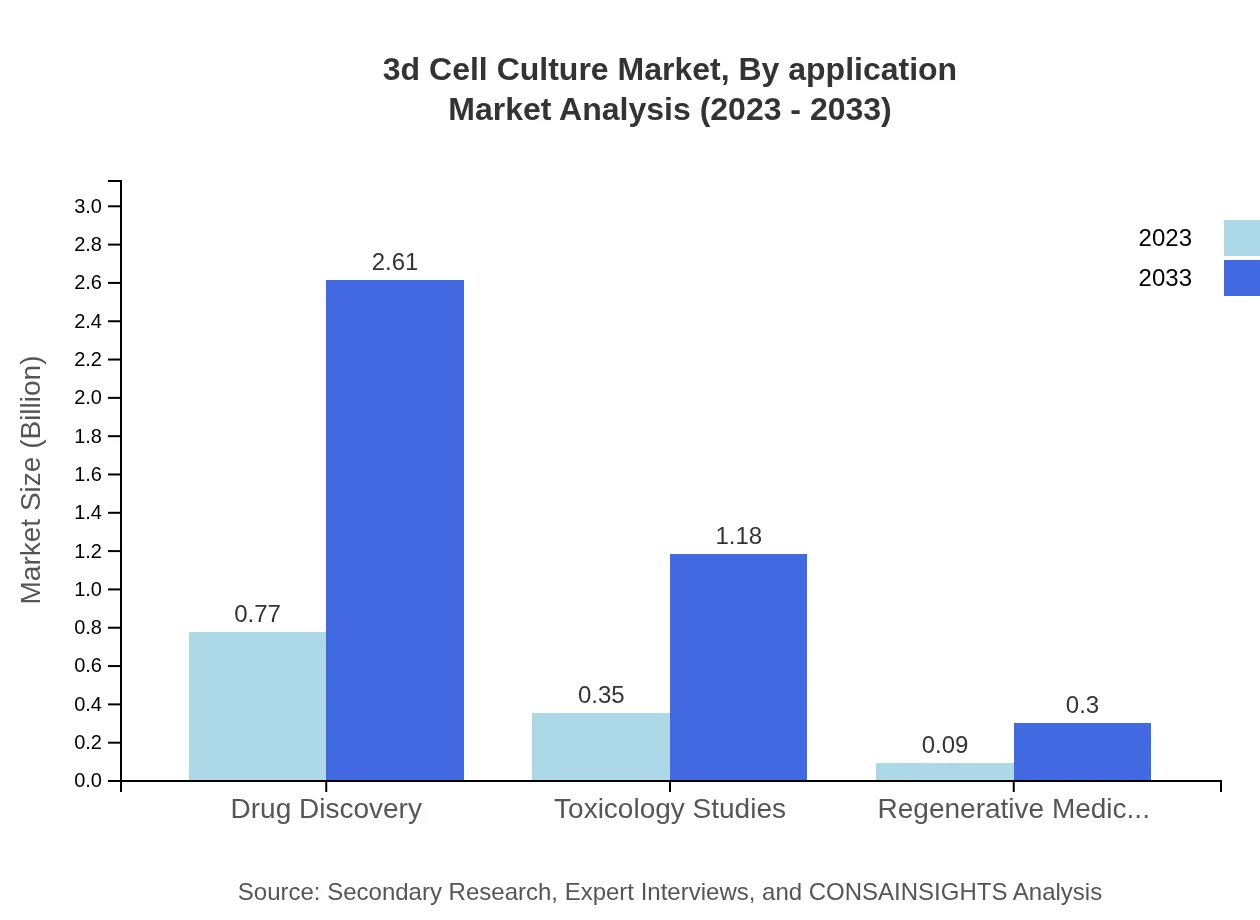
Drug discovery reflects the largest segment owing to its vital role in accelerating the development of new therapies. Specifically, it constitutes approximately 63.82% of the market in 2023, subsequently transitioning to the same share by 2033. Toxicology studies and regenerative medicine are also key applications observing solid growth.
3d Cell Culture Market Analysis By End User
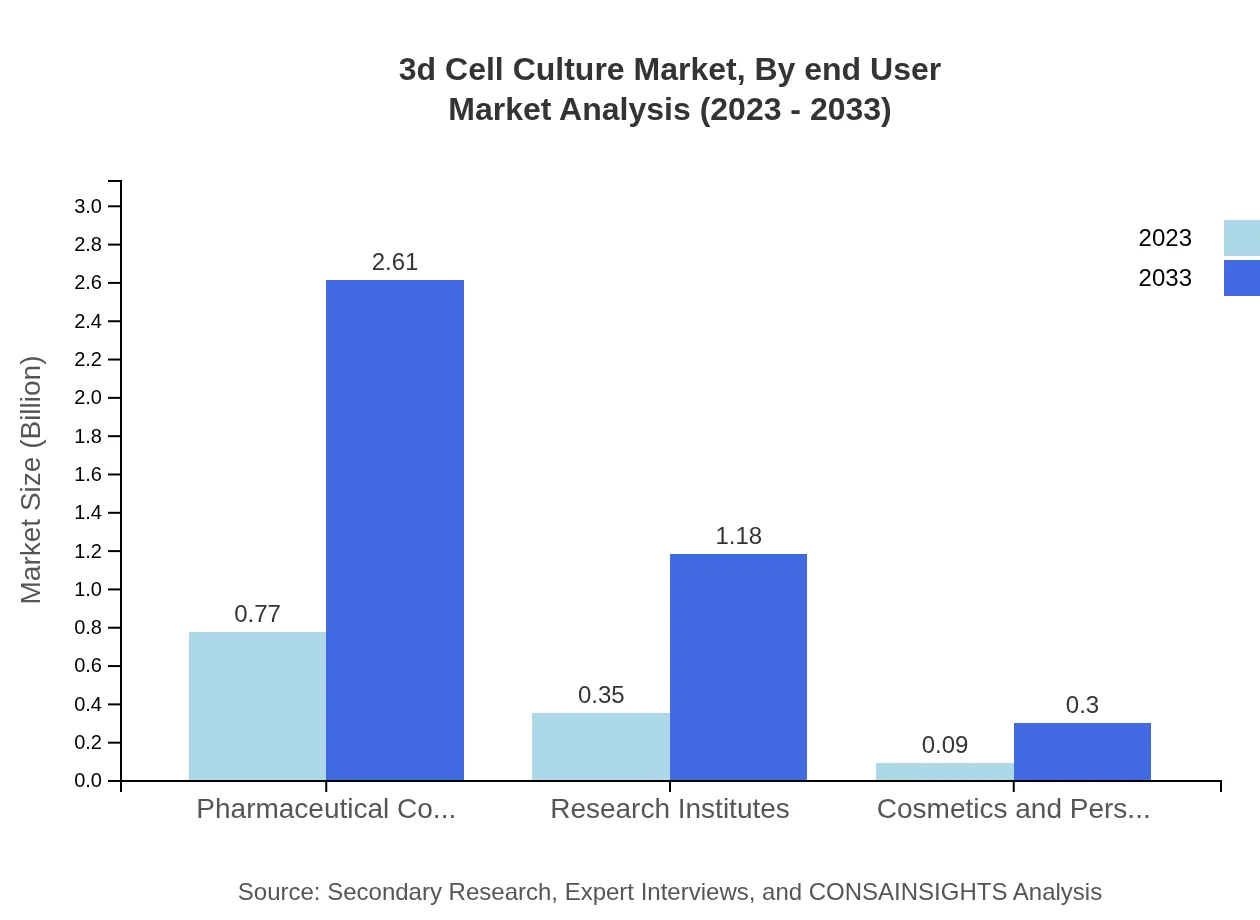
Pharmaceutical companies dominate the end-user segment in 2023 with a market share of 63.82%, expected to sustain that percentage through 2033. Research institutes follow closely behind due to their increasing involvement in innovative research methodologies.
3d Cell Culture Market Analysis By Technology
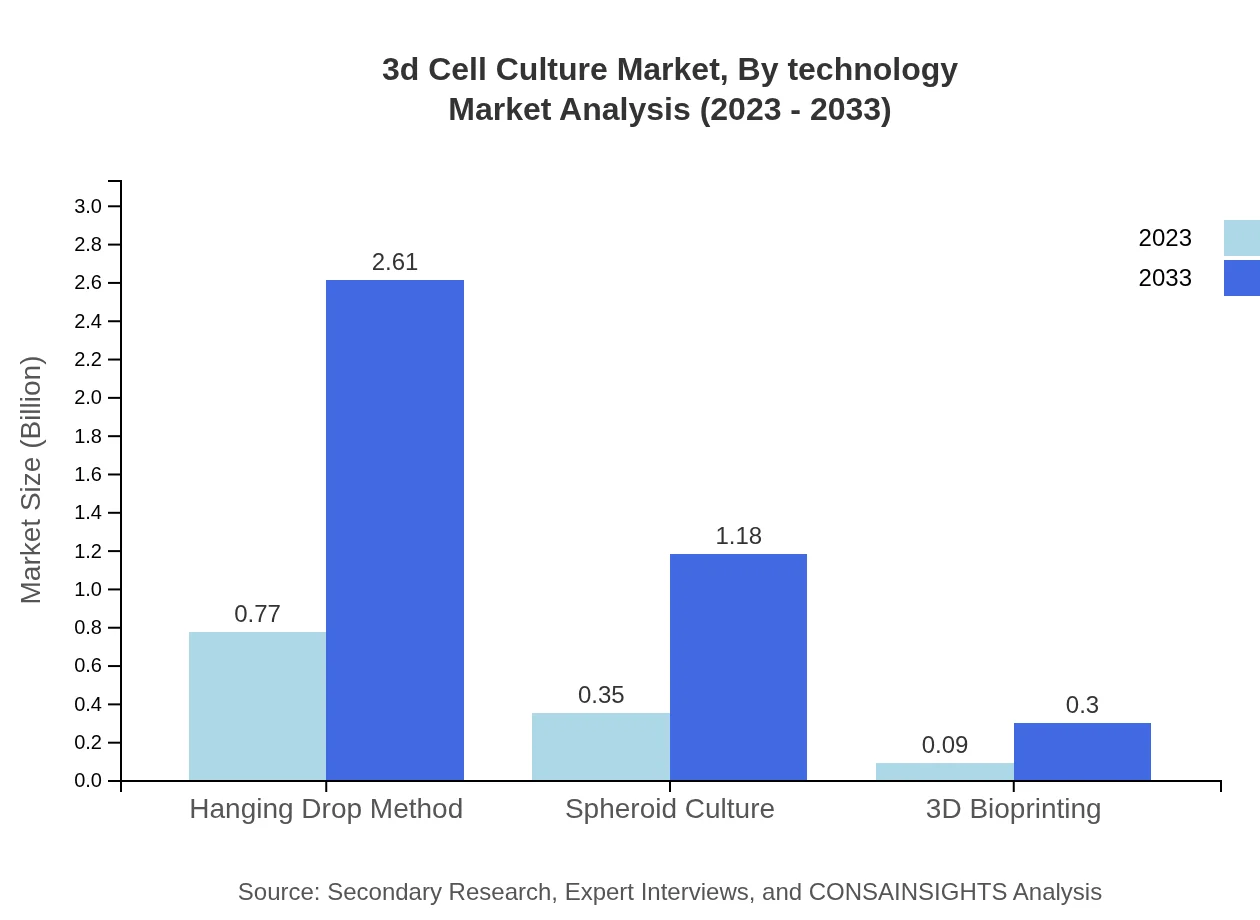
Technologies like the hanging drop method and spheroid cultures are emerging as powerful strategies within this space, allowing improved representation of complex tissue structures. The data suggest a market shift towards bioprinting techniques, driving further innovation.
3d Cell Culture Market Analysis By Region
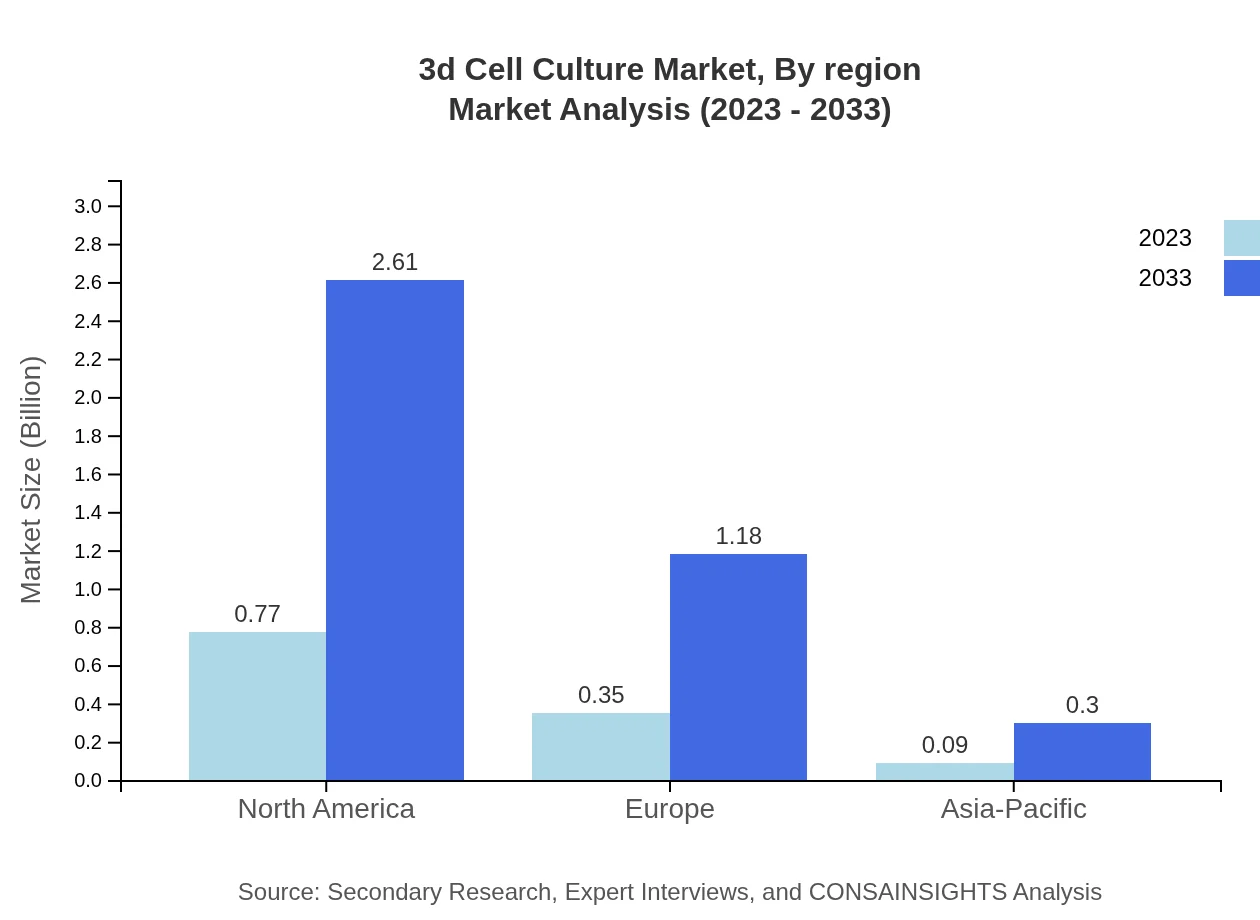
Regionally, North America leads with significant investments in R&D, while Europe shows promising growth driven by regulatory support for animal testing alternatives. Asia-Pacific is gradually gaining ground supported by favorable market conditions and increasing industry participation.
3D Cell Culture Market Trends and Future Forecast
Tell us your focus area and get a customized research report.
Global Market Leaders and Top Companies in 3D Cell Culture Industry
Lonza Group:
A leading global supplier of custom development and manufacturing solutions for the pharmaceutical and biotechnology industries, Lonza is committed to advancing cell culture technologies.Corning Incorporated:
Corning is a prominent player in 3D cell culture systems providing innovative solutions that optimize cell behaviors for drug discovery and toxicology assessments.Thermo Fischer Scientific:
A key supplier of laboratory products and technologies, specializing in enabling researchers through enhanced cell culture methodologies.Merck KGaA:
Merck KGaA is involved in various sectors including biosciences and offers a wide range of products and services for 3D cell culture.3D Biotek:
3D Biotek specializes on unique patented technology for 3D cell culture and is known for its well-designed scaffolding technologies.STEMCELL Technologies:
A global supplier of cell culture media, reagents and specialized kits, STEMCELL Technologies supports 3D cell culture workflows with matrices, organoid expansion media and technical services for stem cell and tissue modeling applications.Bio-Rad Laboratories:
Bio‑Rad supplies instrumentation, reagents and assay platforms enabling 3D cell culture analysis, including imaging-compatible consumables and multiplexed assays that support high-content screening and translational research workflows.MatTek Corporation:
MatTek manufactures validated human 3D tissue models and reconstructed human epidermis used in toxicity, irritation and disease modeling, offering ready-to-use constructs that reduce animal testing and accelerate drug and cosmetic evaluations.InSphero AG:
InSphero designs and manufactures scaffold-free 3D microtissues and spheroid platforms and offers outsourced assay services, providing predictive organotypic models for drug safety, efficacy testing and ADME studies in pharma and biotech.Organovo Holdings:
Organovo develops bioprinted human tissues and tissue models for preclinical research, combining 3D bioprinting hardware, bioinks and tissue engineering expertise to produce functional human tissue constructs for disease modeling and drug screening.BICO:
BICO (formerly CELLINK) provides bioprinting hardware, bioinks and lab automation solutions for 3D cell culture and tissue engineering. Its integrated platforms and software accelerate biofabrication, reproducibility and translational research workflows.Advanced BioMatrix:
Advanced BioMatrix supplies extracellular matrix products, hydrogels and scaffold materials tailored for 3D cell culture, organoids and tissue engineering, enabling physiologically relevant microenvironments for research and regenerative medicine development.nano3D Biosciences:
nano3D Biosciences offers magnetic 3D bioprinting and levitation technologies, enabling rapid formation and manipulation of spheroids and 3D tissues. Their tools facilitate scalable organotypic models for drug screening and mechanobiology studies.Emulate:
Emulate develops organ‑on‑a‑chip platforms that integrate microfluidics with 3D cell culture to recreate human organ physiology. Their systems and services support mechanistic toxicology, disease modeling and translational drug discovery efforts.Greiner Bio‑One:
Greiner Bio‑One manufactures lab consumables and specialty plates adapted for 3D cell culture, including ultra-low attachment and microplate solutions, as well as automation-compatible products for high-throughput spheroid and organoid workflows.We're grateful to work with incredible clients.









FAQs
What is the market size of the 3d Cell Culture Market Report in 2023?
The market size in 2023 is $1.20 Billion, as specified in the report data. This baseline anchors projections and informs comparative regional analyses and strategic planning.
How big will the market be in 2033?
By 2033 the market is projected to reach $4.09 Billion according to the provided forecast values, reflecting long-term expansion across products, technologies and end users.
What is CAGR for the forecast period?
The compound annual growth rate for the 2023 to 2033 forecast period is 12.5%, as stated in the input. This rate underlies the market growth trajectory described.
Is there a single fastest Growing region in the 3d Cell Culture Market Report market?
No single fastest-growing region is stated for the 3d Cell Culture Market Report market because the top regional implied CAGR values are within 0.15 percentage points of each other, making the ranking too close to call reliably.
Which regions are profiled in the regional analysis?
The regional analysis covers North America, Europe, Asia Pacific, Latin America and Middle East and Africa, each provided with start and end market values for 2023 and 2033.
Who are some top companies featured in the report?
Top companies listed include Lonza Group, Corning Incorporated, Thermo Fischer Scientific, Merck KGaA, 3D Biotek and others, representing established suppliers and specialized providers.
What applications drive the 3d cell culture market?
Key applications include drug discovery, toxicology studies and regenerative medicine, which demand more biologically relevant in vitro systems than traditional two-dimensional approaches.
How does technology mix influence adoption?
Technologies such as spheroid culture, hanging drop method and 3D bioprinting expand experimental capability and application scope, encouraging adoption across pharmaceutical and research institute end users.