
Reports >
Technology And Media
>
Ai Based Personal Stylists

Ai Based Personal Stylists
First published: 21 March 2025 | Last updated: 24 June 2026 | Report Code: ai-based-personal-stylists
Ai Based Personal Stylists Market — USD $2.5 Billion in 2024, Growing to USD 4.76null by 2033 at 7.2% CAGR
This report provides a comprehensive analysis of the Ai Based Personal Stylists market, unveiling key insights on market dynamics, size, growth forecast, and regional breakdown from 2024 to 2033, enriching stakeholders with crucial data for informed decision-making.
Key Takeaways
- Global market value was $2.50 Billion in 2023 and is forecast to reach $4.76 Billion by 2033, reflecting a 7.2% CAGR for 2024 to 2033.
- North America is largest regional market, while no single fastest-growing region is stated because regional CAGR differences remain within 0.15 percentage points.
- Europe grows from $0.71 Billion in 2024 to $1.35 Billion in 2033, while Asia Pacific rises from $0.52 Billion to $1.00 Billion over the same period.
- Market segmentation includes technology (Machine Learning, Natural Language Processing, Augmented Reality), price bands (Budget to Premium), and service types (Virtual Styling, Subscription, One-Time Styling).
- Leading firms noted include Stitch Fix, True Fit, and H&M, reflecting cross-industry collaboration between retail and technology.
Ai Based Personal Stylists — Executive Summary
North America remains largest market by forecast-period value, while no single fastest-growing region is stated because top regional growth rates are separated by less than 0.15 percentage points. The report outlines the Ai Based Personal Stylists market structure, key trends, and growth factors driving adoption across retail and e-commerce. Core catalysts include increasing demand for personalized shopping experiences, wider deployment of machine learning and augmented reality, and investments from fashion and technology companies. Service models span virtual styling sessions, subscription offerings, and one-time styling engagements, addressing diverse user demographics such as women, men, and kids. Regional trajectories vary: North America is the largest market by 2033, while Europe and Asia Pacific exhibit substantial expansion between 2024 and 2033. The analysis integrates primary interviews with industry experts, company disclosures, and secondary sources to present a validated view of market opportunities, segmentation by technology and price range, and competitive positioning featuring Stitch Fix, True Fit, and H&M.
Key Growth Drivers
- Rising consumer appetite for tailored fashion recommendations fuels demand for AI-driven styling platforms.
- Advances in machine learning and augmented reality improve recommendation accuracy and immersive virtual try-on experiences.
- Growth in e-commerce encourages retailers to adopt personalization tools to reduce returns and increase conversion rates.
- Subscription and virtual styling services create recurring revenue models that accelerate vendor investment and product refinement.
| Metric | Value |
|---|---|
| Study Period | 2024 - 2033 |
| 2024 Market Size | $2.50 Billion |
| CAGR (2024-2033) | 7.2% |
| 2033 Market Size | $4.76 Billion |
| Top Companies | Stitch Fix, True Fit, H&M |
| Published Date | 21 March 2025 |
| Last Modified Date | 24 June 2026 |
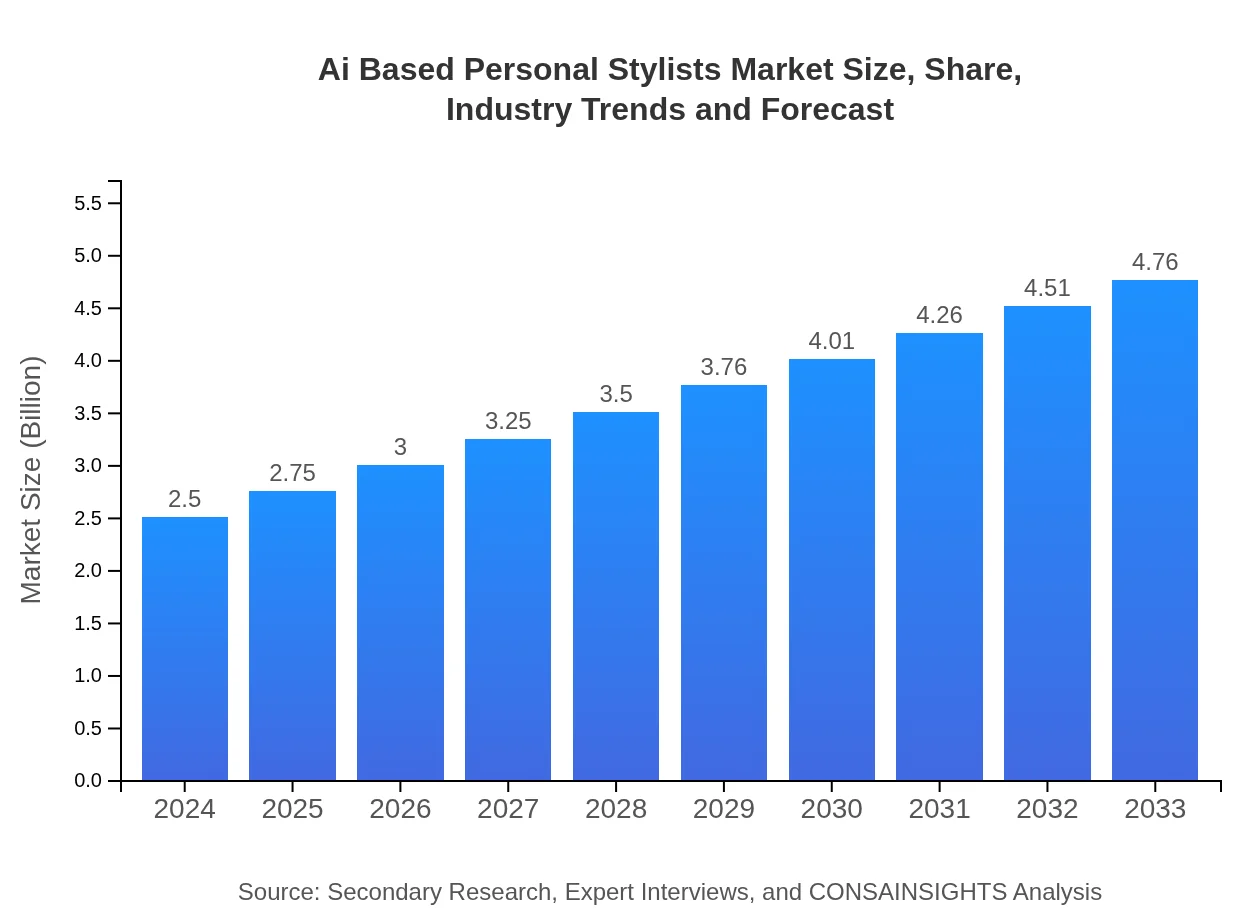
Ai Based Personal Stylists Market Overview
Customize Ai Based Personal Stylists market research report
- ✔ Get in-depth analysis of Ai Based Personal Stylists market size, growth, and forecasts.
- ✔ Understand Ai Based Personal Stylists's regional dynamics and industry-specific trends.
- ✔ Identify potential applications, end-user demand, and growth segments in Ai Based Personal Stylists
What is the Market Size & CAGR of Ai Based Personal Stylists market in 2024?
Ai Based Personal Stylists Industry Analysis
Ai Based Personal Stylists Market Segmentation and Scope
Tell us your focus area and get a customized research report.
Ai Based Personal Stylists Market Analysis Report by Region
Europe Ai Based Personal Stylists:
Europe grows from $0.71 Billion in 2024 to $1.35 Billion in 2033. Adoption is propelled by fashion retailers integrating AI for recommendations and virtual try-ons, alongside investments in data analytics and tailored online services.Asia Pacific Ai Based Personal Stylists:
Asia Pacific grows from $0.52 Billion in 2024 to $1 Billion in 2033. Growth reflects expanding online retail activity, rising consumer demand for personalized experiences, and adoption of machine learning and AR-enabled styling tools.North America Ai Based Personal Stylists:
North America is largest regional market, rising from $0.84 Billion in 2024 to $1.61 Billion in 2033. Regional expansion is supported by strong e-commerce penetration, investments by retailers in personalization technologies, and high consumer interest in digital styling services.South America Ai Based Personal Stylists:
Latin America grows from $0.13 Billion in 2024 to $0.25 Billion in 2033. Local growth is influenced by gradual e-commerce expansion and emerging interest in cost-effective virtual styling solutions among retailers.Middle East & Africa Ai Based Personal Stylists:
Middle East and Africa grows from $0.29 Billion in 2024 to $0.55 Billion in 2033. Regional uptake is supported by investments in retail tech, growing digital shopping habits, and increased use of personalization to reach diverse consumer segments.Tell us your focus area and get a customized research report.
Research Methodology
Ai Based Personal Stylists Market Analysis By Service Type
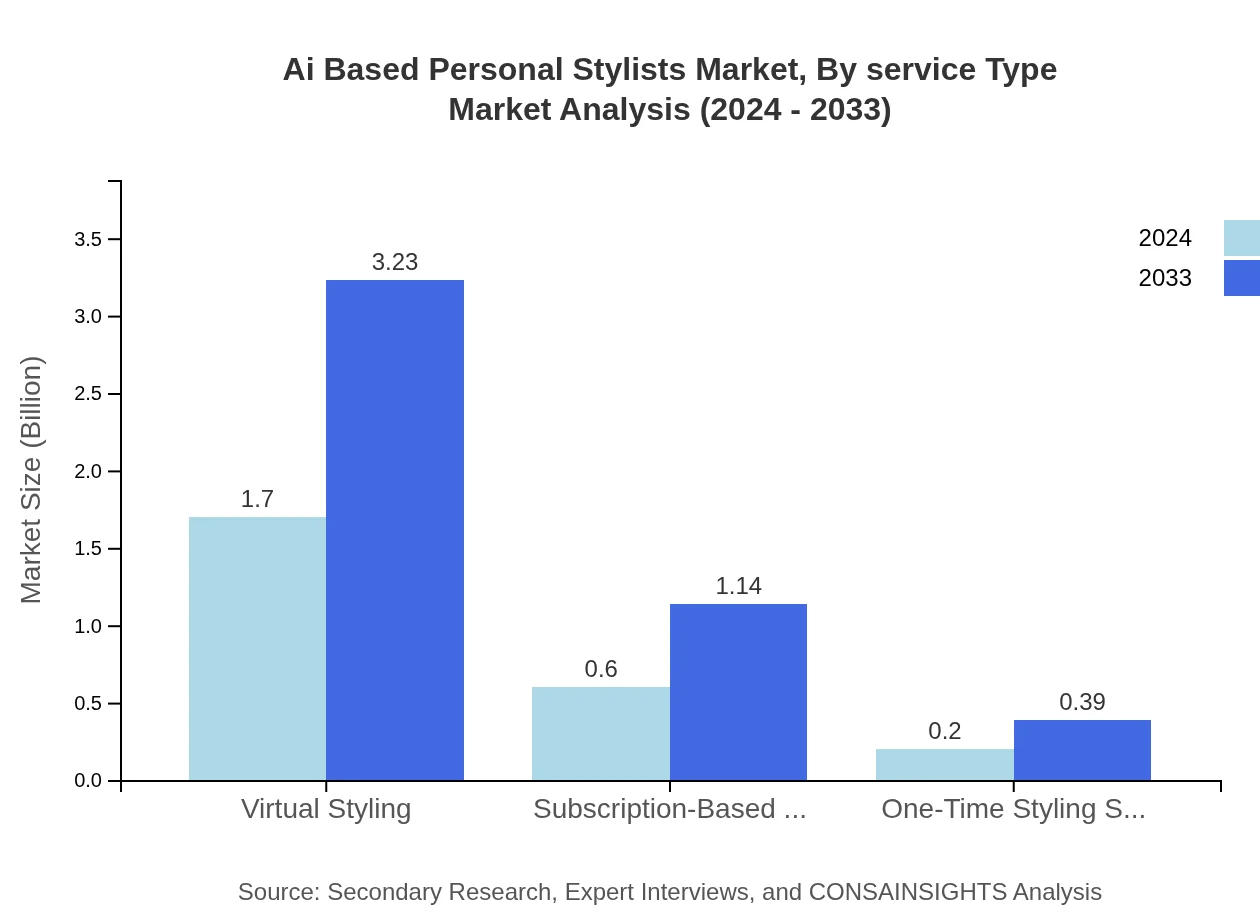
The service type segment in the Ai Based Personal Stylists market showcases diverse offerings, including Virtual Styling, Subscription-Based Services, and One-Time Styling Services. Virtual Styling, with a significant market size of $1.70 billion in 2024, is projected to reach $3.23 billion by 2033, indicating a growing consumer preference for interactive and personalized styling experiences accessible from home. Subscription-Based Services, representing a quick rise from $0.60 billion to $1.14 billion in the same period, appeal to consumers seeking ongoing style assistance. One-Time Styling Services are also on the rise but at a slower pace, growing from $0.20 billion to $0.39 billion.
Ai Based Personal Stylists Market Analysis By User Demographics
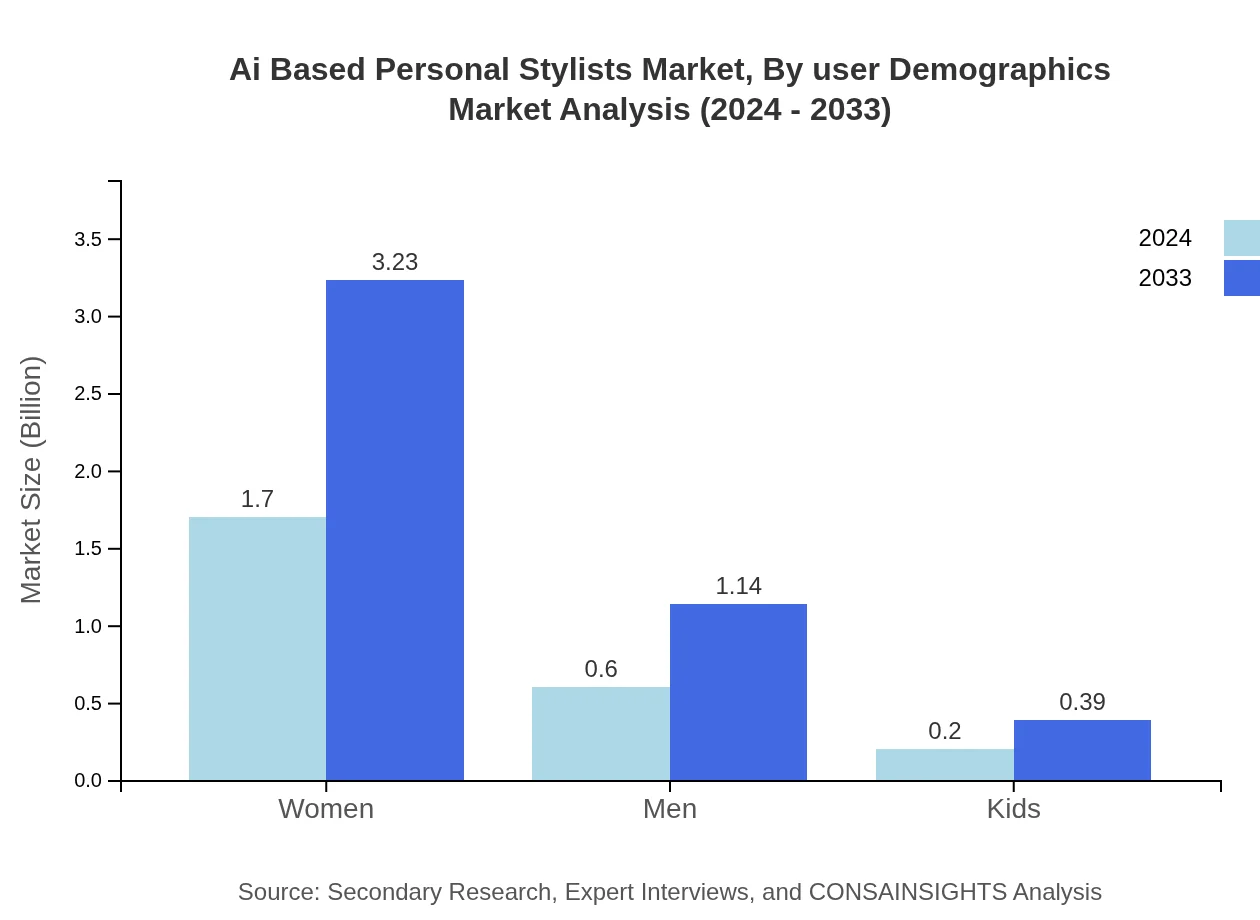
Segmenting by user demographics, the Women category is the most dominant, with market sizes projected to climb from $1.70 billion in 2024 to $3.23 billion by 2033. The Male demographic follows, growing from $0.60 billion to $1.14 billion, as brands increasingly target male consumers seeking tailored fashion choices. The Kids demographic, while smaller, shows consistent growth, moving from $0.20 billion to $0.39 billion, responding to rising parental investments in children’s fashion.
Ai Based Personal Stylists Market Analysis By Technology
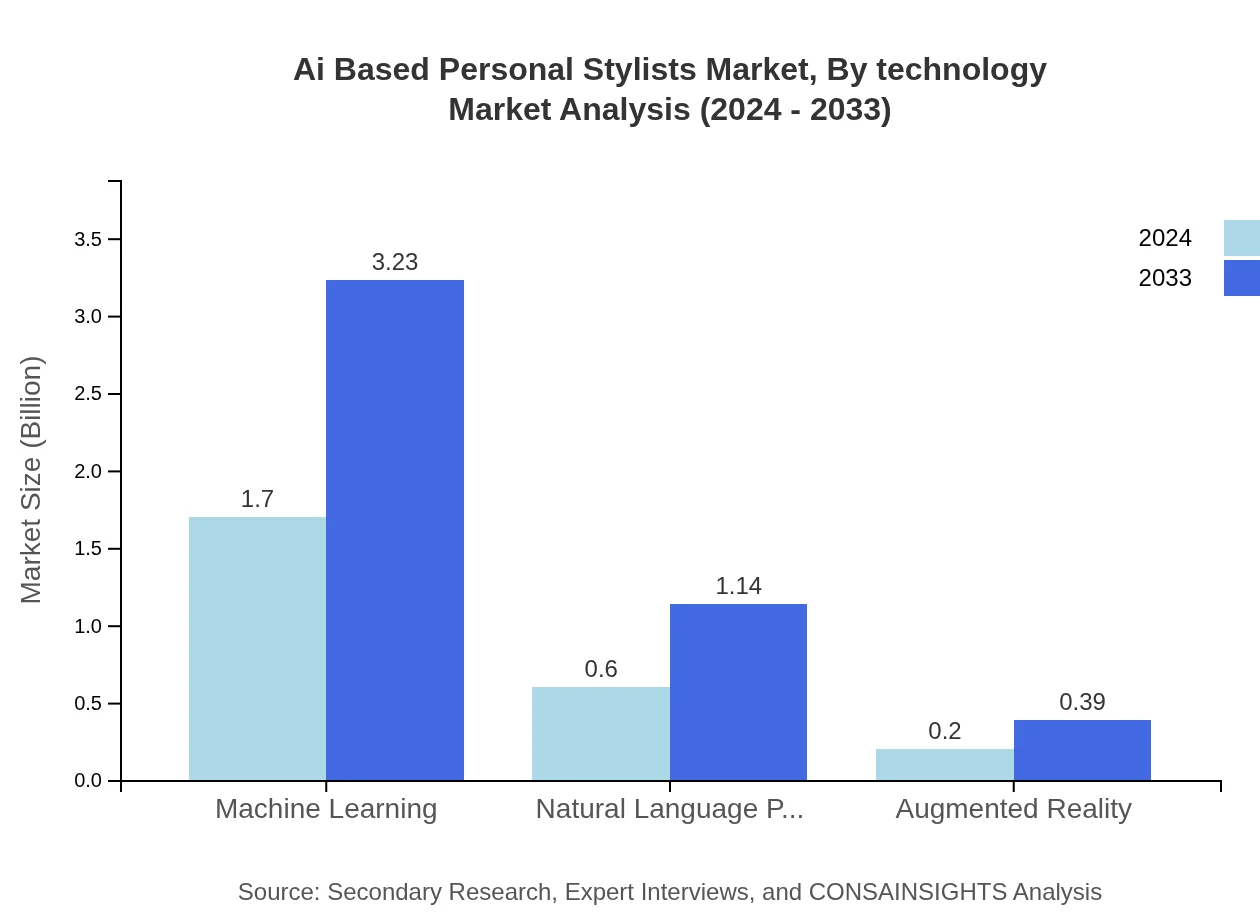
The technology segment illustrates three key components: Machine Learning leads with a market size from $1.70 billion in 2024 to $3.23 billion by 2033, showcasing the importance of data-driven recommendations. Natural Language Processing is also significant, expanding from $0.60 billion to $1.14 billion, enhancing user interaction through conversational interfaces. Augmented Reality is a smaller yet valuable segment, expected to grow from $0.20 billion to $0.39 billion, supporting immersive styling experiences.
Ai Based Personal Stylists Market Analysis By Price Range
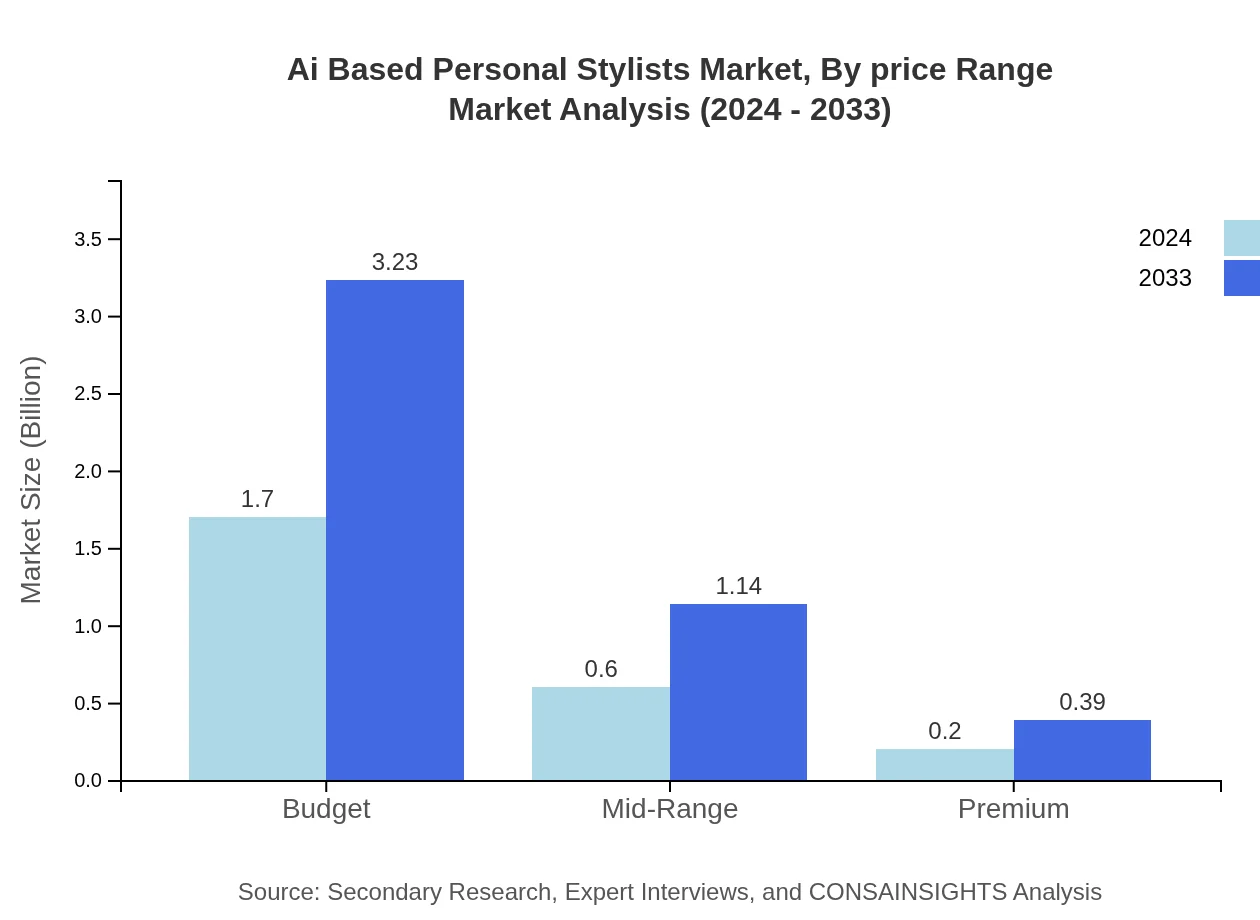
Analyzing by price range, the Budget segment emerges as the largest, projected to maintain a market size of $1.70 billion in 2024 and growing to $3.23 billion by 2033. Mid-Range and Premium segments are also expanding, indicating consumers' willingness to invest more in personalized services, progressively rising from $0.60 billion to $1.14 billion, and $0.20 billion to $0.39 billion, respectively, reinforcing the market’s diversity in offerings.
Ai Based Personal Stylists Market Trends and Future Forecast
Tell us your focus area and get a customized research report.
Global Market Leaders and Top Companies in Ai Based Personal Stylists Industry
Stitch Fix:
A pioneer in personal styling services, Stitch Fix combines data science and personal styling to deliver customized clothing selections to clients, showcasing the potential of Ai in fashion.True Fit:
True Fit leverages breakthrough technologies in fit personalization, helping brands enhance their online shopping experience with intelligent recommendations that adjust to individual preferences.H&M:
A global fashion retailer that has incorporated Ai tools to improve in-store and online customer engagement, offering personalized styling experiences.We're grateful to work with incredible clients.









FAQs
What is the market size of Ai Based Personal Stylists in 2023?
The market size for 2023 is $2.50 Billion as stated in the report’s base year data and serves as the reference point for the 2024–2033 forecast period.
How big will the market be in 2033?
The market is projected to reach $4.76 Billion by 2033, reflecting the forecast endpoint used to evaluate long-term trends and regional trajectories.
What is CAGR for the forecast period?
The compound annual growth rate for 2024 to 2033 is 7.2%, representing the annualized expansion rate applied across the reported forecast window.
Is there a single fastest Growing region in the Ai Based Personal Stylists market?
No single fastest-growing region is stated for the Ai Based Personal Stylists market because the top regional implied CAGR values are within 0.15 percentage points of each other, making the ranking too close to call reliably.
What drives adoption of AI styling solutions?
Key adoption factors include demand for personalization, improvements in machine learning and augmented reality, and retailer investments to boost online engagement and reduce return rates.
Who are the top companies covered in the report?
The report lists Stitch Fix, True Fit, and H&M among the leading companies active in the Ai Based Personal Stylists market landscape.
Why are virtual styling services important?
Virtual styling services offer scalable, cost-efficient personalization that enhances customer experience, supports recurring engagement, and helps retailers tailor offerings across digital channels.
How is segmentation structured in the report?
Segmentation is organized by technology (Machine Learning, Natural Language Processing, Augmented Reality), price range (Budget to Premium), service type, and user demographics such as women, men, and kids.