

Allergy Diagnostics Market Report
First published: 12 October 2024 | Last updated: 25 May 2026 | Report Code: allergy-diagnostics
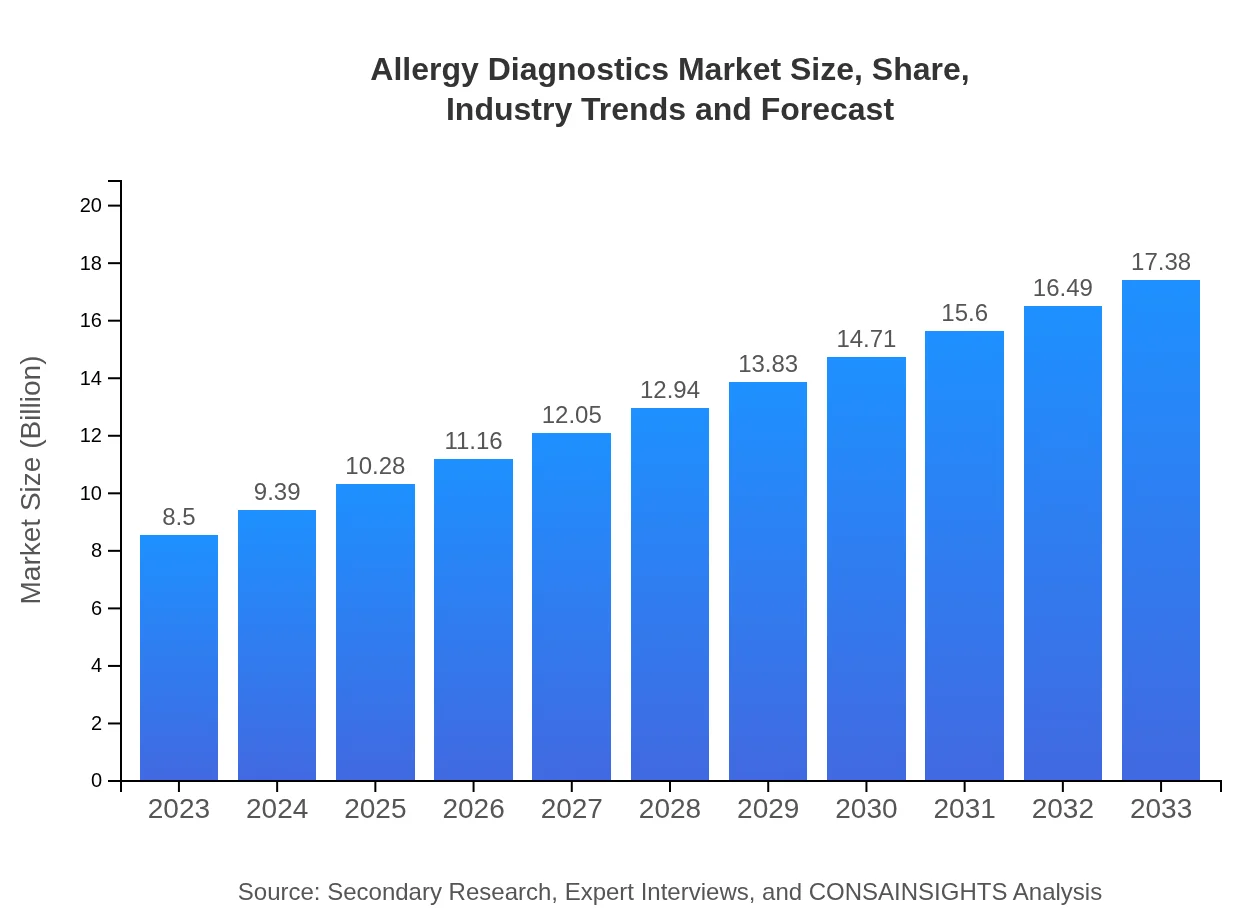
Allergy Diagnostics Market — USD 8.5 billion in 2023, Growing to USD 17.38B by 2033 at 7.2% CAGR
This report provides a comprehensive analysis of the Allergy Diagnostics market, covering key insights, trends, technologies, and a detailed forecast from 2023 to 2033, exploring market dynamics and opportunities for growth.
Key Takeaways
- Global market value grows from $8.50 Billion in 2023 to $17.38 Billion in 2033 at a 7.2% CAGR.
- North America is largest regional market, while no single fastest-growing region is stated because regional CAGR differences remain within 0.15 percentage points.
- North America is identified as the largest region, rising from $2.9 Billion to $5.93 Billion between 2023 and 2033.
- Europe expands from $2.67 Billion to $5.46 Billion; Asia Pacific moves from $1.62 Billion to $3.32 Billion in the same period.
- Product categories include diagnostic kits, laboratory services, and point-of-care devices; test types include skin prick tests and serological assays.
- Key industry players include Thermo Fisher Scientific, Roche Diagnostics, Mylan N.V., Abbott Laboratories, and LG Chem.
Allergy Diagnostics Market Report — Executive Summary
North America remains largest market by forecast-period value, while no single fastest-growing region is stated because top regional growth rates are separated by less than 0.15 percentage points. The Allergy Diagnostics market is undergoing sustained expansion driven by rising allergy prevalence, increased demand for precise diagnostic tools, and technology-led improvements in testing accuracy. Market value climbs from $8.50 Billion in 2023 to $17.38 Billion by 2033 at a 7.2% CAGR over the 2023 to 2033 forecast period. Clinical and outpatient settings, diagnostic laboratories, and home-based testing solutions are central to the market structure. Major vendors such as Thermo Fisher Scientific, Roche Diagnostics, Mylan N.V., Abbott Laboratories, and LG Chem are active in product development and distribution. Ongoing trends include adoption of serological assays, broader availability of diagnostic kits, and integration of point-of-care devices, all supported by heightened preventive healthcare spending and research efforts. The report covers segmentation by test type, product type, allergen type, and end-user, and outlines regional developments with North America serving as the largest regional market.
Key Growth Drivers
- Increasing prevalence of allergic conditions boosting demand for accurate diagnostic solutions.
- Technological improvements in testing methods enhancing sensitivity and diagnostic throughput.
- Greater healthcare expenditure and emphasis on preventive care accelerating adoption of diagnostics.
- Expansion of testing access across hospitals, diagnostic laboratories, and home care settings.
- Ongoing industry investment and product innovation from established life-sciences companies.
| Metric | Value |
|---|---|
| Study Period | 2023 - 2033 |
| 2023 Market Size | $8.50 Billion |
| CAGR (2023-2033) | 7.2% |
| 2033 Market Size | $17.38 Billion |
| Top Companies | Thermo Fisher Scientific, Roche Diagnostics, Mylan N.V., Abbott Laboratories, LG Chem |
| Published Date | 12 October 2024 |
| Last Modified Date | 25 May 2026 |
Allergy Diagnostics Market Overview
Customize Allergy Diagnostics Market Report market research report
- ✔ Get in-depth analysis of Allergy Diagnostics market size, growth, and forecasts.
- ✔ Understand Allergy Diagnostics's regional dynamics and industry-specific trends.
- ✔ Identify potential applications, end-user demand, and growth segments in Allergy Diagnostics
What is the Market Size & CAGR of Allergy Diagnostics Market Report market in 2023?
Allergy Diagnostics Industry Analysis
Allergy Diagnostics Market Segmentation and Scope
Tell us your focus area and get a customized research report.
Allergy Diagnostics Market Report Market Analysis Report by Region
Europe Allergy Diagnostics Market Report:
Europe grows from $2.67 Billion in 2023 to $5.46 Billion in 2033. Regional expansion is driven by increased diagnostic service uptake, investments in laboratory services, and adoption of serological and skin testing methods.Asia Pacific Allergy Diagnostics Market Report:
Asia Pacific grows from $1.62 Billion in 2023 to $3.32 Billion in 2033. Growth is fueled by rising awareness of allergic conditions, expanding diagnostic capacity, and wider access to point-of-care and laboratory testing solutions.North America Allergy Diagnostics Market Report:
North America is largest regional market, rising from $2.9 Billion in 2023 to $5.93 Billion in 2033. 9 Billion in 2023 and increases to $5.93 Billion by 2033. The region is noted as the largest market, supported by established healthcare infrastructure, higher preventive care spending, and strong adoption of advanced diagnostic kits and point-of-care technologies.South America Allergy Diagnostics Market Report:
Latin America grows from $0.55 Billion in 2023 to $1.12 Billion in 2033. Market development reflects growing demand for diagnostic kits and improved laboratory services alongside expanding healthcare access.Middle East & Africa Allergy Diagnostics Market Report:
Middle East and Africa grows from $0.76 Billion in 2023 to $1.56 Billion in 2033. Progress is supported by gradual healthcare infrastructure development, increased diagnostic adoption, and a focus on preventive health measures.Tell us your focus area and get a customized research report.
Research Methodology
Allergy Diagnostics Market Analysis By Product Type
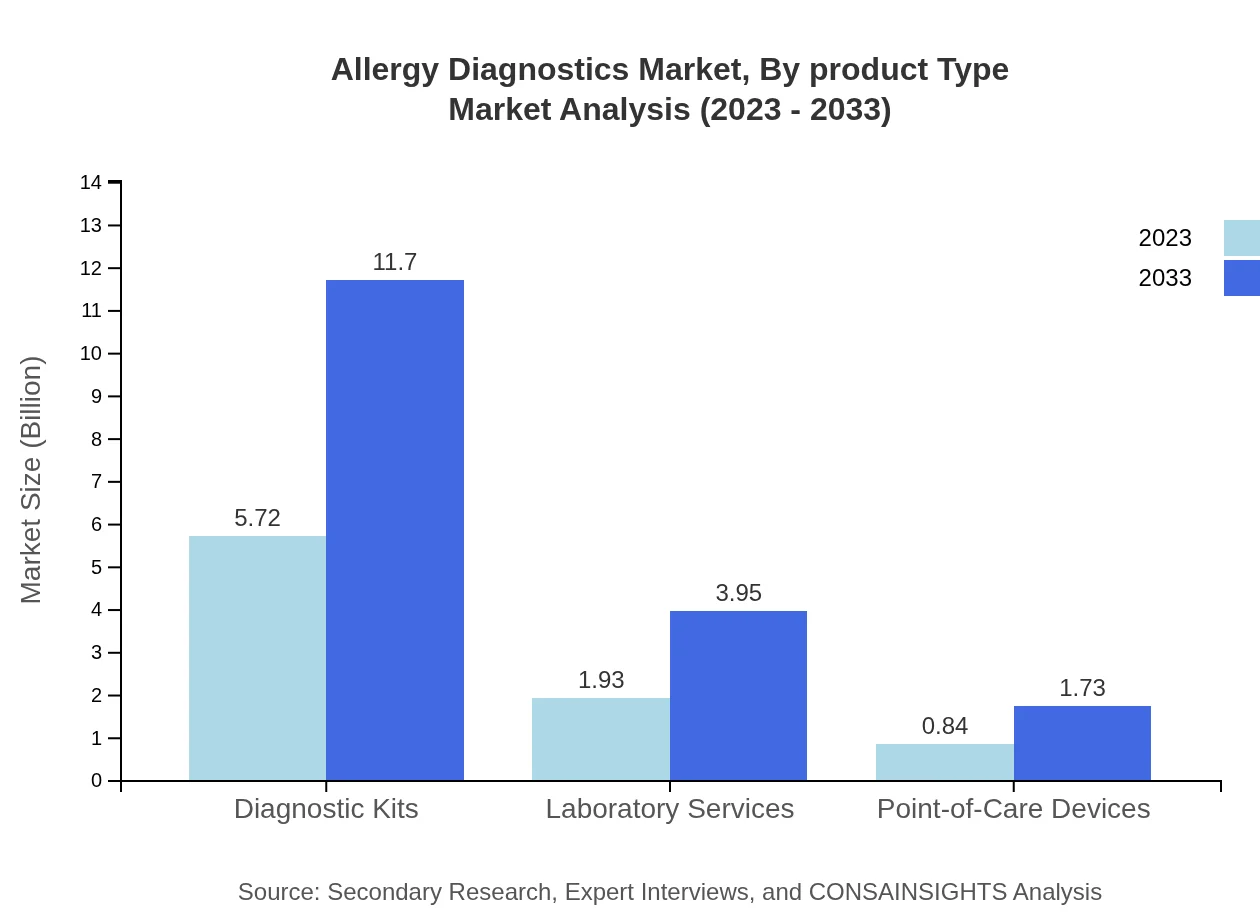
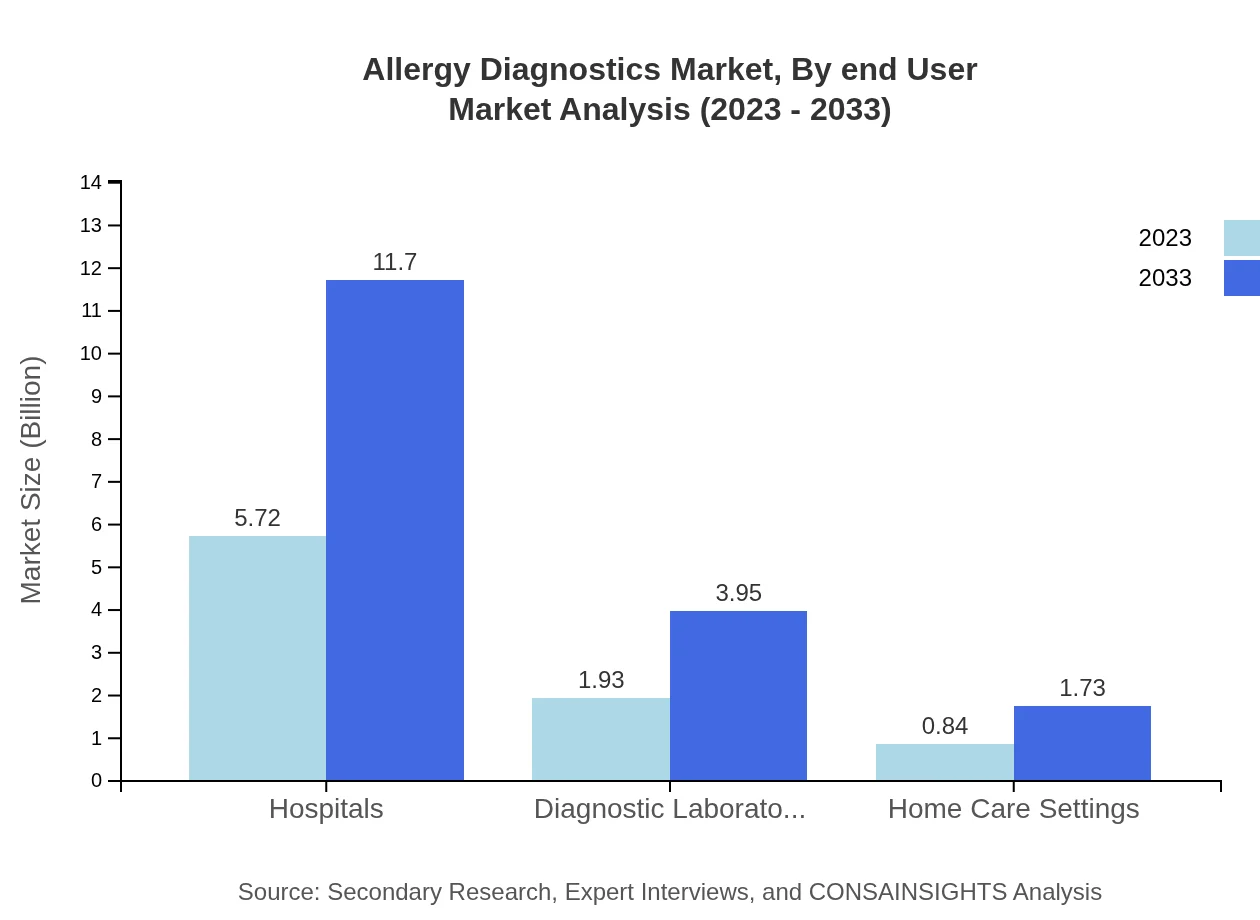
In 2023, the market for various product types in Allergy Diagnostics saw significant value distribution. Diagnostic kits dominated, valued at $5.72 billion in 2023, representing a 67.34% market share, and expected to reach $11.70 billion by 2033. Serological assays and laboratory services also held considerable shares, with values emerging at $1.93 billion (22.73%) and expected to scale up to $3.95 billion respectively by 2033.
Allergy Diagnostics Market Analysis By Allergen Type
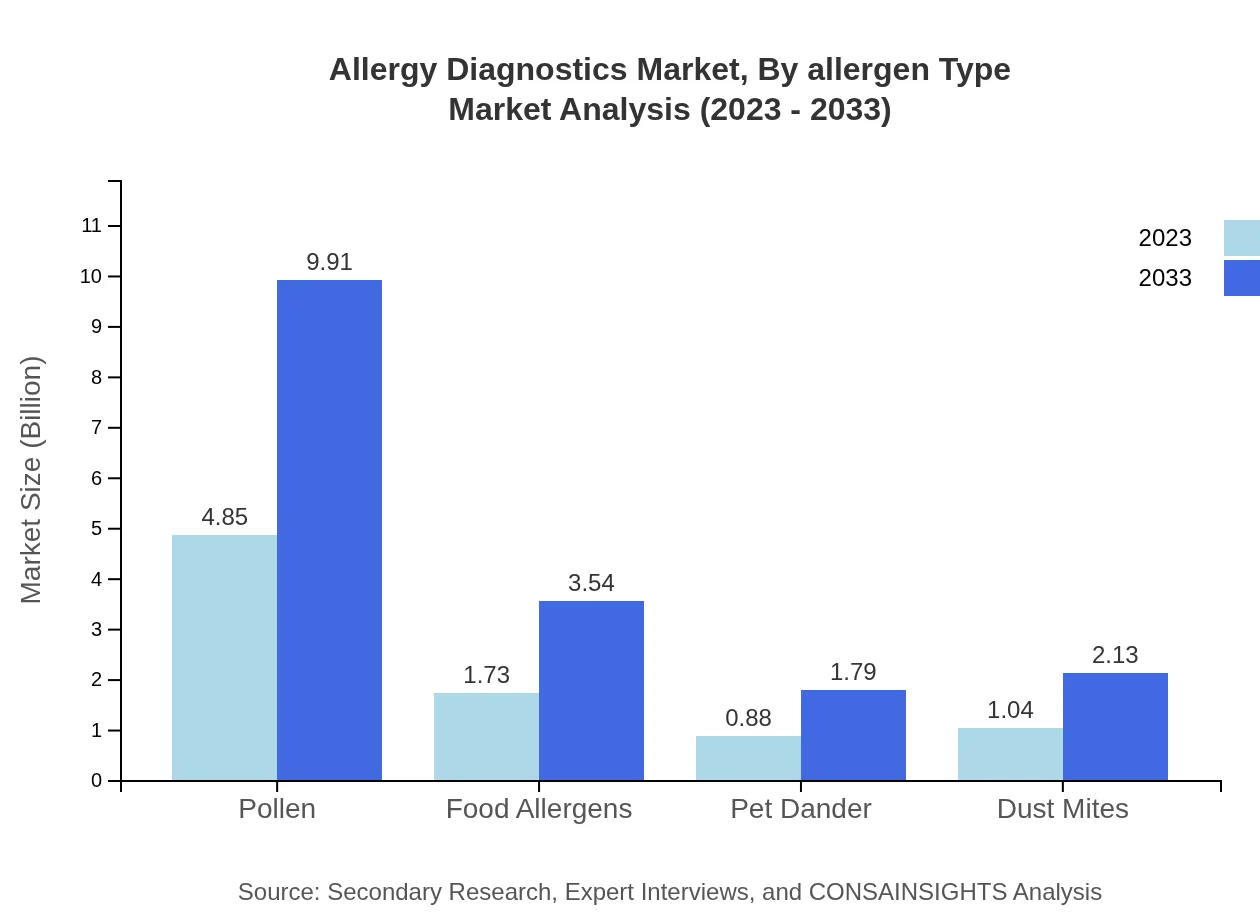
The allergen type segment highlights significant contributors such as pollen, food allergens, and pet dander. Pollen, which constituted 57.05% of the market share in 2023 at $4.85 billion, will double to reach $9.91 billion in 2033. Food allergens and pet dander followed suit, progressing from $1.73 billion (20.37%) and $0.88 billion (10.33%) in 2023 to $3.54 billion and $1.79 billion respectively in 2033.
Allergy Diagnostics Market Analysis By Test Type
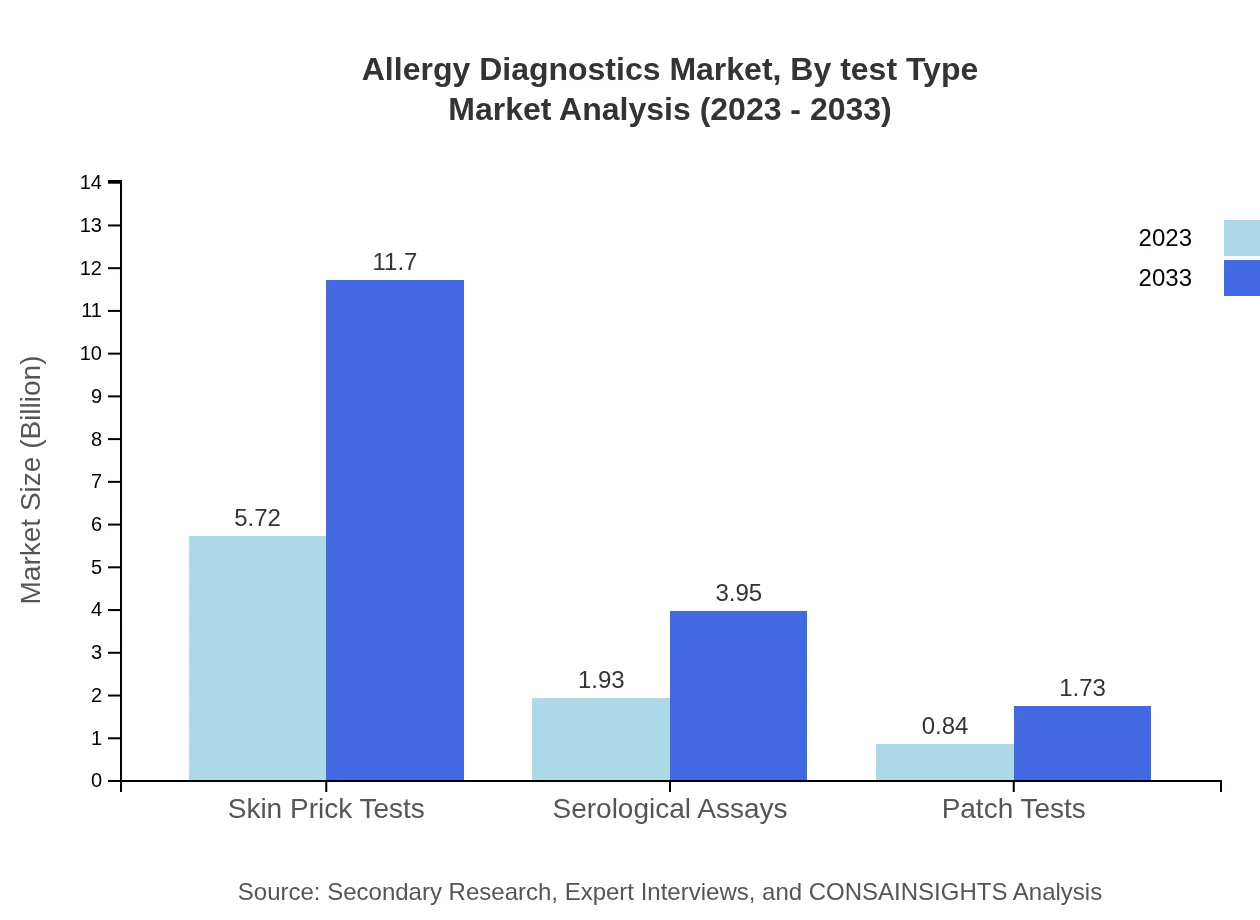
The differentiation of tests reveals a major dominance by skin prick tests and point-of-care devices, each generating substantial revenue by 2033. Skin prick tests grossed around $5.72 billion in 2023, with an excellent retention of market share at 67.34%, projected to sustain the same share till 2033.
Allergy Diagnostics Market Trends and Future Forecast
Tell us your focus area and get a customized research report.
Global Market Leaders and Top Companies in Allergy Diagnostics Industry
Thermo Fisher Scientific:
A leading player in the field, known for its extensive range of allergy diagnostics and innovative testing technologies.Roche Diagnostics:
Renowned for its diagnostic solutions, particularly in serology and molecular assays aimed at allergy testing.Mylan N.V.:
A significant contributor in the development of allergy treatments and diagnostic kits, enhancing accessibility.Abbott Laboratories:
Offers a broad array of allergy diagnostics and has made strides in integrating technology with diagnostic processes.LG Chem:
Investing in research for new serological methods to improve testing accuracy in allergy diagnostics.We're grateful to work with incredible clients.








FAQs
What is the market size of the Allergy Diagnostics Market Report in 2023?
The market size in 2023 is $8.50 Billion, as stated in the report data for the 2023 base year.
How big is the market expected to be by 2033?
Projected market value for 2033 is $17.38 Billion, based on the provided forecast figures.
What is CAGR of the market during the forecast period?
The reported compound annual growth rate for the 2023 to 2033 forecast period is 7.2%.
Is there a single fastest Growing region in the Allergy Diagnostics Market Report market?
No single fastest-growing region is stated for the Allergy Diagnostics Market Report market because the top regional implied CAGR values are within 0.15 percentage points of each other, making the ranking too close to call reliably.
Which companies are listed as leading players?
Top companies named in the report include Thermo Fisher Scientific, Roche Diagnostics, Mylan N.V., Abbott Laboratories, and LG Chem.
What are the main product categories covered?
Product types specified include diagnostic kits, laboratory services, and point-of-care devices as primary market offerings.
How big is the Europe market in 2023 and 2033?
Europe is reported at $2.67 Billion in 2023 and projected to reach $5.46 Billion by 2033 according to the regional facts.
What end Users are included in the segmentation?
End-user segments listed include hospitals, diagnostic laboratories, and home care settings as specified sub-segments.
How big is the Asia Pacific market in 2023 and 2033?
Asia Pacific is shown at $1.62 Billion in 2023 and is expected to grow to $3.32 Billion by 2033 per the input data.
Who conducted the research for the report?
Research involved primary interviews with industry experts and secondary research using company reports and publications, with data triangulation and validation.