

Automatic Pill Dispenser Market Report
First published: 07 October 2024 | Last updated: 25 May 2026 | Report Code: automatic-pill-dispenser
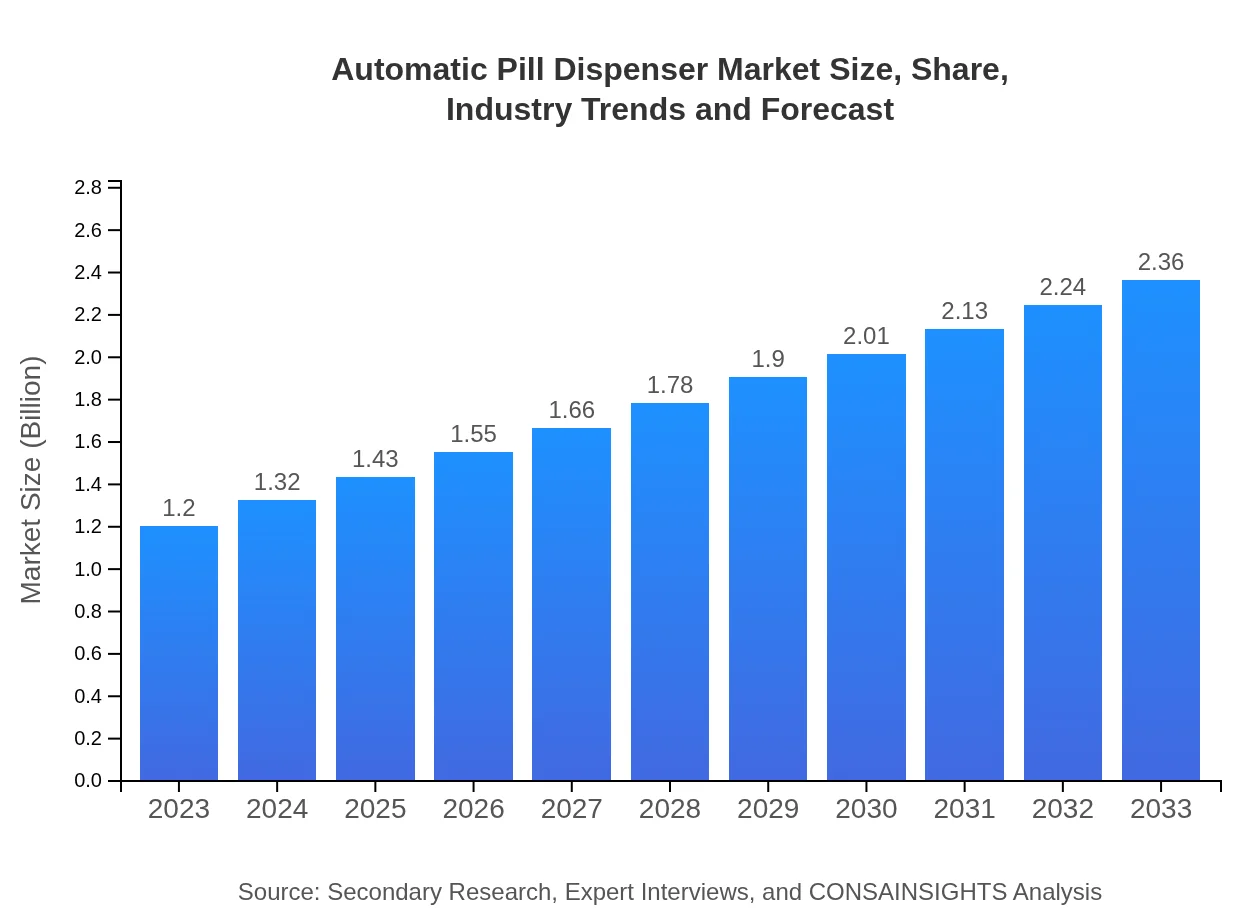
Automatic Pill Dispenser Market — USD 1.2 billion in 2023, Growing to USD 2.36B by 2033 at 6.8% CAGR
This report provides a comprehensive analysis of the Automatic Pill Dispenser market from 2023 to 2033, highlighting market size, trends, regional insights, and key players. Detailed data and insights enable better decision-making and forecasting in this growing sector.
Key Takeaways
- Global market value increases from $1.20 Billion in 2023 to $2.36 Billion in 2033, reflecting a 6.8% CAGR over 2023 to 2033.
- North America is largest regional market, while no single fastest-growing region is stated because regional CAGR differences remain within 0.15 percentage points.
- Europe grows from $0.38 Billion in 2023 to $0.76 Billion in 2033, underscoring demand across clinical and home-care settings.
- Asia Pacific expands from $0.22 Billion in 2023 to $0.44 Billion in 2033, driven by aging populations and healthcare investments.
- Key vendors include Omnicell, Inc., Tablets on Call, MedMinder Systems, Inc., ScriptPro LLC and Hero Health.
Automatic Pill Dispenser Market Report — Executive Summary
North America remains largest market by forecast-period value, while no single fastest-growing region is stated because top regional growth rates are separated by less than 0.15 percentage points. The report outlines the Automatic Pill Dispenser market trajectory from $1.20 Billion in 2023 to $2.36 Billion by 2033, at a 6.8% CAGR for 2023 to 2033. Growth is supported by rising chronic disease prevalence, an expanding elderly population, and increasing adoption of home-care technologies. Innovation in electronic and software-integrated dispensers, along with connectivity to digital health platforms, is reshaping product offerings. Regional variations are notable: North America is the largest market, moving from $0.41 Billion to $0.81 Billion between 2023 and 2033, while Europe and Asia Pacific also show substantive increases. The market structure includes product types such as robotic and manual dispensers, multiple end users including elderly and chronic disease patients, and distribution via online and offline channels. Competitive activity is led by firms like Omnicell, Inc., Tablets on Call, MedMinder Systems, Inc., ScriptPro LLC and Hero Health. The research emphasizes technology integration, regulatory support, and shifting care models as central themes for stakeholders evaluating opportunities and strategies.
Key Growth Drivers
- Increasing prevalence of chronic illnesses that require long-term medication management, boosting demand for adherence solutions.
- A growing elderly population that benefits from automated dosing and reminder features to reduce missed or incorrect doses.
- Advances in connected and software-integrated dispensers that enable remote monitoring and integration with digital health systems.
- Greater investment in home-care services and telehealth, encouraging adoption of devices suitable for non-clinical settings.
- Competitive vendor innovation and declining unit costs improving accessibility across consumer and institutional channels.
| Metric | Value |
|---|---|
| Study Period | 2023 - 2033 |
| 2023 Market Size | $1.20 Billion |
| CAGR (2023-2033) | 6.8% |
| 2033 Market Size | $2.36 Billion |
| Top Companies | Omnicell, Inc., Tablets on Call, MedMinder Systems, Inc., ScriptPro LLC, Hero Health |
| Published Date | 07 October 2024 |
| Last Modified Date | 25 May 2026 |
Automatic Pill Dispenser Market Overview
Customize Automatic Pill Dispenser Market Report market research report
- ✔ Get in-depth analysis of Automatic Pill Dispenser market size, growth, and forecasts.
- ✔ Understand Automatic Pill Dispenser's regional dynamics and industry-specific trends.
- ✔ Identify potential applications, end-user demand, and growth segments in Automatic Pill Dispenser
What is the Market Size & CAGR of Automatic Pill Dispenser Market Report market in 2023?
Automatic Pill Dispenser Industry Analysis
Automatic Pill Dispenser Market Segmentation and Scope
Tell us your focus area and get a customized research report.
Automatic Pill Dispenser Market Report Market Analysis Report by Region
Europe Automatic Pill Dispenser Market Report:
Europe grows from $0.38 Billion in 2023 to $0.76 Billion in 2033. Regional drivers include aging demographics, healthcare system investments in adherence technologies, and increasing use of connected devices in both home and institutional care settings.Asia Pacific Automatic Pill Dispenser Market Report:
Asia Pacific grows from $0.22 Billion in 2023 to $0.44 Billion in 2033. The region’s growth reflects rising healthcare spending, broader access to home-based care solutions and growing awareness of medication adherence among aging populations.North America Automatic Pill Dispenser Market Report:
North America is largest regional market, rising from $0.41 Billion in 2023 to $0.81 Billion in 2033. Growth in this region is driven by strong adoption of home-care technologies, investments in digital health integration, and high uptake of electronic and software-integrated dispensing solutions.South America Automatic Pill Dispenser Market Report:
Latin America grows from $0.09 Billion in 2023 to $0.18 Billion in 2033. Demand is supported by expanding healthcare access, greater interest in remote care solutions, and gradual adoption of automated medication management tools.Middle East & Africa Automatic Pill Dispenser Market Report:
Middle East and Africa grows from $0.09 Billion in 2023 to $0.18 Billion in 2033. Market momentum is influenced by investments in healthcare infrastructure, increasing chronic disease management needs and emerging uptake of connected health devices.Tell us your focus area and get a customized research report.
Research Methodology
Automatic Pill Dispenser Market Analysis By Product
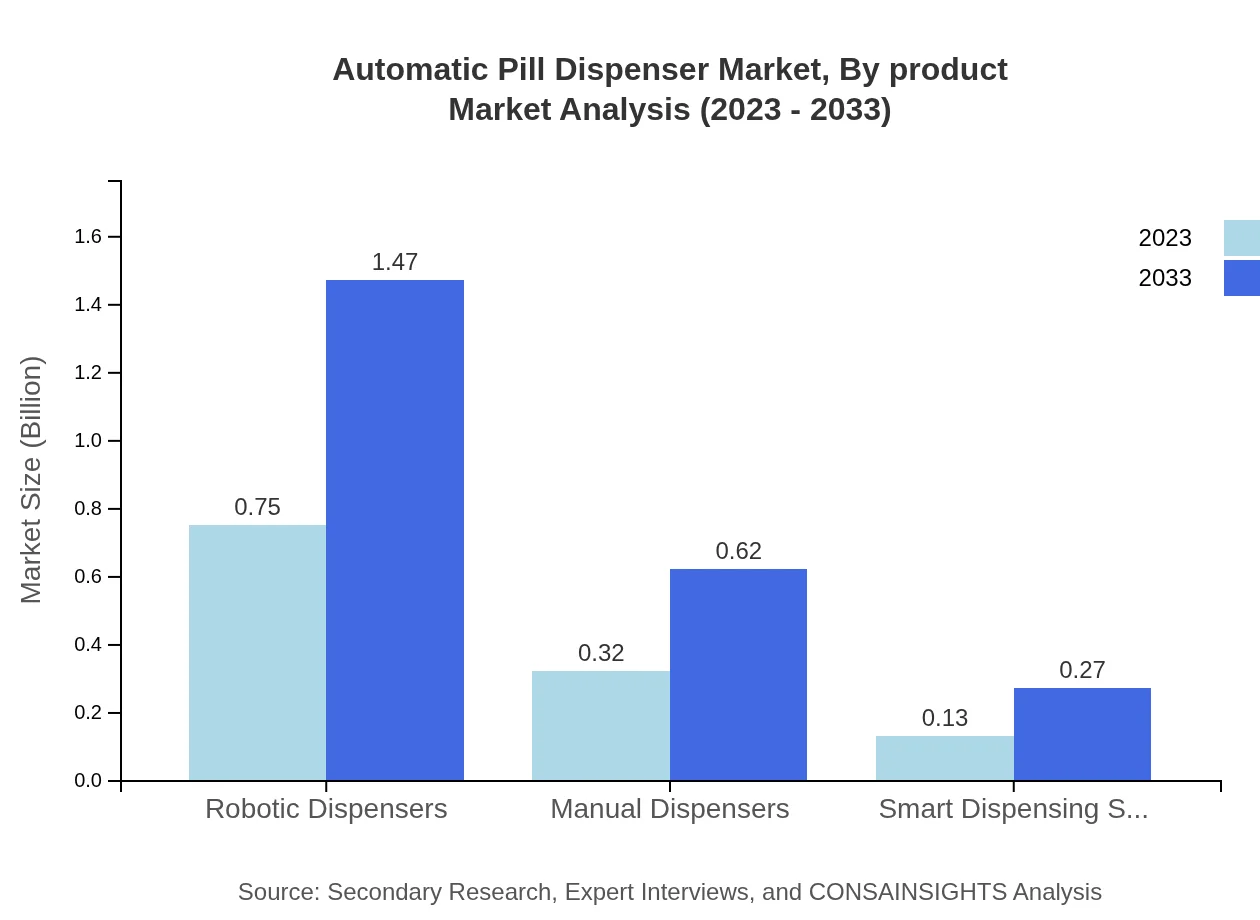
The Automatic Pill Dispenser market by product consists primarily of robotic dispensers, manual dispensers, and smart dispensing solutions. In 2023, robotic dispensers dominate the market with a size of $0.75 billion and are expected to reach $1.47 billion by 2033, maintaining a 62.32% market share. Manual dispensers account for $0.32 billion, projected to grow to $0.62 billion with a 26.44% share, while smart dispensing solutions are expected to grow from $0.13 billion to $0.27 billion, holding an 11.24% share.
Automatic Pill Dispenser Market Analysis By Application
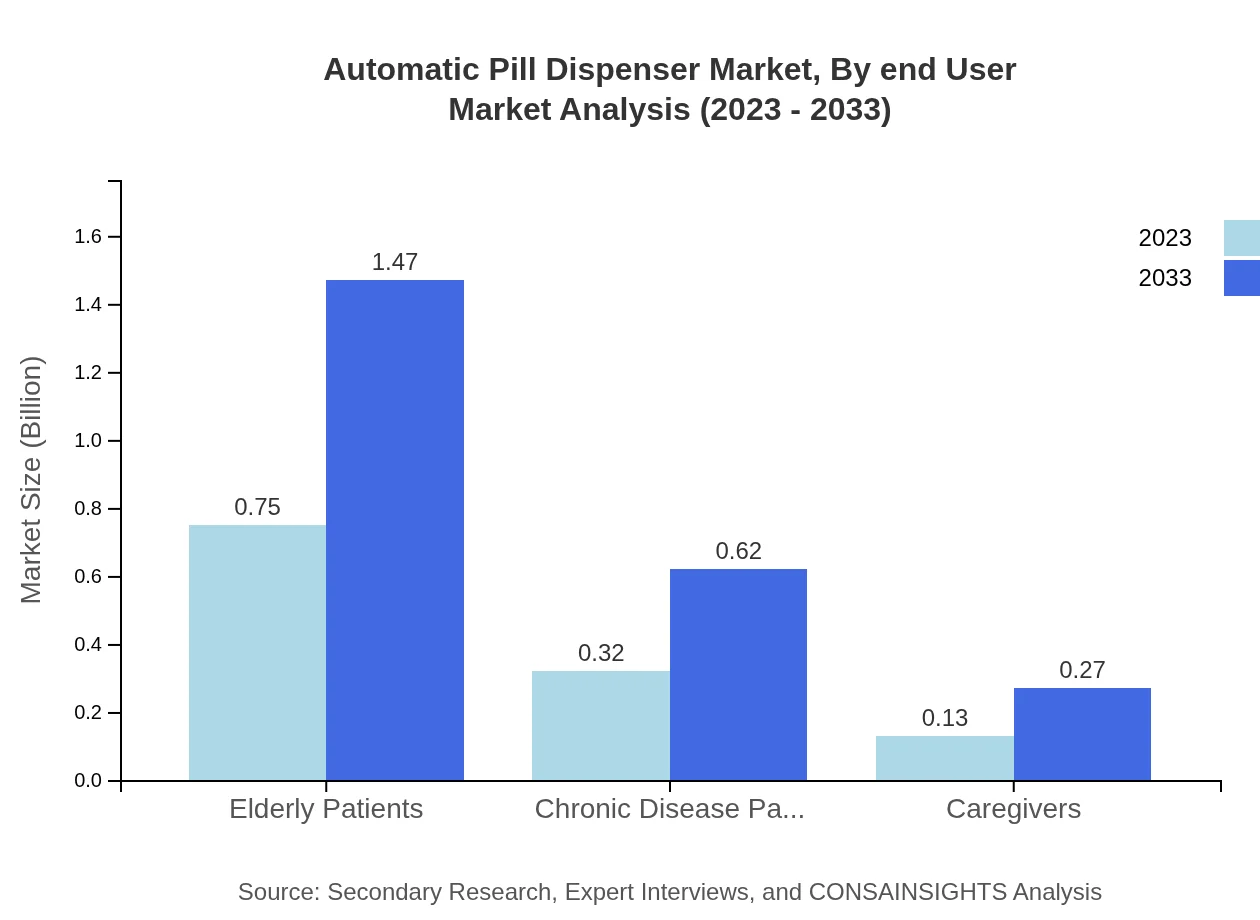
The application segment for Automatic Pill Dispensers consists of elderly patients, chronic disease patients, and caregivers. The market for elderly patients is expected to grow from $0.75 billion in 2023 to $1.47 billion by 2033, representing 62.32% of market share. Chronic disease patients constitute a market size of $0.32 billion, anticipated to grow to $0.62 billion with a 26.44% share, while caregiver-related solutions hold an 11.24% share, projected to grow from $0.13 billion to $0.27 billion.
Automatic Pill Dispenser Market Analysis By End User
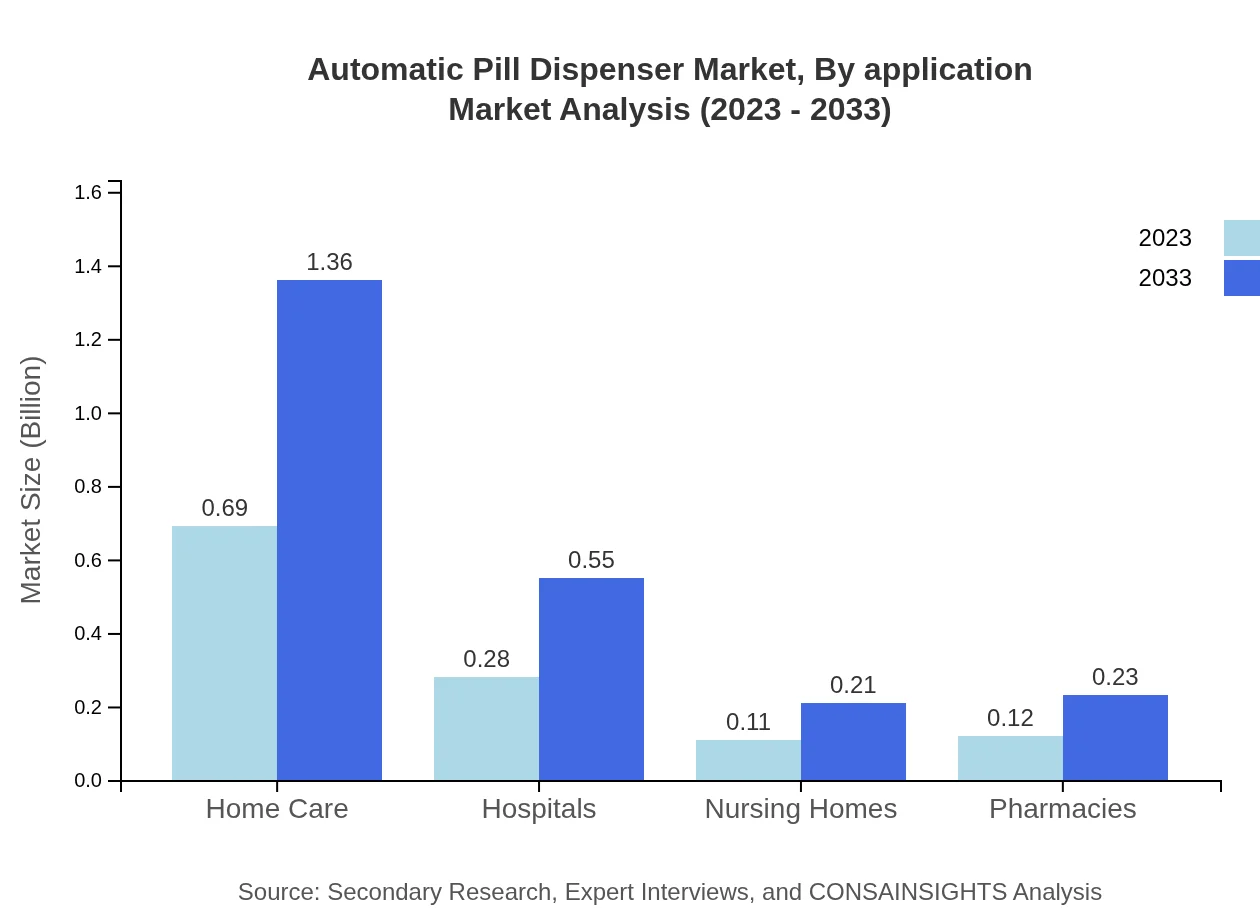
The end-user segment includes hospitals, nursing homes, home care, and pharmacies. The home care market in 2023 stands at $0.69 billion with a growth estimate to $1.36 billion by 2033, securing 57.78% of market share. Hospitals are responsible for $0.28 billion, expected to grow to $0.55 billion. Nursing homes and pharmacies also show steady growth, from $0.11 billion to $0.21 billion and from $0.12 billion to $0.23 billion, respectively.
Automatic Pill Dispenser Market Analysis By Distribution Channel
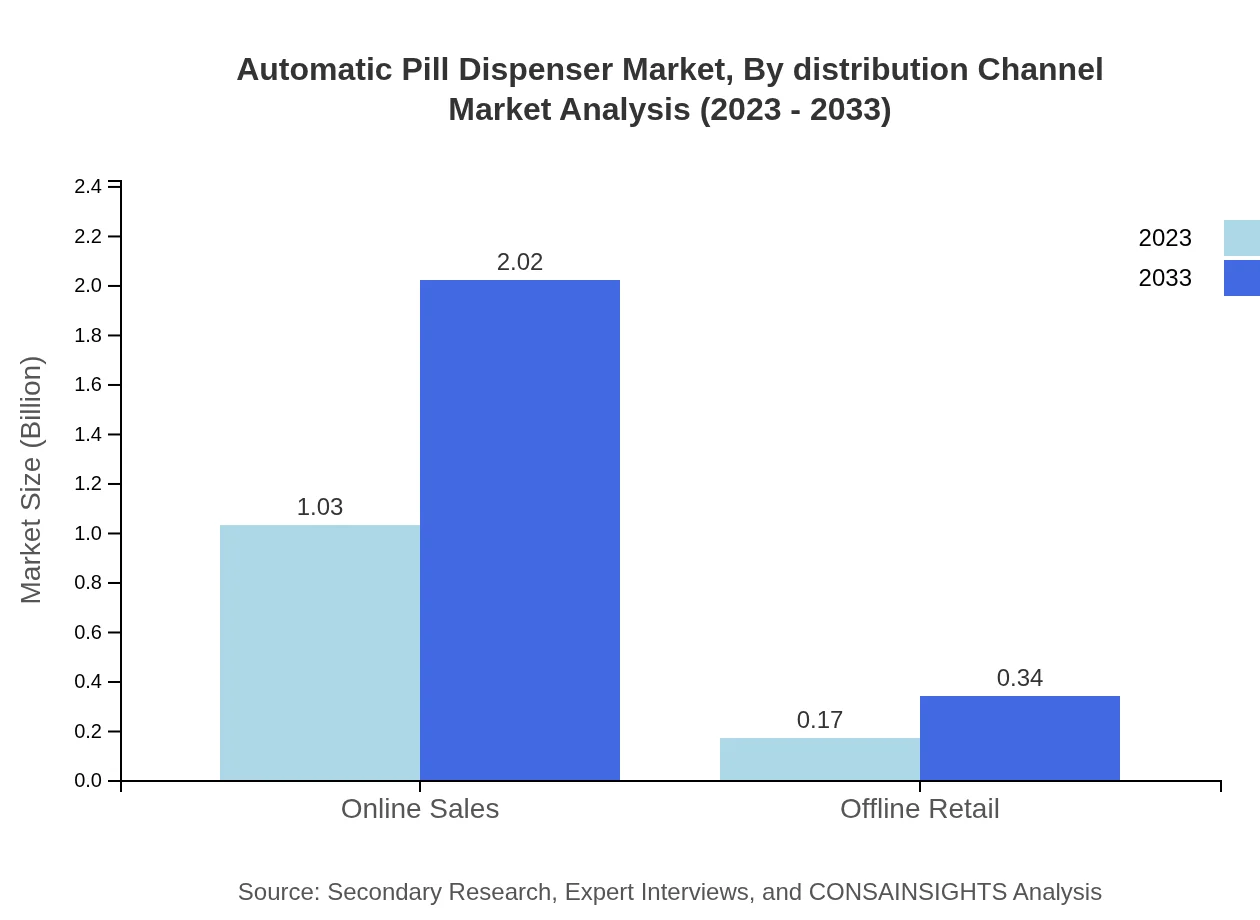
The distribution channels for Automatic Pill Dispensers include online sales and offline retail. Online sales dominate this market segment, reporting $1.03 billion in 2023 and projected to reach $2.02 billion by 2033, accounting for 85.48% of the share. Offline retail is expected to grow from $0.17 billion to $0.34 billion, holding a 14.52% market share.
Automatic Pill Dispenser Market Analysis By Technology
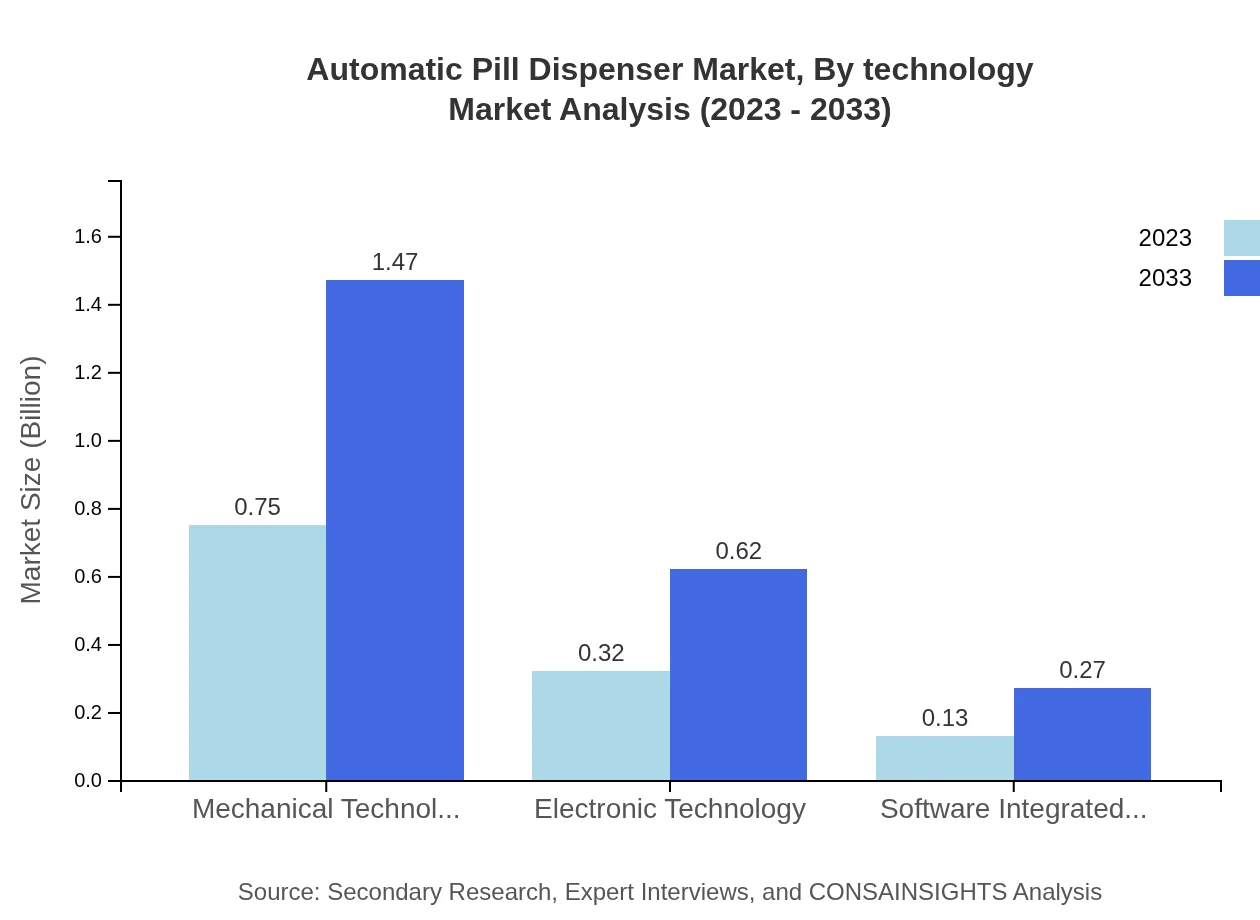
The technology segment consists of mechanical technology, electronic technology, and software integrated technology. Mechanical technology leads with a market size of $0.75 billion in 2023, expected to grow to $1.47 billion by 2033 (62.32% share). Electronic technology is projected to increase from $0.32 billion to $0.62 billion holding 26.44% share, while software integrated technology, although smaller, is set to grow from $0.13 billion to $0.27 billion representing an 11.24% share.
Automatic Pill Dispenser Market Trends and Future Forecast
Tell us your focus area and get a customized research report.
Global Market Leaders and Top Companies in Automatic Pill Dispenser Industry
Omnicell, Inc.:
A leading provider of medication and pharmacy automation solutions, Omnicell focuses on enhancing operational efficiency in healthcare settings.Tablets on Call:
Specializes in providing high-tech medication dispensing systems to streamline medication management for elderly and chronic disease patients.MedMinder Systems, Inc.:
Offers innovative medication adherence solutions tailored toward seniors, featuring intuitive dispensers that help manage prescriptions.ScriptPro LLC:
A company dedicated to promoting medication safety, ScriptPro provides comprehensive dispensing solutions that improve pharmacy operations.Hero Health:
Combining technology with ease of use, Hero Health designs smart dispensers for individuals requiring consistent medication schedules.We're grateful to work with incredible clients.









FAQs
What is the market size of the Automatic Pill Dispenser Market Report in 2023?
The market size in 2023 is $1.20 Billion, as stated in the report's baseline year valuation for the forecast spanning 2023 to 2033.
What is the projected market size in 2033?
The market is projected to reach $2.36 Billion in 2033 according to the provided forecast for the period 2023 to 2033.
What is CAGR of the market for the forecast period?
The specified compound annual growth rate for 2023 to 2033 is 6.8%, reflecting the period covered by the forecast.
Is there a single fastest Growing region in the Automatic Pill Dispenser Market Report market?
No single fastest-growing region is stated for the Automatic Pill Dispenser Market Report market because the top regional implied CAGR values are within 0.15 percentage points of each other, making the ranking too close to call reliably.
Which companies are listed as top players?
Top companies identified include Omnicell, Inc., Tablets on Call, MedMinder Systems, Inc., ScriptPro LLC and Hero Health.
Why is the market growing at 6.8% CAGR?
Growth at 6.8% is attributed to demographic shifts, higher chronic disease burden, adoption of home-care devices and technological enhancements in dispensers.
What end users are covered in the segmentation?
End-user categories noted include elderly patients, chronic disease patients and caregivers, reflecting primary demand sources for dispensing solutions.
How big is the Europe market in 2023 and 2033?
Europe is reported at $0.38 Billion in 2023 and is projected to reach $0.76 Billion by 2033, indicating notable regional expansion.
What is the Asia Pacific market size change from 2023 to 2033?
Asia Pacific grows from $0.22 Billion in 2023 to $0.44 Billion in 2033, per the input regional figures for the forecast period.
Who are the primary beneficiaries of dispenser adoption?
Primary beneficiaries include elderly patients and individuals with chronic conditions who require routine medication management and adherence support.