

Cellulite Treatment Market Report
First published: 21 October 2024 | Last updated: 28 May 2026 | Report Code: cellulite-treatment
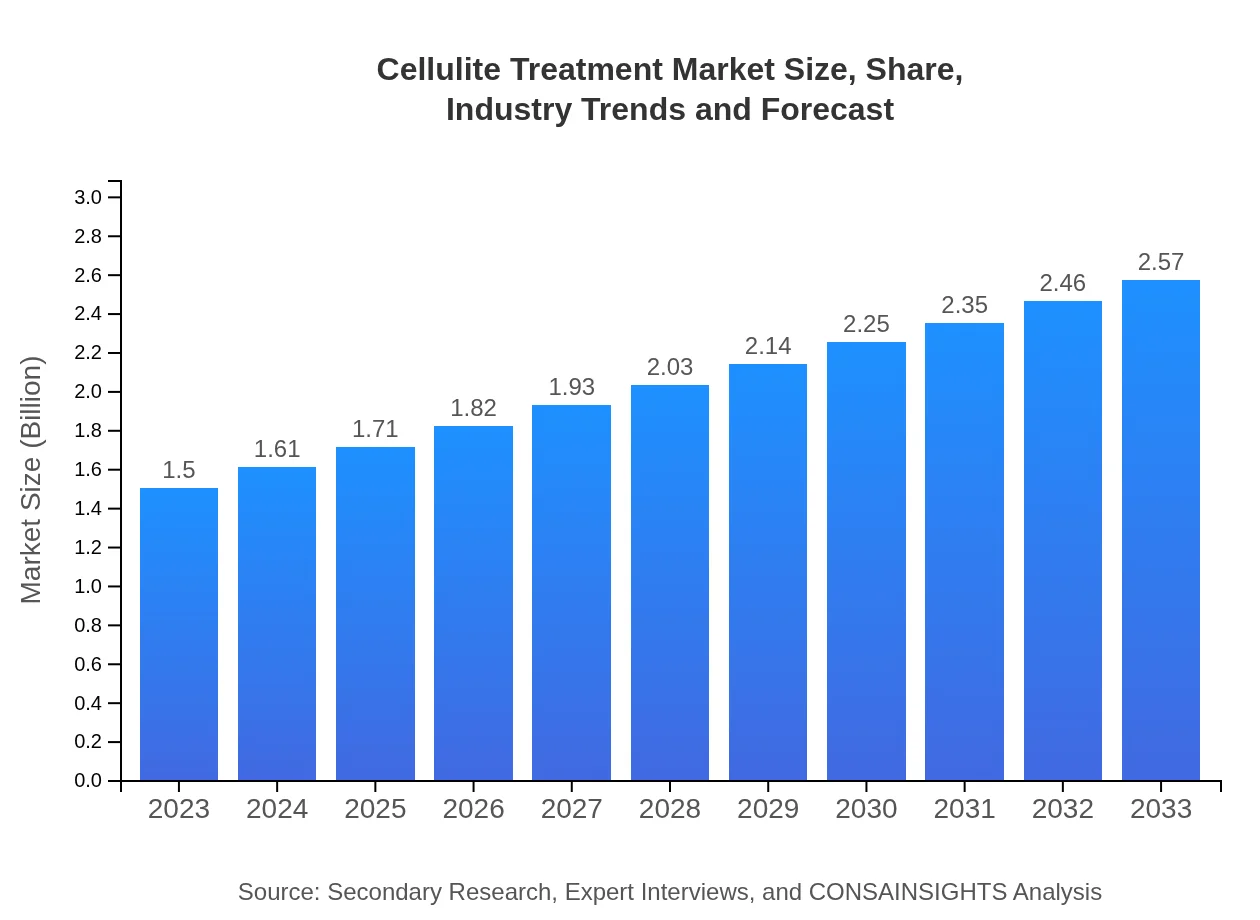
Cellulite Treatment Market — USD 1.5 billion in 2023, Growing to USD 2.57B by 2033 at 5.4% CAGR
This report analyzes the Cellulite Treatment market from 2023 to 2033, providing insights into market trends, size, segmentation, regional analysis, and competitive landscape for informed decision-making.
Key Takeaways
- Global market rises from $1.50 Billion in 2023 to $2.57 Billion in 2033 with a 5.4% CAGR during 2023 to 2033.
- North America is largest regional market; Latin America is regional market region based on implied CAGR across 2023 to 2033.
- Latin America posts the strongest implied growth, moving from $0.05 Billion in 2023 to $0.09 Billion in 2033 at an implied 6.05% CAGR.
- Segment diversity includes topical, minimally invasive, and surgical alternatives across online and offline channels, with products using natural and synthetic ingredients.
- Key players include Allergan, Inc., Revance Therapeutics, Inc., Medytox, Inc., Cynosure, Inc., and Sientra, Inc.
Cellulite Treatment Market Report — Executive Summary
Regional analysis shows North America as largest market and Latin America as fastest-growing region by implied CAGR. The cellulite treatment sector is on a steady expansion path, with market size increasing from $1.50 Billion in 2023 to $2.57 Billion by 2033 at a 5.4% CAGR for 2023 to 2033. Growth is supported by rising consumer focus on aesthetics, greater acceptance of non-surgical options, and the introduction of varied treatment modalities such as topical formulations, minimally invasive procedures, and surgical alternatives. Regional dynamics differ: North America is identified as the largest regional market, while Latin America is explicitly noted as the regional market region. Product differentiation by ingredient—natural and synthetic—and distribution via online and offline channels create multiple routes to market. Leading firms named in the report include Allergan, Inc., Revance Therapeutics, Inc., Medytox, Inc., Cynosure, Inc., and Sientra, Inc. The competitive landscape emphasizes innovation, R&D, and regulatory compliance as companies seek to improve efficacy and customer trust.
Key Growth Drivers
- Rising consumer demand for aesthetic and anti-aging treatments boosts adoption of cellulite therapies.
- Preference for minimally invasive procedures and topical alternatives expands treatment uptake across demographics.
- Shift toward natural ingredient formulations drives product development and marketing differentiation.
- Greater online distribution complements traditional offline channels, improving access and convenience.
- Continued investment by key players in R&D fosters new technologies and enhanced treatment efficacy.
| Metric | Value |
|---|---|
| Study Period | 2023 - 2033 |
| 2023 Market Size | $1.50 Billion |
| CAGR (2023-2033) | 5.4% |
| 2033 Market Size | $2.57 Billion |
| Top Companies | Allergan, Inc., Revance Therapeutics, Inc., Medytox, Inc., Cynosure, Inc., Sientra, Inc. |
| Published Date | 21 October 2024 |
| Last Modified Date | 28 May 2026 |
Cellulite Treatment Market Overview
Customize Cellulite Treatment Market Report market research report
- ✔ Get in-depth analysis of Cellulite Treatment market size, growth, and forecasts.
- ✔ Understand Cellulite Treatment's regional dynamics and industry-specific trends.
- ✔ Identify potential applications, end-user demand, and growth segments in Cellulite Treatment
What is the Market Size & CAGR of Cellulite Treatment Market Report market in 2023?
Cellulite Treatment Industry Analysis
Cellulite Treatment Market Segmentation and Scope
Tell us your focus area and get a customized research report.
Cellulite Treatment Market Report Market Analysis Report by Region
Europe Cellulite Treatment Market Report:
Europe grows from $0.43 Billion in 2023 to $0.73 Billion in 2033. Regional expansion is supported by heightened awareness of appearance-related treatments, regulatory oversight, and uptake of both topical and minimally invasive solutions.Asia Pacific Cellulite Treatment Market Report:
Asia Pacific grows from $0.29 Billion in 2023 to $0.49 Billion in 2033. Growth drivers include expanding disposable incomes, interest in non-surgical options, and growing availability of both online and offline distribution channels.North America Cellulite Treatment Market Report:
North America is largest regional market, rising from $0.56 Billion in 2023 to $0.96 Billion in 2033. The region’s scale reflects strong consumer demand for aesthetic procedures, established clinical services, and active participation by major companies in product development.South America Cellulite Treatment Market Report:
Latin America is fastest-growing region by implied CAGR, increasing from $0.05 Billion in 2023 to $0.09 Billion in 2033. This region is explicitly identified as the fastest-growing market at an implied 6.05% CAGR, with increasing acceptance of newer therapies and rising consumer spending on aesthetics.Middle East & Africa Cellulite Treatment Market Report:
Middle East and Africa grows from $0.17 Billion in 2023 to $0.3 Billion in 2033. Market progression is linked to rising demand for cosmetic treatments, broader access to clinics, and emerging interest in ingredient-driven topical products.Tell us your focus area and get a customized research report.
Research Methodology
Cellulite Treatment Market Analysis By Treatment Type
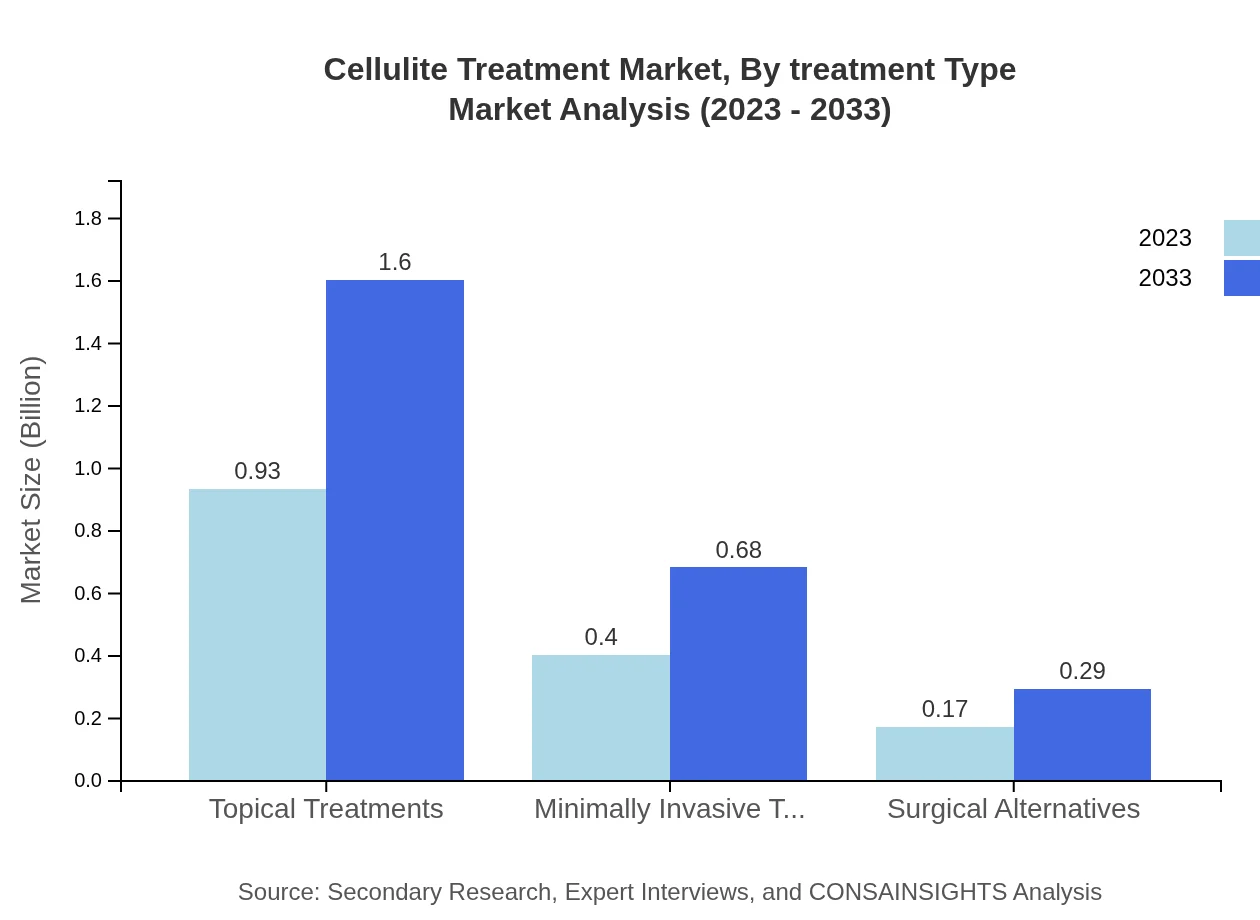
Topical treatments dominate the market, holding significant shares and increasing from USD 0.93 billion in 2023 to USD 1.60 billion by 2033. Minimally invasive treatments follow, with expected growth from USD 0.40 billion to USD 0.68 billion. Surgical alternatives, while smaller, show promising growth from USD 0.17 billion to USD 0.29 billion, as they cater to severe cases of cellulite.
Cellulite Treatment Market Analysis By Distribution Channel
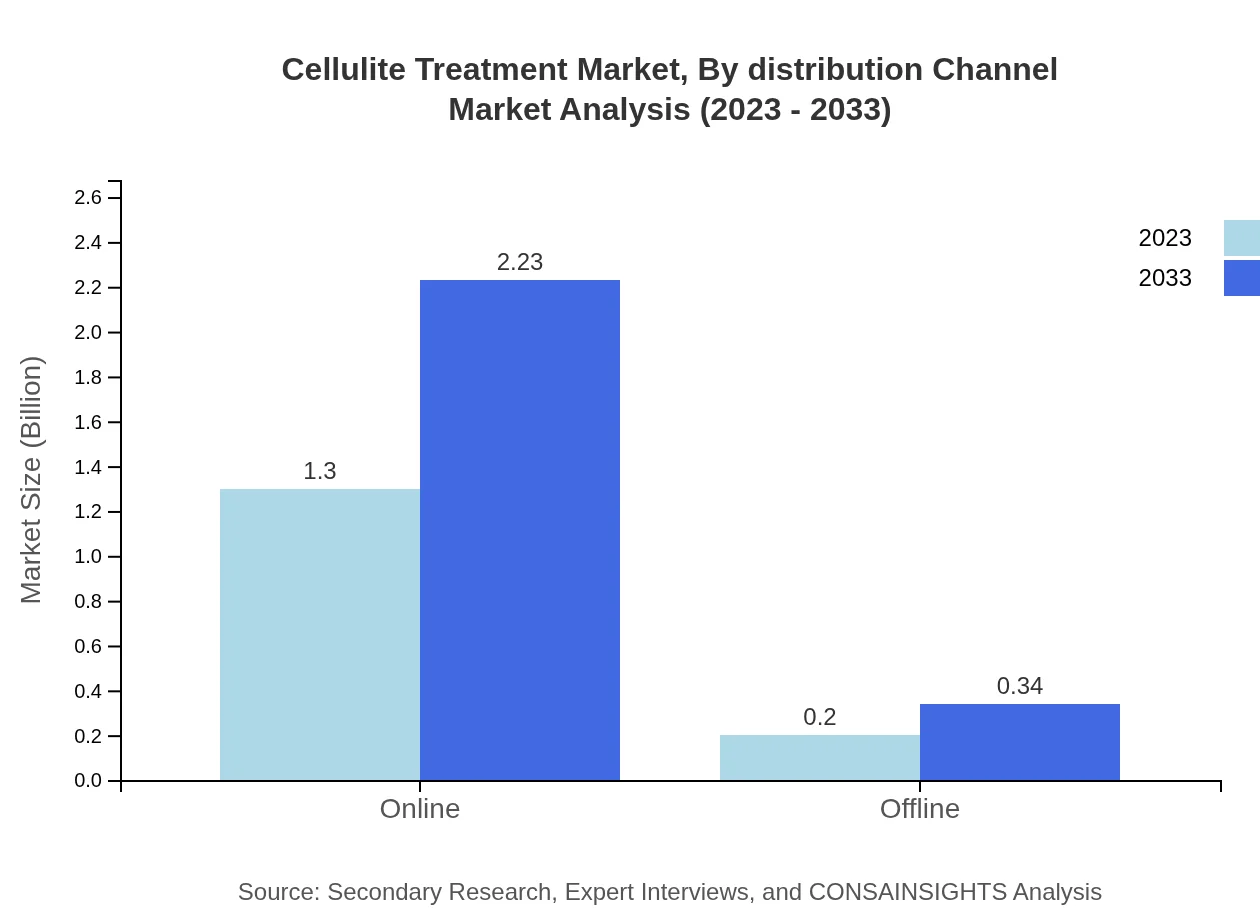
The market is primarily segmented into online and offline distribution channels. Online sales are projected to show significant growth due to the increasing trend of e-commerce, reaching USD 1.30 billion by 2033. Offline channels, although stable, are expected to grow more slowly from USD 0.20 billion to USD 0.34 billion.
Cellulite Treatment Market Analysis By End User
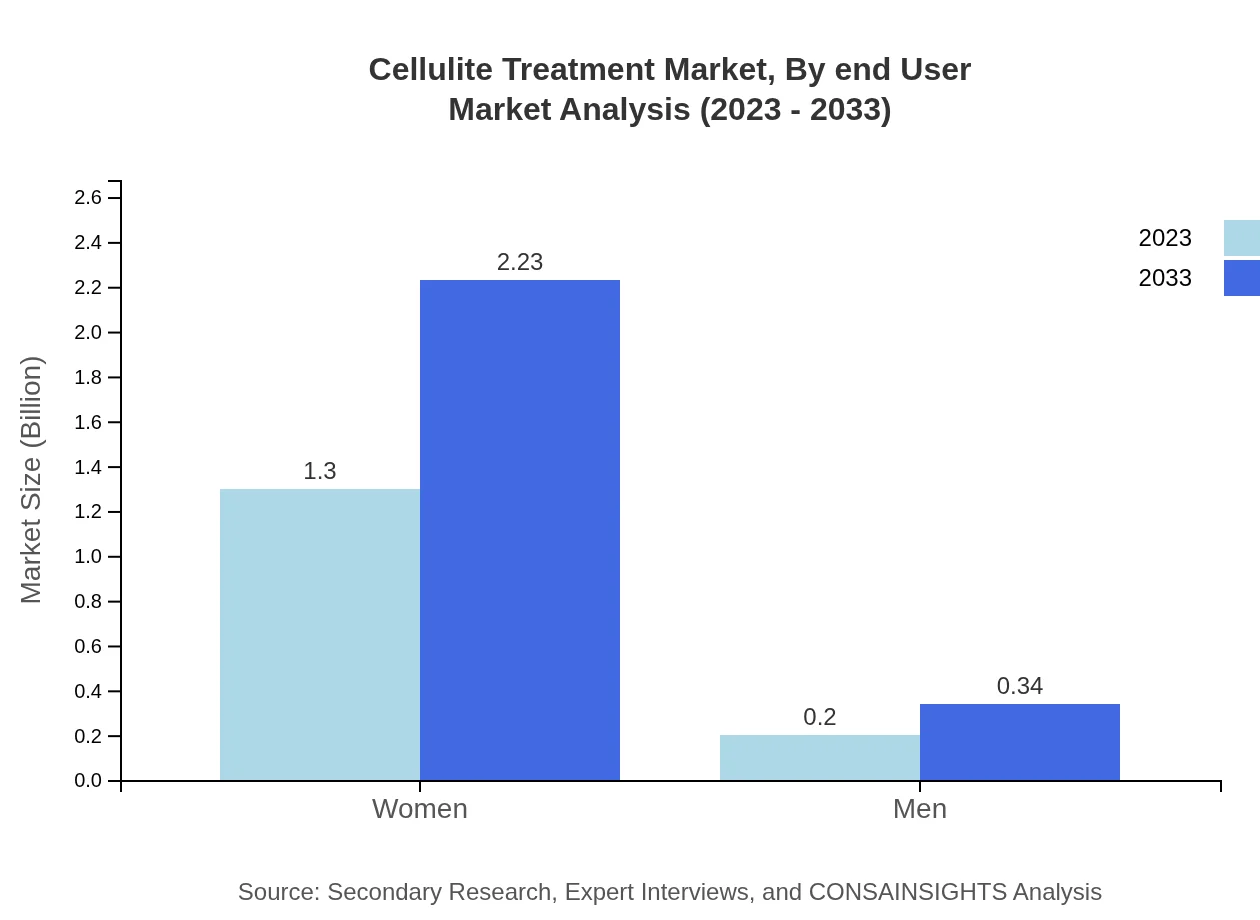
The end-user market is predominantly female, with women holding an 86.74% market share in 2023 and expected to maintain this through 2033, growing from USD 1.30 billion to USD 2.23 billion in market size. Men represent a smaller, yet increasing segment, expected to grow from USD 0.20 billion to USD 0.34 billion.
Cellulite Treatment Market Analysis By Ingredient
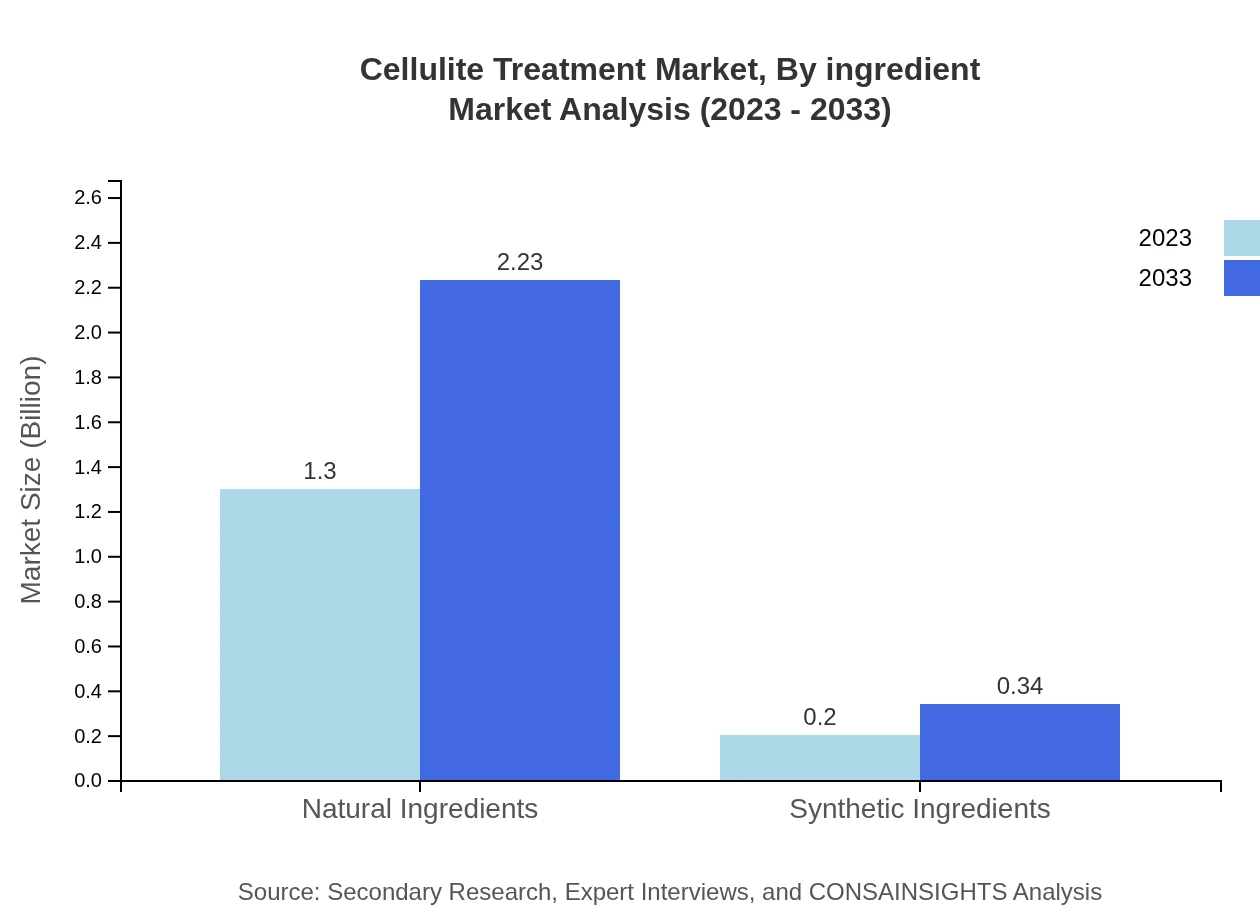
Natural ingredients continue to dominate the ingredient segment, comprising 86.74% of the market share. The size of this segment is projected to grow from USD 1.30 billion in 2023 to USD 2.23 billion by 2033. Synthetic ingredients hold a smaller share but are expanding, with growth from USD 0.20 billion to 0.34 billion.
Cellulite Treatment Market Analysis By Application Area
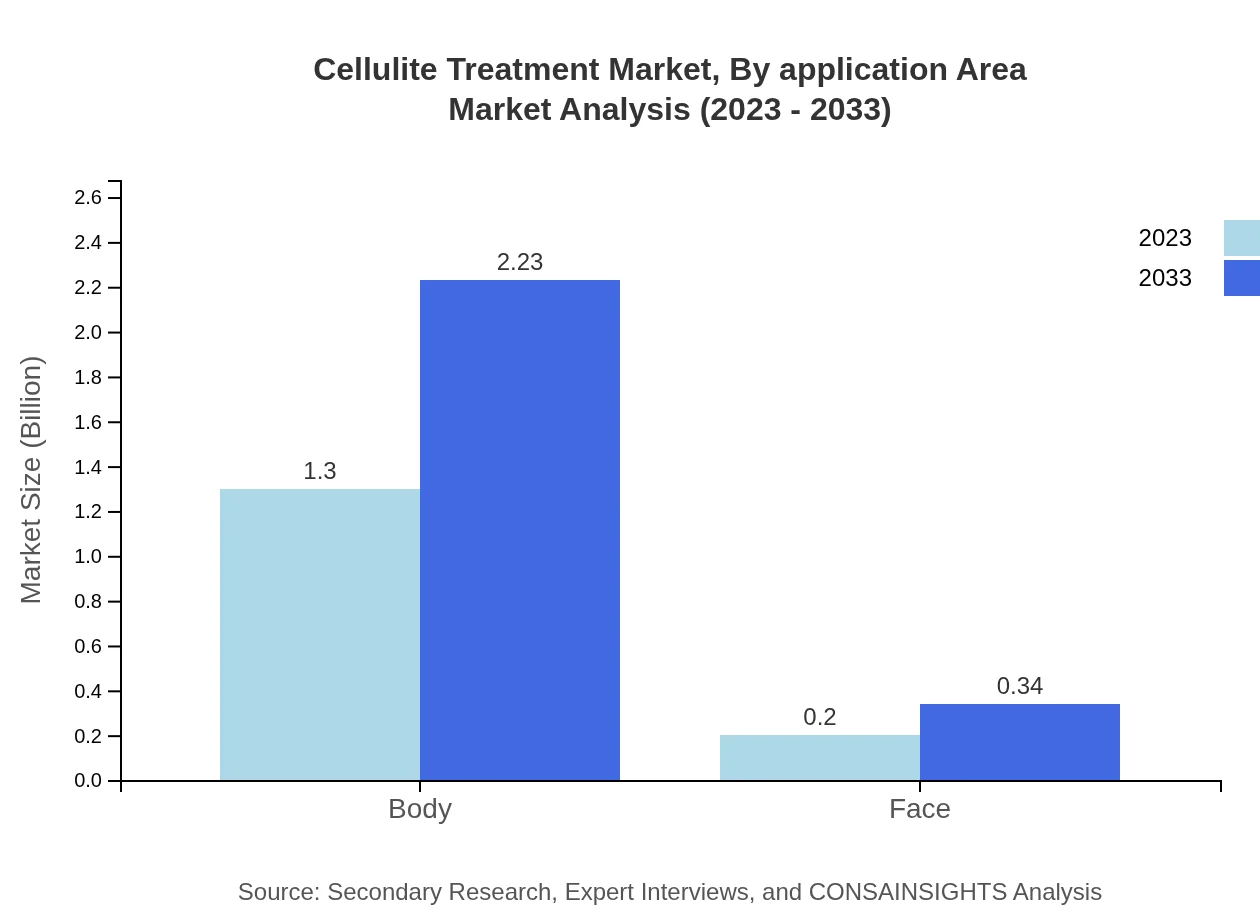
The market is split between body and facial treatments, with body treatments representing a significant share at 86.74% and expected to grow from USD 1.30 billion to USD 2.23 billion. Facial treatments, while smaller, are gradually gaining traction with growth from USD 0.20 billion to USD 0.34 billion.
Cellulite Treatment Market Trends and Future Forecast
Tell us your focus area and get a customized research report.
Global Market Leaders and Top Companies in Cellulite Treatment Industry
Allergan, Inc.:
Allergan is a global pharmaceutical company known for its innovation in medical aesthetics, particularly with its advanced cellulite treatment products. Its commitment to research and customer satisfaction has positioned it as a market leader.Revance Therapeutics, Inc.:
Revance specializes in innovative aesthetic and therapeutic offerings, including treatments for cellulite. The company's RHA collection of products showcases its dedication to providing effective and long-lasting results.Medytox, Inc.:
Medytox focuses on developing biological products and has excelled in creating effective cellulite treatments, contributing significantly to the market through technological advancements and product efficacy.Cynosure, Inc.:
Cynosure is well-known for its pioneering laser and light-based aesthetic solutions. Their broad portfolio includes several options for cellulite treatments, catering to a diverse customer base.Sientra, Inc.:
Sientra is famous for its focus on women's aesthetic health, providing innovative and safe solutions for cellulite and body contouring, contributing to the growing market segment.We're grateful to work with incredible clients.









FAQs
What is the market size of the cellulite treatment market in 2023?
The cellulite treatment market size in 2023 is $1.50 Billion, as specified in the report data.
How big will the market be in 2033?
By 2033 the market is reported to reach $2.57 Billion according to the provided forecast figures.
What is CAGR for the forecast period?
The compound annual growth rate (CAGR) for 2023 to 2033 is 5.4% as stated in the input data.
Which region is the fastest Growing in the Cellulite Treatment Market Report market?
Latin America is the fastest-growing region, projected to expand from $0.05 Billion in 2023 to $0.09 Billion in 2033, reflecting an implied 6.05% CAGR over the forecast period.
Which region is the fastest Growing?
Latin America is noted as the regional market region with an implied 6.05% CAGR, increasing from $0.05 Billion in 2023 to $0.09 Billion in 2033.
Who are some top companies mentioned?
Top firms listed include Allergan, Inc., Revance Therapeutics, Inc., Medytox, Inc., Cynosure, Inc., and Sientra, Inc.
What treatment types are covered in the segmentation?
Treatment types include topical treatments, minimally invasive treatments, and surgical alternatives as specified in the segment facts.
How are distribution channels categorized?
Distribution channels are divided into online and offline categories per the provided segmentation facts.
What ingredient categories are included?
Ingredient segments specified are natural ingredients and synthetic ingredients in the input data.
Which end User groups are identified?
The report lists women and men as the end-user subsegments in the supplied segment information.