

Cellulose Ether Derivatives Market Report
First published: 10 October 2024 | Last updated: 25 May 2026 | Report Code: cellulose-ether-derivatives
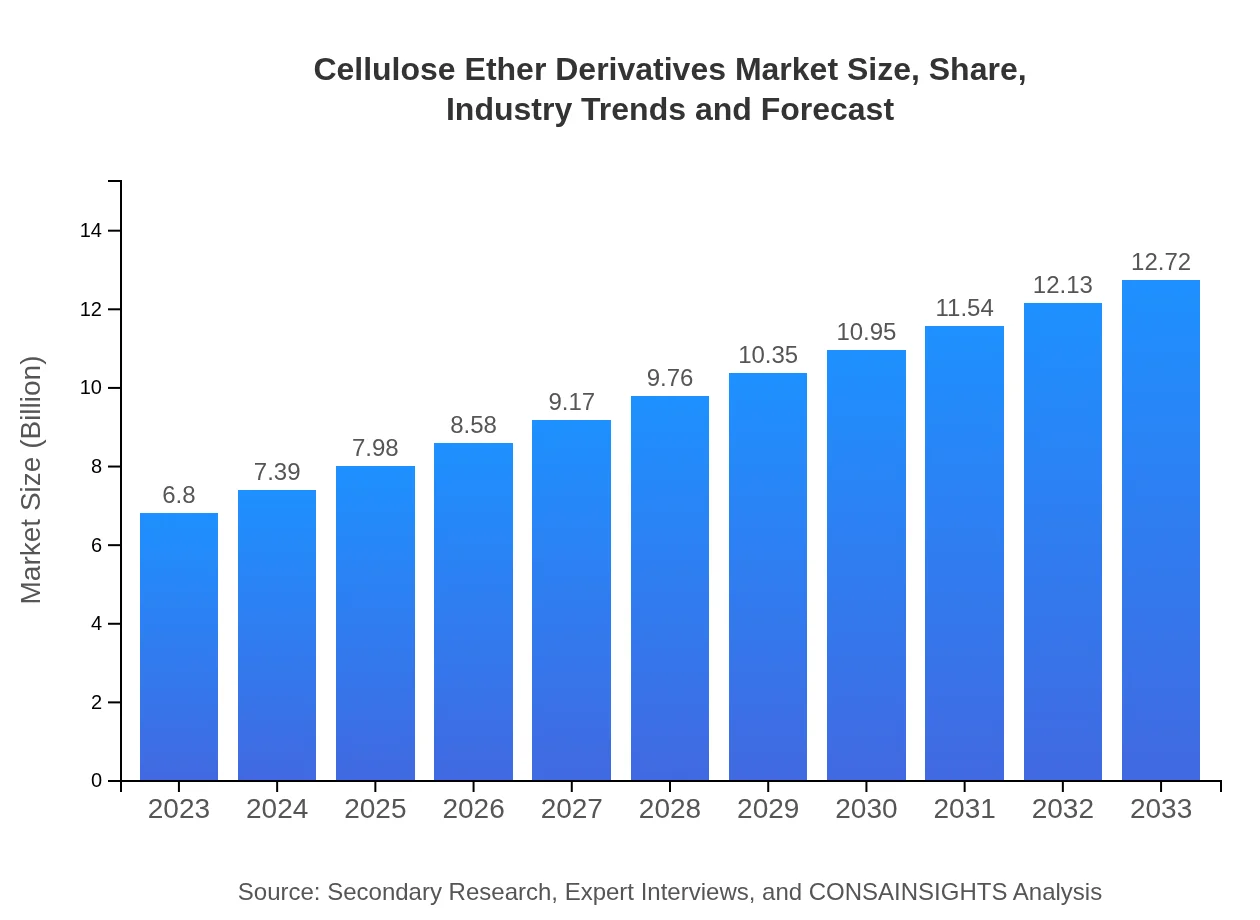
Cellulose Ether Derivatives Market — USD $6.8 Billion in 2023, Growing to USD 12.72B by 2033 at 6.3% CAGR
This report on Cellulose Ether Derivatives analyzes market trends, size, and growth forecasts from 2023 to 2033. The insights provided cover industry dynamics, segment analysis, regional performance, and competitive landscape to guide stakeholders in informed decision-making.
Key Takeaways
- Global market expands from $6.80 Billion in 2023 to $12.72 Billion in 2033 at a 6.3% CAGR.
- North America is largest regional market, while no single fastest-growing region is stated because regional CAGR differences remain within 0.15 percentage points.
- Europe, Asia Pacific, Latin America, and Middle East & Africa all register substantive gains by 2033.
- Primary functionalities include thickening, binding, and film-forming across multiple end-use industries.
- Major participants listed include Ashland, Dow Chemical Company, Shin-Etsu Chemical Co., and Merck KGaA.
Cellulose Ether Derivatives Market Report — Executive Summary
North America remains largest market by forecast-period value, while no single fastest-growing region is stated because top regional growth rates are separated by less than 0.15 percentage points. Demand for cellulose ether derivatives is driven by multifunctional performance in pharmaceuticals, food, construction, and personal-care formulations. The market size rises from $6.80 Billion in 2023 to $12.72 Billion in 2033 at a 6.3% CAGR for the forecast period 2023 to 2033. Sustainability preferences, regulatory focus on safe ingredients, and ongoing product development are motivating manufacturers to invest in R&D and broaden formulation uses. Key product families include Hydroxypropyl Methylcellulose (HPMC), Carboxymethylcellulose (CMC), and Methylcellulose, which serve as thickening, binding, and film-forming agents. Regional performance varies: North America is the largest market by 2033. Market participants such as Ashland, Dow Chemical Company, Shin-Etsu Chemical Co., and Merck KGaA are active in product innovation and commercial supply chains. Competitive dynamics emphasize formulation improvements, compliance with food and pharmaceutical regulations, and sustainability-driven product positioning.
Key Growth Drivers
- Rising demand for multifunctional additives in pharmaceuticals and personal care that require thickening, binding, and film formation.
- Shifts toward biodegradable and sustainable ingredients, prompting reformulation away from less eco-friendly alternatives.
- Increased R&D investments by manufacturers to enhance product performance and broaden application scopes.
- Regulatory emphasis on ingredient safety in food and pharmaceutical sectors encouraging adoption of validated cellulose derivatives.
- Growth in end-user industries such as construction and processed foods that use cellulose ethers for functional properties.
| Metric | Value |
|---|---|
| Study Period | 2023 - 2033 |
| 2023 Market Size | $6.80 Billion |
| CAGR (2023-2033) | 6.3% |
| 2033 Market Size | $12.72 Billion |
| Top Companies | Ashland, Dow Chemical Company, Shin-Etsu Chemical Co., Merck KGaA |
| Published Date | 10 October 2024 |
| Last Modified Date | 25 May 2026 |
Cellulose Ether Derivatives Market Overview
Customize Cellulose Ether Derivatives Market Report market research report
- ✔ Get in-depth analysis of Cellulose Ether Derivatives market size, growth, and forecasts.
- ✔ Understand Cellulose Ether Derivatives's regional dynamics and industry-specific trends.
- ✔ Identify potential applications, end-user demand, and growth segments in Cellulose Ether Derivatives
What is the Market Size & CAGR of Cellulose Ether Derivatives Market Report market in 2023?
Cellulose Ether Derivatives Industry Analysis
Cellulose Ether Derivatives Market Segmentation and Scope
Tell us your focus area and get a customized research report.
Cellulose Ether Derivatives Market Report Market Analysis Report by Region
Europe Cellulose Ether Derivatives Market Report:
Europe grows from $1.78 Billion in 2023 to $3.33 Billion in 2033. Market uptake is supported by regulatory attention to ingredient safety, reformulation for cleaner labels, and manufacturers focusing on biodegradable cellulose ether offerings.Asia Pacific Cellulose Ether Derivatives Market Report:
Asia Pacific grows from $1.29 Billion in 2023 to $2.42 Billion in 2033. Growth drivers include expanding pharmaceuticals and processed-food industries, rising formulation needs, and increasing industrial adoption of multifunctional cellulose derivatives.North America Cellulose Ether Derivatives Market Report:
North America is largest regional market, rising from $2.29 Billion in 2023 to $4.28 Billion in 2033. Regional demand is fueled by strong pharmaceutical and construction sectors, active R&D programs, and formulated product adoption across personal care and food segments.South America Cellulose Ether Derivatives Market Report:
Latin America grows from $0.65 Billion in 2023 to $1.22 Billion in 2033. Regional gains are driven by development in construction and food processing, as well as growing interest in sustainable ingredient solutions for local manufacturers.Middle East & Africa Cellulose Ether Derivatives Market Report:
Middle East and Africa grows from $0.79 Billion in 2023 to $1.48 Billion in 2033. Demand stems from expanding infrastructure projects, increased processed-food production, and interest in adaptable cellulose-based additives for diverse applications.Tell us your focus area and get a customized research report.
Research Methodology
Cellulose Ether Derivatives Market Analysis By Type
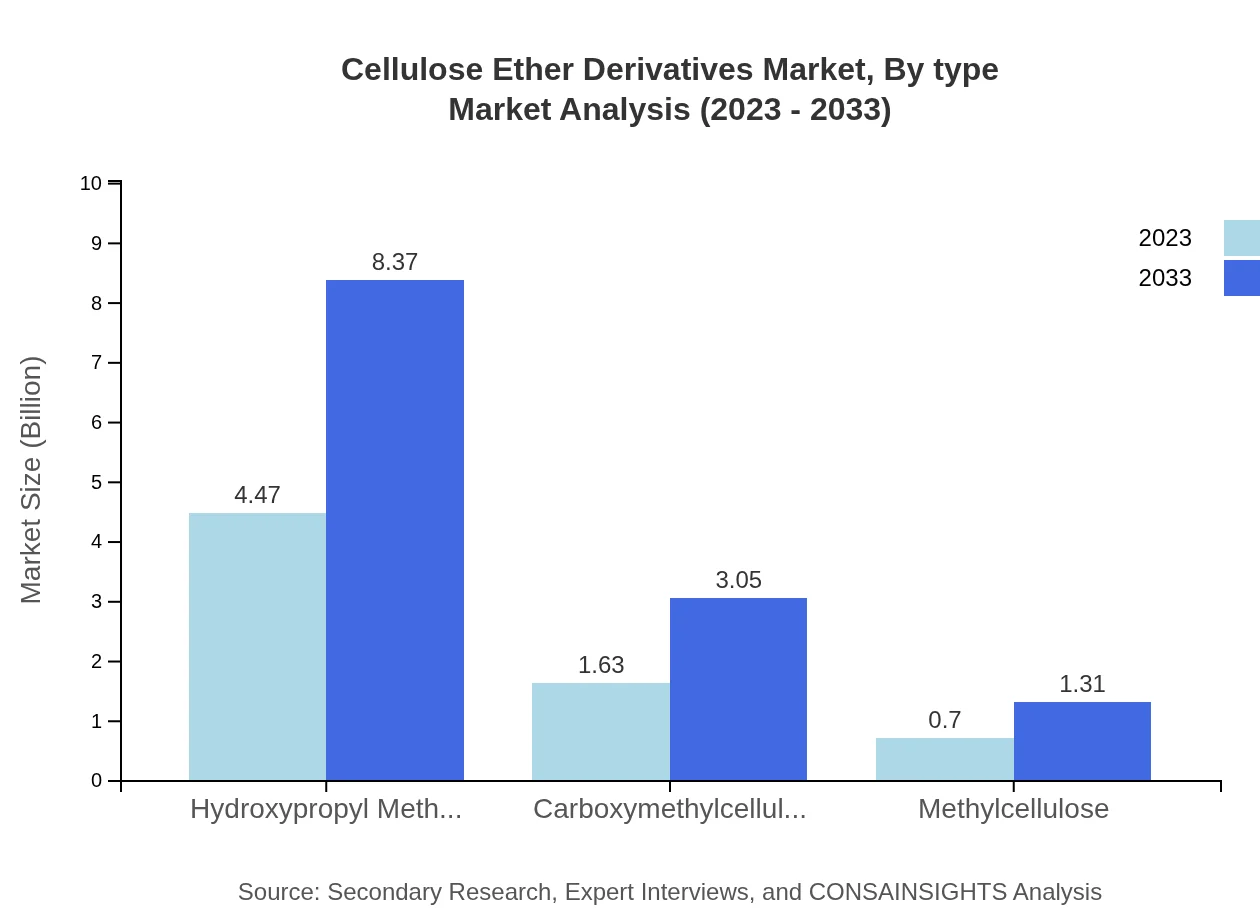
Hydroxypropyl Methylcellulose (HPMC) is projected to expand from $4.47 billion in 2023 to $8.37 billion by 2033, capturing a dominant 65.75% market share. Carboxymethylcellulose (CMC) follows with a projected size increase from $1.63 billion to $3.05 billion, holding 23.98% of the market share. Methylcellulose, despite capturing a smaller share of 10.27%, is expected to grow from $0.70 billion to $1.31 billion over the same period.
Cellulose Ether Derivatives Market Analysis By Application
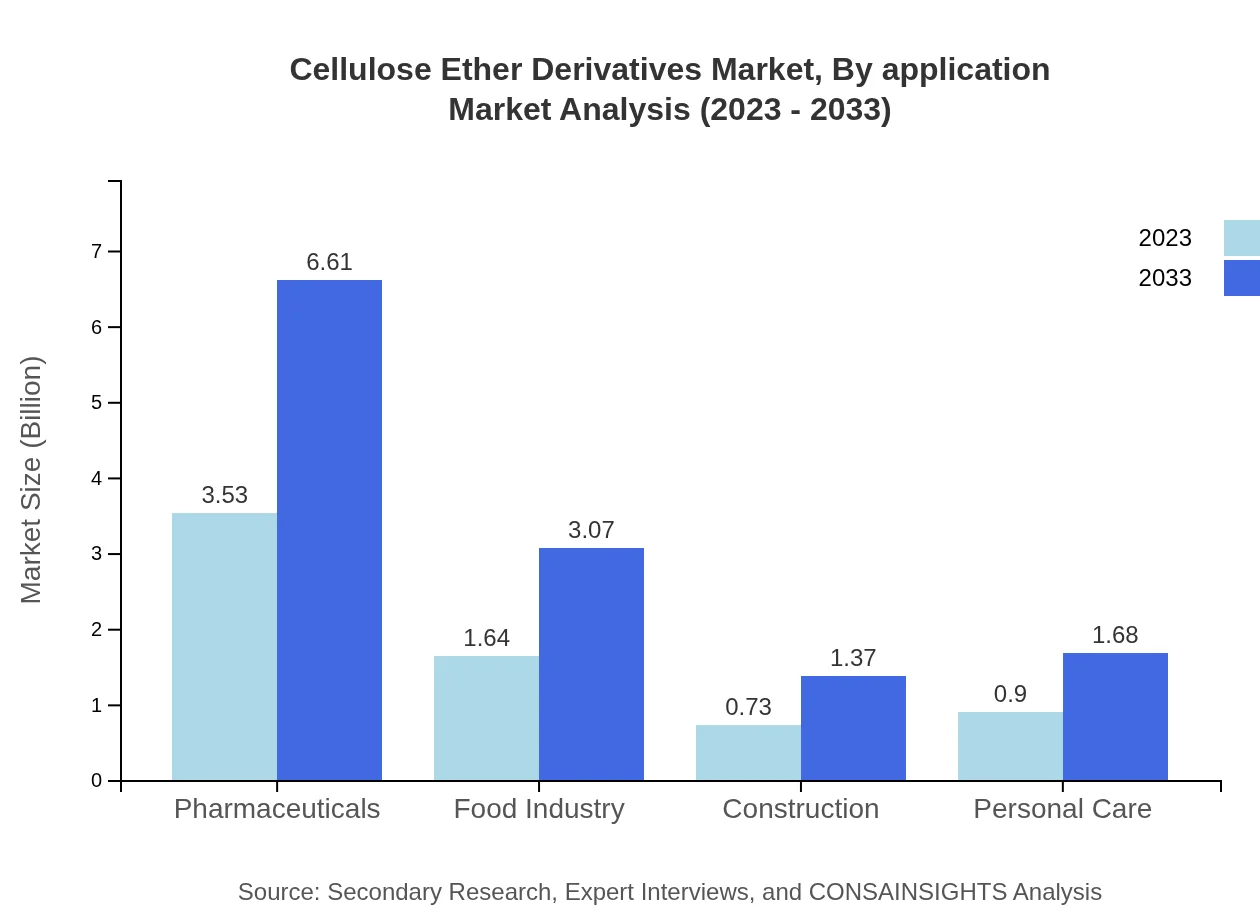
Applications in pharmaceuticals account for a leading share, increasing from $3.53 billion in 2023 to $6.61 billion by 2033, representing 51.93% of the market. The food industry is also significant, expanding from $1.64 billion to $3.07 billion, capturing 24.1% of the market. Construction and personal care sectors show steady growth as well, with shares of 10.78% and 13.19% respectively.
Cellulose Ether Derivatives Market Analysis By Functionality
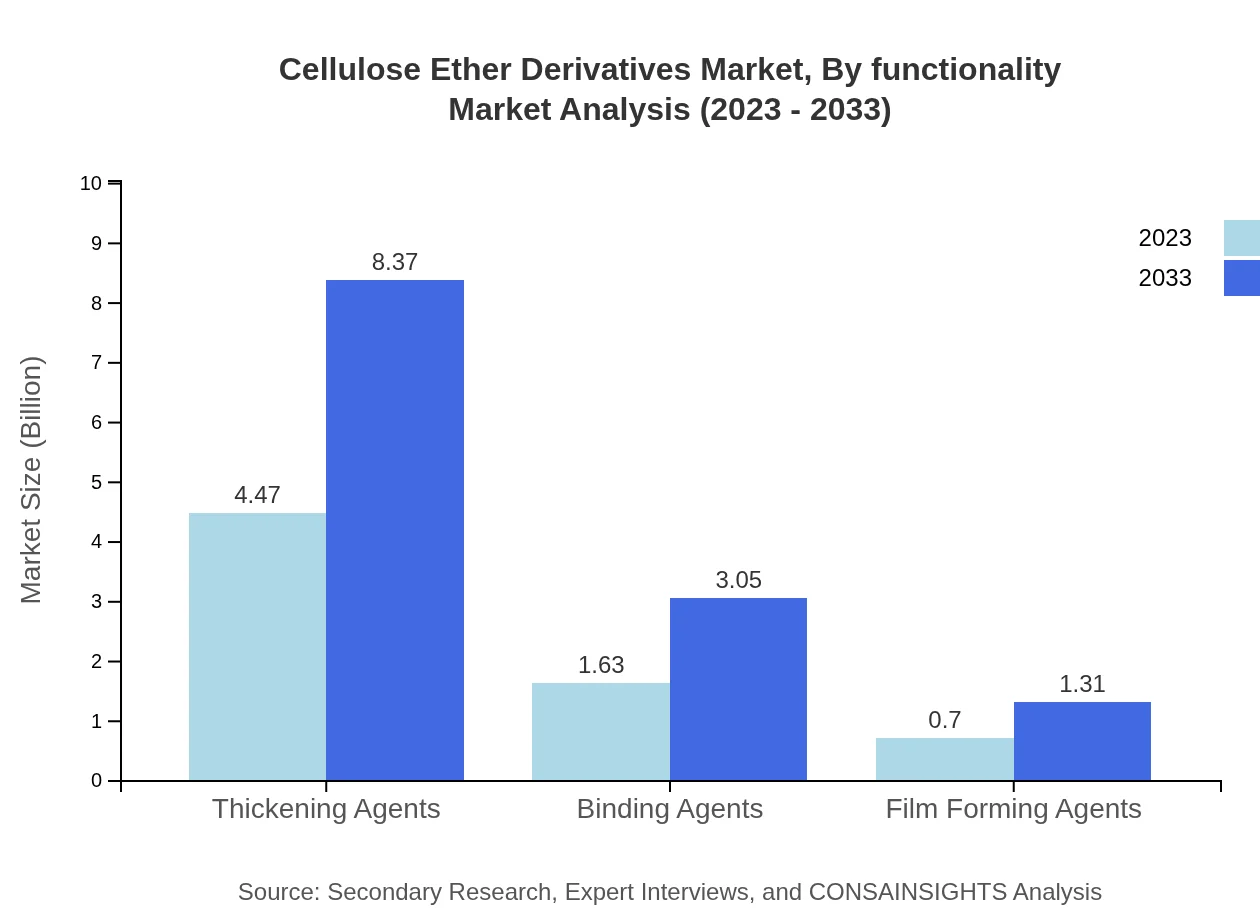
The thickening agents segment is the largest, growing from $4.47 billion to $8.37 billion by 2033, accounting for 65.75% of the market. Following this, binding agents expand from $1.63 billion to $3.05 billion, while film-forming agents see growth from $0.70 billion to $1.31 billion. These functionalities are essential across multiple applications, driving the demand for cellulose ether derivatives.
Cellulose Ether Derivatives Market Analysis By End User
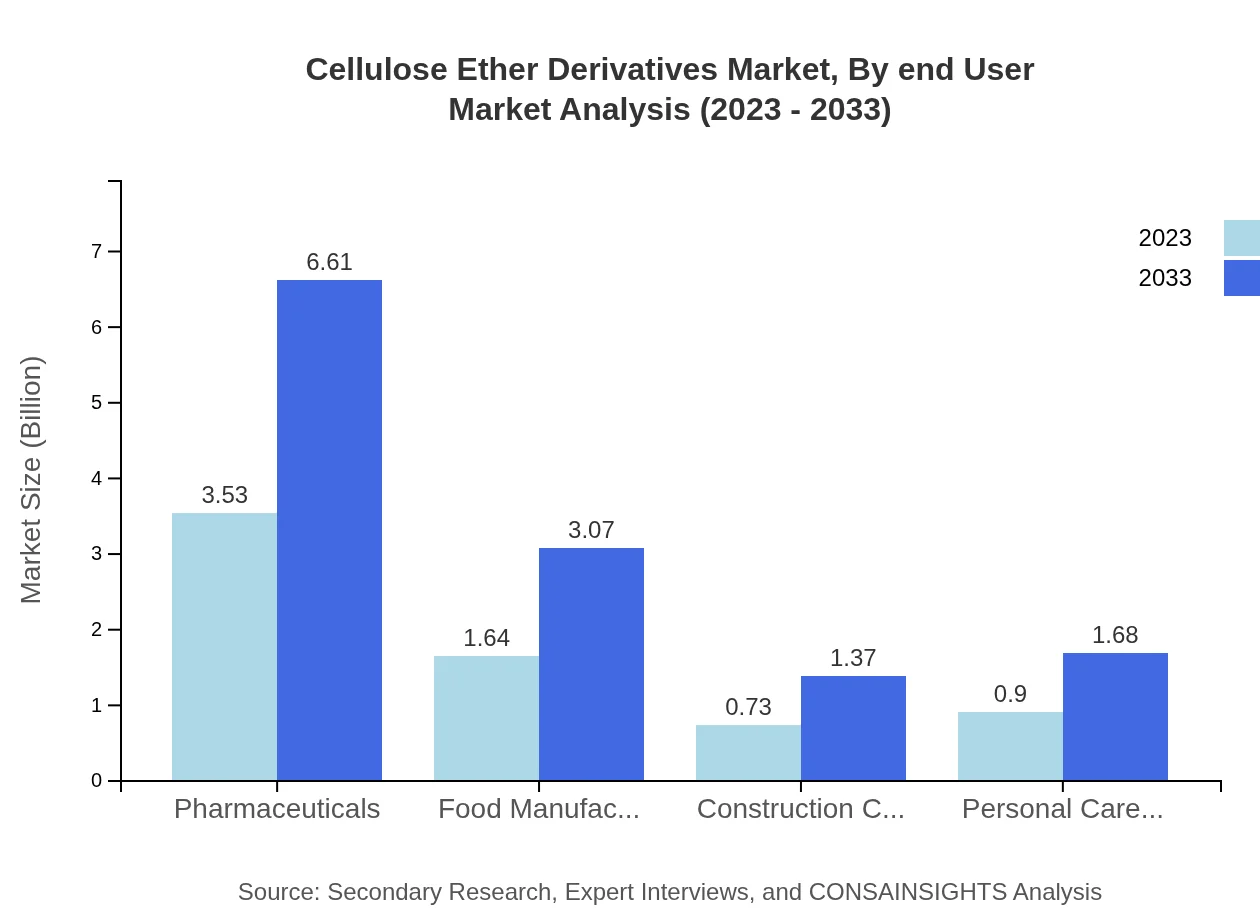
Pharmaceuticals lead the end-user industries, witnessing growth from $3.53 billion to $6.61 billion by 2033, maintaining a 51.93% market share. The food industry and construction sectors follow, with the food sector growing from $1.64 billion to $3.07 billion and construction expanding from $0.73 billion to $1.37 billion, holding shares of 24.1% and 10.78% respectively.
Cellulose Ether Derivatives Market Trends and Future Forecast
Tell us your focus area and get a customized research report.
Global Market Leaders and Top Companies in Cellulose Ether Derivatives Industry
Ashland:
A leading specialty chemical company providing a wide range of cellulose ethers used in various applications including pharmaceuticals and food products.Dow Chemical Company:
A global leader in material science and a key producer of cellulose ether derivatives, known for their innovations and quality control in product manufacturing.Shin-Etsu Chemical Co.:
A prominent manufacturer of silicone and cellulose derivatives that supports various applications, particularly in personal care and construction.Merck KGaA:
A major player in the pharmaceutical and chemicals sector, Merck KGaA provides cellulose derivatives extensively used for formulatory purposes in drug manufacturing.We're grateful to work with incredible clients.






FAQs
What is the market size of the cellulose ether derivatives market in 2023?
The market size in 2023 is $6.80 Billion, based on reported figures for the global cellulose ether derivatives industry.
How big will the market be in 2033?
The market is projected to reach $12.72 Billion by 2033 according to the provided forecast data.
What is CAGR of the market for 2023 to 2033?
The reported compound annual growth rate for the 2023 to 2033 period is 6.3%.
Is there a single fastest Growing region in the Cellulose Ether Derivatives Market Report market?
No single fastest-growing region is stated for the Cellulose Ether Derivatives Market Report market because the top regional implied CAGR values are within 0.15 percentage points of each other, making the ranking too close to call reliably.
Why are cellulose ether derivatives in demand?
Demand is linked to their roles as thickening, binding, and film-forming agents across pharmaceuticals, food, construction, and personal care applications.
Who are key companies in the market?
Top companies cited include Ashland, Dow Chemical Company, Shin-Etsu Chemical Co., and Merck KGaA.
What end Use industries drive consumption?
Major end users include pharmaceuticals, food manufacturers, construction companies, and personal care product companies.
How is regulation influencing the market?
Regulatory focus on ingredient safety in food and pharmaceuticals is encouraging manufacturers to adopt validated, compliant cellulose ether solutions.
What product types are commonly offered?
Common product types include Hydroxypropyl Methylcellulose (HPMC), Carboxymethylcellulose (CMC), and Methylcellulose, serving varied formulation needs.
Which functionalities do these derivatives provide?
They function primarily as thickening agents, binding agents, and film-forming agents across multiple applications.