

Clinical Chemistry Analyzers Market Report
First published: 21 October 2024 | Last updated: 28 May 2026 | Report Code: clinical-chemistry-analyzers
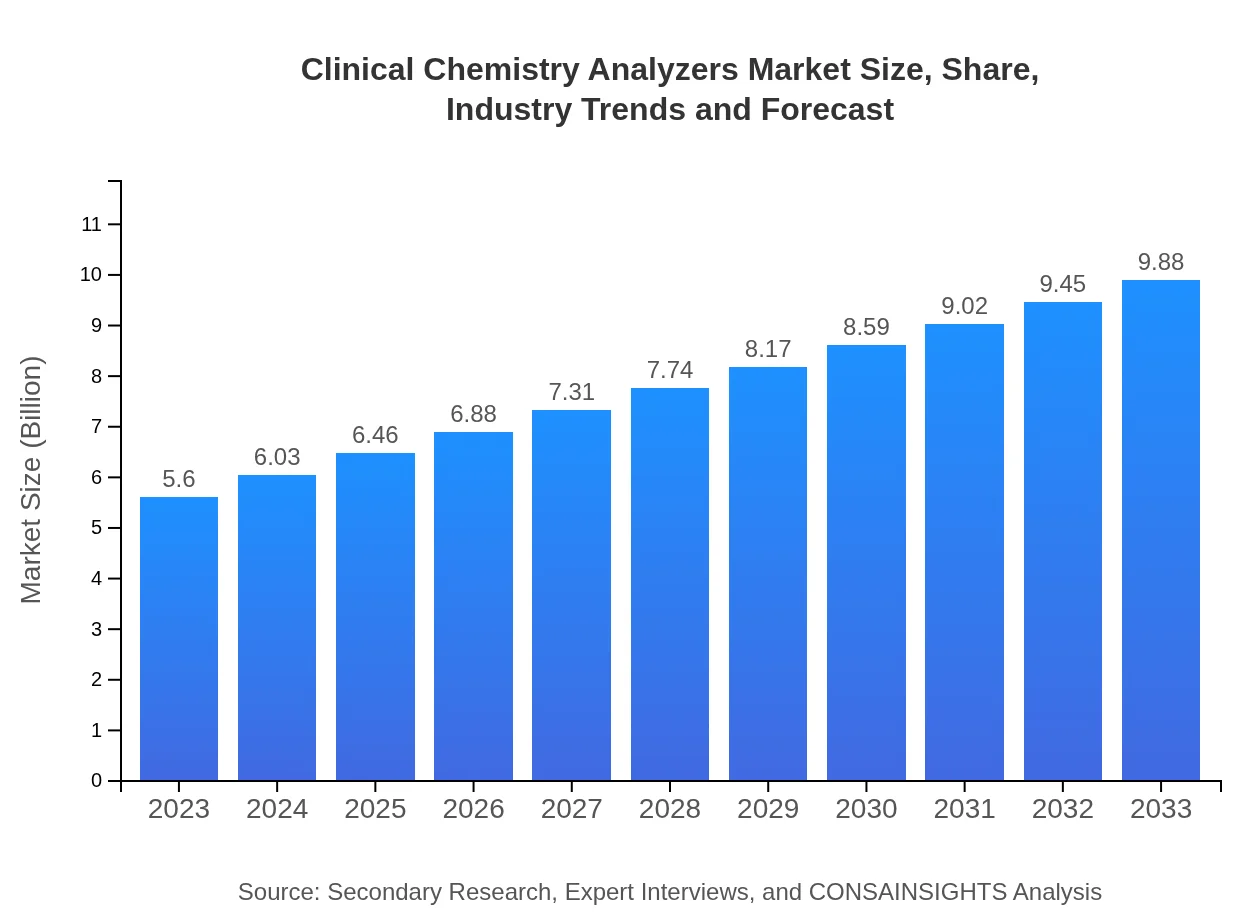
Clinical Chemistry Analyzers Market — USD 5.6 billion in 2023, Growing to USD 9.88B by 2033 at 5.7% CAGR
This report provides a comprehensive analysis of the Clinical Chemistry Analyzers market, exploring its size, growth trends, segmentation, and regional dynamics, along with insights into leading companies and future market forecasts from 2023 to 2033.
Key Takeaways
- Market value rises from $5.60 Billion in 2023 to $9.88 Billion by 2033, with a 5.7% CAGR for 2023 to 2033.
- North America is the largest region, increasing from $2.06 Billion in 2023 to $3.63 Billion in 2033.
- North America is largest regional market; Middle East and Africa is regional market region based on implied CAGR across 2023 to 2033.
- Europe expands from $1.85 Billion in 2023 to $3.27 Billion in 2033, reflecting steady investment in diagnostics.
- Key vendors include Roche Diagnostics, Abbott Laboratories, Siemens Healthineers, and Thermo Fisher Scientific.
Clinical Chemistry Analyzers Market Report — Executive Summary
Regional analysis shows North America as largest market and Middle East and Africa as fastest-growing region by implied CAGR. The Clinical Chemistry Analyzers market is projected to grow from $5.60 Billion in 2023 to $9.88 Billion by 2033 at a 5.7% CAGR for 2023 to 2033. Growth is propelled by rising chronic disease prevalence, increased laboratory automation, and demand for faster, more accurate diagnostics. Vendors prioritize enhancements to analyzer throughput, reagent portfolios, and integration with laboratory information systems. Regional dynamics vary: North America remains the largest market while Middle East and Africa shows the highest implied growth rate. Market segmentation covers product types such as analyzers and reagents, deployment across hospitals and laboratories, and technologies including spectroscopy and immunoassays. Competitive activity centers on product innovation, strategic partnerships, and expanded service offerings by major players such as Roche Diagnostics, Abbott Laboratories, Siemens Healthineers, and Thermo Fisher Scientific. This report structure includes market sizing, regional breakdowns, segment analysis, and vendor profiles to support stakeholder decision-making.
Key Growth Drivers
- Rising prevalence of chronic conditions increases demand for routine biochemical testing and monitoring.
- Adoption of laboratory automation and workflow integration improves throughput in hospitals and diagnostic centers.
- Technological advances in spectroscopy and immunoassays enhance accuracy and reduce turnaround time for results.
- Expanded reagent and consumable offerings support recurring revenue streams and long-term equipment utilization.
- Investment by major suppliers to broaden product portfolios and provide integrated diagnostic solutions.
| Metric | Value |
|---|---|
| Study Period | 2023 - 2033 |
| 2023 Market Size | $5.60 Billion |
| CAGR (2023-2033) | 5.7% |
| 2033 Market Size | $9.88 Billion |
| Top Companies | Roche Diagnostics, Abbott Laboratories, Siemens Healthineers, Thermo Fisher Scientific |
| Published Date | 21 October 2024 |
| Last Modified Date | 28 May 2026 |
Clinical Chemistry Analyzers Market Overview
Customize Clinical Chemistry Analyzers Market Report market research report
- ✔ Get in-depth analysis of Clinical Chemistry Analyzers market size, growth, and forecasts.
- ✔ Understand Clinical Chemistry Analyzers's regional dynamics and industry-specific trends.
- ✔ Identify potential applications, end-user demand, and growth segments in Clinical Chemistry Analyzers
What is the Market Size & CAGR of Clinical Chemistry Analyzers Market Report market in 2023?
Clinical Chemistry Analyzers Industry Analysis
Clinical Chemistry Analyzers Market Segmentation and Scope
Tell us your focus area and get a customized research report.
Clinical Chemistry Analyzers Market Report Market Analysis Report by Region
Europe Clinical Chemistry Analyzers Market Report:
Europe grows from $1.85 Billion in 2023 to $3.27 Billion in 2033. Ongoing modernization of clinical laboratories, regulatory emphasis on quality diagnostics, and demand for improved test throughput contribute to market expansion across European healthcare systems.Asia Pacific Clinical Chemistry Analyzers Market Report:
Asia Pacific grows from $0.98 Billion in 2023 to $1.73 Billion in 2033. Rising healthcare investments, expanding diagnostic laboratory capacity, and growing prevalence of chronic diseases support adoption of clinical chemistry systems and related consumables.North America Clinical Chemistry Analyzers Market Report:
North America is largest regional market, rising from $2.06 Billion in 2023 to $3.63 Billion in 2033. Strong hospital networks, investment in laboratory automation, and high per-capita diagnostic spending support equipment and reagent uptake in this region.South America Clinical Chemistry Analyzers Market Report:
Latin America grows from $0.44 Billion in 2023 to $0.78 Billion in 2033. Improvements in laboratory infrastructure, broader access to diagnostic services, and procurement of analyzers and reagents are key regional drivers.Middle East & Africa Clinical Chemistry Analyzers Market Report:
Middle East and Africa is fastest-growing region by implied CAGR, increasing from $0.26 Billion in 2023 to $0.47 Billion in 2033. Targeted investments in clinical diagnostics, expanding hospital services, and increasing laboratory automation underpin this higher implied growth rate.Tell us your focus area and get a customized research report.
Research Methodology
Clinical Chemistry Analyzers Market Analysis By Product Type
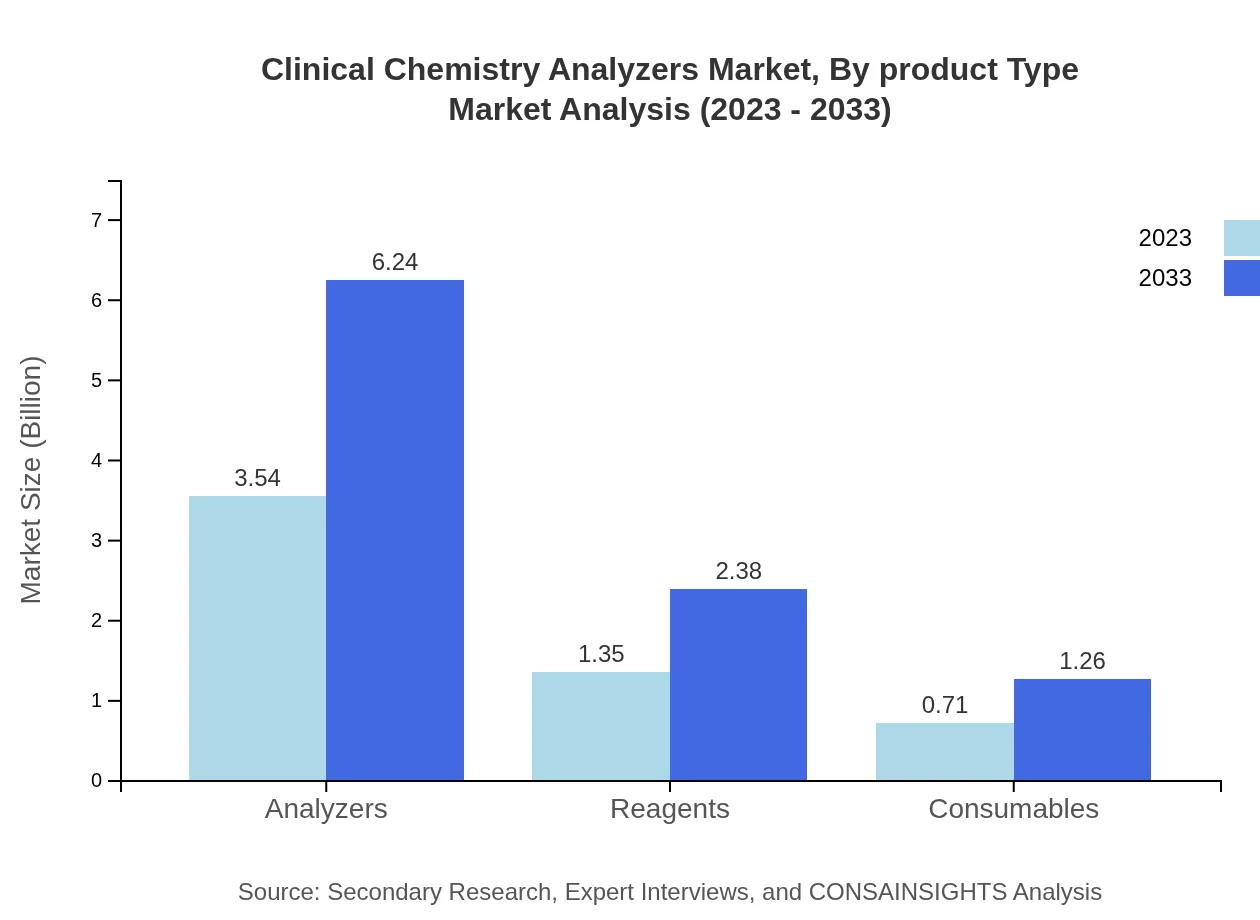
In terms of product type, the Clinical Chemistry Analyzers market showcases significant growth in the Nephrology segment, valued at 3.17 billion USD in 2023 and predicted to reach 5.59 billion USD by 2033, holding a consistent market share of 56.62%. The Cardiology segment, worth 1.36 billion USD in 2023, is projected to grow to 2.40 billion USD by 2033, capturing 24.33% market share. The Oncology segment, valued at 0.51 billion USD in 2023, will expand to 0.90 billion USD by 2033, representing 9.07% of the market. Moreover, the Diabetes segment is estimated to range from 0.56 billion USD (2023) to 0.99 billion USD (2033), reflecting 9.98% of the market share.
Clinical Chemistry Analyzers Market Analysis By Technology
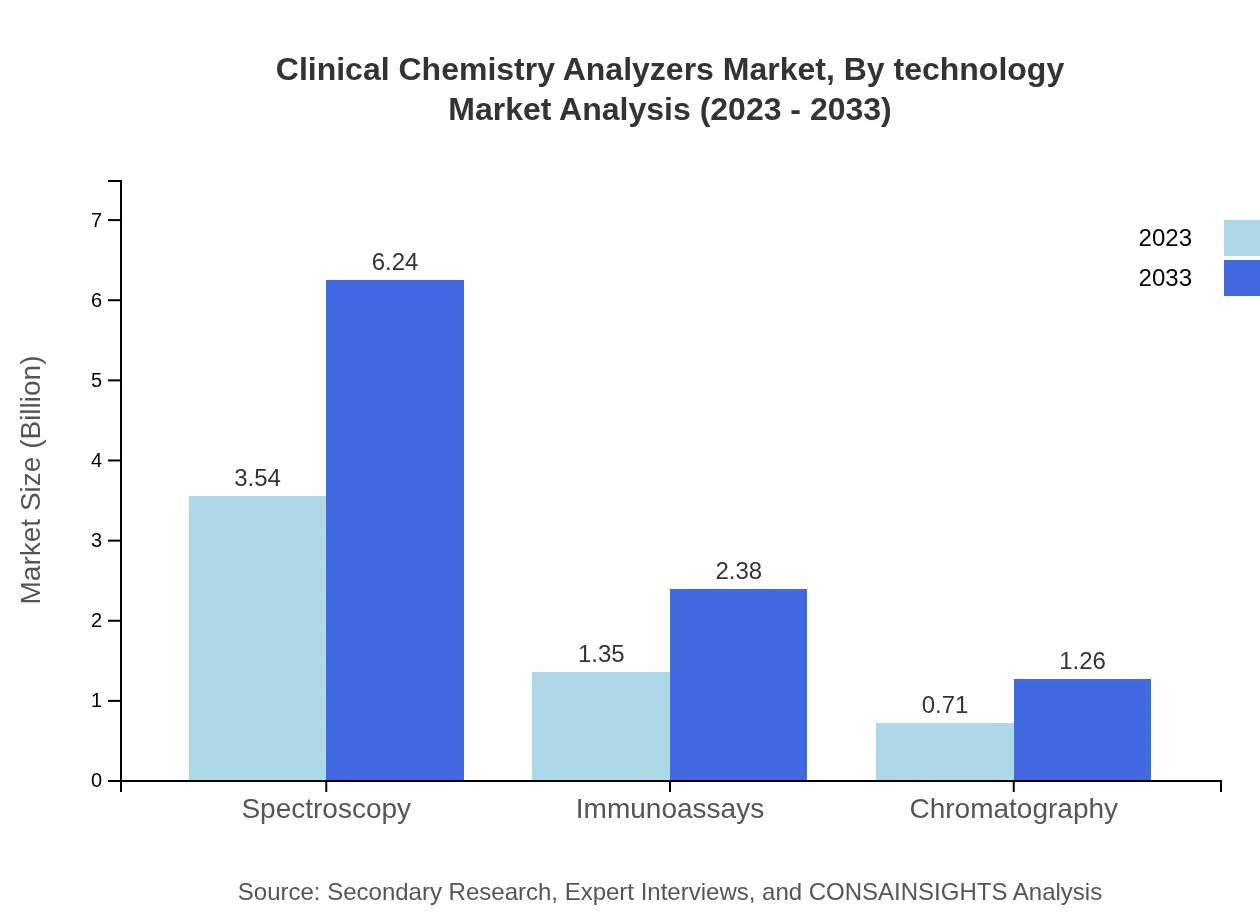
Analyzers using spectroscopy technology dominate the market, with a share of 63.21%, growing from 3.54 billion USD in 2023 to 6.24 billion USD by 2033. The immunoassays segment follows, valued at 1.35 billion USD in 2023 and projected to shift to 2.38 billion USD by 2033 with a 24.05% market share. Chromatography, currently at 0.71 billion USD, anticipates reaching 1.26 billion USD by 2033, possessing a 12.74% share.
Clinical Chemistry Analyzers Market Analysis By End User
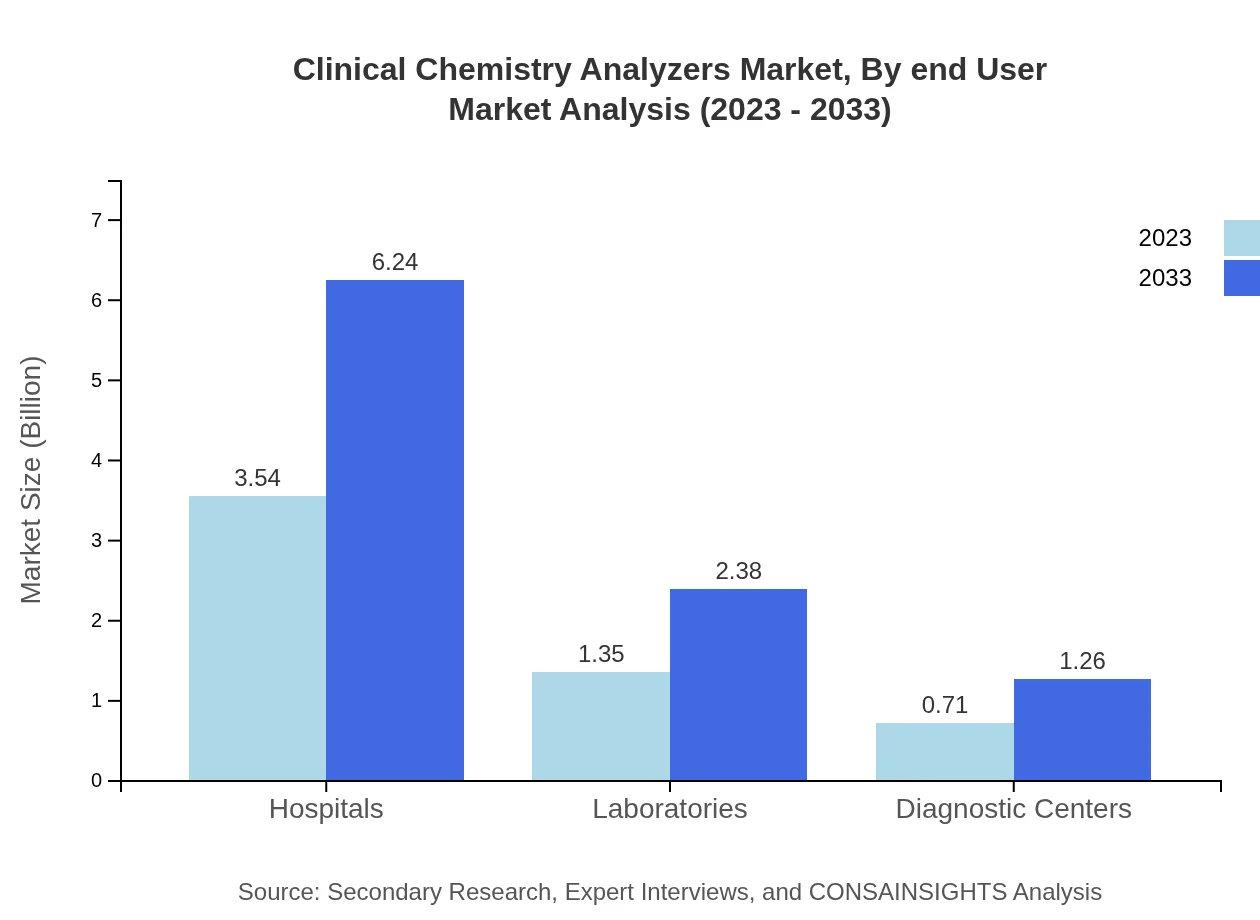
The clinical chemistry analyzers market by end-user shows hospitals leading with a share of 63.21%, growing from 3.54 billion USD in 2023 to 6.24 billion USD by 2033. Laboratories hold 24.05% of the market, starting at 1.35 billion USD in 2023 and climbing to 2.38 billion USD by 2033. Diagnostic centers are expanding from 0.71 billion USD (2023) to 1.26 billion USD (2033) with a 12.74% market share.
Clinical Chemistry Analyzers Market Analysis By Region
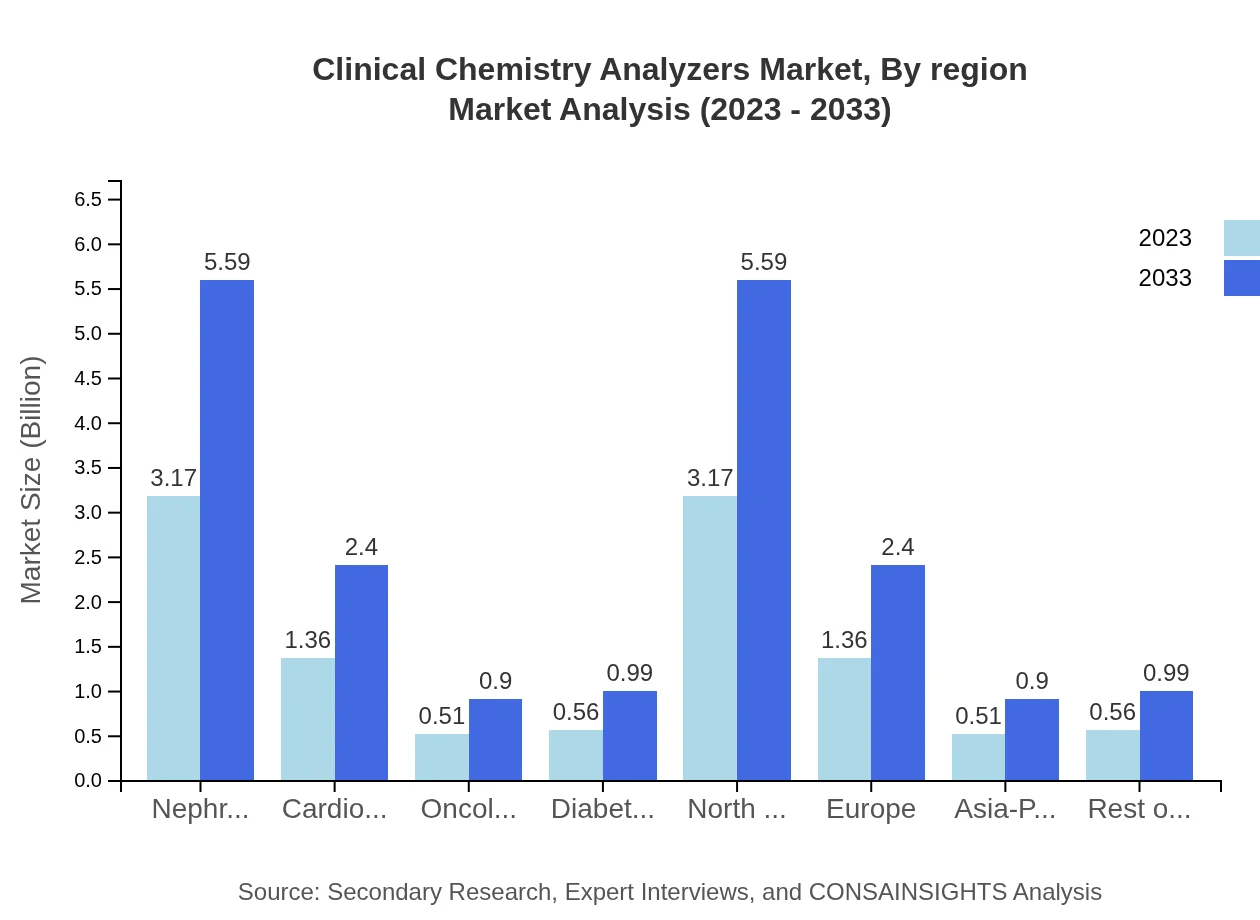
The Clinical Chemistry Analyzers market shows regional variations, with North America leading in size, followed by Europe. The Asia Pacific market is rapidly growing due to increased urbanization and healthcare investments. South America and Middle East/Africa are also expected to contribute with modest growth rates through improved healthcare access and technological integration in diagnostics.
Clinical Chemistry Analyzers Market Trends and Future Forecast
Tell us your focus area and get a customized research report.
Global Market Leaders and Top Companies in Clinical Chemistry Analyzers Industry
Roche Diagnostics:
A leading player in the diagnostics field, Roche offers an extensive range of clinical chemistry analyzers known for their innovative technology and efficiency in various laboratory settings.Abbott Laboratories:
Abbott is recognized for its pioneering work in medical diagnostics, providing advanced clinical chemistry analyzers that support healthcare professionals in delivering high-quality patient care.Siemens Healthineers:
With a strong focus on diagnostic imaging and laboratory diagnostics, Siemens provides wide-ranging clinical chemistry analyzers designed to meet the evolving needs of laboratories.Thermo Fisher Scientific:
A leading name in scientific equipment, Thermo Fisher offers a diverse portfolio of clinical chemistry analyzers, integrating cutting-edge technology to enhance diagnostic accuracy.We're grateful to work with incredible clients.









FAQs
What is the market size of the Clinical Chemistry Analyzers Market Report in 2023?
The market size in 2023 is $5.60 Billion, reflecting current demand across hospitals, laboratories, and diagnostic centers for clinical chemistry testing solutions.
How big will the market be in 2033?
By 2033 the market is projected to reach $9.88 Billion, driven by increased testing volumes and investments in diagnostic instrumentation and consumables.
What is CAGR for the forecast period?
The compound annual growth rate for 2023 to 2033 is 5.7%, indicating steady expansion across product, technology, and end-user segments.
Which region is the fastest Growing in the Clinical Chemistry Analyzers Market Report market?
Middle East and Africa is the fastest-growing region, projected to expand from $0.26 Billion in 2023 to $0.47 Billion in 2033, reflecting an implied 6.10% CAGR over the forecast period.
Which region is the fastest Growing?
The Middle East and Africa, rising from $0.26 Billion in 2023 to $0.47 Billion in 2033 with an implied 6.10% CAGR.
Who are the leading companies in this market?
Top companies named in the report include Roche Diagnostics, Abbott Laboratories, Siemens Healthineers, and Thermo Fisher Scientific.
What end users drive demand for analyzers?
Hospitals, laboratories, and diagnostic centers are primary end users, requiring analyzers for routine panels, acute care testing, and high-throughput laboratory operations.
How big is the Europe market in 2023 and 2033?
Europe grows from $1.85 Billion in 2023 to $3.27 Billion in 2033, supported by investments in laboratory capabilities and diagnostic services.
What role do reagents play in market dynamics?
Reagents are essential consumables that drive recurring revenue, support analyzer utilization, and influence purchasing decisions by laboratories and hospitals.
Why do technology advances matter for this market?
Improvements in spectroscopy, immunoassays, and automation increase test accuracy and speed, enabling broader deployment across clinical settings and boosting market growth.