
Reports >
Technology And Media
>
Cloud Ran

Cloud Ran
First published: 08 January 2026 | Last updated: 31 January 2026 | Report Code: cloud-ran
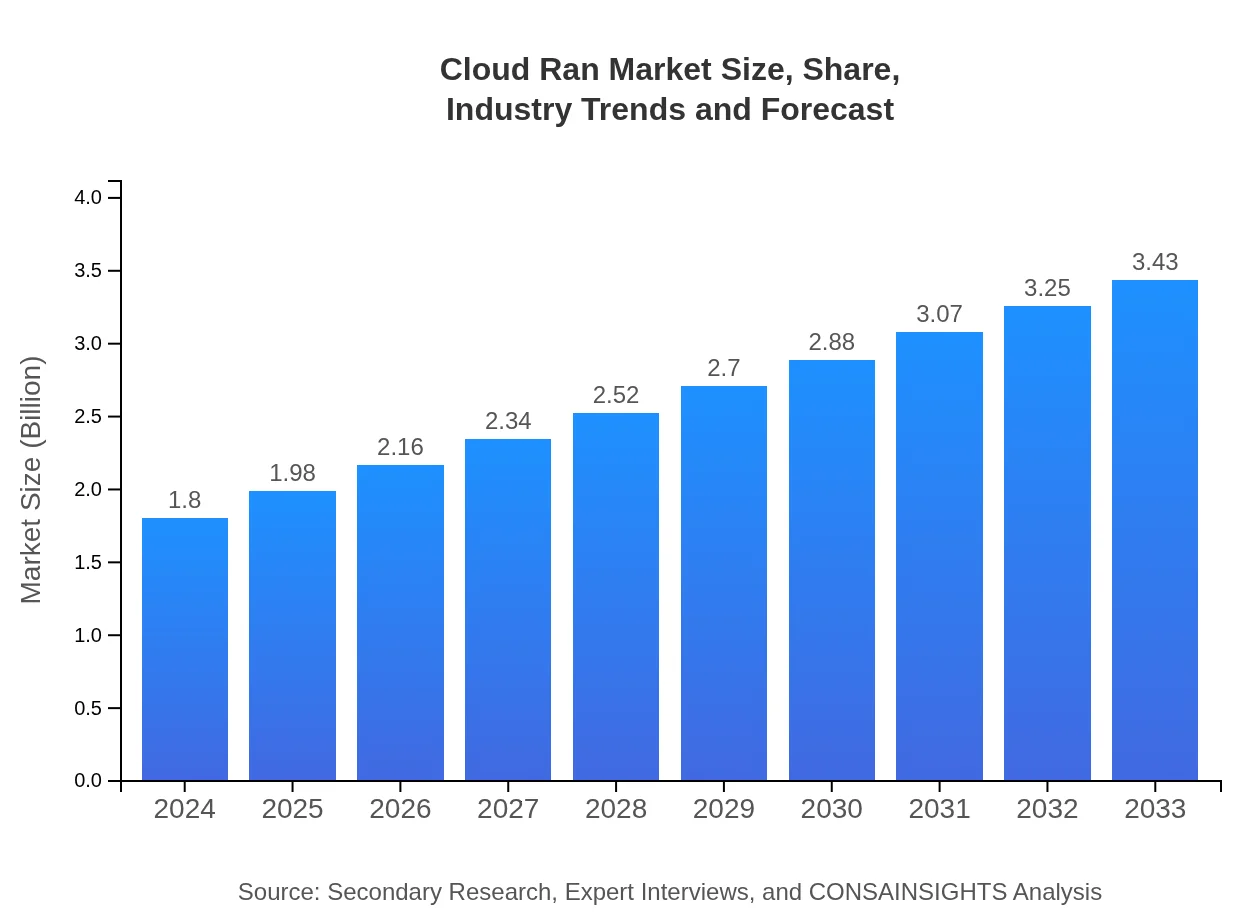
Cloud Ran Market — USD $1.8 Billion in 2024, Growing to USD 3.43 by 2033 at 7.2% CAGR
This detailed Cloud Ran market report provides an exhaustive analysis covering key aspects of the Cloud Ran industry. The report includes a comprehensive market overview, detailed insights on market size and CAGR, an in‐depth industry analysis, segmentation and regional breakdown, technology and product evaluations, profiles of global leaders, and a forecast of market trends from 2024 through 2033, providing invaluable perspectives for stakeholders.
| Metric | Value |
|---|---|
| Study Period | 2024 - 2033 |
| 2024 Market Size | $1.80 Billion |
| CAGR (2024-2033) | 7.2% |
| 2033 Market Size | $3.43 Billion |
| Top Companies | Nokia Networks, Ericsson, Huawei Technologies |
| Published Date | 08 January 2026 |
| Last Modified Date | 31 January 2026 |
Cloud Ran Market Overview
Customize Cloud Ran market research report
- ✔ Get in-depth analysis of Cloud Ran market size, growth, and forecasts.
- ✔ Understand Cloud Ran's regional dynamics and industry-specific trends.
- ✔ Identify potential applications, end-user demand, and growth segments in Cloud Ran
What is the Market Size & CAGR of Cloud Ran market in 2024?
Cloud Ran Industry Analysis
Cloud Ran Market Segmentation and Scope
Tell us your focus area and get a customized research report.
Cloud Ran Market Analysis Report by Region
Europe Cloud Ran:
Europe’s Cloud Ran market, with a recorded size of 0.48 units in 2024, is set to nearly double to 0.91 units by 2033. The region’s strategic emphasis on digital transformation, stringent regulatory standards, and widespread adoption of 5G technologies has accelerated the uptake of Cloud Ran solutions. European market players are leveraging public-private partnerships to drive innovation and expand network capabilities, ensuring long-term competitive advantages in the evolving digital landscape.Asia Pacific Cloud Ran:
In the Asia Pacific region, the Cloud Ran market is experiencing robust growth as countries like China, Japan, South Korea, and India invest heavily in next-generation network technologies. In 2024, the market size was estimated at 0.35 units, growing to 0.66 units by 2033. The region benefits from both high population density and significant government support for advanced telecommunications infrastructure. Furthermore, rapid urbanization and technological innovation spur demand for enhanced connectivity and digital services.North America Cloud Ran:
North America remains a mature and highly competitive market, underpinned by advanced technology deployment and significant R&D investments. With a market size of 0.58 units in 2024, projected to expand to 1.11 units by 2033, the region is characterized by a strong focus on innovation and network optimization. Key players continuously strive to integrate Cloud Ran with emerging technologies such as IoT, edge computing, and AI, delivering enhanced performance and superior customer experiences.South America Cloud Ran:
South America is gradually emerging as a promising market for Cloud Ran, with gradual improvements in network infrastructure and digitization efforts. The region noted a market size of 0.16 units in 2024 that is expected to rise to 0.31 units by 2033. Despite challenges related to economic fluctuations and infrastructural constraints, increased investments and regional collaborations in telecommunications are fostering steady adoption of cloud-based RAN solutions.Middle East & Africa Cloud Ran:
In the Middle East and Africa, the Cloud Ran market is on an upward trajectory despite developmental challenges. The market size, estimated at 0.23 units in 2024, is anticipated to grow to 0.44 units by 2033. Factors such as increasing mobile penetration, government-led digitalization initiatives, and a focus on modernizing legacy systems are driving the adoption of Cloud Ran solutions. The region is witnessing gradual improvements in telecom infrastructure, which, paired with strategic investments, are expected to further bolster market growth.Tell us your focus area and get a customized research report.
Cloud Ran Market Analysis By Deployment Model
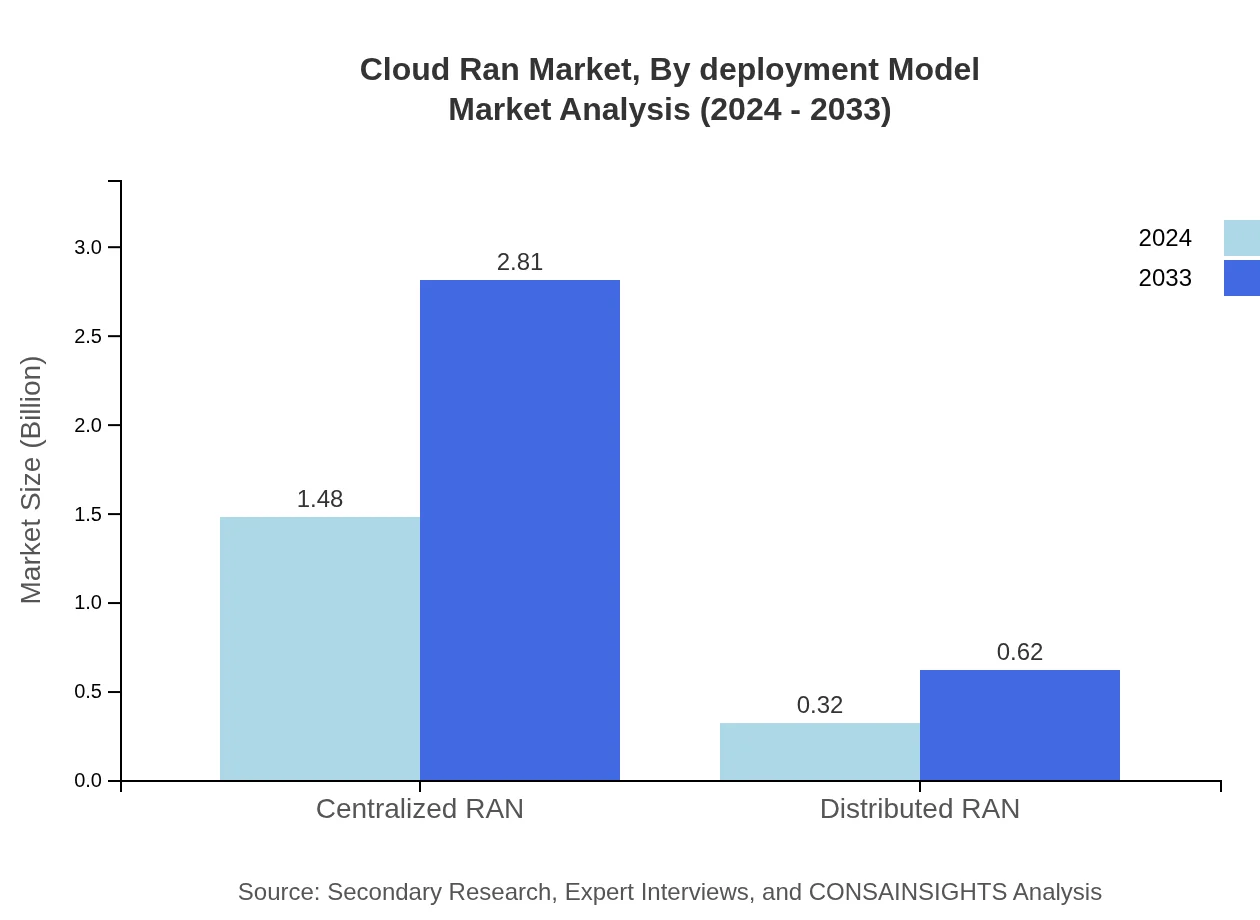
Analysis by deployment model evaluates the structural differences between centralized and distributed RAN architectures. Centralized models offer economies of scale and simplified network management, while distributed models enable enhanced performance and granularity at the network edge. Both models are critical in meeting varied operator requirements and in driving adoption across different geographies.
Cloud Ran Market Analysis By Technology
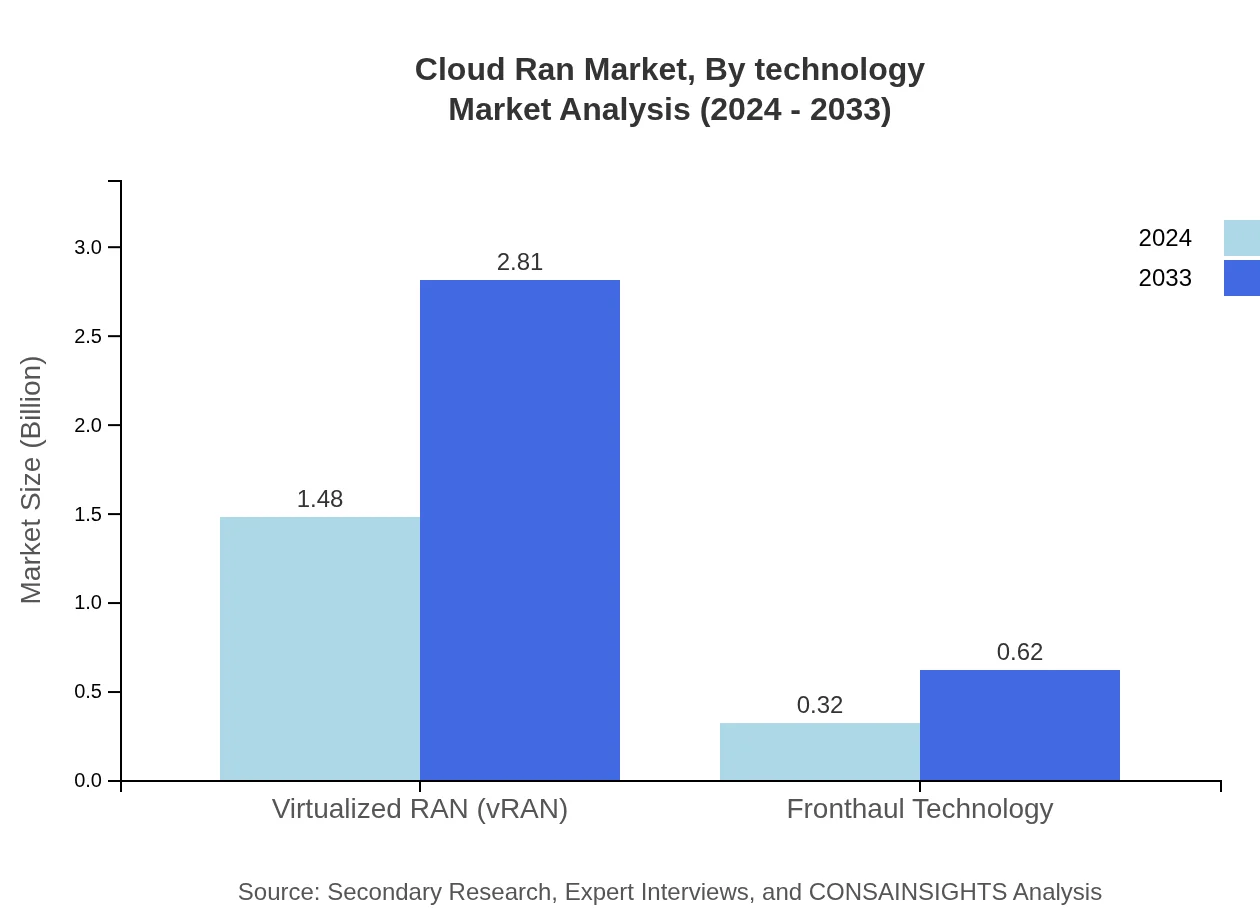
Technological segmentation focuses on advancements in virtualized RAN (vRAN) and fronthaul technologies. With vRAN achieving an 82% market share and significant year-over-year growth, it represents a core pillar of Cloud Ran innovation. Fronthaul technologies, despite holding an 18% share, are essential in linking remote radio units to centralized processing facilities, ensuring seamless data flow and high network reliability.
Cloud Ran Market Analysis By End User
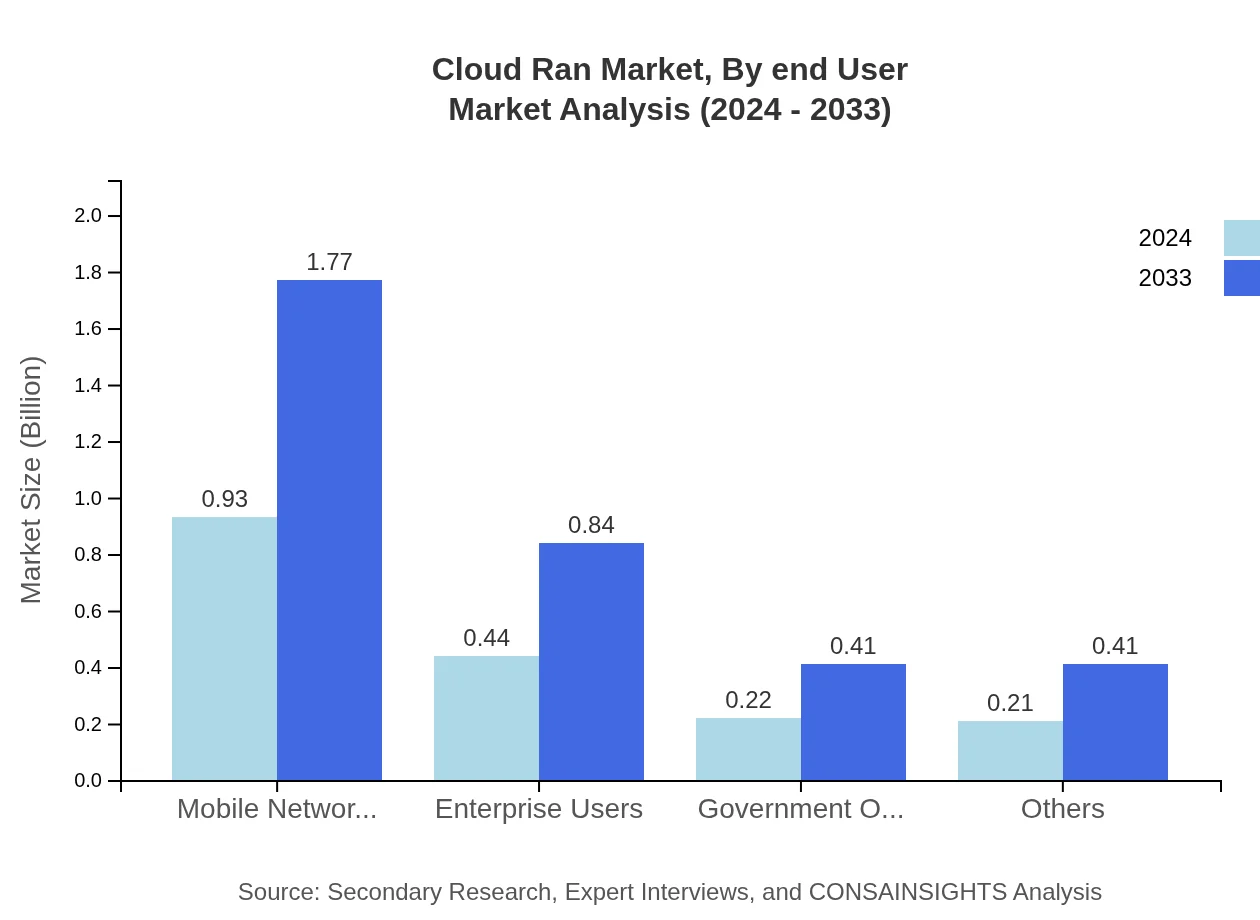
The end-user segmentation encompasses mobile network operators (MNOs), enterprise users, government organizations, and other service providers. MNOs have shown strong growth with market size increasing from 0.93 in 2024 to 1.77 in 2033, maintaining a steady share of 51.69%. Alongside, enterprise users and government organizations are progressively adopting Cloud Ran to support their digital transformation initiatives and critical communication services.
Cloud Ran Market Analysis By Application
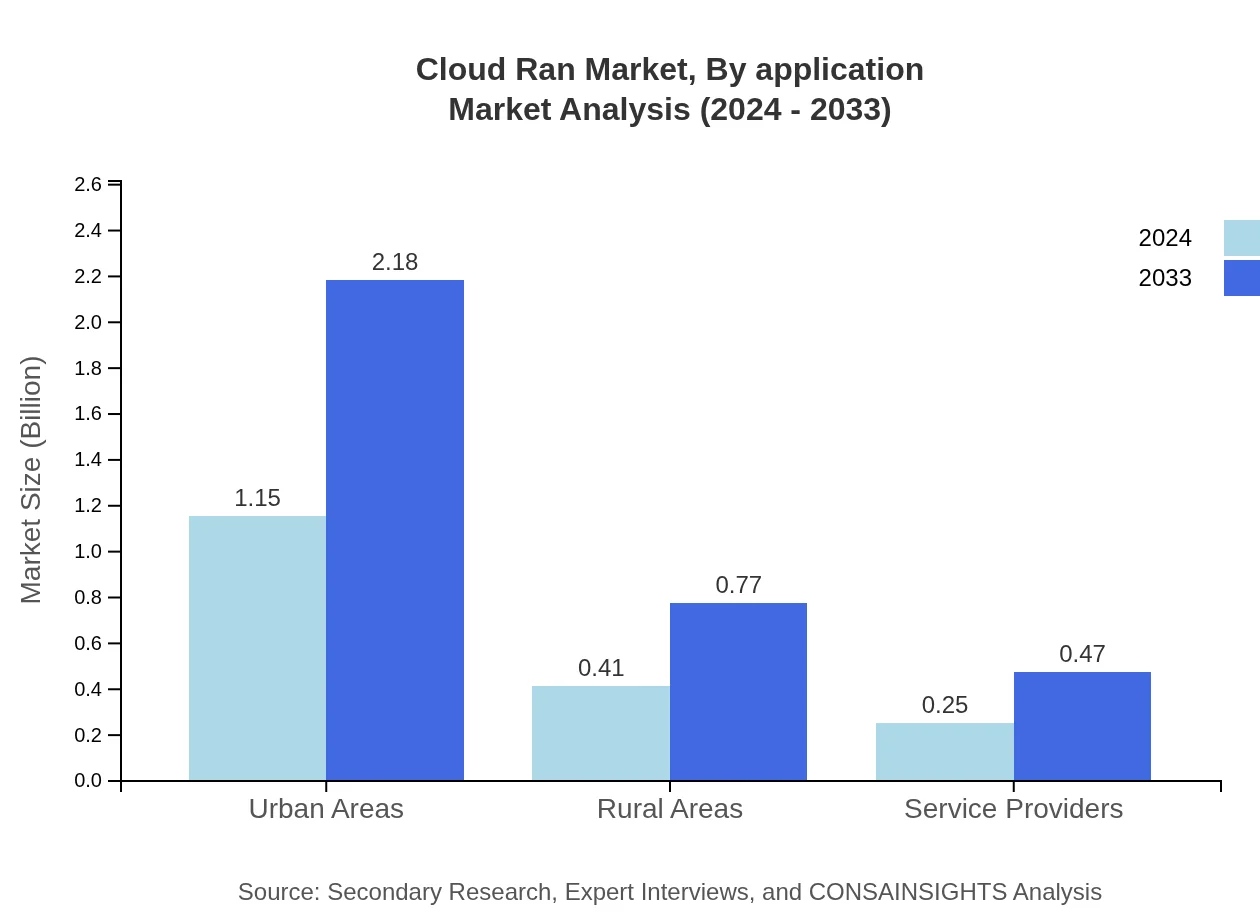
Application-based segmentation distinguishes between urban and rural deployments as well as service-specific implementations. Urban areas are set to witness market growth from 1.15 in 2024 to 2.18 in 2033, dominating with a 63.66% share, driven by dense populations and high data demands. Conversely, rural areas, while growing at a steady pace, remain critical for extending connectivity and bridging the digital divide.
Cloud Ran Market Analysis By Region Competitive Landscape
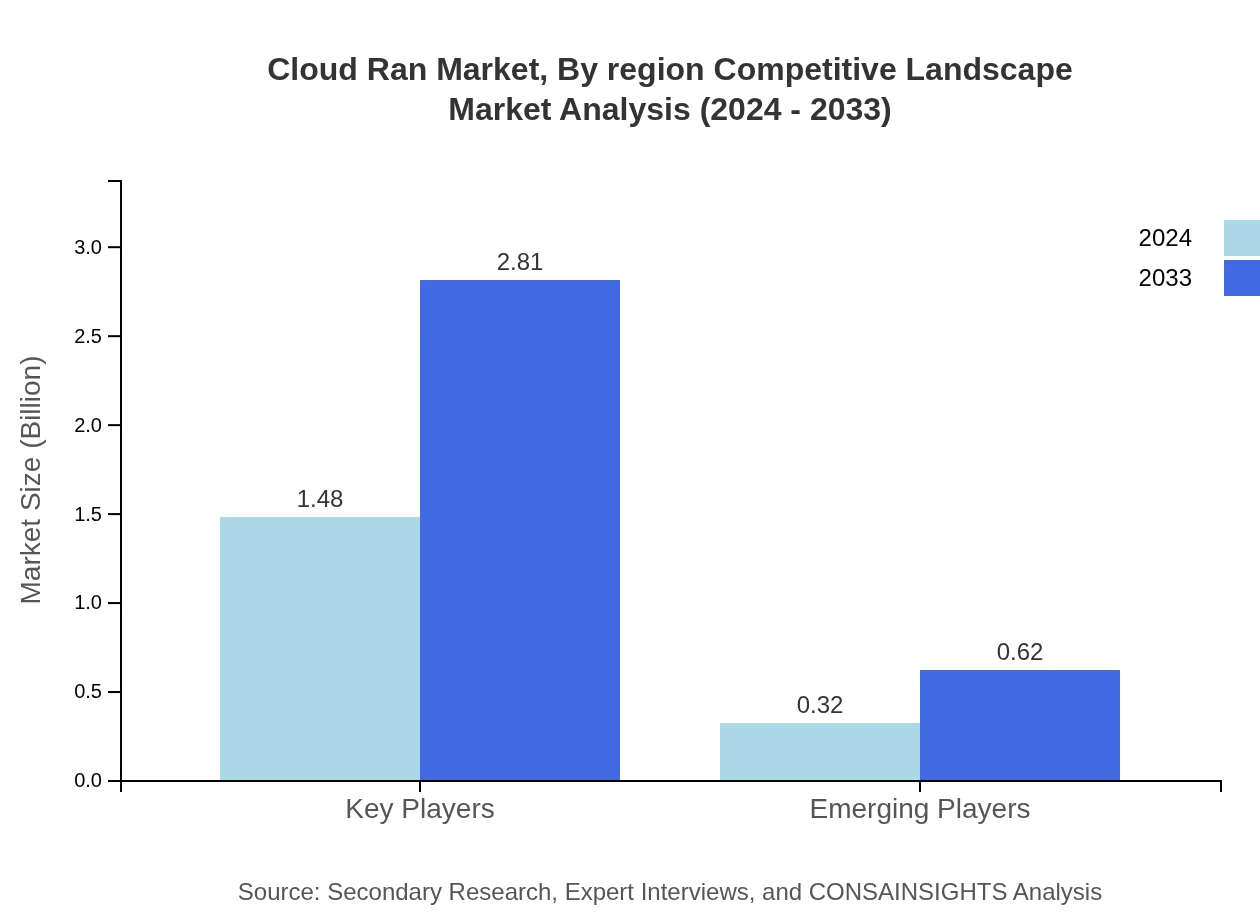
Competitive landscape analysis examines the roles of key market players versus emerging challengers. Established companies continue to lead in deploying large-scale solutions with significant market presence and robust R&D investments, whereas emerging players are innovating rapidly to capture niche market opportunities, thereby intensifying competition and driving overall industry advancements.
Cloud Ran Market Trends and Future Forecast
Tell us your focus area and get a customized research report.
Global Market Leaders and Top Companies in Cloud Ran Industry
Nokia Networks:
Nokia Networks is a pioneering force in the Cloud Ran space, driving innovation with integrated cloud solutions, robust network management, and strategic industry partnerships that enable operators to transition from legacy infrastructure to advanced cloud-based networks.Ericsson:
Ericsson is recognized globally for its cutting-edge Cloud Ran innovations, delivering scalable solutions that enhance network performance and efficiency. Its strong focus on research and development underpins successful deployments across multiple regions.Huawei Technologies:
Huawei leverages its comprehensive expertise in telecommunications to offer end-to-end Cloud Ran infrastructure solutions. With a focus on cost efficiency and network optimization, the company plays a critical role in revolutionizing network architectures worldwide.We're grateful to work with incredible clients.








FAQs
How can the Cloud RAN Market Report help align our marketing strategy with customer adoption trends?
The Cloud RAN Market Report reveals customer adoption trends, with a global market size of $1.8 billion and a CAGR of 7.2%. With clear insights into regional demands and emerging technologies, marketers can align strategies effectively to meet customer expectations.
What product features are in highest demand according to the Cloud RAN trends?
Key product features gaining traction in the Cloud RAN sector include efficiency, scalability, and cost reductions. As the market grows at a CAGR of 7.2%, these features drive enterprise and mobile network operator adoption across global regions.
Which regions offer the best market entry and expansion opportunities in the Cloud RAN industry?
North America leads with a 2024 market size of $0.58 billion, projected to reach $1.11 billion by 2033. Europe ($0.48B to $0.91B), Asia Pacific ($0.35B to $0.66B), and Latin America ($0.16B to $0.31B) also present lucrative opportunities.
What emerging technologies and innovations are shaping the Cloud RAN market?
Emerging technologies like Virtualized RAN (vRAN) and innovative fronthaul technology are shaping the Cloud RAN market. With vRAN expected to grow from $1.48 billion in 2024 to $2.81 billion in 2033, these innovations drive transformation in telecommunications.
Does the Cloud RAN Report include competitive landscape and market share analysis?
Yes, the Cloud RAN Report includes a comprehensive competitive landscape, analyzing major players and market shares. Notably, Mobile Network Operators hold 51.69% share, providing valuable insights for strategic positioning in a market sized at $1.8 billion.
How can executives use the Cloud RAN Report to evaluate investment risks and ROI?
Executives can leverage the Cloud RAN Report to assess market size, regional data, and segment performances. With a CAGR of 7.2%, this information aids in evaluating potential investment risks and estimating ROI within dynamic and emerging markets.
What are the projected market sizes for different segments within the Cloud RAN market?
Projected sizes include Mobile Network Operators ($0.93B to $1.77B), Enterprise Users ($0.44B to $0.84B), and Government Organizations ($0.22B to $0.41B), indicating robust growth in key segments with a collective market value expanding substantially through 2033.