
Reports >
Life Sciences
>
Cold Remedies Market Report

Cold Remedies Market Report
First published: 11 October 2024 | Last updated: 25 May 2026 | Report Code: cold-remedies
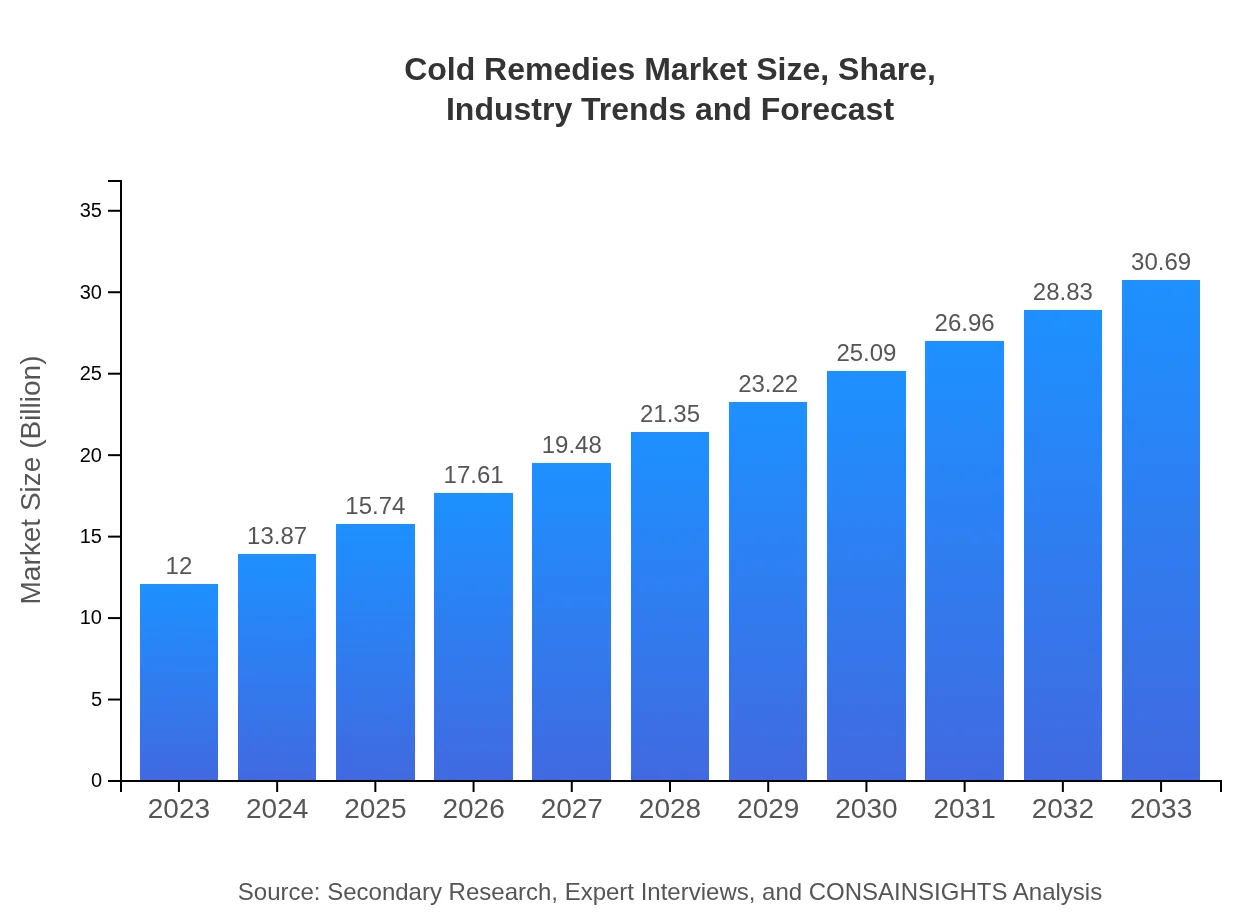
Cold Remedies Market — USD $12 Billion in 2023, Growing to USD 30.69null by 2033 at 9.5% CAGR
This report delves into the Cold Remedies market, providing detailed insights into its current state and future projections from 2023 to 2033, covering market trends, size, segmentation, and regional analyses.
Key Takeaways
- Global market expands from $12.00 Billion in 2023 to $30.69 Billion in 2033 at a 9.5% CAGR.
- North America is largest regional market, while no single fastest-growing region is stated because regional CAGR differences remain within 0.15 percentage points.
- Europe reaches $8.01 Billion by 2033, up from $3.13 Billion in 2023, reflecting steady demand.
- Asia Pacific grows from $2.43 Billion in 2023 to $6.20 Billion in 2033 driven by expanding access and product variety.
- Key industry participants include Pfizer, Johnson & Johnson, Procter & Gamble and GSK, shaping product innovation and distribution.
Cold Remedies Market Report — Executive Summary
North America remains largest market by forecast-period value, while no single fastest-growing region is stated because top regional growth rates are separated by less than 0.15 percentage points. The Cold Remedies Market Report examines a market forecasted to rise from $12.00 Billion in 2023 to $30.69 Billion in 2033 at a 9.5% CAGR. Growth is underpinned by increasing consumer focus on wellness, innovation across OTC and homeopathic offerings, and broader access via retail and online channels. Seasonality and ongoing demand for symptom relief sustain periodic sales peaks, while digital health and packaging sustainability influence product development. The report structures the market by channel, product, application, formulation and consumer type, and profiles leading companies such as Pfizer, Johnson & Johnson, Procter & Gamble and GSK. Methodology combines expert interviews, company publications and data validation to present a validated view of trends and market structure for stakeholders.
Key Growth Drivers
- Rising consumer health awareness increases demand for symptom relief and preventive care solutions.
- Product innovation across OTC, prescription and homeopathic categories broadens available options.
- Expansion of distribution channels, including retail pharmacies and online retail, improves accessibility.
- Seasonal demand patterns create recurring market peaks supporting steady revenue streams.
- Sustainability and natural formulations influence product development and consumer preference.
| Metric | Value |
|---|---|
| Study Period | 2023 - 2033 |
| 2023 Market Size | $12.00 Billion |
| CAGR (2023-2033) | 9.5% |
| 2033 Market Size | $30.69 Billion |
| Top Companies | Pfizer , Johnson & Johnson, Procter & Gamble, GSK |
| Published Date | 11 October 2024 |
| Last Modified Date | 25 May 2026 |
Cold Remedies Market Overview
Customize Cold Remedies Market Report market research report
- ✔ Get in-depth analysis of Cold Remedies market size, growth, and forecasts.
- ✔ Understand Cold Remedies's regional dynamics and industry-specific trends.
- ✔ Identify potential applications, end-user demand, and growth segments in Cold Remedies
What is the Market Size & CAGR of Cold Remedies Market Report market in 2023?
Cold Remedies Industry Analysis
Cold Remedies Market Segmentation and Scope
Tell us your focus area and get a customized research report.
Cold Remedies Market Report Market Analysis Report by Region
Europe Cold Remedies Market Report:
Europe grows from $3.13 Billion in 2023 to $8.01 Billion in 2033. The region benefits from diverse product acceptance, regulatory frameworks supporting OTC availability, and consumer interest in both conventional and homeopathic options.Asia Pacific Cold Remedies Market Report:
Asia Pacific grows from $2.43 Billion in 2023 to $6.2 Billion in 2033. Growth is driven by improving healthcare access, rising consumer health awareness, and increased availability of varied formulations across channels.North America Cold Remedies Market Report:
North America is largest regional market, rising from $4.51 Billion in 2023 to $11.54 Billion in 2033. Regional momentum reflects broad retail and online access, established pharmaceutical presence, and sustained consumer demand for symptom relief.South America Cold Remedies Market Report:
Latin America grows from $0.66 Billion in 2023 to $1.69 Billion in 2033. Market increases reflect expanding retail distribution, growing awareness of cold symptom management, and wider adoption of OTC products.Middle East & Africa Cold Remedies Market Report:
Middle East and Africa grows from $1.27 Billion in 2023 to $3.25 Billion in 2033. Demand is supported by better product availability, interest in preventative care and symptom relief, and gradual expansion of retail and clinical channels.Tell us your focus area and get a customized research report.
Research Methodology
Cold Remedies Market Analysis By Product
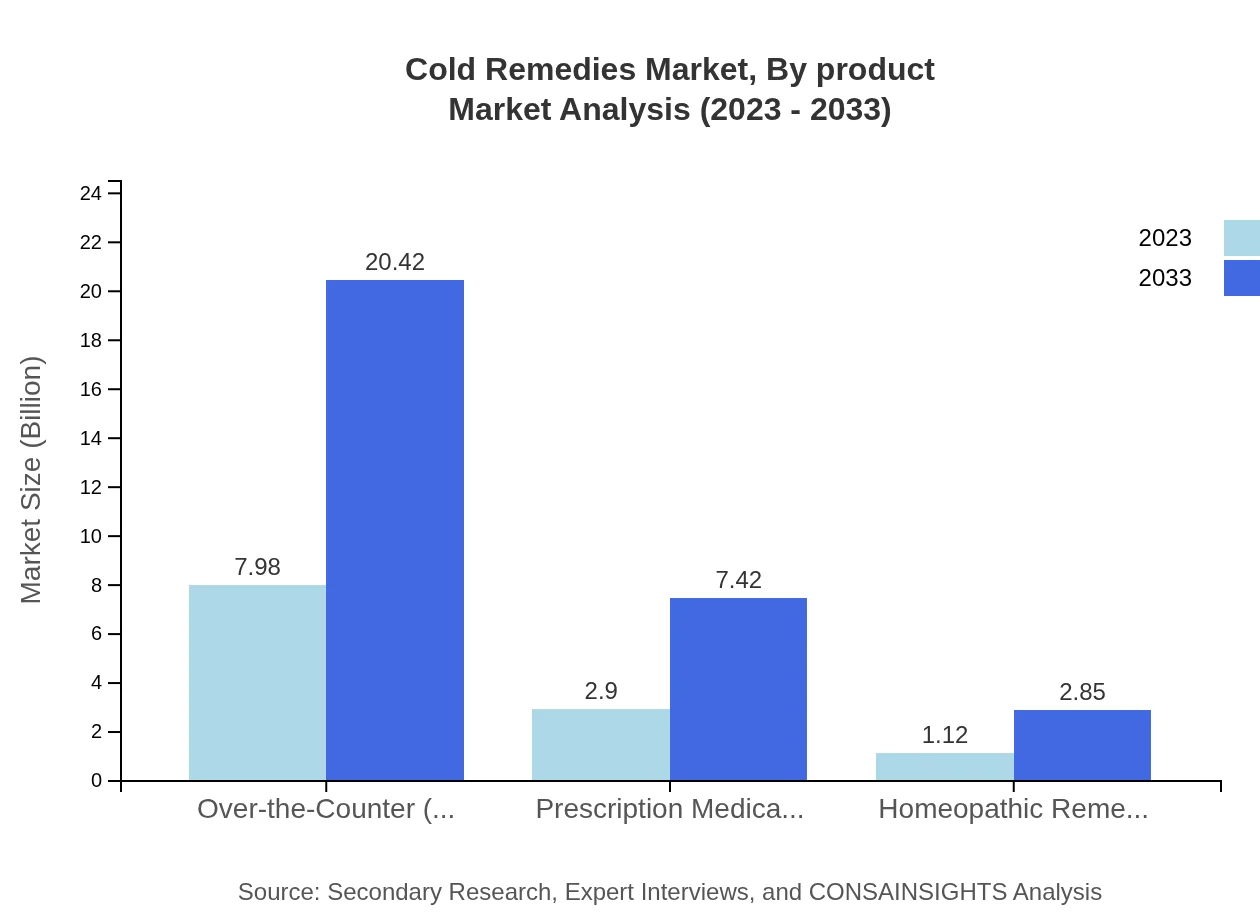
The Cold Remedies market by product segment includes Over-the-Counter (OTC) preparations, Prescription medications, and Homeopathic remedies. OTC preparations hold the largest market share in both value and volume, accounting for approximately $7.98 billion in 2023 and projecting a rise to $20.42 billion by 2033. Prescription medications, while smaller, are growing in demand as healthcare providers increasingly recommend drug therapies for cold symptoms. Homeopathic remedies also present a growing niche, appealing to consumers seeking natural alternatives.
Cold Remedies Market Analysis By Application
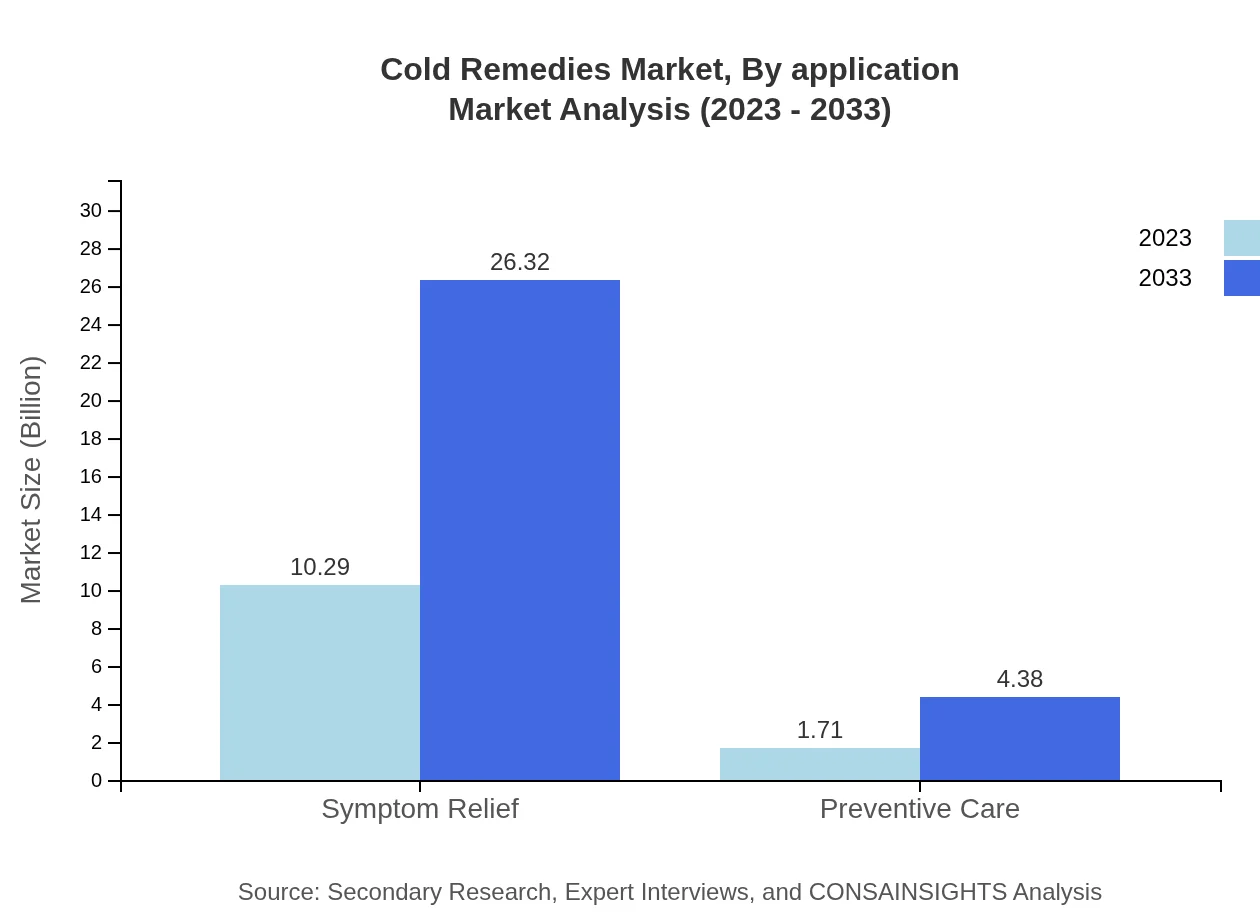
The application segment covers Symptom relief and Preventive care. Symptom relief products dominate the market, accounting for $10.29 billion in 2023, with expected growth to $26.32 billion by 2033. Preventive care accounts for a smaller share but shows potential, growing from $1.71 billion to $4.38 billion during the same period. This growth reflects an increasing focus on preemptive health measures.
Cold Remedies Market Analysis By Formulation
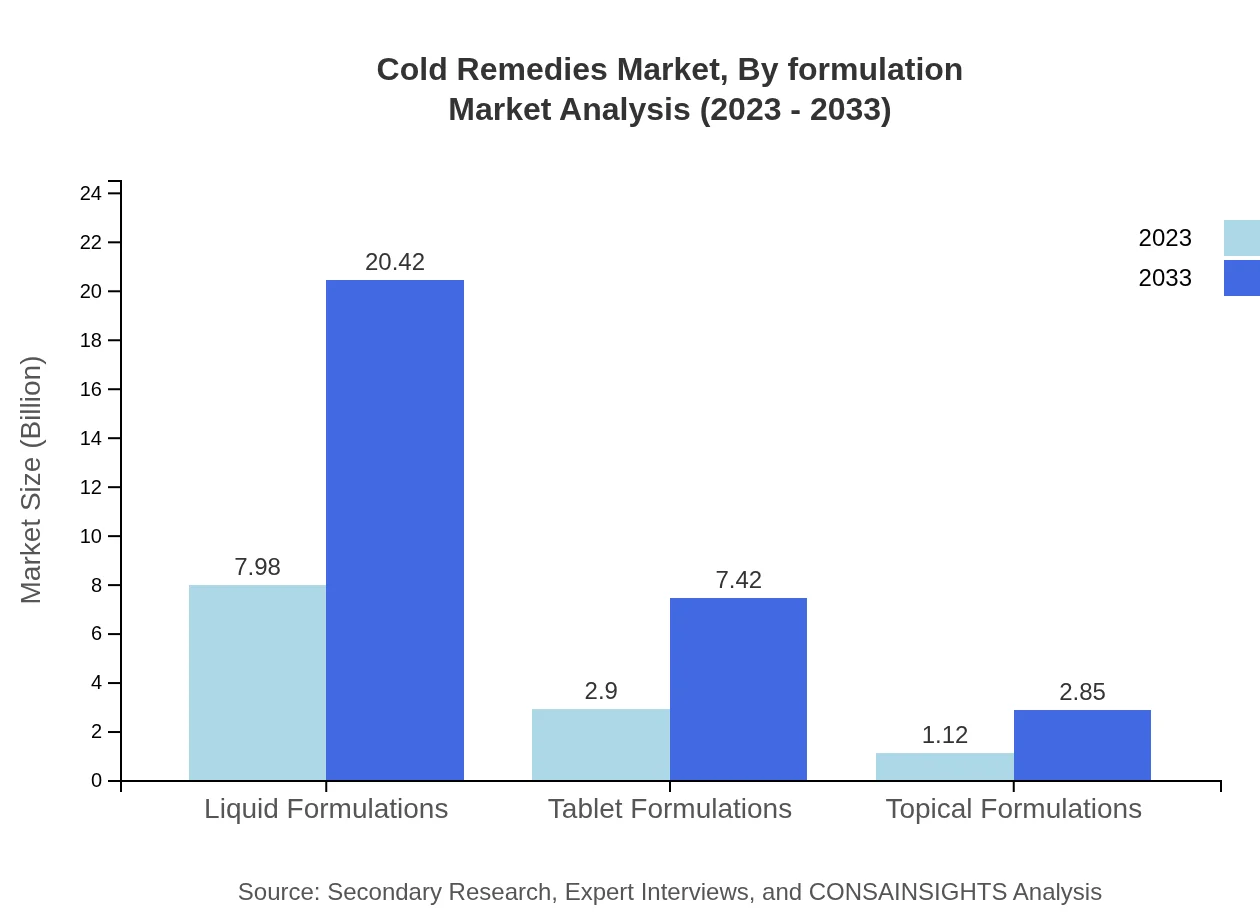
Formulation types in the cold remedies market include Liquid formulations, Tablet formulations, and Topical formulations. Liquid formulations dominate the market in size and share, with a value of $7.98 billion in 2023. These are popular due to their ease of consumption. Tablet formulations are a close second, valued at $2.90 billion, while topical formulations offer specialized local relief, reflecting niche growth.
Cold Remedies Market Analysis By Channel
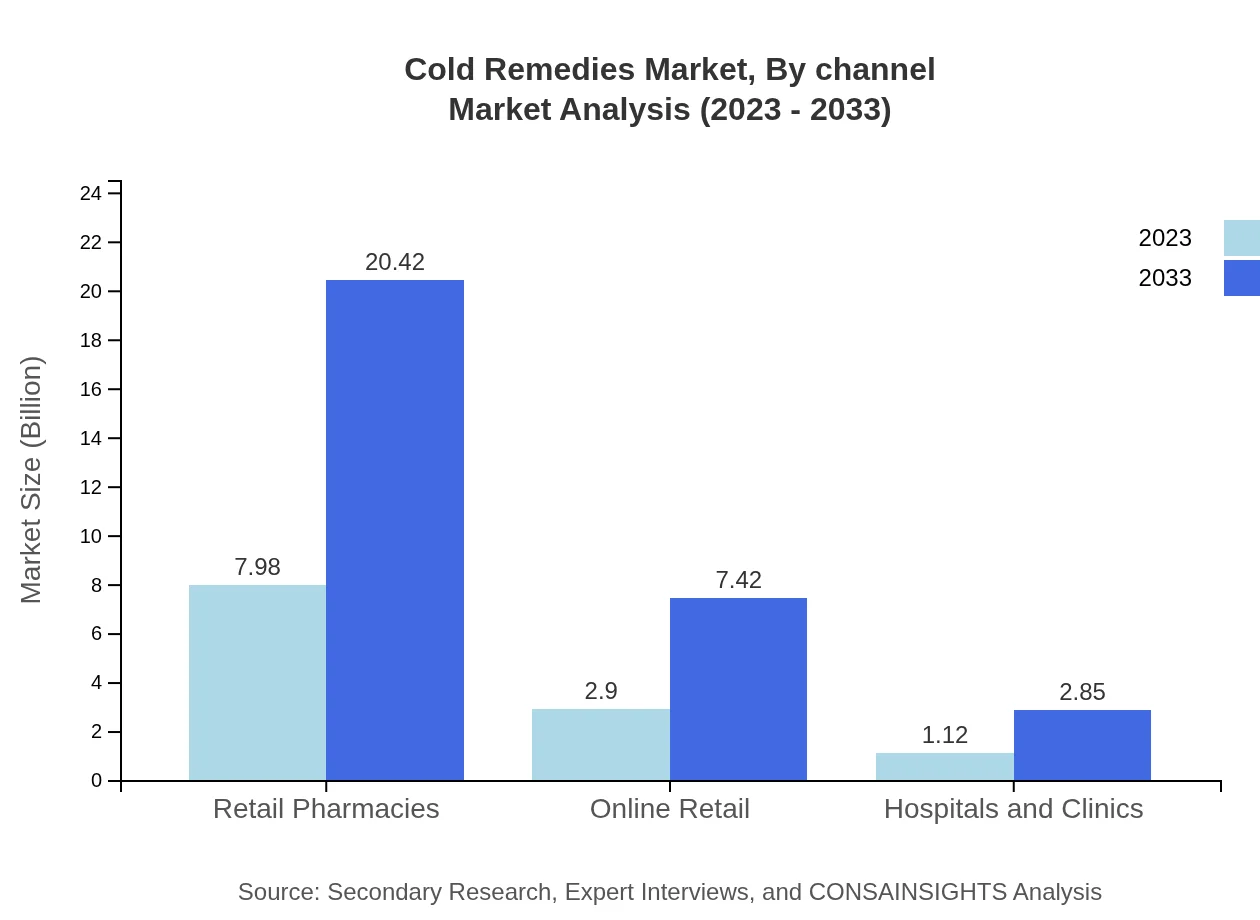
The distribution channels for cold remedies include Retail pharmacies, Online retail, and Hospitals and clinics. Retail pharmacies dominate the distribution landscape, holding a substantial share of approximately 66.53% in 2023, valued at $7.98 billion. Online retail channels have shown rapid growth potential, rising from $2.90 billion to $7.42 billion by 2033, illustrating changing consumer purchasing preferences towards digital platforms.
Cold Remedies Market Analysis By Consumer Type
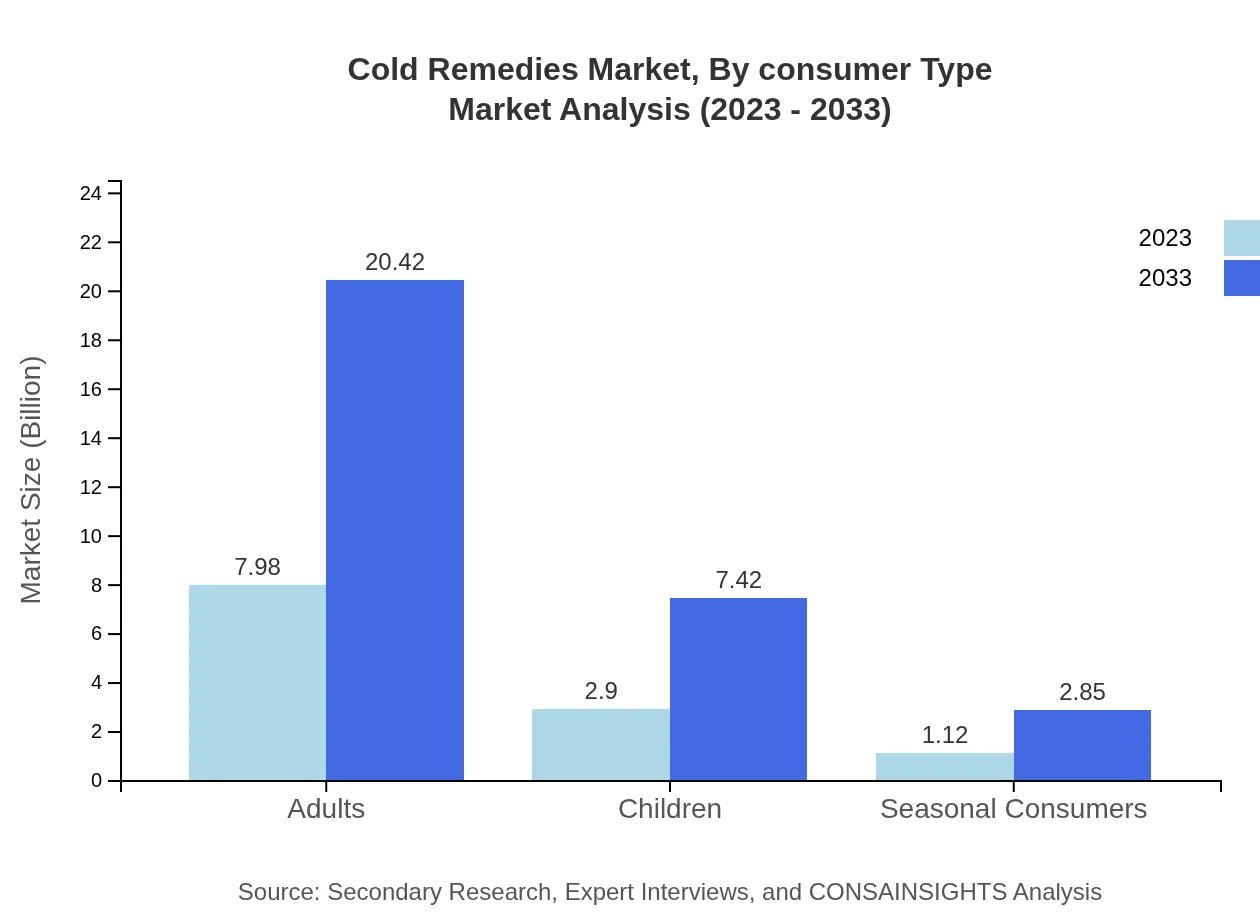
The consumer type segmentation includes Adults, Children, and Seasonal consumers. Adults make up the largest segment, with a value of $7.98 billion in 2023, expected to expand to $20.42 billion by 2033. The children’s segment also shows growth potential, expanding from $2.90 billion to $7.42 billion, as parents increasingly turn to effective remedies for their children. Seasonal consumers represent a smaller segment, indicating steady but moderate demand.
Cold Remedies Market Trends and Future Forecast
Tell us your focus area and get a customized research report.
Global Market Leaders and Top Companies in Cold Remedies Industry
Pfizer :
Pfizer is a multinational pharmaceutical corporation known for its wide range of healthcare products, including cold remedies that combine efficacy with consumer trust.Johnson & Johnson:
Johnson & Johnson is a diversified healthcare giant with a robust portfolio of cold remedy products, focusing on both OTC medications and holistic wellness solutions.Procter & Gamble:
Procter & Gamble is renowned for its consumer health products, including cold remedies, emphasizing innovative marketing and product development.GSK:
GlaxoSmithKline (GSK) is a top player in the Cold Remedies market, providing a range of OTC products that are well-known internationally.We're grateful to work with incredible clients.









FAQs
What is the market size of the Cold Remedies market in 2023?
The market size in 2023 is $12.00 Billion as stated in the report data for the Cold Remedies market.
How big will the Cold Remedies market be in 2033?
The reported market value for 2033 is $30.69 Billion, reflecting the forecasted expansion through the 2023 to 2033 period.
What is CAGR of the Cold Remedies market for 2023 to 2033?
The compound annual growth rate (CAGR) for the 2023 to 2033 forecast period is 9.5% according to the provided figures.
Is there a single fastest Growing region in the Cold Remedies Market Report market?
No single fastest-growing region is stated for the Cold Remedies Market Report market because the top regional implied CAGR values are within 0.15 percentage points of each other, making the ranking too close to call reliably.
Which companies are highlighted in the report?
Top companies listed include Pfizer, Johnson & Johnson, Procter & Gamble and GSK as notable participants in the cold remedies market.
What are common product segments covered?
Product segmentation includes Over-the-Counter (OTC) preparations, prescription medications and homeopathic remedies as specified in the sub-segments.
How are distribution channels classified in the report?
Distribution channels in the data include retail pharmacies, online retail, and hospitals and clinics as primary sub-segments.
What drives market expansion according to the report?
The report associates growth with consumer wellness awareness, product innovation, channel expansion and seasonal demand dynamics.
Who contributed to the research methodology?
Research combined primary interviews with industry experts and secondary sources such as company reports and publications.
What consumer types are analyzed in the segmentation?
Consumer-type sub-segments listed are adults, children and seasonal consumers to reflect different demand profiles.