

Fecal Occult Testing Market Report
First published: 20 October 2024 | Last updated: 25 May 2026 | Report Code: fecal-occult-testing
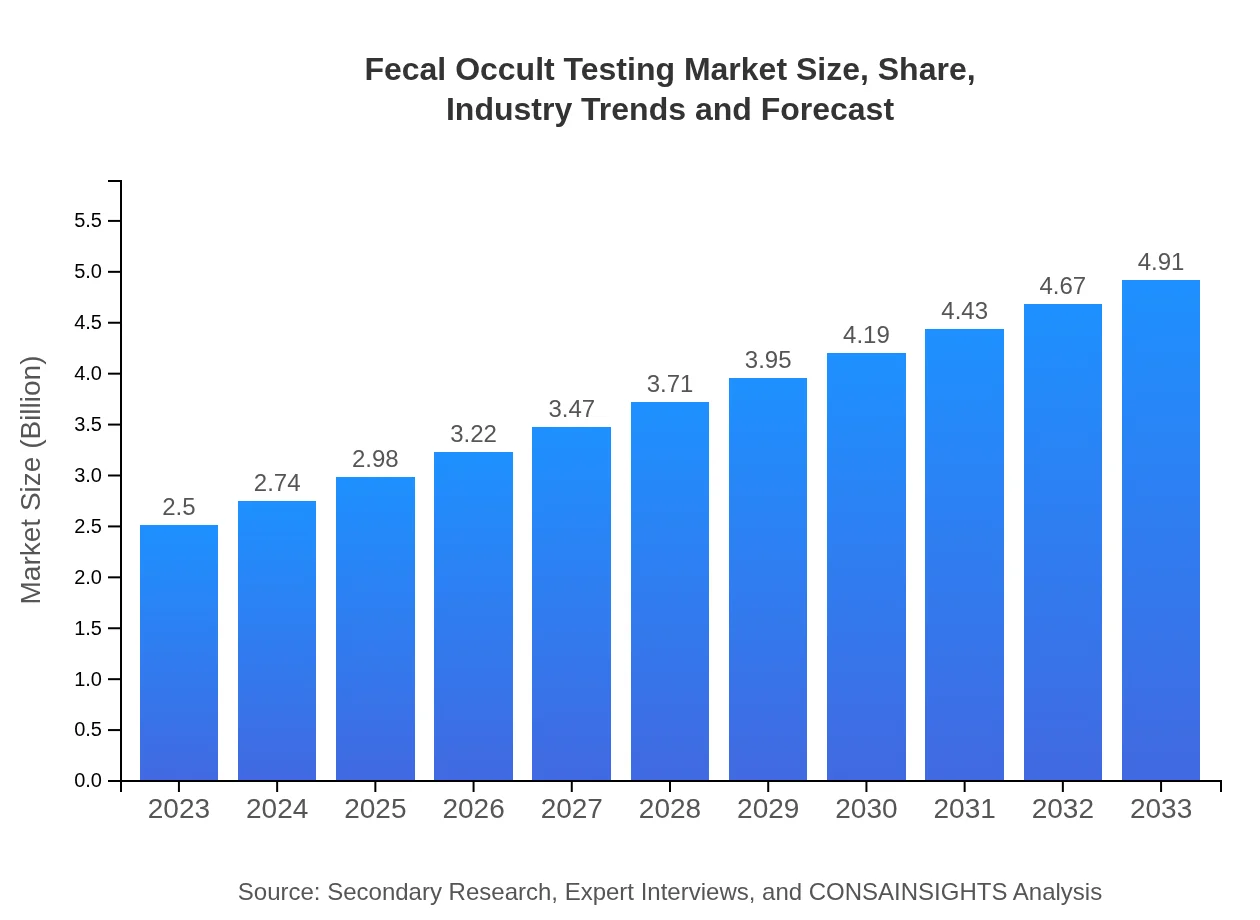
Fecal Occult Testing Market — USD 2.5 billion in 2023, Growing to USD 4.91B by 2033 at 6.8% CAGR
This report provides a comprehensive analysis of the fecal occult testing market, encompassing market size, growth trends, regional insights, and segmentation from 2023 to 2033.
Key Takeaways
- Global market expands from $2.50 Billion in 2023 to $4.91 Billion in 2033 with a 6.8% CAGR during 2023 to 2033.
- North America is largest regional market, while no single fastest-growing region is stated because regional CAGR differences remain within 0.15 percentage points.
- North America holds the largest regional share, rising from $0.9 Billion in 2023 to $1.77 Billion in 2033.
- Europe and Asia Pacific show notable increases: Europe from $0.67 Billion to $1.31 Billion; Asia Pacific from $0.49 Billion to $0.97 Billion.
- Segments include test kits, accessories, manual and automated tests, hospitals, clinics and home testing, and both product and service revenue models.
- Leading firms referenced include Abbott Laboratories, F. Hoffmann-La Roche Ltd., Beckman Coulter, Inc., Siemens Healthineers, and Cardinal Health, Inc.
Fecal Occult Testing Market Report — Executive Summary
North America remains largest market by forecast-period value, while no single fastest-growing region is stated because top regional growth rates are separated by less than 0.15 percentage points. This report examines the fecal occult testing market, which registers $2.50 Billion in 2023 and is forecast to reach $4.91 Billion by 2033 at a 6.8% CAGR for 2023 to 2033. Growth is driven by expanding preventive screening initiatives, rising awareness of colorectal health, and technological progress such as automated testing and improved home testing options. The market structure is analyzed across product types (test kits, accessories), test methods (manual and automated), end-users (hospitals, clinics, home testing), and revenue models (product sales and service revenue). Regional trends highlight North America as the largest market, with Europe, Asia Pacific, Latin America, and the Middle East and Africa showing steady increases. Competitive dynamics feature major diagnostics and healthcare suppliers, including Abbott Laboratories, F. Hoffmann-La Roche Ltd., Beckman Coulter, Inc., Siemens Healthineers, and Cardinal Health, Inc. The report emphasizes regulatory considerations, R&D investment, and the shift toward patient-centered screening pathways as central themes shaping market activity.
Key Growth Drivers
- Rising preventive healthcare awareness and screening programs that increase demand for fecal occult testing.
- Technological advancements, including automated testing, that improve throughput and accuracy for diagnostic providers.
- Growth of home testing kits that enhance patient convenience and support decentralized screening models.
- Increased investment in diagnostics and screening by public health systems and private providers.
- Regulatory emphasis on safety and performance, prompting manufacturers to innovate and adapt product offerings.
| Metric | Value |
|---|---|
| Study Period | 2023 - 2033 |
| 2023 Market Size | $2.50 Billion |
| CAGR (2023-2033) | 6.8% |
| 2033 Market Size | $4.91 Billion |
| Top Companies | Abbott Laboratories, F. Hoffmann-La Roche Ltd., Beckman Coulter, Inc., Siemens Healthineers, Cardinal Health, Inc. |
| Published Date | 20 October 2024 |
| Last Modified Date | 25 May 2026 |
Fecal Occult Testing Market Overview
Customize Fecal Occult Testing Market Report market research report
- ✔ Get in-depth analysis of Fecal Occult Testing market size, growth, and forecasts.
- ✔ Understand Fecal Occult Testing's regional dynamics and industry-specific trends.
- ✔ Identify potential applications, end-user demand, and growth segments in Fecal Occult Testing
What is the Market Size & CAGR of Fecal Occult Testing Market Report market in 2023?
Fecal Occult Testing Industry Analysis
Fecal Occult Testing Market Segmentation and Scope
Tell us your focus area and get a customized research report.
Fecal Occult Testing Market Report Market Analysis Report by Region
Europe Fecal Occult Testing Market Report:
Europe grows from $0.67 Billion in 2023 to $1.31 Billion in 2033. Public health screening initiatives, regulatory frameworks, and investments in diagnostic technologies underpin market expansion across hospitals, clinics, and home-testing channels.Asia Pacific Fecal Occult Testing Market Report:
Asia Pacific grows from $0.49 Billion in 2023 to $0.97 Billion in 2033. Rising awareness of preventive care, expanding healthcare access, and gradual adoption of automated and home testing products drive regional uptake.North America Fecal Occult Testing Market Report:
North America is largest regional market, rising from $0.9 Billion in 2023 to $1.77 Billion in 2033. Established screening programs, diagnostic infrastructure, and adoption of automated testing and home kits support regional demand.South America Fecal Occult Testing Market Report:
Latin America grows from $0.16 Billion in 2023 to $0.31 Billion in 2033. Growing screening collaborations, improving diagnostic capacity, and broader access to test kits contribute to market progression in the region.Middle East & Africa Fecal Occult Testing Market Report:
Middle East and Africa grows from $0.28 Billion in 2023 to $0.55 Billion in 2033. Investments in healthcare infrastructure, screening initiatives, and increased availability of testing products support regional market growth.Tell us your focus area and get a customized research report.
Research Methodology
Fecal Occult Testing Market Analysis By Product Type
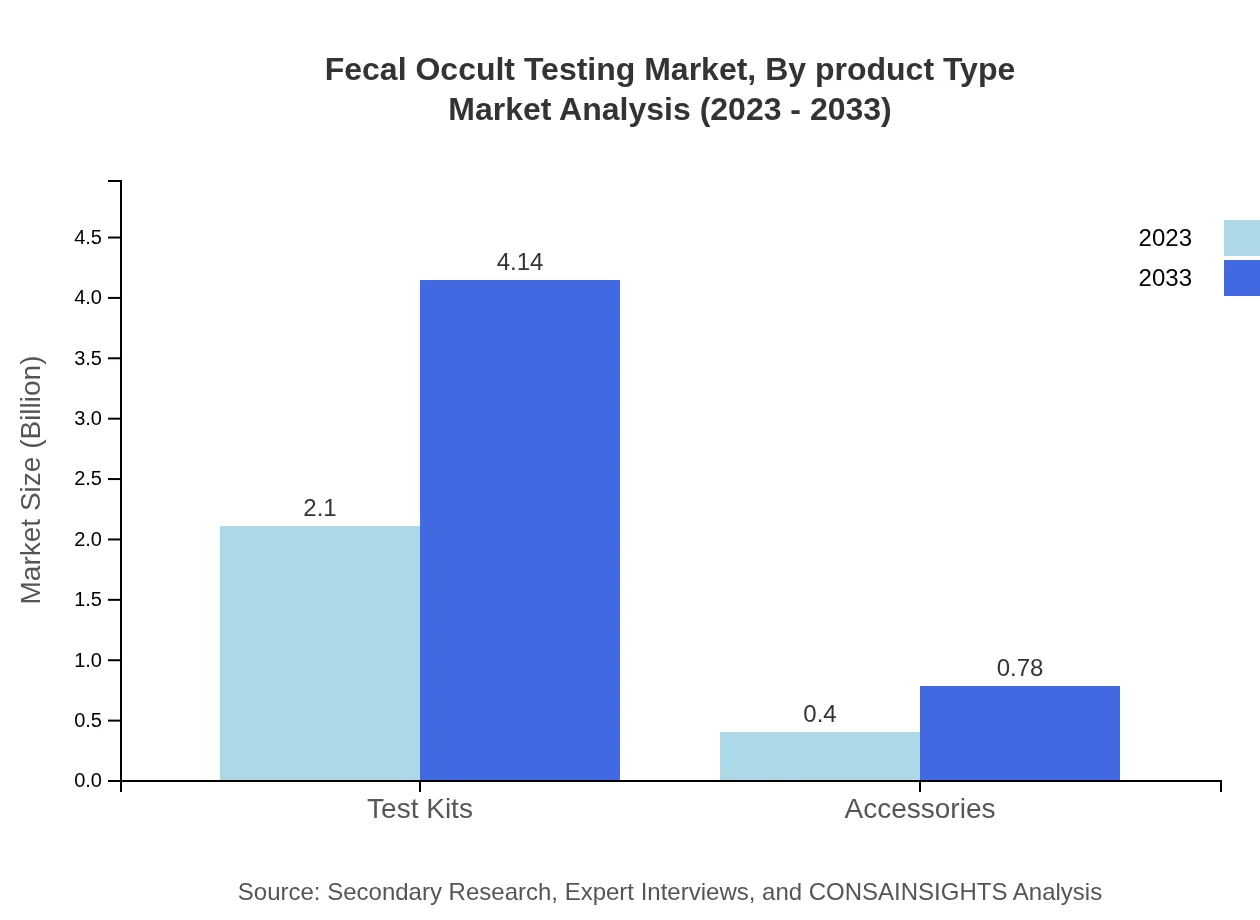
For 2023, test kits dominate this market segment with a size of USD 2.10 billion, constituting 84.19% market share. This is anticipated to increase to USD 4.14 billion by 2033, maintaining the same share. Accessories generate a modest revenue stream, projected to grow from USD 0.40 billion to USD 0.78 billion, balancing a 15.81% share throughout the decade.
Fecal Occult Testing Market Analysis By Test Method
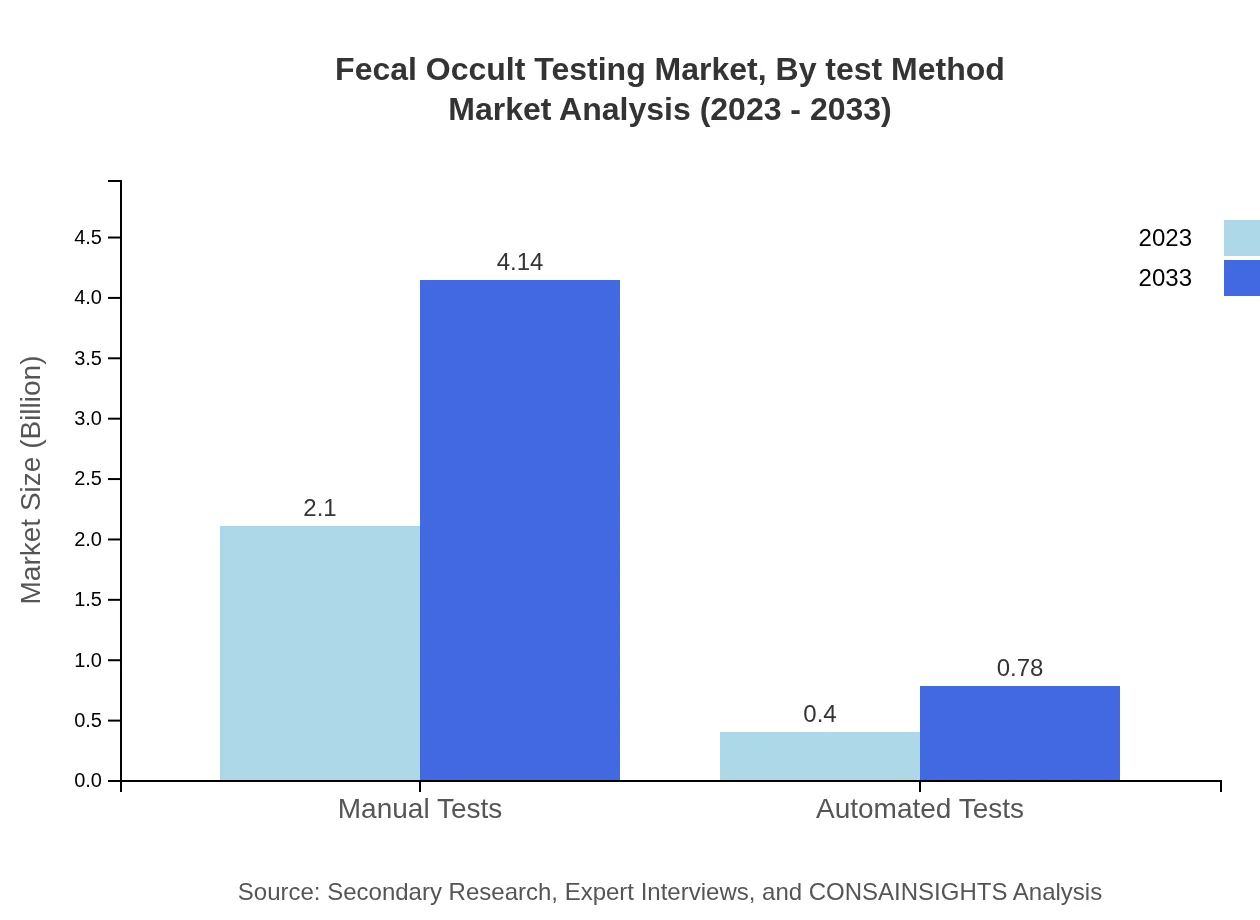
Manual tests account for 84.19% market share, with revenues surging from USD 2.10 billion in 2023 to USD 4.14 billion in 2033, reflective of their established protocols in clinical settings. Automated tests, while currently smaller at USD 0.40 billion and a share of 15.81%, demonstrate rapid growth potential as innovation drives the convenience and efficacy of fecal testing.
Fecal Occult Testing Market Analysis By End User
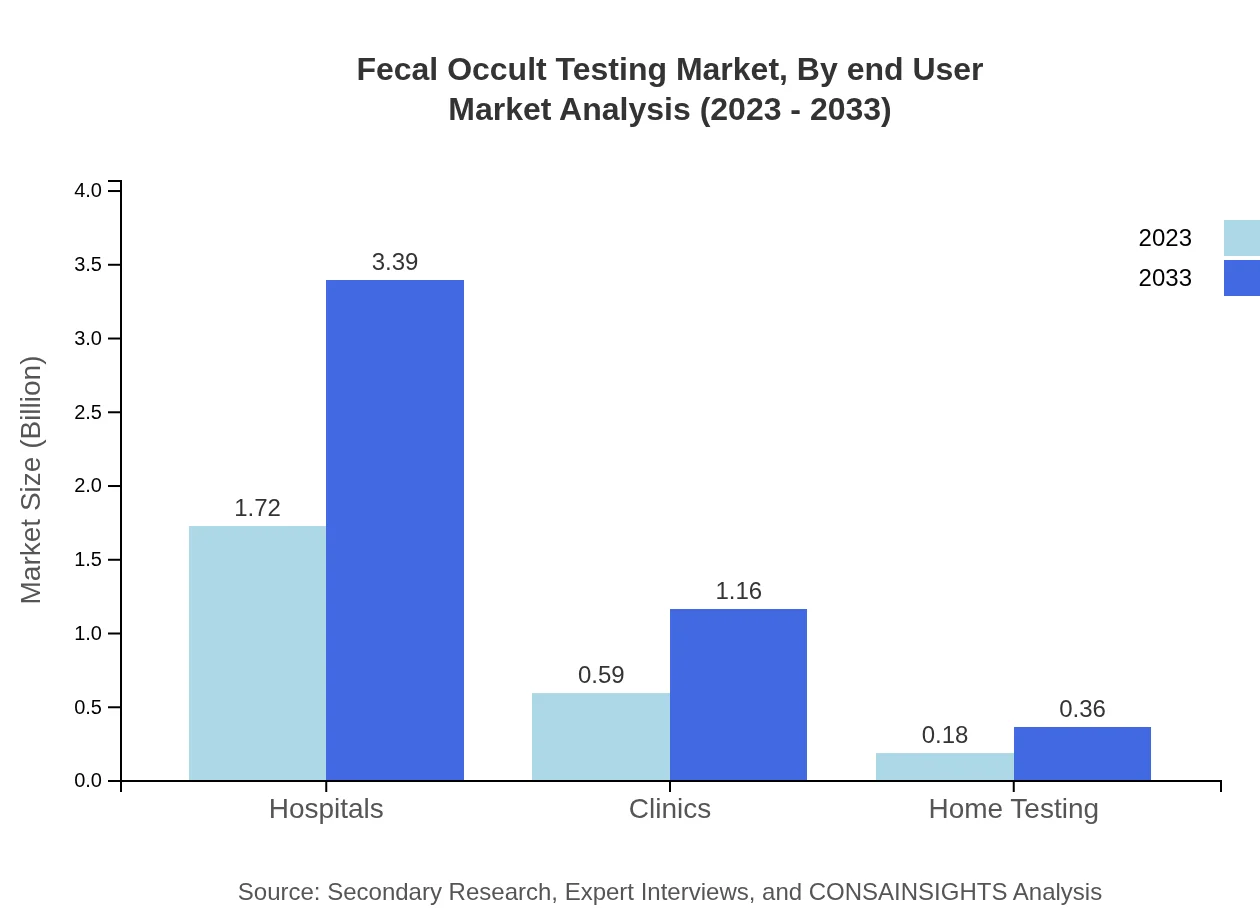
Hospitals lead as key end-users, commanding USD 1.72 billion in 2023 (68.98% share) and expanding to USD 3.39 billion by 2033. Clinics and home testing exhibit notable growth too, with clinics rising from USD 0.59 billion to USD 1.16 billion and home testing from USD 0.18 billion to USD 0.36 billion, showcasing the broadening scope of fecal testing.
Fecal Occult Testing Market Analysis By Revenue Model
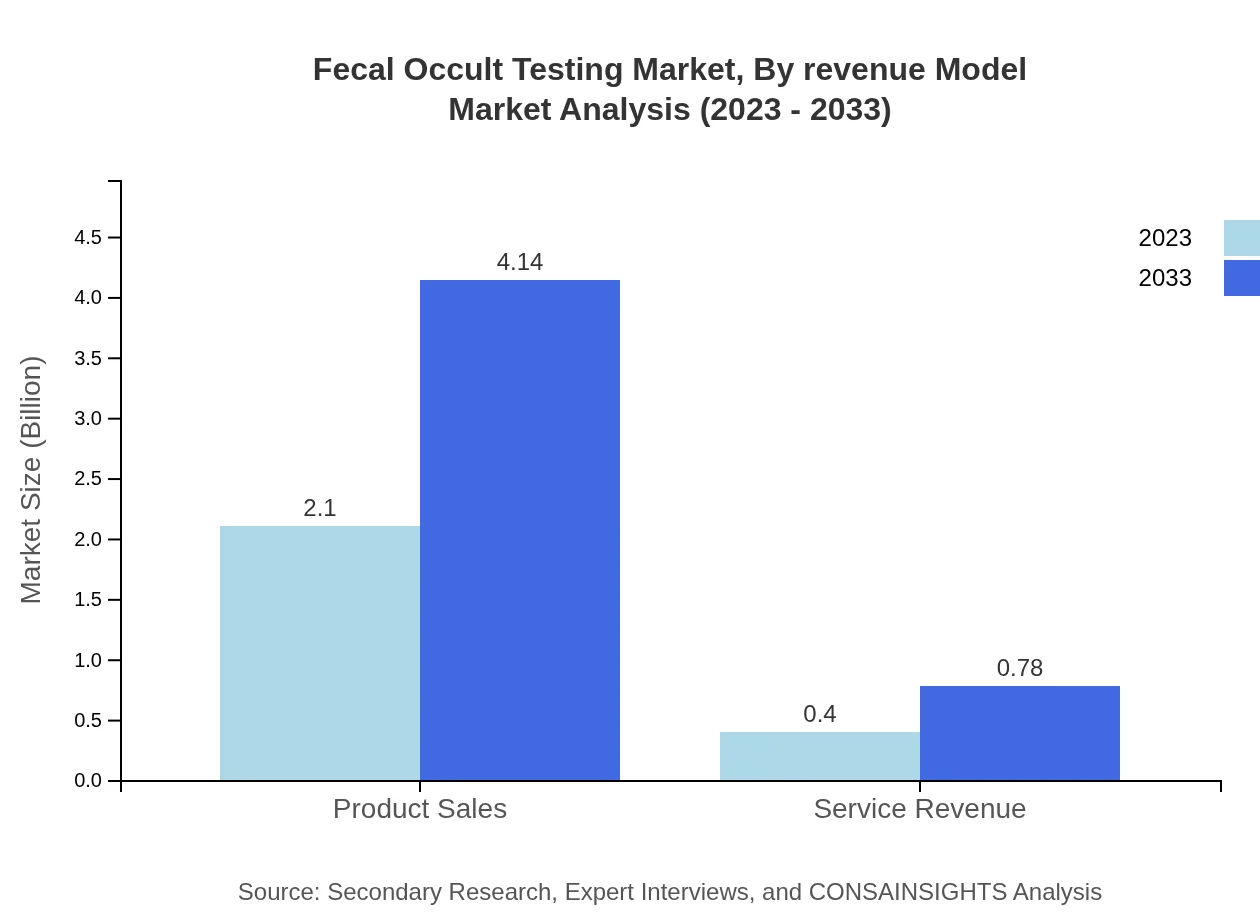
As of 2023, product sales dominate with USD 2.10 billion and a consistent 84.19% market share, expected to rise to USD 4.14 billion by 2033. Service revenue follows with a smaller yet important contribution, growing from USD 0.40 billion to USD 0.78 billion, reflecting costs associated with additional diagnostic services.
Fecal Occult Testing Market Trends and Future Forecast
Tell us your focus area and get a customized research report.
Global Market Leaders and Top Companies in Fecal Occult Testing Industry
Abbott Laboratories:
A leading global healthcare company known for its diagnostic solutions in fecal occult blood testing, focusing on innovation and precision in patient care.F. Hoffmann-La Roche Ltd.:
Prominent for its investments in advanced testing methodologies and a comprehensive approach to colorectal screening solutions.Beckman Coulter, Inc.:
Specializes in diagnostic instruments and tests, making significant contributions to lab automation and efficiency in fecal occult testing.Siemens Healthineers:
Provides innovative diagnostic solutions and significantly invests in research to improve patient diagnostic methodologies.Cardinal Health, Inc.:
Offers a wide range of medical products and services, including key diagnostics resources for fecal occult testing, contributing to improved healthcare outcomes.We're grateful to work with incredible clients.







FAQs
What is the market size of the fecal occult testing market in 2023?
The market size in 2023 is $2.50 Billion as reported for the global fecal occult testing market, serving as the baseline for the 2023 to 2033 forecast period.
How big will the market be in 2033?
The market is projected to reach $4.91 Billion by 2033 according to the provided forecast, reflecting growth across product, test method, and end-user segments.
What is CAGR for the forecast period?
The compound annual growth rate (CAGR) for the forecast period 2023 to 2033 is 6.8%, based on the reported 2023 and 2033 market values.
Is there a single fastest Growing region in the Fecal Occult Testing Market Report market?
No single fastest-growing region is stated for the Fecal Occult Testing Market Report market because the top regional implied CAGR values are within 0.15 percentage points of each other, making the ranking too close to call reliably.
Which companies are listed as market leaders?
Top companies cited include Abbott Laboratories, F. Hoffmann-La Roche Ltd., Beckman Coulter, Inc., Siemens Healthineers, and Cardinal Health, Inc., reflecting major diagnostic players.
What are the main product types covered?
Primary product types include Test Kits and Accessories, which are tracked across manual and automated testing approaches and across end-users such as hospitals and home testing.
How are end Users segmented in the report?
End-users are segmented into Hospitals, Clinics, and Home Testing, each analyzed for market share and adoption within the broader diagnostic and screening landscape.
What research methods were used to compile the report?
The study used primary interviews with industry experts, secondary research from company reports and publications, data triangulation, and internal validation led by domain experts.
How does the report address regulatory influence?
The report highlights tightening regulatory requirements as a driver for innovation and compliance, pressuring manufacturers to enhance safety, efficacy, and performance of tests.
Why are home testing solutions important?
Home testing offers greater patient convenience and access, supporting screening uptake outside clinical settings and complementing hospital and clinic-based testing pathways.