
Reports >
Life Sciences
>
Hemodynamic Monitoring Market Report

Hemodynamic Monitoring Market Report
First published: 21 October 2024 | Last updated: 28 May 2026 | Report Code: hemodynamic-monitoring
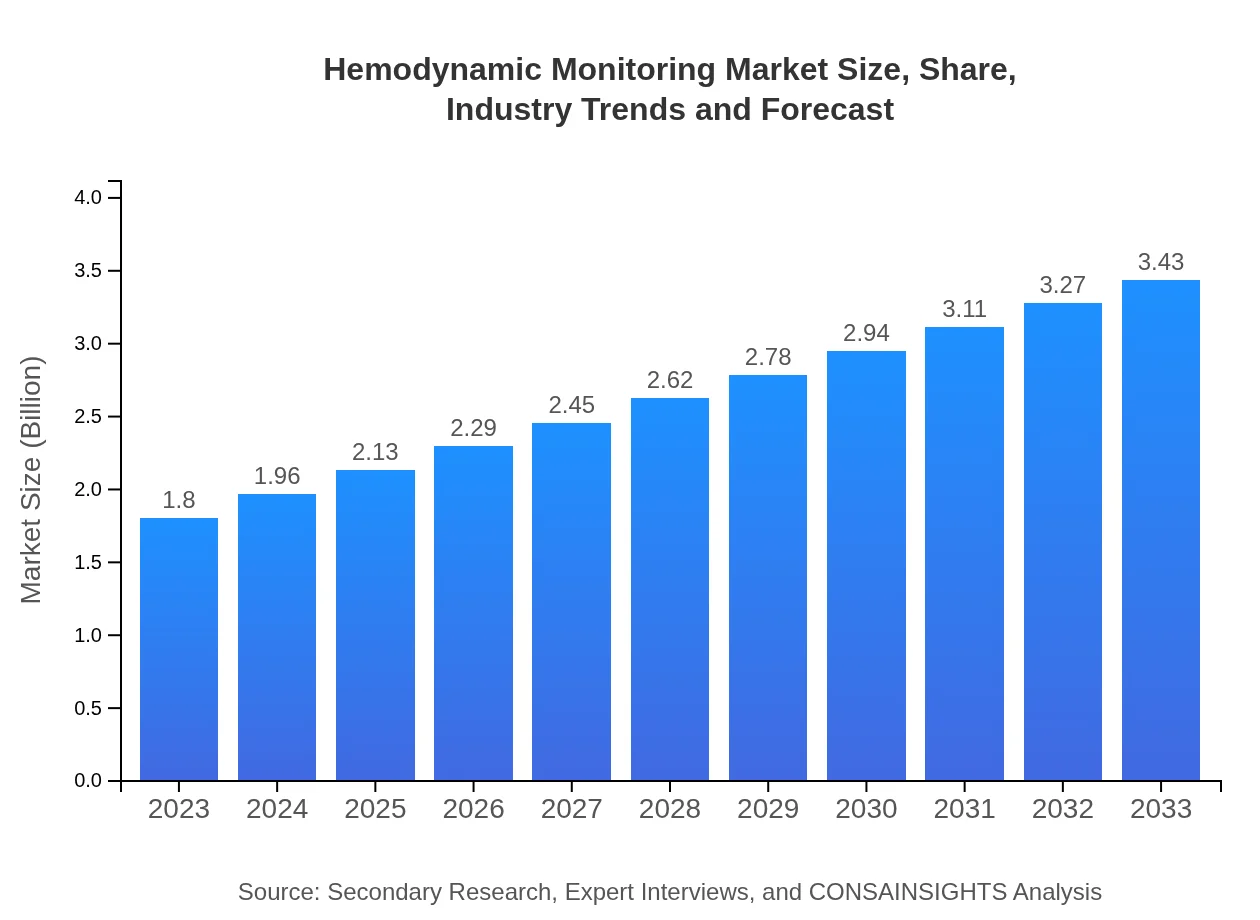
Hemodynamic Monitoring Market — USD 1.8 billion in 2023, Growing to USD 3.43B by 2033 at 6.5% CAGR
This detailed market report covers insights on the Hemodynamic Monitoring market, including market size, growth trends, industry analysis, and forecasts from 2023 to 2033.
Key Takeaways
- Global market rises from $1.80 Billion in 2023 to $3.43 Billion by 2033 at a 6.5% CAGR.
- North America is largest regional market; Middle East and Africa is regional market region based on implied CAGR across 2023 to 2033.
- North America leads regional market value, growing from $0.65 Billion in 2023 to $1.25 Billion in 2033.
- Middle East and Africa records the highest implied growth at a 7.18% CAGR, moving from $0.09 Billion to $0.18 Billion.
- Non-invasive monitoring, wearable devices, and digital continuous solutions are prominent subsegments across product and technology classifications.
- Top vendors include Edwards Lifesciences, Medtronic, GE Healthcare, and Philips Healthcare.
- End users span hospitals, ambulatory surgical centers, and home care settings, reflecting a shift toward decentralized monitoring.
Hemodynamic Monitoring Market Report — Executive Summary
Regional analysis shows North America as largest market and Middle East and Africa as fastest-growing region by implied CAGR. This report provides a concise evaluation of the Hemodynamic Monitoring Market between 2023 and 2033. The market’s expansion from $1.80 Billion to $3.43 Billion at a 6.5% CAGR reflects rising clinical demand for continuous cardiovascular assessment and greater adoption of non-invasive and wearable technologies. Key influences include demographic trends, increased healthcare spending, and integration of monitoring systems into acute and home care workflows. The analysis covers product categories such as invasive and non-invasive devices, wearable solutions, and technology types including continuous, digital, and manual approaches. Regional breakdowns detail starting and ending market values for North America, Europe, Asia Pacific, Latin America, and Middle East and Africa, with North America identified as the largest regional market and Middle East and Africa noted for its implied rapid expansion. Competitive profiling highlights major providers—Edwards Lifesciences, Medtronic, GE Healthcare, and Philips Healthcare—while methodological notes describe primary and secondary data gathering, triangulation, and expert validation used to support findings.
Key Growth Drivers
- Rising prevalence of cardiovascular conditions increasing clinical need for hemodynamic monitoring solutions.
- Adoption of non-invasive and wearable devices enabling continuous patient assessment outside traditional ICU settings.
- Healthcare infrastructure upgrades and higher expenditure supporting integration of digital monitoring platforms.
- Expansion of home care and ambulatory services driving demand for portable and user-friendly monitoring systems.
- Technological progress in continuous and digital monitoring improving data accuracy and clinical decision support.
| Metric | Value |
|---|---|
| Study Period | 2023 - 2033 |
| 2023 Market Size | $1.80 Billion |
| CAGR (2023-2033) | 6.5% |
| 2033 Market Size | $3.43 Billion |
| Top Companies | Edwards Lifesciences, Medtronic , GE Healthcare, Philips Healthcare |
| Published Date | 21 October 2024 |
| Last Modified Date | 28 May 2026 |
Hemodynamic Monitoring Market Overview
Customize Hemodynamic Monitoring Market Report market research report
- ✔ Get in-depth analysis of Hemodynamic Monitoring market size, growth, and forecasts.
- ✔ Understand Hemodynamic Monitoring's regional dynamics and industry-specific trends.
- ✔ Identify potential applications, end-user demand, and growth segments in Hemodynamic Monitoring
What is the Market Size & CAGR of Hemodynamic Monitoring Market Report market in 2023?
Hemodynamic Monitoring Industry Analysis
Hemodynamic Monitoring Market Segmentation and Scope
Tell us your focus area and get a customized research report.
Hemodynamic Monitoring Market Report Market Analysis Report by Region
Europe Hemodynamic Monitoring Market Report:
Europe grows from $0.6 Billion in 2023 to $1.14 Billion in 2033. Regional adoption is influenced by growing emphasis on non-invasive techniques, integration of monitoring into hospital workflows, and initiatives to enhance patient monitoring capacity across acute and perioperative care.Asia Pacific Hemodynamic Monitoring Market Report:
Asia Pacific grows from $0.32 Billion in 2023 to $0.62 Billion in 2033. Market movement reflects rising healthcare expenditure, broader access to monitoring devices, and growing use of portable and wearable systems in both hospital and ambulatory contexts.North America Hemodynamic Monitoring Market Report:
North America is largest regional market, rising from $0.65 Billion in 2023 to $1.25 Billion in 2033. This regional performance aligns with sustained demand in acute care, adoption of advanced monitoring systems, and investment in healthcare infrastructure supporting bedside and continuous technologies.South America Hemodynamic Monitoring Market Report:
Latin America grows from $0.13 Billion in 2023 to $0.25 Billion in 2033. Development is driven by expanding clinical infrastructure, gradual uptake of digital monitoring solutions, and increasing focus on improving cardiovascular care access.Middle East & Africa Hemodynamic Monitoring Market Report:
Middle East and Africa is fastest-growing region by implied CAGR, increasing from $0.09 Billion in 2023 to $0.18 Billion in 2033. 09 Billion in 2023 to $0.18 Billion in 2033, registering an implied 7.18% CAGR. Growth is propelled by investments in healthcare capacity, adoption of non-invasive and wearable monitoring options, and efforts to expand services beyond central hospitals.Tell us your focus area and get a customized research report.
Research Methodology
Hemodynamic Monitoring Market Analysis By Product
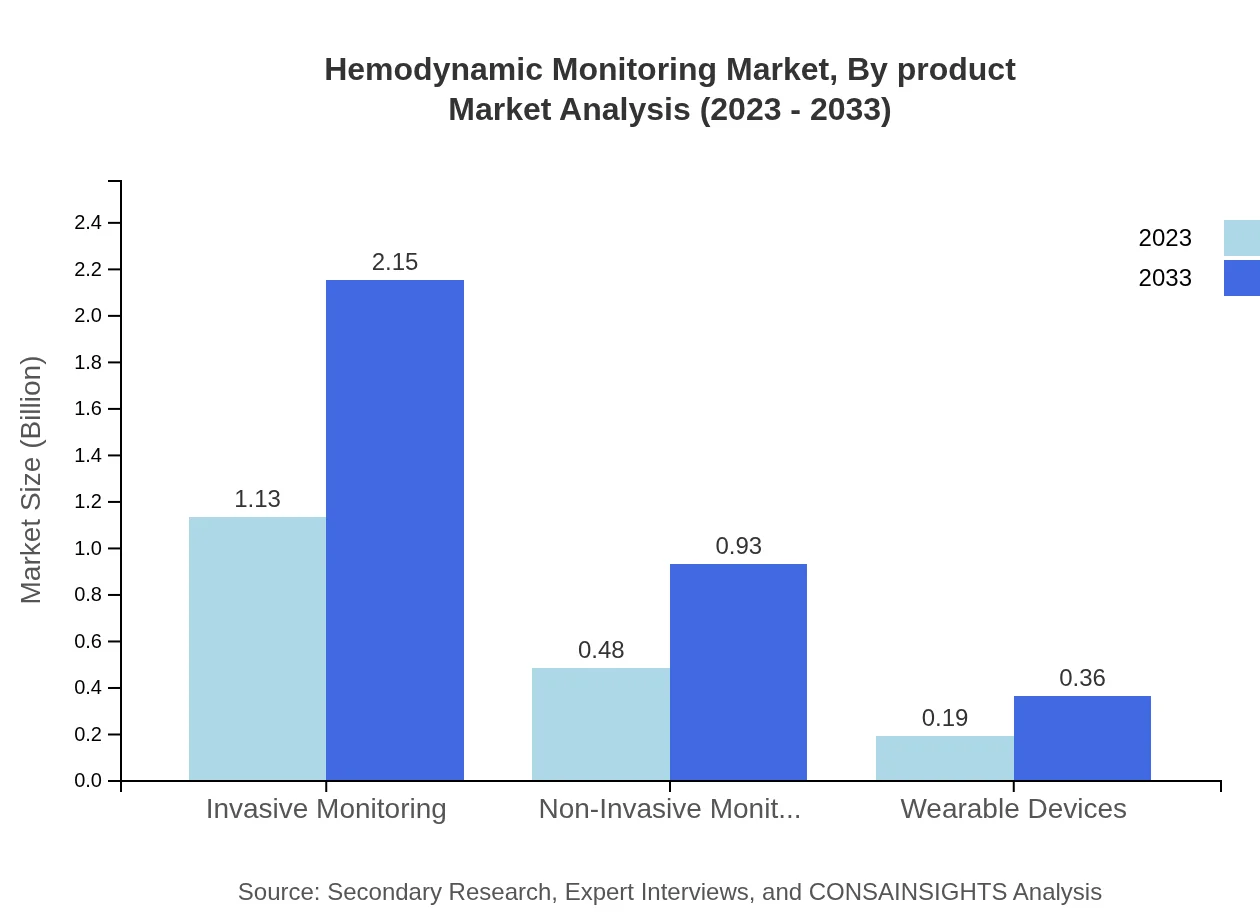
The Hemodynamic Monitoring market by product includes invasive monitoring devices, non-invasive monitoring devices, and wearable devices. Invasive monitoring holds the largest share, accounting for $1.13 billion in 2023 and set to increase to $2.15 billion by 2033. Non-invasive devices also show growth, from $0.48 billion in 2023 to $0.93 billion in 2033, reflecting increasing preferences for patient comfort. Wearable devices, projected to expand from $0.19 billion in 2023 to $0.36 billion by 2033, indicate a growing trend towards remote monitoring.
Hemodynamic Monitoring Market Analysis By Technology
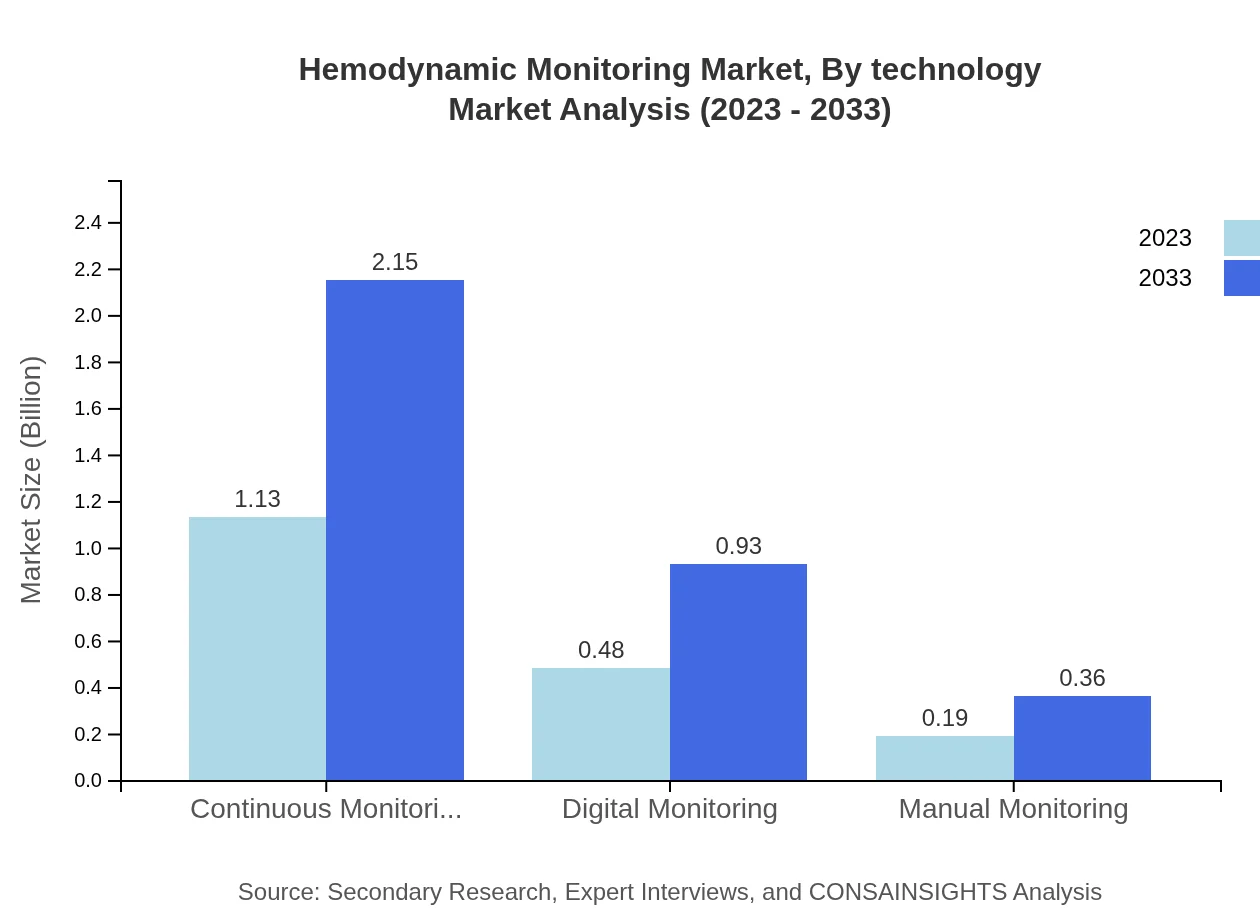
Market segments based on technology include continuous monitoring, digital monitoring, and manual monitoring. Continuous monitoring leads with a size of $1.13 billion in 2023, expected to rise to $2.15 billion by 2033. Digital monitoring is also expected to grow, moving from $0.48 billion to $0.93 billion, while manual monitoring remains the smallest segment, starting at $0.19 billion in 2023 and reaching $0.36 billion in 2033, reflecting shifting preferences towards automated solutions.
Hemodynamic Monitoring Market Analysis By Application
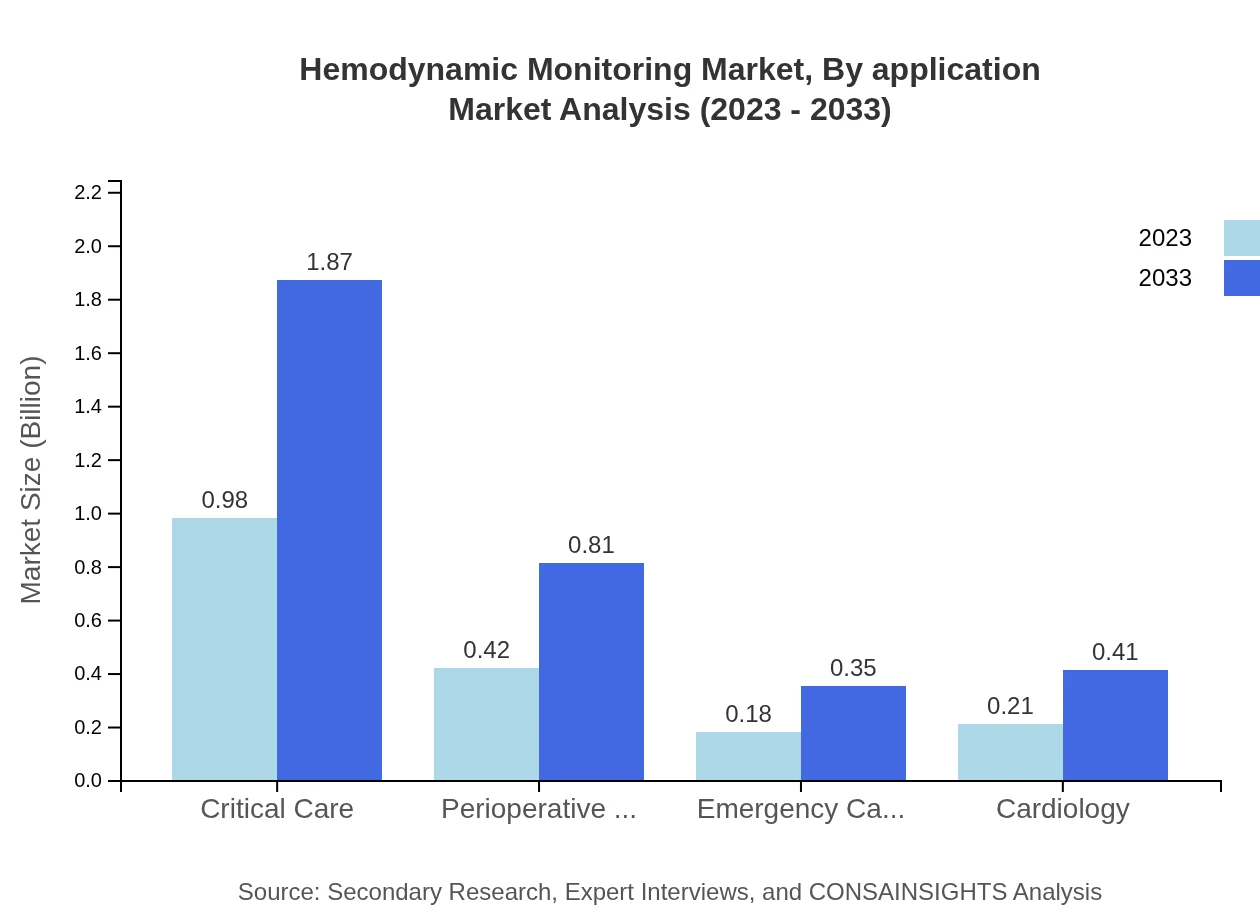
The applications of Hemodynamic Monitoring include critical care, perioperative care, and emergency care. Critical care represents the largest application, with a market size of $0.98 billion in 2023, rising to $1.87 billion by 2033. Perioperative care is also significant, growing from $0.42 billion to $0.81 billion. Emergency care, while smaller, shows positive growth from $0.18 billion to $0.35 billion as rapid response times become essential.
Hemodynamic Monitoring Market Analysis By End User
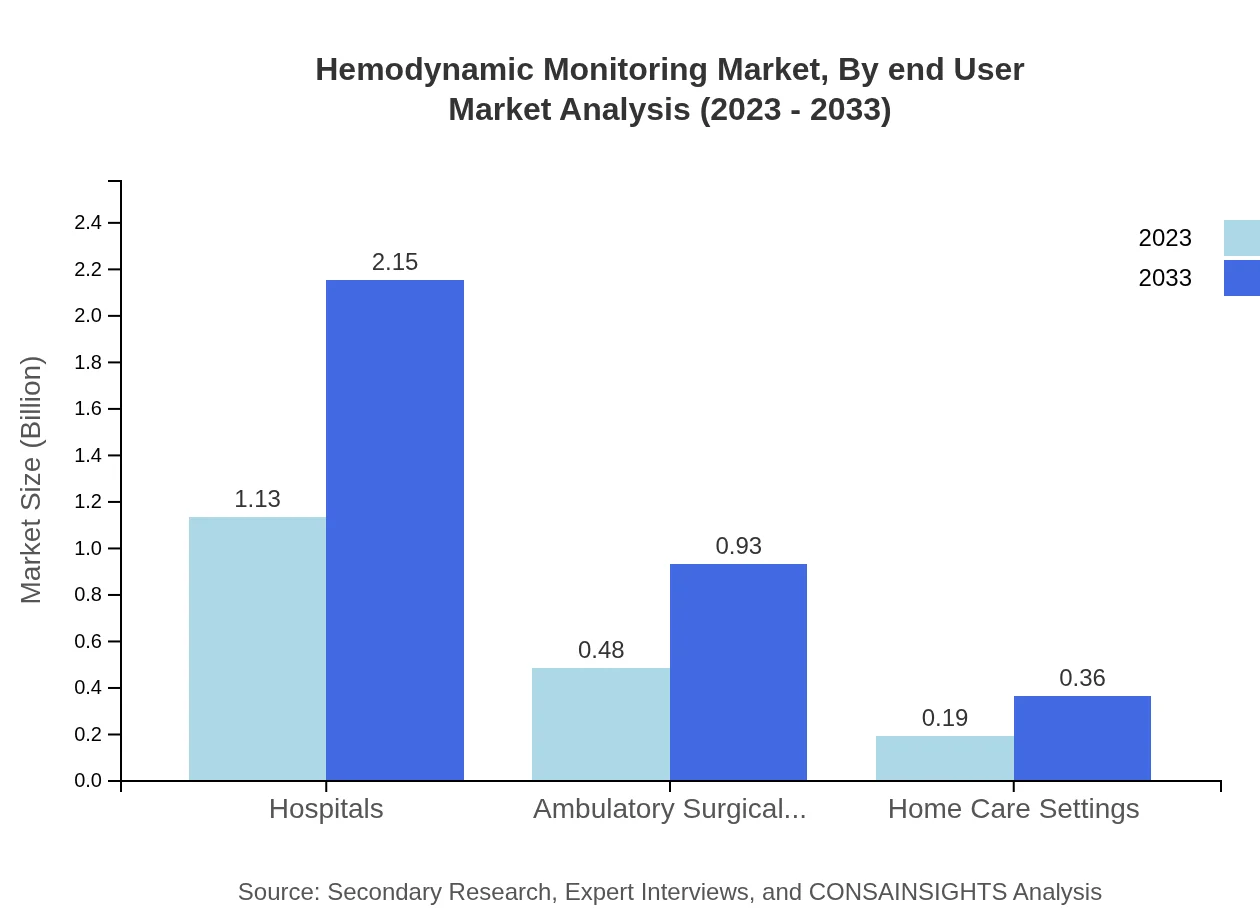
The primary end-users in this market consist of hospitals, ambulatory surgical centers, and home care settings. Hospitals are the leading segment, with sizes of $1.13 billion in 2023 and an expected increase to $2.15 billion by 2033. Ambulatory surgical centers also grow from $0.48 billion to $0.93 billion. Home care settings represent a smaller segment but still important, moving from $0.19 billion to $0.36 billion as remote healthcare services gain traction.
Hemodynamic Monitoring Market Trends and Future Forecast
Tell us your focus area and get a customized research report.
Global Market Leaders and Top Companies in Hemodynamic Monitoring Industry
Edwards Lifesciences:
Edwards Lifesciences is a global leader in innovative cardiovascular disease monitoring, providing advanced hemodynamic monitoring solutions, including the Swan-Ganz catheter and non-invasive monitoring technologies.Medtronic :
Medtronic is a prominent player in the healthcare market, offering a range of hemodynamic monitoring systems that integrate into existing hospital architectures, enhancing data sharing and patient management.GE Healthcare:
GE Healthcare specializes in a range of medical imaging and monitoring solutions, providing advanced hemodynamic monitoring devices that support critical care and perioperative environments.Philips Healthcare:
Philips Healthcare develops innovative healthcare technologies, focusing on improving patient outcomes and enhancing clinical workflows through its robust hemodynamic monitoring systems.We're grateful to work with incredible clients.









FAQs
What is the market size of the Hemodynamic Monitoring Market Report in 2023?
The market size in 2023 is $1.80 Billion, as stated in the report’s baseline year data.
How big will the market be in 2033?
The forecasted market value for 2033 is $3.43 Billion according to the provided projections.
What is CAGR for the forecast period?
The report specifies a compound annual growth rate of 6.5% for the 2023 to 2033 forecast period.
Which region is the fastest Growing in the Hemodynamic Monitoring Market Report market?
Middle East and Africa is the fastest-growing region, projected to expand from $0.09 Billion in 2023 to $0.18 Billion in 2033, reflecting an implied 7.18% CAGR over the forecast period.
Which region is the fastest Growing?
Middle East and Africa is noted as the regional market region at an implied 7.18% CAGR, rising from $0.09 Billion to $0.18 Billion.
Who are the top companies in this market?
Top companies listed include Edwards Lifesciences, Medtronic, GE Healthcare, and Philips Healthcare as principal industry participants.
What are the primary product subsegments covered?
Product subsegments include invasive monitoring, non-invasive monitoring, and wearable devices, reflecting a mix of bedside and portable solutions.
Why is non Invasive monitoring significant in this market?
Non-invasive monitoring reduces procedural risk, supports patient comfort, and enables broader adoption in ambulatory and home care environments, encouraging market uptake.
How are end User segments defined?
End-user segments comprise hospitals, ambulatory surgical centers, and home care settings, indicating both institutional and decentralized care applications.
What technology categories are analyzed?
The report covers continuous monitoring, digital monitoring, and manual monitoring as primary technology classifications.