
Reports >
Life Sciences
>
Hemoglobin Analyzer Market Report

Hemoglobin Analyzer Market Report
First published: 12 October 2024 | Last updated: 25 May 2026 | Report Code: hemoglobin-analyzer
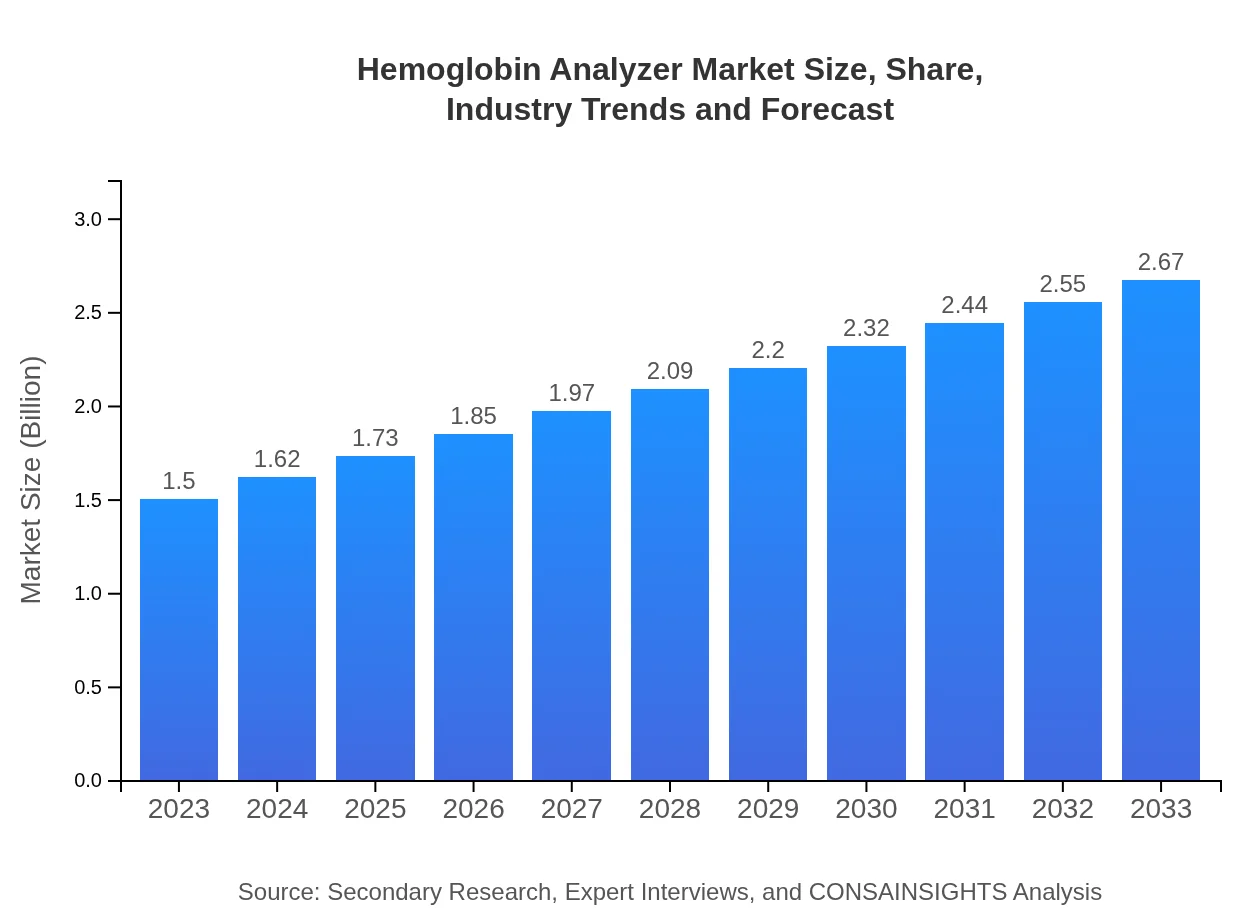
Hemoglobin Analyzer Market — USD 1.5 billion in 2023, Growing to USD 2.67B by 2033 at 5.8% CAGR
This report provides a comprehensive analysis of the Hemoglobin Analyzer market, covering critical insights, market conditions, trends, and forecasts through 2033. The report aims to aid stakeholders in understanding the evolving dynamics of the industry.
Key Takeaways
- Global market value rises from $1.50 Billion in 2023 to $2.67 Billion in 2033 at a 5.8% CAGR.
- North America is largest regional market, while no single fastest-growing region is stated because regional CAGR differences remain within 0.15 percentage points.
- Europe expands from $0.38 Billion to $0.67 Billion over the forecast period, reflecting sustained clinical demand.
- Point-of-care and home-care adoption supports accessibility alongside traditional tabletop analyzers and reagents.
- Leading companies include Beckman Coulter, Inc., Abbott Laboratories, Roche Diagnostics, and Siemens Healthineers.
Hemoglobin Analyzer Market Report — Executive Summary
North America remains largest market by forecast-period value, while no single fastest-growing region is stated because top regional growth rates are separated by less than 0.15 percentage points. The report analyzes the Hemoglobin Analyzer market trajectory from 2023 to 2033, driven by persistent demand for anemia screening, rising diagnostic needs, and advances in point-of-care devices. Market structure covers product types — tabletop analyzers, point-of-care analyzers, and reagents and kits — as well as technologies such as spectrophotometry, electrochemical platforms, and microfluidics. End-user coverage includes hospitals, diagnostic laboratories, blood banks, and home care channels. Regional breakdown highlights North America as the largest market and provides growth profiles for Europe, Asia Pacific, Latin America, and the Middle East and Africa. Competitive dynamics focus on established diagnostic firms including Beckman Coulter, Inc., Abbott Laboratories, Roche Diagnostics, and Siemens Healthineers. The research combines primary expert interviews and secondary company reporting to map trends, adoption patterns, and strategic priorities through 2033.
Key Growth Drivers
- Rising prevalence of anemia and other hematologic disorders increasing diagnostic testing volumes.
- Greater adoption of point-of-care analyzers expanding access outside centralized labs.
- Technological improvements in microfluidics and portable platforms enabling decentralized screening.
- Healthcare policy emphasis on preventive diagnostics and routine anemia screening supporting demand.
- Growing home care and community screening initiatives promoting compact analyzers and rapid tests.
| Metric | Value |
|---|---|
| Study Period | 2023 - 2033 |
| 2023 Market Size | $1.50 Billion |
| CAGR (2023-2033) | 5.8% |
| 2033 Market Size | $2.67 Billion |
| Top Companies | Beckman Coulter, Inc., Abbott Laboratories, Roche Diagnostics, Siemens Healthineers |
| Published Date | 12 October 2024 |
| Last Modified Date | 25 May 2026 |
Hemoglobin Analyzer Market Overview
Customize Hemoglobin Analyzer Market Report market research report
- ✔ Get in-depth analysis of Hemoglobin Analyzer market size, growth, and forecasts.
- ✔ Understand Hemoglobin Analyzer's regional dynamics and industry-specific trends.
- ✔ Identify potential applications, end-user demand, and growth segments in Hemoglobin Analyzer
What is the Market Size & CAGR of Hemoglobin Analyzer Market Report market in 2023?
Hemoglobin Analyzer Industry Analysis
Hemoglobin Analyzer Market Segmentation and Scope
Tell us your focus area and get a customized research report.
Hemoglobin Analyzer Market Report Market Analysis Report by Region
Europe Hemoglobin Analyzer Market Report:
Europe grows from $0.38 Billion in 2023 to $0.67 Billion in 2033. The region's expansion reflects continued screening programs, investments in diagnostic laboratories, and integration of automated analyzers into clinical workflows.Asia Pacific Hemoglobin Analyzer Market Report:
Asia Pacific grows from $0.29 Billion in 2023 to $0.51 Billion in 2033. Growth is supported by rising healthcare access, expanding community screening initiatives, and greater adoption of portable and point-of-care testing across varied care settings.North America Hemoglobin Analyzer Market Report:
North America is largest regional market, rising from $0.52 Billion in 2023 to $0.92 Billion in 2033. Local demand is driven by established clinical infrastructure, adoption of advanced diagnostic platforms, and strong uptake of point-of-care and tabletop systems in hospitals and laboratories.South America Hemoglobin Analyzer Market Report:
Latin America grows from $0.12 Billion in 2023 to $0.21 Billion in 2033. Regional momentum is linked to growing awareness of anemia, scaling of diagnostic services, and incremental uptake of compact analyzers in clinical and community environments.Middle East & Africa Hemoglobin Analyzer Market Report:
Middle East and Africa grows from $0.2 Billion in 2023 to $0.35 Billion in 2033. Drivers include increased diagnostic screening efforts, focus on preventive healthcare, and gradual adoption of point-of-care and decentralized testing solutions.Tell us your focus area and get a customized research report.
Research Methodology
Hemoglobin Analyzer Market Analysis By End User
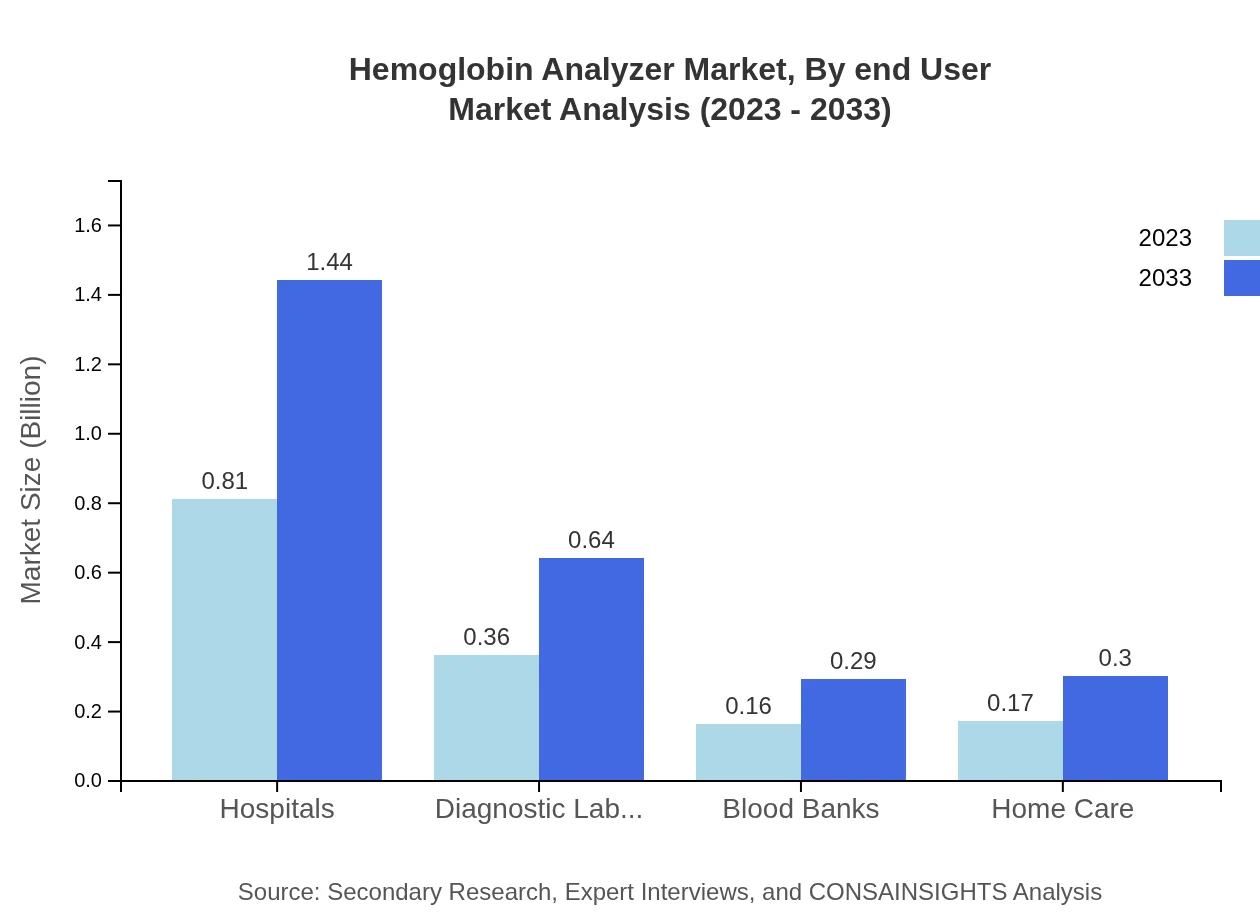
The key end-user segments of the Hemoglobin Analyzer market include Hospitals, Diagnostic Laboratories, Blood Banks, and Home Care settings. Hospitals dominate the market, expected to grow from USD 0.81 billion in 2023 to USD 1.44 billion by 2033, maintaining a market share of 53.88%. Diagnostic Laboratories follow with projections of growth from USD 0.36 billion to USD 0.64 billion, holding a 24.07% share, and Blood Banks are also significant contributors, projected to expand from USD 0.16 billion to USD 0.29 billion.
Hemoglobin Analyzer Market Analysis By Product Type
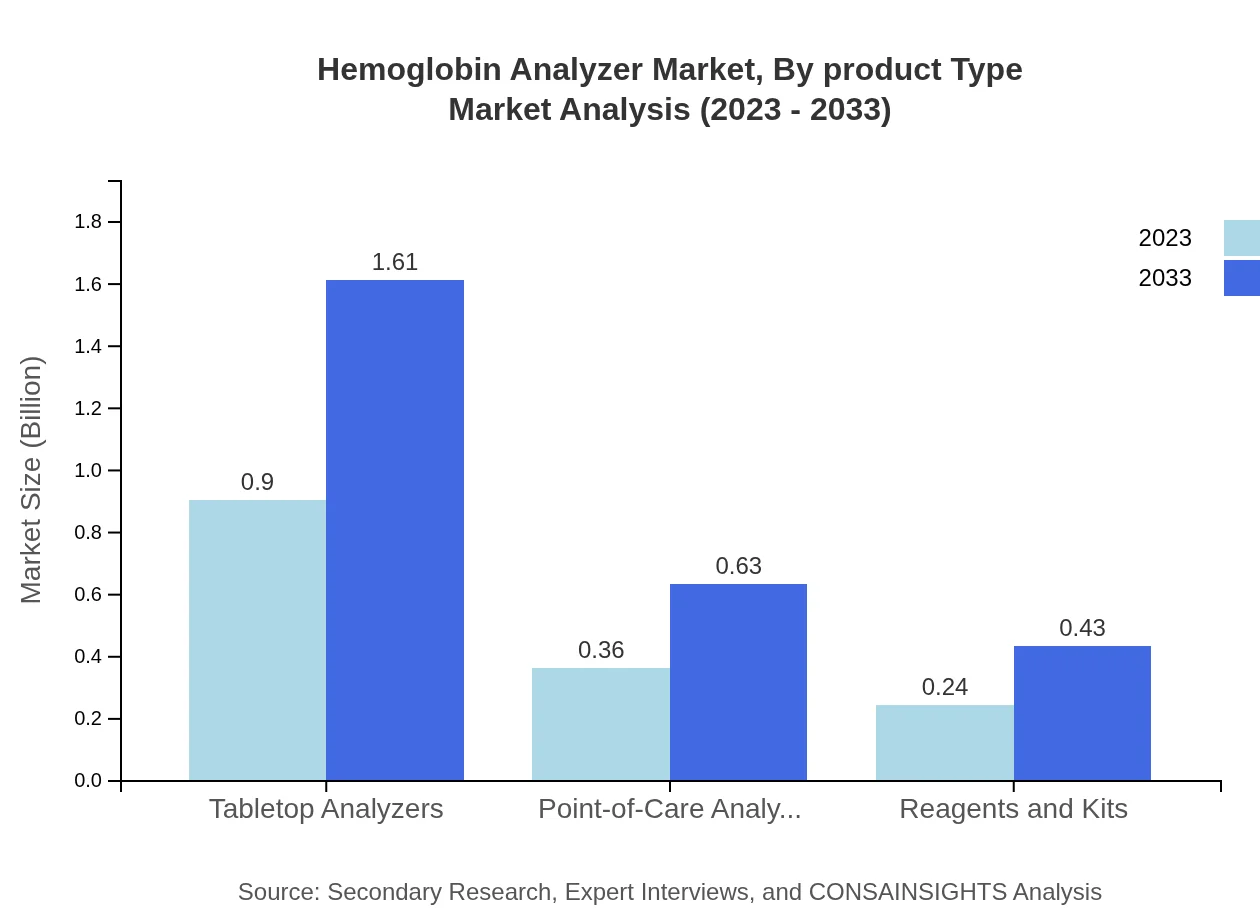
The market segments by product include Tabletop Analyzers, Point-of-Care Analyzers, and Reagents/Kits. Tabletop Analyzers are the largest segment, set to grow from USD 0.90 billion in 2023 to USD 1.61 billion by 2033, representing 60.33% of the market share. Point-of-Care Analyzers are also significant, expected to increase from USD 0.36 billion to USD 0.63 billion, holding a 23.73% share.
Hemoglobin Analyzer Market Analysis By Technology
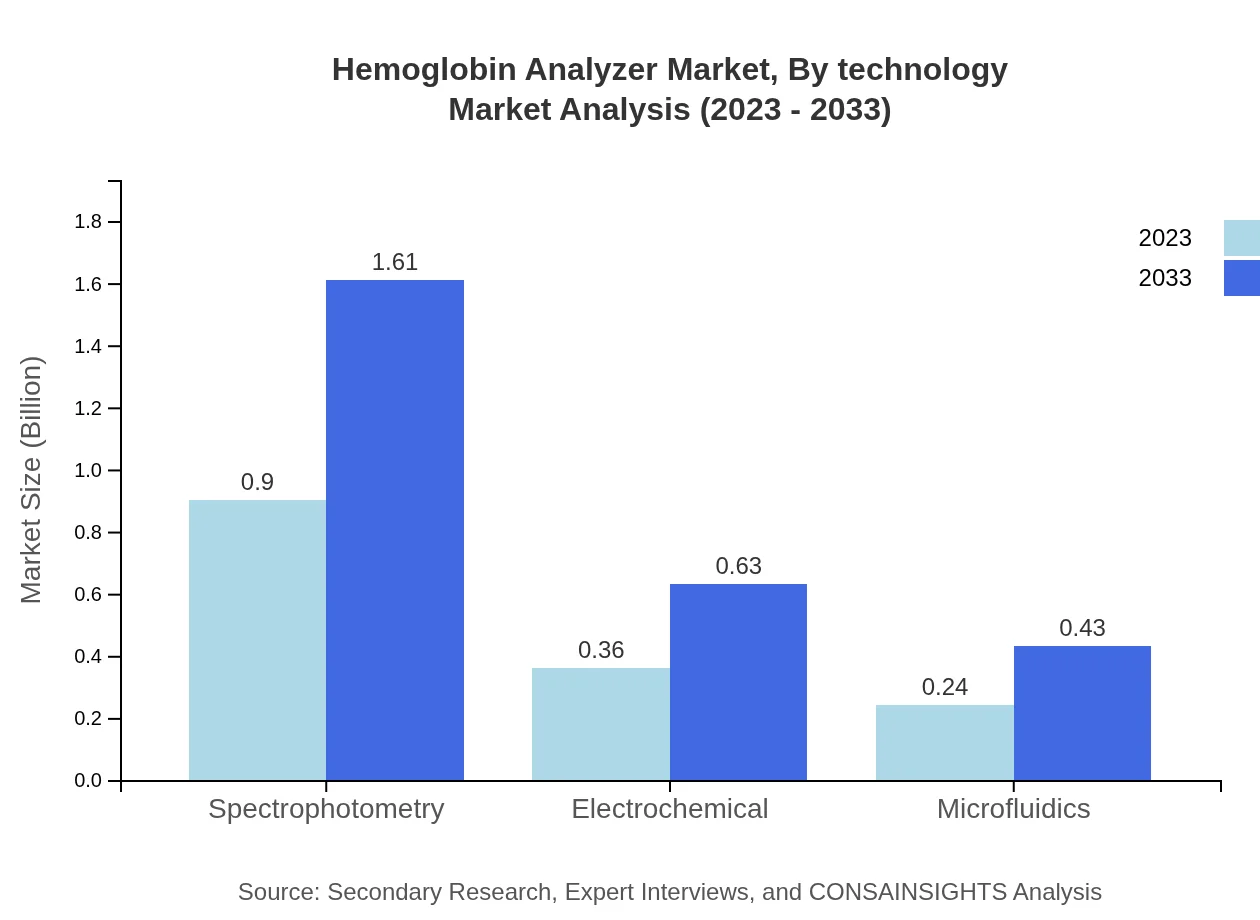
Technological advancements categorize the Hemoglobin Analyzer market into various segments including Spectrophotometry, Electrochemical, and Microfluidics technologies. Spectrophotometry leads the market with a value of USD 0.90 billion in 2023, expected to reach USD 1.61 billion by 2033 (60.33% share). Electrochemical technology is poised to grow from USD 0.36 billion to USD 0.63 billion, with Microfluidics growing from USD 0.24 billion to USD 0.43 billion.
Hemoglobin Analyzer Market Analysis By Application
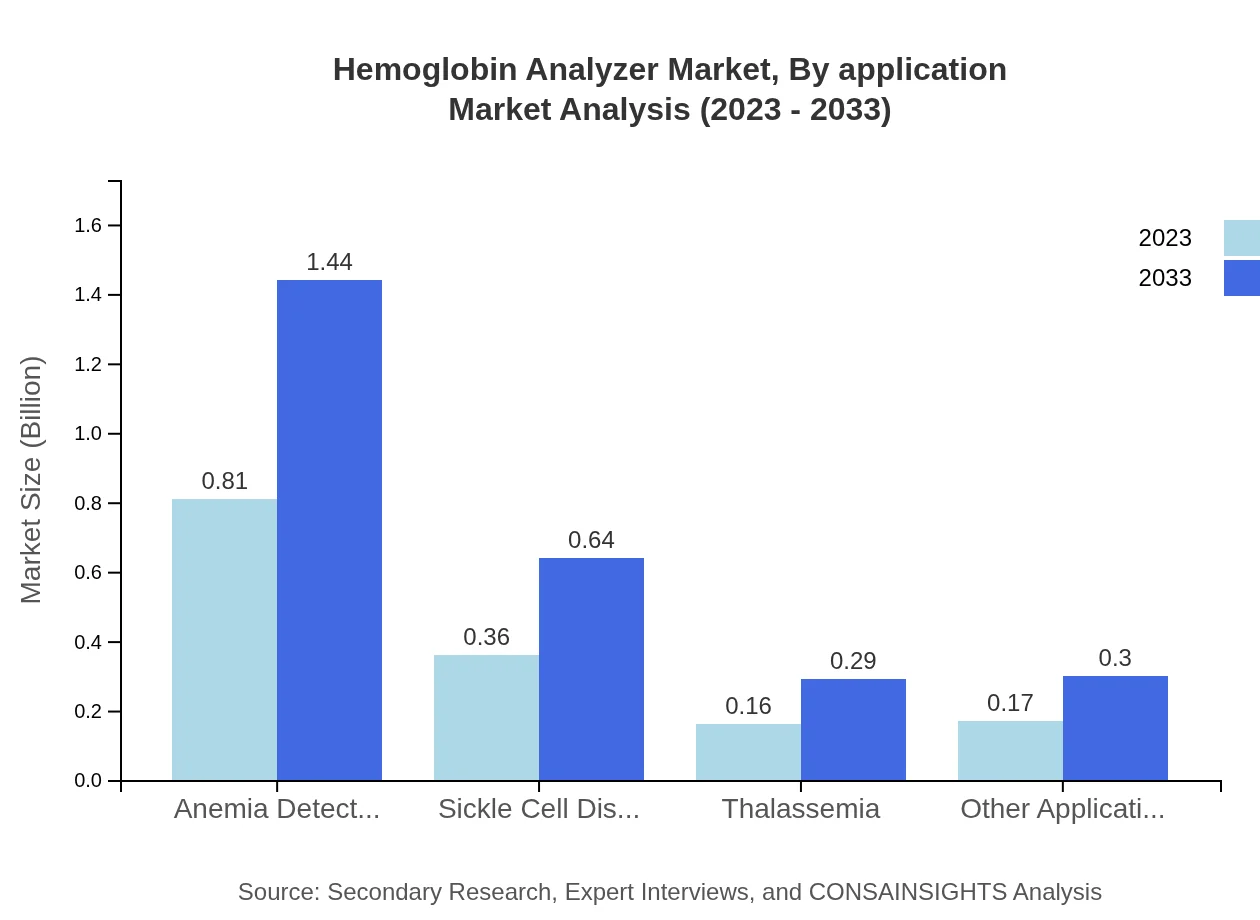
Applications of the Hemoglobin Analyzer include Anemia Detection, Sickle Cell Disease testing, and Thalassemia screening. Anemia detection remains a major focus, with a market size of USD 0.81 billion in 2023, projected to grow to USD 1.44 billion by 2033, comprising 53.88% of the total application market. Other applications such as Sickle Cell Disease are also increasing, with growth from USD 0.36 billion to USD 0.64 billion.
Hemoglobin Analyzer Market Trends and Future Forecast
Tell us your focus area and get a customized research report.
Global Market Leaders and Top Companies in Hemoglobin Analyzer Industry
Beckman Coulter, Inc.:
A leader in clinical hematology, Beckman Coulter offers innovative solutions for blood testing, enhancing efficiency and reliability in hemoglobin levels measurement.Abbott Laboratories:
Abbott provides a range of advanced diagnostic solutions, including portable hemoglobin analyzers that facilitate point-of-care testing for accurate anemia assessment.Roche Diagnostics:
Specializing in diagnostic solutions, Roche's innovative hemoglobin analyzers are renowned for their precision and are widely used in hospitals and clinics globally.Siemens Healthineers:
Siemens focuses on integrated diagnostics, delivering high-quality hemoglobin testing solutions that ensure accurate results in diverse healthcare settings.We're grateful to work with incredible clients.









FAQs
What is the market size of the Hemoglobin Analyzer market in 2023?
The market size in 2023 is $1.50 Billion as reported for the global hemoglobin analyzer market.
How big is the market expected to be in 2033?
The market is expected to reach $2.67 Billion by 2033 according to the provided forecast data.
What is CAGR of the Hemoglobin Analyzer market for 2023 to 2033?
The compound annual growth rate for the period 2023 to 2033 is 5.8% as specified in the report data.
Is there a single fastest Growing region in the Hemoglobin Analyzer Market Report market?
No single fastest-growing region is stated for the Hemoglobin Analyzer Market Report market because the top regional implied CAGR values are within 0.15 percentage points of each other, making the ranking too close to call reliably.
Which companies are named as leading players?
Top companies listed include Beckman Coulter, Inc., Abbott Laboratories, Roche Diagnostics, and Siemens Healthineers in the input data.
What are the main product categories covered?
Product categories include tabletop analyzers, point-of-care analyzers, and reagents and kits as provided in the segment data.
What are the primary technologies used in hemoglobin analyzers?
Technologies specified are spectrophotometry, electrochemical methods, and microfluidics in the input segment facts.
How is the market research conducted?
The methodology comprises primary interviews with industry experts, secondary research of company reports and publications, data triangulation, and internal validation.