

Heparin Market Report
First published: 10 October 2024 | Last updated: 28 May 2026 | Report Code: heparin
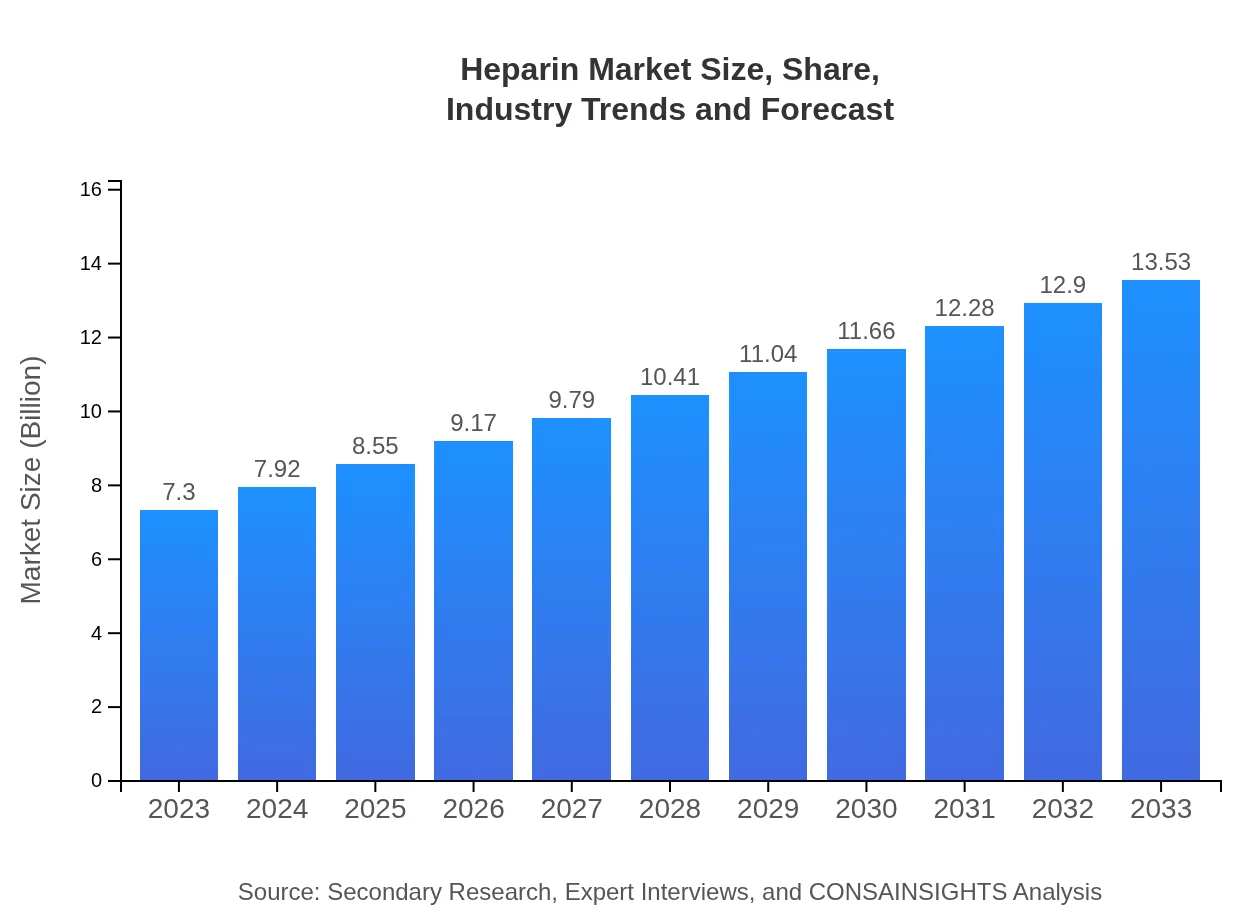
Heparin Market — USD $7.3 Billion in 2023, Growing to USD 13.53null by 2033 at 6.2% CAGR
This report provides comprehensive insights into the Heparin market, covering market size, growth trends, industry analysis, and forecasts for 2023-2033. It includes details on segmentation, regional insights, key players, and emerging trends shaping the future of Heparin.
Key Takeaways
- Global market expands from $7.30 Billion in 2023 to $13.53 Billion in 2033 at a 6.2% CAGR.
- North America is largest regional market; Latin America is regional market region based on implied CAGR across 2023 to 2033.
- Latin America is the regional market region, increasing from $0.17 Billion in 2023 to $0.32 Billion in 2033.
- Europe and Asia Pacific show notable growth: Europe from $2.38 Billion to $4.41 Billion; Asia Pacific from $1.23 Billion to $2.28 Billion.
Heparin Market Report — Executive Summary
Regional analysis shows North America as largest market and Latin America as fastest-growing region by implied CAGR. This report examines the Heparin market through 2033, highlighting a rise from $7.30 Billion in 2023 to $13.53 Billion in 2033 at a 6.2% CAGR. Demand is supported by expanding use in anticoagulation therapies and growth in surgical volumes and cardiovascular care. The analysis covers product subsegments—Unfractionated Heparin, Low Molecular Weight Heparins (LMWH), and Heparinoids—alongside end users such as hospitals, homecare, and clinics. Regional coverage details market movement in North America, Europe, Asia Pacific, Latin America, and the Middle East and Africa. The competitive overview references established players including Sanofi, Baxter International Inc., Pfizer Inc., Bristol-Myers Squibb, and Novartis AG. Methodology combines expert interviews, company reports, and internal validation to ensure robust trend interpretation and segment-level clarity for strategic planning.
Key Growth Drivers
- Rising prevalence of cardiovascular conditions increases demand for anticoagulant therapies.
- Expansion in surgical procedures and hospital services raises consumption of injectable anticoagulants.
- Continued formulation and delivery improvements enhance clinical adoption and patient compliance.
- Wider availability in emerging regional markets supports volumetric growth across distribution channels.
| Metric | Value |
|---|---|
| Study Period | 2023 - 2033 |
| 2023 Market Size | $7.30 Billion |
| CAGR (2023-2033) | 6.2% |
| 2033 Market Size | $13.53 Billion |
| Top Companies | Sanofi, Baxter International Inc., Pfizer Inc., Bristol-Myers Squibb, Novartis AG |
| Published Date | 10 October 2024 |
| Last Modified Date | 28 May 2026 |
Heparin Market Overview
Customize Heparin Market Report market research report
- ✔ Get in-depth analysis of Heparin market size, growth, and forecasts.
- ✔ Understand Heparin's regional dynamics and industry-specific trends.
- ✔ Identify potential applications, end-user demand, and growth segments in Heparin
What is the Market Size & CAGR of Heparin Market Report market in 2023?
Heparin Industry Analysis
Heparin Market Segmentation and Scope
Tell us your focus area and get a customized research report.
Heparin Market Report Market Analysis Report by Region
Europe Heparin Market Report:
Europe grows from $2.38 Billion in 2023 to $4.41 Billion in 2033. Expansion reflects sustained use in cardiovascular care and perioperative settings, alongside ongoing product development and regulatory oversight.Asia Pacific Heparin Market Report:
Asia Pacific grows from $1.23 Billion in 2023 to $2.28 Billion in 2033. Growth is linked to expanding healthcare access, rising surgical procedures, and increasing prevalence of conditions requiring anticoagulation.North America Heparin Market Report:
North America is largest regional market, rising from $2.7 Billion in 2023 to $5 Billion in 2033. Regional demand is supported by extensive hospital networks, high procedural volumes, and established clinical adoption of anticoagulant therapies.South America Heparin Market Report:
Latin America is fastest-growing region by implied CAGR, increasing from $0.17 Billion in 2023 to $0.32 Billion in 2033. The region is identified as the fastest-growing, supported by improving healthcare infrastructure and broader availability of anticoagulant therapies.Middle East & Africa Heparin Market Report:
Middle East and Africa grows from $0.82 Billion in 2023 to $1.51 Billion in 2033. Market expansion is driven by growing healthcare investments, rising procedural volumes, and enhanced access to specialty therapies.Tell us your focus area and get a customized research report.
Research Methodology
Heparin Market Analysis By Product
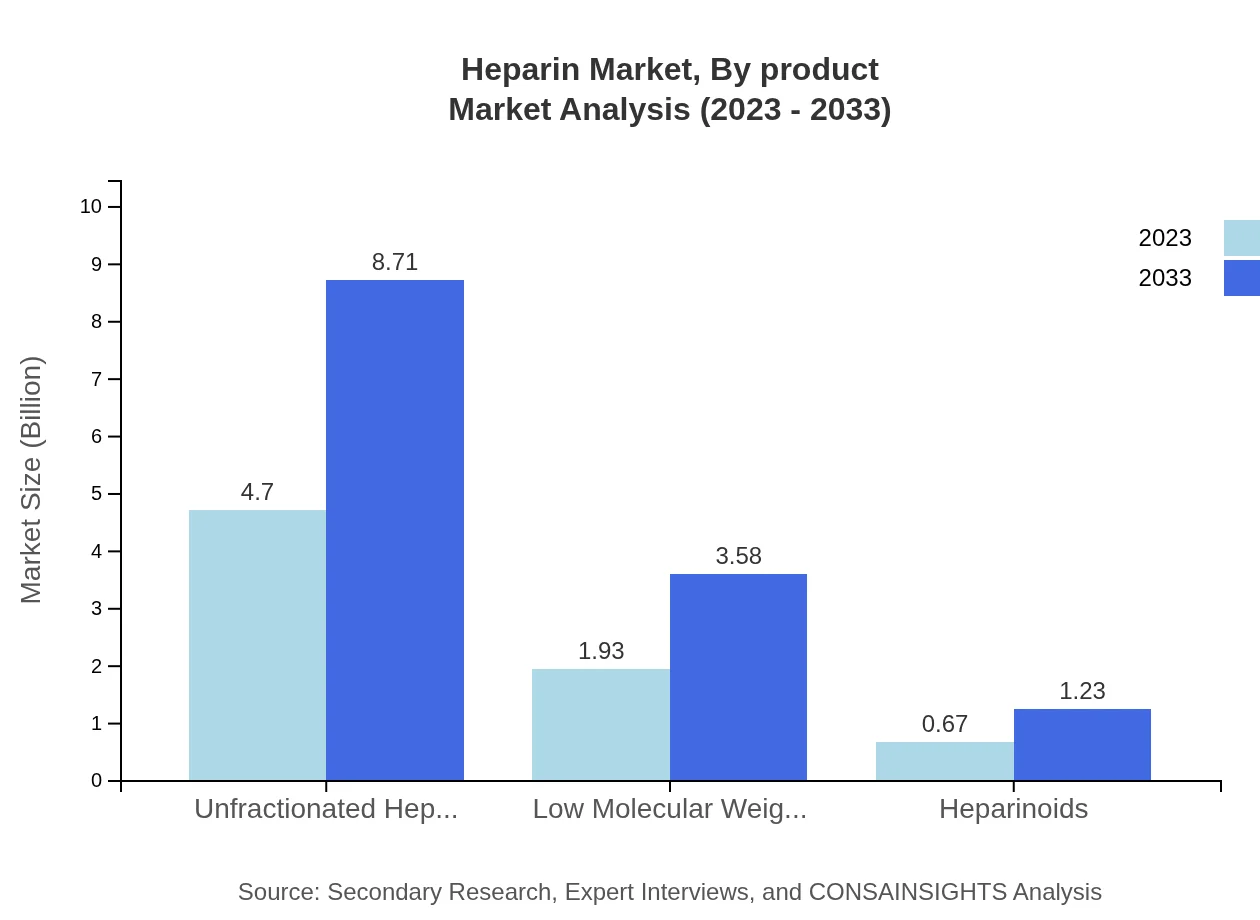
In 2023, Unfractionated Heparin accounted for $4.70 billion, while Low Molecular Weight Heparins (LMWH) and Heparinoids generated revenues of $1.93 billion and $0.67 billion, respectively. By 2033, Unfractionated Heparin is projected to grow to $8.71 billion, while LMWH and Heparinoids are forecasted at $3.58 billion and $1.23 billion, indicating their continued dominance in the product segmentation.
Heparin Market Analysis By Application
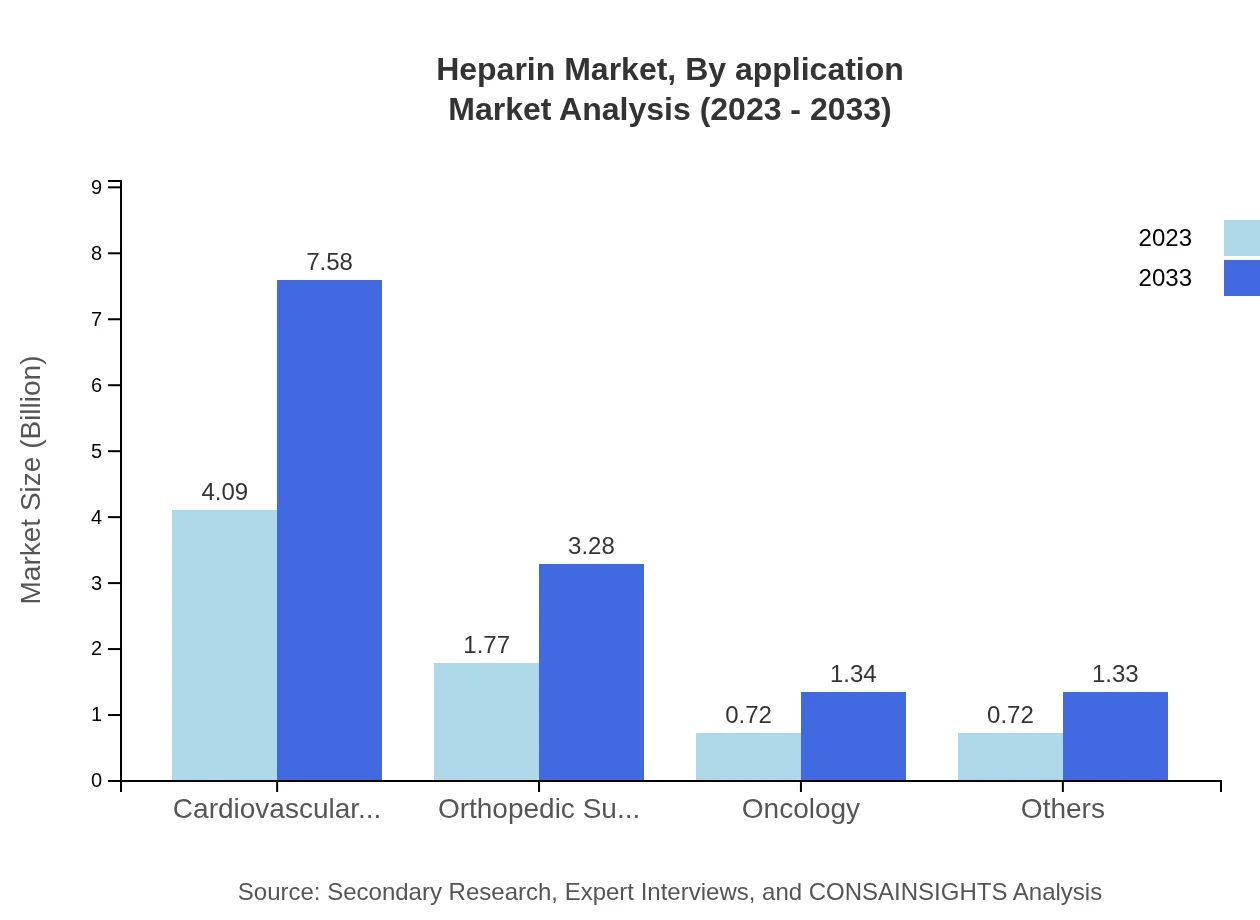
The application segment is chiefly driven by cardiovascular diseases, representing $4.09 billion in 2023 and expected to rise to $7.58 billion by 2033. Orthopedic surgeries and oncology remain significant applications, contributing $1.77 billion and $0.72 billion in 2023, respectively, and are projected to grow correspondingly to $3.28 billion and $1.34 billion by 2033.
Heparin Market Analysis By Route Of Administration
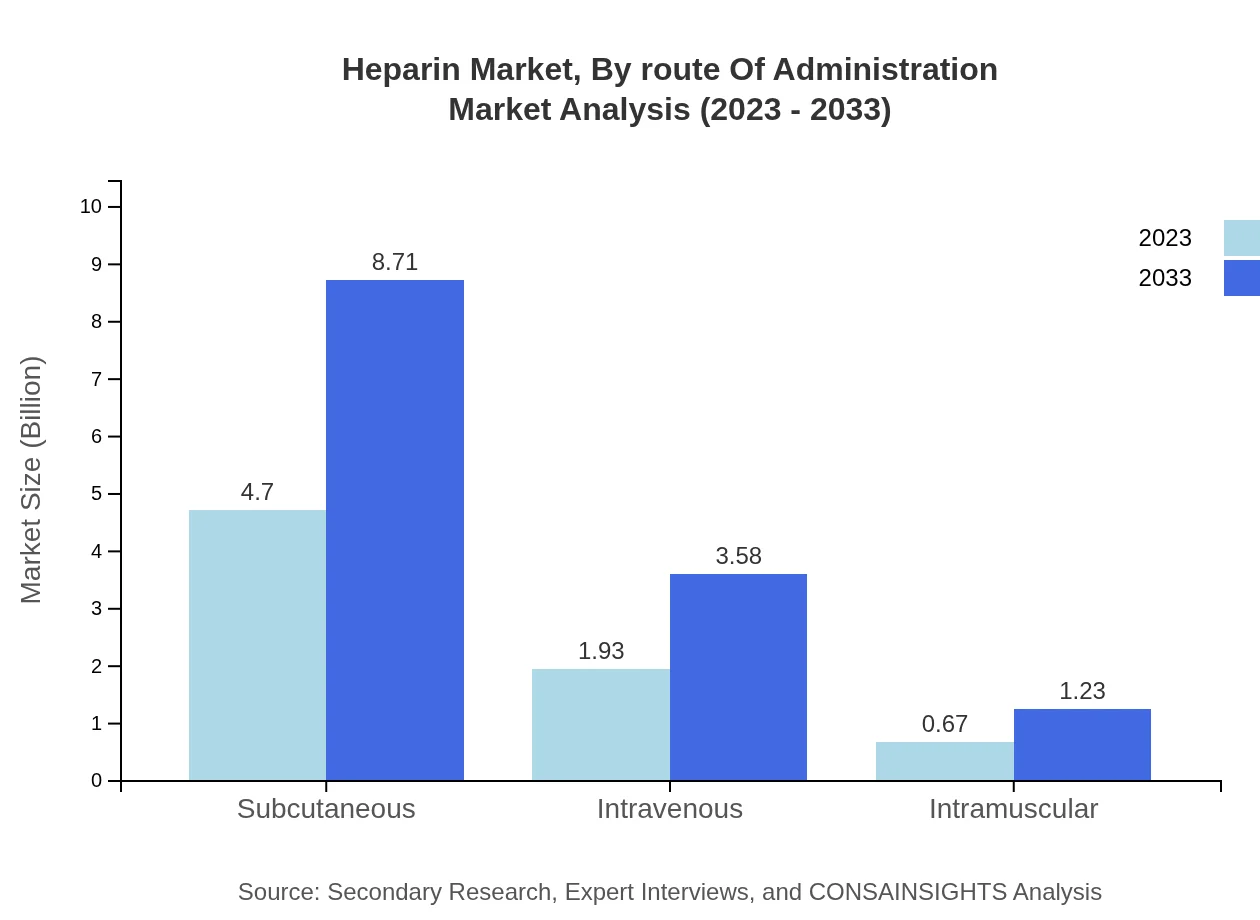
Subcutaneous administration dominates the Heparin market, contributing $4.70 billion in 2023 and is expected to grow to $8.71 billion by 2033. Intravenous and intramuscular routes account for $1.93 billion and $0.67 billion, respectively, and are projected to reach $3.58 billion and $1.23 billion by 2033.
Heparin Market Analysis By End User
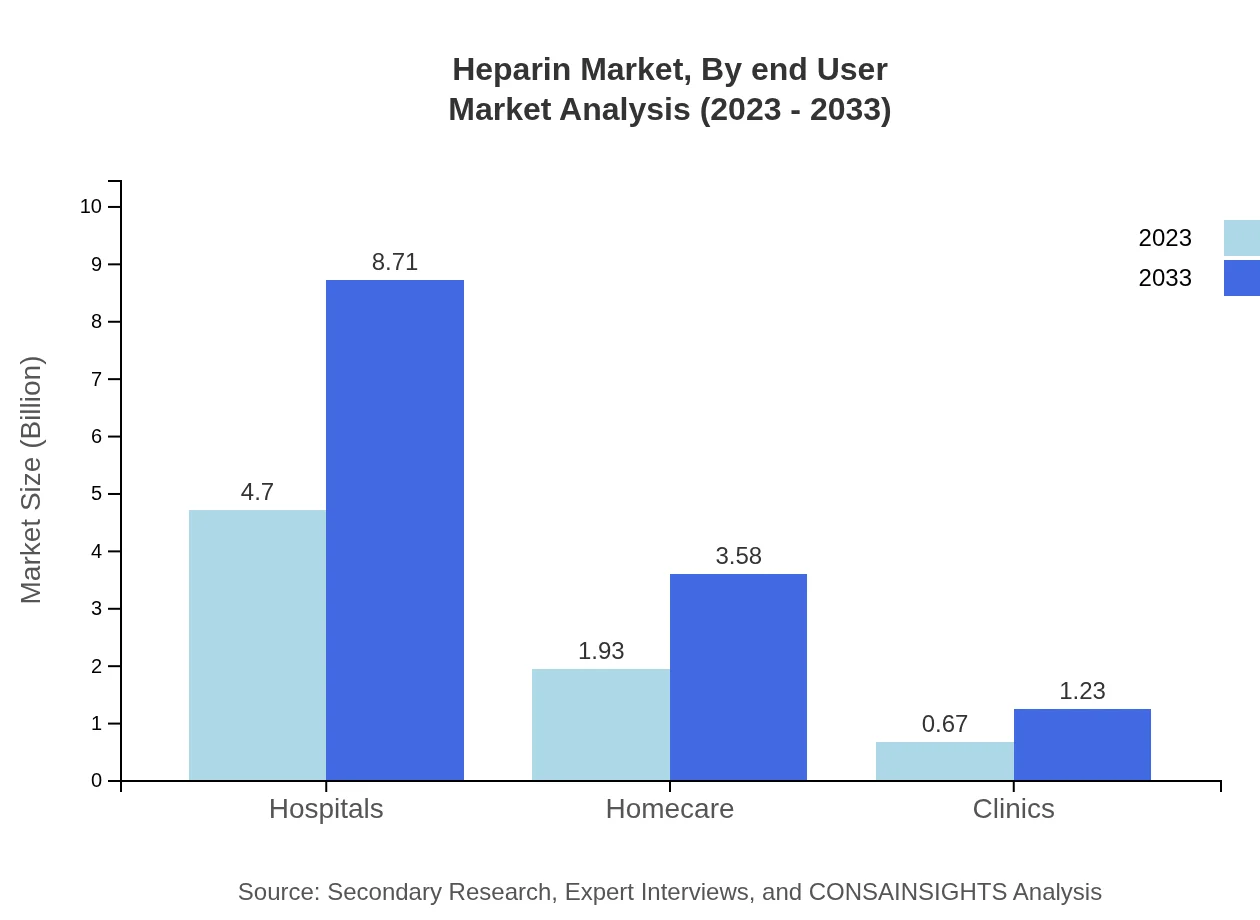
Hospitals represent the largest end-user segment, with a market value of $4.70 billion in 2023, expected to grow to $8.71 billion in 2033. Homecare services and clinics account for $1.93 billion and $0.67 billion and are predicted to grow steadily by 2033.
Heparin Market Analysis By Distribution Channel
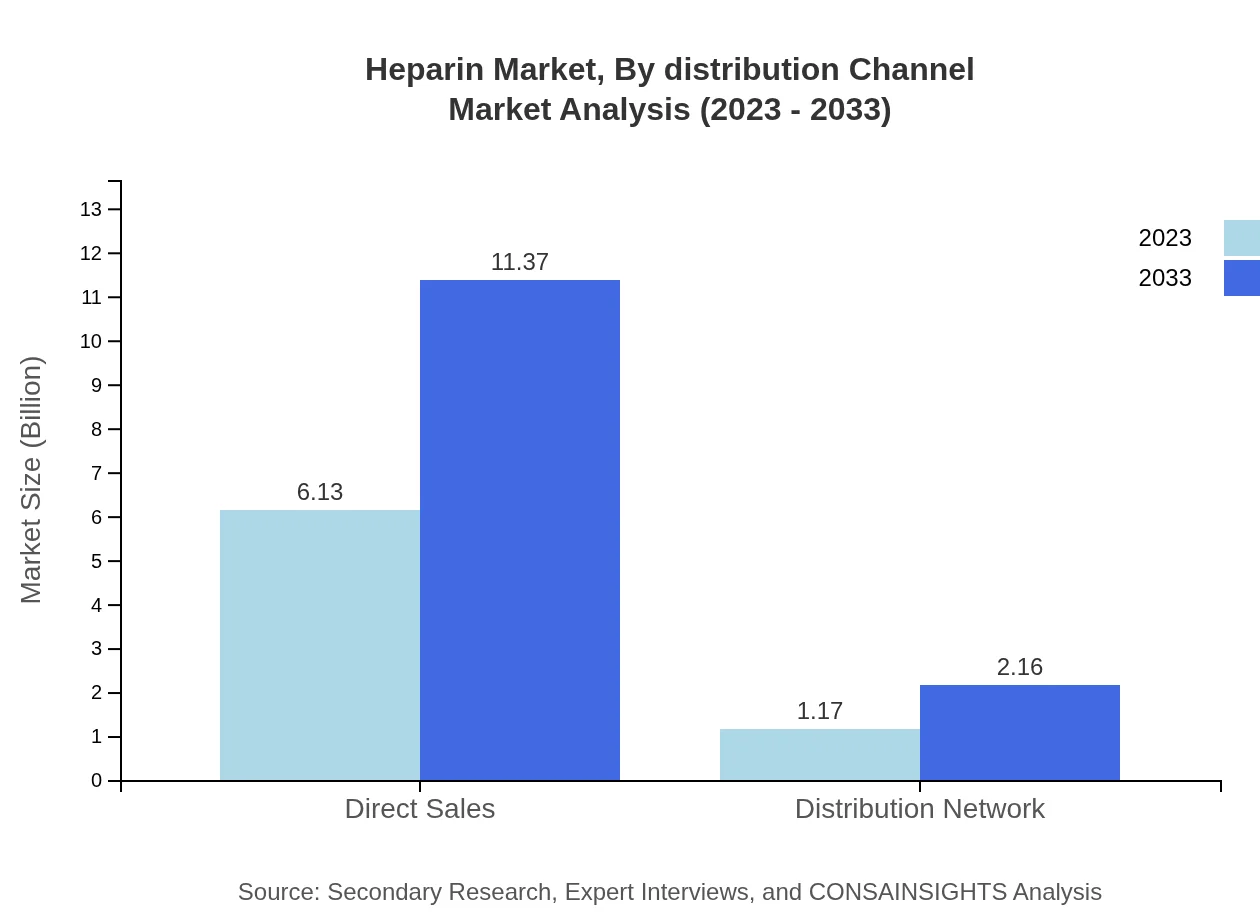
Direct Sales hold a significant market share, with a revenue of $6.13 billion in 2023, anticipated to reach $11.37 billion by 2033. The Distribution Network contributes $1.17 billion in 2023 and is projected to expand to $2.16 billion by 2033 as healthcare providers increasingly rely on established distribution channels.
Heparin Market Trends and Future Forecast
Tell us your focus area and get a customized research report.
Global Market Leaders and Top Companies in Heparin Industry
Sanofi:
A leading global healthcare company that produces and markets a range of pharmaceutical products, including Heparin, targeted at various therapeutic areas, notably cardiovascular treatments.Baxter International Inc.:
Baxter is a prominent player in the healthcare industry, offering a diverse portfolio of medical products and services, including a significant range of Heparin formulations for hospital and outpatient care.Pfizer Inc.:
A major pharmaceutical corporation, Pfizer provides innovative Heparin solutions while investing vigorously in research to develop next-generation anticoagulant therapies.Bristol-Myers Squibb:
Bristol-Myers Squibb is recognized for its extensive research efforts and product offerings in anticoagulants, enhancing treatment protocols involving Heparin.Novartis AG:
Novartis is a significant player in the pharmaceutical sector, focusing on innovative therapies that include Heparin products aimed at improving treatment efficacy.We're grateful to work with incredible clients.








FAQs
What is the current market size of the Heparin market?
The Heparin market size is $7.30 Billion in 2023, as stated in the report’s base-year figures for global market valuation.
How big will the Heparin market be by 2033?
The market is projected to reach $13.53 Billion by 2033, based on the report’s forecasted global market value for the end of the period.
What is CAGR for the forecast period?
The compound annual growth rate for the 2023 to 2033 forecast period is 6.2%, as specified in the report data.
Which region is the fastest Growing in the Heparin Market Report market?
Latin America is the fastest-growing region, projected to expand from $0.17 Billion in 2023 to $0.32 Billion in 2033, reflecting an implied 6.53% CAGR over the forecast period.
Which region is the fastest Growing?
Latin America is noted as the regional market region, increasing from $0.17 Billion in 2023 to $0.32 Billion in 2033 with an implied 6.53% CAGR.
Who are the top companies operating in the Heparin market?
Leading firms listed include Sanofi, Baxter International Inc., Pfizer Inc., Bristol-Myers Squibb, and Novartis AG as major market participants.
What are the primary product subsegments covered?
Product subsegments examined include Unfractionated Heparin, Low Molecular Weight Heparins (LMWH), and Heparinoids, per the report’s segmentation.
Which end users are included in the segmentation?
End-user categories covered are hospitals, homecare, and clinics, reflecting primary channels for heparin administration and distribution.
What distribution channels does the report analyze?
The report analyzes direct sales and distribution networks as the primary distribution routes for heparin products.
How is route of administration categorized in the report?
Route-of-administration segments included are subcutaneous, intravenous, and intramuscular applications.