

Image Intensifier Market Report
First published: 21 October 2024 | Last updated: 25 May 2026 | Report Code: image-intensifier
Image Intensifier Market — USD $1.8 Billion in 2023, Growing to USD 3.34null by 2033 at 6.2% CAGR
This report provides comprehensive insights into the Image Intensifier market, covering key market trends, industry analysis, and regional data from 2023 to 2033. It highlights growth forecasts, technological advancements, and profiles of major market players, facilitating strategic planning and informed decision-making.
Key Takeaways
- Global market expands from $1.80 Billion in 2023 to $3.34 Billion by 2033 at a 6.2% CAGR.
- Europe is largest regional market, while no single fastest-growing region is stated because regional CAGR differences remain within 0.15 percentage points.
- North America grows from $0.60 Billion to $1.12 Billion between 2023 and 2033, reflecting sustained investment in imaging.
- Asia Pacific rises from $0.32 Billion in 2023 to $0.60 Billion in 2033, driven by medical and industrial adoption.
Image Intensifier Market Report — Executive Summary
Europe remains largest market by forecast-period value, while no single fastest-growing region is stated because top regional growth rates are separated by less than 0.15 percentage points. This report provides a focused analysis of the Image Intensifier market, which measured $1.80 Billion in 2023 and is projected to reach $3.34 Billion by 2033 at a 6.2% CAGR. Demand is supported by expanding medical imaging requirements, ongoing defense procurement for low-light systems, and industrial uses requiring enhanced low-light visualization. Technological shifts toward digital intensifiers, improved manufacturing, and integration with advanced image processing underpin product innovation. Regional dynamics show Europe as the largest market, while other regions record steady increases. Coverage includes product types, end-user segments such as hospitals, defense organizations, and research institutes, along with company profiles for Thales Group, L3Harris Technologies, Northrop Grumman Corporation, and Hamamatsu Photonics K.K. The study synthesizes primary interviews, secondary sources, and internal validation to present actionable insights for stakeholders considering investment, development, or procurement.
Key Growth Drivers
- Rising clinical demand for enhanced low-light medical imaging in hospitals and clinics.
- Continued defense spending on night-vision and reconnaissance equipment for military applications.
- Industrial requirements for reliable low-light inspection systems in manufacturing environments.
- Advances in digital intensifier technology and improved detector components that enhance image quality.
- Research and development investments from leading suppliers to broaden application capabilities.
| Metric | Value |
|---|---|
| Study Period | 2023 - 2033 |
| 2023 Market Size | $1.80 Billion |
| CAGR (2023-2033) | 6.2% |
| 2033 Market Size | $3.34 Billion |
| Top Companies | Thales Group, L3Harris Technologies, Northrop Grumman Corporation, Hamamatsu Photonics K.K. |
| Published Date | 21 October 2024 |
| Last Modified Date | 25 May 2026 |
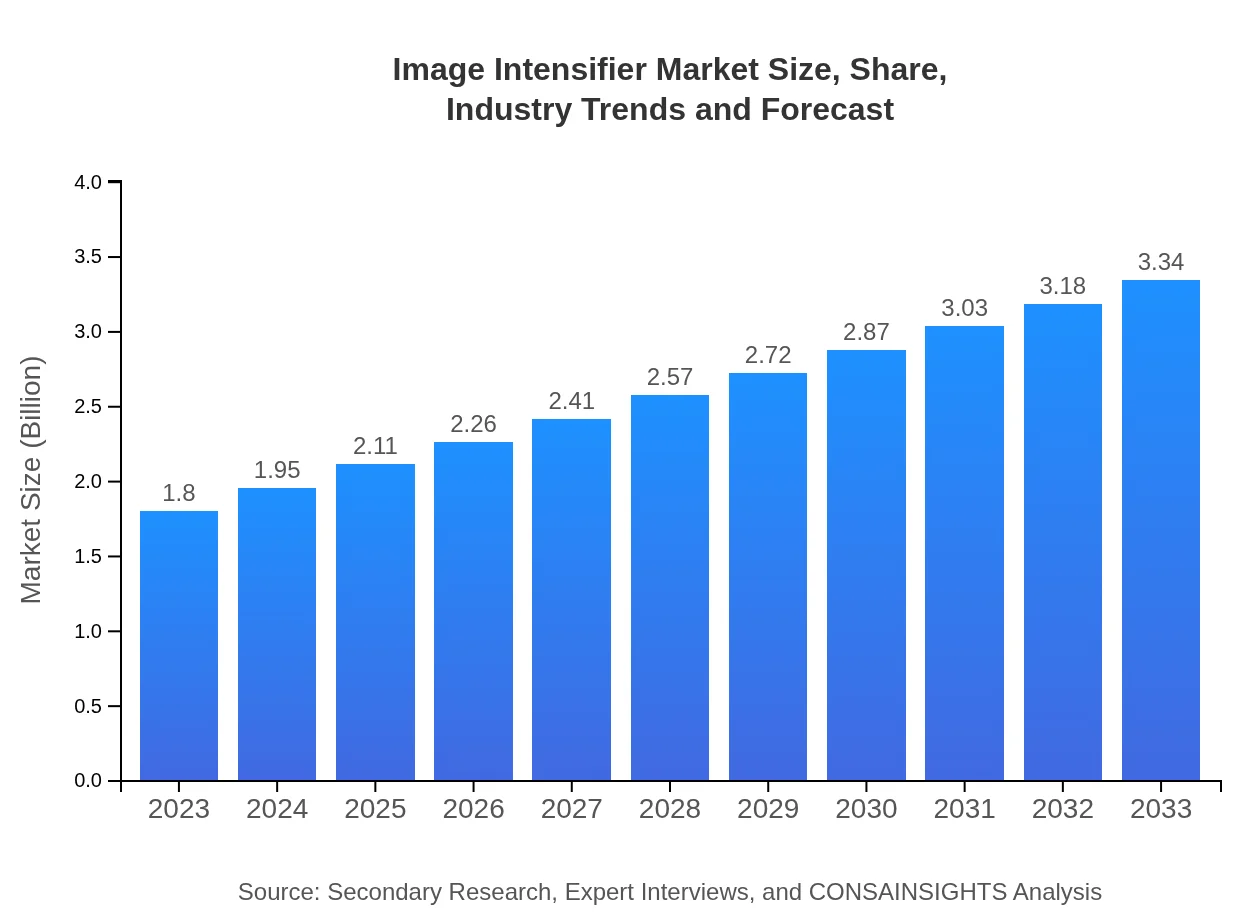
Image Intensifier Market Overview
Customize Image Intensifier Market Report market research report
- ✔ Get in-depth analysis of Image Intensifier market size, growth, and forecasts.
- ✔ Understand Image Intensifier's regional dynamics and industry-specific trends.
- ✔ Identify potential applications, end-user demand, and growth segments in Image Intensifier
What is the Market Size & CAGR of Image Intensifier Market Report market in 2023?
Image Intensifier Industry Analysis
Image Intensifier Market Segmentation and Scope
Tell us your focus area and get a customized research report.
Image Intensifier Market Report Market Analysis Report by Region
Europe Image Intensifier Market Report:
Europe is largest regional market, rising from $0.61 Billion in 2023 to $1.12 Billion in 2033. 61 Billion in 2023 to $1.12 Billion in 2033 and is identified as the largest regional market. Growth reflects healthcare upgrades, defense modernization, and adoption in industrial inspection.Asia Pacific Image Intensifier Market Report:
Asia Pacific grows from $0.32 Billion in 2023 to $0.6 Billion in 2033. 32 Billion in 2023 to $0.6 Billion in 2033 with gains driven by expanding medical infrastructure, increasing industrial automation, and growing research applications.North America Image Intensifier Market Report:
North America grows from $0.6 Billion in 2023 to $1.12 Billion in 2033. Regional expansion is linked to sustained defense spending, hospital modernization programs, and industrial investment in imaging solutions.South America Image Intensifier Market Report:
Latin America grows from $0.05 Billion in 2023 to $0.09 Billion in 2033. Market movement is shaped by selective healthcare investments, industrial needs, and gradual adoption of advanced imaging technologies.Middle East & Africa Image Intensifier Market Report:
Middle East and Africa grows from $0.22 Billion in 2023 to $0.4 Billion in 2033. 22 Billion in 2023 to $0.4 Billion in 2033, supported by defense procurement, rising clinical capabilities, and demand for surveillance and security systems.Tell us your focus area and get a customized research report.
Research Methodology
Image Intensifier Market Analysis By Product
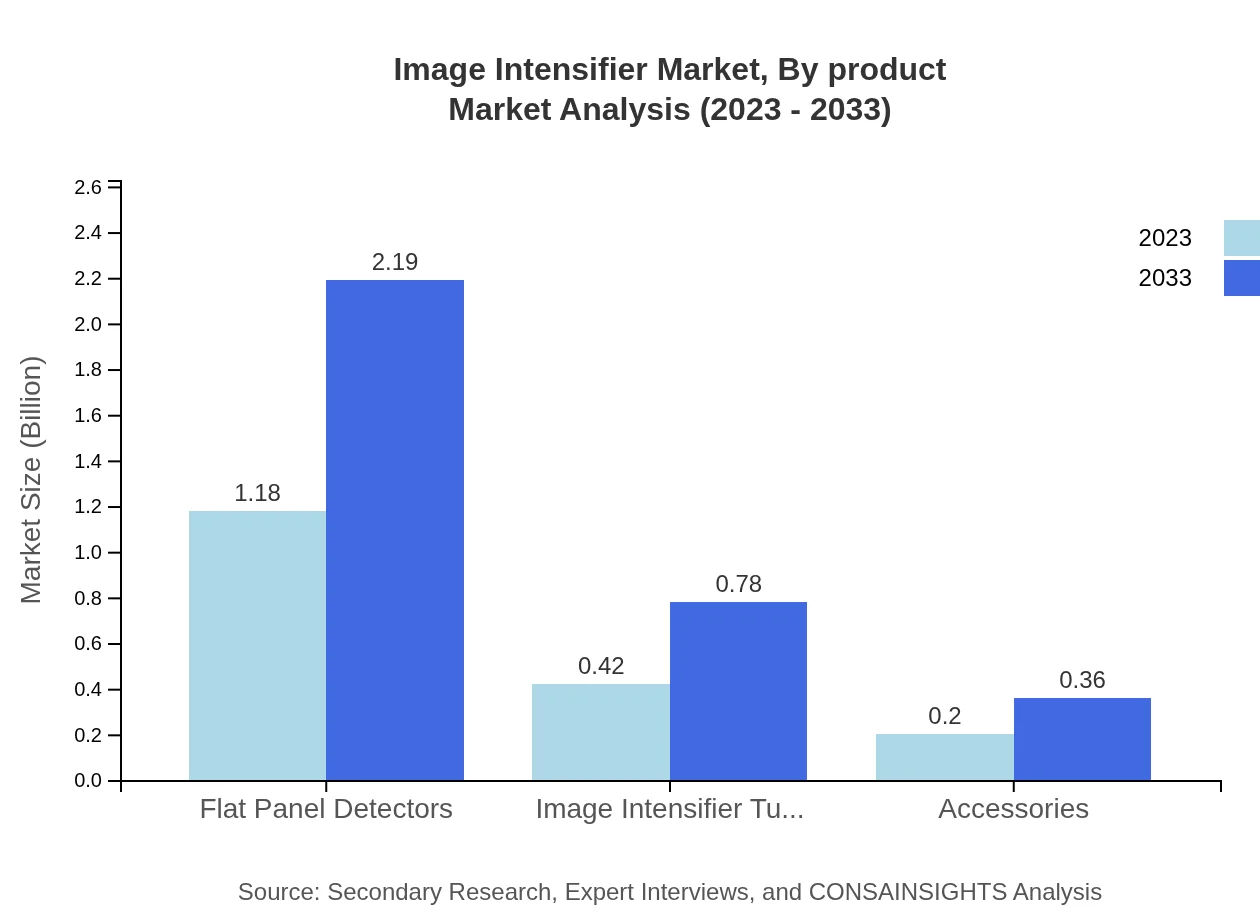
The market for Image Intensifiers, categorized by product types, is led by Flat Panel Detectors, which dominated the market with a share of 65.56% in 2023, valued at $1.18 billion, and expected to grow to $2.19 billion in 2033. Image Intensifier Tubes hold the second largest share at 23.51%, showing significant relevance in both military and medical applications. Accessories contribute an essential part of the market, reflecting a 10.93% share in 2023.
Image Intensifier Market Analysis By Application
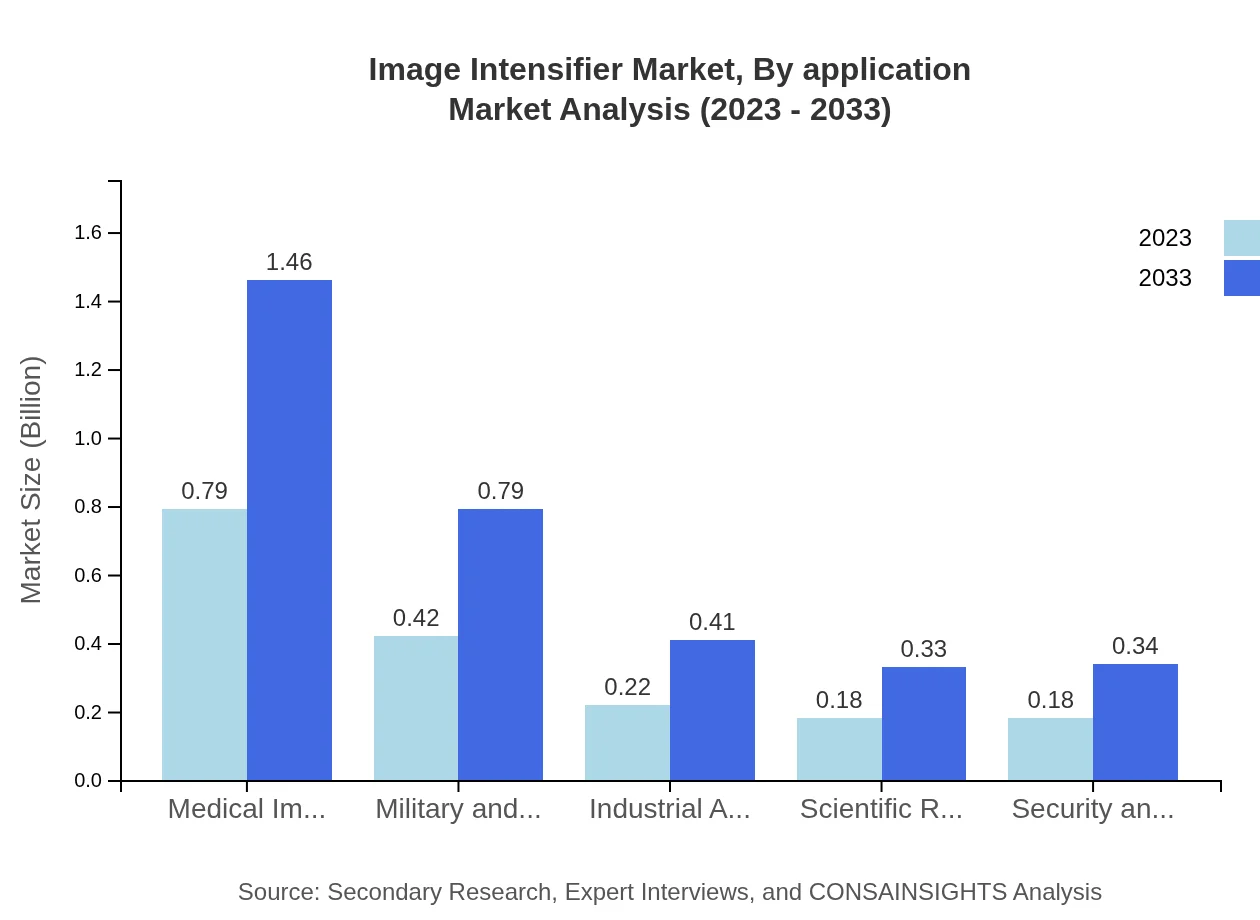
Segmenting the market by application reveals that Medical Imaging occupies the largest share at 43.81%, valued at $0.79 billion in 2023 and projected to reach $1.46 billion by 2033. Military and Defense applications are a close second, with similar growth patterns driven by enhanced technological demands. Industrial Applications and Security Agencies follow, representing critical end-user segments.
Image Intensifier Market Analysis By End User
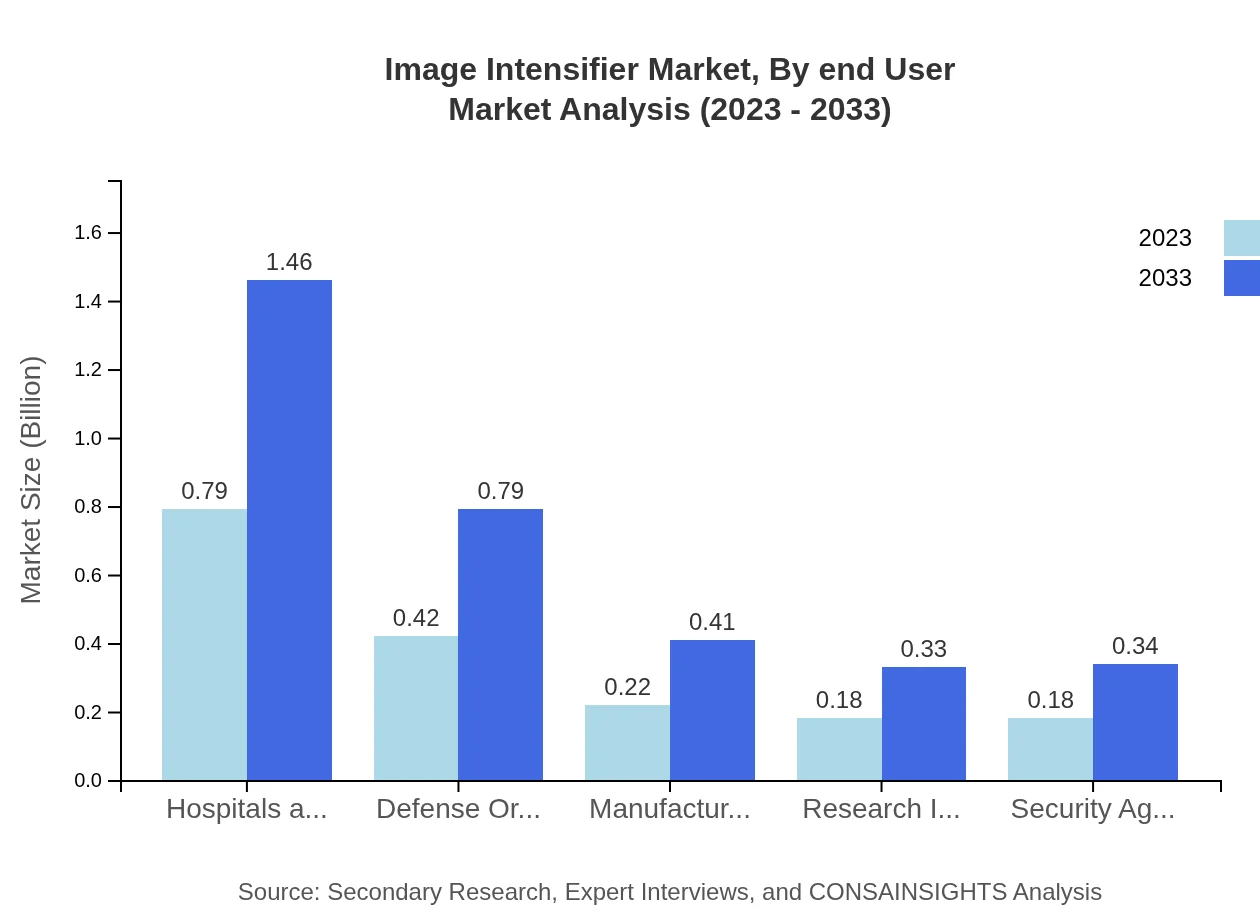
The end-user segment of Hospitals and Clinics holds a solid market share of 43.81%, reflecting a growing need for advanced diagnostic capabilities. Defense Organizations account for 23.54% of the market demand for image intensifiers, indicating a strong investment in security and military equipment. Other segments, including Manufacturing Companies and Research Institutes, also contribute significantly to the market.
Image Intensifier Market Analysis By Technology
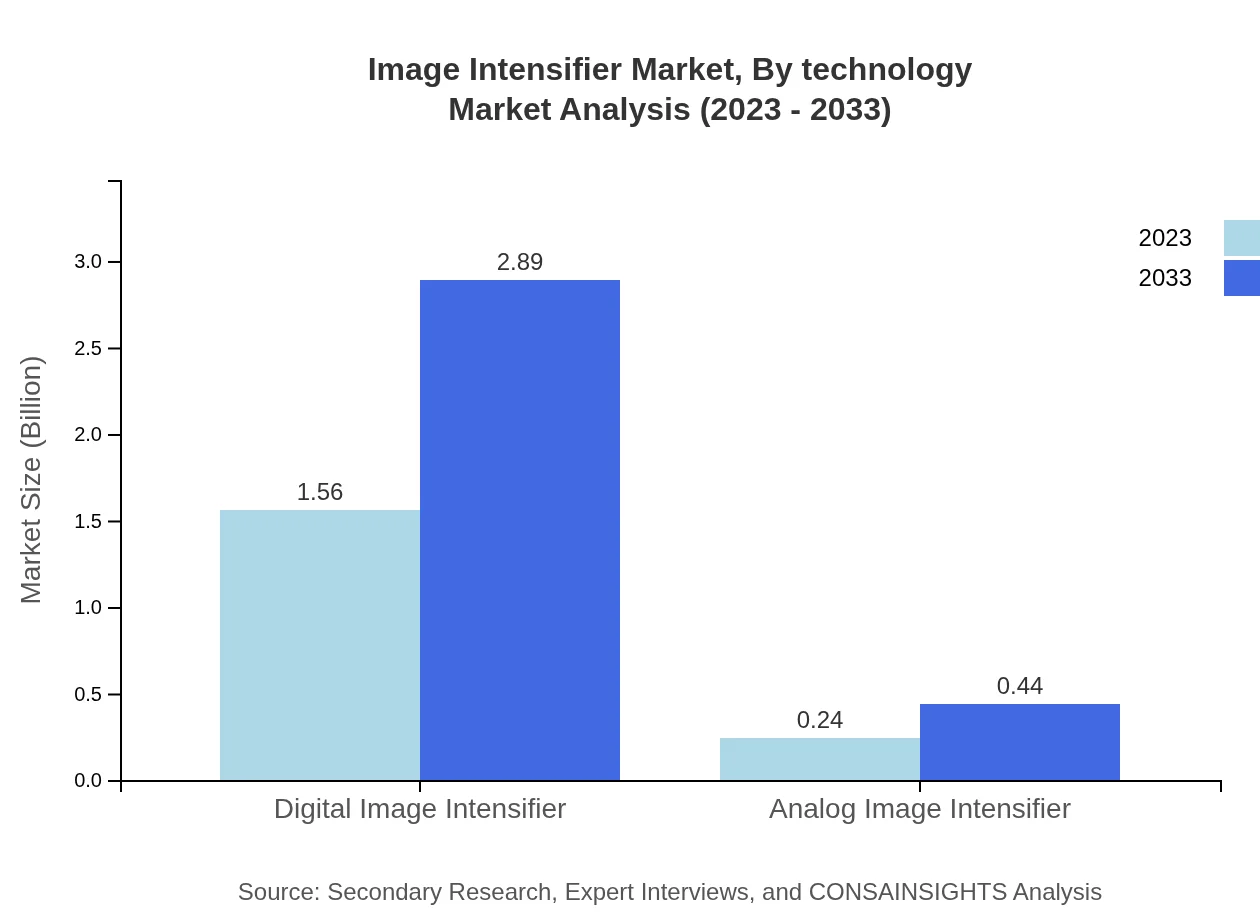
The market divided by technology shows that Digital Image Intensifiers dominate with a share of 86.67% in 2023, valued at $1.56 billion, growing to $2.89 billion by 2033. Analog Image Intensifiers, while having a smaller market share at 13.33%, still play an important role in specific applications where lower costs and simplicity are preferred.
Image Intensifier Market Analysis By Region
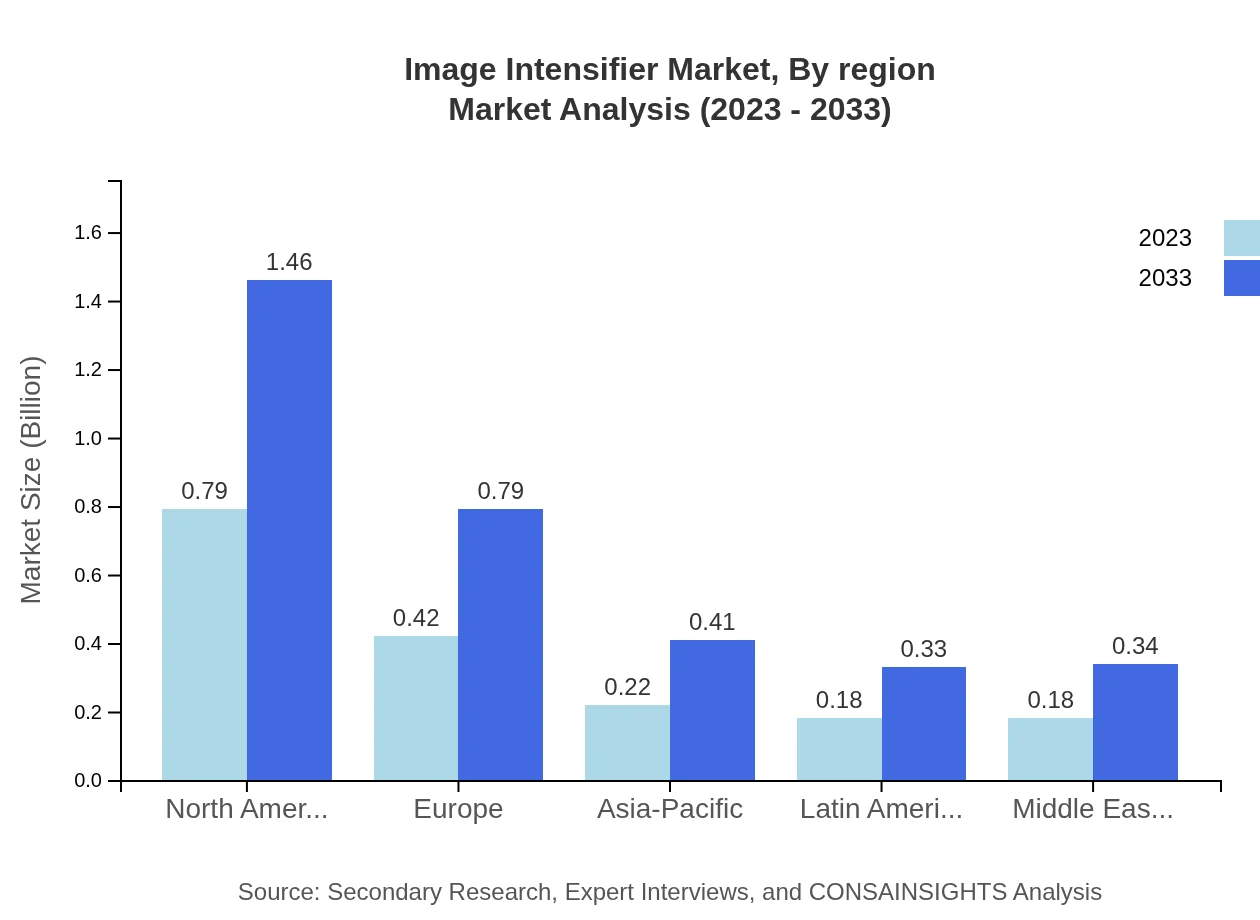
The regional analysis indicates North America continues to lead the market due to advanced technological adoption and military investments. Europe's market, driven by demand for superior healthcare diagnostics, follows closely. The Asia Pacific region is experiencing rapid growth, influenced by increased infrastructure spending and healthcare modernization initiatives.
Image Intensifier Market Trends and Future Forecast
Tell us your focus area and get a customized research report.
Global Market Leaders and Top Companies in Image Intensifier Industry
Thales Group:
Thales Group is a global leader in providing advanced technology solutions across various sectors including defense and aerospace. Their innovations in image intensification technology enhance operational visibility during challenging conditions.L3Harris Technologies:
L3Harris Technologies specializes in communication and electronic systems, offering advanced imaging solutions for military applications. Their image intensifiers are known for reliability and performance.Northrop Grumman Corporation:
Northrop Grumman is involved in defense contractor services, focusing on high-technology systems integrating image intensifiers in various military platforms.Hamamatsu Photonics K.K.:
Hamamatsu is a leading manufacturer of photonic sensors and devices, recognized for their contributions to medical imaging and development of high-performance image intensifiers.We're grateful to work with incredible clients.









FAQs
What is the market size of the Image Intensifier market in 2023?
The market size for Image Intensifier in 2023 is $1.80 Billion as stated in the report data.
How big will the Image Intensifier market be in 2033?
The forecasted market value for 2033 is $3.34 Billion according to the provided figures.
What is CAGR for the Image Intensifier market over the forecast period?
The report specifies a compound annual growth rate of 6.2% for 2023 to 2033.
Is there a single fastest Growing region in the Image Intensifier Market Report market?
No single fastest-growing region is stated for the Image Intensifier Market Report market because the top regional implied CAGR values are within 0.15 percentage points of each other, making the ranking too close to call reliably.
Which companies are listed as top participants in the market?
Top companies highlighted include Thales Group, L3Harris Technologies, Northrop Grumman Corporation, and Hamamatsu Photonics K.K.
What are principal applications driving demand for image intensifiers?
Primary applications include medical imaging, military and defense, industrial inspection, scientific research, and security and surveillance.
Who benefits from advancements in image intensifier technology?
Hospitals, defense organizations, manufacturing firms, research institutes, and security agencies are key beneficiaries of improved intensifier performance.
How was the research for this market report conducted?
The study used primary interviews with industry experts plus secondary research from company reports and publications, followed by data triangulation and validation.