

Immunohistochemistry Market Report
First published: 12 October 2024 | Last updated: 25 May 2026 | Report Code: immunohistochemistry
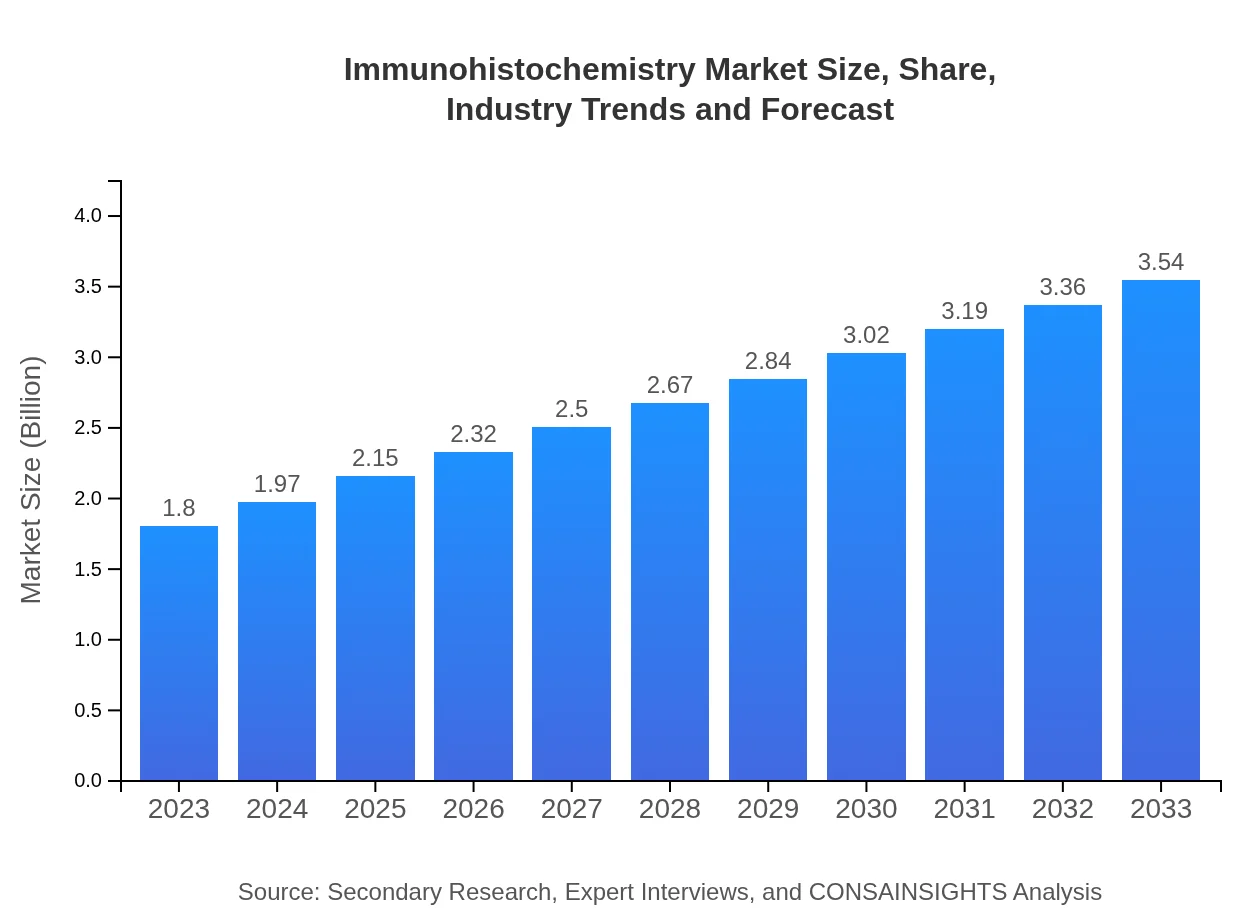
Immunohistochemistry Market — USD $1.8 Billion in 2023, Growing to USD 3.54null by 2033 at 6.8% CAGR
This report provides a comprehensive analysis of the Immunohistochemistry market, offering insights on market trends, size, and forecasts from 2023 to 2033, along with detailed evaluations by region and segment.
Key Takeaways
- Global market expansion from $1.80 Billion in 2023 to $3.54 Billion by 2033 at a 6.8% CAGR.
- North America is largest regional market, while no single fastest-growing region is stated because regional CAGR differences remain within 0.15 percentage points.
- Europe grows from $0.6 Billion in 2023 to $1.18 Billion in 2033, reflecting sustained clinical and research adoption.
- Asia Pacific rises from $0.32 Billion in 2023 to $0.62 Billion in 2033, driven by growing research investment and diagnostic use.
- Top suppliers noted in the market include R&D Systems, Thermo Fisher Scientific, Abcam, and Merck KGaA.
Immunohistochemistry Market Report — Executive Summary
North America remains largest market by forecast-period value, while no single fastest-growing region is stated because top regional growth rates are separated by less than 0.15 percentage points. The Immunohistochemistry market is forecast to grow from $1.80 Billion in 2023 to $3.54 Billion in 2033, registering a 6.8% CAGR over the 2023 to 2033 period. Expansion is supported by increasing clinical diagnostic use, rising research activity, and the integration of automated and digital workflow solutions. Product categories such as antibodies, reagents, and instruments remain central to adoption, while hospitals, diagnostic laboratories, research institutes, and pharmaceutical companies are primary end users. Regional progress varies: North America leads in absolute market size, with Europe and Asia Pacific showing notable gains. Market participants including R&D Systems, Thermo Fisher Scientific, Abcam, and Merck KGaA focus on product innovation and collaborations. Regulatory complexity and the need for skilled personnel are ongoing considerations, prompting investment in training and validation. The report synthesizes primary interviews and secondary sources to present an evidence-based view of market structure, trends, and competitive positioning.
Key Growth Drivers
- Rising demand for precise diagnostic tools in clinical settings, boosting uptake in hospitals and diagnostic laboratories.
- Increased research funding and biomarker discovery efforts that expand applications in research institutes and pharmaceutical R&D.
- Technological advancements including automation and integration with digital workflows that improve throughput and consistency.
- Continued development of specialized antibodies, reagents, and instrument platforms by established suppliers to address clinical needs.
- Growing prevalence of targeted therapies and personalized medicine, elevating the use of IHC for patient stratification.
| Metric | Value |
|---|---|
| Study Period | 2023 - 2033 |
| 2023 Market Size | $1.80 Billion |
| CAGR (2023-2033) | 6.8% |
| 2033 Market Size | $3.54 Billion |
| Top Companies | R&D Systems, Thermo Fisher Scientific, Abcam, Merck KGaA |
| Published Date | 12 October 2024 |
| Last Modified Date | 25 May 2026 |
Immunohistochemistry Market Overview
Customize Immunohistochemistry Market Report market research report
- ✔ Get in-depth analysis of Immunohistochemistry market size, growth, and forecasts.
- ✔ Understand Immunohistochemistry's regional dynamics and industry-specific trends.
- ✔ Identify potential applications, end-user demand, and growth segments in Immunohistochemistry
What is the Market Size & CAGR of Immunohistochemistry Market Report market in 2023?
Immunohistochemistry Industry Analysis
Immunohistochemistry Market Segmentation and Scope
Tell us your focus area and get a customized research report.
Immunohistochemistry Market Report Market Analysis Report by Region
Europe Immunohistochemistry Market Report:
Europe grows from $0.6 Billion in 2023 to $1.18 Billion in 2033. Growth is driven by established diagnostic networks, active research institutions, and investments in advanced IHC assays and platforms.Asia Pacific Immunohistochemistry Market Report:
Asia Pacific grows from $0.32 Billion in 2023 to $0.62 Billion in 2033. The region's rise is supported by growing research expenditure, expanding diagnostic services, and rising demand for precision diagnostics.North America Immunohistochemistry Market Report:
North America is largest regional market, rising from $0.62 Billion in 2023 to $1.21 Billion in 2033. Regional strength reflects strong clinical laboratory infrastructure, significant research funding, and adoption of automated and digital workflows.South America Immunohistochemistry Market Report:
Latin America grows from $0.17 Billion in 2023 to $0.33 Billion in 2033. Market progress is linked to expanding clinical diagnostics capacity and increasing research collaborations with international institutions.Middle East & Africa Immunohistochemistry Market Report:
Middle East and Africa grows from $0.1 Billion in 2023 to $0.19 Billion in 2033. Growth factors include gradual expansion of diagnostic services, increased awareness of biomarker-driven care, and targeted investments in laboratory capabilities.Tell us your focus area and get a customized research report.
Research Methodology
Immunohistochemistry Market Analysis By Product Type
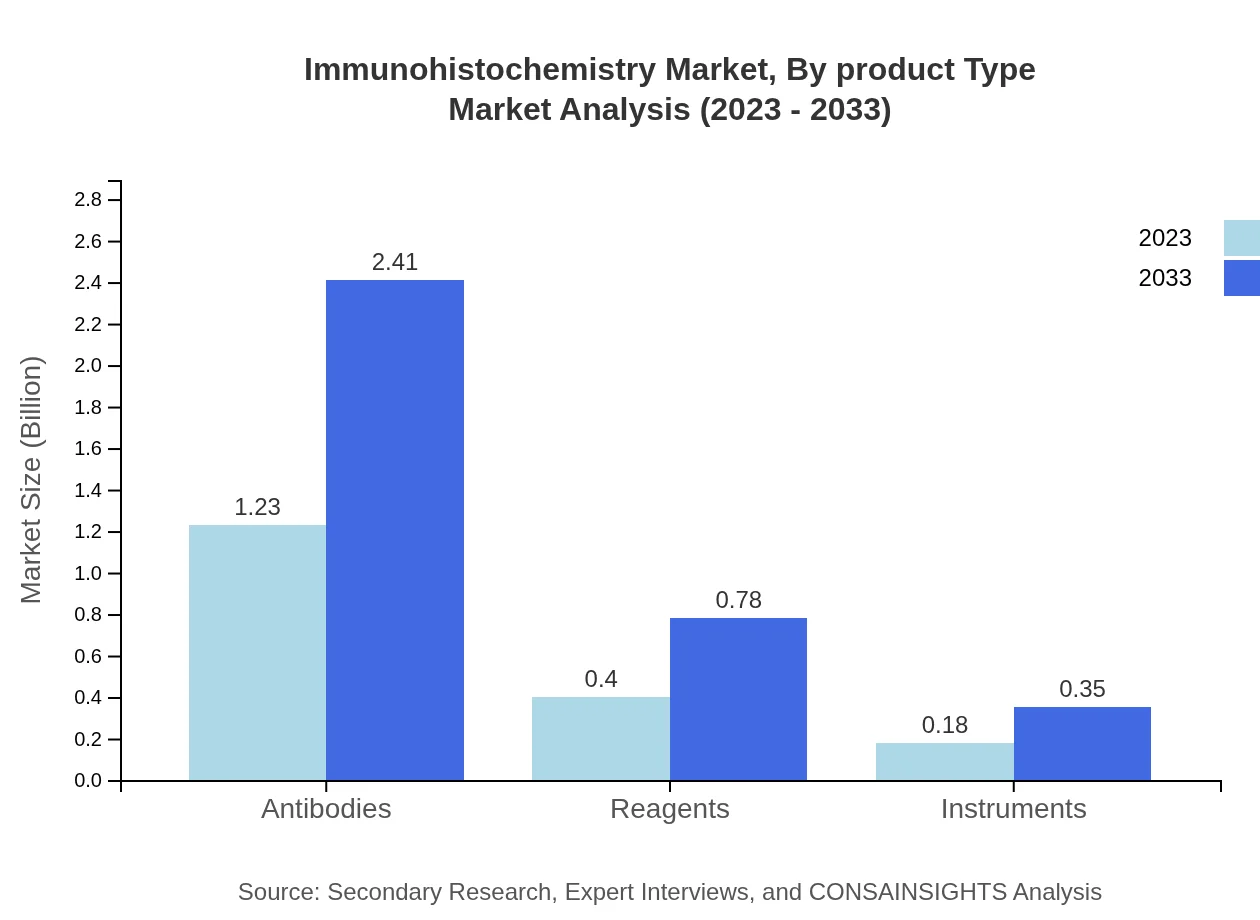
In 2023, antibodies are the dominant product type within the Immunohistochemistry market, accounting for 1.23 billion USD or 68.12% of the market share, and projected to grow to 2.41 billion USD by 2033. Reagents follow, comprising a market size of 0.40 billion USD in 2023, anticipated to increase to 0.78 billion USD. Instruments represent a smaller segment with a market size of 0.18 billion USD in 2023 and expected to grow to 0.35 billion USD by 2033.
Immunohistochemistry Market Analysis By Application
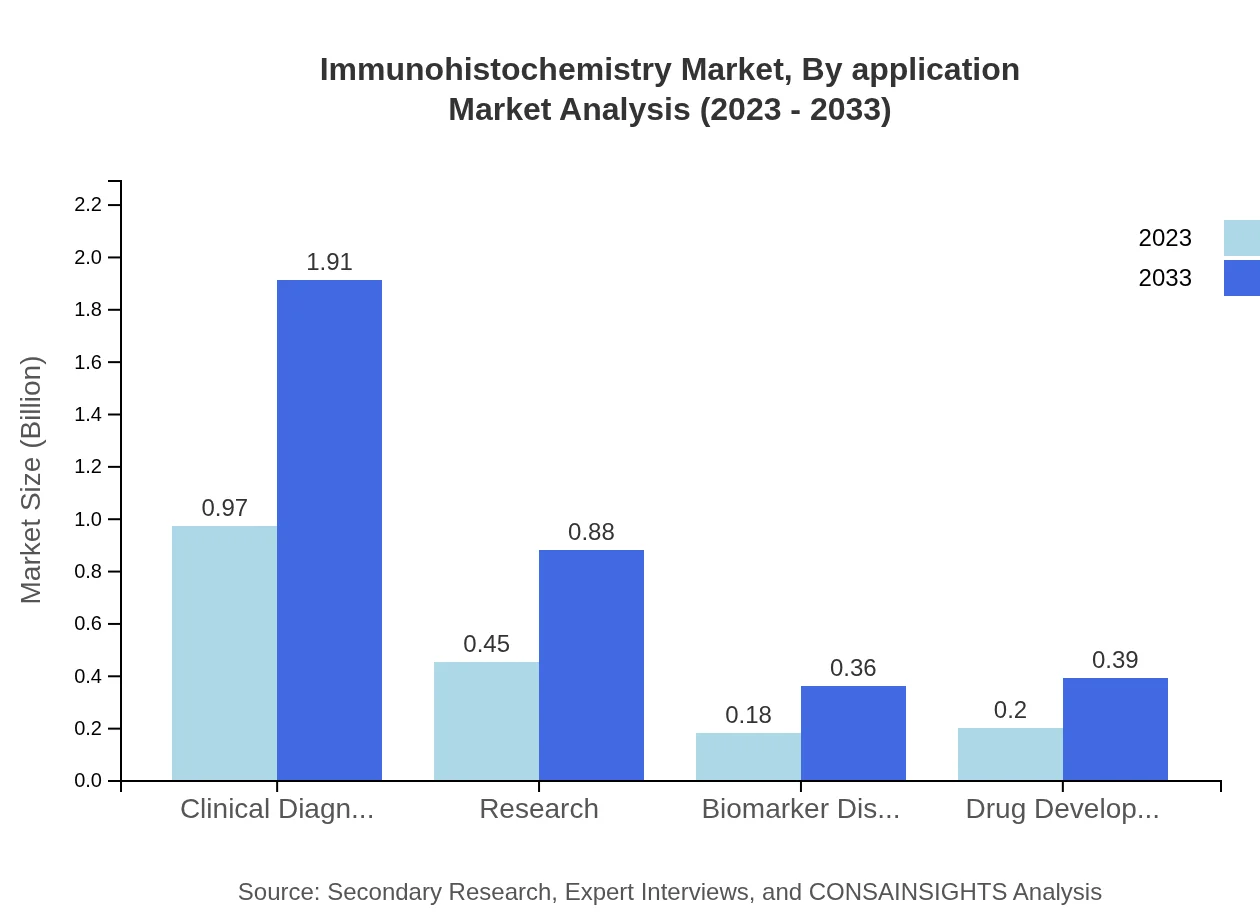
The application of Immunohistochemistry in clinical diagnostics holds the largest share, representing 0.97 billion USD (53.86% market share) in 2023, doubling to 1.91 billion USD by 2033. Other significant applications include research (0.45 billion USD in 2023) and biomarker discovery (0.18 billion USD in 2023), with both segments experiencing steady growth.
Immunohistochemistry Market Analysis By End User
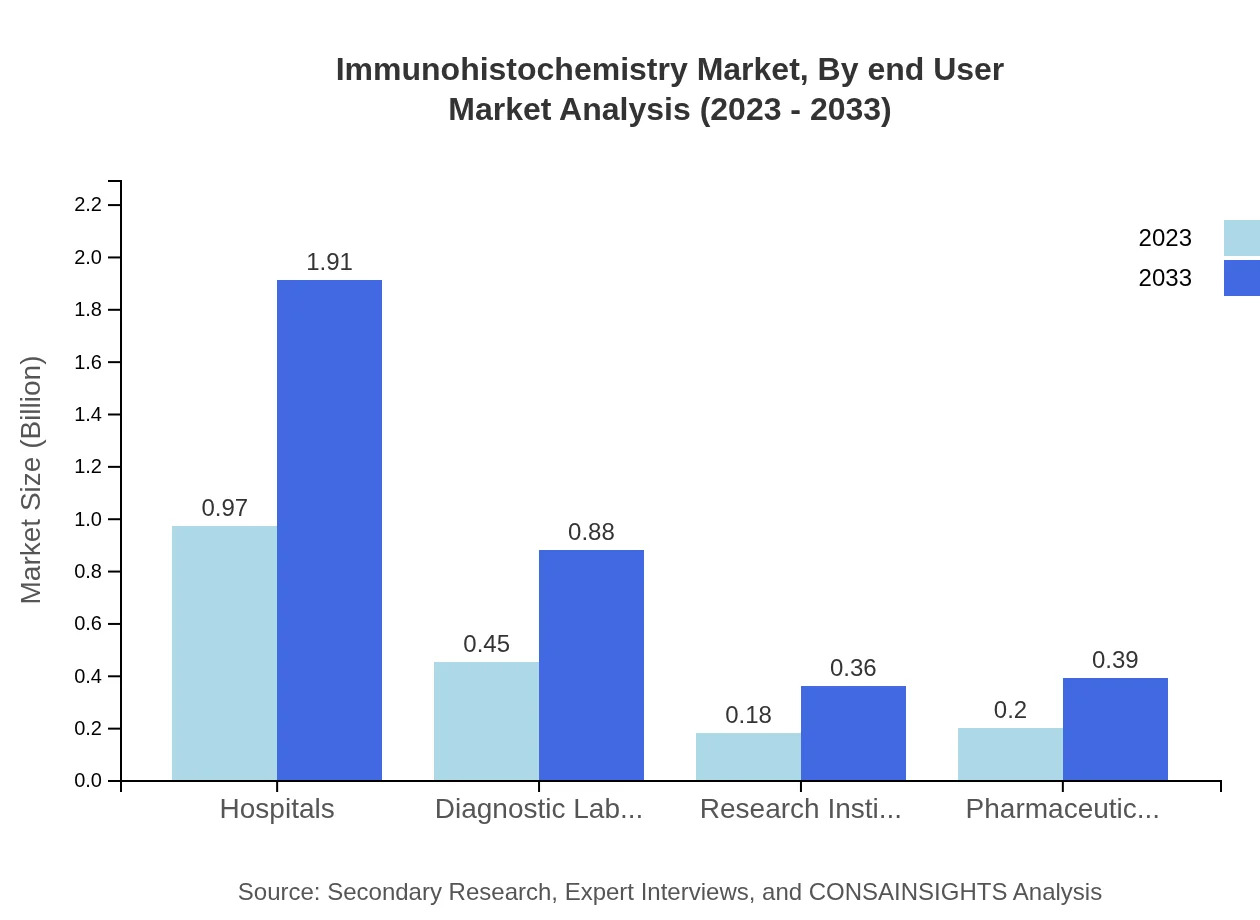
Hospitals remain the leading end-user in the Immunohistochemistry market, with a size of 0.97 billion USD in 2023, and expected to reach 1.91 billion USD by 2033. Diagnostic laboratories also hold a significant position with a market size of 0.45 billion USD initially, growing to 0.88 billion USD, indicating strong reliance on IHC for disease diagnostics in clinical settings.
Immunohistochemistry Market Analysis By Region Type
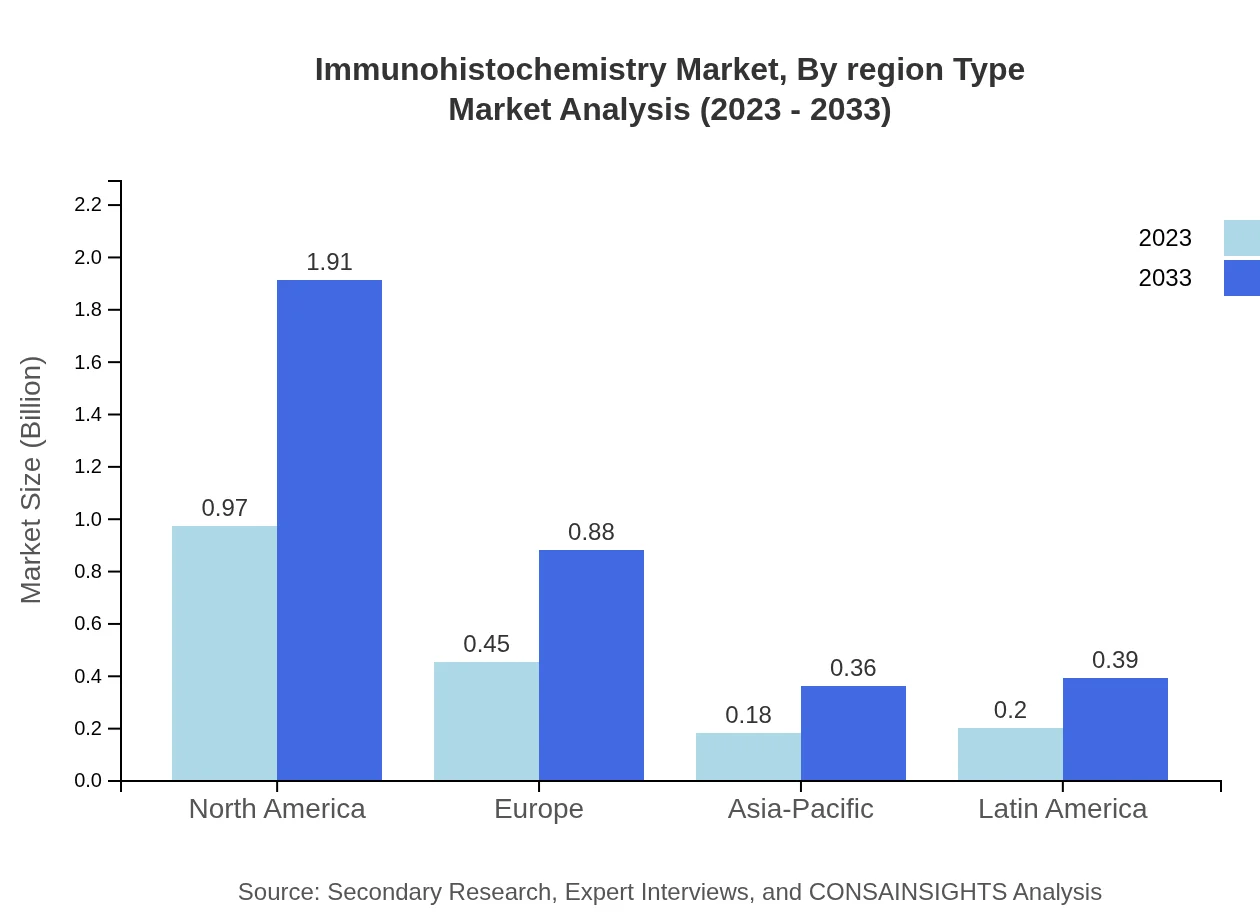
Regional divisions reveal the North American market as the most substantial contributor, driven by high healthcare spending and research initiatives. In contrast, the Asia Pacific market, while smaller, is experiencing the fastest growth due to an increasing focus on healthcare accessibility and technological adoption in diagnostics.
Immunohistochemistry Market Trends and Future Forecast
Tell us your focus area and get a customized research report.
Global Market Leaders and Top Companies in Immunohistochemistry Industry
R&D Systems:
A leading provider of antibodies and reagents for research and diagnostics, R&D Systems contributes significantly to the Immunohistochemistry sector by offering cutting-edge products facilitating accurate disease detection.Thermo Fisher Scientific:
With a vast portfolio of IHC reagents and instruments, Thermo Fisher Scientific is instrumental in driving innovation within the industry, focusing on enhancing diagnostic capabilities and research solutions.Abcam:
Known for its high-quality antibodies, Abcam continues to expand its offerings to include innovative immunohistochemistry solutions, enabling researchers and clinicians to improve diagnostic accuracy.Merck KGaA:
Merck KGaA provides a comprehensive range of immunohistochemistry products and is focused on advancing biopharmaceutical innovations to enhance research and diagnostics.We're grateful to work with incredible clients.









FAQs
What is the market size of the Immunohistochemistry Market Report in 2023?
The market size in 2023 is $1.80 Billion, as reported for the Immunohistochemistry market.
What is the projected market size of the Immunohistochemistry Market Report in 2033?
The market is projected to reach $3.54 Billion by 2033 according to the provided forecast data.
What is CAGR for the Immunohistochemistry Market Report forecast period?
The compound annual growth rate (CAGR) for the 2023 to 2033 forecast period is 6.8%.
Is there a single fastest Growing region in the Immunohistochemistry Market Report market?
No single fastest-growing region is stated for the Immunohistochemistry Market Report market because the top regional implied CAGR values are within 0.15 percentage points of each other, making the ranking too close to call reliably.
Which companies are listed as top players in the Immunohistochemistry market?
Top companies identified include R&D Systems, Thermo Fisher Scientific, Abcam, and Merck KGaA.
Why is demand increasing for immunohistochemistry products?
Demand is rising due to greater clinical adoption for diagnostics, expanded research activities, and the need for accurate biomarker detection in therapy development.
Who are the primary end users for immunohistochemistry products?
Primary end users include hospitals, diagnostic laboratories, research institutes, and pharmaceutical companies as listed in the segmentation.
How big is the Europe market for Immunohistochemistry in 2023 and 2033?
Europe's market is $0.6 Billion in 2023 and is projected to reach $1.18 Billion by 2033, reflecting steady clinical and research demand.
What factors could limit growth in the Immunohistochemistry market?
Constraints include regulatory requirements, the need for skilled personnel, and validation challenges that can affect adoption and rollout in some settings.
Why are antibodies, reagents, and instruments important in this market?
These product types form the core IHC workflow, enabling detection, staining, and analysis, and therefore drive procurement and innovation across end users.