

Intraoral Scanner Market Report
First published: 11 October 2024 | Last updated: 28 May 2026 | Report Code: intraoral-scanner
Intraoral Scanner Market — USD 1.25 billion in 2023, Growing to USD 3.11B by 2033 at 9.2% CAGR
This report analyzes the Intraoral Scanner market, offering insights into market size, growth trends, segmentation, and regional performance from 2023 to 2033. It provides a comprehensive overview of current market dynamics and future forecasted developments.
Key Takeaways
- Global market expands from $1.25 Billion in 2023 to $3.11 Billion by 2033 at a 9.2% CAGR.
- North America is largest regional market; Latin America is regional market region based on implied CAGR across 2023 to 2033.
- Latin America is identified as the regional market region at an implied 10.03% CAGR, rising from $0.05 Billion to $0.13 Billion.
- Optical scanners, laser scanners, and software form the core product types supporting clinical adoption.
- Top vendors include Align Technology, Inc., 3M Company, Carestream Health, and Planmeca Oy, driving innovation and distribution.
Intraoral Scanner Market Report — Executive Summary
The Intraoral Scanner Market Report documents a transition toward digital impression techniques, with the market growing from $1.25 Billion in 2023 to $3.11 Billion in 2033 at a 9.2% CAGR. Growth is propelled by improved imaging accuracy, streamlined clinical workflows, and increasing patient preference for less invasive procedures. Regional dynamics show North America as the largest market while Latin America posts the highest implied growth rate at 10.03% CAGR. Product segmentation centers on optical scanners, laser scanners, and software, with end users including dentists, dental labs, and hospitals. Adoption drivers include portable devices, enhanced software interoperability, and cost efficiencies in restorative and orthodontic applications. Competitive activity is led by Align Technology, Inc., 3M Company, Carestream Health, and Planmeca Oy, who focus on product upgrades and expanding installation footprints. The report structure covers market sizing, segmentation by product and application, Regional analysis shows North America as largest market and Latin America as fastest-growing region by implied CAGR.
Key Growth Drivers
- Technological improvements in imaging and portability that enhance diagnostic accuracy and clinician convenience.
- Rising preference for digital workflows in restorative dentistry, orthodontics, and implant planning, reducing turnaround times.
- Increasing installations and upgrade cycles among dental practices and labs, supporting recurring software and hardware demand.
- Vendor investment in interoperability and usability, enabling broader adoption across clinics and hospitals.
- Patient demand for comfortable, non-invasive impression methods encouraging clinician adoption.
| Metric | Value |
|---|---|
| Study Period | 2023 - 2033 |
| 2023 Market Size | $1.25 Billion |
| CAGR (2023-2033) | 9.2% |
| 2033 Market Size | $3.11 Billion |
| Top Companies | Align Technology, Inc., 3M Company, Carestream Health, Planmeca Oy |
| Published Date | 11 October 2024 |
| Last Modified Date | 28 May 2026 |
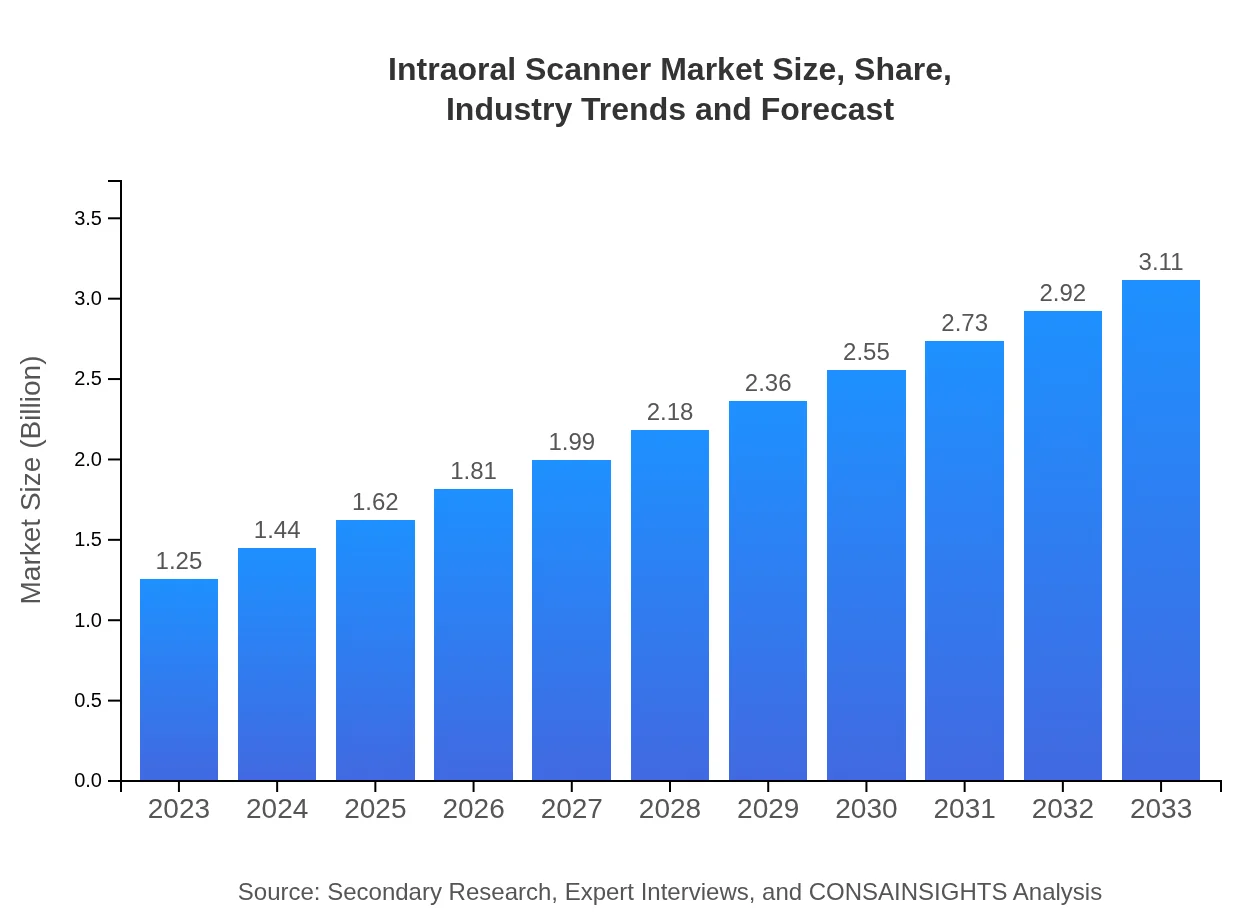
Intraoral Scanner Market Overview
Customize Intraoral Scanner Market Report market research report
- ✔ Get in-depth analysis of Intraoral Scanner market size, growth, and forecasts.
- ✔ Understand Intraoral Scanner's regional dynamics and industry-specific trends.
- ✔ Identify potential applications, end-user demand, and growth segments in Intraoral Scanner
What is the Market Size & CAGR of Intraoral Scanner Market Report market in 2023?
Intraoral Scanner Industry Analysis
Intraoral Scanner Market Segmentation and Scope
Tell us your focus area and get a customized research report.
Intraoral Scanner Market Report Market Analysis Report by Region
Europe Intraoral Scanner Market Report:
Europe grows from $0.31 Billion in 2023 to $0.77 Billion in 2033. Regional momentum is supported by increasing clinician adoption of digital workflows, regulatory alignment for dental devices, and investments in software-driven restorative solutions.Asia Pacific Intraoral Scanner Market Report:
Asia Pacific grows from $0.24 Billion in 2023 to $0.61 Billion in 2033. Expansion is driven by rising dental service capacity, greater procurement of portable scanners, and broader acceptance of digital treatment planning across clinics.North America Intraoral Scanner Market Report:
North America is largest regional market, rising from $0.48 Billion in 2023 to $1.18 Billion in 2033. The region’s growth reflects strong clinical uptake of digital impressions, established distribution networks, and investments in integrated dental technologies that accelerate adoption.South America Intraoral Scanner Market Report:
Latin America is fastest-growing region by implied CAGR, increasing from $0.05 Billion in 2023 to $0.13 Billion in 2033. Identified as the regional growth market with an implied 10.03% CAGR, growth stems from expanding dental services, increasing upgrades, and improving access to digital tools.Middle East & Africa Intraoral Scanner Market Report:
Middle East and Africa grows from $0.17 Billion in 2023 to $0.41 Billion in 2033. Growth factors include rising investment in dental infrastructure, gradual adoption of digital imaging, and vendor efforts to expand regional support and training.Tell us your focus area and get a customized research report.
Research Methodology
Intraoral Scanner Market Analysis By Product Type
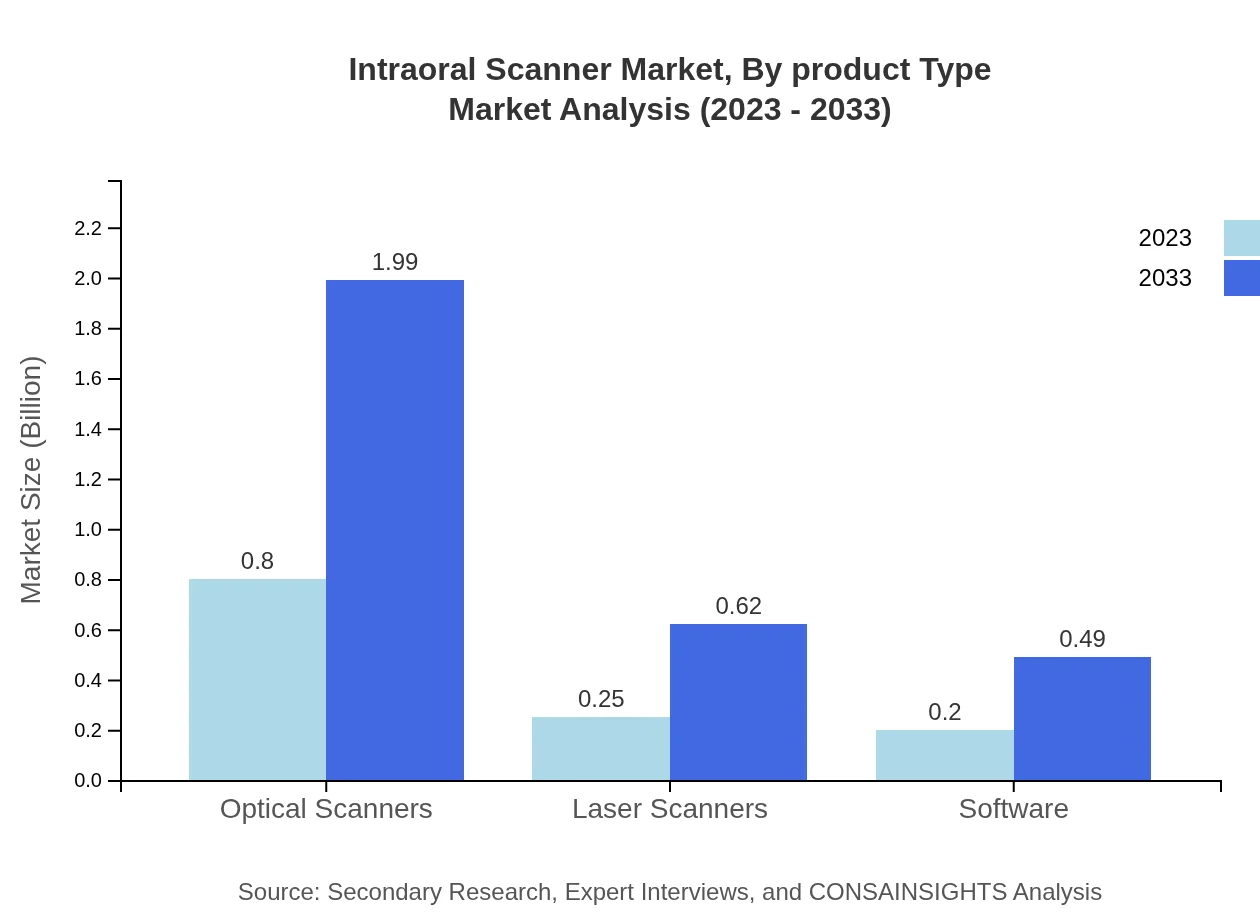
The Intraoral Scanner market is dominated by optical scanners, projected to grow from $1.07 billion in 2023 to $2.66 billion by 2033, making up 85.72% of the overall market. Laser scanners comprise 20.07% of the market share, showing steady growth due to their precision. Software solutions account for 15.78%, while new installations represent a significant market driver.
Intraoral Scanner Market Analysis By Application
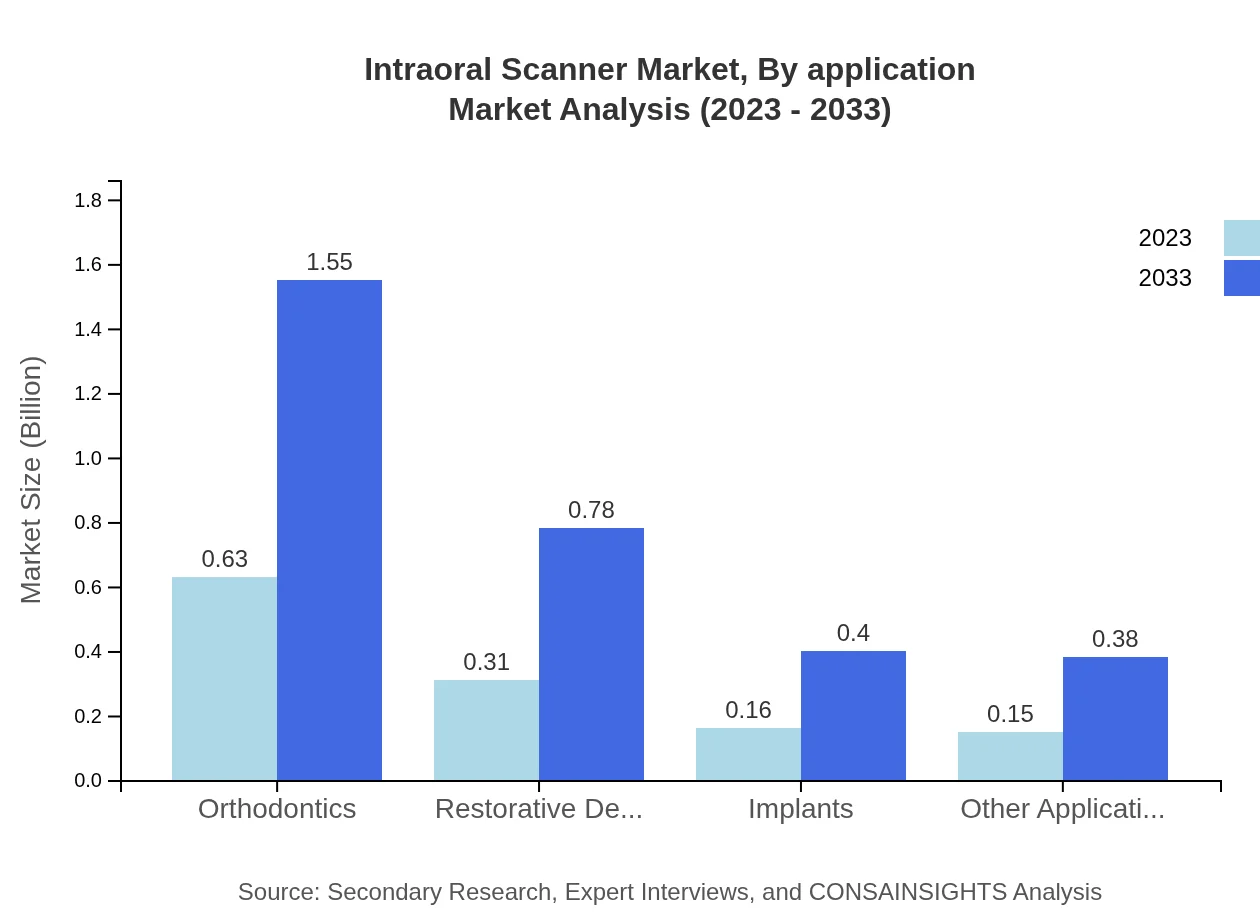
The orthodontics segment remains the leader in market share and growth, expected to rise from $0.63 billion in 2023 to $1.55 billion by 2033. Other important segments include restorative dentistry and implants, with respective market shares of 24.98% and 12.79%. This diversification demonstrates the scanner's versatility across various dental applications.
Intraoral Scanner Market Analysis By End User
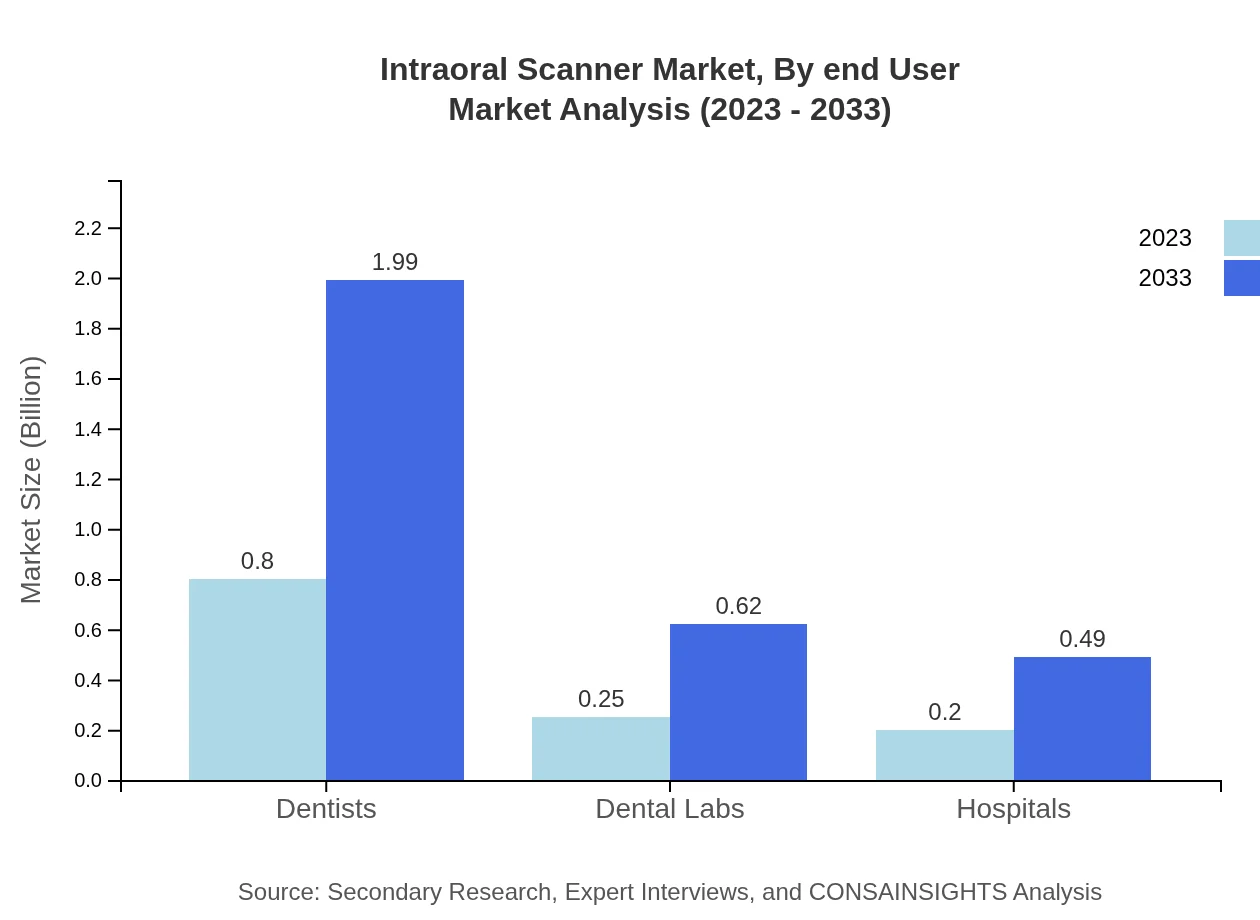
The dental practices segment is the largest consumer of intraoral scanners, with a market size forecast to reach $1.99 billion by 2033, keeping a consistent share of 64.15% throughout the decade. Dental labs and hospitals also represent significant end-users, although they account for smaller market shares compared to dental practices.
Intraoral Scanner Market Analysis By Region Adoption
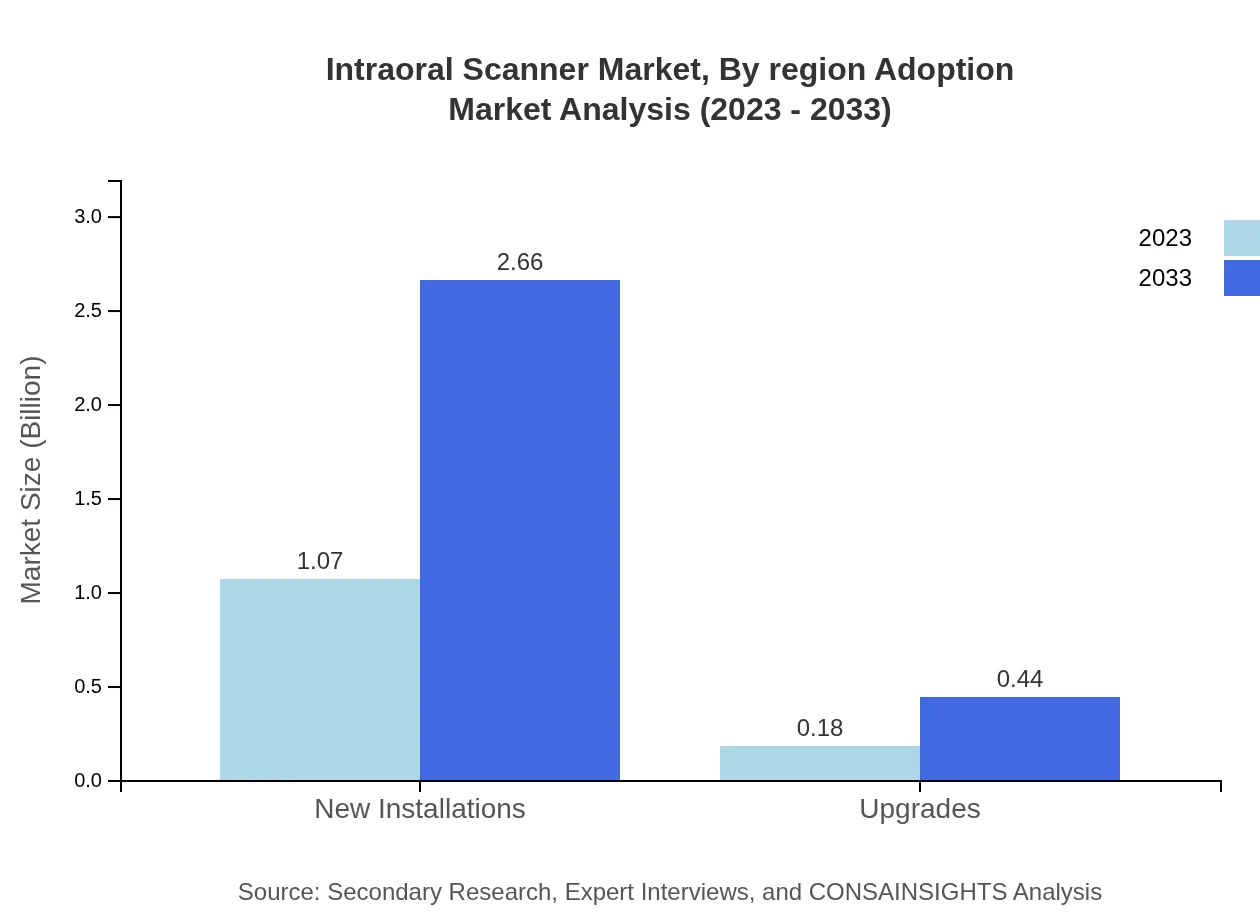
Adoption of intraoral scanners is notably rising among various regions, with North America leading due to established dental practices aligning with technological advancements. Europe follows closely, driven by regulatory frameworks favoring digital tools. Asia Pacific presents a growing adoption landscape, with increasing healthcare initiatives and a focus on modern dental practices.
Intraoral Scanner Market Trends and Future Forecast
Tell us your focus area and get a customized research report.
Global Market Leaders and Top Companies in Intraoral Scanner Industry
Align Technology, Inc.:
Align Technology is a pioneer in digital dentistry, known for its innovative intraoral scanning solutions that cater to orthodontic and restorative needs.3M Company:
3M offers advanced intraoral scanners that are integral to their dental product lines, emphasizing precision and ease of use for dental professionals.Carestream Health:
Carestream provides cutting-edge imaging solutions, focusing heavily on digital dentistry technologies which enhance diagnostic capabilities.Planmeca Oy:
Planmeca is a leading manufacturer of dental equipment, renowned for its intraoral scanners that combine advanced technology with user-friendly design.We're grateful to work with incredible clients.








FAQs
What is the current market size?
The market size in 2023 is $1.25 Billion, reflecting the value of intraoral scanning systems and related software at the start of the forecast period.
How big will the market be in 2033?
The market is projected to reach $3.11 Billion by 2033 based on the provided forecast, reflecting expected growth across product and regional segments.
What is CAGR for the forecast period?
The reported compound annual growth rate for 2023 to 2033 is 9.2%, representing the annualized expansion rate used in the projection.
Which region is the fastest Growing in the Intraoral Scanner Market Report market?
Latin America is the fastest-growing region, projected to expand from $0.05 Billion in 2023 to $0.13 Billion in 2033, reflecting an implied 10.03% CAGR over the forecast period.
Which region is fastest Growing?
Latin America is identified as the regional market region with an implied 10.03% CAGR, rising from $0.05 Billion in 2023 to $0.13 Billion in 2033.
Who are the prominent companies?
Top companies listed include Align Technology, Inc., 3M Company, Carestream Health, and Planmeca Oy, noted for product development and market presence.
What end users are covered?
End-user categories include dentists, dental labs, and hospitals, reflecting the primary settings where intraoral scanners are adopted and utilized.
What product types are tracked?
The report tracks optical scanners, laser scanners, and software as the main product-type segments influencing hardware and service revenues.
How are applications categorized?
Applications in the analysis include orthodontics, restorative dentistry, implants, and other dental procedures where digital impressions support treatment planning.
What drives regional growth?
Regional expansion is driven by factors such as improved clinical workflows, regulatory acceptance, vendor distribution, and increasing patient preference for digital care.