
Reports >
Life Sciences
>
Iot Healthcare Market Report

Iot Healthcare Market Report
First published: 15 October 2024 | Last updated: 25 May 2026 | Report Code: iot-healthcare
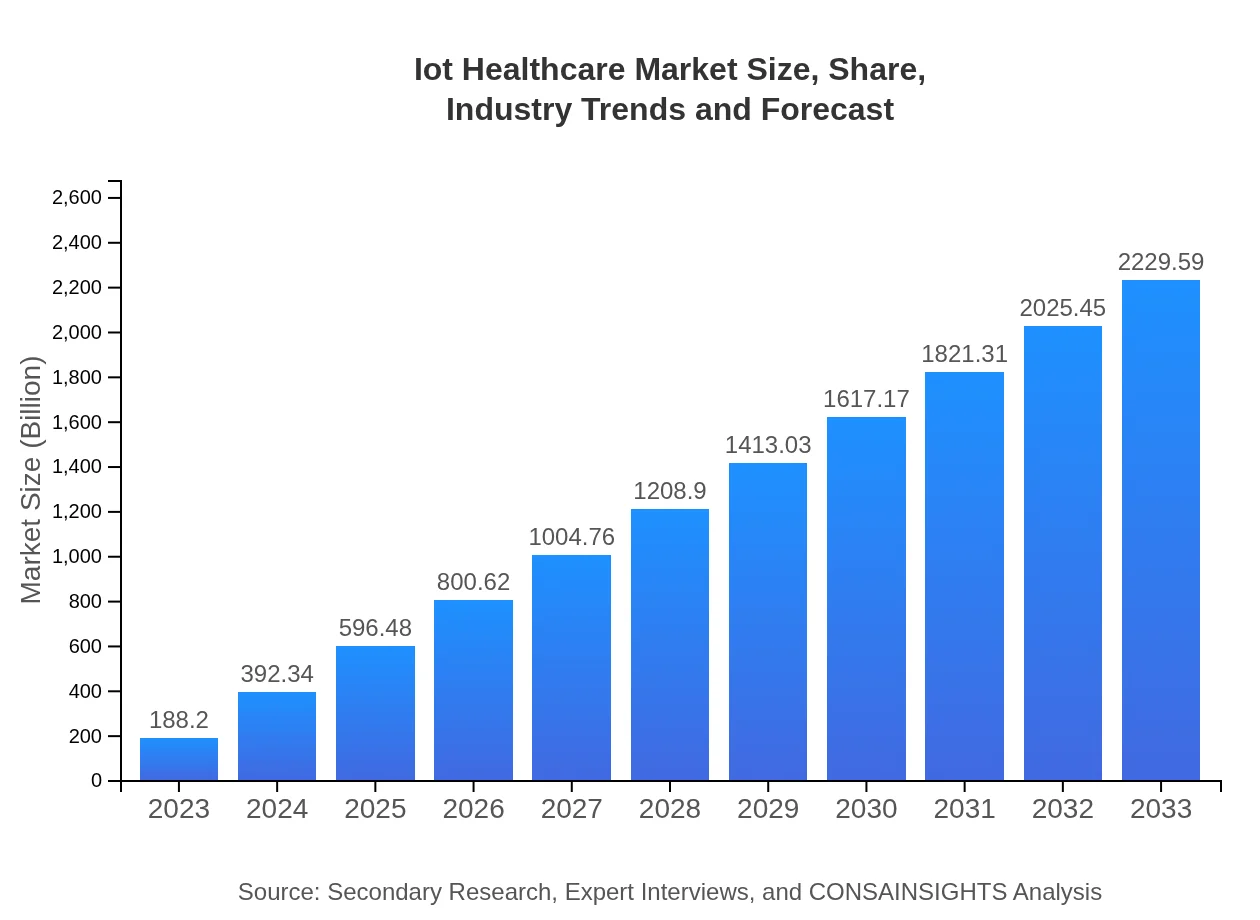
Iot Healthcare Market — USD 188.2 billion in 2023, Growing to USD 2229.59B by 2033 at 26.2% CAGR
This report provides a comprehensive analysis of the IoT Healthcare market, covering key insights on market size, growth trends, segmentation, and regional dynamics from 2023 to 2033.
Key Takeaways
- $188.20 Billion global market in 2023 expanding to $2229.59 Billion by 2033 at a 26.2% CAGR.
- North America is largest regional market, while no single fastest-growing region is stated because regional CAGR differences remain within 0.15 percentage points.
- Europe and Asia Pacific show substantial expansion: Europe from $61.65 Billion to $730.41 Billion, Asia Pacific from $35.59 Billion to $421.62 Billion.
- Core technologies include wearable devices, remote monitoring, and health data analytics driving service and device demand.
- Leading vendors profiled include Philips Healthcare, IBM Watson Health, GE Healthcare, Medtronic, and Siemens Healthineers.
Iot Healthcare Market Report — Executive Summary
North America remains largest market by forecast-period value, while no single fastest-growing region is stated because top regional growth rates are separated by less than 0.15 percentage points. This report examines the IoT Healthcare market dynamics from 2023 to 2033, documenting a rise from $188.20 Billion to $2229.59 Billion at a 26.2% CAGR. Growth is propelled by expanded use of wearable devices, remote monitoring platforms, and health data analytics that enable continuous patient observation and preventive care. Shifts toward decentralized care models and investments in connected medical devices are elevating demand across hospitals, clinics, and homecare settings. Regional breakdowns highlight North America as the largest market, with Europe, Asia Pacific, Latin America, and Middle East and Africa each displaying notable increases. The analysis addresses segmentation by end-user, technology, application, data source, and device type, and profiles major industry players including Philips Healthcare, IBM Watson Health, GE Healthcare, Medtronic, and Siemens Healthineers. Methodology blends primary interviews with experts and secondary sources such as company reports, supported by data triangulation and internal validation to ensure robust findings and trend interpretation.
Key Growth Drivers
- Rising uptake of wearable sensors and connected implants enabling continuous patient monitoring and early intervention.
- Expansion of telemedicine and remote monitoring services reducing barriers to care and increasing demand for IoT platforms.
- Greater emphasis on health data analytics to transform clinical and patient-generated data into actionable insights.
- Policy and regulatory support for digital health solutions encouraging provider adoption and vendor investment.
- Hospital and homecare adoption driven by cost-efficiency goals and the need for scalable chronic disease management.
| Metric | Value |
|---|---|
| Study Period | 2023 - 2033 |
| 2023 Market Size | $188.20 Billion |
| CAGR (2023-2033) | 26.2% |
| 2033 Market Size | $2229.59 Billion |
| Top Companies | Philips Healthcare, IBM Watson Health, GE Healthcare, Medtronic , Siemens Healthineers |
| Published Date | 15 October 2024 |
| Last Modified Date | 25 May 2026 |
IoT Healthcare Market Overview
Customize Iot Healthcare Market Report market research report
- ✔ Get in-depth analysis of Iot Healthcare market size, growth, and forecasts.
- ✔ Understand Iot Healthcare's regional dynamics and industry-specific trends.
- ✔ Identify potential applications, end-user demand, and growth segments in Iot Healthcare
What is the Market Size & CAGR of Iot Healthcare Market Report market in 2023?
IoT Healthcare Industry Analysis
IoT Healthcare Market Segmentation and Scope
Tell us your focus area and get a customized research report.
Iot Healthcare Market Report Market Analysis Report by Region
Europe Iot Healthcare Market Report:
Europe grows from $61.65 Billion in 2023 to $730.41 Billion in 2033. Growth reflects increased use of wearable devices and analytics, supportive digital health policies, and rising telemedicine and remote monitoring services across clinical and homecare settings.Asia Pacific Iot Healthcare Market Report:
Asia Pacific grows from $35.59 Billion in 2023 to $421.62 Billion in 2033. Market advancement is fueled by growing healthcare digitization, adoption of remote monitoring technologies, and rising focus on chronic disease management and preventive care.North America Iot Healthcare Market Report:
North America is largest regional market, rising from $62.95 Billion in 2023 to $745.8 Billion in 2033. Regional demand is driven by strong hospital and homecare adoption of connected devices, investments in health IT, and established vendor presence supporting rapid deployment.South America Iot Healthcare Market Report:
Latin America grows from $4.48 Billion in 2023 to $53.06 Billion in 2033. Expansion is underpinned by gradual uptake of connected healthcare solutions, telemedicine growth, and rising investments in health data platforms and sensors.Middle East & Africa Iot Healthcare Market Report:
Middle East and Africa grows from $23.52 Billion in 2023 to $278.7 Billion in 2033. Drivers include investment in digital health infrastructure, increased use of remote patient monitoring, and adoption of wearables for chronic care and preventive services.Tell us your focus area and get a customized research report.
Research Methodology
Iot Healthcare Market Analysis By Technology
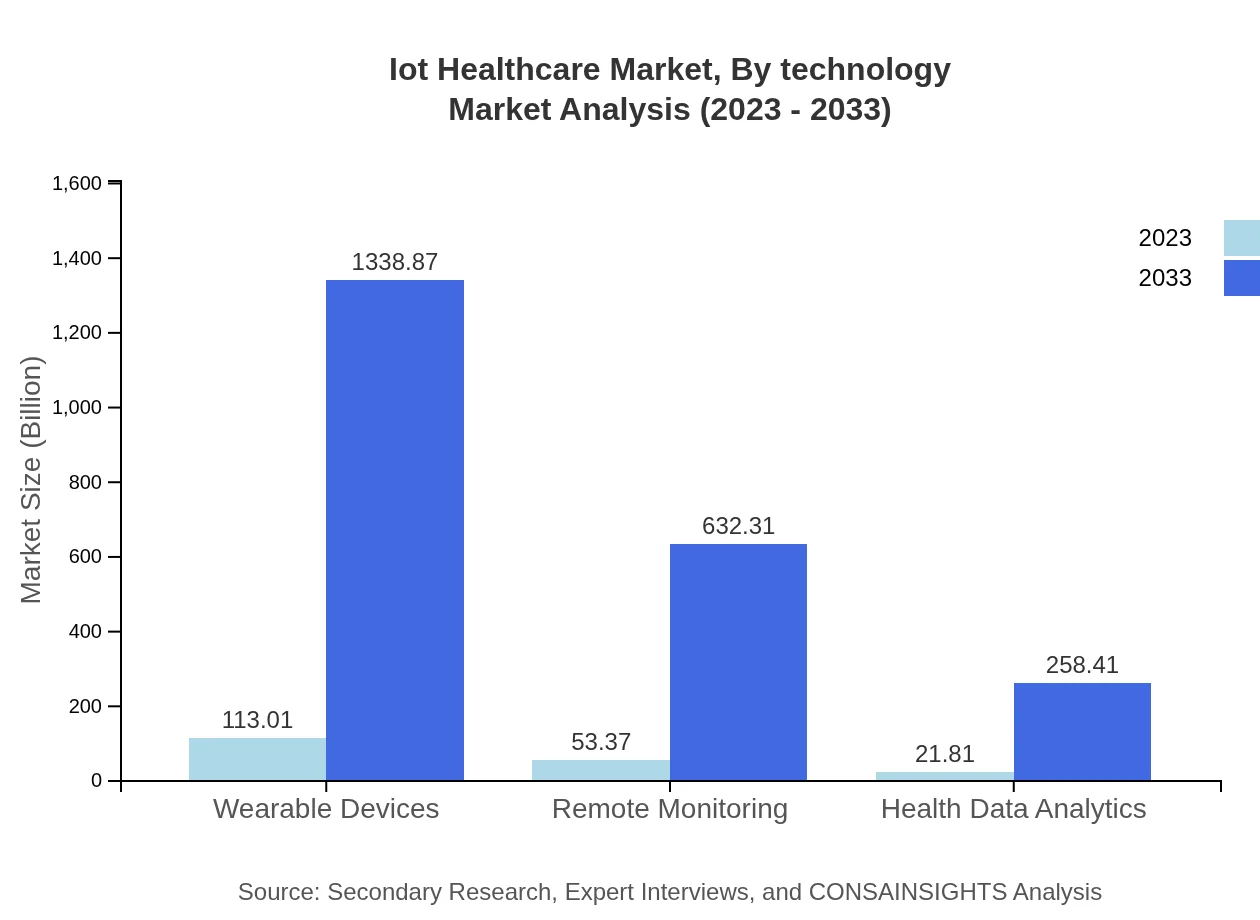
Wearables constitute the largest technology segment, projected to expand from $113.01 billion in 2023 to $1,338.87 billion by 2033. Remote monitoring follows with an increase from $53.37 billion to $632.31 billion, driven by the growing need for continuous healthcare monitoring. Health data analytics will also see substantial growth, from $21.81 billion to $258.41 billion, as providers leverage data for better insights.
Iot Healthcare Market Analysis By Application
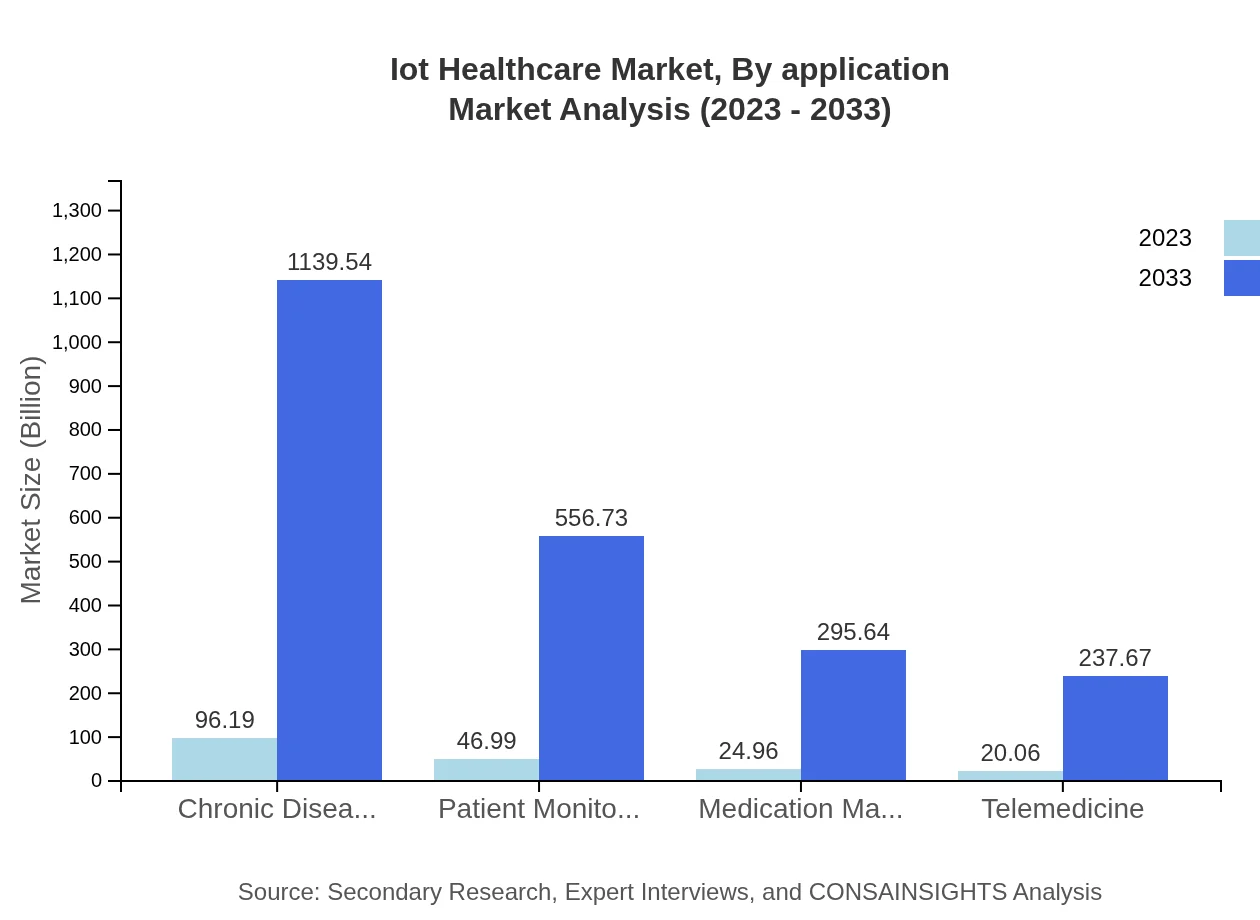
Chronic disease management is one of the largest application areas, expected to grow from $96.19 billion in 2023 to $1,139.54 billion by 2033. Telemedicine is also on the rise, increasing from $20.06 billion to $237.67 billion, as it facilitates remote consultations and healthcare delivery.
Iot Healthcare Market Analysis By End User
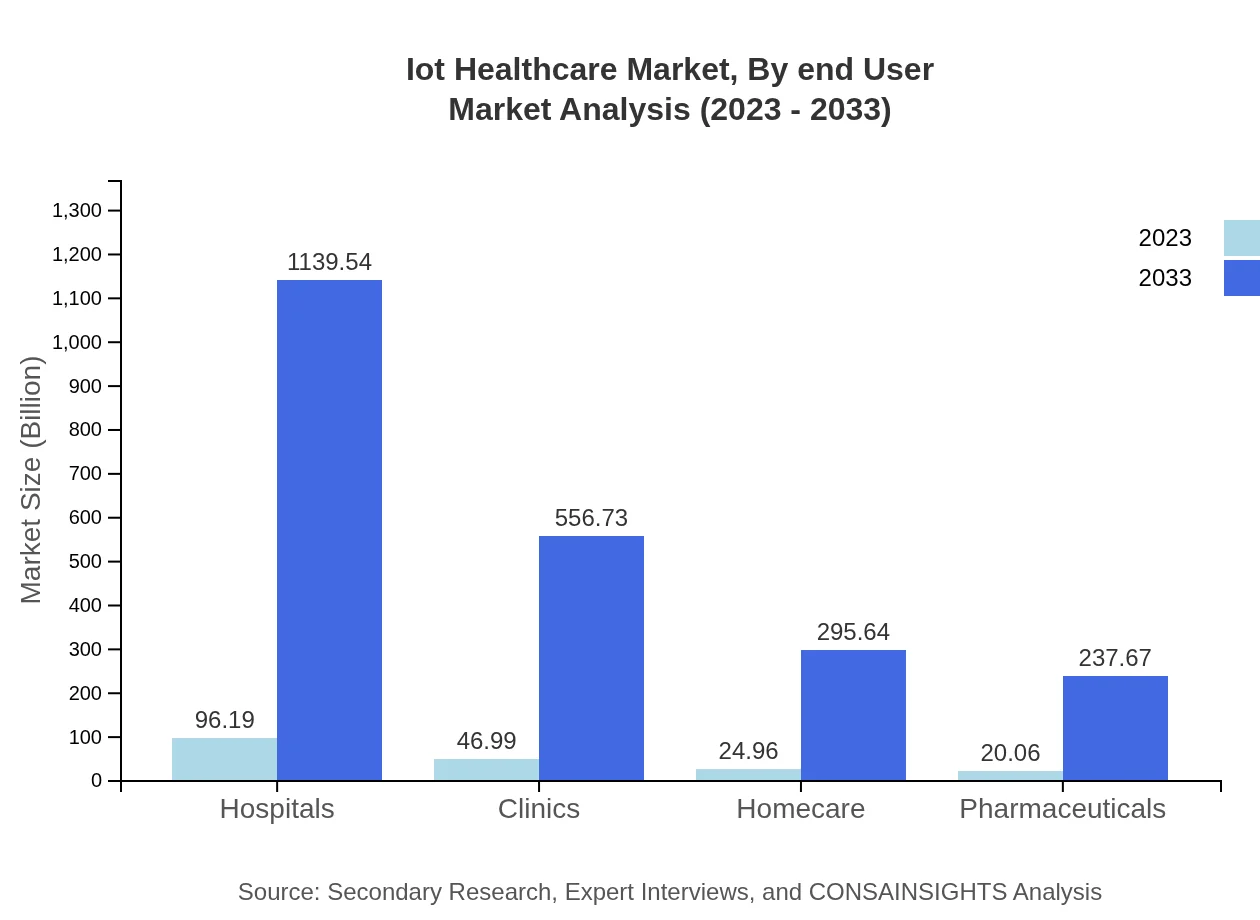
Hospitals dominate the end-user segment, growing from $96.19 billion in 2023 to $1,139.54 billion by 2033. Clinics and homecare segments are also crucial, with clinic markets expanding from $46.99 billion to $556.73 billion, driven by the need for localized care solutions.
Iot Healthcare Market Analysis By Device Type
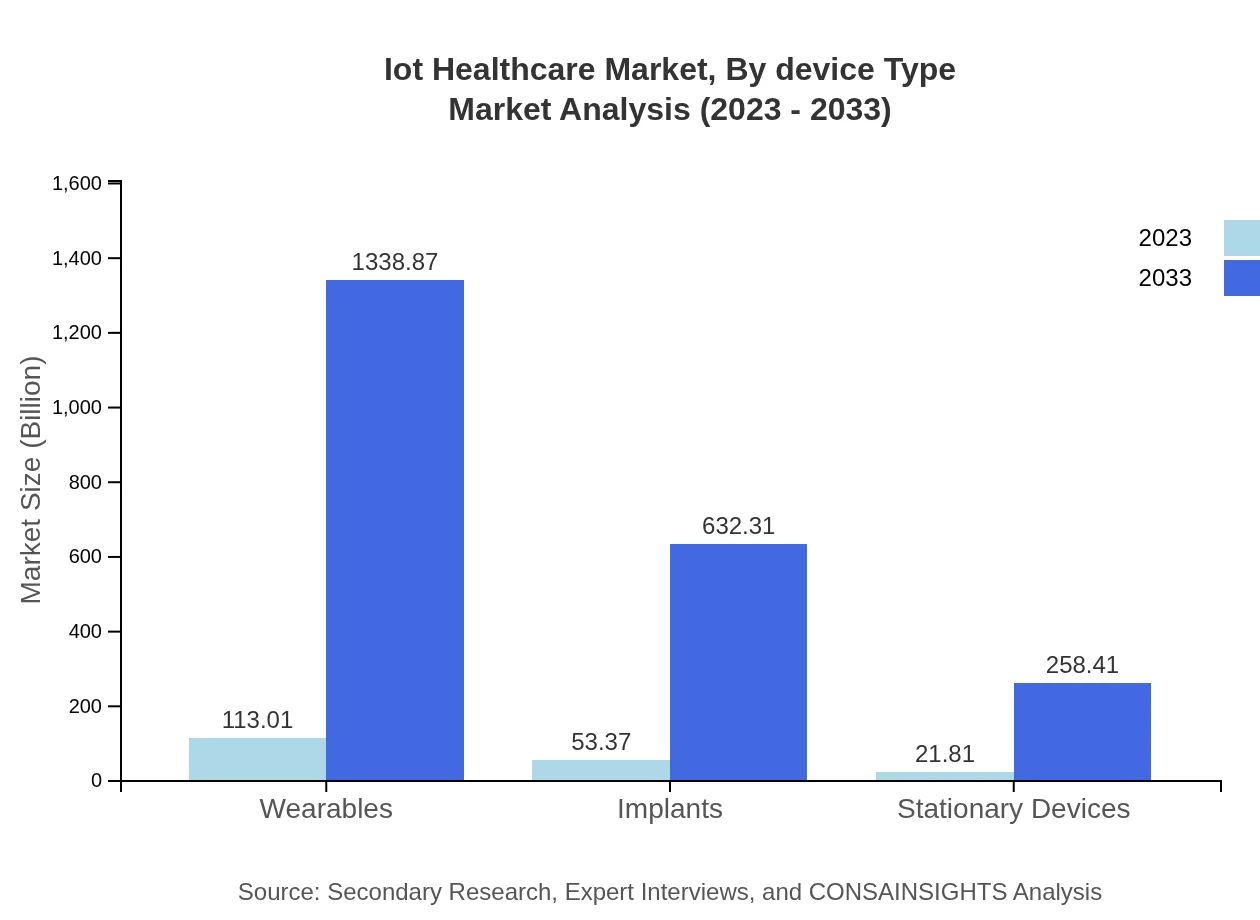
Wearable devices maintain a significant growth trajectory from $113.01 billion in 2023 to $1,338.87 billion by 2033. Stationary devices and implants also show promising growth, indicating an increasing reliance on diverse healthcare technologies.
Iot Healthcare Market Analysis By Data Source
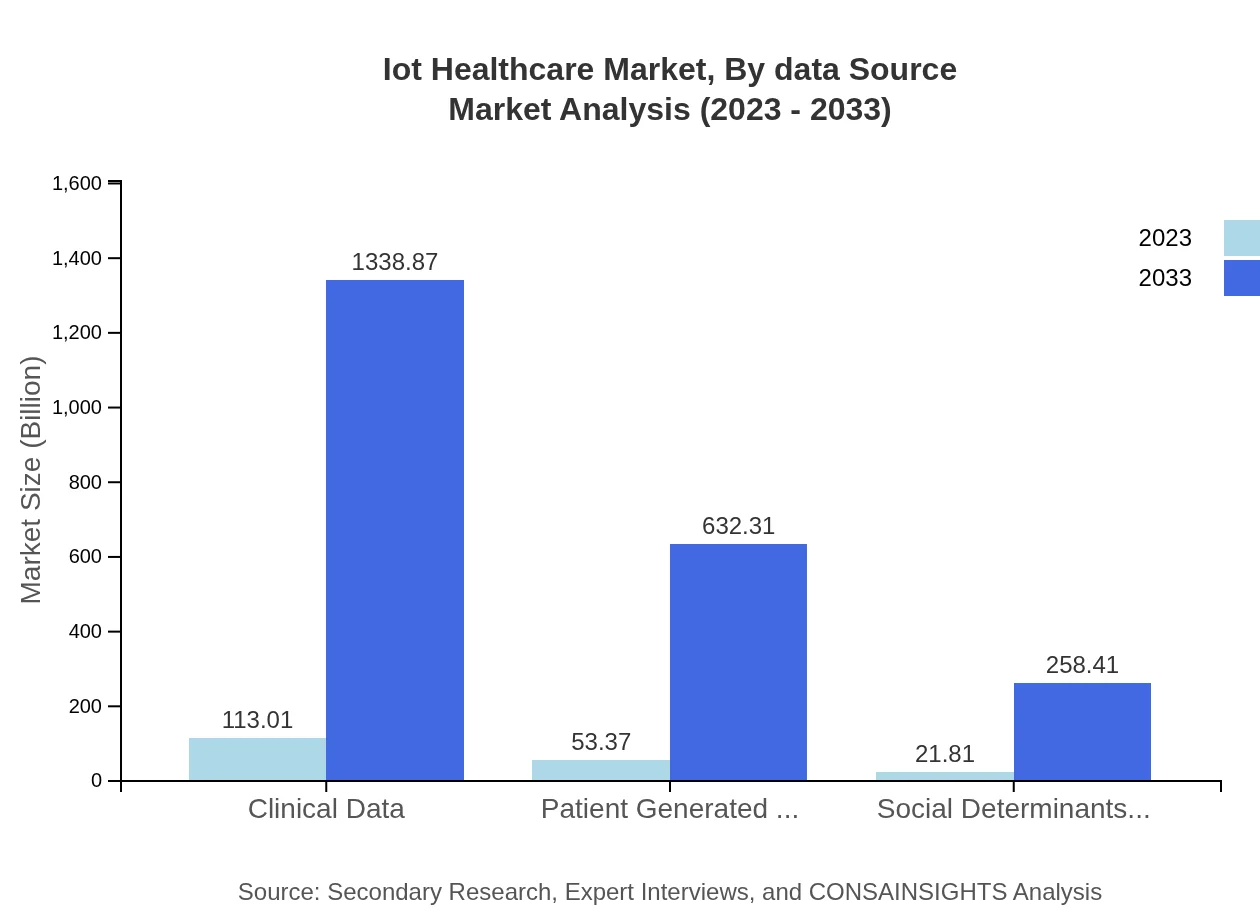
Clinical data leads the data source segment with growth from $113.01 billion in 2023 to $1,338.87 billion by 2033. The demand for patient-generated data is also notable, projected to rise to $632.31 billion, highlighting the importance of self-reported data in enhancing health outcomes.
IoT Healthcare Market Trends and Future Forecast
Tell us your focus area and get a customized research report.
Global Market Leaders and Top Companies in IoT Healthcare Industry
Philips Healthcare:
Philips Healthcare is a leader in healthcare technology, providing innovative solutions to improve patient care and healthcare management with a strong focus on IoT devices and systems.IBM Watson Health:
IBM Watson Health leverages AI and cloud technologies to empower healthcare companies with analytics and data-driven insights, significantly improving decision-making in patient care.GE Healthcare:
GE Healthcare focuses on medical imaging and connected devices, offering IoT solutions that enhance patient monitoring, diagnostics, and operational efficiency in healthcare facilities.Medtronic :
Medtronic is a prominent player in medical technology, spearheading developments in connected devices, particularly in chronic disease management and remote patient monitoring.Siemens Healthineers:
Siemens Healthineers combines technology and data skills to innovate in healthcare, providing IoT solutions that improve the quality and efficiency of healthcare delivery.We're grateful to work with incredible clients.








FAQs
What is the market size of the IoT Healthcare market in 2023?
The market size in 2023 is $188.20 Billion as reported for the global IoT Healthcare market for the base year.
How big will the IoT Healthcare market be in 2033?
By 2033 the market is projected to reach $2229.59 Billion according to the forecast period specified in the report.
What is CAGR for the forecast period?
The compound annual growth rate for 2023 to 2033 is 26.2%, reflecting the projected expansion over the ten-year period.
Is there a single fastest Growing region in the Iot Healthcare Market Report market?
No single fastest-growing region is stated for the Iot Healthcare Market Report market because the top regional implied CAGR values are within 0.15 percentage points of each other, making the ranking too close to call reliably.
Which technologies drive IoT Healthcare adoption?
Key technologies include wearable devices, remote monitoring systems, and health data analytics that support remote patient observation and analytics.
Who are the principal companies covered in the report?
Top companies featured include Philips Healthcare, IBM Watson Health, GE Healthcare, Medtronic, and Siemens Healthineers.
What end Users are considered in the segmentation?
End-user segments include hospitals, clinics, homecare providers, and pharmaceutical stakeholders as detailed in the report.
How is data sourced for the research?
Research is based on primary interviews with industry experts and secondary sources such as company reports and publications.
What applications are emphasized in the market?
Prominent applications include chronic disease management, patient monitoring, medication management, and telemedicine.
Why are health data analytics important?
Health data analytics convert clinical and patient-generated data into insights that improve preventive care, treatment personalization, and operational efficiency.