

Joint Reconstruction Devices Market Report
First published: 12 October 2024 | Last updated: 25 May 2026 | Report Code: joint-reconstruction-devices
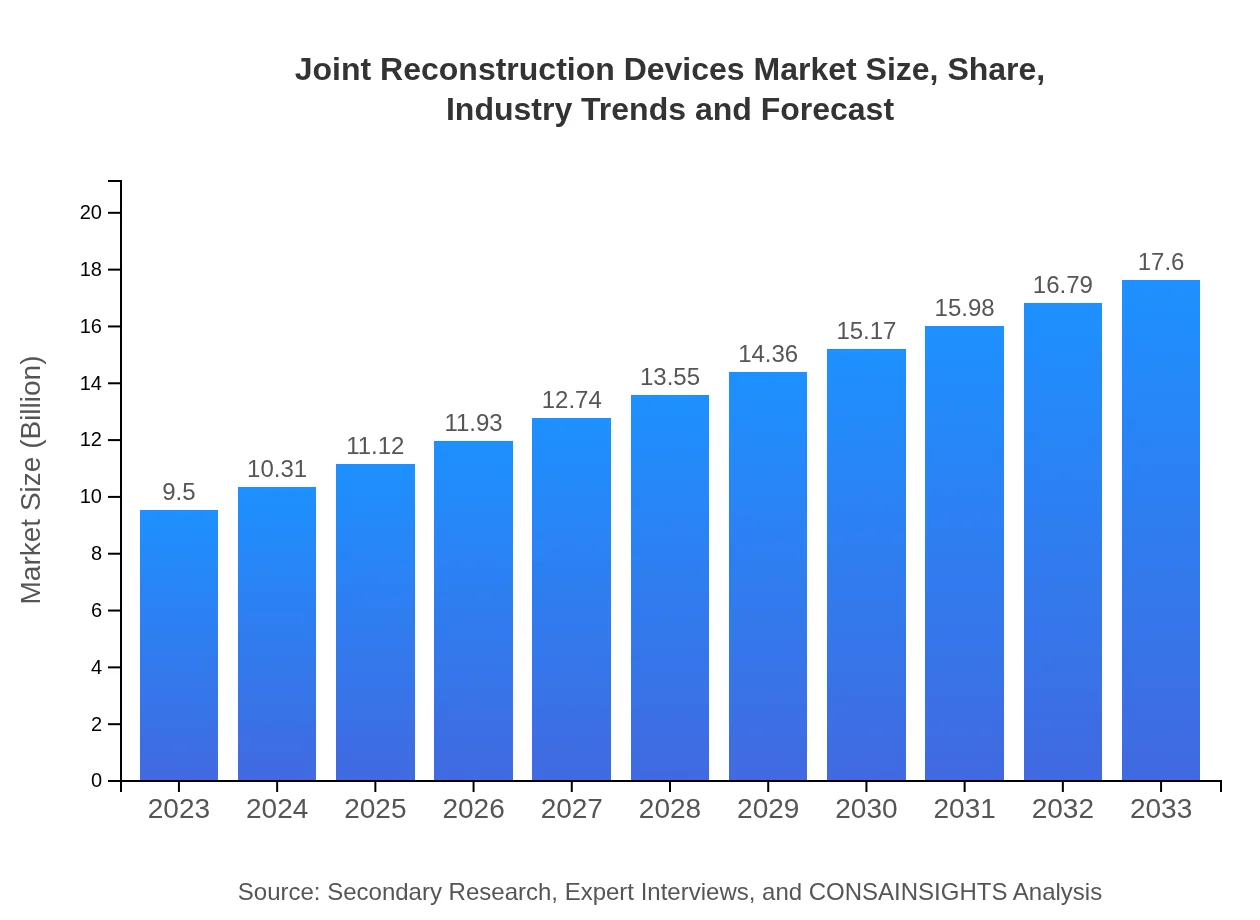
Joint Reconstruction Devices Market — USD $9.5 Billion in 2023, Growing to USD 17.60null by 2033 at 6.2% CAGR
This report provides an in-depth analysis of the Joint Reconstruction Devices market from 2023 to 2033, covering market size, growth trends, innovative technologies, and the competitive landscape, offering insights for strategic decision-making.
Key Takeaways
- Global market grows from $9.50 Billion in 2023 to $17.60 Billion in 2033 at a 6.2% CAGR.
- North America is largest regional market, while no single fastest-growing region is stated because regional CAGR differences remain within 0.15 percentage points.
- Europe expands from $3.04 Billion in 2023 to $5.63 Billion in 2033, reflecting sustained demand.
- Asia Pacific increases from $1.71 Billion in 2023 to $3.17 Billion in 2033, driven by procedure volumes.
- Key manufacturers include Stryker Corporation, Zimmer Biomet Holdings, Inc., DePuy Synthes (Johnson & Johnson), and Medtronic plc.
Joint Reconstruction Devices Market Report — Executive Summary
North America remains largest market by forecast-period value, while no single fastest-growing region is stated because top regional growth rates are separated by less than 0.15 percentage points. This report examines the joint reconstruction devices market from 2023 to 2033, quantifying growth from $9.50 Billion to $17.60 Billion at a 6.2% CAGR. Expansion is supported by increasing prevalence of orthopedic conditions, an aging population, and technological progress in surgical techniques and materials. The study evaluates product types—knee, hip, and shoulder devices—materials such as metal, polymer, and ceramic, and end users including hospitals, ambulatory surgical centers, and orthopedic clinics. North America remains largest market by forecast-period value, while no single fastest-growing region is stated because top regional growth rates are separated by less than 0.15 percentage points. Competitive coverage profiles leading suppliers including Stryker Corporation, Zimmer Biomet Holdings, Inc., DePuy Synthes (Johnson & Johnson), and Medtronic plc. Methodology combines expert interviews, company publications, and data validation to produce actionable market intelligence for stakeholders.
Key Growth Drivers
- Rising incidence of orthopedic disorders and age-related joint degeneration increasing procedural demand.
- Advancements in surgical techniques and implant materials improving clinical outcomes and adoption rates.
- Shift toward outpatient and ambulatory surgical centers expanding access to reconstructive procedures.
- Continuous R&D investment by major manufacturers enhancing product portfolios and innovation.
| Metric | Value |
|---|---|
| Study Period | 2023 - 2033 |
| 2023 Market Size | $9.50 Billion |
| CAGR (2023-2033) | 6.2% |
| 2033 Market Size | $17.60 Billion |
| Top Companies | Stryker Corporation, Zimmer Biomet Holdings, Inc., DePuy Synthes (Johnson & Johnson), Medtronic plc |
| Published Date | 12 October 2024 |
| Last Modified Date | 25 May 2026 |
Joint Reconstruction Devices Market Overview
Customize Joint Reconstruction Devices Market Report market research report
- ✔ Get in-depth analysis of Joint Reconstruction Devices market size, growth, and forecasts.
- ✔ Understand Joint Reconstruction Devices's regional dynamics and industry-specific trends.
- ✔ Identify potential applications, end-user demand, and growth segments in Joint Reconstruction Devices
What is the Market Size & CAGR of Joint Reconstruction Devices Market Report market in 2023?
Joint Reconstruction Devices Industry Analysis
Joint Reconstruction Devices Market Segmentation and Scope
Tell us your focus area and get a customized research report.
Joint Reconstruction Devices Market Report Market Analysis Report by Region
Europe Joint Reconstruction Devices Market Report:
Europe grows from $3.04 Billion in 2023 to $5.63 Billion in 2033. Demand is driven by aging populations, established clinical infrastructure, and adoption of minimally invasive procedures that support reconstruction device use.Asia Pacific Joint Reconstruction Devices Market Report:
Asia Pacific grows from $1.71 Billion in 2023 to $3.17 Billion in 2033. Growth stems from increasing access to orthopedic care, rising surgical volumes, and investment in healthcare facilities across key markets.North America Joint Reconstruction Devices Market Report:
North America is largest regional market, rising from $3.4 Billion in 2023 to $6.29 Billion in 2033. Local expansion is supported by high procedure volumes, established reimbursement frameworks, and continual innovation from major device manufacturers.South America Joint Reconstruction Devices Market Report:
Latin America grows from $0.65 Billion in 2023 to $1.2 Billion in 2033. Market progress is linked to improving healthcare delivery, greater availability of reconstructive procedures, and expanding hospital and clinic capabilities.Middle East & Africa Joint Reconstruction Devices Market Report:
Middle East and Africa grows from $0.71 Billion in 2023 to $1.31 Billion in 2033. Regional gains are supported by enhancements in surgical capacity, growing demand for joint therapies, and gradual infrastructure development.Tell us your focus area and get a customized research report.
Research Methodology
Joint Reconstruction Devices Market Analysis By Product Type
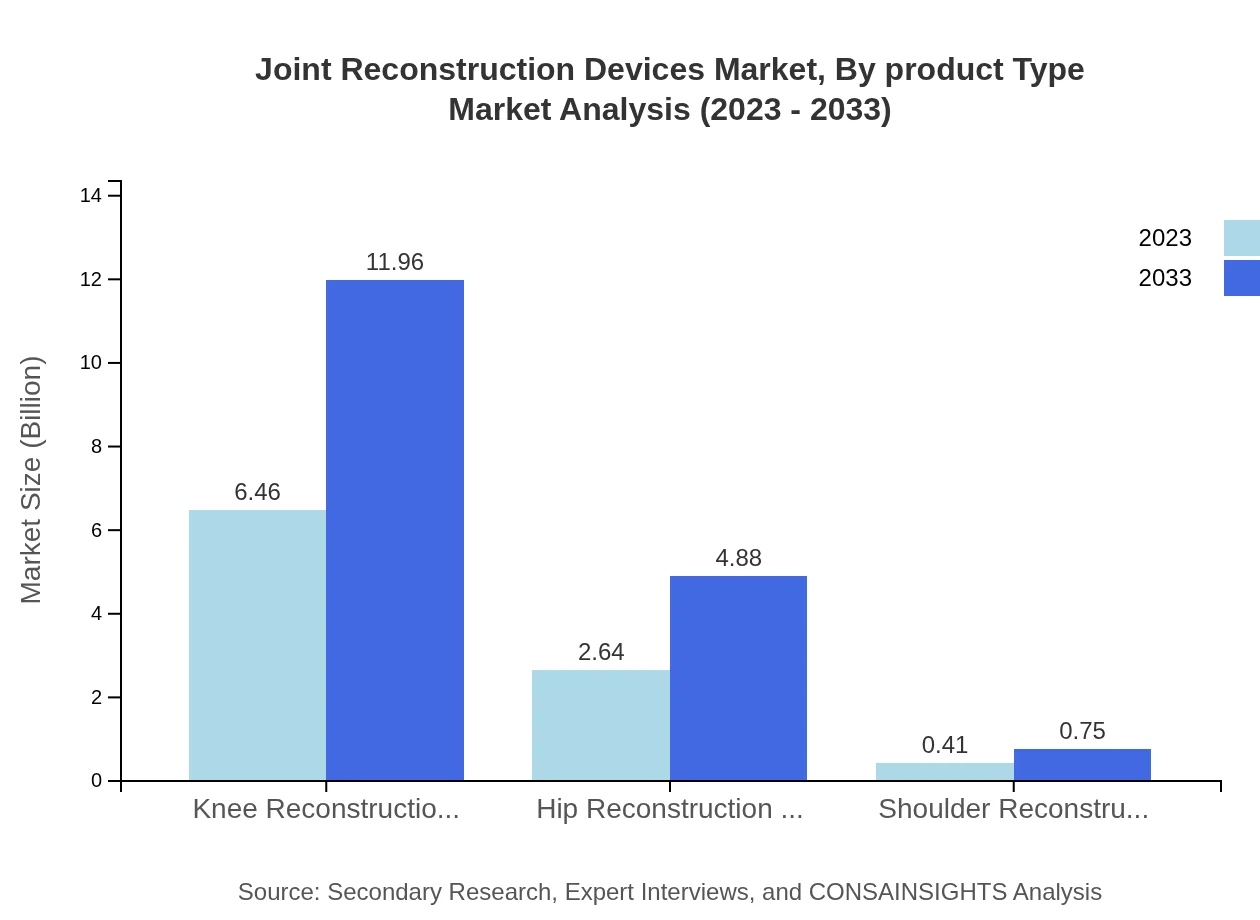
The predominant share of the Joint Reconstruction Devices market is held by knee reconstruction devices, expected to grow from USD 6.46 billion in 2023 to USD 11.96 billion by 2033, representing 67.97% market share. Hip reconstruction devices follow with growth from USD 2.64 billion to USD 4.88 billion, holding a 27.75% market share, while shoulder reconstruction devices account for the smallest segment with growth from USD 0.41 billion to USD 0.75 billion.
Joint Reconstruction Devices Market Analysis By Material
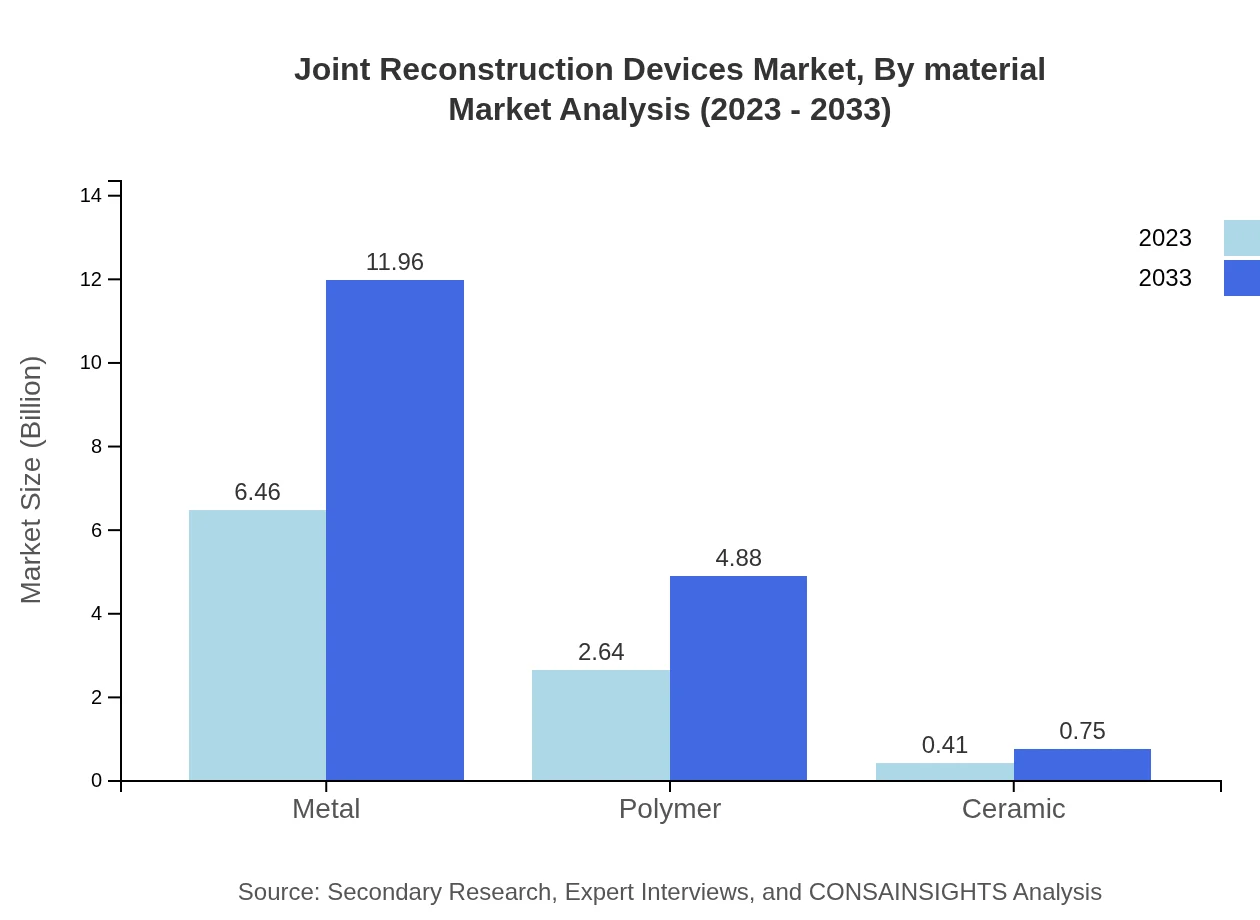
Metals are the most utilized material in joint reconstruction devices, with an estimated market size of USD 6.46 billion in 2023, projected to reach USD 11.96 billion by 2033, representing a 67.97% share. Polymers are gaining popularity, expected to grow from USD 2.64 billion to USD 4.88 billion, while ceramics will see modest growth from USD 0.41 billion to USD 0.75 billion.
Joint Reconstruction Devices Market Analysis By Application
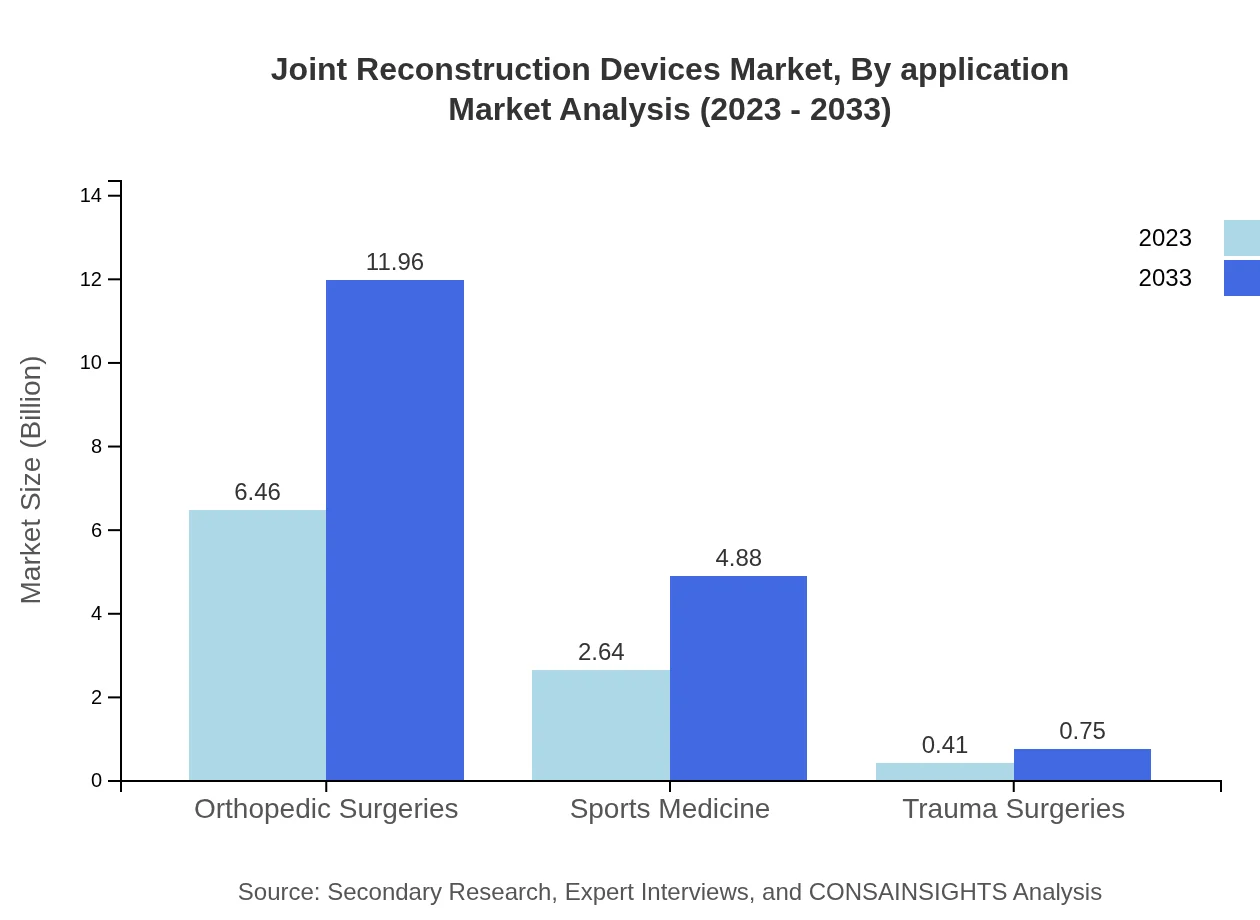
Orthopedic surgeries dominate the application landscape of the Joint Reconstruction Devices market, with the size expanding from USD 6.46 billion in 2023 to USD 11.96 billion by 2033, holding a 67.97% share. Sports medicine will see growth from USD 2.64 billion to USD 4.88 billion, while trauma surgeries represent a smaller share, increasing from USD 0.41 billion to USD 0.75 billion.
Joint Reconstruction Devices Market Analysis By End User
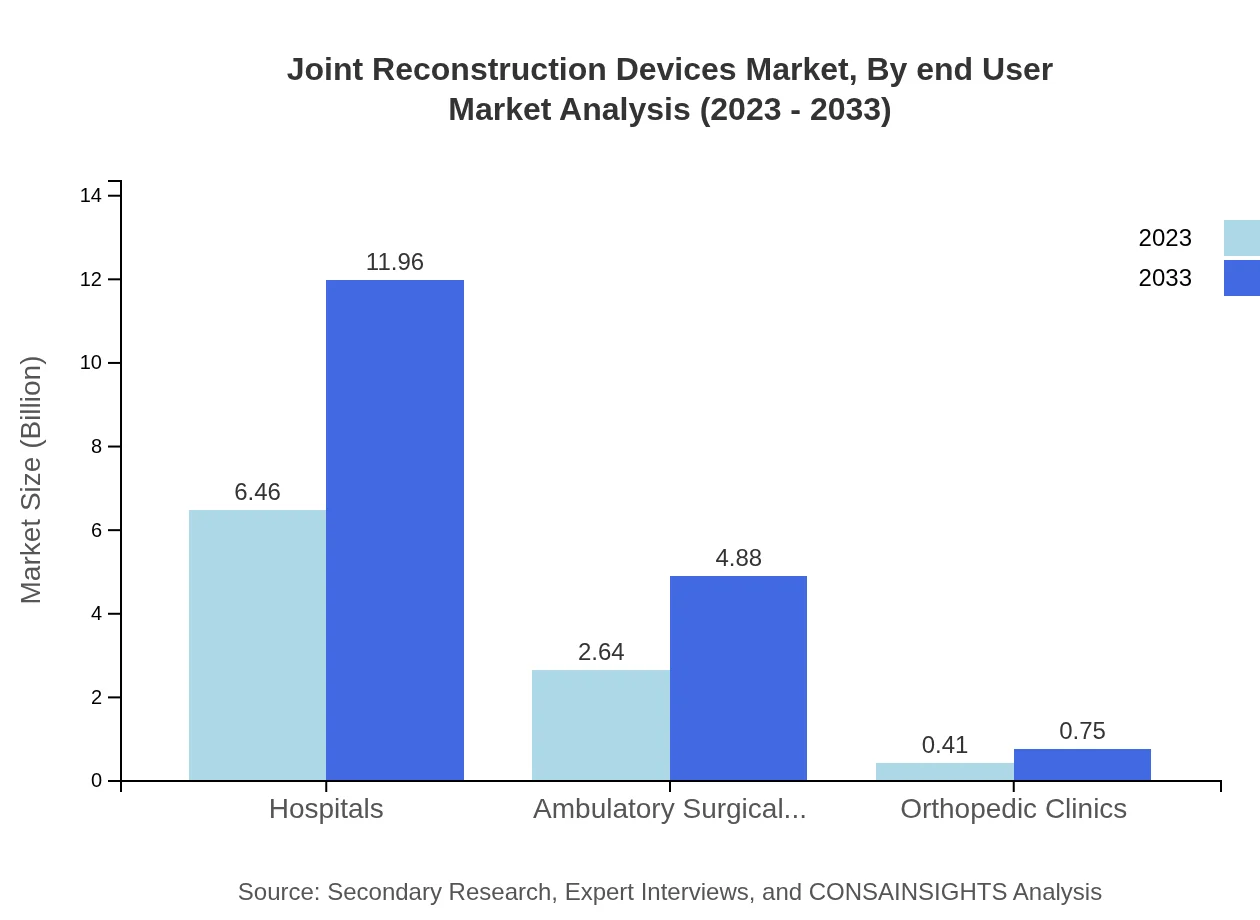
Hospitals are the primary end-user segment, exhibiting a market size of USD 6.46 billion in 2023, anticipated to grow to USD 11.96 billion by 2033. Ambulatory surgical centers will also see growth, from USD 2.64 billion to USD 4.88 billion, with orthopedic clinics growing from USD 0.41 billion to USD 0.75 billion.
Joint Reconstruction Devices Market Trends and Future Forecast
Tell us your focus area and get a customized research report.
Global Market Leaders and Top Companies in Joint Reconstruction Devices Industry
Stryker Corporation:
Stryker is a leading medical technology company with a strong focus on orthopedics, offering a wide range of joint reconstruction devices known for their innovation and quality.Zimmer Biomet Holdings, Inc.:
Zimmer Biomet develops advanced products for joint reconstruction and is known for its pioneering technologies in orthopedic solutions and surgical procedures.DePuy Synthes (Johnson & Johnson):
DePuy Synthes specializes in high-quality orthopedic implants, focusing on joint reconstruction and providing surgeons with advanced techniques and devices.Medtronic plc:
Medtronic focuses on medical technologies, providing a range of joint reconstruction solutions and emphasizing surgical innovation and patient outcomes.We're grateful to work with incredible clients.








FAQs
What is the market size of the joint reconstruction devices market in 2023?
The market size for 2023 is $9.50 Billion, as stated in the report's baseline year data and used for the 2023 to 2033 forecast analysis.
How big will the joint reconstruction devices market be in 2033?
By 2033, the market is projected to reach $17.60 Billion according to the report's forecast covering the 2023 to 2033 period.
What is CAGR of the market over the forecast period?
The report specifies a compound annual growth rate (CAGR) of 6.2% for the 2023 to 2033 forecast period.
Why is North America identified in the report?
North America is identified as the largest regional market, increasing from $3.4 Billion in 2023 to $6.29 Billion in 2033 based on region-level figures.
Which product segments are covered in the market segmentation?
The segmentation includes product types such as Knee Reconstruction Devices, Hip Reconstruction Devices, and Shoulder Reconstruction Devices as core product categories.
Who are the top companies featured in the analysis?
Top companies listed in the report include Stryker Corporation, Zimmer Biomet Holdings, Inc., DePuy Synthes (Johnson & Johnson), and Medtronic plc.
What are the primary materials analyzed in the report?
Materials examined in the report comprise Metal, Polymer, and Ceramic categories used across joint reconstruction device offerings.
How big is the European regional market in 2023 and 2033?
Europe's regional market is reported at $3.04 Billion in 2023 and grows to $5.63 Billion by 2033 within the forecast period.
What drives growth in Asia Pacific according to the report?
Asia Pacific growth is supported by rising procedure volumes and access to care, with regional values moving from $1.71 Billion in 2023 to $3.17 Billion in 2033.
Is there a single fastest Growing region in the Joint Reconstruction Devices Market Report market?
No single fastest-growing region is stated for the Joint Reconstruction Devices Market Report market because the top regional implied CAGR values are within 0.15 percentage points of each other, making the ranking too close to call reliably.