

Mobile Medical Imaging Services Market Report
First published: 08 October 2024 | Last updated: 25 May 2026 | Report Code: mobile-medical-imaging-services
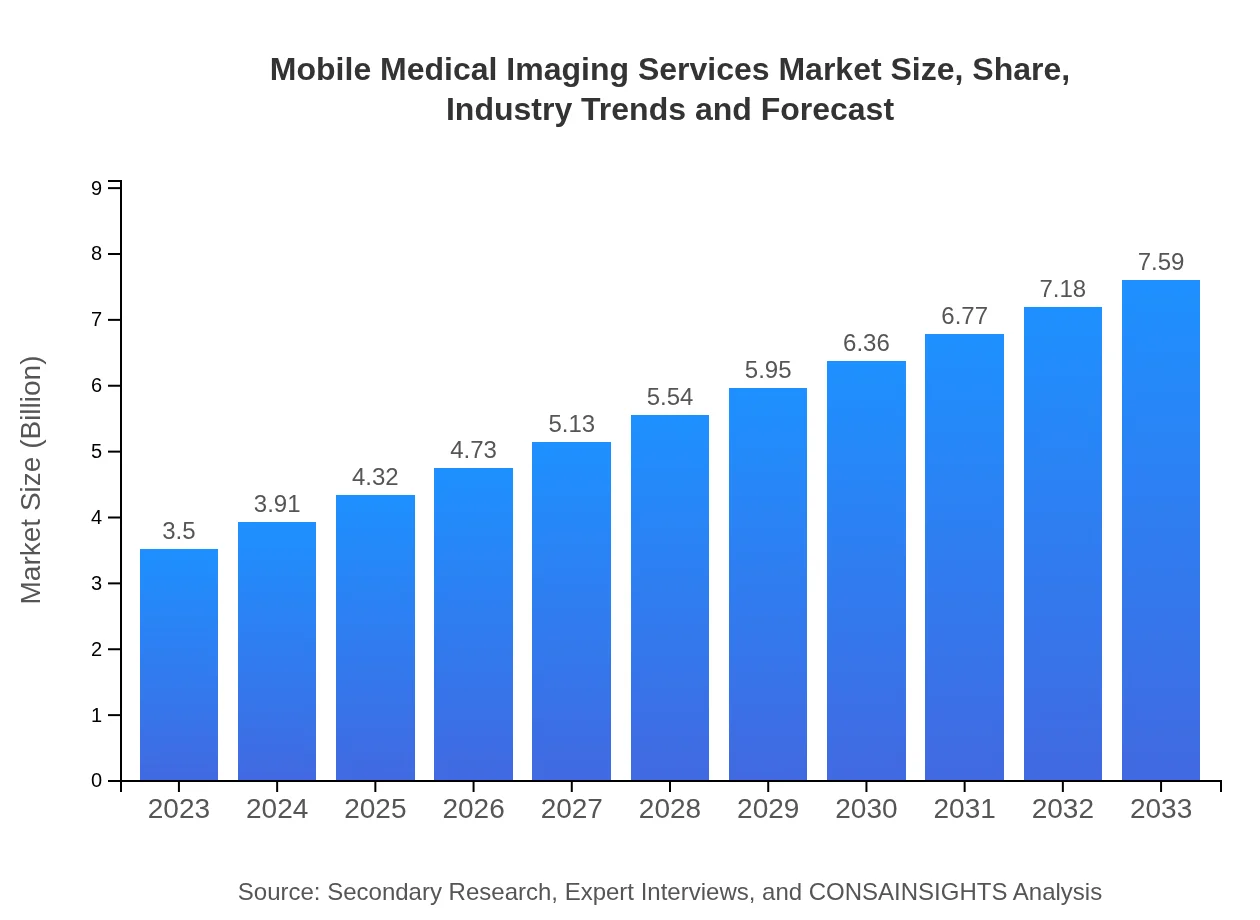
Mobile Medical Imaging Services Market — USD 3.5 billion in 2023, Growing to USD 7.59B by 2033 at 7.8% CAGR
This report offers a comprehensive analysis of the Mobile Medical Imaging Services market, focusing on insights and trends from 2023 to 2033, including market size, segmentation, regional performance, and key industry players.
Key Takeaways
- Market expands from $3.50 Billion in 2023 to $7.59 Billion in 2033 at a 7.8% CAGR, driven by demand for accessible diagnostics.
- North America is largest regional market, while no single fastest-growing region is stated because regional CAGR differences remain within 0.15 percentage points.
- Regional growth is supported by portable imaging, telemedicine integration, and partnerships between providers and hospitals.
- Leading companies include Siemens Healthineers, GE Healthcare, Philips Healthcare, Roche Diagnostics, and Mobius Biomedical.
- Service mix includes ultrasound, X-ray, CT, and MRI offerings delivered via on-site and direct-to-consumer models.
Mobile Medical Imaging Services Market Report — Executive Summary
North America remains largest market by forecast-period value, while no single fastest-growing region is stated because top regional growth rates are separated by less than 0.15 percentage points. This report outlines the Mobile Medical Imaging Services market trajectory, starting at $3.50 Billion in 2023 and reaching $7.59 Billion by 2033 with a 7.8% CAGR from 2023 to 2033. Market expansion is propelled by a growing need for point-of-care diagnostics, investments in portable imaging systems, and broader telemedicine adoption. Providers are extending reach through hospital partnerships and direct-to-consumer deployments, while technologies span digital and analog imaging across ultrasound, X‑ray, CT, and MRI services. Primary end users include hospitals, diagnostic centers, emergency services and home care programs. Regional variation is notable, with North America identified as the largest market. Competitive activity features established medical technology companies alongside specialized mobile-service operators. The report combines primary interviews and secondary data to map market structure, segments, and strategic opportunities for stakeholders.
Key Growth Drivers
- Rising demand for accessible diagnostic services that bring imaging to patient locations, improving care timeliness.
- Investment in portable and digital imaging systems enabling more efficient mobile deployments and service scalability.
- Expansion of telemedicine and remote diagnostics that integrate mobile imaging into virtual care pathways.
- Partnerships between mobile providers and hospitals increase service reach and operational integration.
- Demographic trends, including aging populations and higher chronic disease prevalence, elevate imaging service needs.
| Metric | Value |
|---|---|
| Study Period | 2023 - 2033 |
| 2023 Market Size | $3.50 Billion |
| CAGR (2023-2033) | 7.8% |
| 2033 Market Size | $7.59 Billion |
| Top Companies | Siemens Healthineers, GE Healthcare, Philips Healthcare, Roche Diagnostics, Mobius Biomedical |
| Published Date | 08 October 2024 |
| Last Modified Date | 25 May 2026 |
Mobile Medical Imaging Services Market Overview
Customize Mobile Medical Imaging Services Market Report market research report
- ✔ Get in-depth analysis of Mobile Medical Imaging Services market size, growth, and forecasts.
- ✔ Understand Mobile Medical Imaging Services's regional dynamics and industry-specific trends.
- ✔ Identify potential applications, end-user demand, and growth segments in Mobile Medical Imaging Services
What is the Market Size & CAGR of Mobile Medical Imaging Services Market Report market in 2023?
Mobile Medical Imaging Services Industry Analysis
Mobile Medical Imaging Services Market Segmentation and Scope
Tell us your focus area and get a customized research report.
Mobile Medical Imaging Services Market Report Market Analysis Report by Region
Europe Mobile Medical Imaging Services Market Report:
Europe grows from $0.95 Billion in 2023 to $2.07 Billion in 2033. Growth is supported by investments in digital imaging technologies, aging populations, and integration of mobile services into existing care pathways.Asia Pacific Mobile Medical Imaging Services Market Report:
Asia Pacific grows from $0.66 Billion in 2023 to $1.44 Billion in 2033. Regional momentum reflects increasing healthcare spending, wider telemedicine uptake, and demand for decentralized diagnostic access.North America Mobile Medical Imaging Services Market Report:
North America is largest regional market, rising from $1.36 Billion in 2023 to $2.96 Billion in 2033. Expansion is driven by established healthcare infrastructure, adoption of portable imaging solutions, and collaborations between mobile providers and hospitals.South America Mobile Medical Imaging Services Market Report:
Latin America grows from $0.3 Billion in 2023 to $0.65 Billion in 2033. Market development is influenced by greater focus on accessible diagnostics and adoption of portable imaging to reach underserved areas.Middle East & Africa Mobile Medical Imaging Services Market Report:
Middle East and Africa grows from $0.22 Billion in 2023 to $0.47 Billion in 2033. Drivers include investments in healthcare technology, increased need for remote diagnostics, and initiatives to improve diagnostic availability.Tell us your focus area and get a customized research report.
Research Methodology
Mobile Medical Imaging Services Market Analysis By Service Type
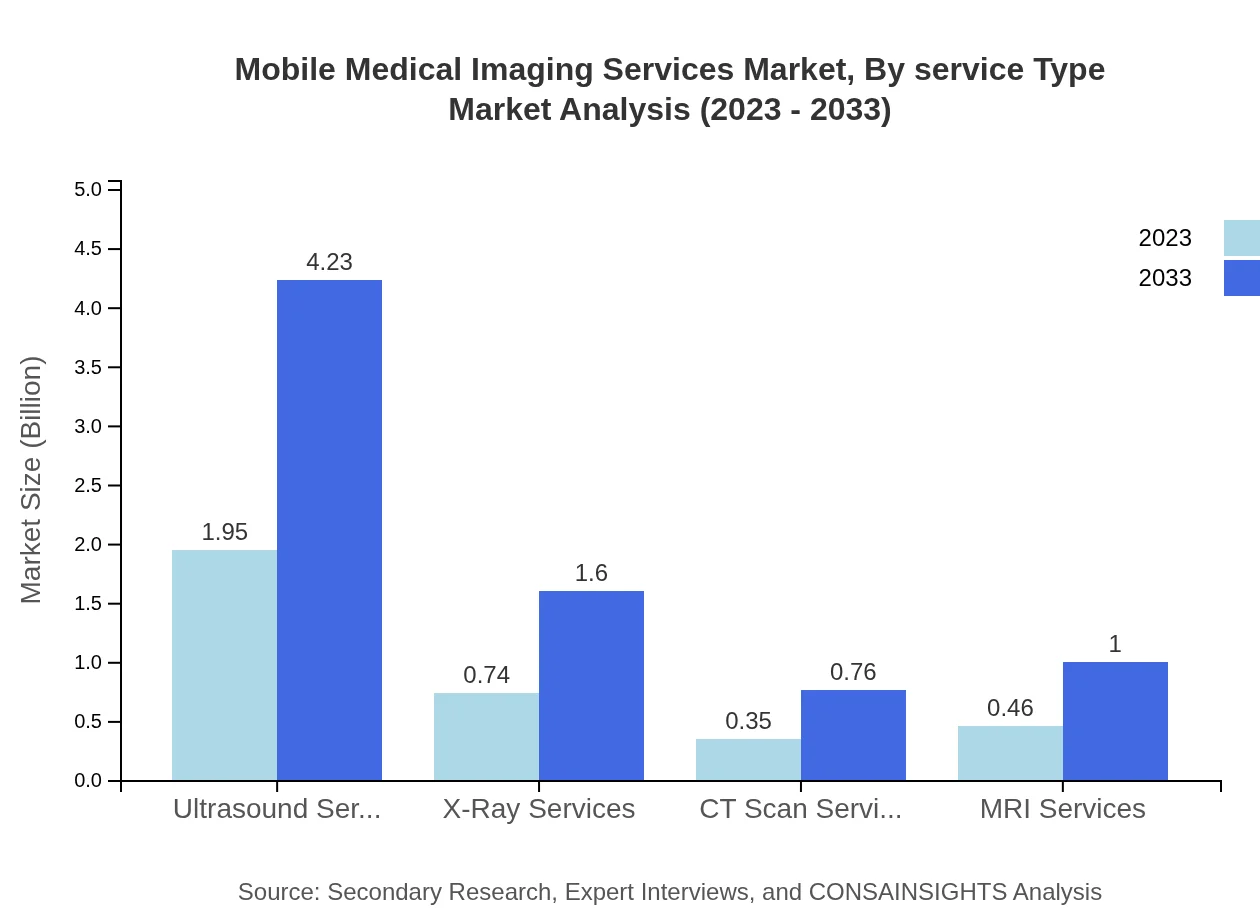
The by-service-type segment of the Mobile Medical Imaging Services market reveals that ultrasound services are expected to dominate with a market size of $1.95 billion in 2023, escalating to $4.23 billion by 2033, holding a significant market share of 55.71%. Other critical services include diagnostic centers, emergency services, and digital imaging technologies, which are pivotal to enhancing patient outcomes.
Mobile Medical Imaging Services Market Analysis By Patient Type
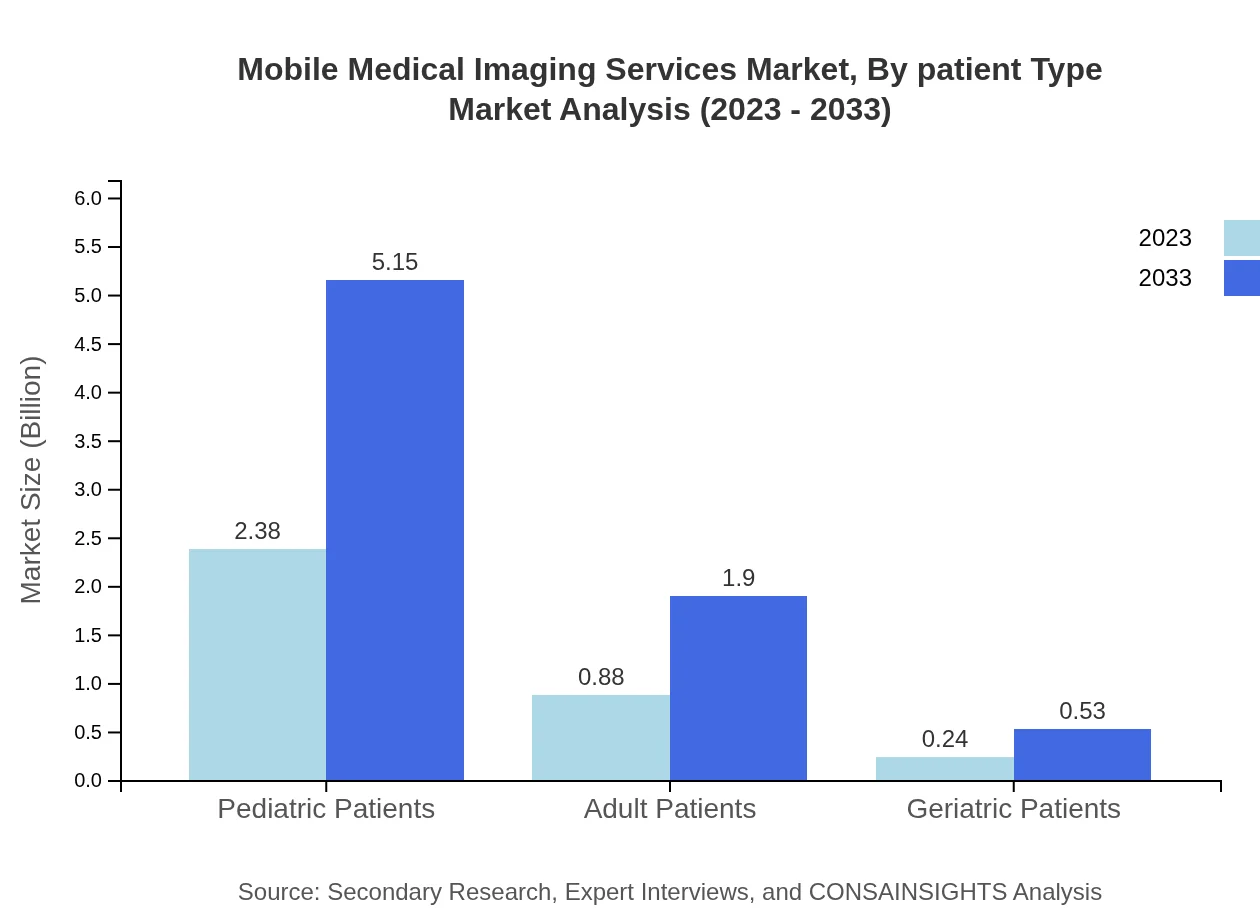
When categorized by patient type, pediatric patients represent the largest segment, with a market size of $2.38 billion in 2023 and a forecast of $5.15 billion by 2033, comprising 67.92% of the market share. This is followed by adult patients and geriatric patients, with notable sizes reflecting the diverse needs for mobile imaging services.
Mobile Medical Imaging Services Market Analysis By Deployment Model
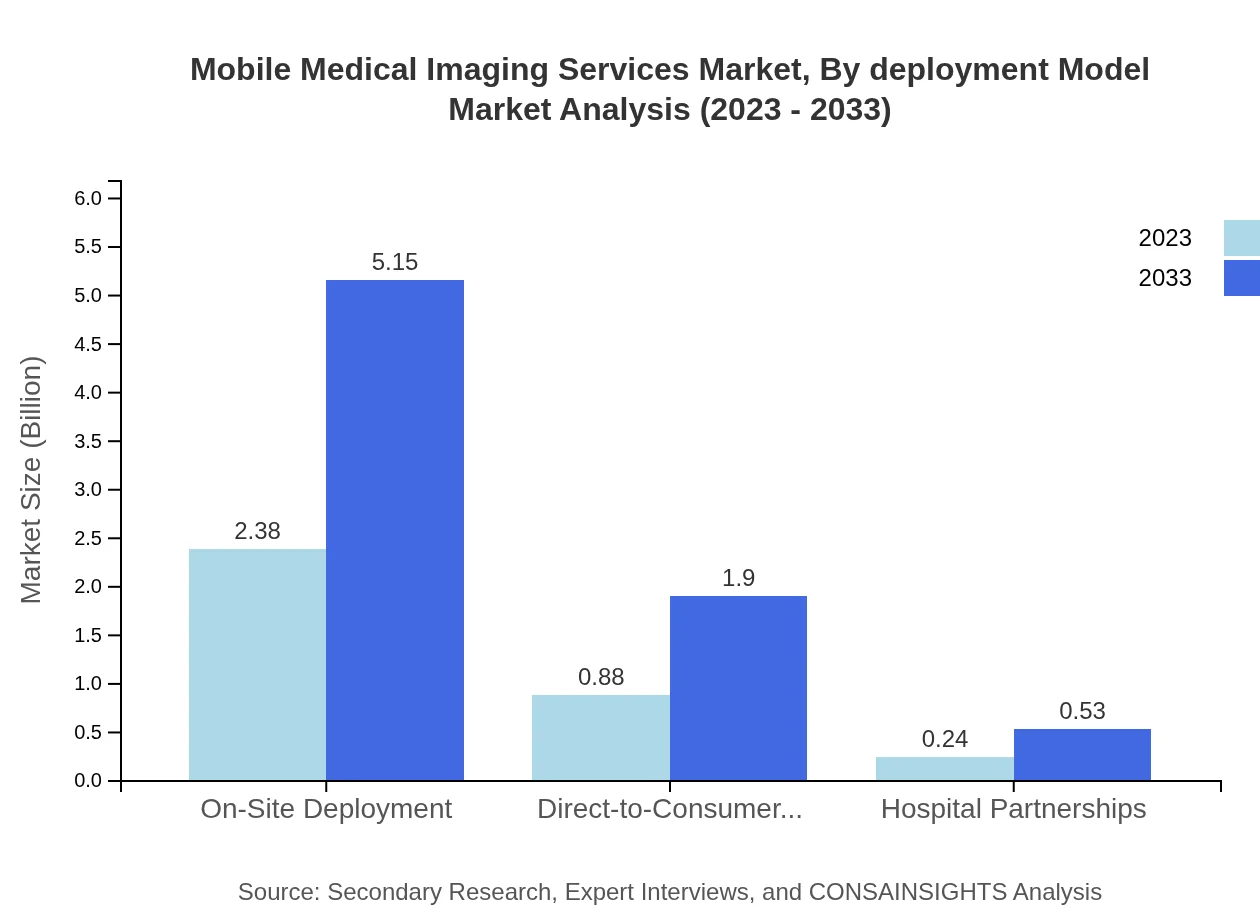
In terms of deployment models, on-site deployment leads with a market size of $2.38 billion in 2023, scaling to $5.15 billion by 2033, capturing 67.92% market share. This model's effectiveness and convenience resonate strongly with both patients and healthcare providers, facilitating immediate and efficient diagnostic solutions.
Mobile Medical Imaging Services Market Analysis By Technology
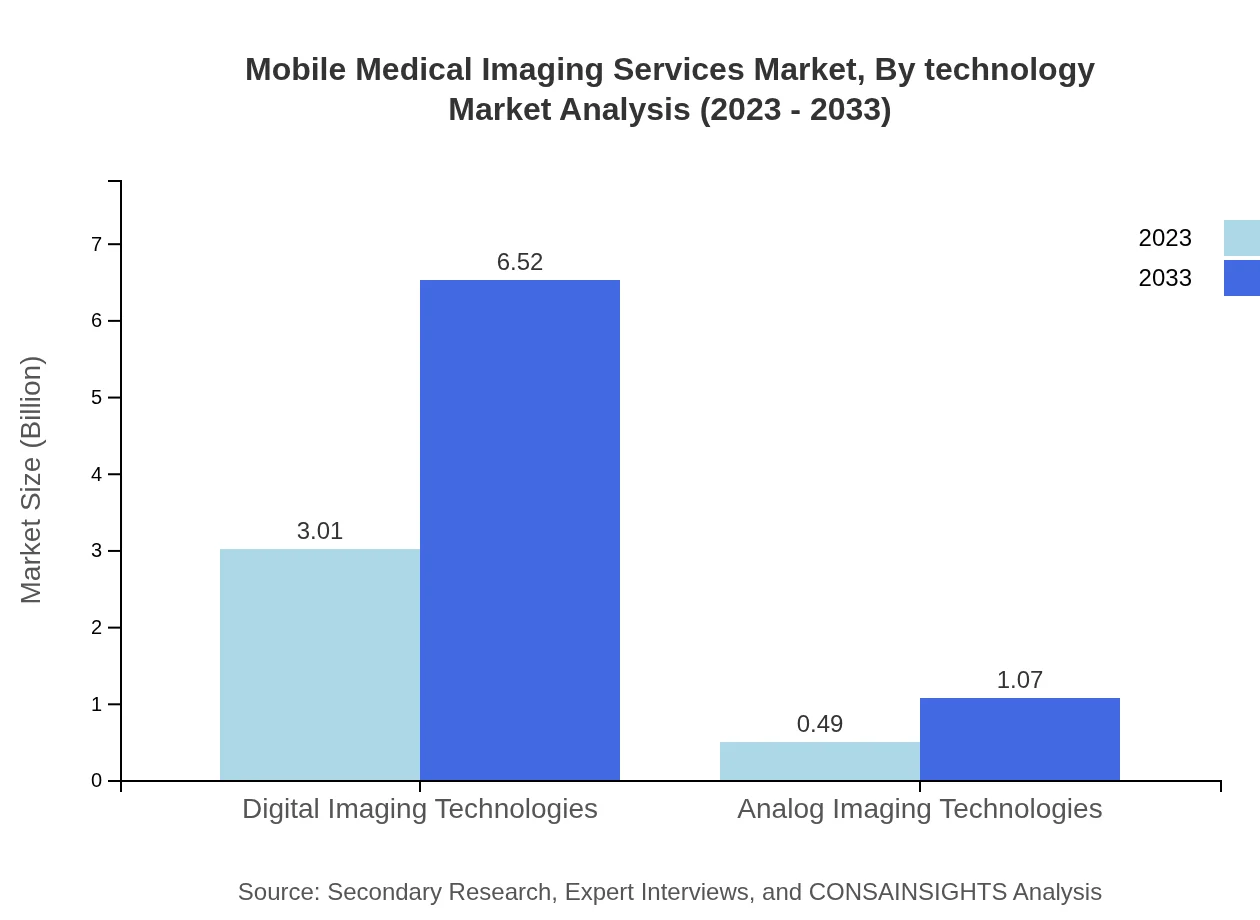
Digital imaging technologies dominate the market, valued at $3.01 billion in 2023 and projected to reach $6.52 billion by 2033, accounting for 85.89% market share. Innovations such as AI integration and portable devices optimize diagnostic accuracy and workflow efficiency within the mobile imaging sector.
Mobile Medical Imaging Services Market Analysis By End User
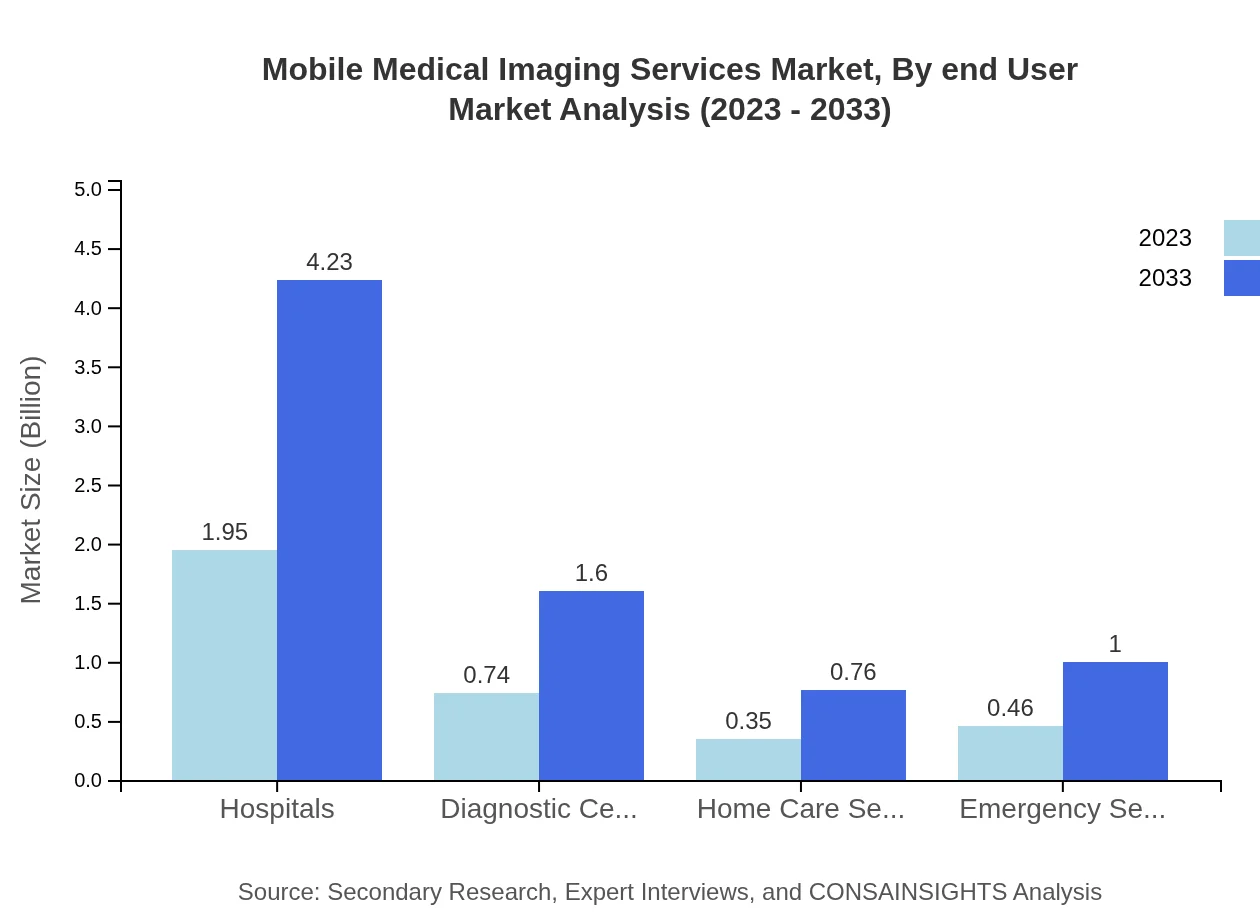
By end-user, hospitals are the leading segment with a market value of $1.95 billion in 2023 and expected growth to $4.23 billion by 2033, holding a substantial market share of 55.71%. This reflects the indispensable nature of mobile imaging services in hospital settings amidst rising patient demands for prompt diagnostic services.
Mobile Medical Imaging Services Market Trends and Future Forecast
Tell us your focus area and get a customized research report.
Global Market Leaders and Top Companies in Mobile Medical Imaging Services Industry
Siemens Healthineers:
Siemens Healthineers is a leading global provider of medical technology, particularly known for its advanced imaging solutions and diagnostic services, which significantly contribute to the growth of the mobile imaging sector.GE Healthcare:
GE Healthcare specializes in innovative medical technologies, including mobile imaging systems, playing a crucial role in enhancing diagnostic procedures and transforming patient care delivery.Philips Healthcare:
Philips Healthcare is recognized for its commitment to improving patient outcomes through advanced imaging technologies and mobile solutions, maintaining a strong presence in the global market.Roche Diagnostics:
Roche Diagnostics focuses on diagnostic solutions, integrating mobile imaging services into comprehensive healthcare solutions to improve access and efficiency in patient treatments.Mobius Biomedical:
Mobius Biomedical offers cutting-edge solutions in mobile imaging, enabling effective diagnostic services and contributing significantly to the mobile medical imaging landscape.We're grateful to work with incredible clients.









FAQs
What is the market size of Mobile Medical Imaging Services in 2023?
The market size in 2023 is $3.50 Billion as stated in the report's base-year valuation.
How big will the market be in 2033?
The market is projected to reach $7.59 Billion by 2033 according to the provided forecast figures.
What is CAGR of the market for 2023 to 2033?
The forecast period 2023 to 2033 shows a compound annual growth rate (CAGR) of 7.8% as reported.
Is there a single fastest Growing region in the Mobile Medical Imaging Services Market Report market?
No single fastest-growing region is stated for the Mobile Medical Imaging Services Market Report market because the top regional implied CAGR values are within 0.15 percentage points of each other, making the ranking too close to call reliably.
Which companies lead the Mobile Medical Imaging Services market?
Top companies listed include Siemens Healthineers, GE Healthcare, Philips Healthcare, Roche Diagnostics, and Mobius Biomedical.
What are primary service types in this market?
Core service types include ultrasound, X‑ray, CT scan, and MRI services as identified in the segment breakdown.
How are deployments structured in this market?
Deployment models include on-site deployment, direct-to-consumer services, and hospital partnerships as specified in the report.
What research methods were used for this report?
The study used primary interviews with industry experts and secondary research from company reports, plus data triangulation and expert validation.