

Needle Free Drug Delivery Devices Market Report
First published: 16 October 2024 | Last updated: 25 May 2026 | Report Code: needle-free-drug-delivery-devices
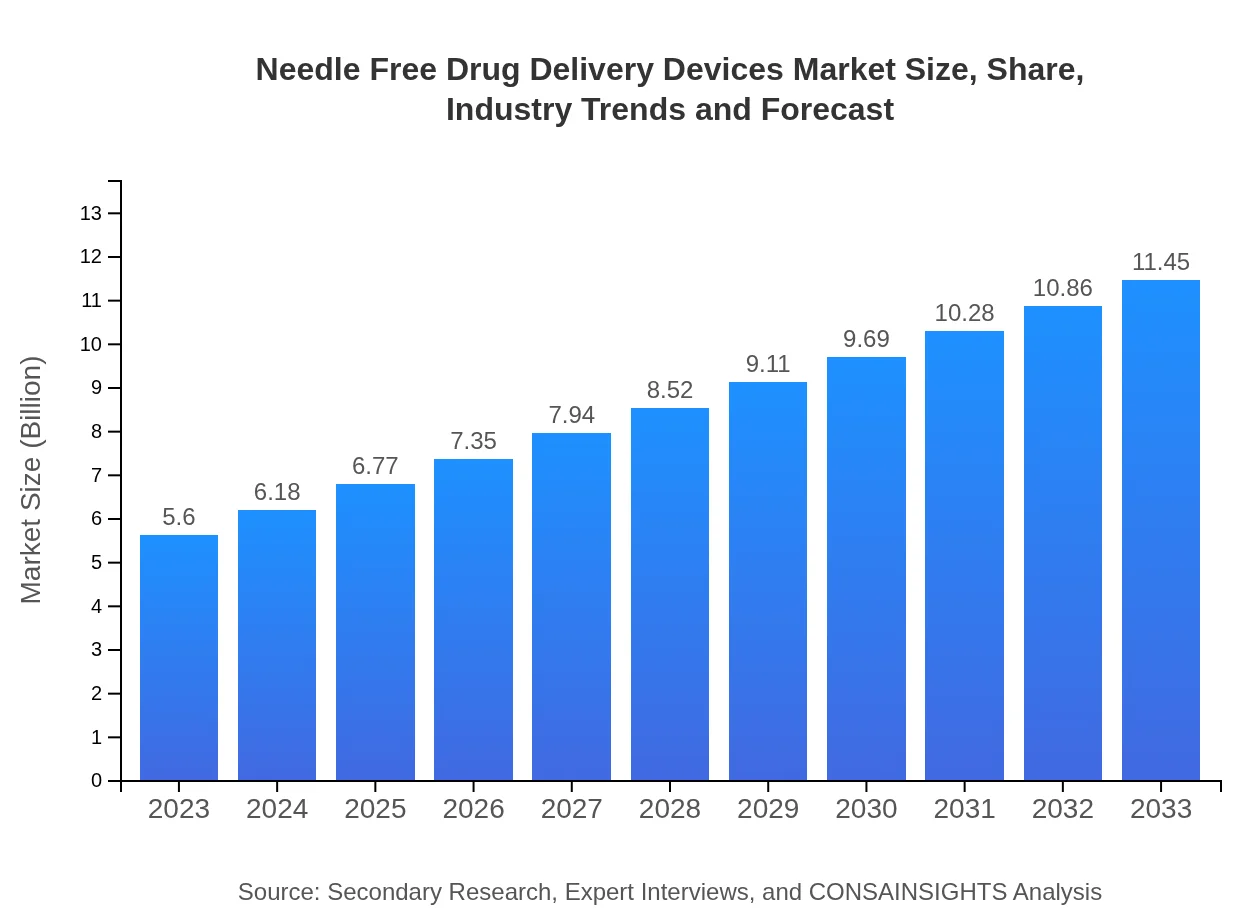
Needle Free Drug Delivery Devices Market — USD 5.6 billion in 2023, Growing to USD 11.45B by 2033 at 7.2% CAGR
This report provides a comprehensive analysis of the Needle Free Drug Delivery Devices market, detailing current market conditions, segmentation, regional insights, industry trends, and forecasts from 2023 to 2033.
Key Takeaways
- Global market projected to expand from $5.60 Billion in 2023 to $11.45 Billion by 2033 at a 7.2% CAGR.
- North America is largest regional market, while no single fastest-growing region is stated because regional CAGR differences remain within 0.15 percentage points.
- Technology advances and rising vaccination and chronic disease management needs are central growth enablers.
- Prominent companies include BD Medical, PharmaJet, Zogenix, and Syringe Technology driving product innovation.
- Device types span injectors, microneedles, and non-invasive options, with hospitals and homecare as key end users.
Needle Free Drug Delivery Devices Market Report — Executive Summary
North America remains largest market by forecast-period value, while no single fastest-growing region is stated because top regional growth rates are separated by less than 0.15 percentage points. The report outlines a steady expansion of the needle-free drug delivery market, with value increasing from $5.60 Billion in 2023 to $11.45 Billion by 2033 at a 7.2% CAGR. Demand is supported by the need to reduce needle-stick injuries, improve patient adherence, and expand vaccination and chronic disease treatment delivery. Product innovation across injectors, microneedles, and non-invasive systems is reshaping clinical and homecare use. Regional dynamics show North America as the largest market, while Europe, Asia Pacific, Latin America, and the Middle East and Africa each contribute measurable growth. Major firms such as BD Medical, PharmaJet, Zogenix, and Syringe Technology are focusing on development and commercialization to capture emerging opportunities. The market structure is examined across technology, application, device type, and end-user segments to guide stakeholders on investment and partnership priorities.
Key Growth Drivers
- Increased vaccination campaigns and higher vaccine administration rates boosting demand for needle-free options.
- Rising prevalence of chronic conditions prompting adoption of patient-friendly, repeatable delivery methods.
- Technological advancements in microneedles, jet injectors, and electronic delivery platforms enhancing device performance.
- Heightened focus on patient safety and reduction of needle-stick injuries in clinical and home settings.
- Growing interest from pharmaceutical companies in developing formulations compatible with needle-free delivery.
| Metric | Value |
|---|---|
| Study Period | 2023 - 2033 |
| 2023 Market Size | $5.60 Billion |
| CAGR (2023-2033) | 7.2% |
| 2033 Market Size | $11.45 Billion |
| Top Companies | BD Medical, PharmaJet, Zogenix, Syringe Technology |
| Published Date | 16 October 2024 |
| Last Modified Date | 25 May 2026 |
Needle Free Drug Delivery Devices Market Overview
Customize Needle Free Drug Delivery Devices Market Report market research report
- ✔ Get in-depth analysis of Needle Free Drug Delivery Devices market size, growth, and forecasts.
- ✔ Understand Needle Free Drug Delivery Devices's regional dynamics and industry-specific trends.
- ✔ Identify potential applications, end-user demand, and growth segments in Needle Free Drug Delivery Devices
What is the Market Size & CAGR of Needle Free Drug Delivery Devices Market Report market in 2023?
Needle Free Drug Delivery Devices Industry Analysis
Needle Free Drug Delivery Devices Market Segmentation and Scope
Tell us your focus area and get a customized research report.
Needle Free Drug Delivery Devices Market Report Market Analysis Report by Region
Europe Needle Free Drug Delivery Devices Market Report:
Europe grows from $1.6 Billion in 2023 to $3.27 Billion in 2033. Growth in this region is driven by adoption in hospitals and clinics, regulatory support for safer delivery options, and rising use in vaccination and chronic disease settings.Asia Pacific Needle Free Drug Delivery Devices Market Report:
Asia Pacific grows from $1.06 Billion in 2023 to $2.16 Billion in 2033. The region’s increase is linked to broader immunization efforts, growing healthcare infrastructure, and interest from pharmaceutical companies in alternative delivery platforms.North America Needle Free Drug Delivery Devices Market Report:
North America is largest regional market, rising from $2.1 Billion in 2023 to $4.3 Billion in 2033. Regional expansion reflects strong clinical uptake, investment in device innovation, and significant procurement for vaccination and chronic care programs.South America Needle Free Drug Delivery Devices Market Report:
Latin America grows from $0.47 Billion in 2023 to $0.95 Billion in 2033. Regional drivers include expanding vaccination initiatives, gradual adoption in hospitals and clinics, and increasing awareness of non-invasive delivery benefits.Middle East & Africa Needle Free Drug Delivery Devices Market Report:
Middle East and Africa grows from $0.37 Billion in 2023 to $0.76 Billion in 2033. Growth is supported by targeted public health programs, improving healthcare access, and growing interest in patient-friendly delivery options across settings.Tell us your focus area and get a customized research report.
Research Methodology
Needle Free Drug Delivery Devices Market Analysis By Device Type
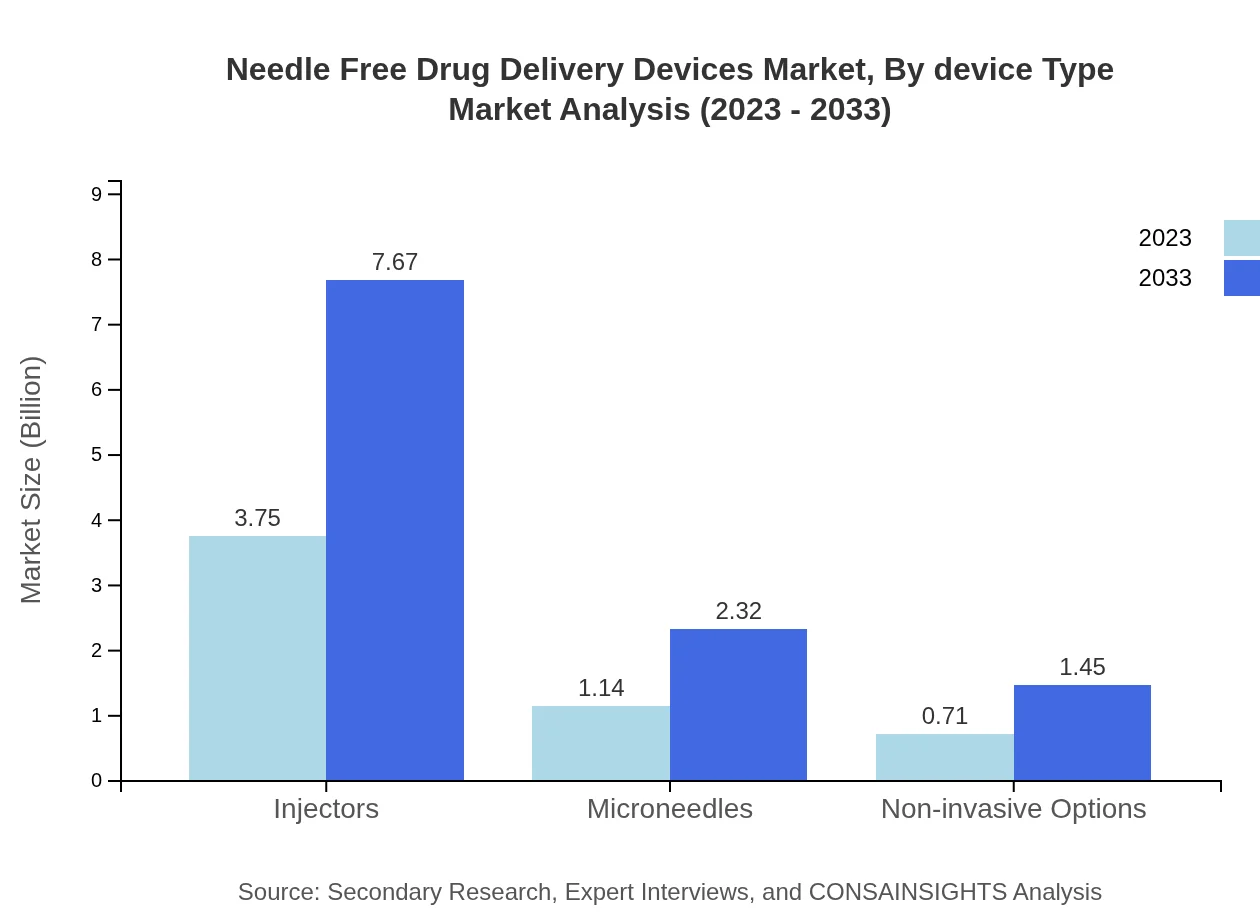
The Needle-free Drug Delivery Devices market by device type consists predominantly of Jet Injectors and Microneedle technologies. While Jet Injectors accounted for a substantial market share due to their efficiency in delivering vaccines and medications without needles, Microneedles are gaining traction for their versatility in drug delivery applications. In 2023, the market size for Injectors is around USD 3.75 billion, rising to USD 7.67 billion by 2033, reflecting their dominance in the market.
Needle Free Drug Delivery Devices Market Analysis By Technology
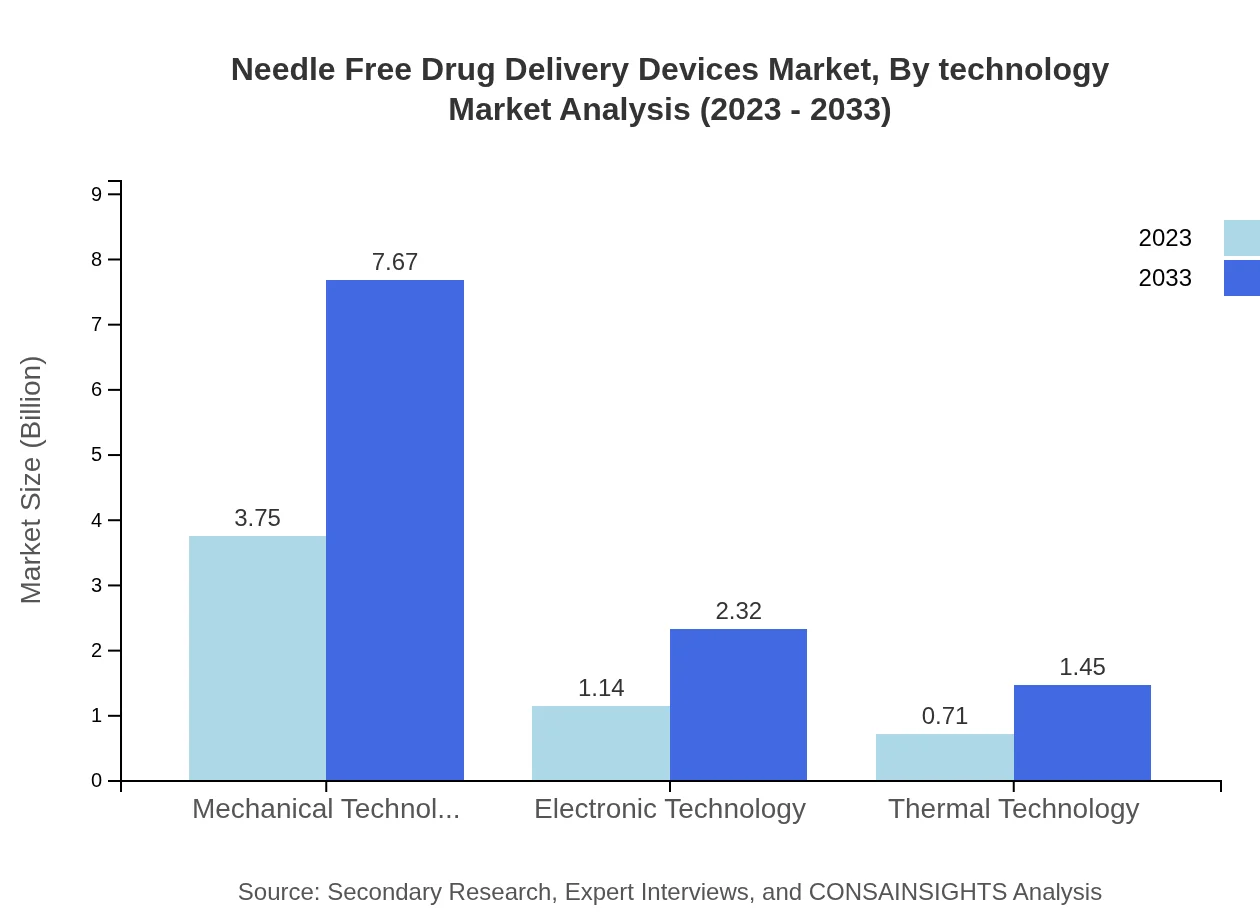
The market segments by technology include Mechanical Technology, Electronic Technology, and Thermal Technology. Mechanical technology remains the most dominant segment, accounting for over 67% of the market share in 2023, with an increase to 67.03% by 2033. Electronic technology follows with a significant market presence, while Thermal technology shows increasing relevance in specialized applications.
Needle Free Drug Delivery Devices Market Analysis By Application
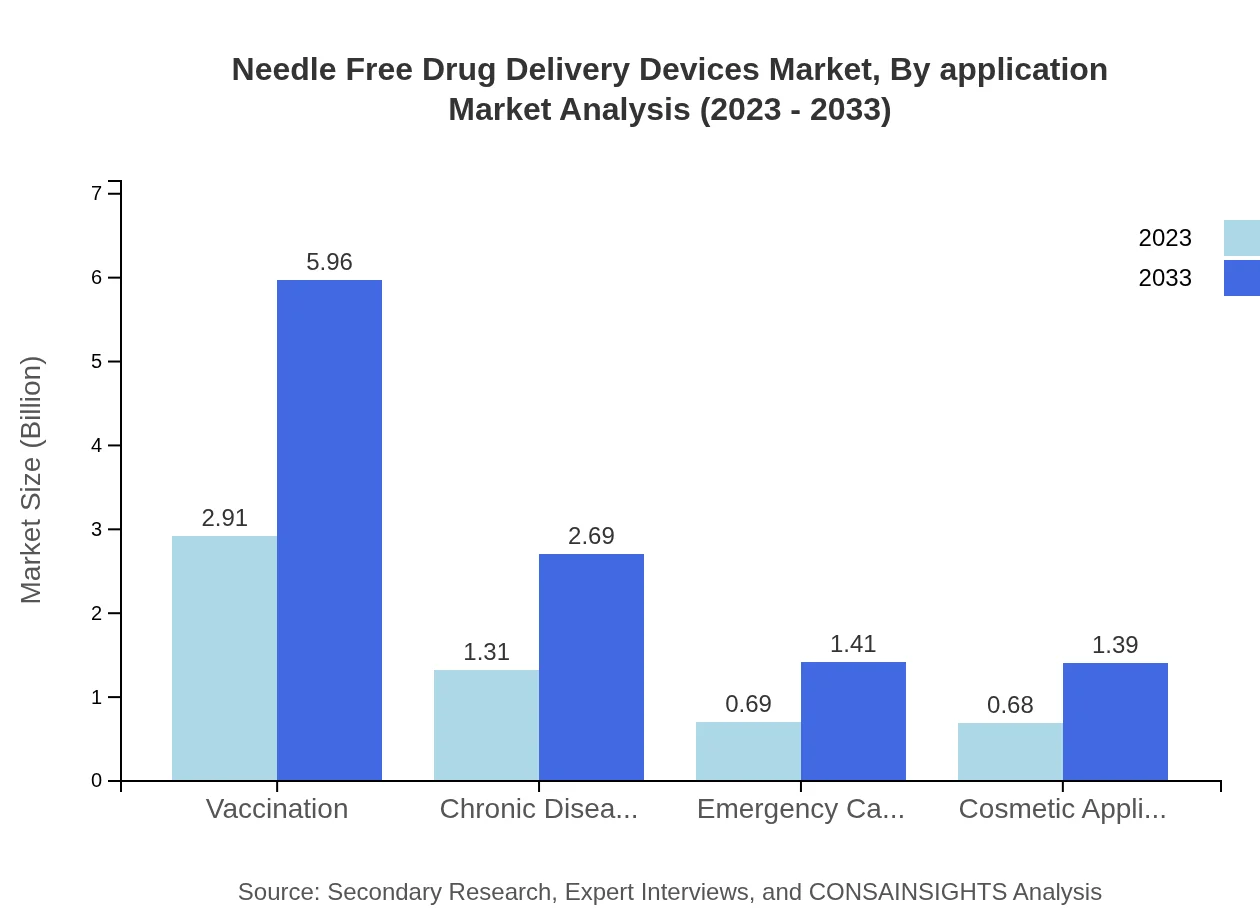
Segmenting by application reveals significant categories such as Vaccination, Chronic Diseases Management, Emergency Care, and Cosmetic Applications. Vaccination continues to be the leading application area, accounting for 52% in 2023, with projections of similar growth due to ongoing vaccination drives globally. Chronic Diseases Management shows increasing demand given the rising prevalence of diabetes and other chronic conditions.
Needle Free Drug Delivery Devices Market Analysis By End User
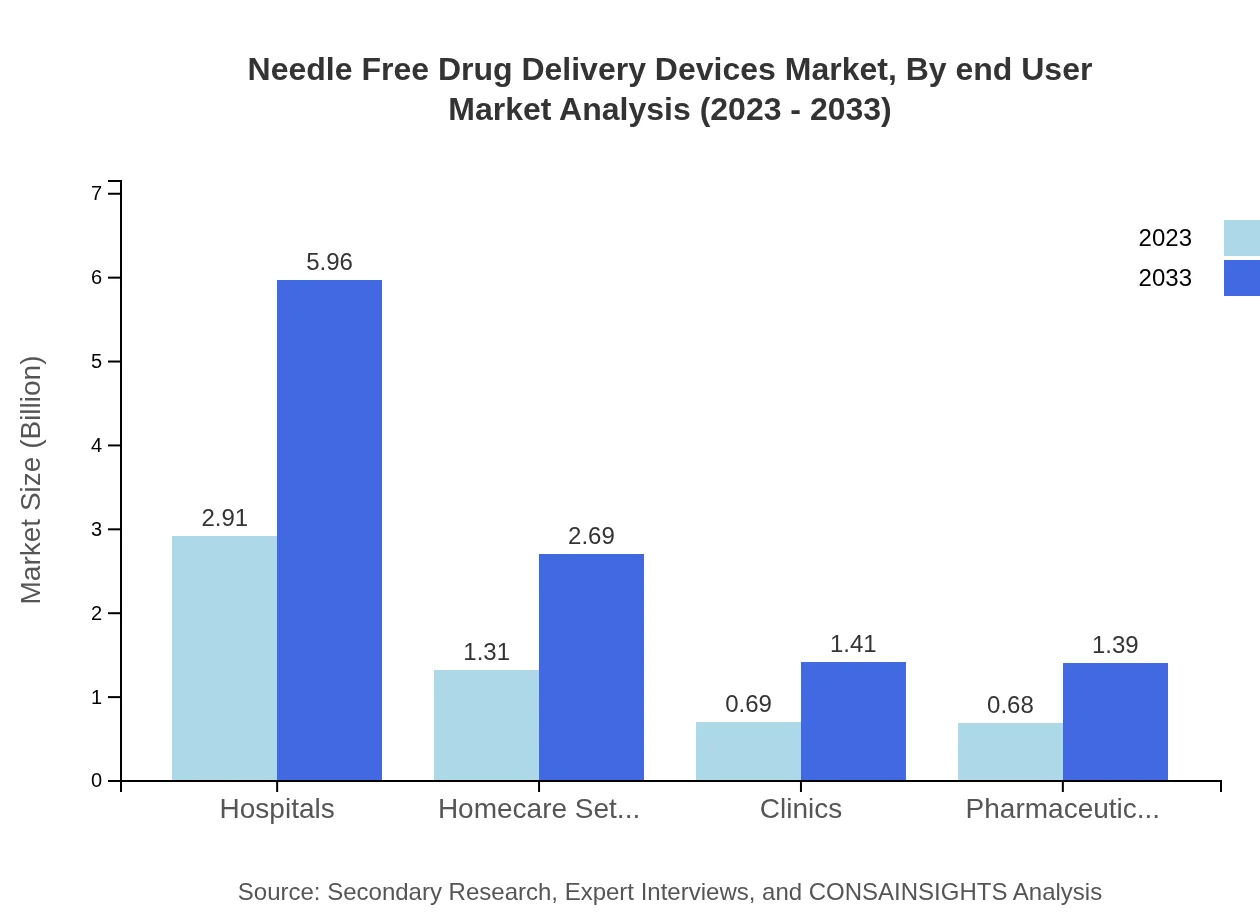
Market segmentation by end-users encompasses Hospitals, Homecare Settings, Clinics, and Pharmaceutical Companies. Hospitals account for the largest market share at 52.03% in 2023, which is projected to remain stable over the forecast period, reflecting the sustained demand for advanced drug delivery methods within healthcare facilities.
Needle Free Drug Delivery Devices Market Trends and Future Forecast
Tell us your focus area and get a customized research report.
Global Market Leaders and Top Companies in Needle Free Drug Delivery Devices Industry
BD Medical:
A leading company specializing in injection devices, BD Medical offers advanced needle-free injection solutions focusing on safety and efficiency.PharmaJet:
PharmaJet is a pioneer in the field of needle-free injection technology, delivering innovative solutions aimed at improving vaccine delivery and patient compliance.Zogenix:
Zogenix develops and commercializes needle-free injection devices intended for various health applications, enhancing drug delivery systems globally.Syringe Technology:
Specializes in developing advanced needle-free injection technologies that ensure patient safety and comfort across numerous therapeutic applications.We're grateful to work with incredible clients.








FAQs
What is the market size of the Needle Free Drug Delivery Devices market in 2023?
The market size in 2023 is $5.60 Billion, as reported in the study, representing the base year value used for the 2023 to 2033 forecast period.
How big will the market be in 2033?
By 2033 the market is projected to reach $11.45 Billion according to the report, reflecting the end-point value for the 2023 to 2033 forecast horizon.
What is CAGR for the 2023 to 2033 period?
The reported compound annual growth rate for the 2023 to 2033 forecast period is 7.2%, based on the market values provided for the start and end years.
Is there a single fastest Growing region in the Needle Free Drug Delivery Devices Market Report market?
No single fastest-growing region is stated for the Needle Free Drug Delivery Devices Market Report market because the top regional implied CAGR values are within 0.15 percentage points of each other, making the ranking too close to call reliably.
Which companies are named as key players?
Top companies highlighted in the report include BD Medical, PharmaJet, Zogenix, and Syringe Technology as notable contributors to product development and commercialization.
What end users are covered in the segmentation?
The report lists end-user subsegments including Hospitals, Homecare Settings, Clinics, and Pharmaceutical Companies as primary categories for device deployment.
What technology categories are included?
Technology subsegments specified are Mechanical Technology, Electronic Technology, and Thermal Technology, covering the principal engineering approaches to needle-free delivery.
How are applications classified in the report?
Applications detailed in the report include Vaccination, Chronic Diseases Management, Emergency Care, and Cosmetic Applications across clinical and consumer settings.
What device types are analyzed?
Device-type subsegments covered are Injectors, Microneedles, and Non-invasive Options, representing the main formats for needle-free administration.
Who contributed to the research methodology?
The study’s methodology involved primary interviews with industry experts, secondary research from company reports and publications, data triangulation, and internal validation led by experts.