

Phototherapy Equipment Market Report
First published: 12 October 2024 | Last updated: 25 May 2026 | Report Code: phototherapy-equipment
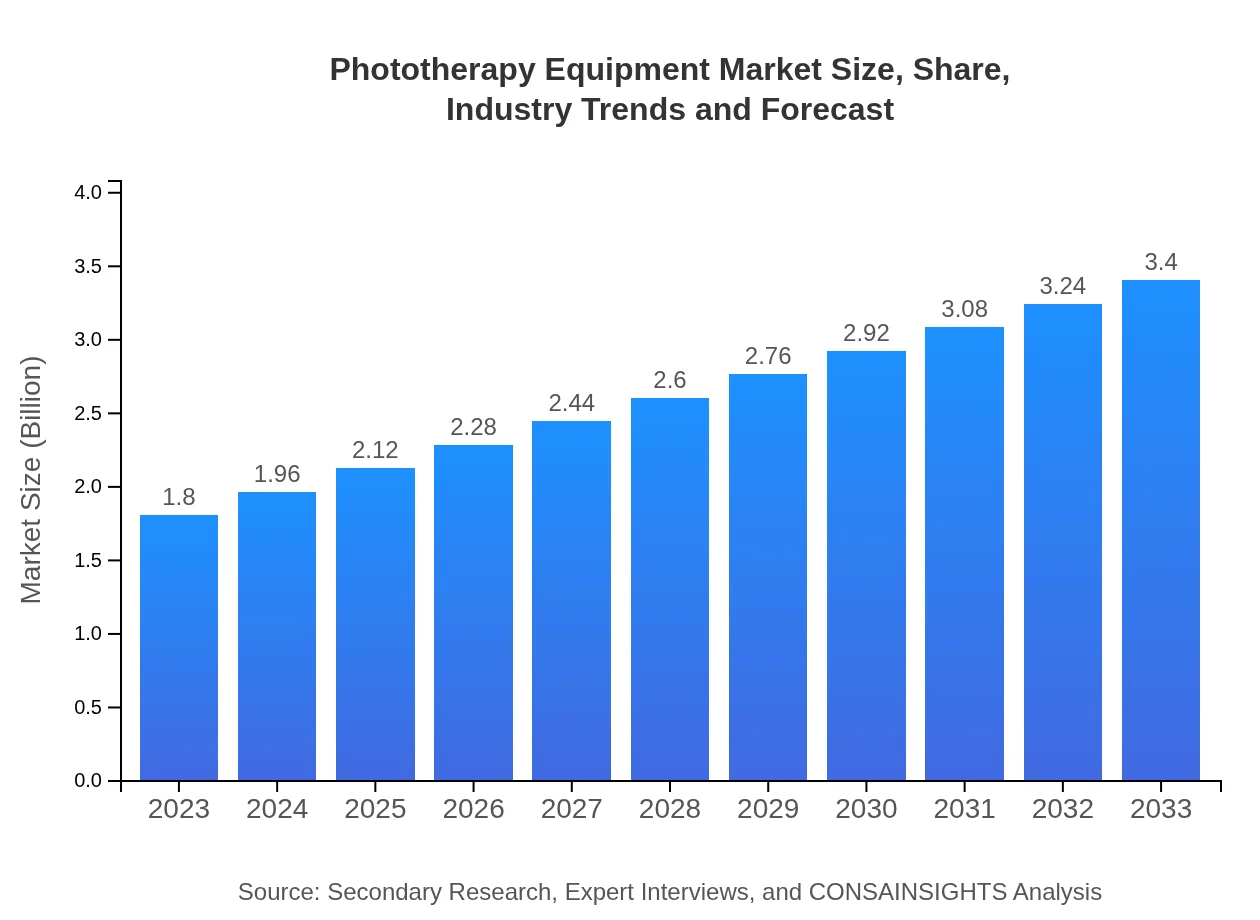
Phototherapy Equipment Market — USD $1.8 Billion in 2023, Growing to USD 3.40null by 2033 at 6.4% CAGR
This report provides comprehensive insights into the Phototherapy Equipment market, focusing on market dynamics, trends, and forecasts from 2023 to 2033, including detailed analyses of regions, segments, and industry leaders.
Key Takeaways
- Global market value increases from $1.80 Billion in 2023 to $3.40 Billion in 2033, reflecting a 6.4% CAGR over the forecast period.
- North America is largest regional market, while no single fastest-growing region is stated because regional CAGR differences remain within 0.15 percentage points.
- Europe grows from $0.49 Billion in 2023 to $0.92 Billion in 2033, supported by clinical adoption and regulatory frameworks.
- Asia Pacific expands from $0.36 Billion in 2023 to $0.69 Billion in 2033 amid rising clinical awareness and urban healthcare demand.
- Key suppliers include Philips Healthcare, Natus Medical Incorporated, Daavlin Company and Welch Allyn, driving product development and distribution.
Phototherapy Equipment Market Report — Executive Summary
North America remains largest market by forecast-period value, while no single fastest-growing region is stated because top regional growth rates are separated by less than 0.15 percentage points. This report examines the Phototherapy Equipment market across a 2023 to 2033 forecast window. The market reached $1.80 Billion in 2023 and is expected to grow to $3.40 Billion by 2033 at a 6.4% CAGR. Growth drivers include rising prevalence of skin and neonatal conditions, increased clinical awareness of phototherapy efficacy, and ongoing product innovation from established vendors such as Philips Healthcare and Natus Medical Incorporated. The analysis segments the market by product type, technology, application, distribution and end user, highlighting adoption in hospitals, clinics and home care. Regional performance is assessed with North America identified as the largest market. The competitive landscape focuses on product launches, partnerships and distribution strategies. Methodology blends primary expert interviews with secondary sources and internal validation to ensure robust trend interpretation and data triangulation.
Key Growth Drivers
- Increasing incidence of dermatological and neonatal conditions creates sustained demand for phototherapy systems in clinical settings.
- Technological improvements in light-based devices enhance treatment precision and safety, encouraging wider clinical adoption.
- Expansion of hospital networks and outpatient clinics in urban areas raises procurement of phototherapy equipment.
- Active product development and distribution by major vendors support market accessibility and service offerings.
| Metric | Value |
|---|---|
| Study Period | 2023 - 2033 |
| 2023 Market Size | $1.80 Billion |
| CAGR (2023-2033) | 6.4% |
| 2033 Market Size | $3.40 Billion |
| Top Companies | Philips Healthcare, Natus Medical Incorporated, Daavlin Company, Welch Allyn |
| Published Date | 12 October 2024 |
| Last Modified Date | 25 May 2026 |
Phototherapy Equipment Market Overview
Customize Phototherapy Equipment Market Report market research report
- ✔ Get in-depth analysis of Phototherapy Equipment market size, growth, and forecasts.
- ✔ Understand Phototherapy Equipment's regional dynamics and industry-specific trends.
- ✔ Identify potential applications, end-user demand, and growth segments in Phototherapy Equipment
What is the Market Size & CAGR of Phototherapy Equipment Market Report market in 2023?
Phototherapy Equipment Industry Analysis
Phototherapy Equipment Market Segmentation and Scope
Tell us your focus area and get a customized research report.
Phototherapy Equipment Market Report Market Analysis Report by Region
Europe Phototherapy Equipment Market Report:
Europe grows from $0.49 Billion in 2023 to $0.92 Billion in 2033. Adoption is supported by clinical guidelines, regulatory frameworks and growing use of phototherapy in dermatology and neonatal care across healthcare systems.Asia Pacific Phototherapy Equipment Market Report:
Asia Pacific grows from $0.36 Billion in 2023 to $0.69 Billion in 2033. Drivers include increasing clinical awareness, urban healthcare capacity expansion and rising demand for light-based treatments in dermatology and neonatal applications.North America Phototherapy Equipment Market Report:
North America is largest regional market, rising from $0.65 Billion in 2023 to $1.23 Billion in 2033. Growth is driven by clinical adoption in hospitals and outpatient centers, established vendor presence and investment in product innovation.South America Phototherapy Equipment Market Report:
Latin America grows from $0.13 Billion in 2023 to $0.24 Billion in 2033. Market expansion is linked to rising healthcare access in urban areas and gradual uptake of phototherapy devices in hospitals and clinics.Middle East & Africa Phototherapy Equipment Market Report:
Middle East and Africa grows from $0.17 Billion in 2023 to $0.32 Billion in 2033. Growth factors include improving healthcare infrastructure and greater clinical recognition of phototherapy benefits in regional healthcare centers.Tell us your focus area and get a customized research report.
Research Methodology
Phototherapy Equipment Market Analysis By Product Type
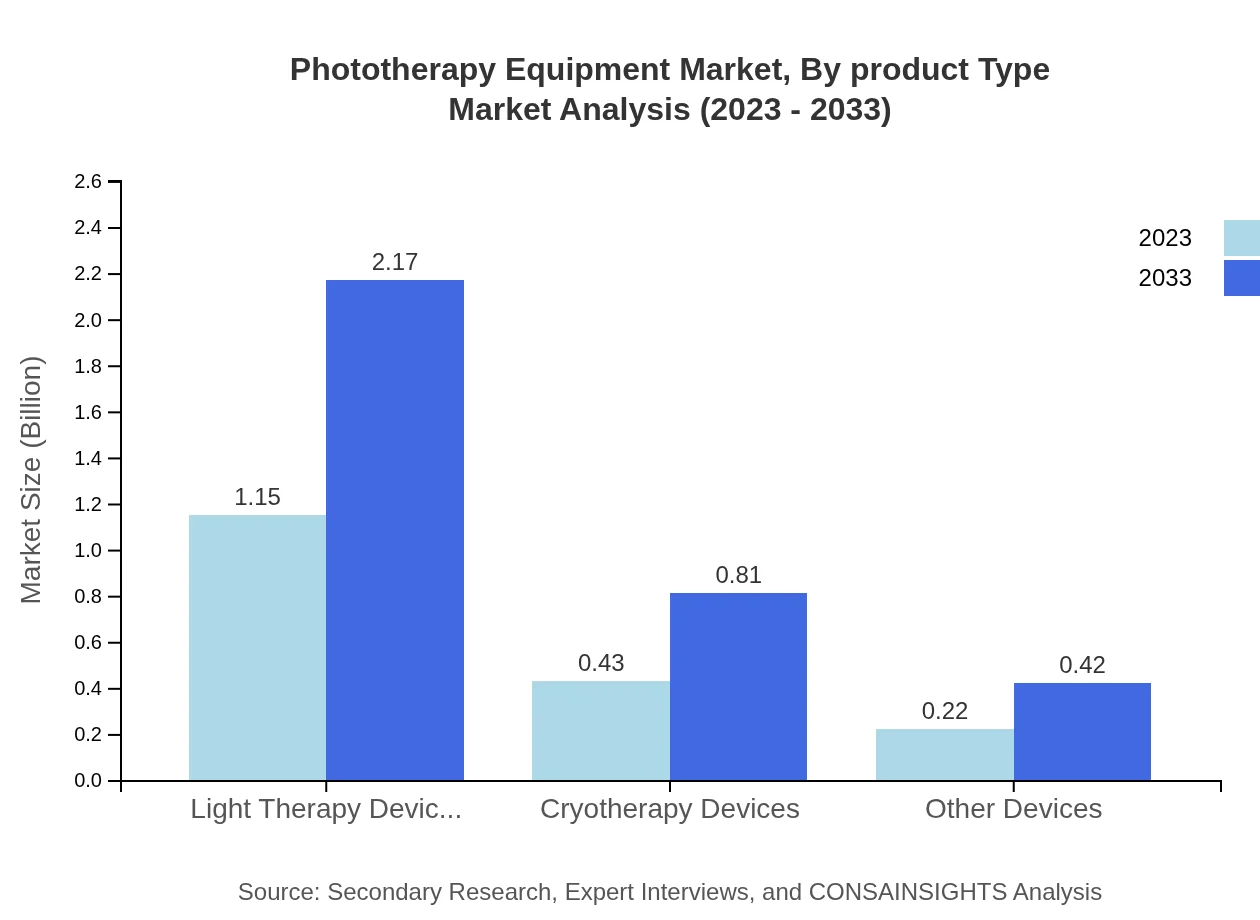
In 2023, Light Therapy Devices are projected to capture a significant market size of $1.15 billion, expected to grow to $2.17 billion by 2033, holding a market share of 63.69%. Cryotherapy Devices follow with $0.43 billion in 2023, set to increase to $0.81 billion by 2033, holding 23.9% share. Other Devices account for the remaining 12.41% share grows from $0.22 billion in 2023 to $0.42 billion in 2033.
Phototherapy Equipment Market Analysis By Application
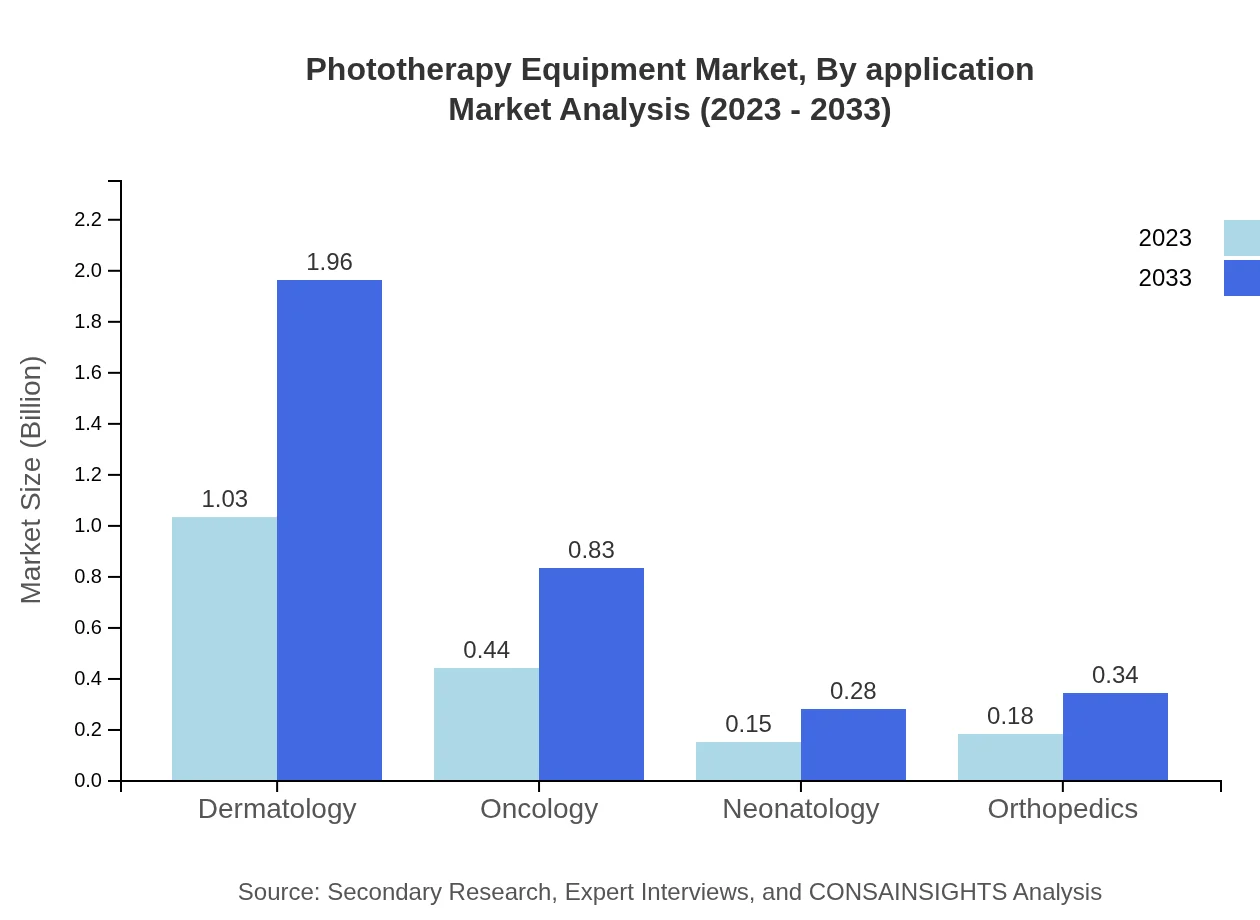
Dermatology is a leading application area, growing from $1.03 billion in 2023 to $1.96 billion by 2033, representing 57.48% market share. Oncology follows with $0.44 billion, set to reach $0.83 billion, corresponding to a 24.4% share. Neonatology holds a respective share of 8.2%, increasing from $0.15 billion to $0.28 billion. Orthopedics also shows demand but remains a smaller segment at $0.18 billion in 2023, with projections of $0.34 billion in 2033.
Phototherapy Equipment Market Analysis By End User
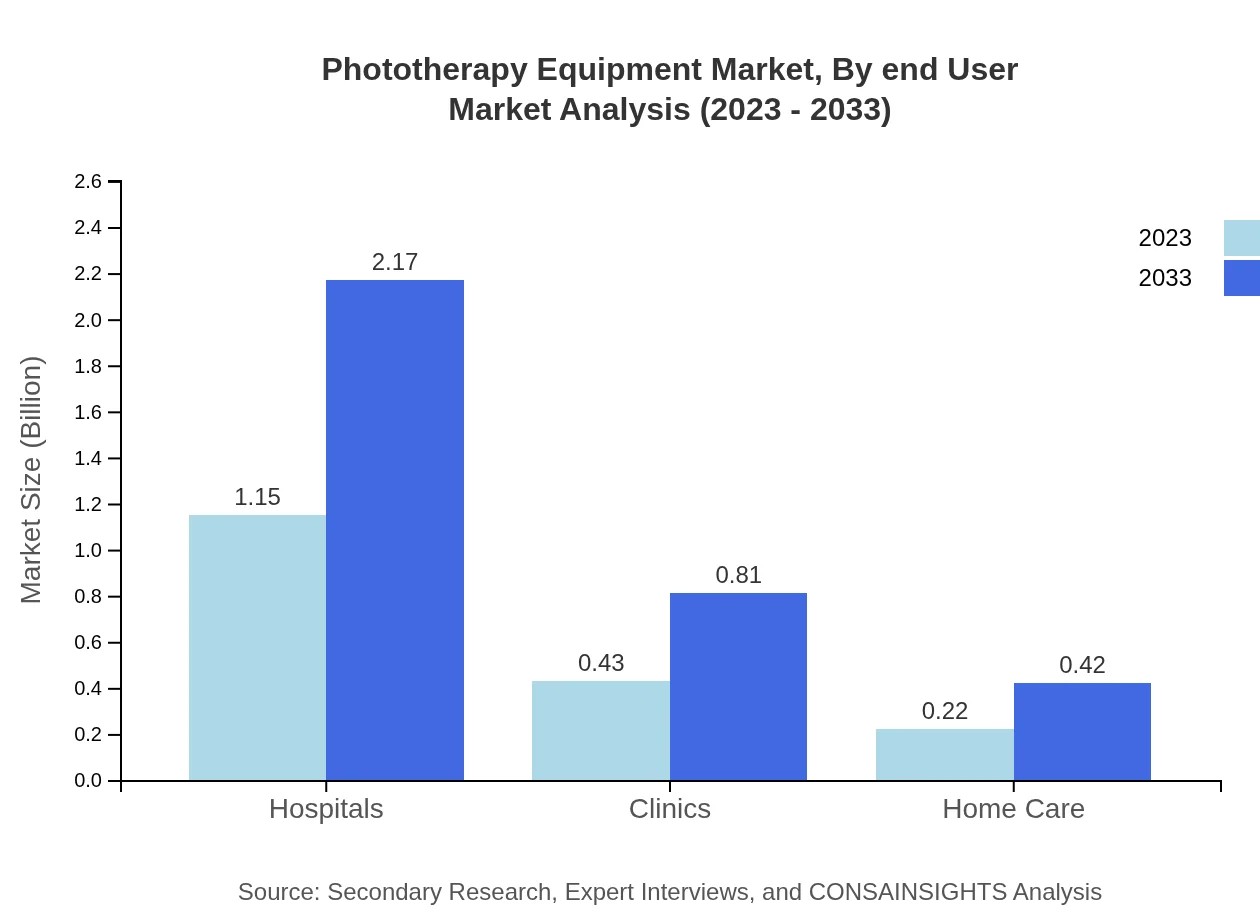
Hospitals dominate with a market size of $1.15 billion in 2023, expected to expand to $2.17 billion by 2033, maintaining a 63.69% market share. Clinics follow with $0.43 billion, projected to grow to $0.81 billion, comprising 23.9% of the share. Home care is an emerging segment with $0.22 billion in 2023, forecasted to reach $0.42 billion, representing 12.41% share.
Phototherapy Equipment Market Analysis By Technology
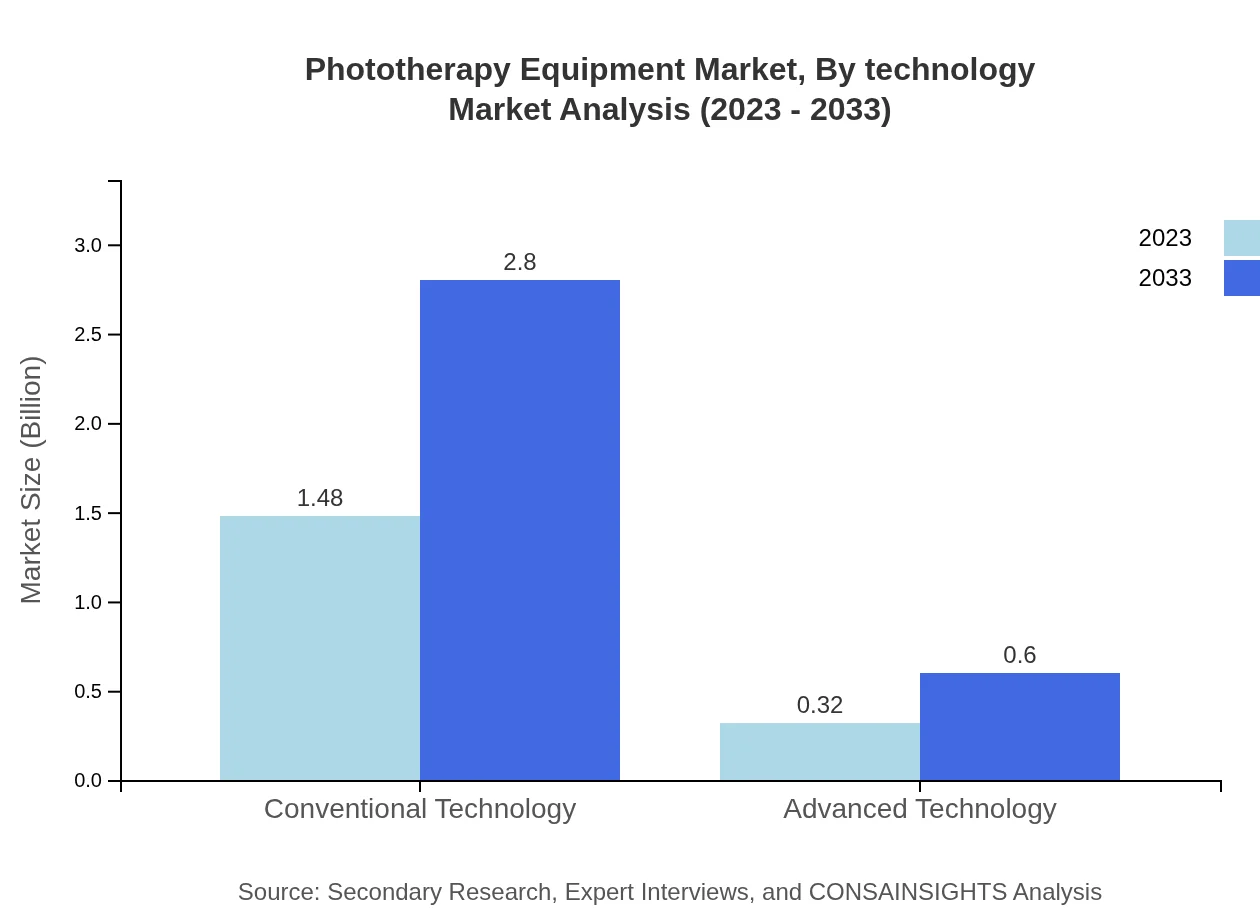
Conventional Technology stands at $1.48 billion in 2023, growing to $2.80 billion by 2033, maintaining an 82.3% share. In contrast, Advanced Technology, accounting for a 17.7% share, rises from $0.32 billion to $0.60 billion over the same period, indicating a trend toward innovative therapeutic solutions.
Phototherapy Equipment Market Analysis By Distribution Channel
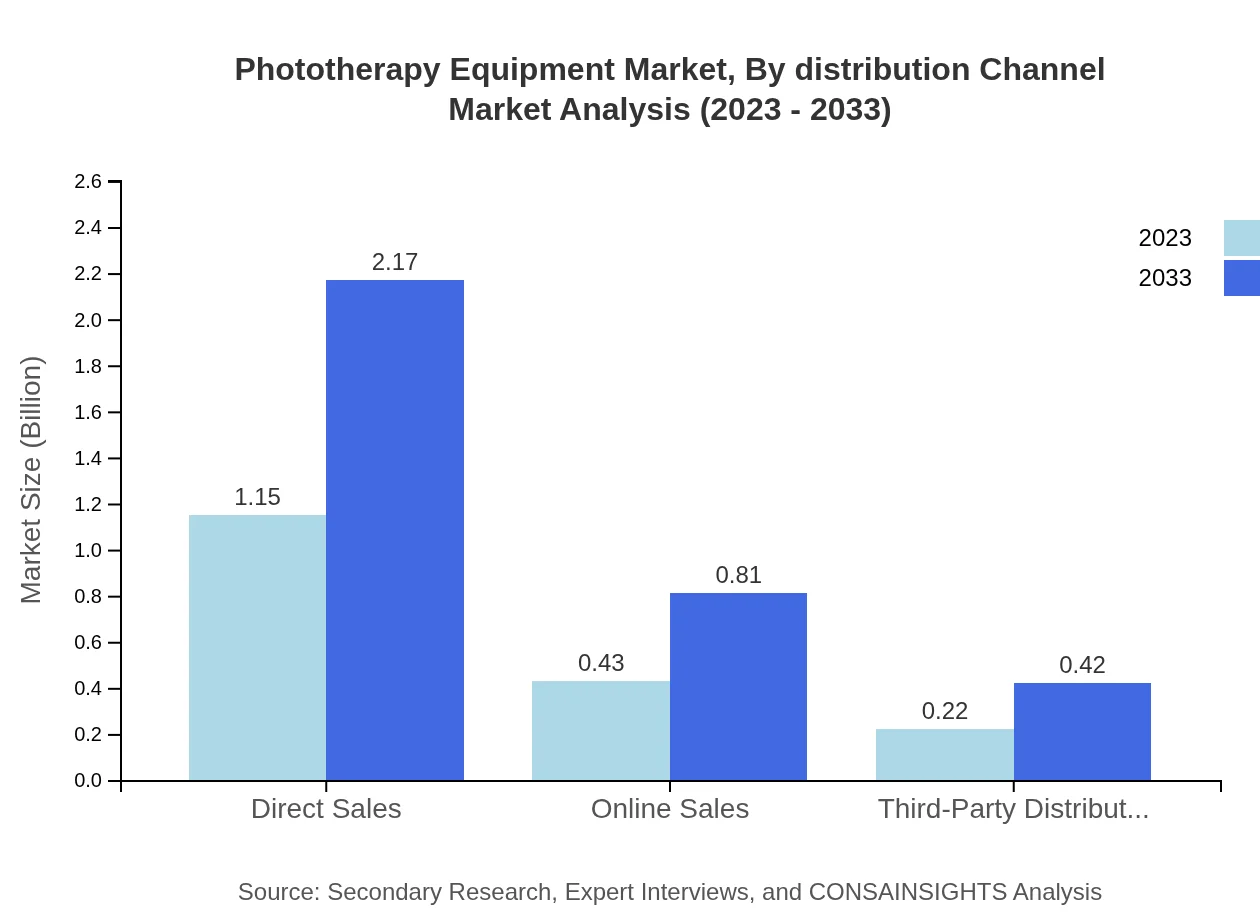
Direct Sales lead the market at $1.15 billion in 2023, with continued growth to $2.17 billion by 2033. Online Sales generate $0.43 billion now, expected to increase to $0.81 billion, while Third-Party Distributors represent a smaller share at $0.22 billion in 2023, with projected growth to $0.42 billion by 2033.
Phototherapy Equipment Market Trends and Future Forecast
Tell us your focus area and get a customized research report.
Global Market Leaders and Top Companies in Phototherapy Equipment Industry
Philips Healthcare:
Philips Healthcare is a renowned leader in medical technology focusing on the development of innovative light therapy solutions for a range of medical fields, including dermatology and oncology.Natus Medical Incorporated:
Natus Medical is a key player in the neonatal care segment, creating advanced phototherapy devices addressing jaundice in neonates, enhancing patient care worldwide.Daavlin Company:
Daavlin specializes in light therapy equipment and is known for its effective UV devices aimed at treating skin conditions, ensuring high-quality patient outcomes.Welch Allyn:
Welch Allyn is recognized for its commitment to developing advanced phototherapy technology, enhancing patient diagnosis and treatment options in healthcare facilities.We're grateful to work with incredible clients.









FAQs
What is the market size of the Phototherapy Equipment Market Report in 2023?
The market size in 2023 is $1.80 Billion, as stated in the provided data for the Phototherapy Equipment market base year.
What is the market size of the Phototherapy Equipment Market Report in 2033?
The projected market size for 2033 is $3.40 Billion, according to the input forecast values for the Phototherapy Equipment market.
What is CAGR of the Phototherapy Equipment Market Report?
The forecast period CAGR is 6.4% for 2023 to 2033, reflecting the annualized growth rate specified in the source data.
Is there a single fastest Growing region in the Phototherapy Equipment Market Report market?
No single fastest-growing region is stated for the Phototherapy Equipment Market Report market because the top regional implied CAGR values are within 0.15 percentage points of each other, making the ranking too close to call reliably.
Which companies are listed as top players in the report?
Top companies cited include Philips Healthcare, Natus Medical Incorporated, Daavlin Company and Welch Allyn, per the input company list.
Why is Europe expected to grow in phototherapy equipment demand?
Europe's growth is tied to clinical adoption and regulatory support, reflected in its increase from $0.49 Billion in 2023 to $0.92 Billion in 2033.
What drives adoption in Asia Pacific according to the report?
Asia Pacific adoption is supported by rising clinical awareness and urban healthcare expansion; the region moves from $0.36 Billion in 2023 to $0.69 Billion in 2033.
Who contributed to the report research methodology?
The methodology includes primary interviews with industry experts and secondary research from company reports and publications, plus data triangulation and validation.