

Protein Hydrolysis Enzymes Market Report
First published: 15 October 2024 | Last updated: 28 May 2026 | Report Code: protein-hydrolysis-enzymes
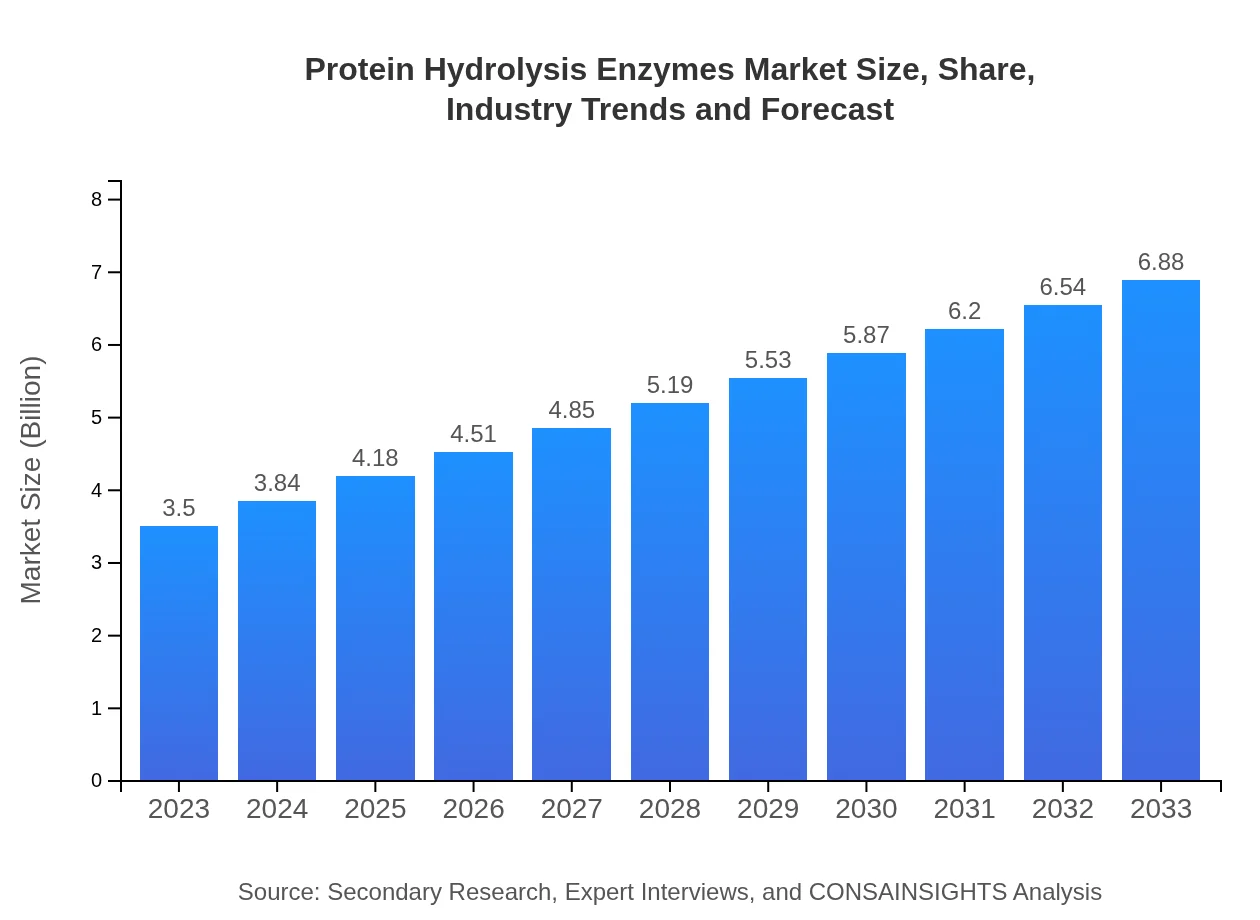
Protein Hydrolysis Enzymes Market — USD $3.5 Billion in 2023, Growing to USD 6.88null by 2033 at 6.8% CAGR
This report covers a comprehensive analysis of the Protein Hydrolysis Enzymes market, providing insights into market size, growth factors, segmentation, and regional analysis. The forecast spans from 2023 to 2033, offering data-driven predictions and trends shaping the industry.
Key Takeaways
- Global market projected from $3.50 Billion in 2023 to $6.88 Billion in 2033 at a 6.8% CAGR.
- North America remains the largest region, increasing from $1.26 Billion in 2023 to $2.47 Billion in 2033.
- North America is largest regional market; Latin America is regional market region based on implied CAGR across 2023 to 2033.
- Europe and Asia Pacific show steady expansion—Europe from $0.95 Billion to $1.87 Billion, Asia Pacific from $0.76 Billion to $1.49 Billion.
- Key participants include BASF SE, Novozymes A/S, DuPont de Nemours, Inc., AB Enzymes, and Chr. Hansen.
Protein Hydrolysis Enzymes Market Report — Executive Summary
Regional analysis shows North America as largest market and Latin America as fastest-growing region by implied CAGR. This report examines the Protein Hydrolysis Enzymes market across applications, enzyme types, sources and forms over the 2023 to 2033 forecast period. The market is valued at $3.50 Billion in 2023 and is expected to reach $6.88 Billion by 2033 at a CAGR of 6.8%. Growth is supported by rising demand in food and beverage, pharmaceuticals and animal feed, along with advances in biotechnology and shifts toward plant-based ingredients. Regional dynamics vary: North America is the largest regional market, while Latin America shows the highest implied growth rate. Major suppliers such as BASF SE, Novozymes A/S, DuPont de Nemours, Inc., AB Enzymes and Chr. Hansen are investing in product development and scale-up to address formulation needs and regulatory requirements. The report structure covers market sizing, segment-level breakdowns by form, source, application and enzyme type, regional industry analysis, and a competitive landscape assessment with key strategic moves.
Key Growth Drivers
- Rising demand in food and beverage and nutrition applications driving enzyme utilization and tailored formulations.
- Growth in pharmaceutical and biotechnology segments increasing need for specialized hydrolysis enzymes.
- Shift toward plant-based sources prompting investment in plant-derived enzyme development and marketing.
- Technological improvements and R&D from leading companies enhancing enzyme specificity and production efficiency.
- Expansion into animal feed formulations encouraging adoption of hydrolysis enzymes for digestibility and nutrient availability.
| Metric | Value |
|---|---|
| Study Period | 2023 - 2033 |
| 2023 Market Size | $3.50 Billion |
| CAGR (2023-2033) | 6.8% |
| 2033 Market Size | $6.88 Billion |
| Top Companies | BASF SE, Novozymes A/S, DuPont de Nemours, Inc., AB Enzymes, Chr. Hansen |
| Published Date | 15 October 2024 |
| Last Modified Date | 28 May 2026 |
Protein Hydrolysis Enzymes Market Overview
Customize Protein Hydrolysis Enzymes Market Report market research report
- ✔ Get in-depth analysis of Protein Hydrolysis Enzymes market size, growth, and forecasts.
- ✔ Understand Protein Hydrolysis Enzymes's regional dynamics and industry-specific trends.
- ✔ Identify potential applications, end-user demand, and growth segments in Protein Hydrolysis Enzymes
What is the Market Size & CAGR of Protein Hydrolysis Enzymes Market Report market in 2023?
Protein Hydrolysis Enzymes Industry Analysis
Protein Hydrolysis Enzymes Market Segmentation and Scope
Tell us your focus area and get a customized research report.
Protein Hydrolysis Enzymes Market Report Market Analysis Report by Region
Europe Protein Hydrolysis Enzymes Market Report:
Europe grows from $0.95 Billion in 2023 to $1.87 Billion in 2033. Expansion is linked to strong food and beverage manufacturing, regulatory focus on food safety, and technology adoption in enzyme formulation and processing.Asia Pacific Protein Hydrolysis Enzymes Market Report:
Asia Pacific grows from $0.76 Billion in 2023 to $1.49 Billion in 2033. Growth stems from rising protein consumption, expanding pharmaceutical production, and greater adoption of enzyme applications in food processing and nutrition products.North America Protein Hydrolysis Enzymes Market Report:
North America is largest regional market, rising from $1.26 Billion in 2023 to $2.47 Billion in 2033. Regional demand is supported by robust food and pharmaceutical industries, ongoing R&D activity, and investment from key market participants.South America Protein Hydrolysis Enzymes Market Report:
Latin America is fastest-growing region by implied CAGR, increasing from $0.18 Billion in 2023 to $0.36 Billion in 2033. Regional advancement reflects growing demand in food and feed sectors and increasing investment in enzyme technologies.Middle East & Africa Protein Hydrolysis Enzymes Market Report:
Middle East and Africa grows from $0.35 Billion in 2023 to $0.68 Billion in 2033. Market development is driven by rising demand in nutrition and feed, plus gradual uptake of biotechnology-enabled solutions in food processing.Tell us your focus area and get a customized research report.
Research Methodology
Protein Hydrolysis Enzymes Market Analysis By Enzyme Type
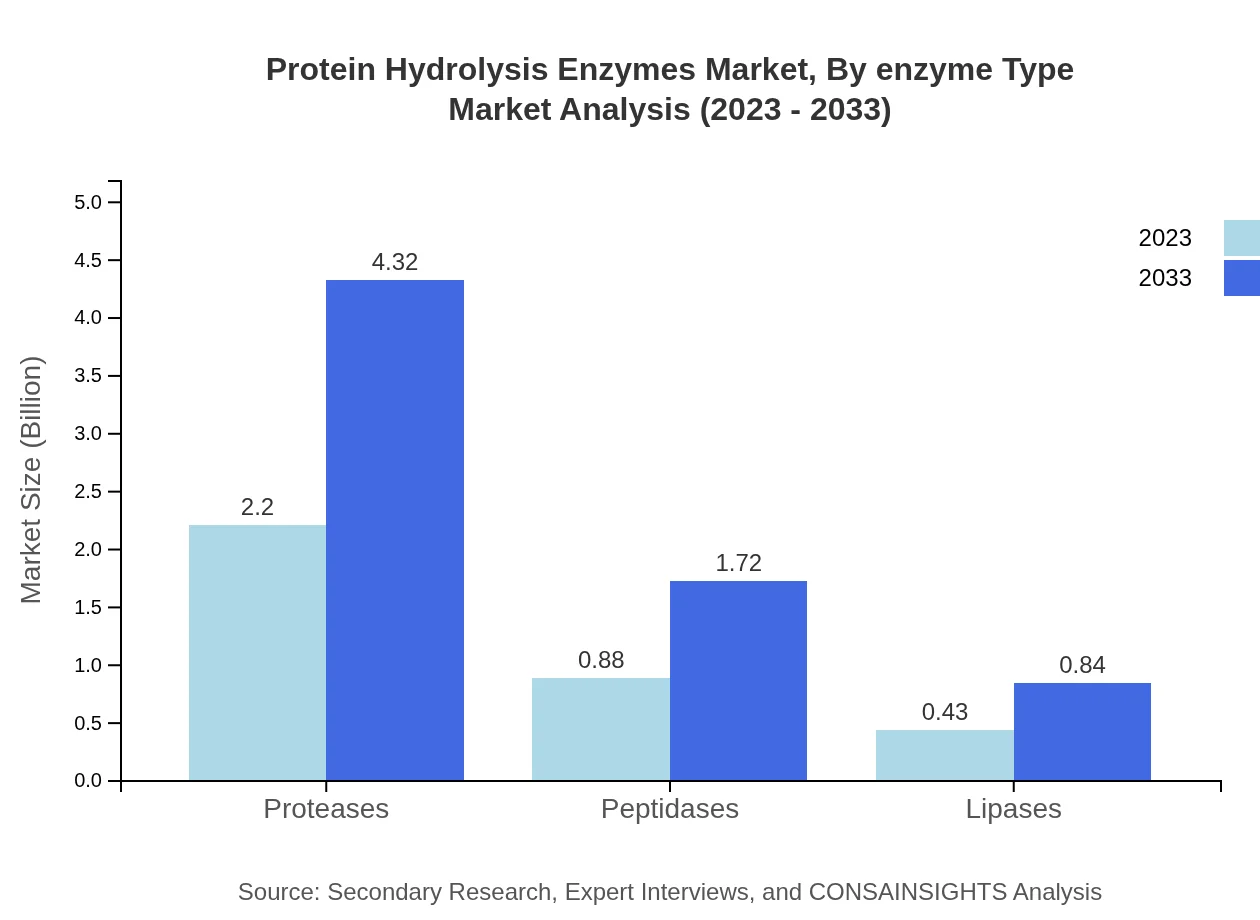
In 2023, proteases dominate the market, valued at $2.20 billion and expected to reach $4.32 billion by 2033, holding a share of 62.73%. Liquid enzymes account for $0.88 billion, growing to $1.72 billion with a 25.05% share. Granules and microbial sources contribute smaller segments, indicating a shift in preference toward efficient, versatile solutions in enzyme applications.
Protein Hydrolysis Enzymes Market Analysis By Application
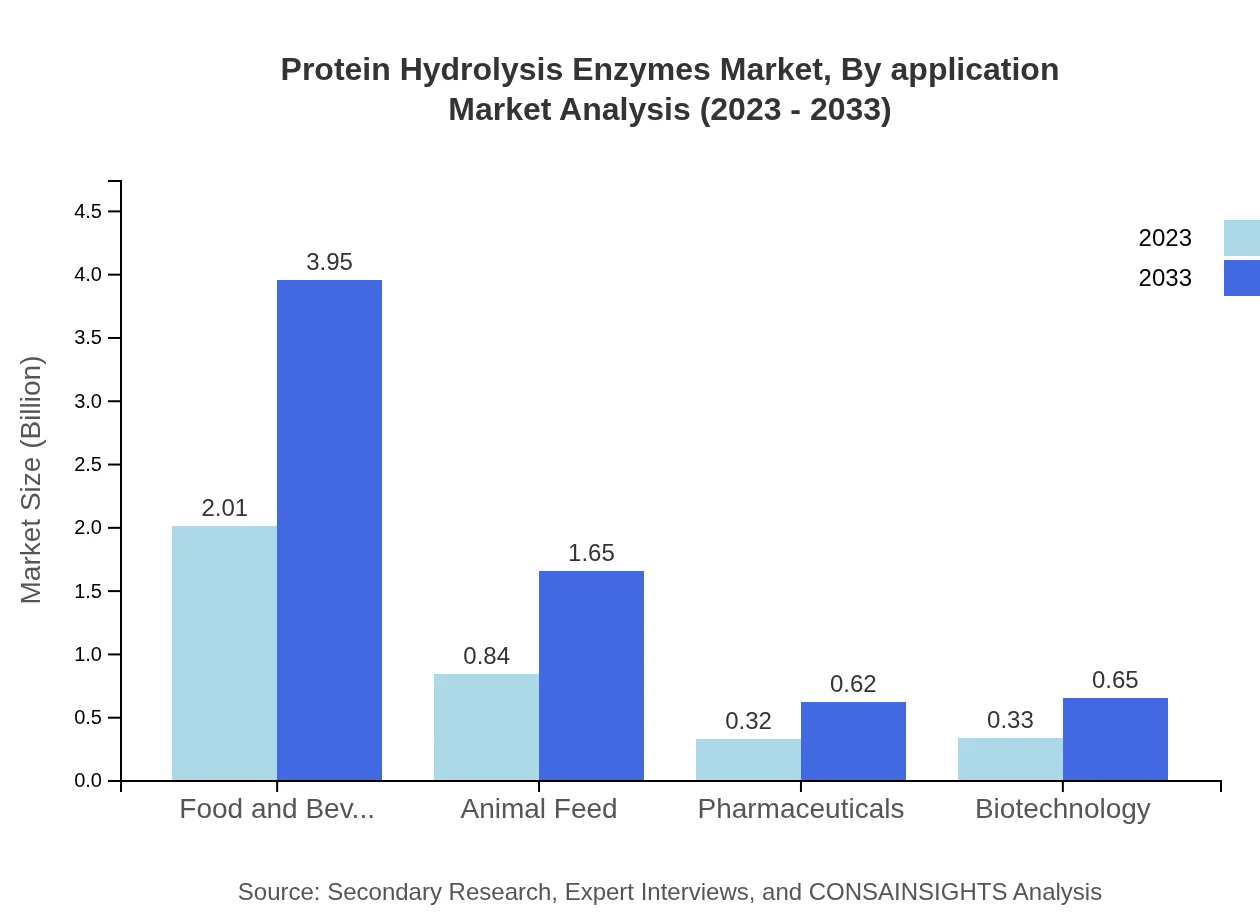
The food and beverage application leads the market with a size of $2.01 billion projected to grow to $3.95 billion by 2033, dominating the share at 57.48%. The animal feed segment and pharmaceutical applications also contribute significantly, each reflecting growing awareness about nutrition and health benefits.
Protein Hydrolysis Enzymes Market Analysis By Source
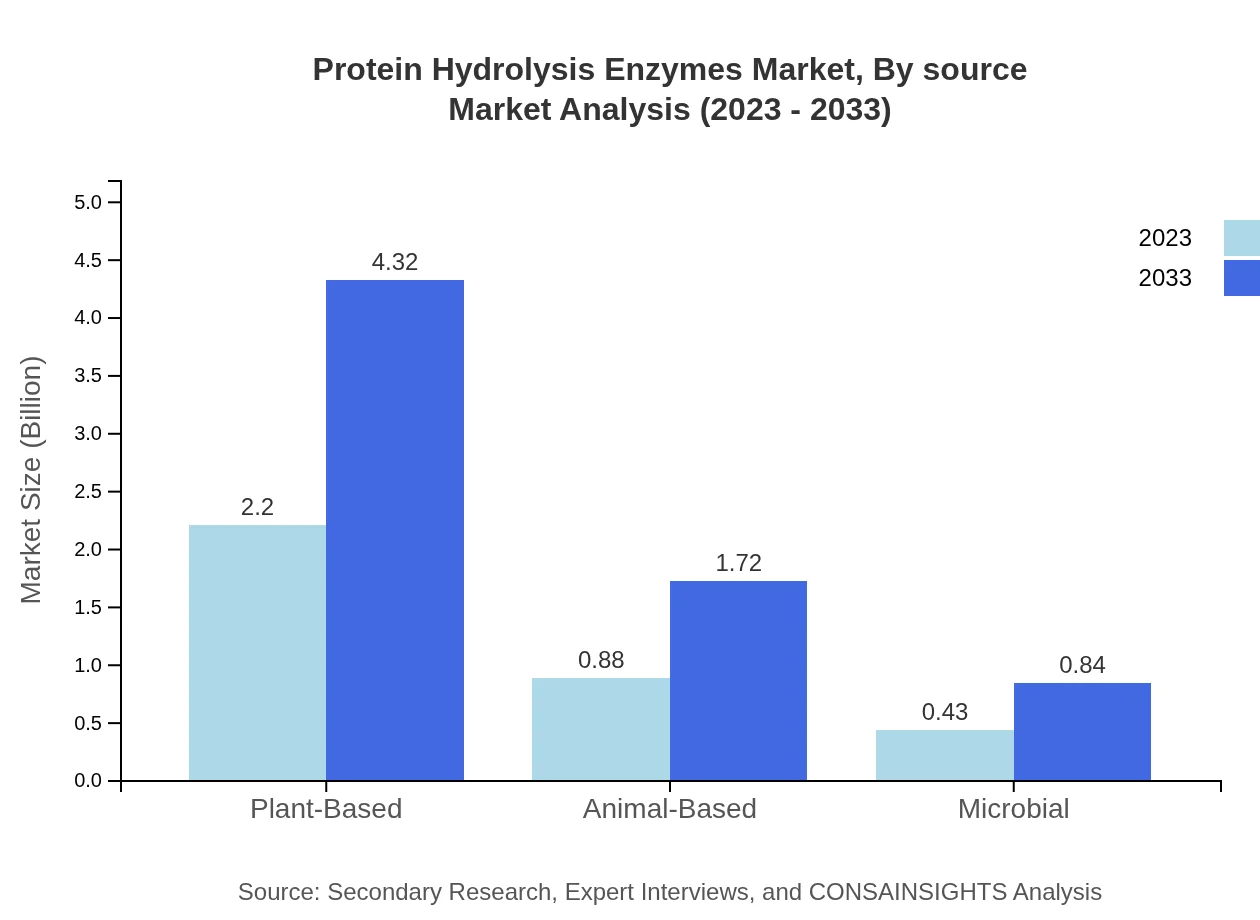
Plant-based protein enzymes represented a significant market segment at $2.20 billion in 2023. This trend is expected to continue as consumers seek plant-derived products. Animal-based and microbial sources also retain noteworthy shares, reflecting varied consumer preferences and application requirements.
Protein Hydrolysis Enzymes Market Analysis By Form
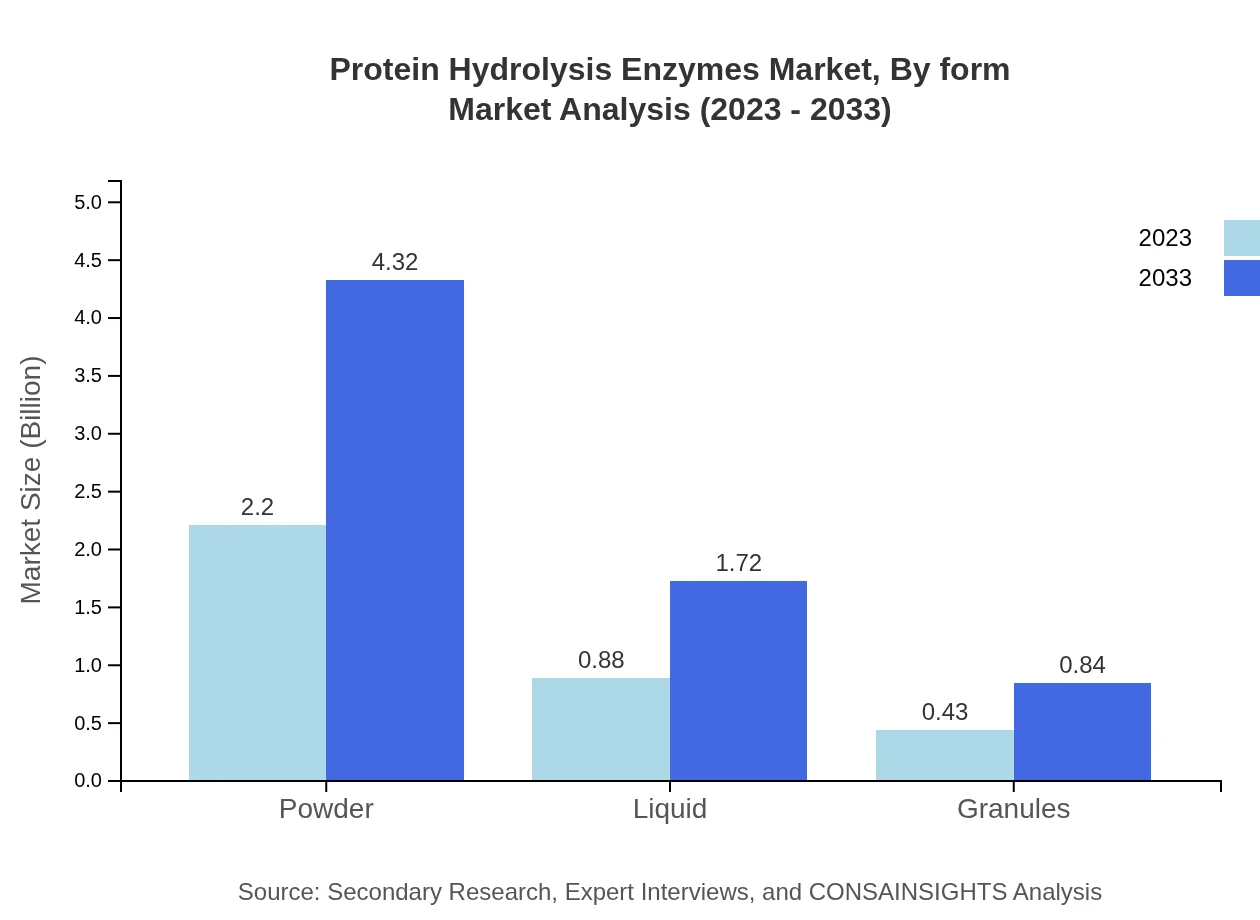
The powdered form of protein hydrolysis enzymes is predominantly used, valued at $2.20 billion in 2023 and projected to expand to $4.32 billion by 2033. Liquid forms, despite a smaller market share at $0.88 billion, are gaining popularity due to convenience in application, particularly in the food and beverage sector.
Protein Hydrolysis Enzymes Market Trends and Future Forecast
Tell us your focus area and get a customized research report.
Global Market Leaders and Top Companies in Protein Hydrolysis Enzymes Industry
BASF SE:
A global leader in chemical production, BASF develops a variety of enzyme solutions, notably for the food and feed industries, focusing on sustainability and cutting-edge biotechnology.Novozymes A/S:
Specializing in industrial enzymes, Novozymes holds a prominent position in the protein hydrolysis sector, known for their innovation and strong commitment to sustainable practices across various applications.DuPont de Nemours, Inc.:
An established player in the enzyme market, DuPont focuses on research and development to provide enhanced enzyme solutions, catering primarily to the food industry with a diverse product range.AB Enzymes:
AB Enzymes provides a range of enzyme products across several sectors, particularly in baking and food processing, emphasizing high performance and efficiency.Chr. Hansen:
Chr. Hansen is known for its natural solutions, focusing on enzymes in the food and beverage sector, promoting innovation in health and nutrition products.We're grateful to work with incredible clients.









FAQs
What is the market size of the Protein Hydrolysis Enzymes Market Report in 2023?
The market size in 2023 is $3.50 Billion. This figure serves as the baseline for the 2023 to 2033 forecast and for segment and regional comparisons in the report.
How big will the market be in 2033?
The projected market value for 2033 is $6.88 Billion, reflecting expansion across applications and regions over the 2023 to 2033 forecast period.
What is CAGR of the market for 2023 to 2033?
The compounded annual growth rate for the 2023 to 2033 forecast period is 6.8%, based on the market trajectory between the 2023 and 2033 values provided.
Which region is the fastest Growing in the Protein Hydrolysis Enzymes Market Report market?
Latin America is the fastest-growing region, projected to expand from $0.18 Billion in 2023 to $0.36 Billion in 2033, reflecting an implied 7.18% CAGR over the forecast period.
Which region is the largest market?
North America is identified as the largest regional market, expanding from $1.26 Billion in 2023 to $2.47 Billion in 2033 according to the regional facts provided.
Which region is the fastest Growing?
Latin America is designated the regional market region, rising from $0.18 Billion in 2023 to $0.36 Billion in 2033 with an implied 7.18% CAGR as stated.
Why are enzymes important for food and beverage applications?
Enzymes facilitate protein hydrolysis to improve flavor, digestibility and nutrient availability, supporting product innovation and formulation in food and beverage segments.
What sources are covered in market segmentation?
The report lists plant-based, animal-based and microbial sources as the source subsegments used to classify enzyme origins and related product positioning.
Which enzyme types are included in the segmentation?
Enzyme-type segmentation includes proteases, peptidases and lipases to capture functional distinctions across applications and formulations.
What forms are analyzed in the report?
Form subsegments detailed in the input include powder, liquid and granules, representing common commercial presentations of protein hydrolysis enzymes.