
Reports >
Life Sciences
>
Self Injection Device Market Report

Self Injection Device Market Report
First published: 15 October 2024 | Last updated: 25 May 2026 | Report Code: self-injection-device
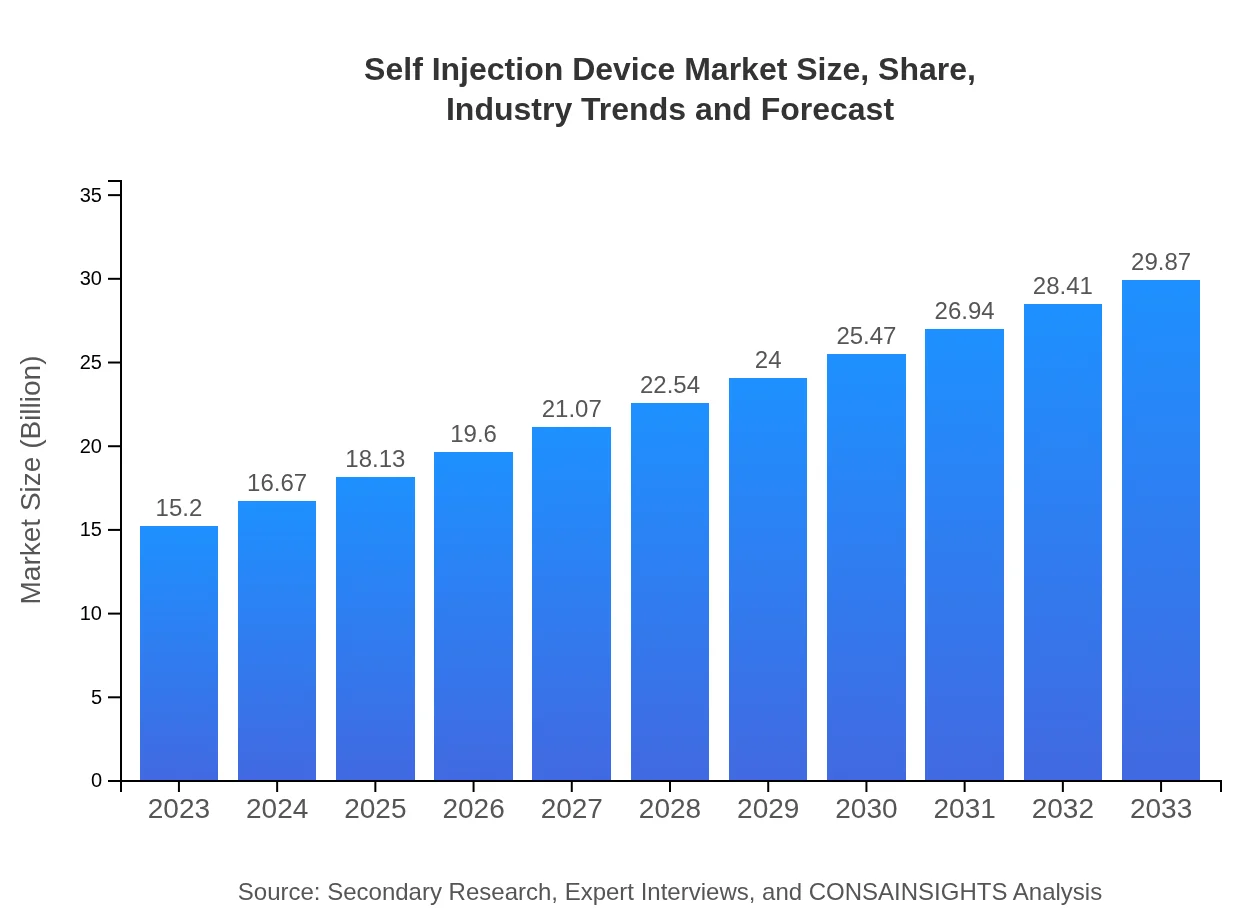
Self Injection Device Market — USD 15.2 billion in 2023, Growing to USD 29.87B by 2033 at 6.8% CAGR
This report provides a comprehensive analysis of the Self Injection Device market, including key insights and data from 2023 to 2033. It covers market size, growth rates, segmentation, regional analysis, and future trends impacting the industry.
Key Takeaways
- Global market expands from $15.20 Billion in 2023 to $29.87 Billion in 2033, reflecting a 6.8% CAGR over the 2023 to 2033 period.
- North America is largest regional market, while no single fastest-growing region is stated because regional CAGR differences remain within 0.15 percentage points.
- Europe grows from $4.23 Billion in 2023 to $8.31 Billion in 2033, supported by advanced healthcare infrastructure.
- Asia Pacific rises from $3.08 Billion in 2023 to $6.06 Billion in 2033 as home healthcare and chronic disease management expand.
- Key providers active in the market include AbbVie, Mylan, Allergan, and Boehringer Ingelheim.
- Product innovation, needle-free options, and digital integration are major trends shaping adoption and competitive strategies.
Self Injection Device Market Report — Executive Summary
North America remains largest market by forecast-period value, while no single fastest-growing region is stated because top regional growth rates are separated by less than 0.15 percentage points. This report examines the Self Injection Device market through a structured review of market drivers, product categories, distribution channels, and regional dynamics. Market value increases from $15.20 Billion in 2023 to $29.87 Billion in 2033 at a CAGR of 6.8% for the 2023 to 2033 forecast period. Growth is supported by rising prevalence of chronic diseases, greater uptake of homecare solutions, and technological advances such as needle-free systems and smart injection devices. The analysis covers segmentation by product type, technology, end user, application, and distribution channel, and highlights activity by leading firms including AbbVie, Mylan, Allergan, and Boehringer Ingelheim. Regional breakdown provides start and end values for North America, Europe, Asia Pacific, Latin America, and Middle East and Africa, with North America identified as the largest regional market. The report concludes with strategic implications for manufacturers, payers, and investors seeking to navigate regulatory, cost, and adoption challenges while capitalizing on product innovation and digital integration.
Key Growth Drivers
- Increasing prevalence of chronic diseases driving demand for self-administered therapies and sustained-use devices.
- Rising preference for homecare solutions that reduce hospital visits and improve patient convenience and adherence.
- Technological progress, including needle-free mechanisms and smart features that enhance usability and monitoring.
- Strategic initiatives by established players—such as AbbVie, Mylan, Allergan, and Boehringer Ingelheim—through product launches and partnerships.
- Growing awareness and acceptance of advanced drug delivery systems among clinicians and patients.
| Metric | Value |
|---|---|
| Study Period | 2023 - 2033 |
| 2023 Market Size | $15.20 Billion |
| CAGR (2023-2033) | 6.8% |
| 2033 Market Size | $29.87 Billion |
| Top Companies | AbbVie, Mylan, Allergan, Boehringer Ingelheim |
| Published Date | 15 October 2024 |
| Last Modified Date | 25 May 2026 |
Self Injection Device Market Overview
Customize Self Injection Device Market Report market research report
- ✔ Get in-depth analysis of Self Injection Device market size, growth, and forecasts.
- ✔ Understand Self Injection Device's regional dynamics and industry-specific trends.
- ✔ Identify potential applications, end-user demand, and growth segments in Self Injection Device
What is the Market Size & CAGR of Self Injection Device Market Report market in 2023?
Self Injection Device Industry Analysis
Self Injection Device Market Segmentation and Scope
Tell us your focus area and get a customized research report.
Self Injection Device Market Report Market Analysis Report by Region
Europe Self Injection Device Market Report:
Europe grows from $4.23 Billion in 2023 to $8.31 Billion in 2033. This trajectory reflects supportive healthcare systems, growing awareness of advanced delivery devices, and regulatory environments that facilitate adoption of innovative injection solutions.Asia Pacific Self Injection Device Market Report:
Asia Pacific grows from $3.08 Billion in 2023 to $6.06 Billion in 2033. Growth is influenced by expanding home healthcare services, increasing chronic disease prevalence, and rising accessibility to modern injection technologies.North America Self Injection Device Market Report:
North America is largest regional market, rising from $5.56 Billion in 2023 to $10.92 Billion in 2033. Regional expansion is supported by established healthcare infrastructure, high adoption of homecare solutions, and active participation from leading firms.South America Self Injection Device Market Report:
Latin America grows from $1.32 Billion in 2023 to $2.6 Billion in 2033. Market development is underpinned by increasing demand for simplified drug administration, growing awareness of chronic condition management, and gradual improvements in healthcare delivery.Middle East & Africa Self Injection Device Market Report:
Middle East and Africa grows from $1.01 Billion in 2023 to $1.98 Billion in 2033. Growth drivers include rising uptake of self-administered therapies, growing focus on homecare, and incremental access to advanced delivery systems.Tell us your focus area and get a customized research report.
Research Methodology
Self Injection Device Market Analysis By Product Type
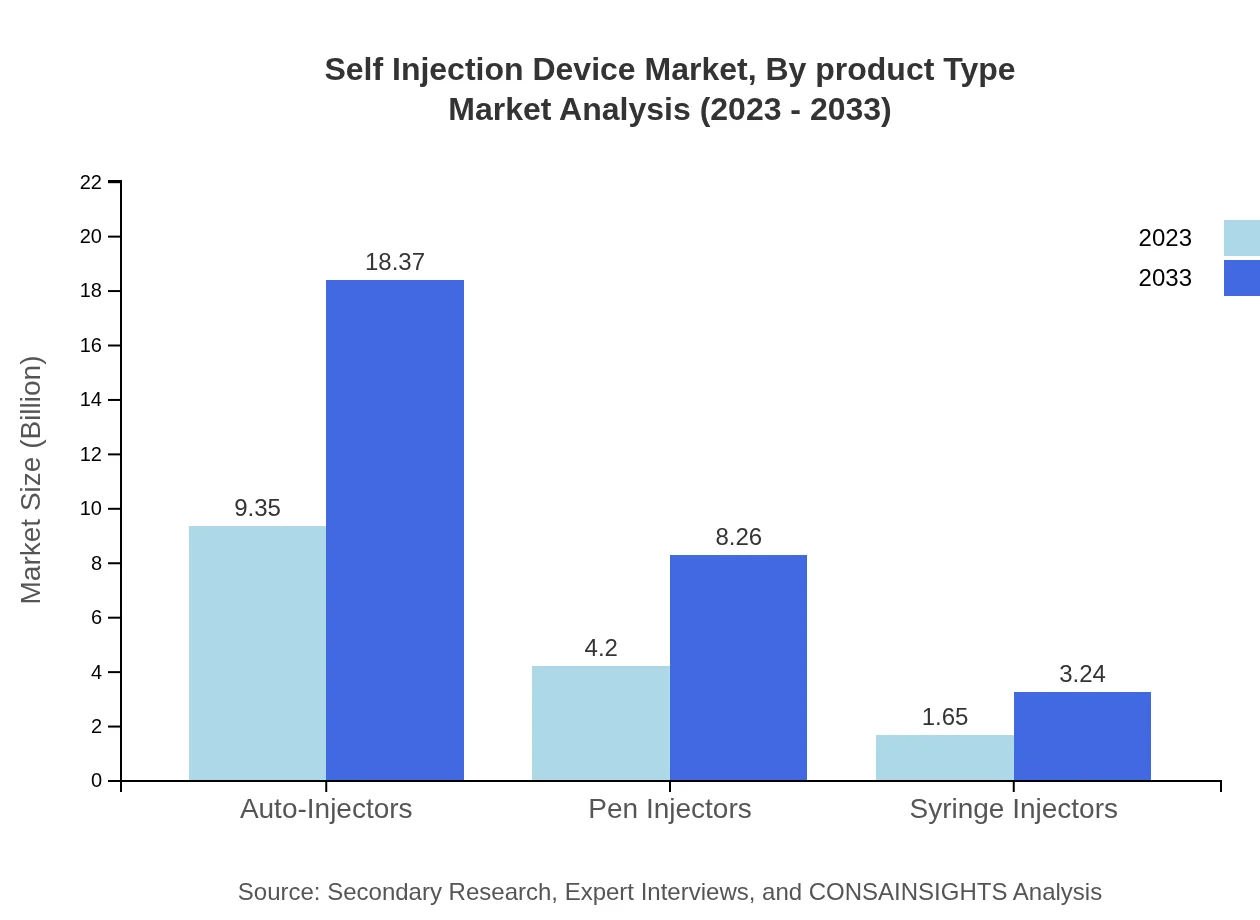
The segmentation by product type sees auto-injectors dominating the market with a size of $9.35 billion in 2023, projected to reach $18.37 billion by 2033, accounting for the highest market share at 61.5%. Pen injectors and syringe injectors follow with market sizes of $4.20 billion and $1.65 billion in 2023, estimated to grow respectively to $8.26 billion and $3.24 billion by 2033.
Self Injection Device Market Analysis By Application Area
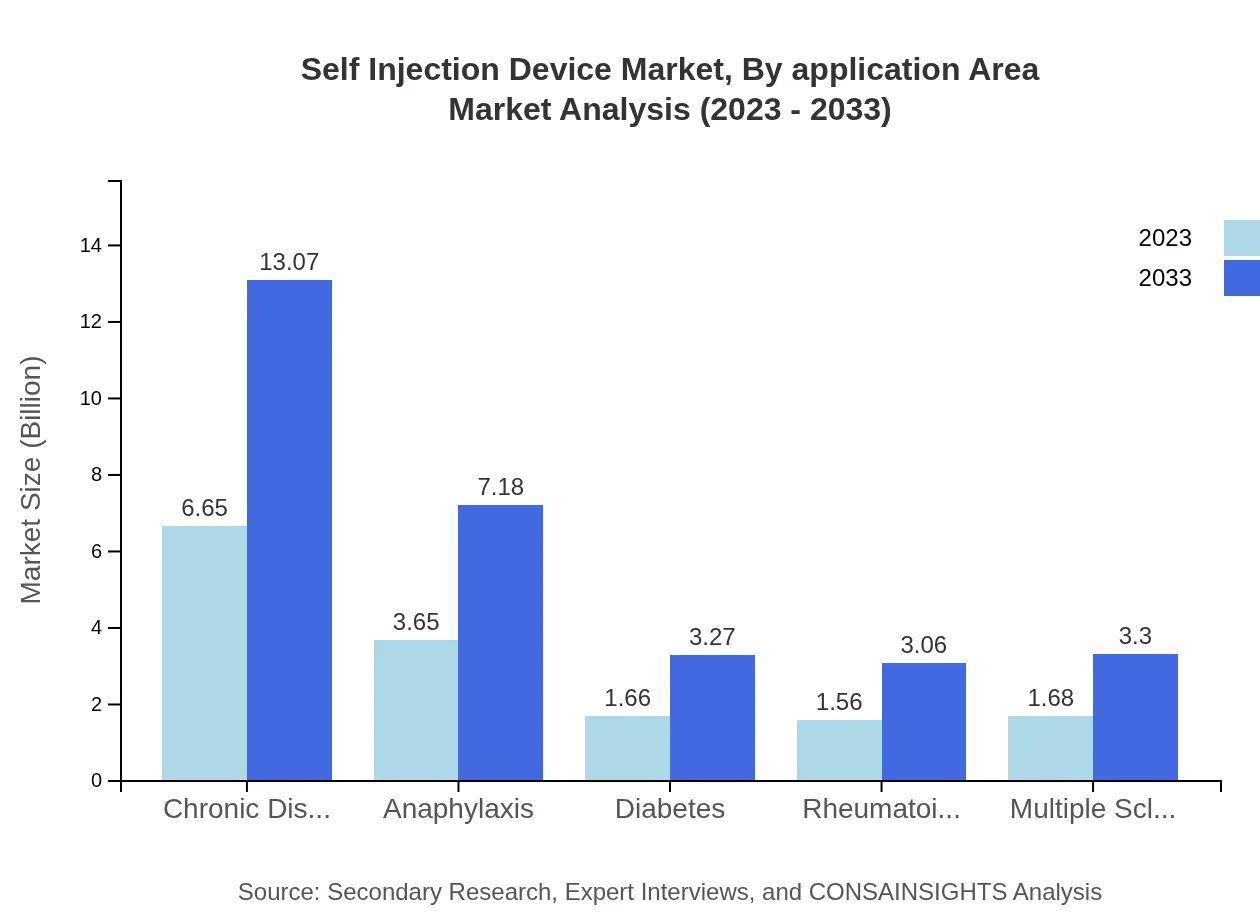
The application area segment highlights chronic diseases as the major contributor with expected sizes of $6.65 billion in 2023 and $13.07 billion by 2033. Anaphylaxis and diabetes are also significant contributors, with expected market sizes growing from $3.65 billion to $7.18 billion, and from $1.66 billion to $3.27 billion, respectively.
Self Injection Device Market Analysis By End User
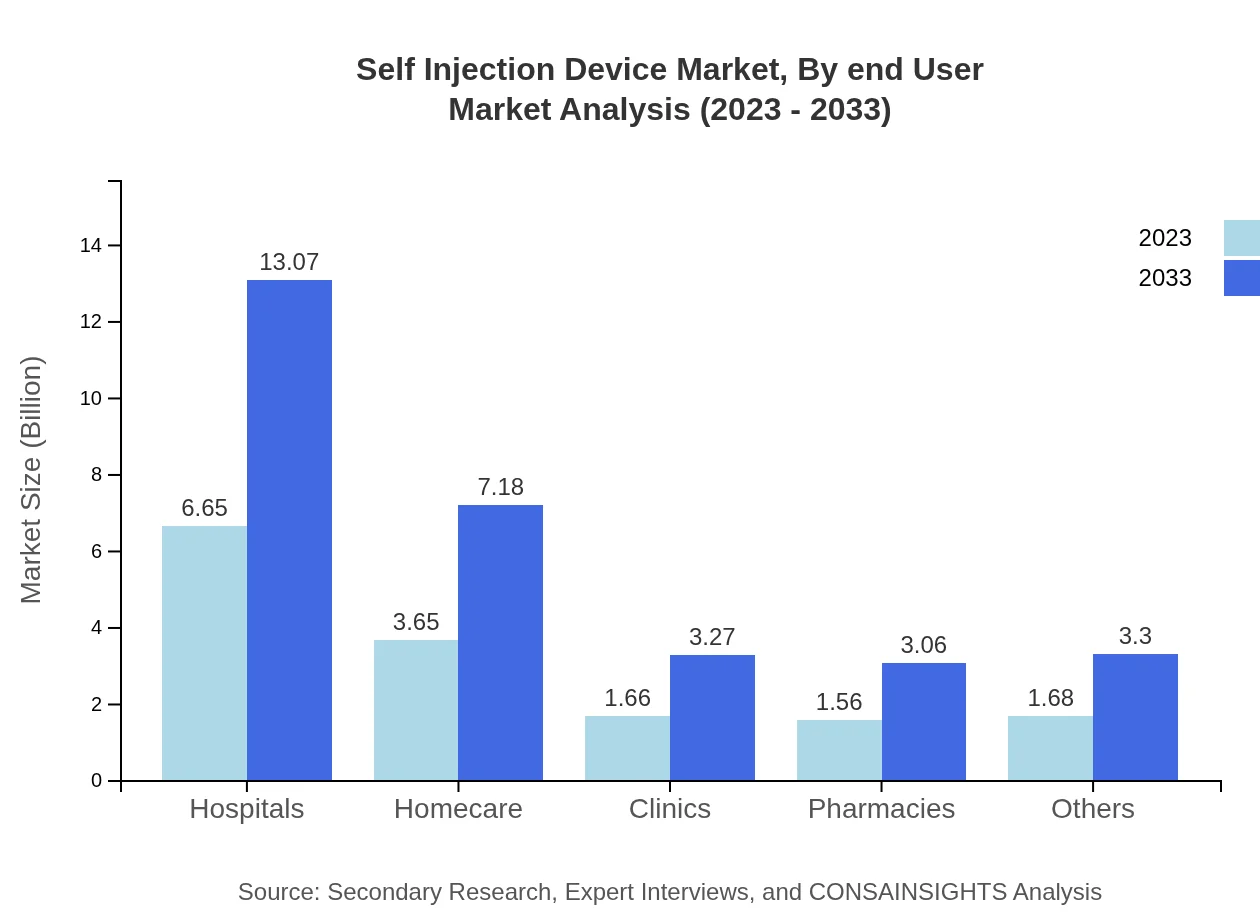
Among end-users, hospitals are significant players with a market size of $6.65 billion in 2023, projected to reach $13.07 billion by 2033, capturing a share of 43.75%. Homecare settings follow with a market size of $3.65 billion, expected to grow to $7.18 billion, maintaining a share of 24.02% across the period.
Self Injection Device Market Analysis By Technology
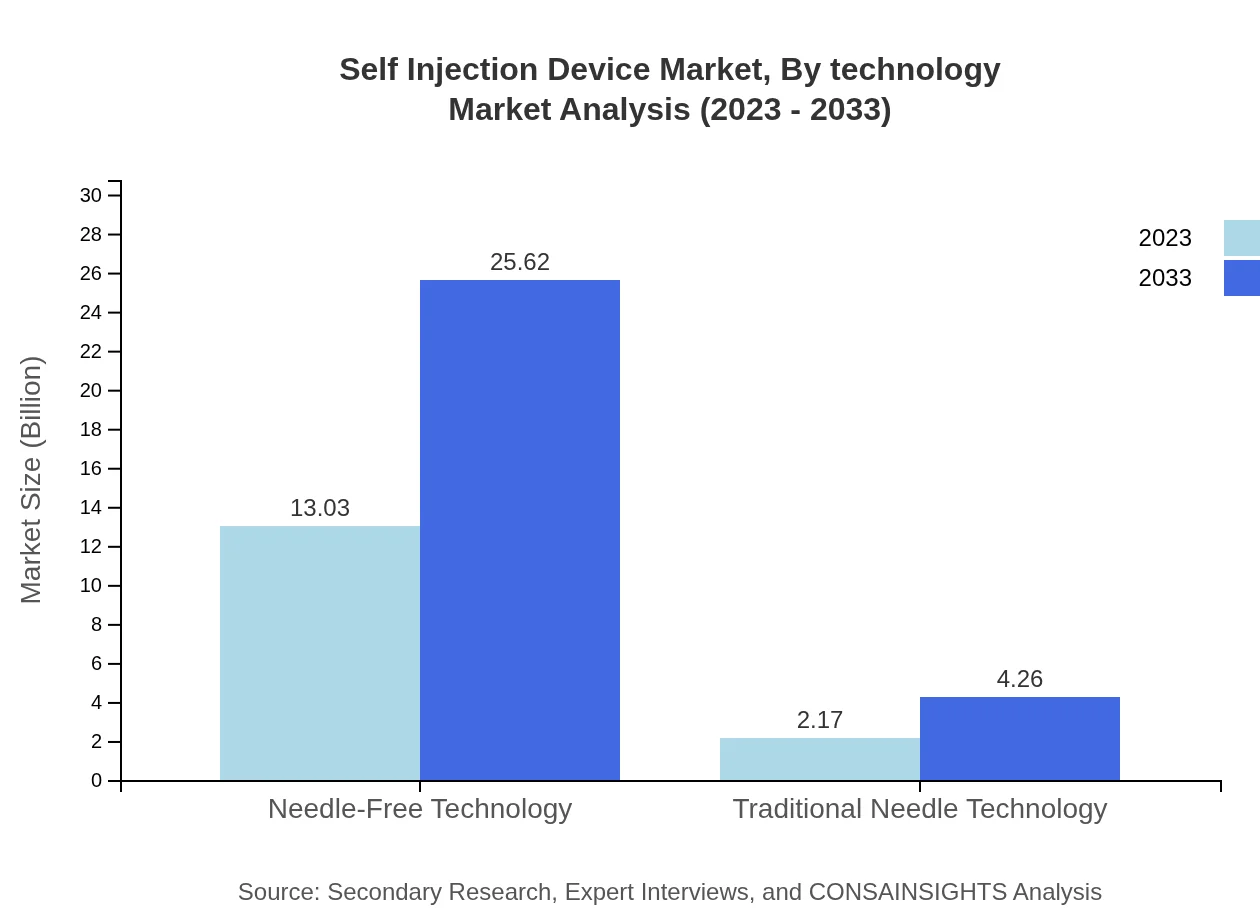
Technology-wise, needle-free technology leads the segment with a significant size of $13.03 billion in 2023, projected to reach $25.62 billion by 2033, claiming 85.75% of the market share. Traditional needle technology, while smaller, is also forecast to grow from $2.17 billion to $4.26 billion, capturing a steady share.
Self Injection Device Market Analysis By Distribution Channel
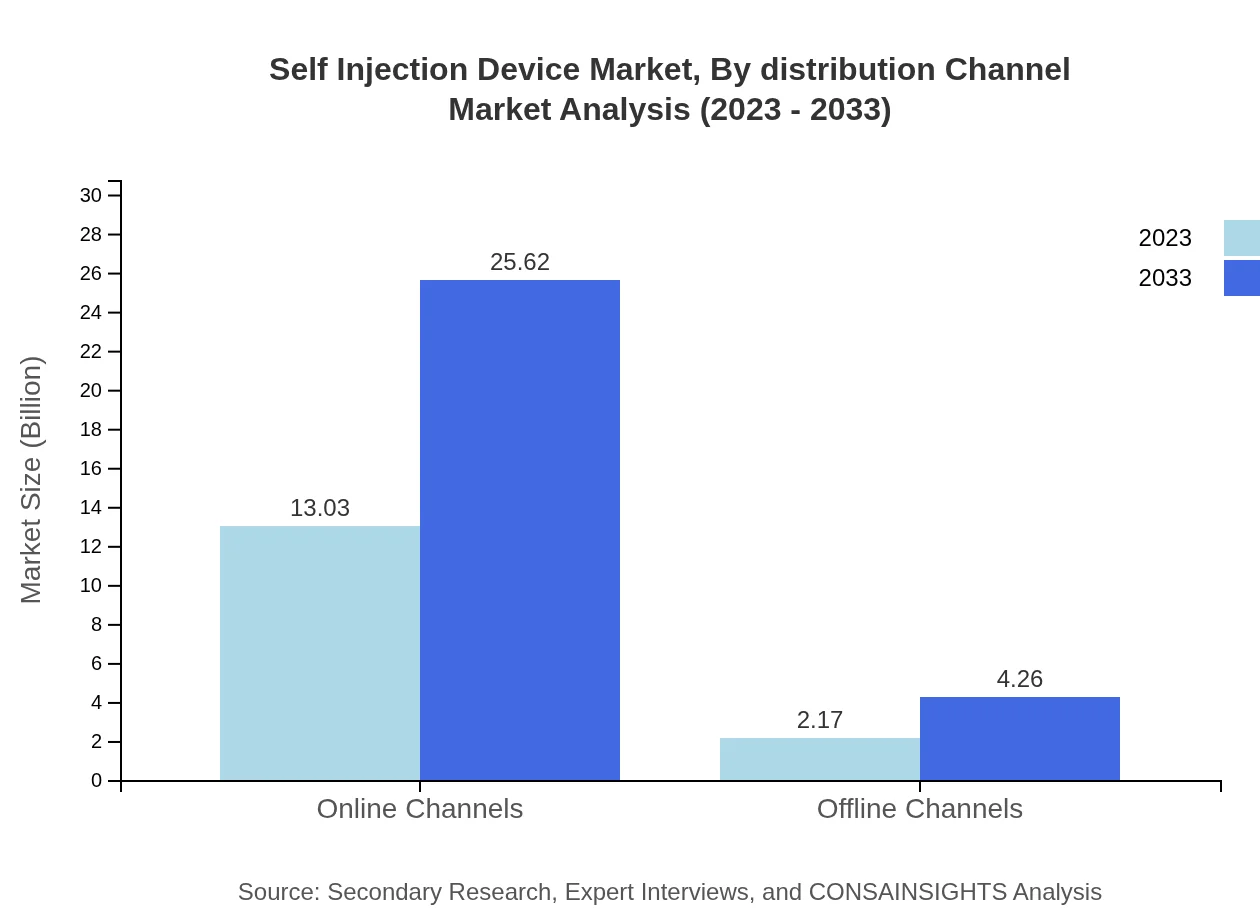
The distribution channel analysis shows online channels commanding a large market size of $13.03 billion in 2023, expected to rise to $25.62 billion by 2033. Offline channels are projected from $2.17 billion in 2023 to $4.26 billion by 2033, reflecting growing preference for e-commerce in health management.
Self Injection Device Market Trends and Future Forecast
Tell us your focus area and get a customized research report.
Global Market Leaders and Top Companies in Self Injection Device Industry
AbbVie:
AbbVie is known for its innovative therapies and products in the self-injection domain, particularly in autoimmune diseases and chronic inflammation.Mylan:
Mylan specializes in developing generic injectable medications and self-injection devices, making it a pivotal player in enhancing accessibility to essential therapies.Allergan:
Allergan, with its focus on aesthetic products and therapies for chronic illnesses, contributes to the self-injection market significantly, with innovations in pen injector technology.Boehringer Ingelheim:
A key player in biopharmaceuticals, Boehringer Ingelheim is at the forefront of developing self-injection devices that improve patient compliance and medication delivery.We're grateful to work with incredible clients.


FAQs
What is the market size of the Self Injection Device market in 2023?
The market size for the Self Injection Device market in 2023 is $15.20 Billion as stated in the report data.
How big will the Self Injection Device market be in 2033?
By 2033 the market is projected to reach $29.87 Billion according to the provided forecast figures.
What is CAGR for the Self Injection Device market during the forecast period?
The compound annual growth rate (CAGR) for the 2023 to 2033 forecast period is 6.8% as specified in the input.
Is there a single fastest Growing region in the Self Injection Device Market Report market?
No single fastest-growing region is stated for the Self Injection Device Market Report market because the top regional implied CAGR values are within 0.15 percentage points of each other, making the ranking too close to call reliably.
Which companies are listed as top players in the market?
Top companies mentioned in the report data include AbbVie, Mylan, Allergan, and Boehringer Ingelheim.
What are the primary technology subsegments in this market?
The technology subsegments specified are Needle-Free Technology and Traditional Needle Technology.
Who are the end users covered in the market segmentation?
End-user subsegments listed include Hospitals, Homecare, Clinics, Pharmacies, and Others as per the input details.
What are common product types in the Self Injection Device market?
Product types detailed in the data include Auto-Injectors, Pen Injectors, and Syringe Injectors.
How do distribution channels divide in the market data?
Distribution channels are categorized as Online Channels and Offline Channels in the provided segmentation.
What application areas are included in the report?
Application areas specified are Chronic Diseases, Anaphylaxis, Diabetes, Rheumatoid Arthritis, and Multiple Sclerosis.