

Singleuse Bioprocessing Material Market Report
First published: 07 October 2024 | Last updated: 28 May 2026 | Report Code: singleuse-bioprocessing-material
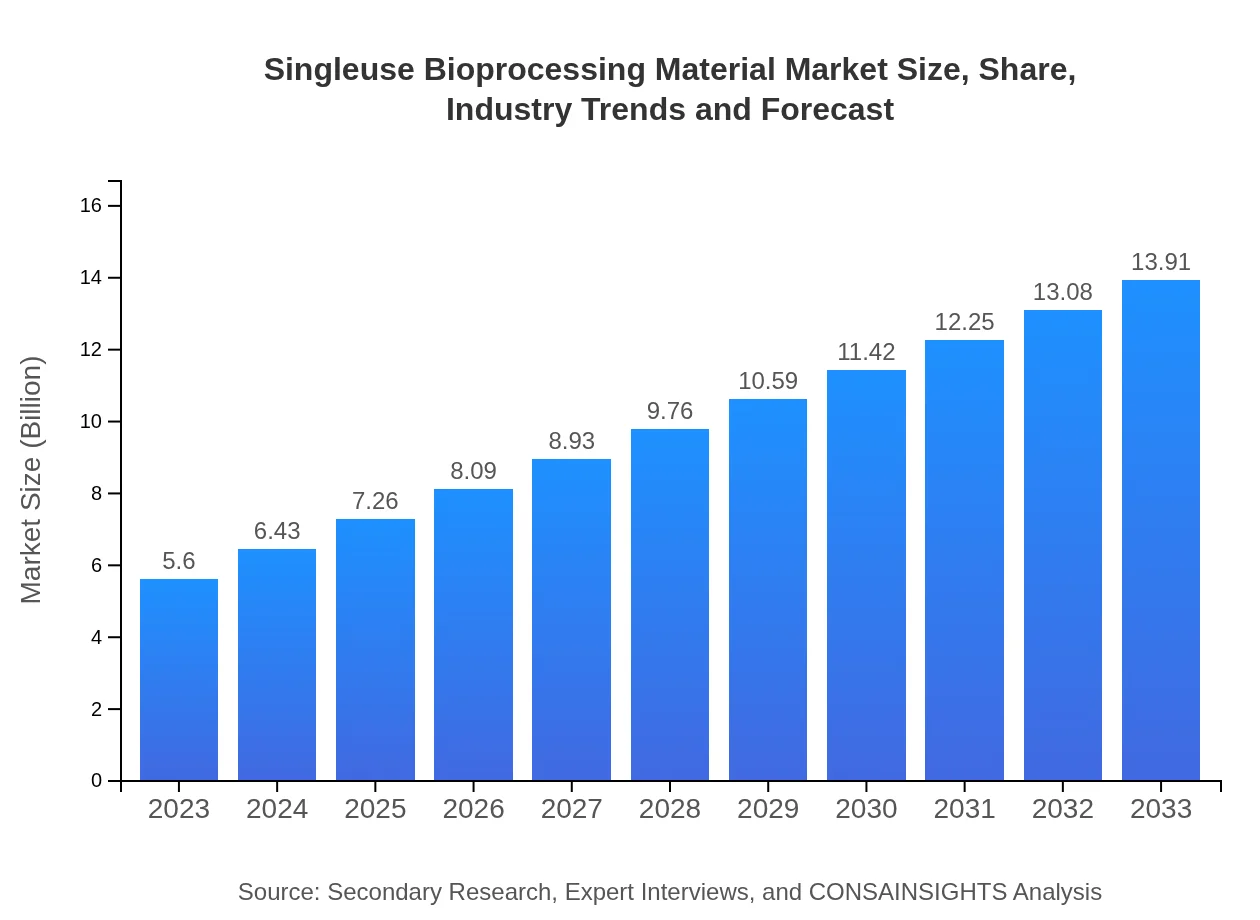
Singleuse Bioprocessing Material Market — USD 5.6 billion in 2023, Growing to USD 13.91B by 2033 at 9.2% CAGR
This report provides a comprehensive analysis of the Singleuse Bioprocessing Material market, highlighting key insights, growth trends, and forecasts from 2023 to 2033.
Key Takeaways
- Global market expands from $5.60 Billion in 2023 to $13.91 Billion in 2033 at a 9.2% CAGR.
- North America is largest regional market, while no single fastest-growing region is stated because regional CAGR differences remain within 0.15 percentage points.
- Europe grows from $1.72 Billion in 2023 to $4.27 Billion in 2033, reflecting substantial regional adoption.
- Asia Pacific rises from $1.12 Billion in 2023 to $2.77 Billion in 2033, supported by bioprocessing investments.
- Top companies include Merck KGaA, Sartorius AG, Thermo Fisher Scientific, GE Healthcare, and Pall Corporation.
Singleuse Bioprocessing Material Market Report — Executive Summary
North America remains largest market by forecast-period value, while no single fastest-growing region is stated because top regional growth rates are separated by less than 0.15 percentage points. The Singleuse Bioprocessing Material market is forecast to grow from $5.60 Billion in 2023 to $13.91 Billion in 2033 at a CAGR of 9.2% for 2023 to 2033. Demand is driven by rising biopharmaceutical production, adoption of single-use systems to lower contamination risk and operational costs, and increased development of biologics. Regional dynamics vary: North America is the largest market, while Europe, Asia Pacific, Latin America, and Middle East and Africa each show notable increases. Product segmentation spans bags and containers, filters, and pipelines, while applications include vaccine manufacturing, cell culture, monoclonal antibody production, and gene therapy. Leading suppliers such as Merck KGaA, Sartorius AG, Thermo Fisher Scientific, GE Healthcare, and Pall Corporation compete on product range and quality. The report synthesizes primary interviews with industry experts and secondary sources to present validated trends and implications for manufacturers, service providers, and investors.
Key Growth Drivers
- Increased biopharmaceutical production requiring flexible, contamination-reducing materials.
- Shift to single-use systems to reduce cleaning, validation time, and capital expenditure.
- Rising demand for vaccines, monoclonal antibodies, and gene therapies boosting material uptake.
- Innovation by major suppliers expanding product availability and application-specific solutions.
- Regulatory emphasis on contamination control and manufacturing efficiency supporting adoption.
| Metric | Value |
|---|---|
| Study Period | 2023 - 2033 |
| 2023 Market Size | $5.60 Billion |
| CAGR (2023-2033) | 9.2% |
| 2033 Market Size | $13.91 Billion |
| Top Companies | Merck KGaA, Sartorius AG, Thermo Fisher Scientific, GE Healthcare, Pall Corporation |
| Published Date | 07 October 2024 |
| Last Modified Date | 28 May 2026 |
Singleuse Bioprocessing Material Market Overview
Customize Singleuse Bioprocessing Material Market Report market research report
- ✔ Get in-depth analysis of Singleuse Bioprocessing Material market size, growth, and forecasts.
- ✔ Understand Singleuse Bioprocessing Material's regional dynamics and industry-specific trends.
- ✔ Identify potential applications, end-user demand, and growth segments in Singleuse Bioprocessing Material
What is the Market Size & CAGR of Singleuse Bioprocessing Material Market Report market in 2023?
Singleuse Bioprocessing Material Industry Analysis
Singleuse Bioprocessing Material Market Segmentation and Scope
Tell us your focus area and get a customized research report.
Singleuse Bioprocessing Material Market Report Market Analysis Report by Region
Europe Singleuse Bioprocessing Material Market Report:
Europe grows from $1.72 Billion in 2023 to $4.27 Billion in 2033. Adoption benefits from established bioprocessing facilities, regulatory emphasis on contamination control, and increasing biologics production that favors single-use materials.Asia Pacific Singleuse Bioprocessing Material Market Report:
Asia Pacific grows from $1.12 Billion in 2023 to $2.77 Billion in 2033. Growth is supported by expanding biomanufacturing capacity, investment in biotech, and rising demand for vaccines and biologics across regional markets.North America Singleuse Bioprocessing Material Market Report:
North America is largest regional market, rising from $1.8 Billion in 2023 to $4.48 Billion in 2033. Regional demand is driven by advanced biopharmaceutical manufacturing infrastructure, high adoption of single-use systems, and presence of major suppliers and research activity.South America Singleuse Bioprocessing Material Market Report:
Latin America grows from $0.46 Billion in 2023 to $1.15 Billion in 2033. Growth drivers include rising local biopharmaceutical activities, increasing adoption of efficient single-use solutions, and evolving research and manufacturing capabilities.Middle East & Africa Singleuse Bioprocessing Material Market Report:
Middle East and Africa grows from $0.5 Billion in 2023 to $1.24 Billion in 2033. Regional advances in healthcare infrastructure, investment in biologics, and growing focus on efficient manufacturing contribute to increased uptake of single-use materials.Tell us your focus area and get a customized research report.
Research Methodology
Singleuse Bioprocessing Material Market Analysis By Product Type
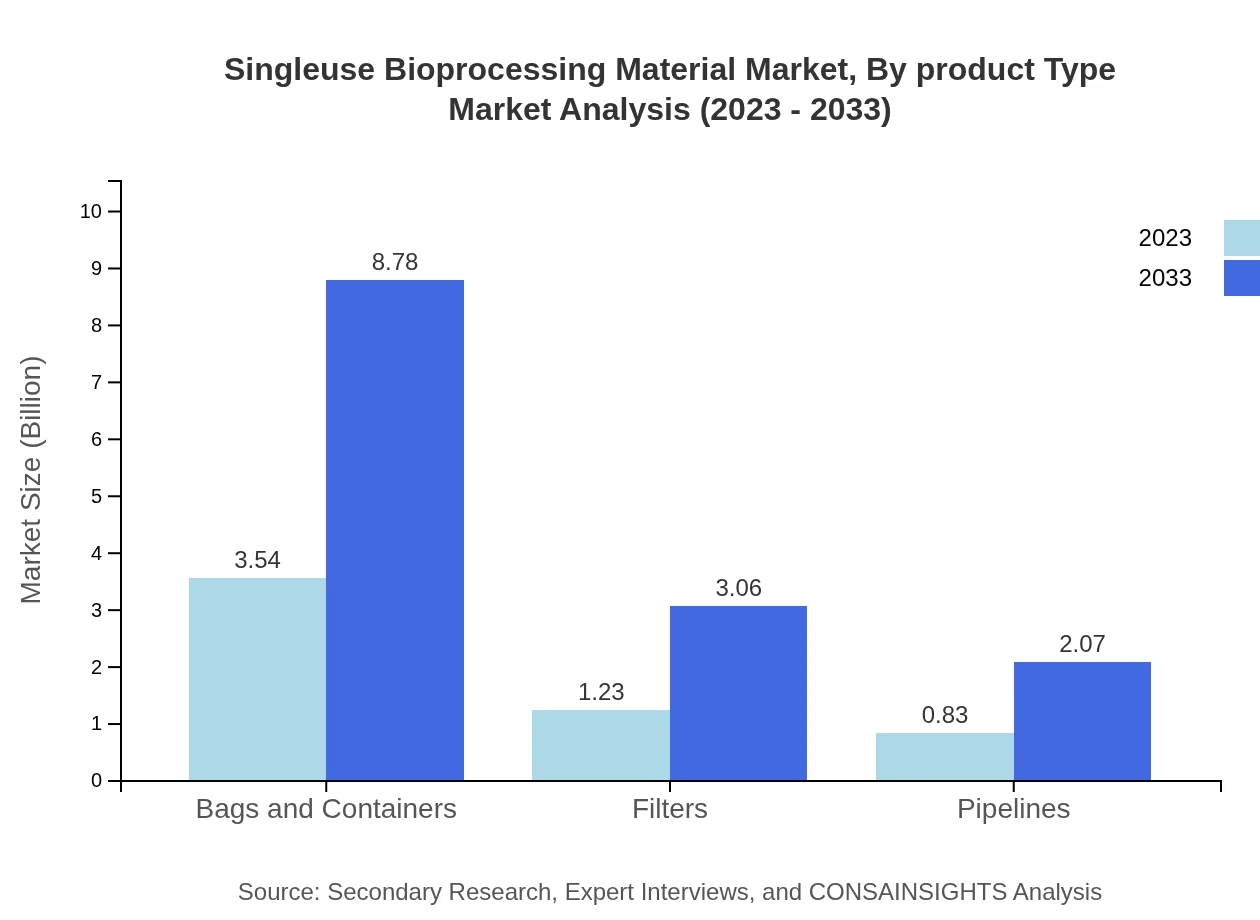
Key product segments within the Singleuse Bioprocessing Material market include bags and containers, filters, and pipelines. Bags and containers dominate the market, accounting for 63.14% of the market share in 2023, with expected growth to 8.78 billion by 2033. Filters and pipelines follow, with substantial shares of 21.97% and 14.89% respectively, indicating their essential roles in filtration and transportation in bioprocessing.
Singleuse Bioprocessing Material Market Analysis By Application
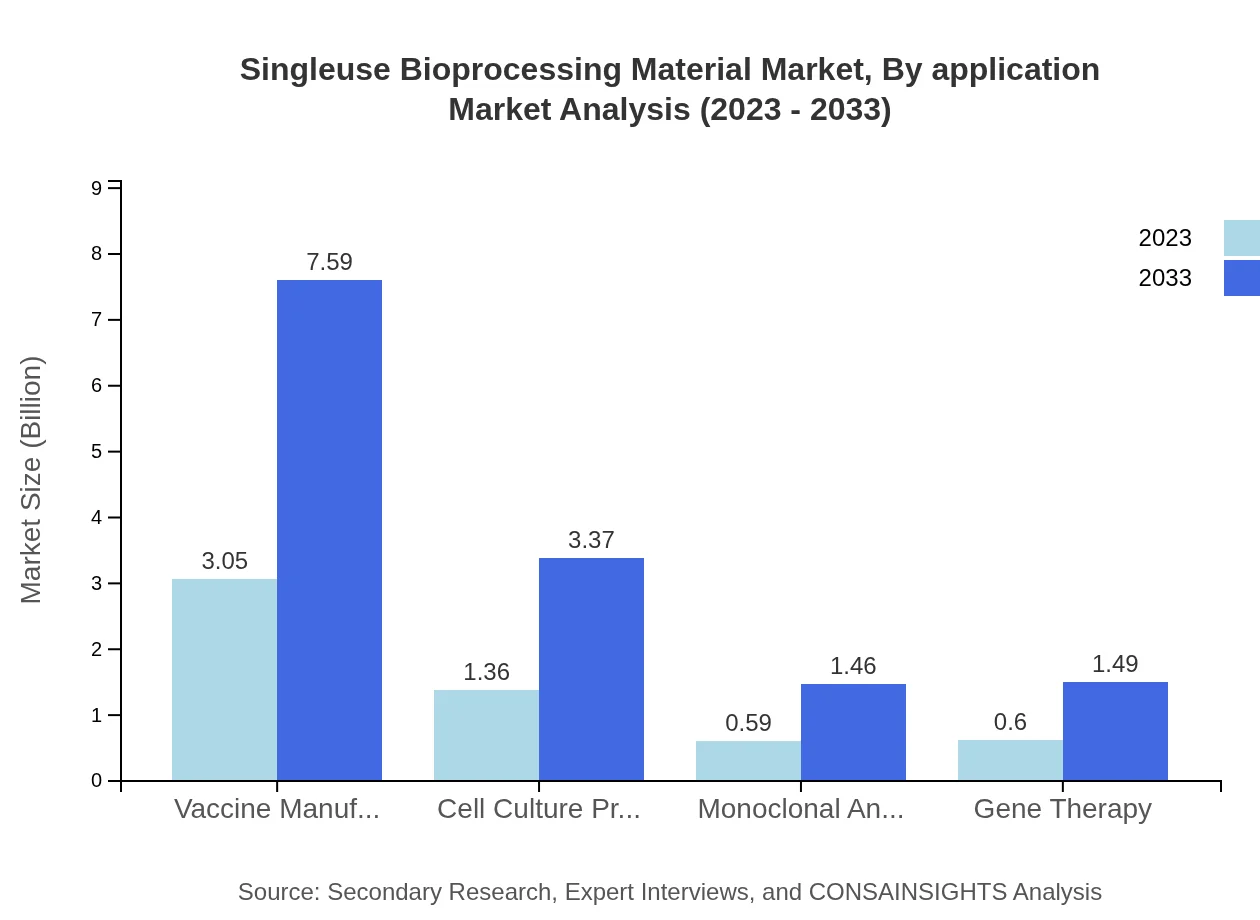
The application segments comprise vaccine manufacturing, monoclonal antibody production, cell culture production, and gene therapy. Vaccine manufacturing is the largest application, representing 54.54% of the market share in 2023, projected to grow to 7.59 billion by 2033. Other segments such as monoclonal antibody production and cell culture production also show significant growth potential.
Singleuse Bioprocessing Material Market Analysis By End User
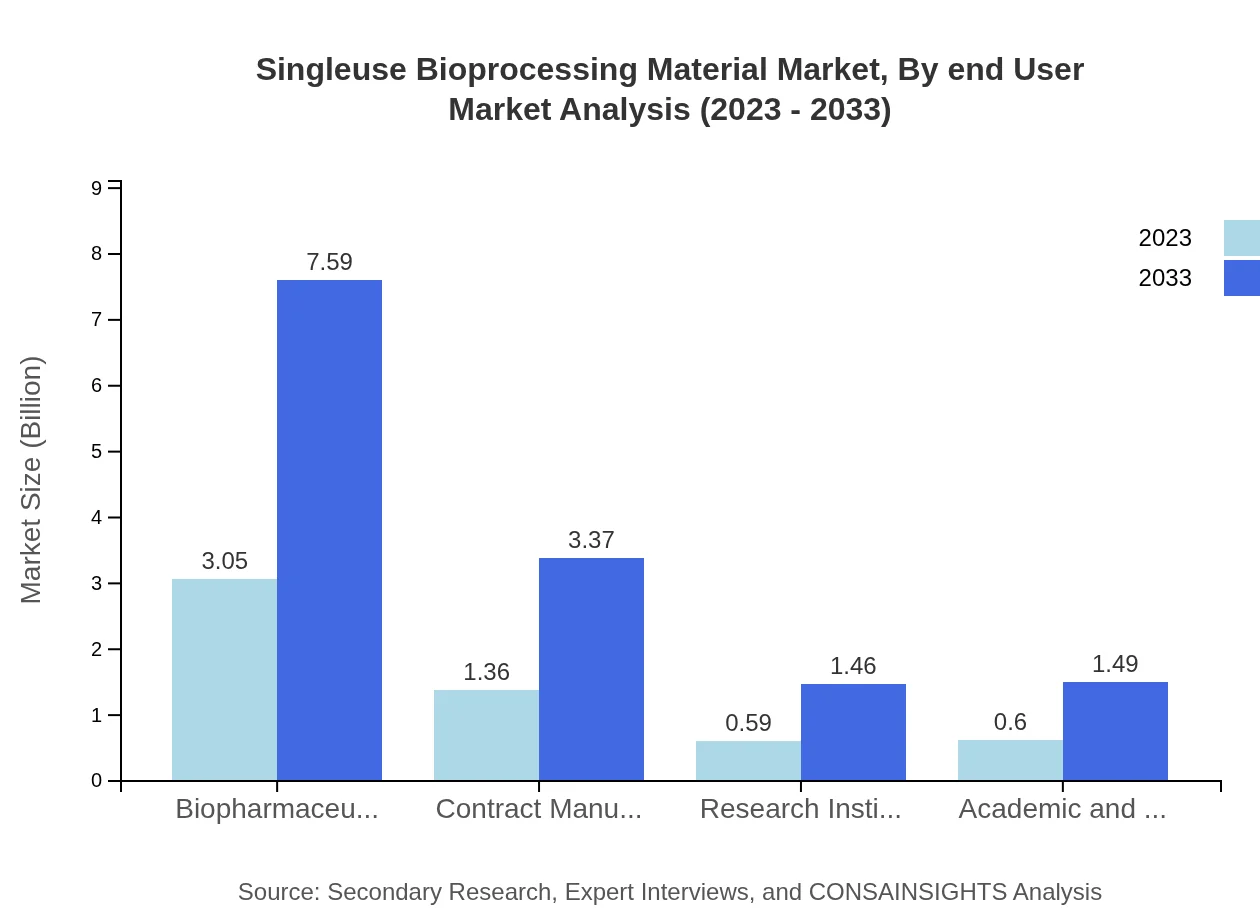
The market serves various end-user segments, including biopharmaceutical companies, contract manufacturing organizations (CMOs), research institutes, and academic/government research entities. Biopharmaceutical companies hold the largest share, contributing 54.54% in 2023 and showcasing steady growth through 2033. CMOs and research institutes follow, highlighting the market's diverse nature.
Singleuse Bioprocessing Material Market Analysis By Region
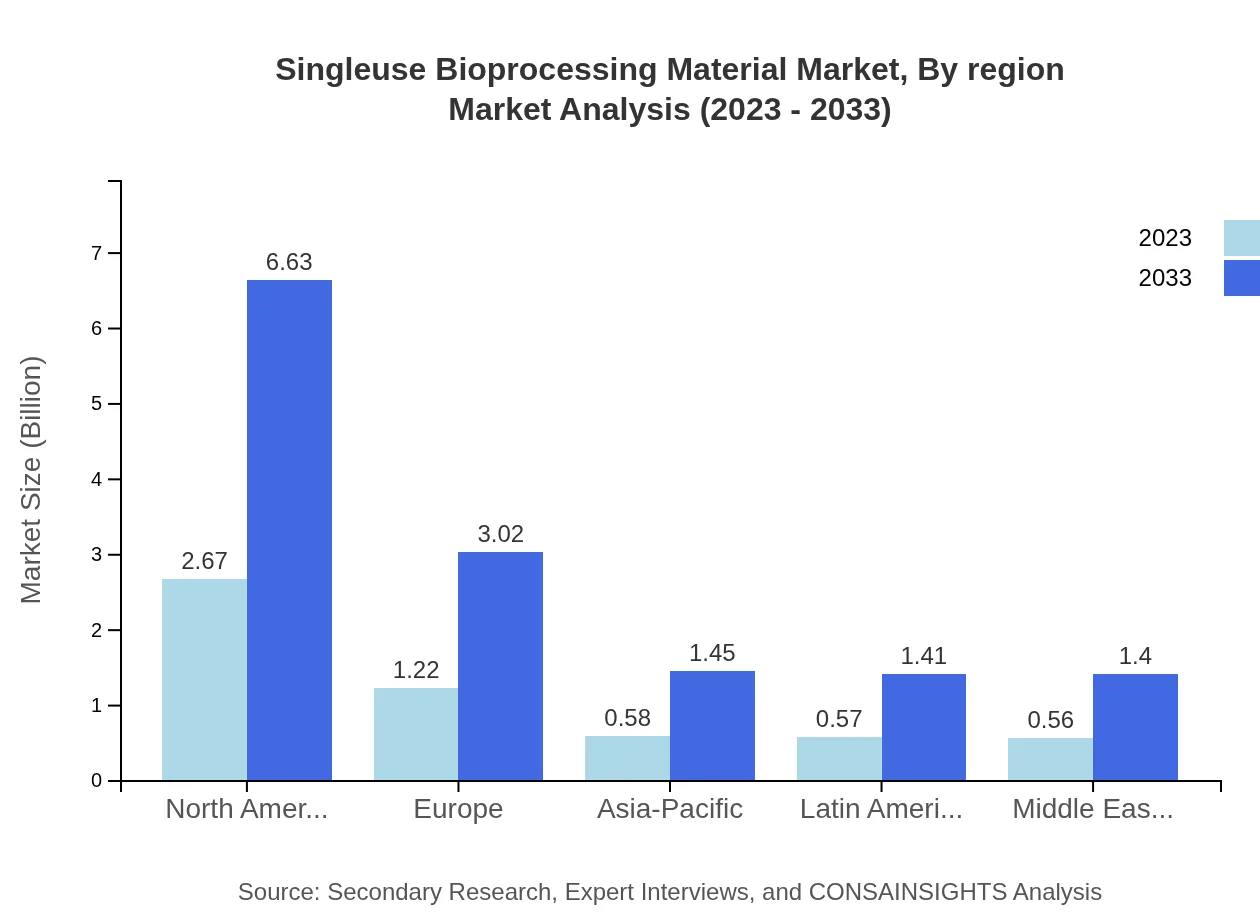
Analysis across regions reveals North America as a key market, with major contributions from the US and Canada, followed by Europe, where Germany and France are prominent. The Asia Pacific region, particularly China and India, is growing rapidly due to advancements in biotechnology. South America and the Middle East and Africa represent emerging markets with significant growth potential.
Singleuse Bioprocessing Material Market Trends and Future Forecast
Tell us your focus area and get a customized research report.
Global Market Leaders and Top Companies in Singleuse Bioprocessing Material Industry
Merck KGaA:
A leader in the life sciences industry, Merck KGaA offers a comprehensive range of single-use bioprocessing solutions catering to various applications in biotechnology and pharmaceuticals.Sartorius AG:
Sartorius AG provides innovative bioprocess solutions, including single-use technologies, establishing a strong presence in the biopharmaceutical market.Thermo Fisher Scientific:
Thermo Fisher Scientific specializes in enabling customers to make the world healthier, cleaner, and safer through its advanced single-use bioprocessing solutions.GE Healthcare:
GE Healthcare offers a wide range of single-use bioprocessing products and technologies, supporting biotechnology and pharmaceutical manufacturing globally.Pall Corporation:
Pall Corporation is known for its filtration and separation technologies, providing a variety of single-use products aimed at enhancing bioprocess efficiency.We're grateful to work with incredible clients.









FAQs
What is the market size of the Singleuse Bioprocessing Material market in 2023?
The market size for 2023 is $5.60 Billion, as reported in the input data and used as the base-year valuation for the forecast period.
How big will the market be in 2033?
The market is projected to reach $13.91 Billion by 2033 according to the provided forecast figures covering 2023 to 2033.
What is CAGR of the market for the forecast period?
The compound annual growth rate (CAGR) for 2023 to 2033 is specified as 9.2% in the input data.
Is there a single fastest Growing region in the Singleuse Bioprocessing Material Market Report market?
No single fastest-growing region is stated for the Singleuse Bioprocessing Material Market Report market because the top regional implied CAGR values are within 0.15 percentage points of each other, making the ranking too close to call reliably.
Which region is the largest market for single Use bioprocessing materials?
North America is identified as the largest regional market, increasing from $1.8 Billion in 2023 to $4.48 Billion in 2033.
Why is single Use material adoption increasing?
Adoption rises due to reduced contamination risk, lower operational and validation costs, and quicker manufacturing turnaround for biopharmaceuticals and related applications.
What are the primary product types covered in segmentation?
Product segmentation includes bags and containers, filters, and pipelines, as specified in the segment facts of the input data.
How was the market research conducted?
Research included primary interviews with industry experts, secondary company reports and publications, data triangulation, internal validation, and expert-led trend analysis.
What applications drive demand for these materials?
Key applications listed are vaccine manufacturing, cell culture production, monoclonal antibody production, and gene therapy, which drive material requirements.
Which end Users are specified for these materials?
End-user segments include biopharmaceutical companies, contract manufacturing organizations (CMOs), research institutes, and academic and government research entities.