

Structural Biology And Molecular Modeling Techniques Market Report
First published: 21 October 2024 | Last updated: 28 May 2026 | Report Code: structural-biology-and-molecular-modeling-techniques
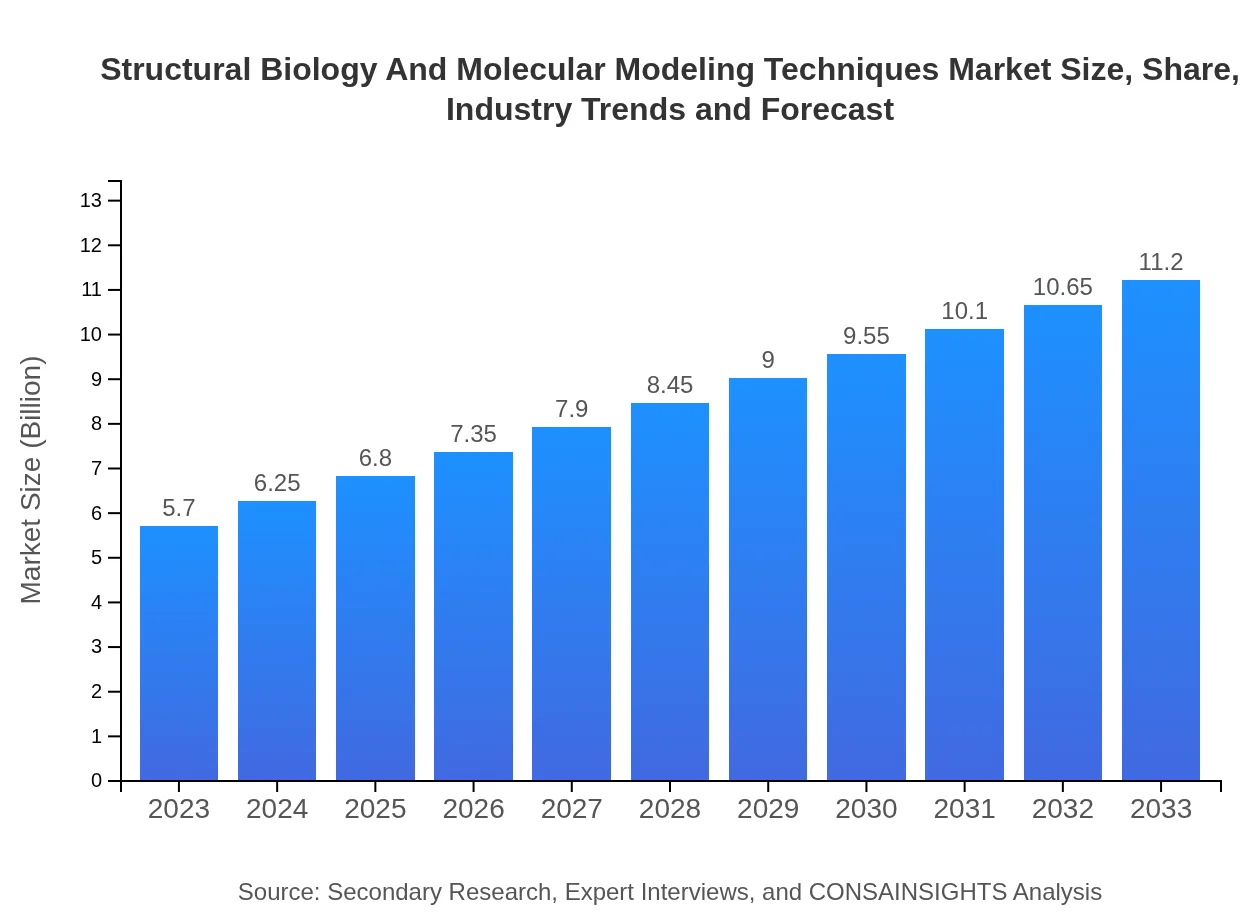
Structural Biology And Molecular Modeling Techniques Market — USD 5.7 billion in 2023, Growing to USD 11.20B by 2033 at 6.8% CAGR
This report provides an in-depth analysis of the Structural Biology and Molecular Modeling Techniques market from 2023 to 2033, detailing market trends, size, growth projections, and competitive landscape insights within the industry.
Key Takeaways
- Global market expands from $5.70 Billion in 2023 to $11.20 Billion by 2033 at a 6.8% CAGR.
- North America is largest regional market, while no single fastest-growing region is stated because regional CAGR differences remain within 0.15 percentage points.
- Europe increases from $1.56 Billion in 2023 to $3.06 Billion in 2033, reflecting steady demand for structural methods.
- Asia Pacific grows from $1.15 Billion in 2023 to $2.27 Billion in 2033, driven by expanding R&D investments.
- Segment breadth includes X-ray crystallography, NMR spectroscopy, electron microscopy, and simulation, visualization, and analysis software.
- Leading providers mentioned include Thermo Fisher Scientific, Schrödinger, Inc., Agilent Technologies, Bionano Genomics, and Bruker Corporation.
Structural Biology And Molecular Modeling Techniques Market Report — Executive Summary
North America remains largest market by forecast-period value, while no single fastest-growing region is stated because top regional growth rates are separated by less than 0.15 percentage points. The market for structural biology and molecular modeling is supported by sustained investment in drug discovery, academic research, and biopharmaceutical development. Key technologies such as X-ray crystallography, nuclear magnetic resonance spectroscopy, and electron microscopy combine with a range of software tools—simulation, visualization, and analysis—to address complex molecular problems. The global market is projected to grow from $5.70 Billion in 2023 to $11.20 Billion in 2033 at a CAGR of 6.8% for 2023 to 2033. Regional demand varies, with North America holding the largest market value in the period analyzed. Industry growth is propelled by richer computational capabilities, increasing R&D expenditures, and closer collaborations between industry and academia. Vendors including Thermo Fisher Scientific, Schrödinger, Inc., Agilent Technologies, Bionano Genomics, and Bruker Corporation are active across product and service portfolios. The report structures coverage by technology, application, software, and end-user, offering a granular view of drivers, adoption patterns, and competitive positioning to inform strategic decisions.
Key Growth Drivers
- Rising R&D spending in pharmaceuticals and biotechnology fuels demand for structural analyses and modeling tools.
- Advances in computational hardware and specialized simulation software increase throughput and accuracy of molecular modeling.
- Stronger collaboration between academic institutions and industry accelerates translation of structural discoveries into therapeutics.
- Growing emphasis on precision medicine and targeted drug design increases reliance on high-resolution structural techniques.
- Wider availability of integrated visualization and analysis platforms lowers barriers for end-users across academia and industry.
| Metric | Value |
|---|---|
| Study Period | 2023 - 2033 |
| 2023 Market Size | $5.70 Billion |
| CAGR (2023-2033) | 6.8% |
| 2033 Market Size | $11.20 Billion |
| Top Companies | Thermo Fisher Scientific, Schrödinger, Inc., Agilent Technologies, Bionano Genomics, Bruker Corporation |
| Published Date | 21 October 2024 |
| Last Modified Date | 28 May 2026 |
Structural Biology And Molecular Modeling Techniques Market Overview
Customize Structural Biology And Molecular Modeling Techniques Market Report market research report
- ✔ Get in-depth analysis of Structural Biology And Molecular Modeling Techniques market size, growth, and forecasts.
- ✔ Understand Structural Biology And Molecular Modeling Techniques's regional dynamics and industry-specific trends.
- ✔ Identify potential applications, end-user demand, and growth segments in Structural Biology And Molecular Modeling Techniques
What is the Market Size & CAGR of Structural Biology And Molecular Modeling Techniques Market Report market in 2023?
Structural Biology And Molecular Modeling Techniques Industry Analysis
Structural Biology And Molecular Modeling Techniques Market Segmentation and Scope
Tell us your focus area and get a customized research report.
Structural Biology And Molecular Modeling Techniques Market Report Market Analysis Report by Region
Europe Structural Biology And Molecular Modeling Techniques Market Report:
Europe grows from $1.56 Billion in 2023 to $3.06 Billion in 2033. Regional uptake is driven by robust academic research networks, investments in translational science, and adoption of advanced microscopy and spectroscopy methods.Asia Pacific Structural Biology And Molecular Modeling Techniques Market Report:
Asia Pacific grows from $1.15 Billion in 2023 to $2.27 Billion in 2033. Growth here is supported by rising life-sciences research investments, expanding biotechnology sectors, and increasing use of modeling tools in drug discovery and academic programs.North America Structural Biology And Molecular Modeling Techniques Market Report:
North America is largest regional market, rising from $2.13 Billion in 2023 to $4.19 Billion in 2033. The region’s scale reflects concentrated pharmaceutical and biotech R&D spending, strong academic-industry collaboration, and established commercial demand for structural analysis technologies.South America Structural Biology And Molecular Modeling Techniques Market Report:
Latin America grows from $0.5 Billion in 2023 to $0.98 Billion in 2033. Market expansion is linked to growing research activities, emerging biotechnology initiatives, and higher demand for structural and computational resources in regional institutions.Middle East & Africa Structural Biology And Molecular Modeling Techniques Market Report:
Middle East and Africa grows from $0.36 Billion in 2023 to $0.71 Billion in 2033. Adoption is influenced by developing research infrastructures, targeted investments in life-sciences capabilities, and partnerships that enable access to structural biology platforms.Tell us your focus area and get a customized research report.
Research Methodology
Structural Biology And Molecular Modeling Techniques Market Analysis By Technology
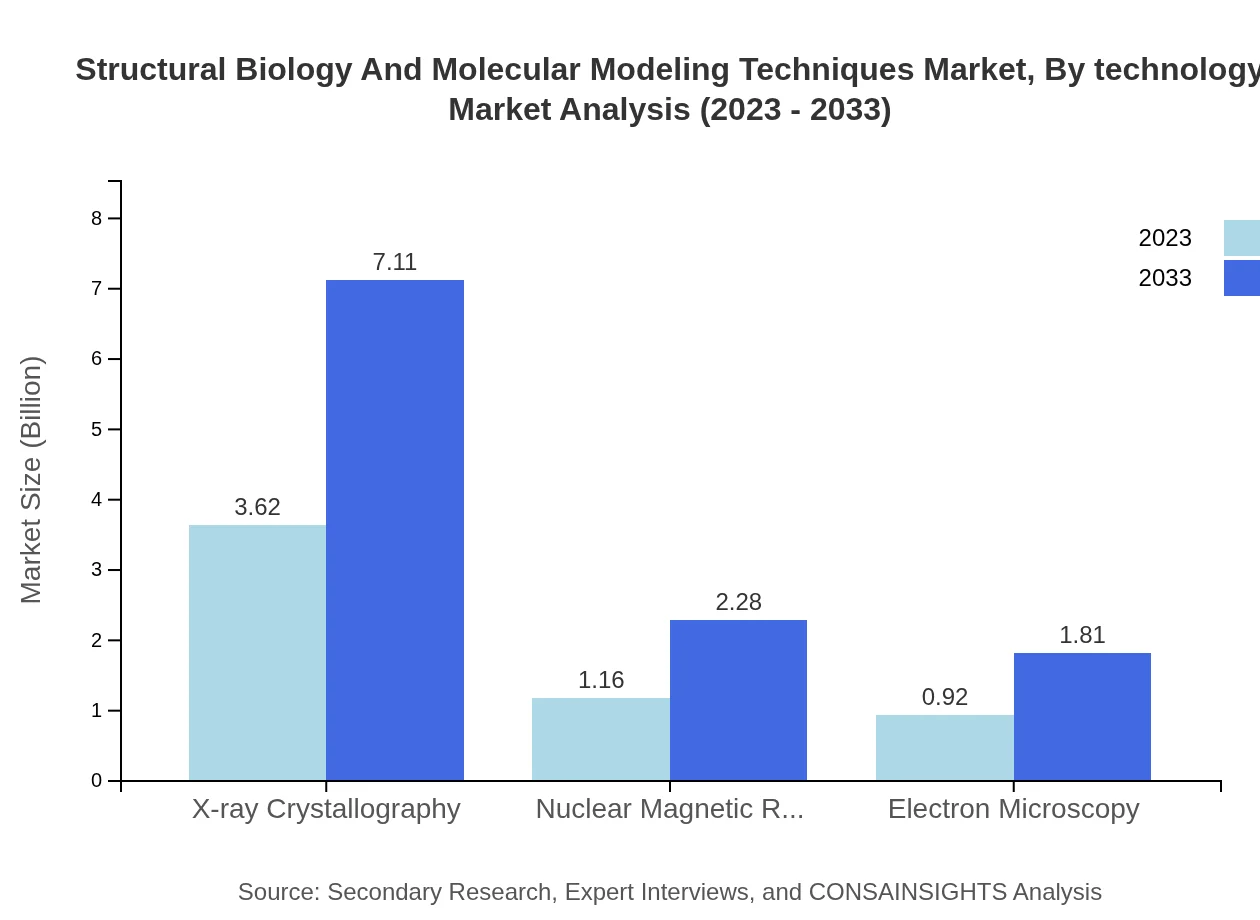
The technology segment reflects major methodologies such as X-ray Crystallography, NMR, and Molecular Dynamics Simulation that play pivotal roles in structural biology studies. X-ray Crystallography leads the market due to its widespread application in high-throughput screening and drug discovery.
Structural Biology And Molecular Modeling Techniques Market Analysis By Software
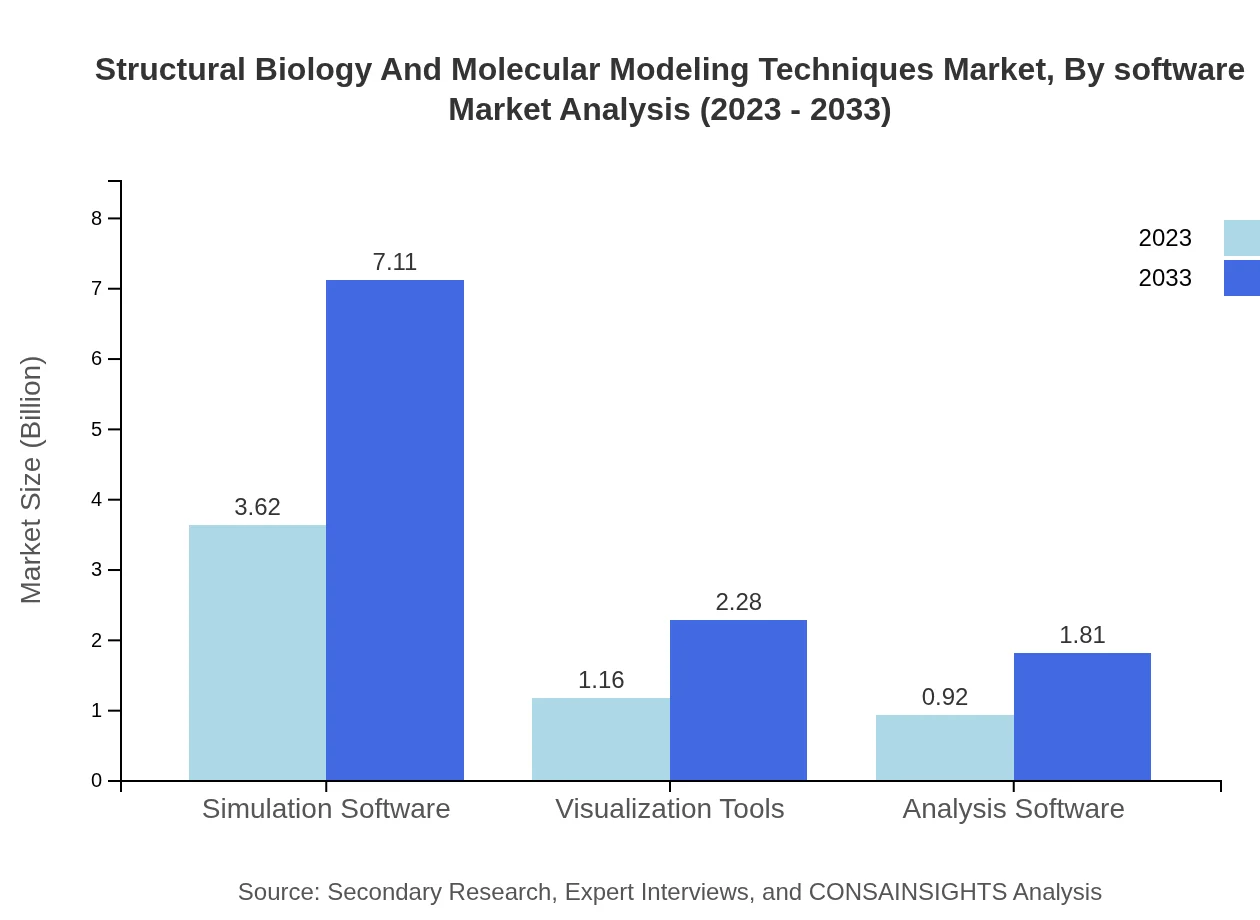
Software applications like simulation tools and data analysis platforms are integral to optimizing molecular modeling. Notably, simulation software is a significant segment, representing approximately 63.44% market share, followed by visualization tools that assist researchers in interpreting complex data effortlessly.
Structural Biology And Molecular Modeling Techniques Market Analysis By Application
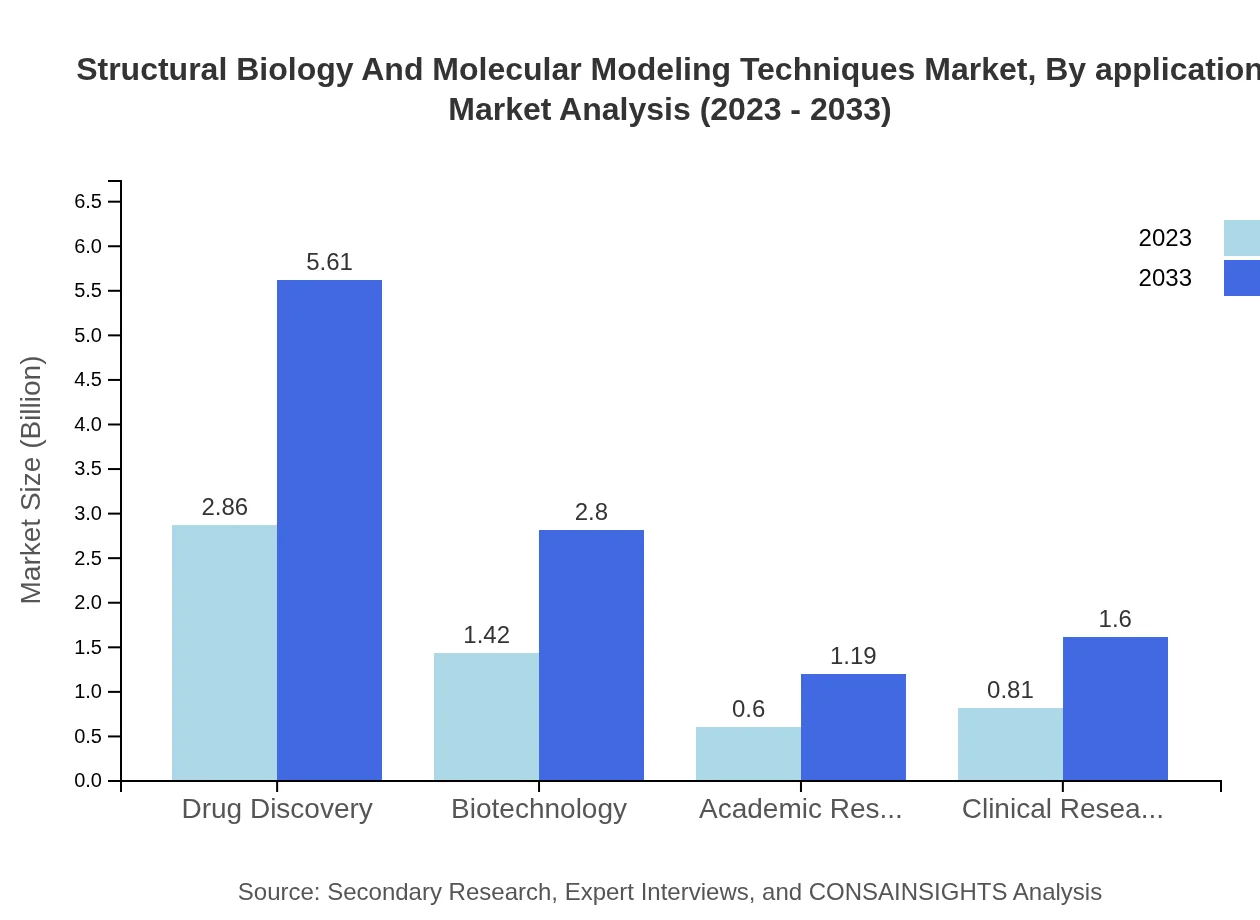
The applications of structural biology are broad, including drug discovery, academic research, and clinical research. Drug discovery dominates the application segment with a market share of 50.12%, reflecting strong reliance on structural biology techniques for therapeutic advancements.
Structural Biology And Molecular Modeling Techniques Market Analysis By End User
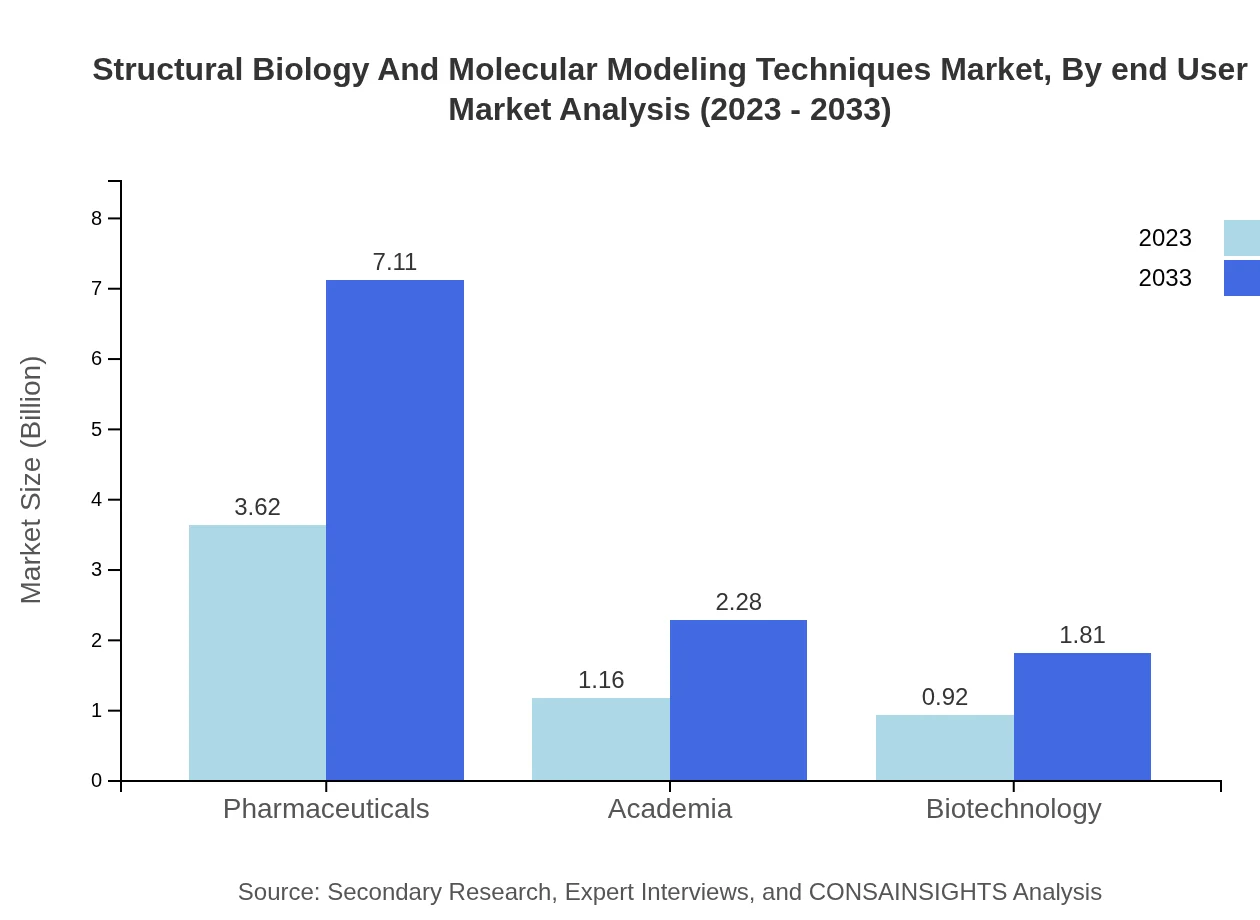
End-users include pharmaceutical companies, academic institutions, and biotechnology firms. Pharmaceutical companies hold the largest market share, leveraging structural biology insights to accelerate drug development and enhance therapeutic efficacy.
Structural Biology And Molecular Modeling Techniques Market Analysis By Region Applications
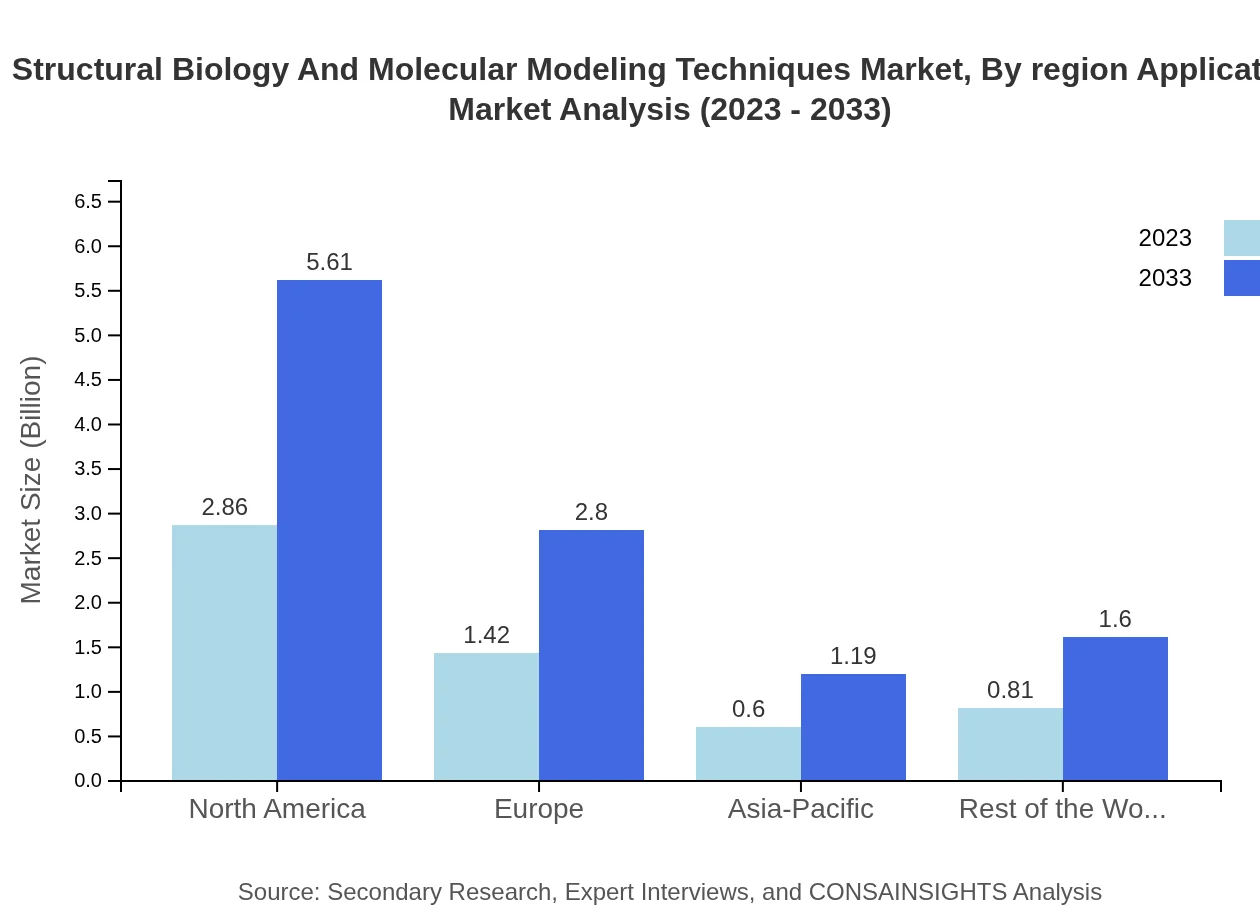
Regionally, North America shows a significant application in drug discovery, whereas Europe and Asia Pacific are pivotal in academic research. Each region's healthcare and research priorities shape the focus and growth potential of structural biology applications.
Structural Biology And Molecular Modeling Techniques Market Trends and Future Forecast
Tell us your focus area and get a customized research report.
Global Market Leaders and Top Companies in Structural Biology And Molecular Modeling Techniques Industry
Thermo Fisher Scientific:
A leading player in the life sciences sector, Thermo Fisher offers comprehensive tools and instruments for structural biology, including biopharmaceutical solutions and molecular modeling software.Schrödinger, Inc.:
Specializes in molecular modeling and computational chemistry, Schrödinger’s software solutions enable advanced molecular simulations, optimizing drug discovery pipelines.Agilent Technologies:
Focuses on providing analytical and life sciences solutions, Agilent supports structural biology workflows through innovative instrumentations and laboratory services.Bionano Genomics:
Engaged in genome mapping and analysis, Bionano offers platforms that assist in structural genomics research, emphasizing accuracy and efficiency in molecular studies.Bruker Corporation:
Provides a range of analytical instrumentation and software, Bruker is significant in the NMR spectroscopy and mass spectrometry sectors, crucial for structural biology applications.We're grateful to work with incredible clients.








FAQs
What is the market size in 2023?
The market size in 2023 is $5.70 Billion, as stated for the global Structural Biology and Molecular Modeling Techniques market.
How big will the market be in 2033?
The market is projected to reach $11.20 Billion in 2033 according to the provided forecast figures for the period 2023 to 2033.
What is CAGR of the market?
The compound annual growth rate for the forecast period 2023 to 2033 is 6.8%, based on the supplied market projections.
Is there a single fastest Growing region in the Structural Biology And Molecular Modeling Techniques Market Report market?
No single fastest-growing region is stated for the Structural Biology And Molecular Modeling Techniques Market Report market because the top regional implied CAGR values are within 0.15 percentage points of each other, making the ranking too close to call reliably.
Which technologies are included in market segmentation?
Segmented technologies explicitly include X-ray crystallography, nuclear magnetic resonance (NMR) spectroscopy, and electron microscopy as per the provided sub-segments.
Who are the leading companies referenced?
Top companies listed in the input are Thermo Fisher Scientific, Schrödinger, Inc., Agilent Technologies, Bionano Genomics, and Bruker Corporation.
What end Users are covered in the report?
End-user sub-segments specified include Pharmaceuticals, Academia, and Biotechnology, each noted in the provided segmentation facts.
How are software categories defined in the report?
Software sub-segments in the input comprise Simulation Software, Visualization Tools, and Analysis Software as distinct categories.