

Total Iron Binding Capacity Reagents Market Report
First published: 20 October 2024 | Last updated: 28 May 2026 | Report Code: total-iron-binding-capacity-reagents
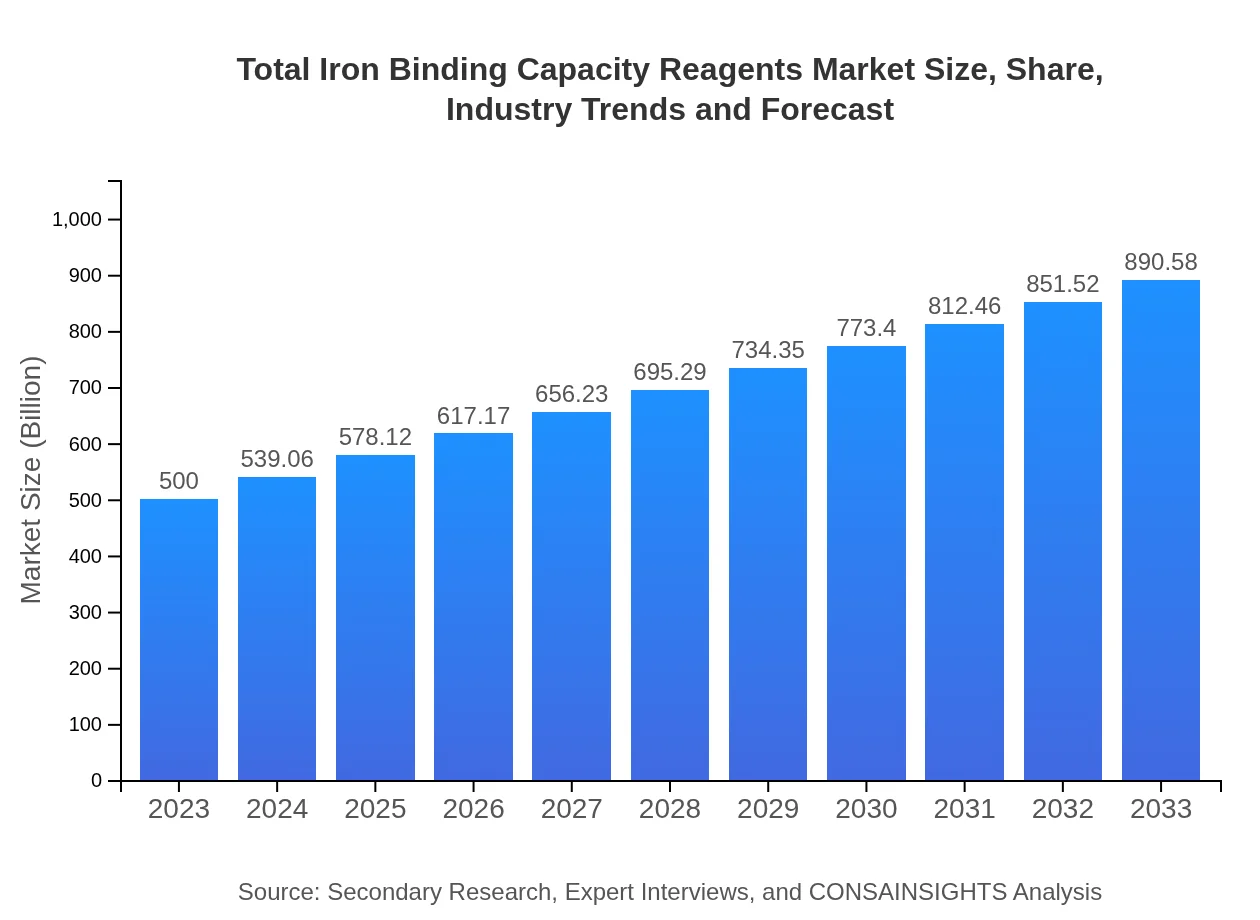
Total Iron Binding Capacity Reagents Market — USD 500 million in 2023, Growing to USD 890.58M by 2033 at 5.8% CAGR
This report provides a comprehensive analysis of the Total Iron Binding Capacity Reagents market from 2023 to 2033, focusing on market trends, growth forecasts, technology advancements, and segmented insights across various applications and regions.
Key Takeaways
- Global market expands from $500.00 Billion in 2023 to $890.58 Billion by 2033 at a 5.8% CAGR.
- North America is largest regional market, while no single fastest-growing region is stated because regional CAGR differences remain within 0.15 percentage points.
- European market rises from $147.2 Billion in 2023 to $262.19 Billion in 2033, reflecting sustained clinical diagnostics demand.
- Asia Pacific grows from $98.6 Billion in 2023 to $175.62 Billion in 2033 amid expanding laboratory capacity and testing access.
Total Iron Binding Capacity Reagents Market Report — Executive Summary
North America remains largest market by forecast-period value, while no single fastest-growing region is stated because top regional growth rates are separated by less than 0.15 percentage points. This report examines the Total Iron Binding Capacity Reagents market over the 2023 to 2033 forecast period, driven by increasing diagnostic testing needs and reagent innovation. Market value advances from $500.00 Billion in 2023 to $890.58 Billion in 2033 at a 5.8% CAGR. Key influences include rising prevalence of iron-related disorders, automation of laboratory workflows, and development of ready-to-use formulations and kits by established suppliers such as Thermo Fisher Scientific, Roche Diagnostics, Abbott Laboratories, and Siemens Healthineers. Regional dynamics vary: North America is the largest market, while Europe and Asia Pacific show notable expansions. The market structure covers product types (liquid, solid, kits), applications (clinical diagnostics, pharmaceutical, R&D), end users (hospitals, diagnostic labs, academic institutions), and formulations (ready-to-use, concentrated, powdered). Regulatory considerations and price competition are important constraints, while partnerships and R&D investment support product availability and performance improvements.
Key Growth Drivers
- Rising clinical testing volumes for iron-related conditions increase reagent demand and recurring consumable purchases.
- Advances in reagent formulations and ready-to-use kits simplify workflows and reduce operator time in laboratories.
- Laboratory automation and instrument integration boost throughput and favor reagent suppliers compatible with automated platforms.
- Investment in diagnostics research and expanded testing capacity in hospitals and diagnostic laboratories supports sustained market expansion.
| Metric | Value |
|---|---|
| Study Period | 2023 - 2033 |
| 2023 Market Size | $500.00 Million |
| CAGR (2023-2033) | 5.8% |
| 2033 Market Size | $890.58 Million |
| Top Companies | Thermo Fisher Scientific, Roche Diagnostics, Abbott Laboratories, Siemens Healthineers |
| Published Date | 20 October 2024 |
| Last Modified Date | 28 May 2026 |
Total Iron Binding Capacity Reagents Market Overview
Customize Total Iron Binding Capacity Reagents Market Report market research report
- ✔ Get in-depth analysis of Total Iron Binding Capacity Reagents market size, growth, and forecasts.
- ✔ Understand Total Iron Binding Capacity Reagents's regional dynamics and industry-specific trends.
- ✔ Identify potential applications, end-user demand, and growth segments in Total Iron Binding Capacity Reagents
What is the Market Size & CAGR of Total Iron Binding Capacity Reagents Market Report market in 2023?
Total Iron Binding Capacity Reagents Industry Analysis
Total Iron Binding Capacity Reagents Market Segmentation and Scope
Tell us your focus area and get a customized research report.
Total Iron Binding Capacity Reagents Market Report Market Analysis Report by Region
Europe Total Iron Binding Capacity Reagents Market Report:
Europe grows from $147.2 Billion in 2023 to $262.19 Billion in 2033. The region’s expansion reflects structured healthcare systems, investment in clinical diagnostics, and steady adoption of standardized reagent kits for hospitals and diagnostic laboratories.Asia Pacific Total Iron Binding Capacity Reagents Market Report:
Asia Pacific grows from $98.6 Billion in 2023 to $175.62 Billion in 2033. Growth drivers include increasing laboratory capacity, greater access to diagnostic services, and rising public health awareness that supports reagent and kit demand across clinical and research settings.North America Total Iron Binding Capacity Reagents Market Report:
North America is largest regional market, rising from $162.1 Billion in 2023 to $288.73 Billion in 2033. Regional demand is underpinned by high diagnostic testing volumes, well-equipped laboratories, and adoption of automated platforms, supporting vendors and advanced reagent formulations.South America Total Iron Binding Capacity Reagents Market Report:
Latin America grows from $31.85 Billion in 2023 to $56.73 Billion in 2033. Market advancement is tied to gradual strengthening of diagnostic infrastructure, growing clinical testing needs, and expanding use of ready-to-use reagents in regional laboratories.Middle East & Africa Total Iron Binding Capacity Reagents Market Report:
Middle East and Africa grows from $60.25 Billion in 2023 to $107.31 Billion in 2033. Progress is driven by investments in healthcare infrastructure, expanding diagnostic services, and adoption of improved reagent formulations for clinical diagnostics.Tell us your focus area and get a customized research report.
Research Methodology
Total Iron Binding Capacity Reagents Market Analysis By Product
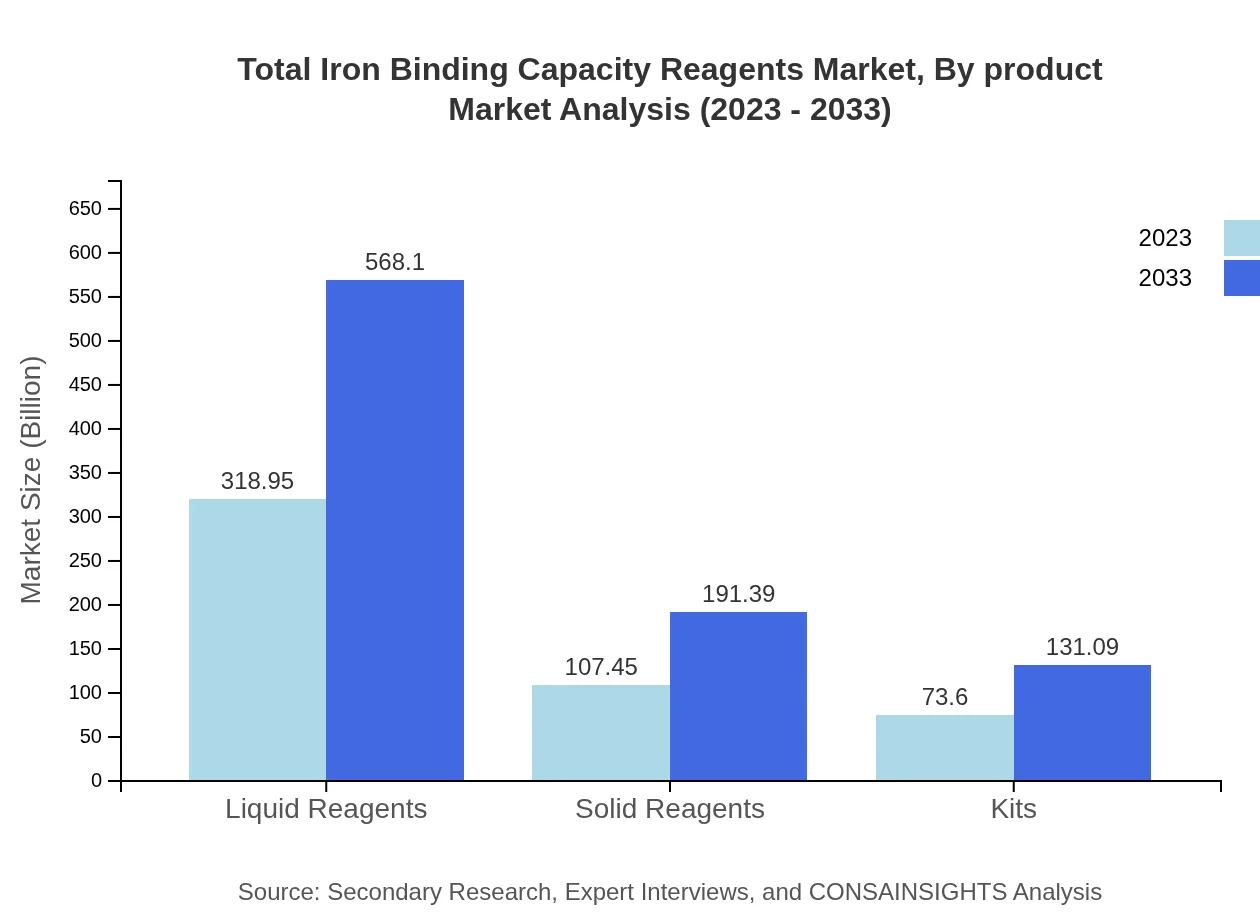
The product analysis of the Total Iron Binding Capacity Reagents market reveals that liquid reagents hold the largest market share, accounting for $318.95 million in 2023 and expected to grow to $568.10 million by 2033. Solid reagents and kits are important, with solid reagents valued at $107.45 million in 2023, projected to rise to $191.39 million by 2033. Kits, accounting for $73.60 million in 2023, are expected to grow to $131.09 million over the same period, reflecting their increasing adoption in various diagnostic settings.
Total Iron Binding Capacity Reagents Market Analysis By Application
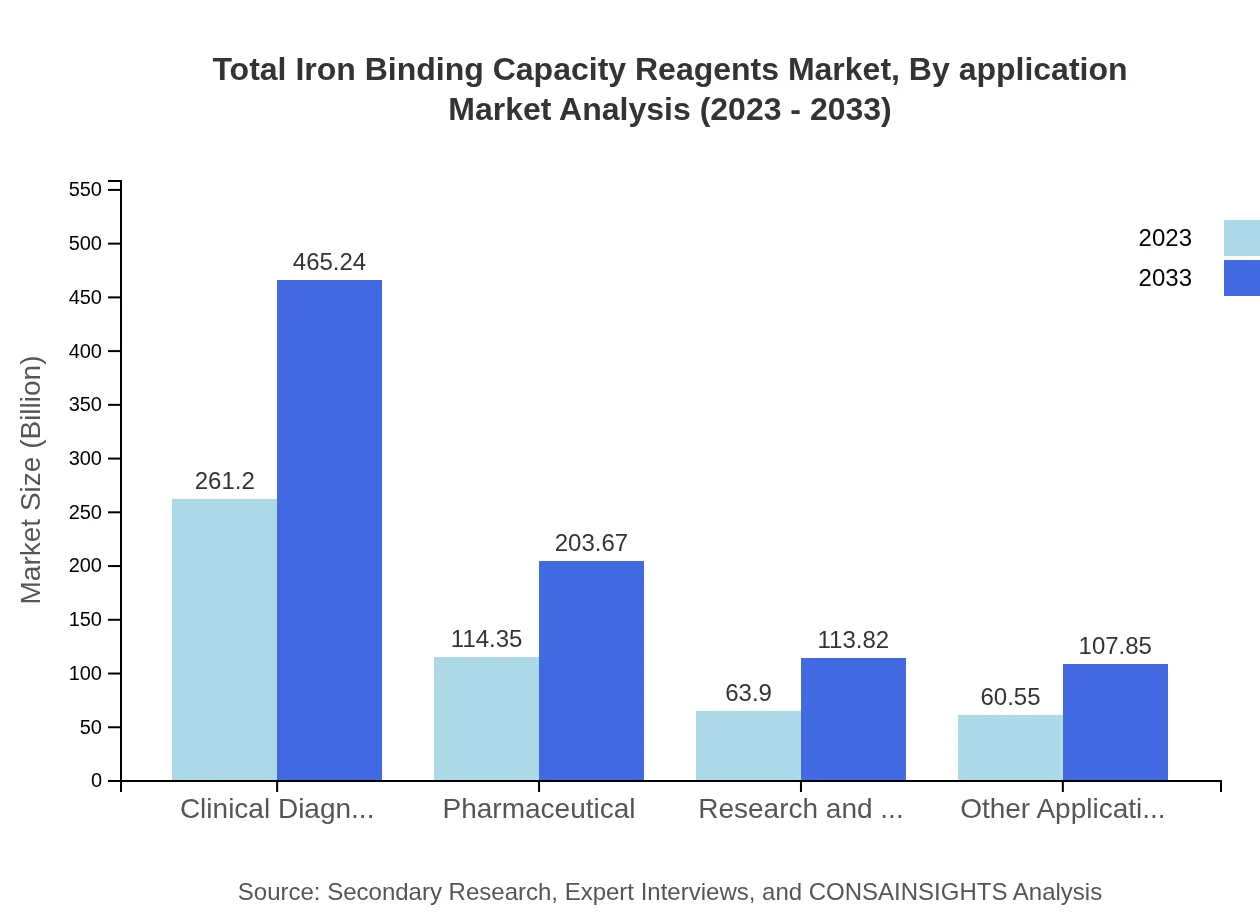
Application-wise, clinical diagnostics is the largest segment, generating $261.20 million in 2023 and anticipated to reach $465.24 million by 2033. Diagnostic laboratories and pharmaceutical research also play significant roles, with diagnostic labs valued at $114.35 million in 2023, projected to grow to $203.67 million by 2033. Academic institutions account for $63.90 million, expected to increase to $113.82 million, driven by growing research initiatives.
Total Iron Binding Capacity Reagents Market Analysis By End User
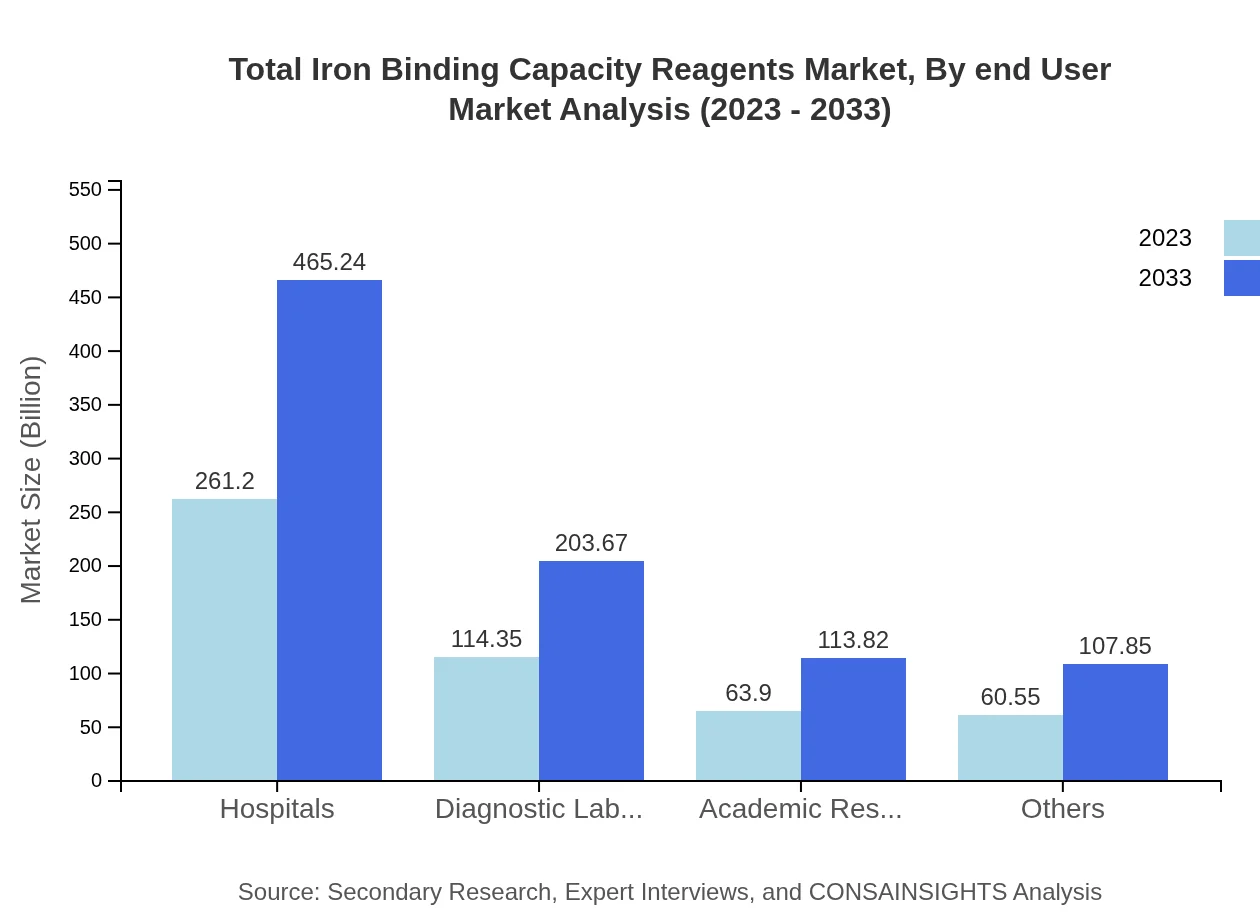
The end-user analysis of the Total Iron Binding Capacity Reagents market indicates that hospitals are the primary consumers, with a market value of $261.20 million in 2023 and a forecasted growth to $465.24 million by 2033. Diagnostic laboratories follow closely, with a current market share of $114.35 million, expected to grow to $203.67 million. Research and development sectors account for $63.90 million, projected to rise steadily due to ongoing innovations.
Total Iron Binding Capacity Reagents Market Analysis By Formulation
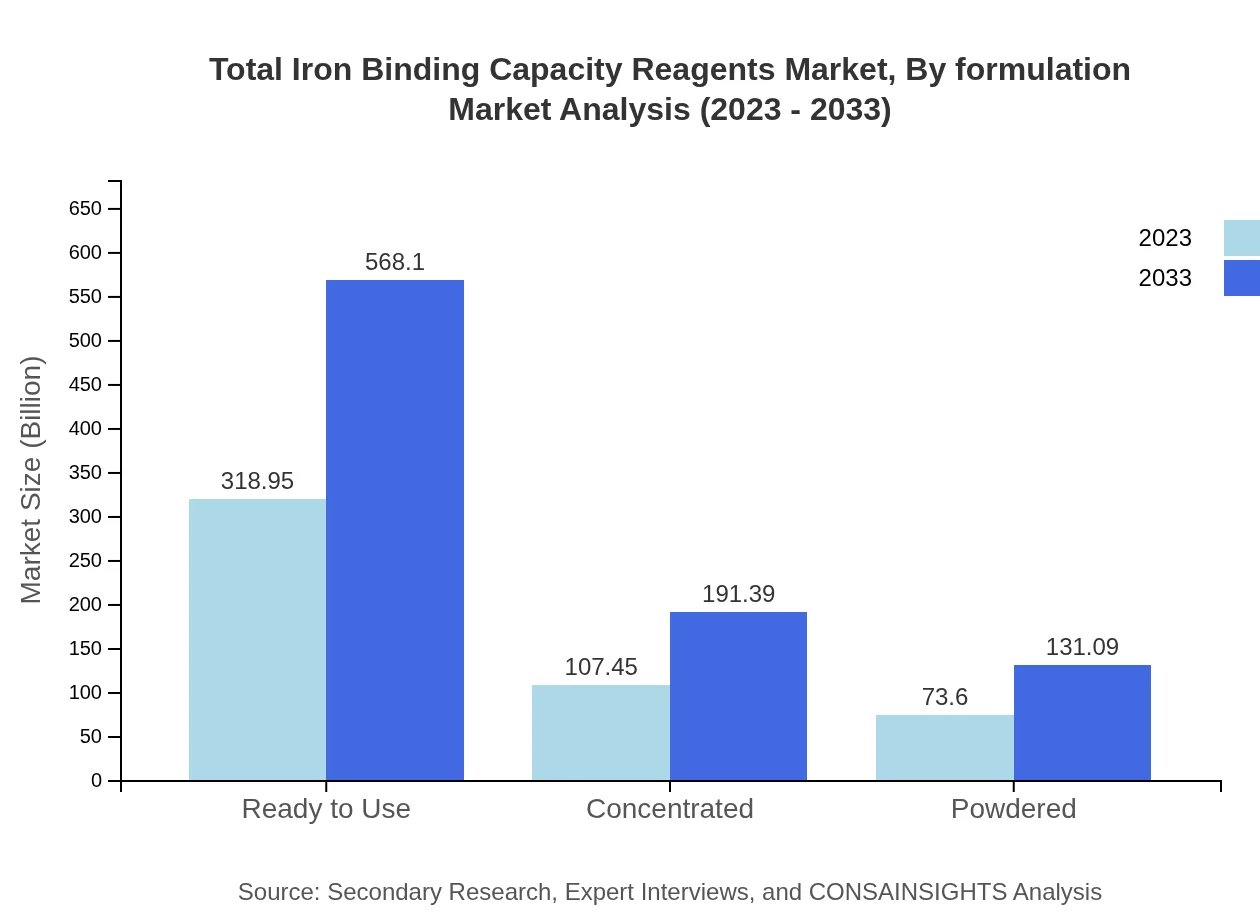
In terms of formulation, ready-to-use reagents dominate the market, valued at $318.95 million in 2023 and projected to reach $568.10 million by 2033. Concentrated formulations, valued at $107.45 million, are anticipated to grow to $191.39 million, while powdered formulations account for $73.60 million, with expectations of reaching $131.09 million by 2033, reflecting their utility in diverse laboratory settings.
Total Iron Binding Capacity Reagents Market Trends and Future Forecast
Tell us your focus area and get a customized research report.
Global Market Leaders and Top Companies in Total Iron Binding Capacity Reagents Industry
Thermo Fisher Scientific:
A leading supplier of analytical instruments, reagents, and consumables, Thermo Fisher is instrumental in providing comprehensive solutions for iron binding capacity testing.Roche Diagnostics:
Roche offers a wide range of diagnostics products and solutions, playing a substantial role in the TIBC market with innovative reagent technologies.Abbott Laboratories:
Abbott specializes in diagnostic tools and solutions, contributing significantly to iron studies with advanced reagents and kits.Siemens Healthineers:
As a global leader in medical technologies, Siemens develops high-quality reagents for TIBC testing and diagnostics applications.We're grateful to work with incredible clients.









FAQs
What is the market size of the Total Iron Binding Capacity Reagents Market Report in 2023?
The market size for 2023 is reported as $500.00 Billion, representing the baseline for the 2023 to 2033 forecast.
How big will the market be by 2033?
By 2033 the market is projected to reach $890.58 Billion according to the report’s provided forecast figures.
What is CAGR for the 2023 to 2033 period?
The compounded annual growth rate for the forecast period 2023 to 2033 is specified as 5.8% in the input data.
Is there a single fastest Growing region in the Total Iron Binding Capacity Reagents Market Report market?
No single fastest-growing region is stated for the Total Iron Binding Capacity Reagents Market Report market because the top regional implied CAGR values are within 0.15 percentage points of each other, making the ranking too close to call reliably.
Which companies lead the Total Iron Binding Capacity Reagents market?
Top companies listed include Thermo Fisher Scientific, Roche Diagnostics, Abbott Laboratories, and Siemens Healthineers.
Why are reagent kits increasingly important?
Kits provide convenience, standardized protocols and faster setup for clinical testing, helping laboratories improve consistency and reduce hands-on time.
What are common end users for these reagents?
Primary end users include hospitals, diagnostic laboratories and academic research institutions, which consume reagents for clinical and research testing workflows.
How are regulatory factors influencing the market?
Regulatory requirements affect product approvals and market access, prompting manufacturers to maintain compliance and invest in validation and quality controls.