
Reports >
Life Sciences
>
Ultrasound Transducer Market Report

Ultrasound Transducer Market Report
First published: 20 October 2024 | Last updated: 28 May 2026 | Report Code: ultrasound-transducer
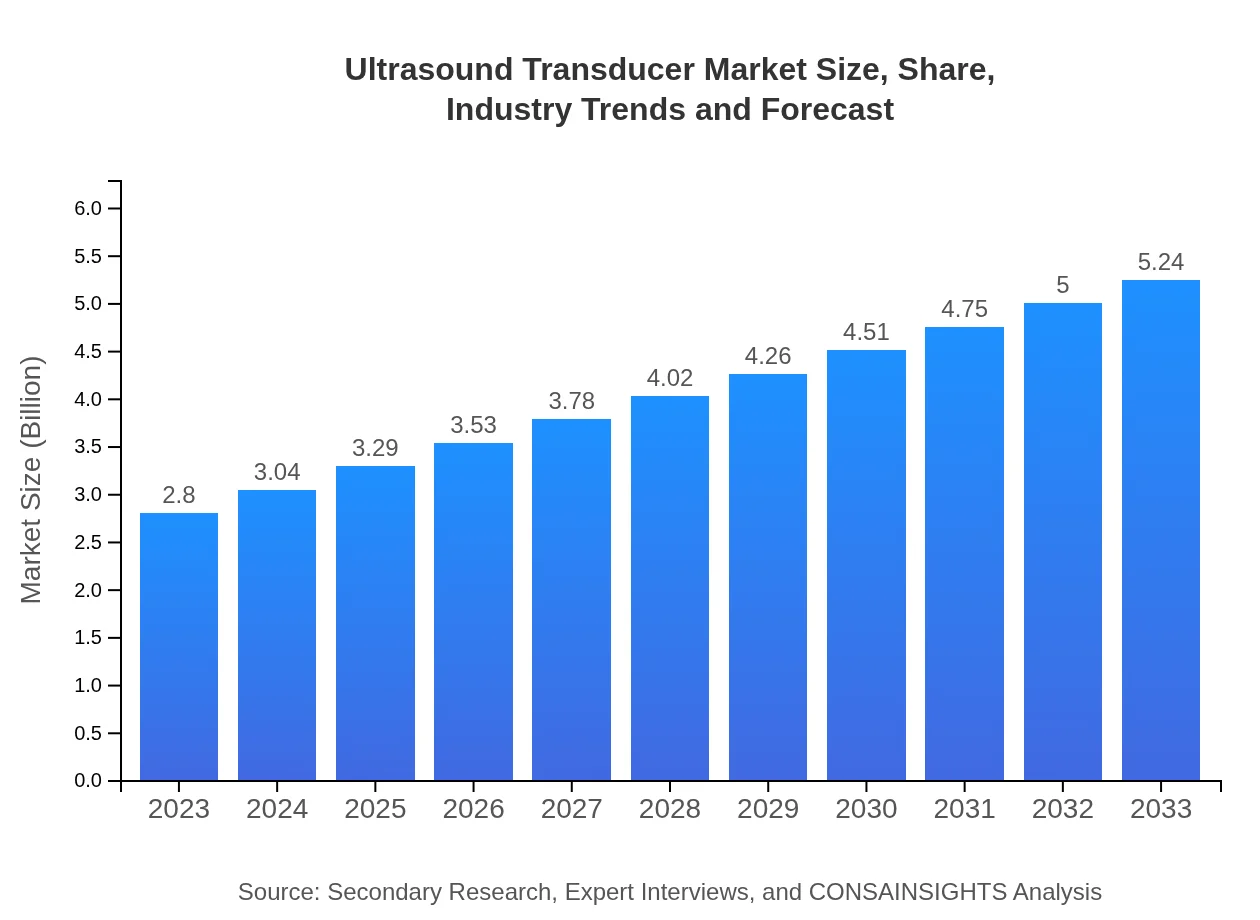
Ultrasound Transducer Market — USD $2.8 Billion in 2023, Growing to USD 5.24null by 2033 at 6.3% CAGR
This report provides an in-depth analysis of the Ultrasound Transducer market, covering key insights and projected trends from 2023 to 2033, including market size, growth rates, regional analyses, technological advancements, and competitive landscape.
Key Takeaways
- Global market expands from $2.80 Billion (2023) to $5.24 Billion (2033) at a 6.3% CAGR.
- North America is largest regional market, while no single fastest-growing region is stated because regional CAGR differences remain within 0.15 percentage points.
- Europe and Asia Pacific show notable increases: Europe from $0.75B to $1.41B; Asia Pacific from $0.57B to $1.07B.
- Segment breadth includes multiple transducer types, end-users, technologies and imaging applications.
- Leading vendors include General Electric Company, Philips Healthcare, Siemens Healthineers, Canon Medical Systems and Mindray Medical International Limited.
Ultrasound Transducer Market Report — Executive Summary
North America remains largest market by forecast-period value, while no single fastest-growing region is stated because top regional growth rates are separated by less than 0.15 percentage points. The report outlines factors driving demand for ultrasound transducers, including rising use of diagnostic imaging, non-invasive procedures and investments in healthcare infrastructure. Market value rises from $2.80 Billion in 2023 to $5.24 Billion in 2033, reflecting a 6.3% CAGR over the 2023 to 2033 forecast period. Regional patterns show North America as the largest market, supported by established healthcare systems and technology adoption. Europe and Asia Pacific are significant contributors to growth, with expanding diagnostic services and increasing access to care. The market structure covers device types, technology platforms, end-users such as hospitals and diagnostic centers, and application areas like obstetrics and vascular imaging. Competitive activity centers on product innovation and strategic plays among major vendors named in the report. The regional growth market is Not specified due to closely aligned regional growth rates.
Key Growth Drivers
- Rising demand for non-invasive diagnostic procedures increases transducer utilization in clinical settings.
- Expansion of imaging services and investments in healthcare infrastructure fuels procurement of ultrasound systems.
- Technological refinement in transducer performance and portability supports broader point-of-care deployment.
- Growing prevalence of chronic conditions and aging populations raises routine imaging volumes.
- Vendor innovation and partnerships drive product upgrades and replacement cycles across end-users.
| Metric | Value |
|---|---|
| Study Period | 2023 - 2033 |
| 2023 Market Size | $2.80 Billion |
| CAGR (2023-2033) | 6.3% |
| 2033 Market Size | $5.24 Billion |
| Top Companies | General Electric Company, Philips Healthcare, Siemens Healthineers, Canon Medical Systems, Mindray Medical International Limited |
| Published Date | 20 October 2024 |
| Last Modified Date | 28 May 2026 |
Ultrasound Transducer Market Overview
Customize Ultrasound Transducer Market Report market research report
- ✔ Get in-depth analysis of Ultrasound Transducer market size, growth, and forecasts.
- ✔ Understand Ultrasound Transducer's regional dynamics and industry-specific trends.
- ✔ Identify potential applications, end-user demand, and growth segments in Ultrasound Transducer
What is the Market Size & CAGR of Ultrasound Transducer Market Report market in 2023?
Ultrasound Transducer Industry Analysis
Ultrasound Transducer Market Segmentation and Scope
Tell us your focus area and get a customized research report.
Ultrasound Transducer Market Report Market Analysis Report by Region
Europe Ultrasound Transducer Market Report:
Europe grows from $0.75 Billion in 2023 to $1.41 Billion in 2033. Expansion reflects broader availability of imaging services, investment in healthcare facilities and uptake of advanced transducer technologies across clinical settings.Asia Pacific Ultrasound Transducer Market Report:
Asia Pacific grows from $0.57 Billion in 2023 to $1.07 Billion in 2033. Demand is driven by growing access to diagnostic care, expanding hospital infrastructure and rising utilization of ultrasound for routine and point-of-care imaging.North America Ultrasound Transducer Market Report:
North America is largest regional market, rising from $1 Billion in 2023 to $1.87 Billion in 2033. Regional strength is supported by established healthcare systems, technology adoption in hospitals and diagnostic centers, and active vendor presence among leading companies.South America Ultrasound Transducer Market Report:
Latin America grows from $0.2 Billion in 2023 to $0.38 Billion in 2033. Growth is supported by incremental healthcare investments, broader diagnostic service adoption and gradual modernization of imaging equipment in regional facilities.Middle East & Africa Ultrasound Transducer Market Report:
Middle East and Africa grows from $0.27 Billion in 2023 to $0.51 Billion in 2033. Regional drivers include increased healthcare spending, enhancements in diagnostic capacity and growing demand for non-invasive imaging options.Tell us your focus area and get a customized research report.
Research Methodology
Ultrasound Transducer Market Analysis By Type
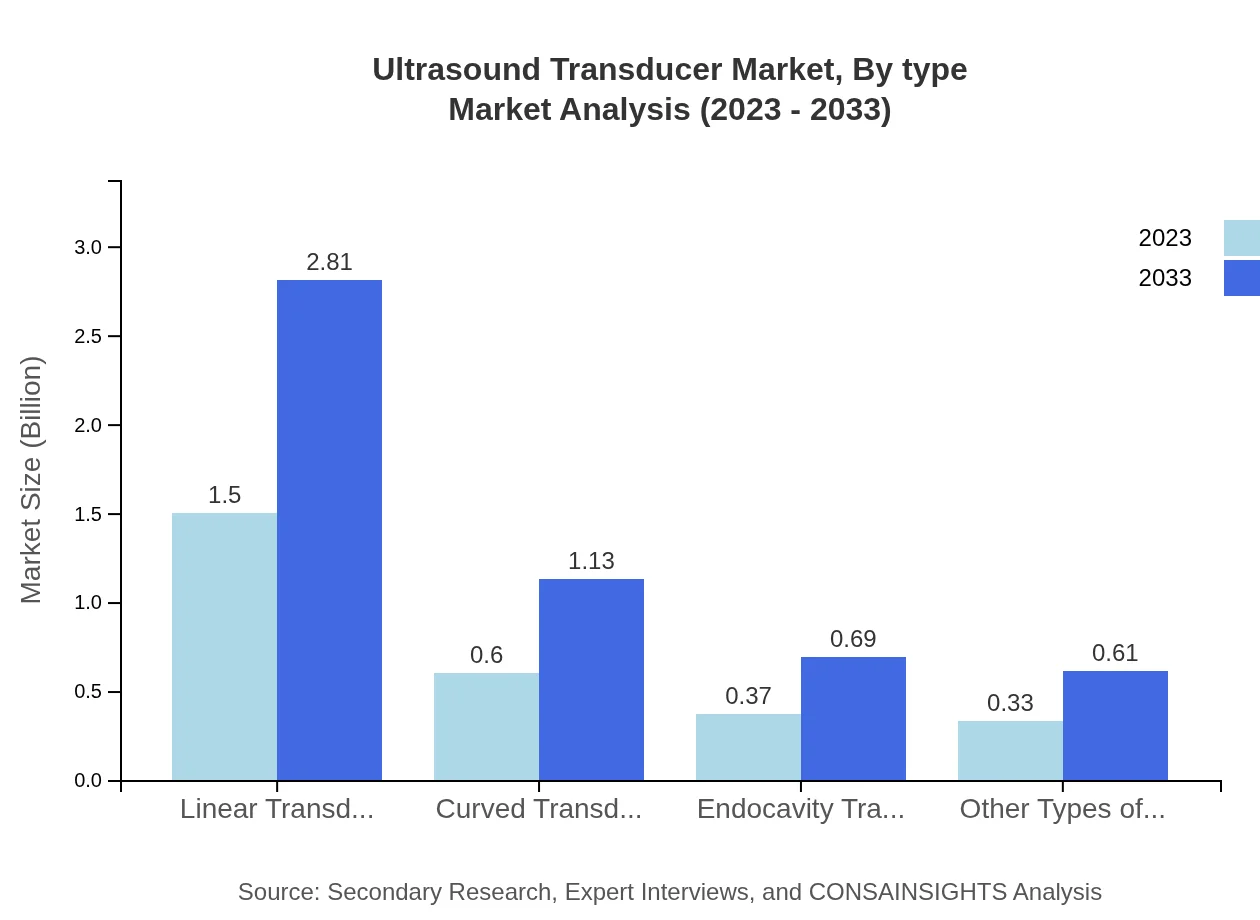
The linear transducers segment dominates the market, contributing 53.71% share with a size of $1.50 billion in 2023, expected to grow to $2.81 billion by 2033. Curved transducers follow with 21.52% share, growing from $0.60 billion to $1.13 billion, while endocavity transducers account for 13.15% with a projected increase from $0.37 billion to $0.69 billion.
Ultrasound Transducer Market Analysis By Application
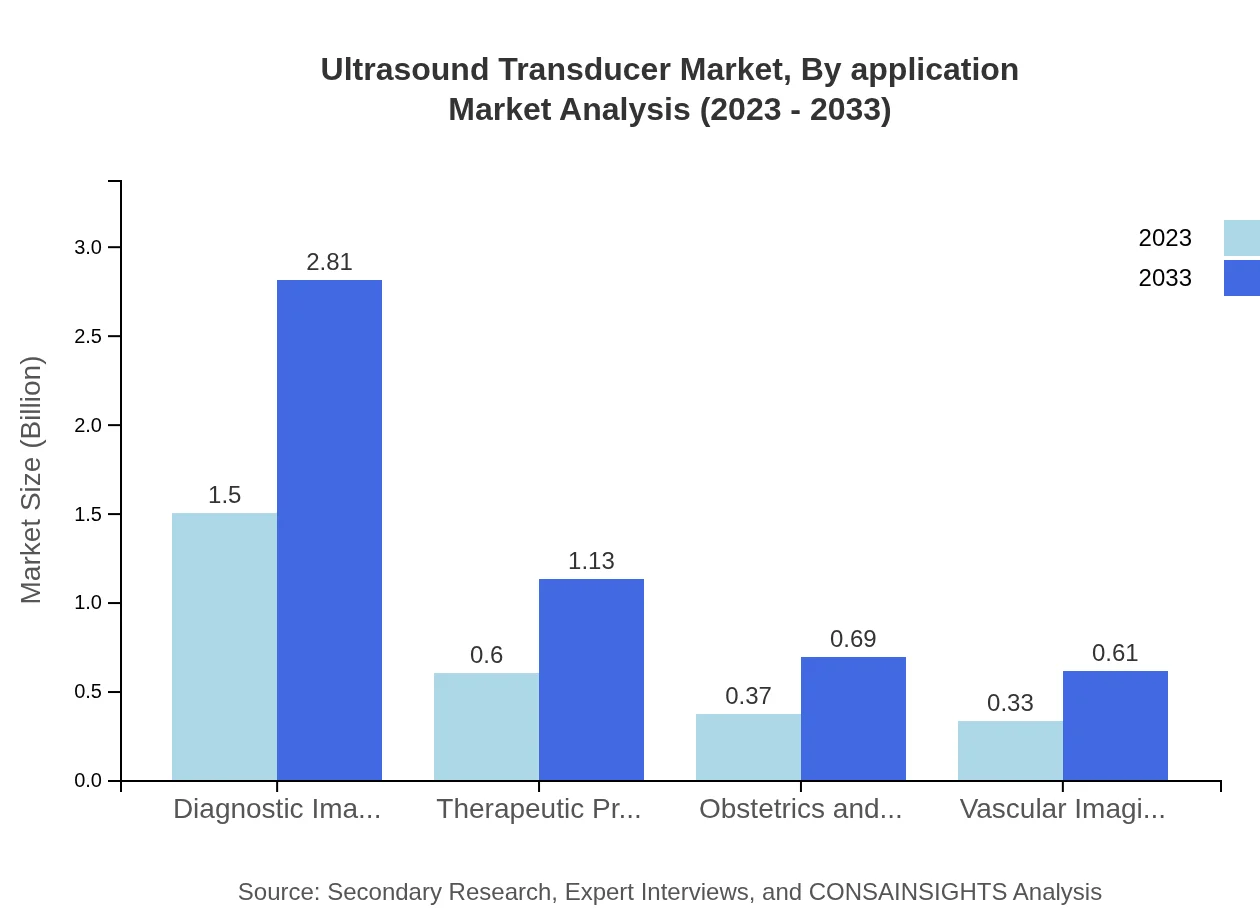
In terms of applications, diagnostic imaging comprises the largest segment at 53.71% share ($1.50 billion in 2023, rising to $2.81 billion by 2033), while therapeutic procedures hold 21.52% share ($0.60 billion to $1.13 billion). Obstetrics and gynecology represent 13.15% ($0.37 billion to $0.69 billion), and vascular imaging accounts for 11.62% ($0.33 billion to $0.61 billion).
Ultrasound Transducer Market Analysis By Technology
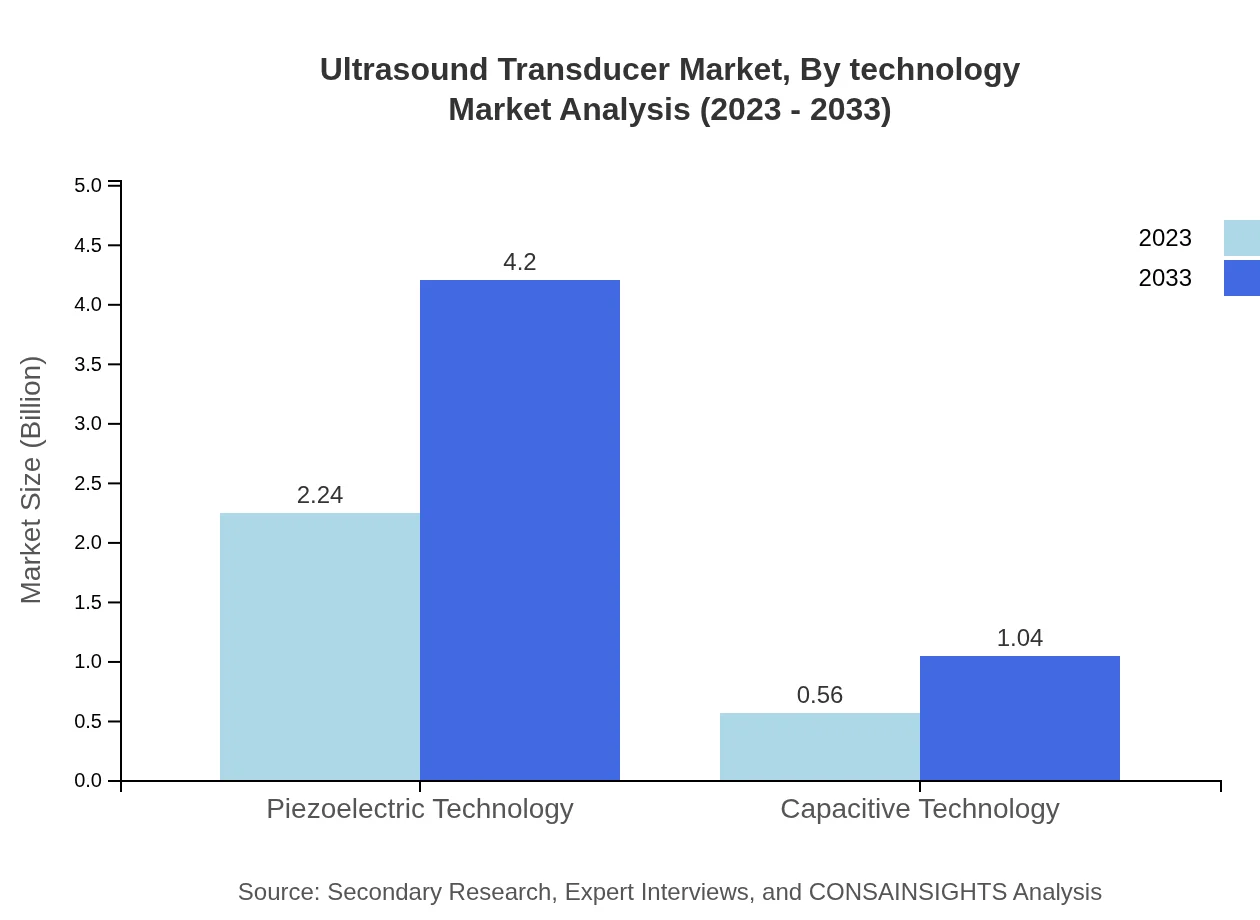
The market is significantly influenced by piezoelectric technology, with a market size of $2.24 billion in 2023, expanding to $4.20 billion by 2033 (80.08% share). Capacitive technology holds a smaller share at 19.92%, with current figures of $0.56 billion projected to rise to $1.04 billion.
Ultrasound Transducer Market Analysis By End User
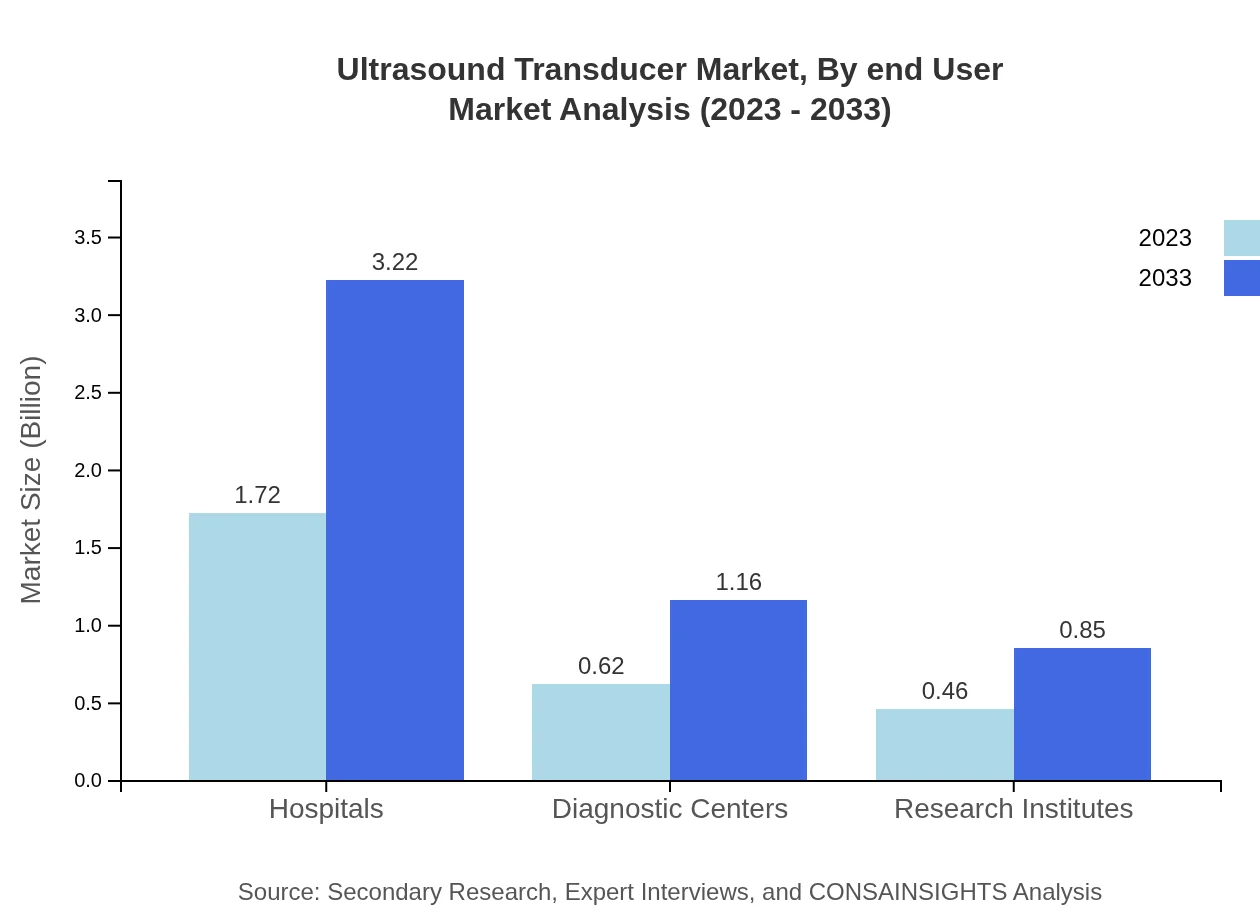
Hospitals are the leading end-user segment, holding a share of 61.48% with a market size of $1.72 billion in 2023, expected to grow to $3.22 billion by 2033. Diagnostic centers also play a vital role, with an increase from $0.62 billion to $1.16 billion (22.21% share), while research institutes account for 16.31% ($0.46 billion to $0.85 billion).
Ultrasound Transducer Market Trends and Future Forecast
Tell us your focus area and get a customized research report.
Global Market Leaders and Top Companies in Ultrasound Transducer Industry
General Electric Company:
GE Healthcare is a world leader in ultrasound imaging technology, contributing innovative ultrasound systems and transducers that enhance diagnostic accuracy in various medical fields.Philips Healthcare:
Philips is known for its advanced imaging solutions, including high-quality ultrasound transducers utilized in hospitals and clinics globally, focusing on superior imaging and patient-centric solutions.Siemens Healthineers:
Siemens Healthineers delivers cutting-edge ultrasound technologies and transducers that support medical professionals in diagnosing and monitoring patients efficiently.Canon Medical Systems:
Canon is recognized for its innovative ultrasound system designs, providing high-performance transducers aimed at improving patient care and diagnostic capabilities.Mindray Medical International Limited:
Mindray specializes in developing imaging transducer technologies and ultrasound systems that cater to both domestic and international markets, emphasizing quality and affordability.We're grateful to work with incredible clients.









FAQs
What is the market size of the ultrasound transducer market in 2023?
The market size in 2023 is $2.80 Billion, based on the report’s base-year valuation and market assessment for that year.
How big will the market be by 2033?
By 2033 the market is projected to reach $5.24 Billion according to the forecast period covering 2023 to 2033.
What is CAGR for the forecast period?
The compounded annual growth rate for the 2023 to 2033 forecast period is 6.3% as stated in the market data.
Is there a single fastest Growing region in the Ultrasound Transducer Market Report market?
No single fastest-growing region is stated for the Ultrasound Transducer Market Report market because the top regional implied CAGR values are within 0.15 percentage points of each other, making the ranking too close to call reliably.
Which companies are listed as top vendors?
Top companies named include General Electric Company, Philips Healthcare, Siemens Healthineers, Canon Medical Systems and Mindray Medical International Limited.
What are the main applications driving demand?
Key applications include diagnostic imaging, therapeutic procedures, obstetrics and gynecology, and vascular imaging, which collectively boost transducer use across care settings.
How big is the European market in 2023 and 2033?
Europe is reported at $0.75 Billion in 2023 and grows to $1.41 Billion in 2033 per the regional figures provided.
Who are the primary end Users for these transducers?
Primary end-users listed are hospitals, diagnostic centers and research institutes, which represent core demand sources for ultrasound transducers.
Which technologies are tracked in the report?
The report includes technologies such as Piezoelectric Technology and Capacitive Technology as the main technology categories.
How is segmentation covered in the study?
Segmentation spans types (linear, curved, endocavity, others), end-users, technology platforms and applications, enabling a multi-dimensional market view.