

Vacuum Mixing Devices Market Report
First published: 21 October 2024 | Last updated: 28 May 2026 | Report Code: vacuum-mixing-devices
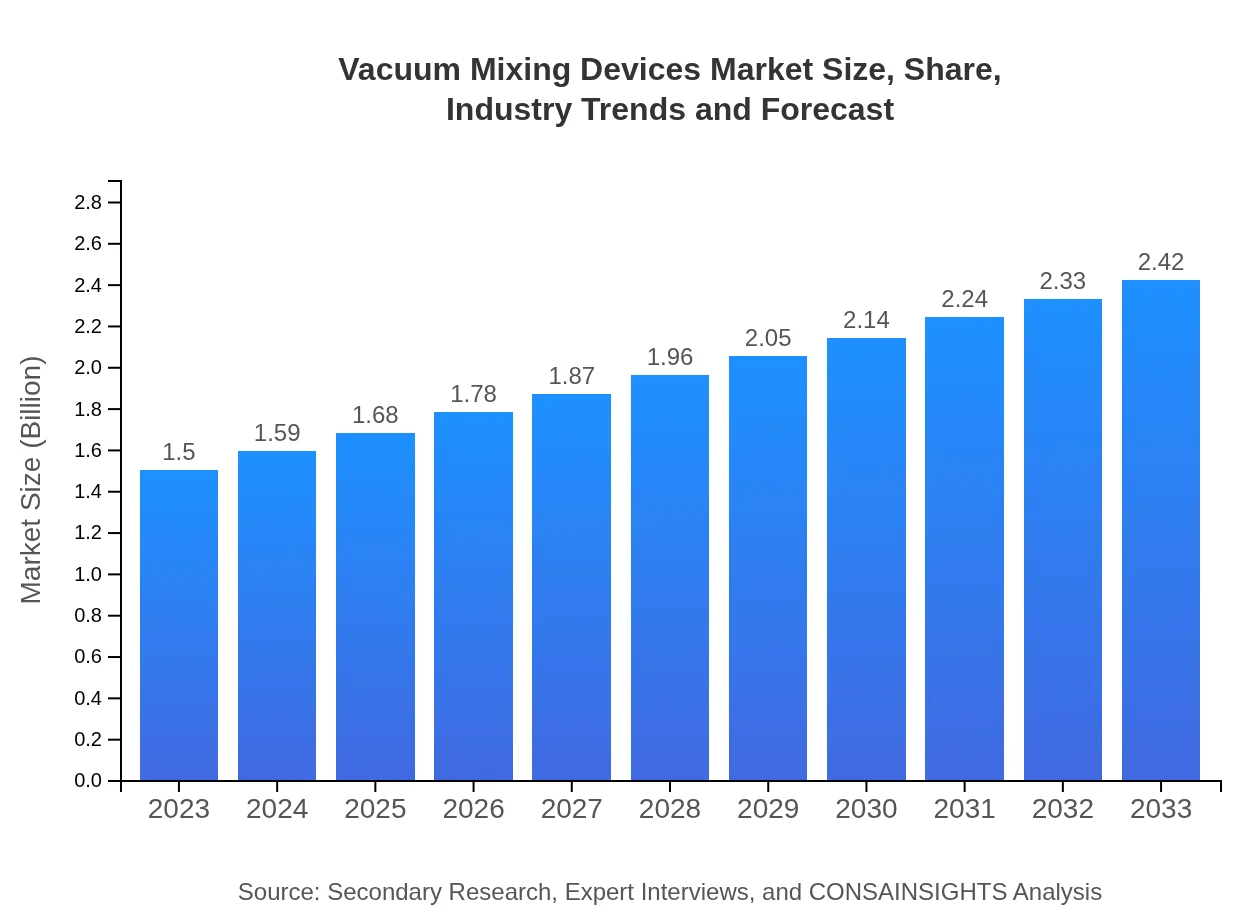
Vacuum Mixing Devices Market — USD $1.5 Billion in 2023, Growing to USD 2.42null by 2033 at 4.8% CAGR
This report provides an in-depth analysis of the Vacuum Mixing Devices market, covering market trends, segmentation, technology advancements, and regional insights for the forecast period from 2023 to 2033.
Key Takeaways
- Global market value increases from $1.50 Billion in 2023 to $2.42 Billion in 2033 with a 4.8% CAGR.
- North America is largest regional market; Latin America is regional market region based on implied CAGR across 2023 to 2033.
- Latin America is identified as the regional market region, rising from $0.01 Billion in 2023 to $0.02 Billion in 2033.
- Europe grows from $0.46 Billion in 2023 to $0.75 Billion in 2033, reflecting steady sector demand.
- Key participants include Bertoli, TEKNO Mix, GEMÜ, Glatt, and HDDM, with emphasis on automation and quality control innovations.
Vacuum Mixing Devices Market Report — Executive Summary
Regional analysis shows North America as largest market and Latin America as fastest-growing region by implied CAGR. This report examines the Vacuum Mixing Devices market across applications such as pharmaceuticals, food and beverage, cosmetics, chemicals and biotechnology. The market size of $1.50 Billion in 2023 is projected to reach $2.42 Billion by 2033 at a 4.8% CAGR during 2023 to 2033. Growth is supported by rising automation, stricter quality and regulatory requirements in pharma and food processing, and investments in advanced mixing technologies. Regional data highlight North America as the largest market and Latin America as the regional market region. The analysis covers segmentation by technology, product type, end-user and distribution channel, and profiles leading suppliers such as Bertoli, TEKNO Mix, GEMÜ, Glatt and HDDM. Findings are aimed at strategic decision-makers seeking concise market intelligence and actionable regional insights.
Key Growth Drivers
- Rising demand from pharmaceutical and food processors for consistent, high-quality mixing solutions.
- Increased automation and digitalization in manufacturing processes improving efficiency and control.
- Regulatory emphasis on product quality in food and pharma encouraging investment in reliable mixing equipment.
- Adoption of advanced technologies and smart monitoring to optimize production and reduce variability.
- Growing interest in sustainable production methods prompting manufacturers to upgrade mixing systems.
| Metric | Value |
|---|---|
| Study Period | 2023 - 2033 |
| 2023 Market Size | $1.50 Billion |
| CAGR (2023-2033) | 4.8% |
| 2033 Market Size | $2.42 Billion |
| Top Companies | Bertoli, TEKNO Mix, GEMÜ, Glatt, HDDM |
| Published Date | 21 October 2024 |
| Last Modified Date | 28 May 2026 |
Vacuum Mixing Devices Market Overview
Customize Vacuum Mixing Devices Market Report market research report
- ✔ Get in-depth analysis of Vacuum Mixing Devices market size, growth, and forecasts.
- ✔ Understand Vacuum Mixing Devices's regional dynamics and industry-specific trends.
- ✔ Identify potential applications, end-user demand, and growth segments in Vacuum Mixing Devices
What is the Market Size & CAGR of Vacuum Mixing Devices Market Report market in 2023?
Vacuum Mixing Devices Industry Analysis
Vacuum Mixing Devices Market Segmentation and Scope
Tell us your focus area and get a customized research report.
Vacuum Mixing Devices Market Report Market Analysis Report by Region
Europe Vacuum Mixing Devices Market Report:
Europe grows from $0.46 Billion in 2023 to $0.75 Billion in 2033. The region's demand is influenced by stringent quality standards in pharmaceuticals and food industries and adoption of advanced mixing technologies to meet regulatory expectations.Asia Pacific Vacuum Mixing Devices Market Report:
Asia Pacific grows from $0.26 Billion in 2023 to $0.42 Billion in 2033. Regional adoption is driven by expanding manufacturing activity in pharmaceuticals, food processing and cosmetics, alongside increasing automation and process control investments.North America Vacuum Mixing Devices Market Report:
North America is largest regional market, rising from $0.57 Billion in 2023 to $0.92 Billion in 2033. Growth is supported by established pharmaceutical and food processing sectors, investment in automated equipment, and demand for high-quality mixing solutions.South America Vacuum Mixing Devices Market Report:
Latin America is fastest-growing region by implied CAGR, increasing from $0.01 Billion in 2023 to $0.02 Billion in 2033. 01 Billion in 2023 to $0.02 Billion in 2033 and is identified as the regional growth market. Growth is tied to rising industrialization, growing demand in pharmaceutical and food sectors, and gradual uptake of modern mixing systems.Middle East & Africa Vacuum Mixing Devices Market Report:
Middle East and Africa grows from $0.19 Billion in 2023 to $0.31 Billion in 2033. Demand is shaped by expanding manufacturing capacity, regulatory focus on product quality, and investment in technologies that enhance process consistency.Tell us your focus area and get a customized research report.
Research Methodology
Vacuum Mixing Devices Market Analysis By Product Type
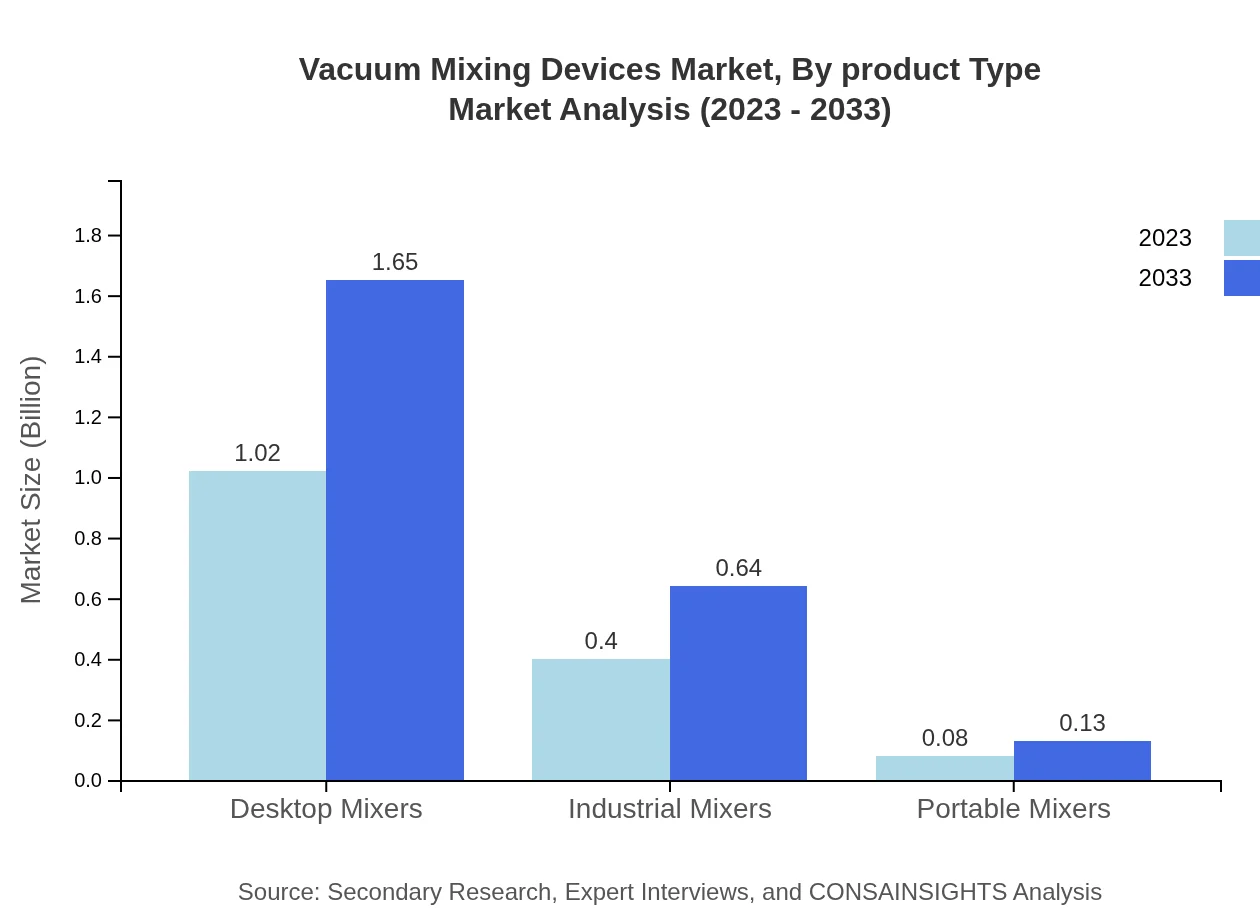
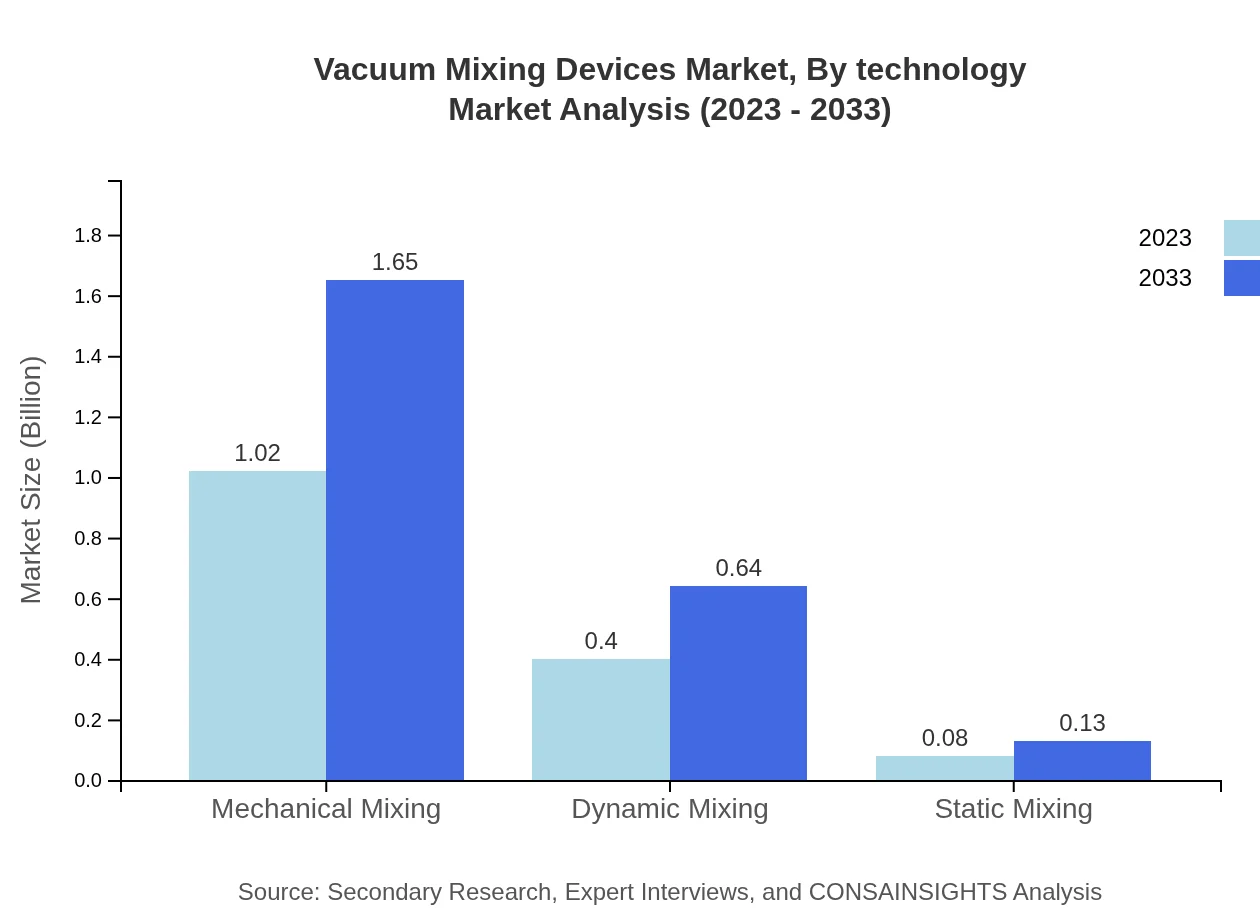
In the product type segment, mechanical mixing leads with a 67.98% share in 2023, valued at $1.02 billion, growing to $1.65 billion by 2033. Dynamic mixing, accounting for 26.58% share, is also seeing significant growth, expected to reach $0.64 billion in 2033.
Vacuum Mixing Devices Market Analysis By Application
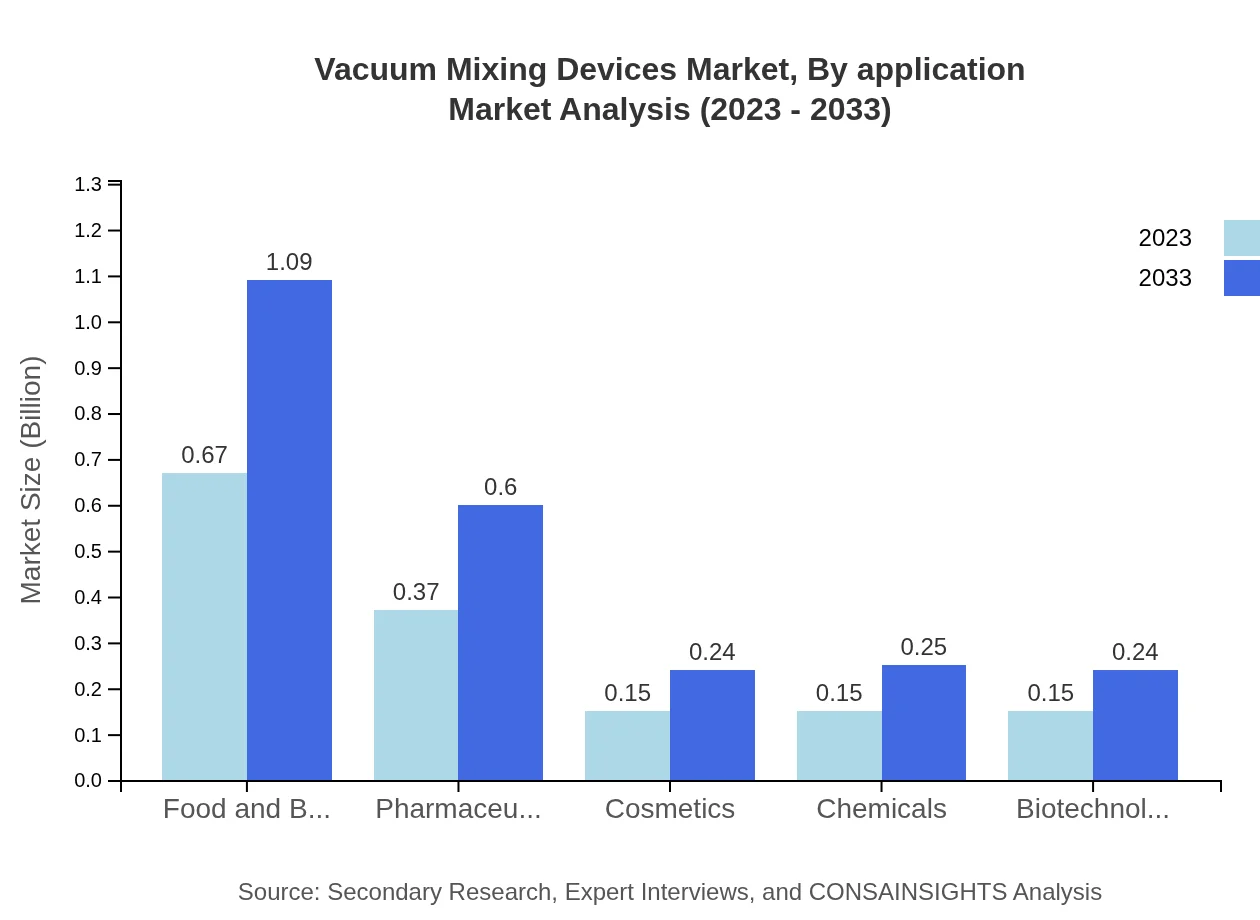
Food and beverage applications constitute a major part of the market, projecting growth from $0.67 billion in 2023 to $1.09 billion by 2033, driven by increased consumer demand for quality products. The pharmaceutical sector is also critical, with sizes moving from $0.37 to $0.60 in the same timeframe.
Vacuum Mixing Devices Market Analysis By End User
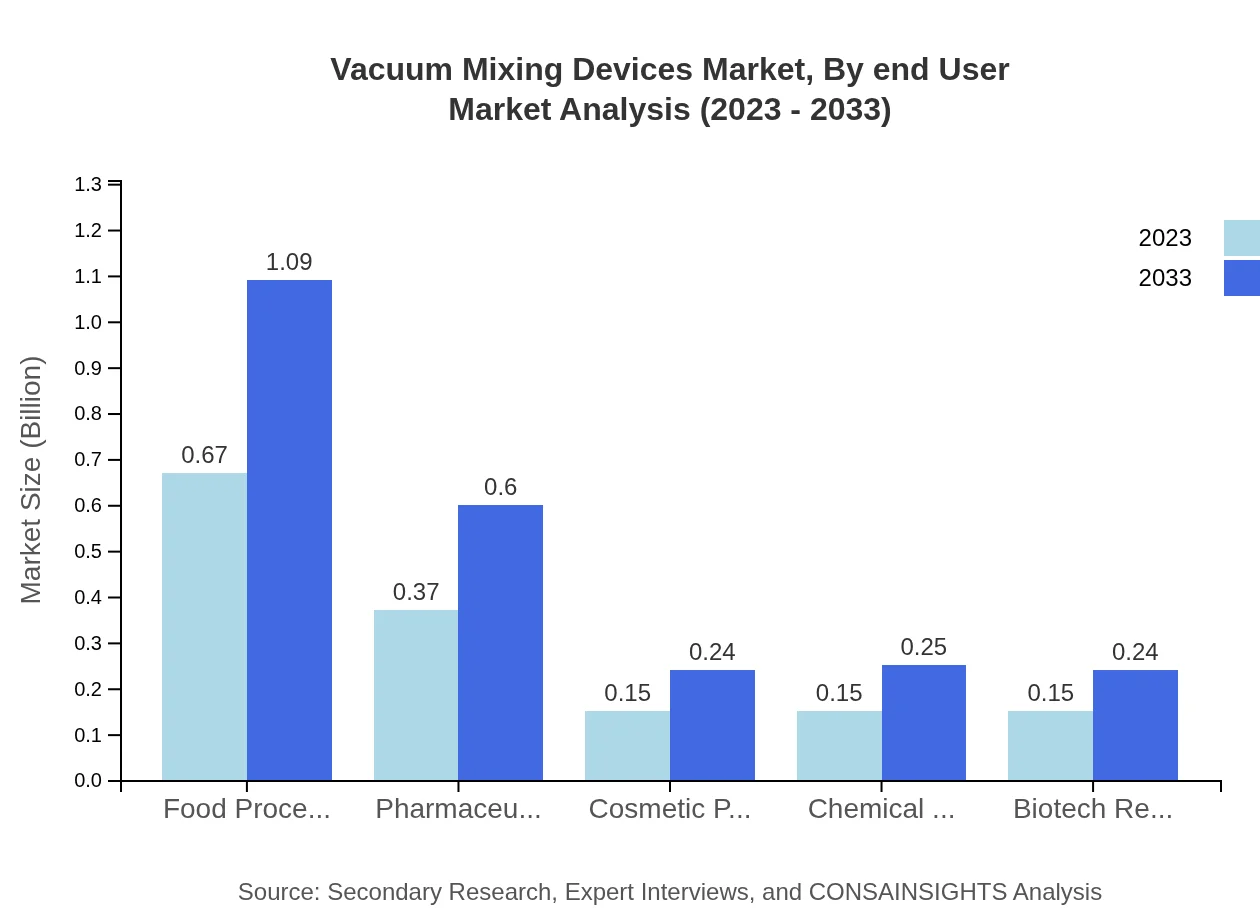
Major end-users include food processors, pharmaceuticals, and cosmetics. The food processing industry, sharing 44.94% of market share, shows tremendous growth potential, alongside cosmetic producers, which contribute to ongoing innovation in product development.
Vacuum Mixing Devices Market Analysis By Distribution Channel
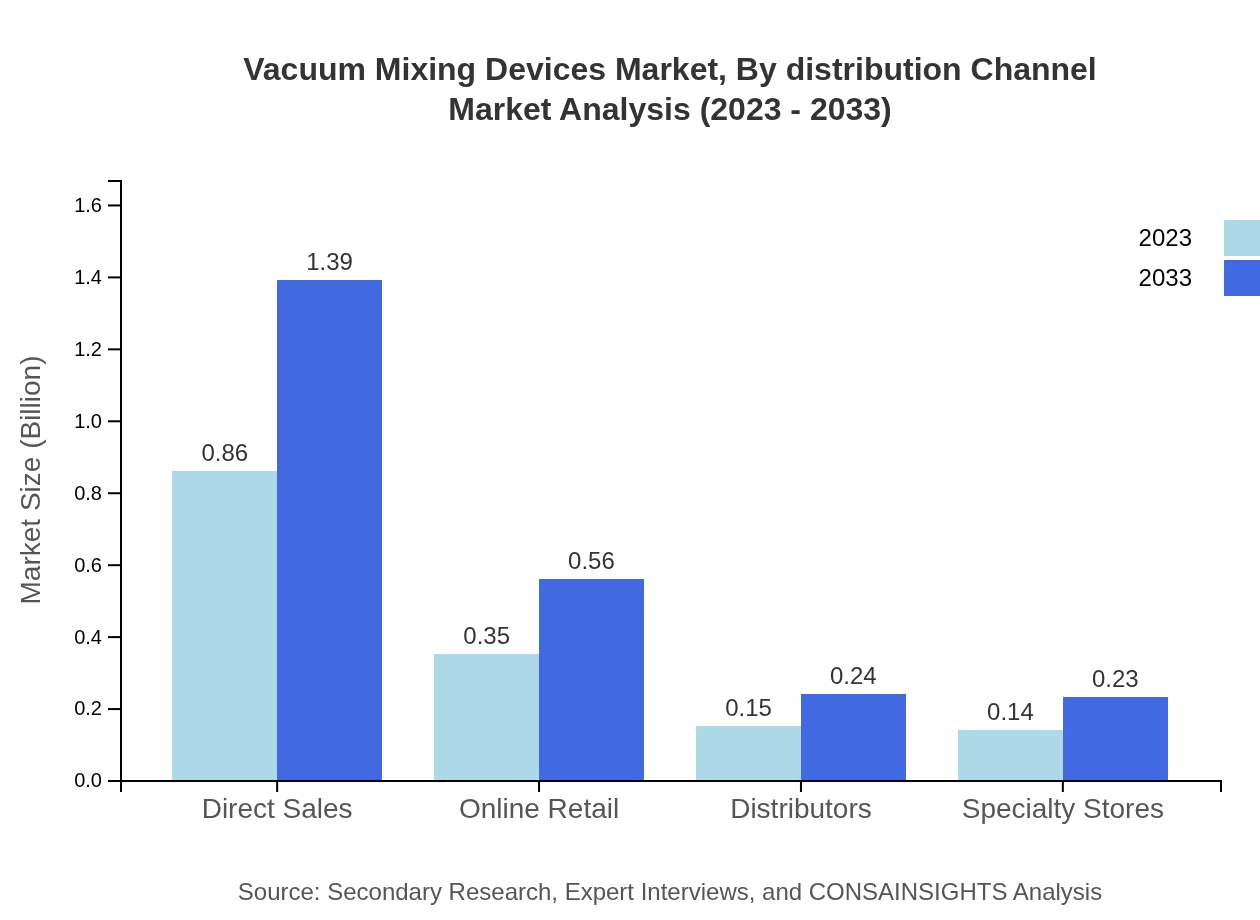
Direct sales account for a majority share at 57.39%, indicating manufacturers’ inclinations to connect directly with end-users, while online retailing is growing steadily as digitalization transforms buying behaviors.
Vacuum Mixing Devices Market Trends and Future Forecast
Tell us your focus area and get a customized research report.
Global Market Leaders and Top Companies in Vacuum Mixing Devices Industry
Bertoli:
Bertoli is known for its innovative vacuum mixing technology and has established a strong presence in both pharmaceutical and cosmetic sectors, delivering high-quality mixing solutions.TEKNO Mix:
A major player in the food processing industry, TEKNO Mix specializes in customized vacuum mixers that enhance food safety and quality. Their focus on R&D keeps them at the forefront of industry trends.GEMÜ:
GEMÜ is recognized for manufacturing high-quality mixing devices catering to the pharmaceutical industry, with an emphasis on precision and compliance with stringent regulations.Glatt:
Glatt specializes in mixing technologies and offers solutions designed for the chemical and pharmaceutical industries. Their products are appreciated for their efficiency and flexibility.HDDM:
HDDM focuses on providing advanced vacuum mixing systems aimed at industries such as cosmetics and pharmaceuticals, enhancing product development processes.We're grateful to work with incredible clients.









FAQs
What is the current market size of the Vacuum Mixing Devices market?
The market size is $1.50 Billion in 2023, based on the provided report data, reflecting baseline industry demand across pharmaceuticals, food processing, cosmetics, chemicals and biotechnology.
How big will the Vacuum Mixing Devices market be in 2033?
The market is projected to reach $2.42 Billion by 2033 according to the report, representing growth driven by automation, quality controls and broader industrial adoption.
Which region is the fastest Growing in the Vacuum Mixing Devices Market Report market?
Latin America is the fastest-growing region, projected to expand from $0.01 Billion in 2023 to $0.02 Billion in 2033, reflecting an implied 7.18% CAGR over the forecast period.
Which region is the fastest Growing for vacuum mixing devices?
Latin America is identified as the regional market region, rising from $0.01 Billion in 2023 to $0.02 Billion in 2033 with an implied 7.18% CAGR provided in the data.
Who are the leading companies in the market?
Top companies listed in the report include Bertoli, TEKNO Mix, GEMÜ, Glatt and HDDM, which are noted for product development and market presence.
What is CAGR for the forecast period?
The compound annual growth rate for 2023 to 2033 is 4.8% as specified in the report, reflecting steady expansion across end-user industries.
How do application segments shape demand?
Applications in pharmaceuticals, food and beverage, cosmetics, chemicals and biotechnology drive demand by requiring precise, reproducible mixing for quality-sensitive products.
What distribution channels are covered in the report?
The report includes direct sales, online retail, distributors and specialty stores as distribution channels, reflecting varied procurement routes for buyers.