

Vaginal Slings Market Report
First published: 12 October 2024 | Last updated: 28 May 2026 | Report Code: vaginal-slings
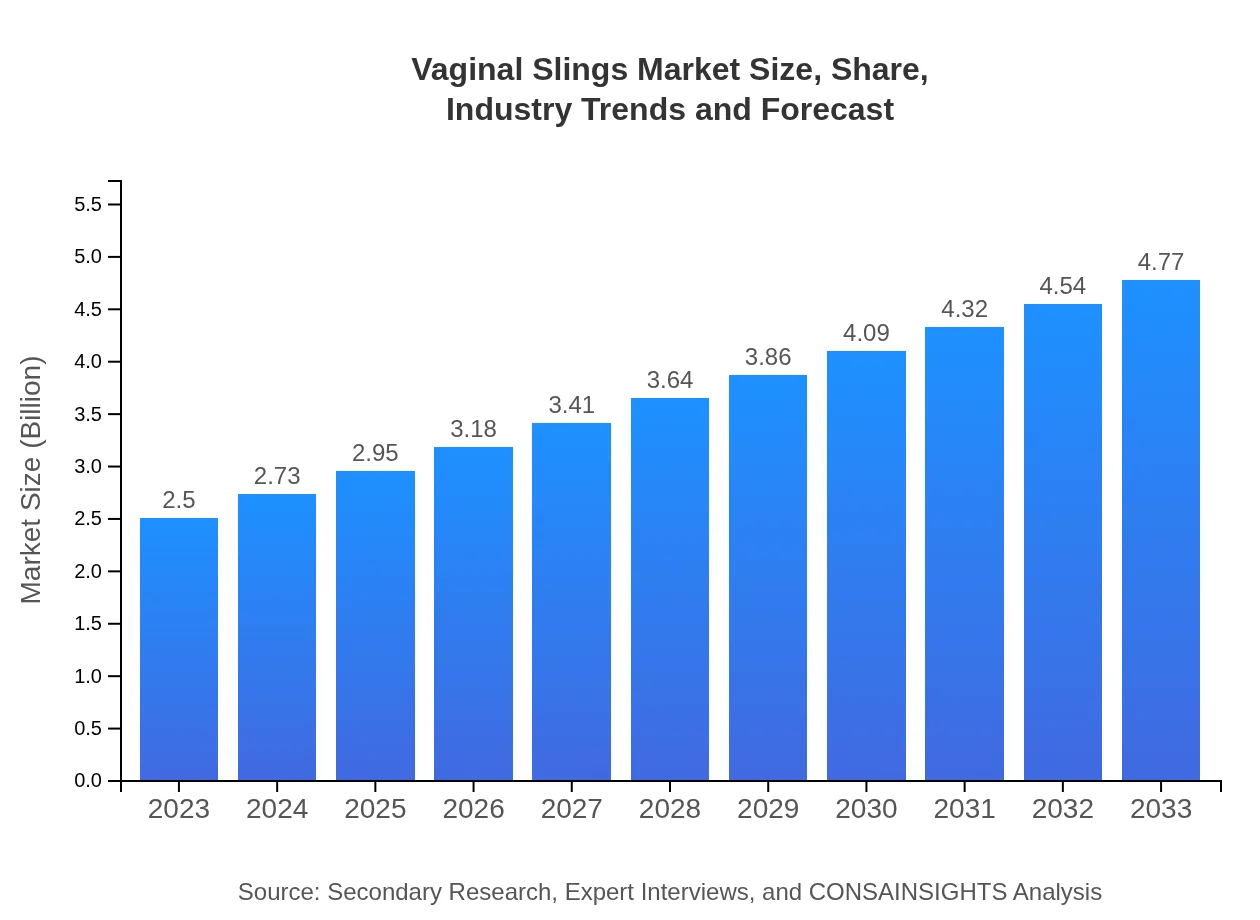
Vaginal Slings Market — USD 2.5 billion in 2023, Growing to USD 4.77B by 2033 at 6.5% CAGR
This report provides an in-depth analysis of the Vaginal Slings market, focusing on the trends, technological advancements, and forecasts from 2023 to 2033. Insights include market size, segmentation, regional analysis, industry leaders, and future growth prospects.
Key Takeaways
- Global market value rising from $2.50 Billion in 2023 to $4.77 Billion in 2033 at a 6.5% CAGR.
- North America is largest regional market; Middle East and Africa is regional market region based on implied CAGR across 2023 to 2033.
- Middle East and Africa is the regional market region, moving from $0.21 Billion in 2023 to $0.41 Billion in 2033 at an implied 6.92% CAGR.
- Europe, Asia Pacific, and Latin America also show growth: Europe $0.74 Billion to $1.42 Billion, Asia Pacific $0.47 Billion to $0.9 Billion, Latin America $0.16 Billion to $0.3 Billion.
- Leading companies noted include Boston Scientific Corporation, Johnson & Johnson, Medtronic Plc, and Coloplast A/S.
Vaginal Slings Market Report — Executive Summary
Regional analysis shows North America as largest market and Middle East and Africa as fastest-growing region by implied CAGR. This report outlines market dynamics for vaginal slings through 2033, driven by rising clinical demand for effective urinary incontinence and pelvic support solutions, material advances, and a shift toward less invasive procedures. Global value increases from $2.50 Billion in 2023 to $4.77 Billion in 2033 at a 6.5% CAGR. Regional patterns vary: North America holds the largest market value by 2033, while Middle East and Africa shows the strongest implied growth rate. Product segmentation covers mid-urethral, autologous, and synthetic slings; service channels include surgical and non-surgical care; and end-users span hospitals, ambulatory surgical centers, clinics, and home care settings. Competitive activity centers on R&D and product refinements by major players such as Boston Scientific Corporation, Johnson & Johnson, Medtronic Plc, and Coloplast A/S. The analysis emphasizes technology improvements, patient-focused care models, and regulatory considerations shaping adoption and reimbursement landscapes.
Key Growth Drivers
- Increasing prevalence of urinary incontinence and pelvic support disorders raising clinical procedure volumes.
- Preference for minimally invasive approaches encouraging adoption of advanced sling designs and materials.
- Ongoing product development and clinical research by major manufacturers improving safety and outcomes.
- Expansion of outpatient and ambulatory surgical centers facilitating broader access to sling procedures.
- Greater awareness and investment in women’s pelvic health driving demand across age cohorts.
| Metric | Value |
|---|---|
| Study Period | 2023 - 2033 |
| 2023 Market Size | $2.50 Billion |
| CAGR (2023-2033) | 6.5% |
| 2033 Market Size | $4.77 Billion |
| Top Companies | Boston Scientific Corporation, Johnson & Johnson, Medtronic Plc, Coloplast A/S |
| Published Date | 12 October 2024 |
| Last Modified Date | 28 May 2026 |
Vaginal Slings Market Overview
Customize Vaginal Slings Market Report market research report
- ✔ Get in-depth analysis of Vaginal Slings market size, growth, and forecasts.
- ✔ Understand Vaginal Slings's regional dynamics and industry-specific trends.
- ✔ Identify potential applications, end-user demand, and growth segments in Vaginal Slings
What is the Market Size & CAGR of Vaginal Slings Market Report market in 2023?
Vaginal Slings Industry Analysis
Vaginal Slings Market Segmentation and Scope
Tell us your focus area and get a customized research report.
Vaginal Slings Market Report Market Analysis Report by Region
Europe Vaginal Slings Market Report:
Europe grows from $0.74 Billion in 2023 to $1.42 Billion in 2033. Regional expansion is supported by clinical adoption of improved sling materials, health-system investments in pelvic care, and emphasis on patient-centered interventions.Asia Pacific Vaginal Slings Market Report:
Asia Pacific grows from $0.47 Billion in 2023 to $0.9 Billion in 2033. Growth drivers include rising clinical capacity, expanding awareness of pelvic disorders, and gradual adoption of less invasive sling procedures and improved device options.North America Vaginal Slings Market Report:
North America is largest regional market, rising from $0.92 Billion in 2023 to $1.75 Billion in 2033. Local growth reflects established clinical infrastructure, broad access to advanced sling products, and uptake of minimally invasive surgical approaches.South America Vaginal Slings Market Report:
Latin America grows from $0.16 Billion in 2023 to $0.3 Billion in 2033. Market advancement is linked to growing access to surgical care, increased awareness of pelvic health, and expanding availability of device options in clinical centers.Middle East & Africa Vaginal Slings Market Report:
Middle East and Africa is fastest-growing region by implied CAGR, increasing from $0.21 Billion in 2023 to $0.41 Billion in 2033. 21 Billion in 2023 to $0.41 Billion in 2033 and is noted as the regional growth market at an implied 6.92% CAGR. Local expansion is driven by improving healthcare infrastructure, rising awareness, and broader adoption of minimally invasive sling techniques.Tell us your focus area and get a customized research report.
Research Methodology
Vaginal Slings Market Analysis By Product Type
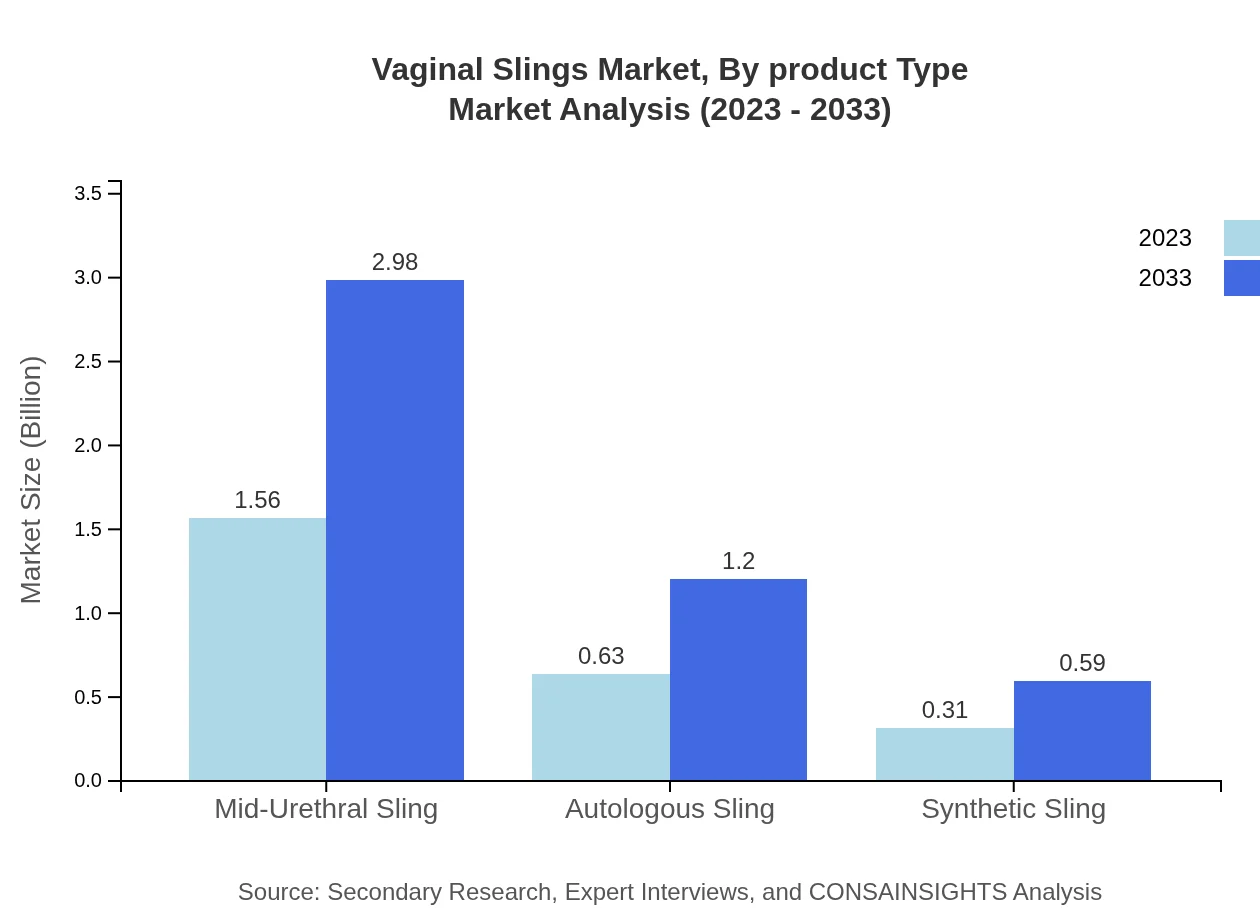
The Vaginal Slings Market is primarily dominated by mid-urethral slings, which are projected to capture 62.39% market share by 2033, with a market size growing from $1.56 billion in 2023 to $2.98 billion. Autologous slings hold a 25.14% share while synthetic slings possess a share of 12.47%.
Vaginal Slings Market Analysis By Surgery Type
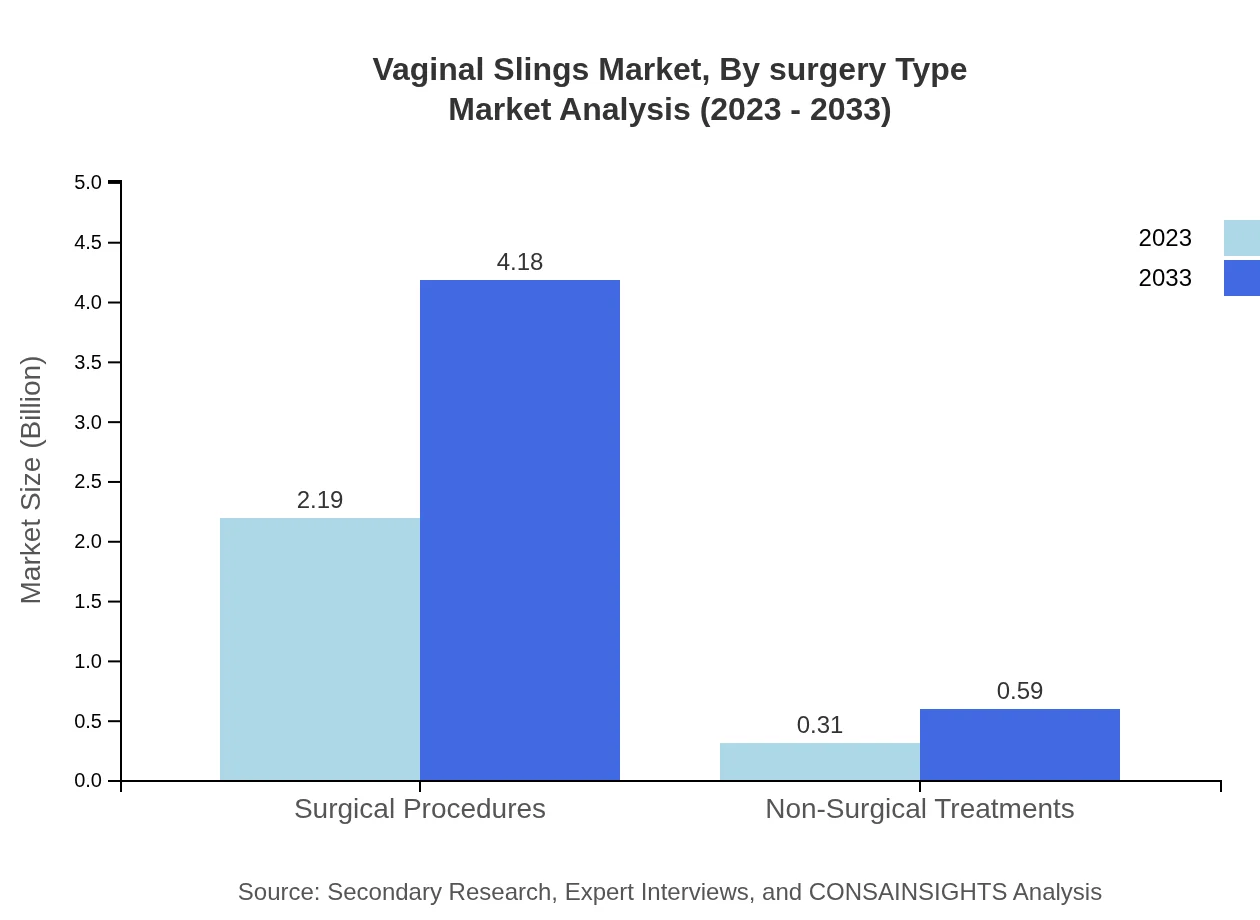
Surgical procedures dominate the Vaginal Slings market, accounting for 87.67% of the revenue in 2023, valued at $2.19 billion, and projected to reach $4.18 billion by 2033. Non-surgical treatments, while growing in recognition, make up a smaller 12.33% share.
Vaginal Slings Market Analysis By Indication
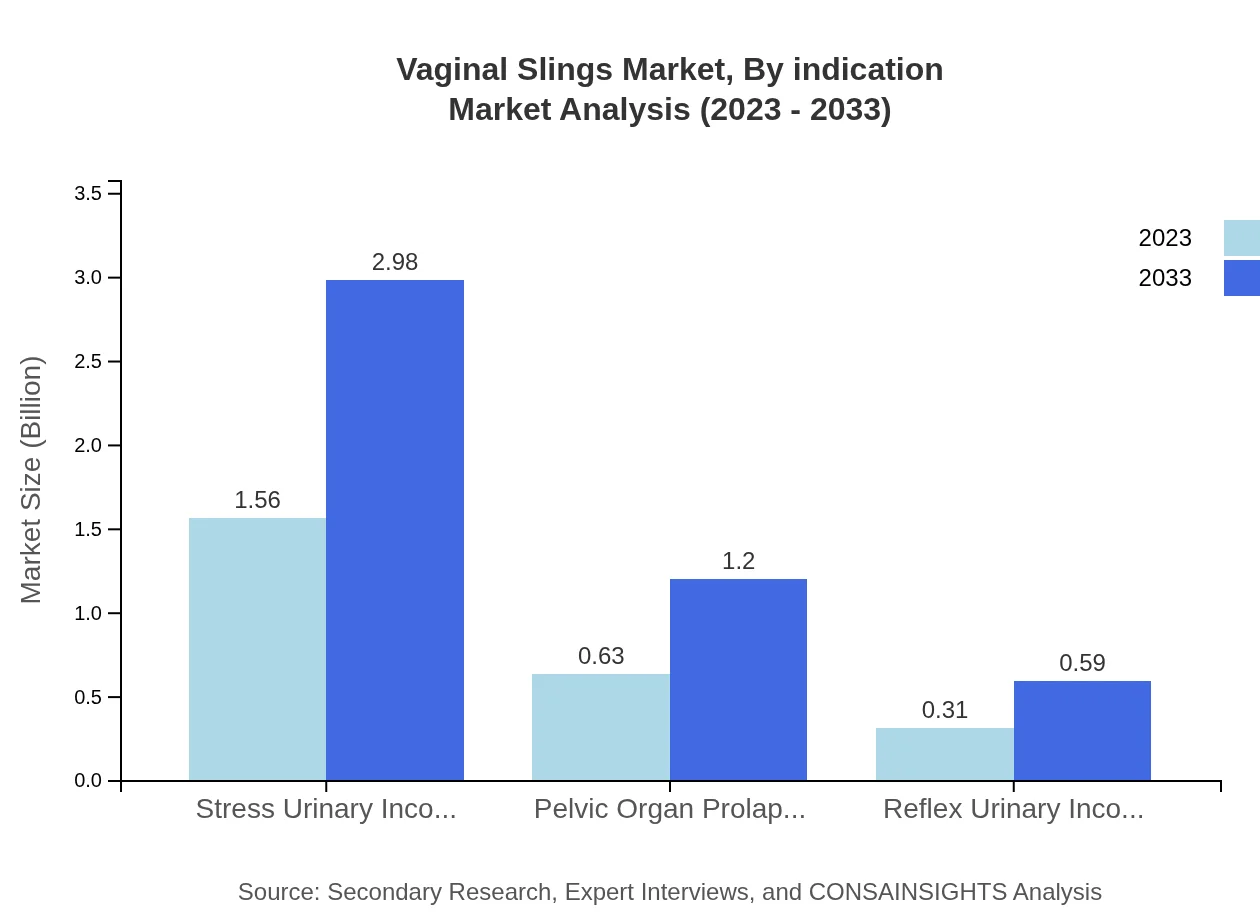
Stress urinary incontinence is the leading indication for Vaginal Sling use, representing a market size of $1.56 billion in 2023 and expected to grow to $2.98 billion by 2033. Pelvic organ prolapse and reflex urinary incontinence follow, with respective shares of 25.14% and 12.47%.
Vaginal Slings Market Analysis By End User

Hospitals are the largest end-user segment of the Vaginal Slings market, representing 56.49% of the market in 2023, with a size of $1.41 billion set to rise to $2.70 billion by 2033. Ambulatory surgical centers and clinics follow, with respective shares of 24.55% and 9.91%.
Vaginal Slings Market Analysis By Age Group
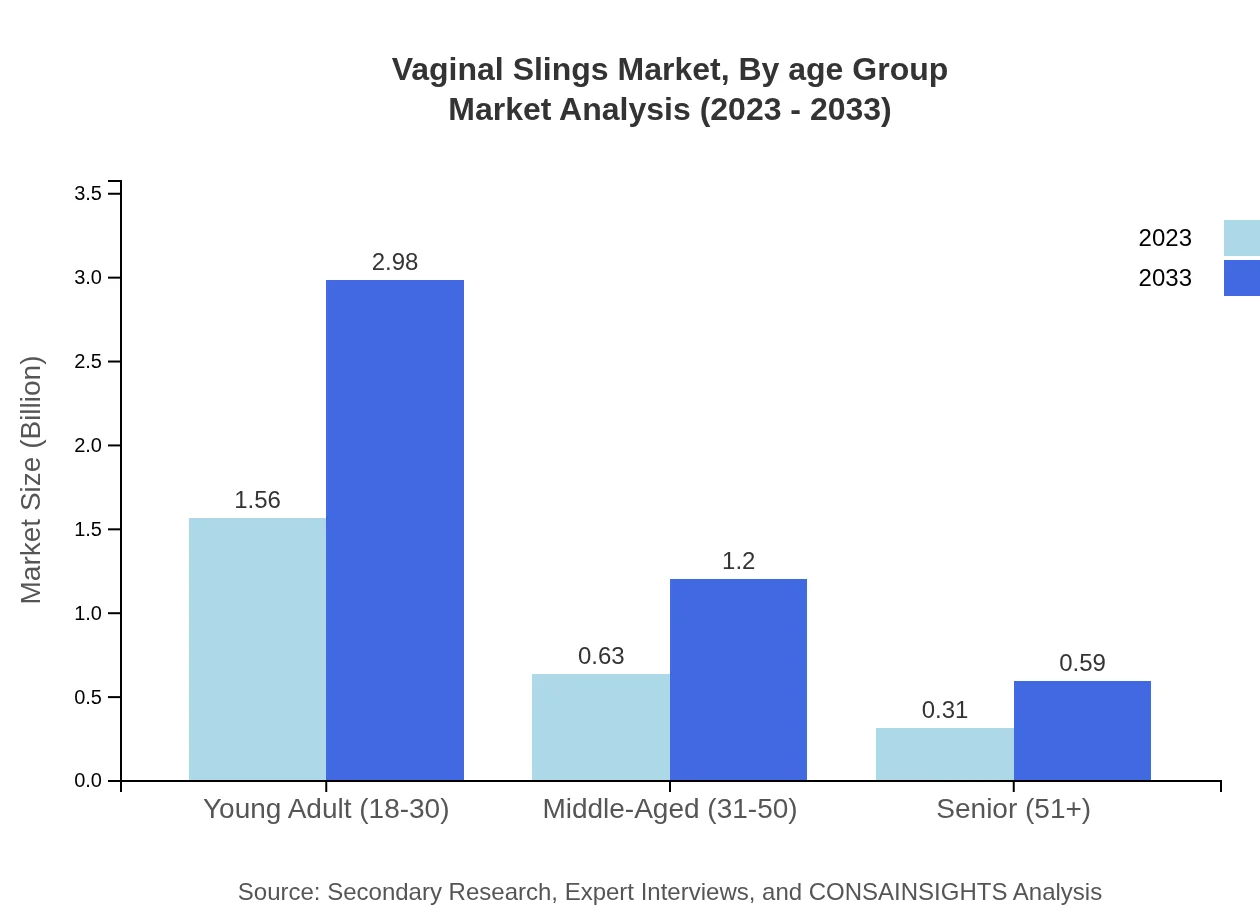
The young adult segment (18-30) accounts for 62.39% of the market in 2023, valued at $1.56 billion, growing to $2.98 billion by 2033. Middle-aged individuals (31-50) and seniors (51+) represent shares of 25.14% and 12.47% respectively, reflecting demographic trends in product usage.
Vaginal Slings Market Trends and Future Forecast
Tell us your focus area and get a customized research report.
Global Market Leaders and Top Companies in Vaginal Slings Industry
Boston Scientific Corporation:
A leading global medical device company engaged in the development of innovative solutions for various medical conditions, including urinary incontinence treatments.Johnson & Johnson:
A renowned multinational firm that provides a broad spectrum of medical devices, including advanced surgical solutions and Vaginal Sling products.Medtronic Plc:
A major player in the global medical technology space, focusing on improving health outcomes through advanced devices in surgical procedures.Coloplast A/S:
A specialty company that focuses on developing products for the surgical treatment of incontinence and pelvic organ prolapse, dedicated to enhancing patient quality of life.We're grateful to work with incredible clients.








FAQs
What is the current market size of the vaginal slings market?
The global market was $2.50 Billion in 2023, reflecting the aggregated value of devices, procedures, and related services within the forecast scope for vaginal slings.
How big will the vaginal slings market be in 2033?
By 2033 the market is projected to reach $4.77 Billion, representing the expected total market value for vaginal slings at the end of the forecast period.
What is CAGR for the forecast period?
The market is projected to grow at a 6.5% compound annual growth rate between 2023 and 2033, based on the provided baseline and terminal market values.
Which region is the fastest Growing in the Vaginal Slings Market Report market?
Middle East and Africa is the fastest-growing region, projected to expand from $0.21 Billion in 2023 to $0.41 Billion in 2033, reflecting an implied 6.92% CAGR over the forecast period.
Which region is the fastest Growing for vaginal slings?
Middle East and Africa is identified as the regional market region, increasing from $0.21 Billion in 2023 to $0.41 Billion in 2033 at an implied 6.92% CAGR.
Who are the top companies operating in this market?
Noted leading firms include Boston Scientific Corporation, Johnson & Johnson, Medtronic Plc, and Coloplast A/S, which focus on product development and clinical evidence generation.
What end User settings are included in segmentation?
End-user categories cover Hospitals, Ambulatory Surgical Centers, Clinics, and Home Care Settings, reflecting locations where sling procedures and follow-up care are delivered.
What product types are covered in the analysis?
The product segmentation includes Mid-Urethral Sling, Autologous Sling, and Synthetic Sling, representing the principal device categories referenced in the market data.
What drives regional expansion in Asia Pacific?
Asia Pacific growth, from $0.47 Billion in 2023 to $0.9 Billion in 2033, is supported by increasing clinical capacity, patient awareness, and adoption of minimally invasive procedures.
How does Europe’s market evolve by 2033?
Europe grows from $0.74 Billion in 2023 to $1.42 Billion in 2033, influenced by clinical adoption, investment in pelvic health, and ongoing product innovation.