
Reports >
Life Sciences
>
Veterinary Vaccines Market Report

Veterinary Vaccines Market Report
First published: 21 October 2024 | Last updated: 28 May 2026 | Report Code: veterinary-vaccines
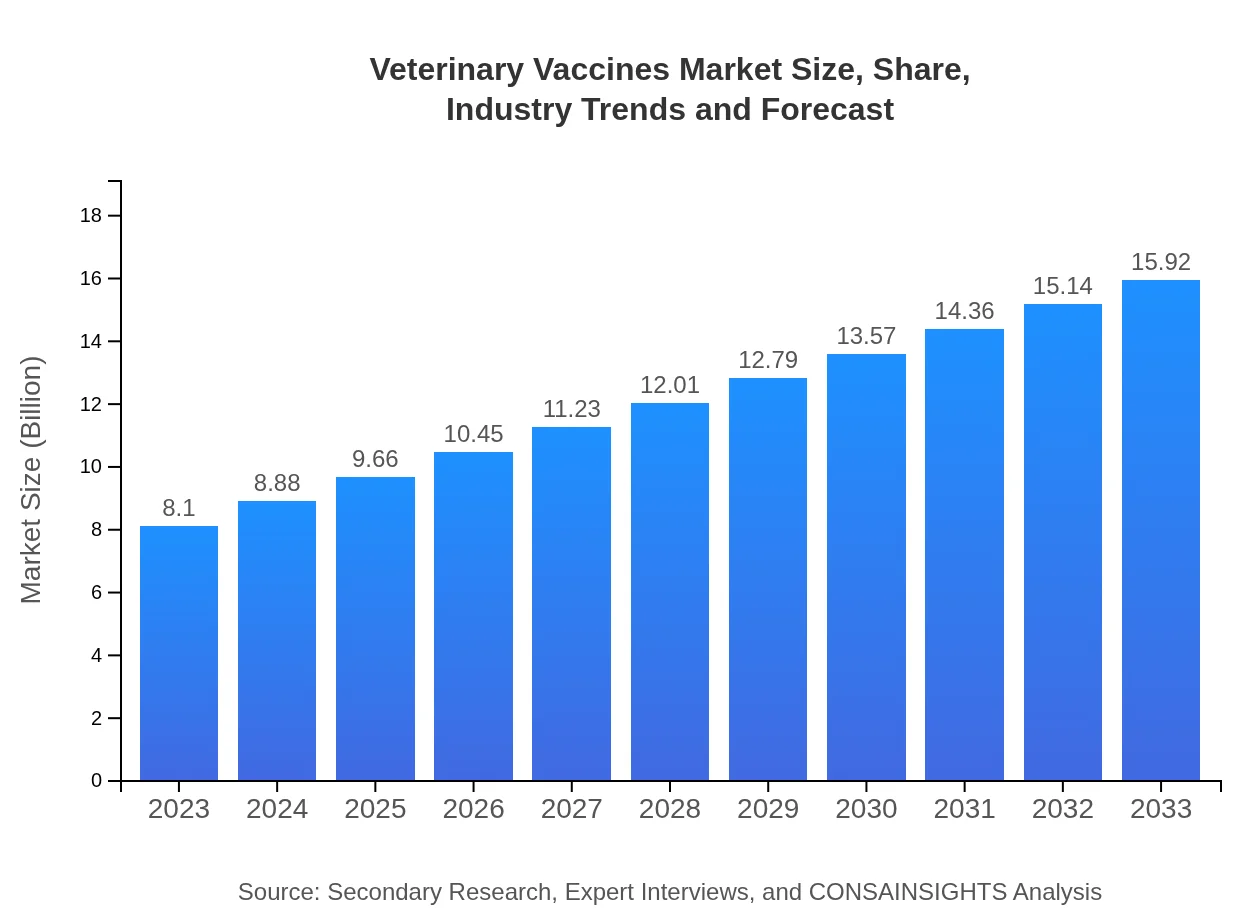
Veterinary Vaccines Market — USD $8.1 Billion in 2023, Growing to USD 15.92null by 2033 at 6.8% CAGR
This report provides an in-depth analysis of the veterinary vaccines market, including market trends, regional insights, and future forecasts for the years 2023 to 2033. Key insights on market size, segments, and leading companies are also covered.
Key Takeaways
- Global market grows from $8.10 Billion in 2023 to $15.92 Billion in 2033 at a 6.8% CAGR over 2023 to 2033.
- North America is largest regional market, while no single fastest-growing region is stated because regional CAGR differences remain within 0.15 percentage points.
- Europe rises from $2.01 Billion to $3.95 Billion between 2023 and 2033, reflecting sustained demand in companion and livestock segments.
- Product diversity includes live attenuated, inactivated, and recombinant vaccines across companion animals and livestock.
- Distribution channels span veterinary clinics, online sales, and pharmacies, while veterinary practices and farms remain key end users.
Veterinary Vaccines Market Report — Executive Summary
North America remains largest market by forecast-period value, while no single fastest-growing region is stated because top regional growth rates are separated by less than 0.15 percentage points. The veterinary vaccines market is projected to expand substantially, driven by preventive animal healthcare, rising pet ownership, and growth in livestock production. Market value increases from $8.10 Billion in 2023 to $15.92 Billion in 2033 at a 6.8% CAGR for 2023 to 2033. Regional dynamics show North America as the largest market, with measurable gains across Europe, Asia Pacific, Latin America, and the Middle East and Africa. Product innovation—including live attenuated, inactivated, and recombinant vaccines—combined with broader distribution via clinics, online channels, and pharmacies supports expansion. Key participants such as Zoetis, Merck Animal Health, Boehringer Ingelheim, Elanco, and Ceva Sante Animale are active in R&D and market deployment. Regulatory attention, zoonotic disease concerns, and investments in animal health infrastructure shape adoption. The report organizes analysis by product type, animal type, end user, and distribution route, offering stakeholders data-driven insights for strategy and investment decisions.
Key Growth Drivers
- Rising pet ownership and companion animal healthcare adoption increasing routine immunization demand.
- Expansion of livestock production driving larger-scale vaccination programs and demand for herd-level solutions.
- Technological advancement in vaccine modalities, including recombinant platforms and improved formulations.
- Stronger regulatory frameworks and heightened awareness of zoonotic disease prevention supporting vaccine uptake.
- Broader distribution networks, such as veterinary clinics and online channels, improving access to vaccines.
| Metric | Value |
|---|---|
| Study Period | 2023 - 2033 |
| 2023 Market Size | $8.10 Billion |
| CAGR (2023-2033) | 6.8% |
| 2033 Market Size | $15.92 Billion |
| Top Companies | Zoetis, Merck Animal Health, Boehringer Ingelheim, Elanco, Ceva Sante Animale |
| Published Date | 21 October 2024 |
| Last Modified Date | 28 May 2026 |
Veterinary Vaccines Market Overview
Customize Veterinary Vaccines Market Report market research report
- ✔ Get in-depth analysis of Veterinary Vaccines market size, growth, and forecasts.
- ✔ Understand Veterinary Vaccines's regional dynamics and industry-specific trends.
- ✔ Identify potential applications, end-user demand, and growth segments in Veterinary Vaccines
What is the Market Size & CAGR of Veterinary Vaccines Market Report market in 2023?
Veterinary Vaccines Industry Analysis
Veterinary Vaccines Market Segmentation and Scope
Tell us your focus area and get a customized research report.
Veterinary Vaccines Market Report Market Analysis Report by Region
Europe Veterinary Vaccines Market Report:
Europe grows from $2.01 Billion in 2023 to $3.95 Billion in 2033. Demand is bolstered by strong regulatory standards, established livestock vaccination programs, and growing preventive care trends for companion animals.Asia Pacific Veterinary Vaccines Market Report:
Asia Pacific grows from $1.66 Billion in 2023 to $3.27 Billion in 2033. Growth drivers include rising livestock production, increasing pet ownership in urban centers, and expanding veterinary infrastructure and access to vaccines.North America Veterinary Vaccines Market Report:
North America is largest regional market, rising from $2.9 Billion in 2023 to $5.7 Billion in 2033. Regional expansion is supported by established veterinary services, high companion animal healthcare spending, and investment in vaccine innovation and distribution channels.South America Veterinary Vaccines Market Report:
Latin America grows from $0.74 Billion in 2023 to $1.45 Billion in 2033. Regional growth is influenced by scaling agricultural production, improving veterinary services, and greater adoption of preventive animal healthcare measures.Middle East & Africa Veterinary Vaccines Market Report:
Middle East and Africa grows from $0.79 Billion in 2023 to $1.56 Billion in 2033. Expansion is supported by investments in animal health systems, rising awareness of zoonotic risks, and gradual improvements in vaccine distribution networks.Tell us your focus area and get a customized research report.
Research Methodology
Veterinary Vaccines Market Analysis By Product Type
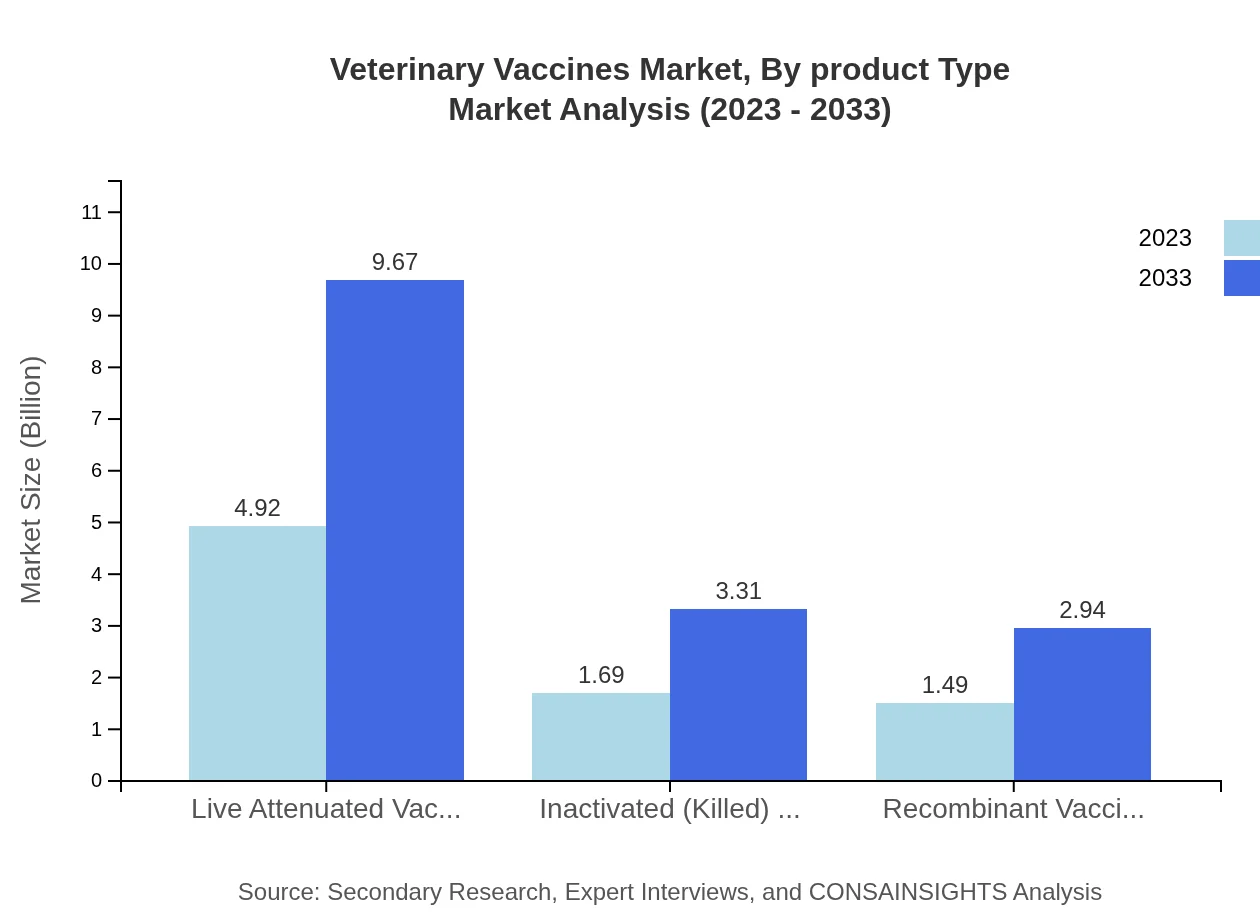
In 2023, the live attenuated vaccines segment was valued at 4.92 billion USD and is expected to reach 9.67 billion USD by 2033, holding a significant market share of 60.73%. Inactivated (killed) vaccines followed with a market value of 1.69 billion USD in 2023, poised to grow to 3.31 billion USD by 2033, representing 20.82% of the market share. Recombinant vaccines accounted for 1.49 billion USD in 2023, with projections of 2.94 billion USD by 2033, maintaining an 18.45% share.
Veterinary Vaccines Market Analysis By Route Of Administration
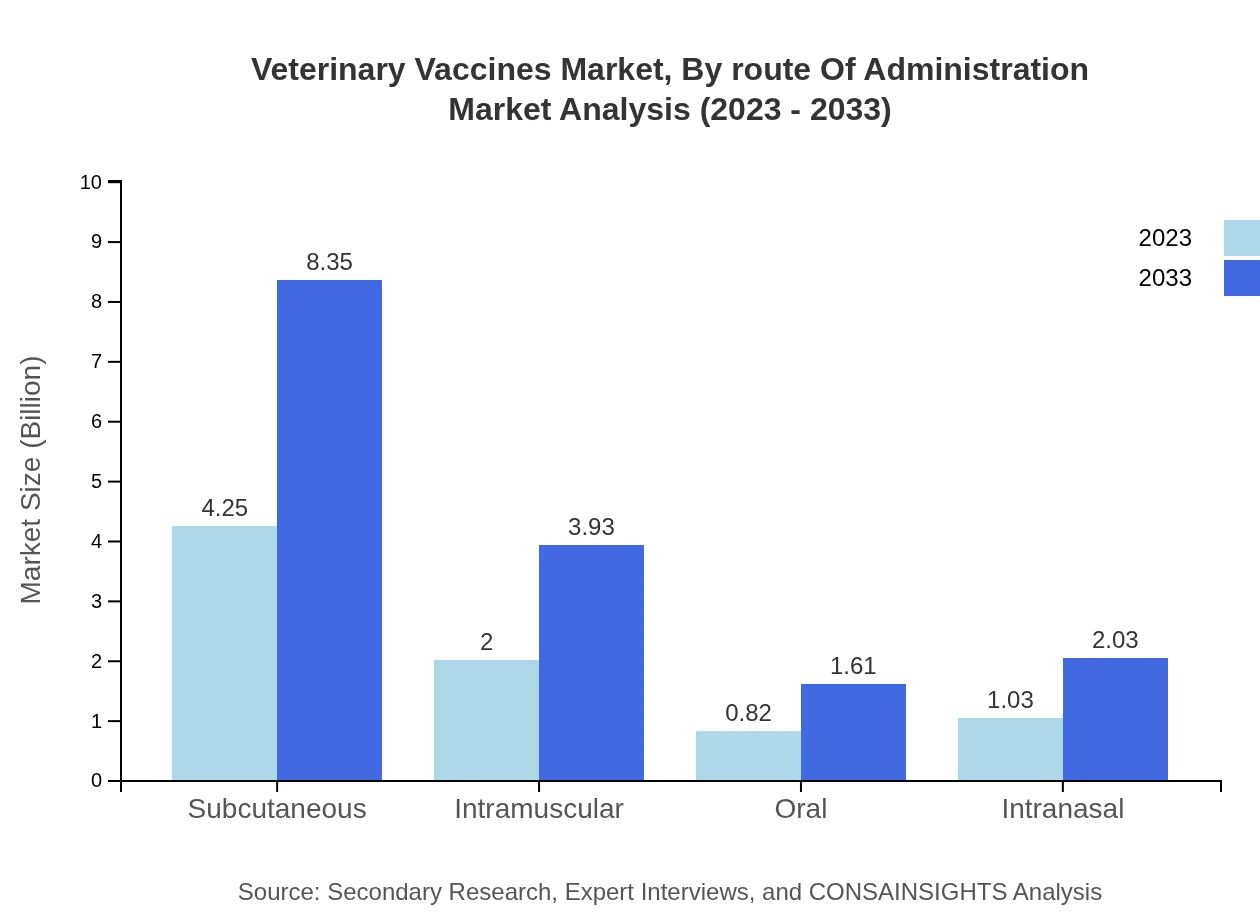
Subcutaneous routes are leading, with a market size of 4.25 billion USD in 2023, set to increase to 8.35 billion USD by 2033 (52.44% market share). Conversely, intramuscular vaccinations are growing steadily, currently at 2.00 billion USD—expected to reach 3.93 billion USD (24.7% share). Oral and intranasal vaccination methods are smaller segments with shares of 10.09% and 12.77% respectively.
Veterinary Vaccines Market Analysis By Animal Type
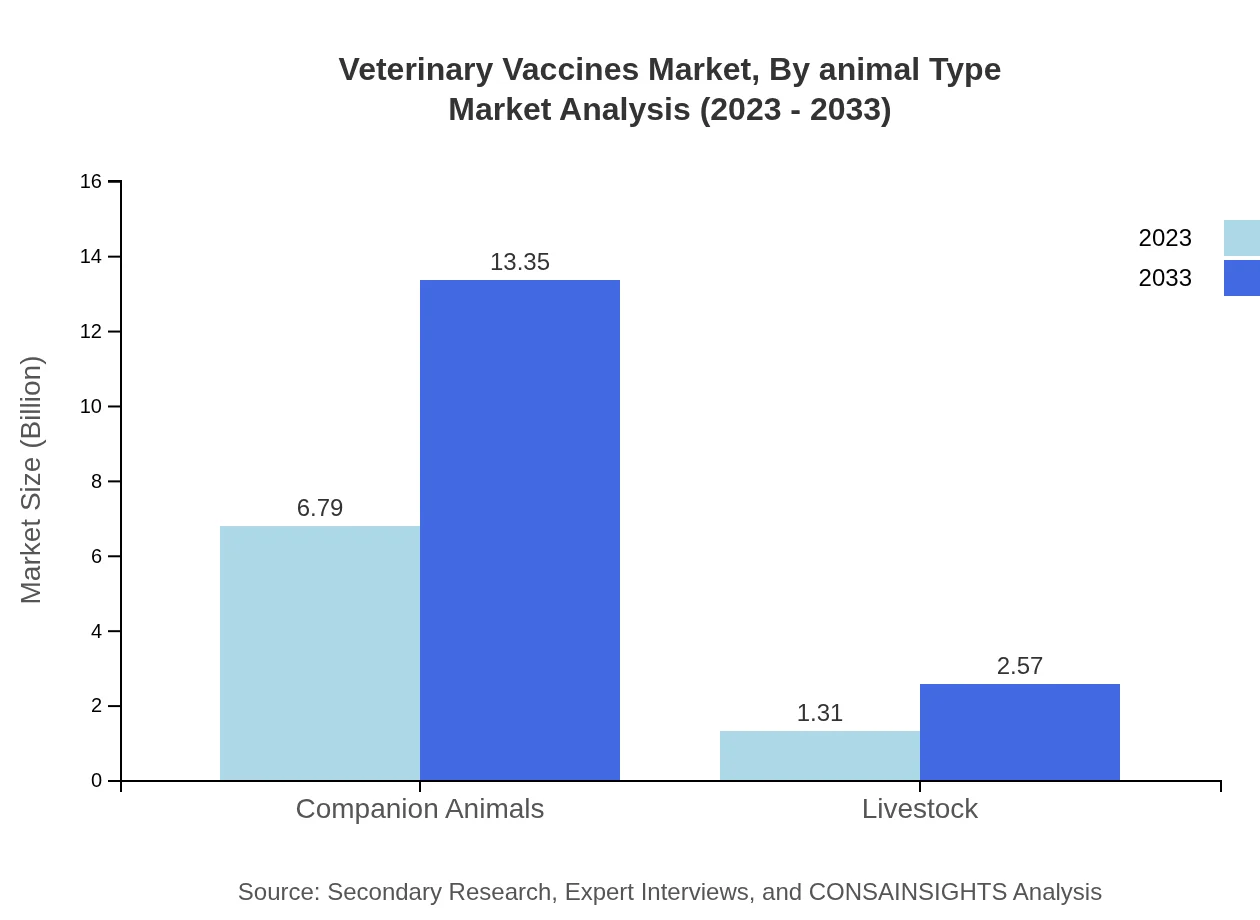
Companion animals lead the veterinary vaccines market with revenues of 6.79 billion USD in 2023, estimated to escalate to 13.35 billion USD (83.83% market share by 2033). Livestock represents a modest share, generating 1.31 billion USD in 2023, growing to 2.57 billion USD (16.17% share).
Veterinary Vaccines Market Analysis By Distribution Channel
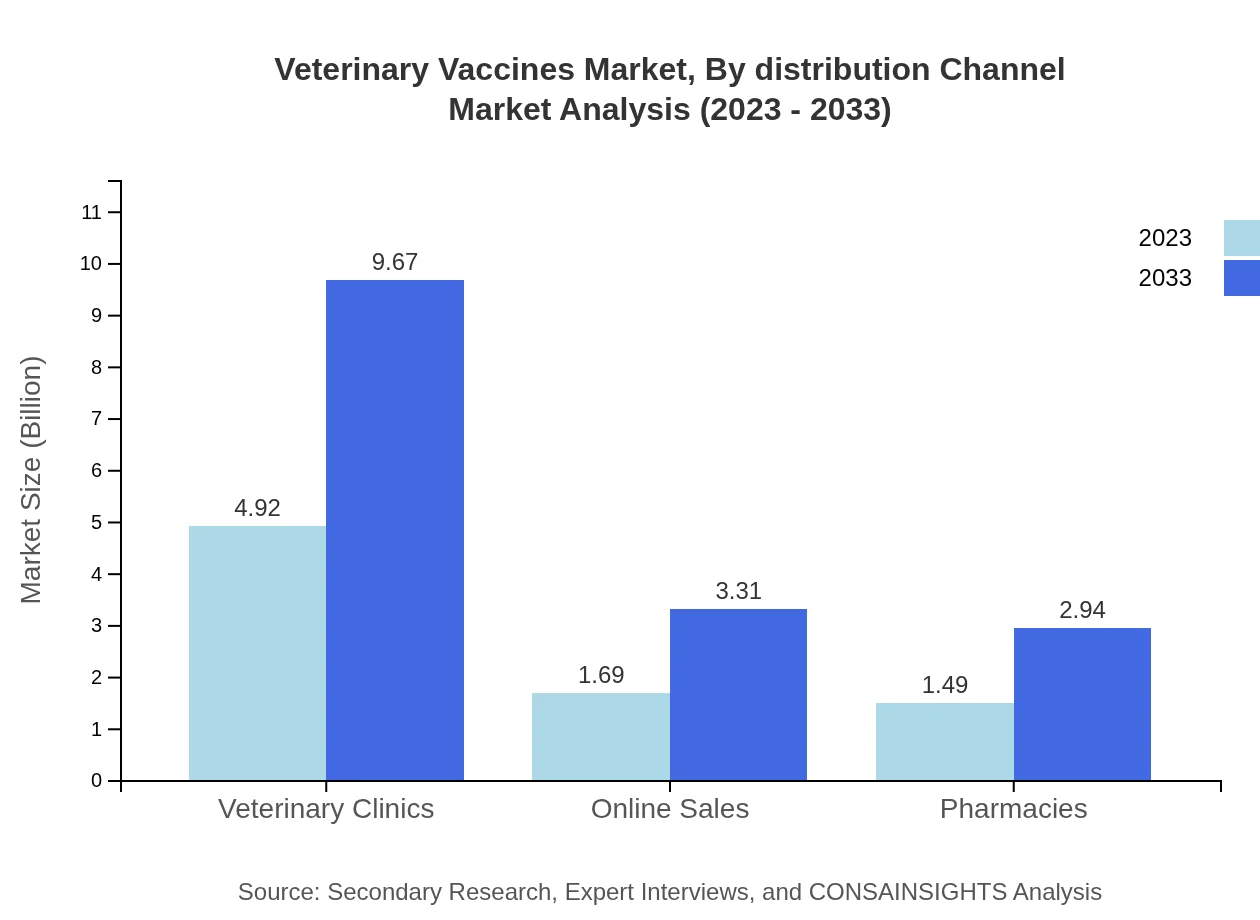
Veterinary clinics dominate sales channels with a total of 4.92 billion USD in 2023, expanding to 9.67 billion USD (60.73% market share). Online sales are also emerging, growing from 1.69 billion USD to 3.31 billion USD (20.82% share), reflecting the changing dynamics of product distribution and consumer behavior.
Veterinary Vaccines Market Analysis By End User
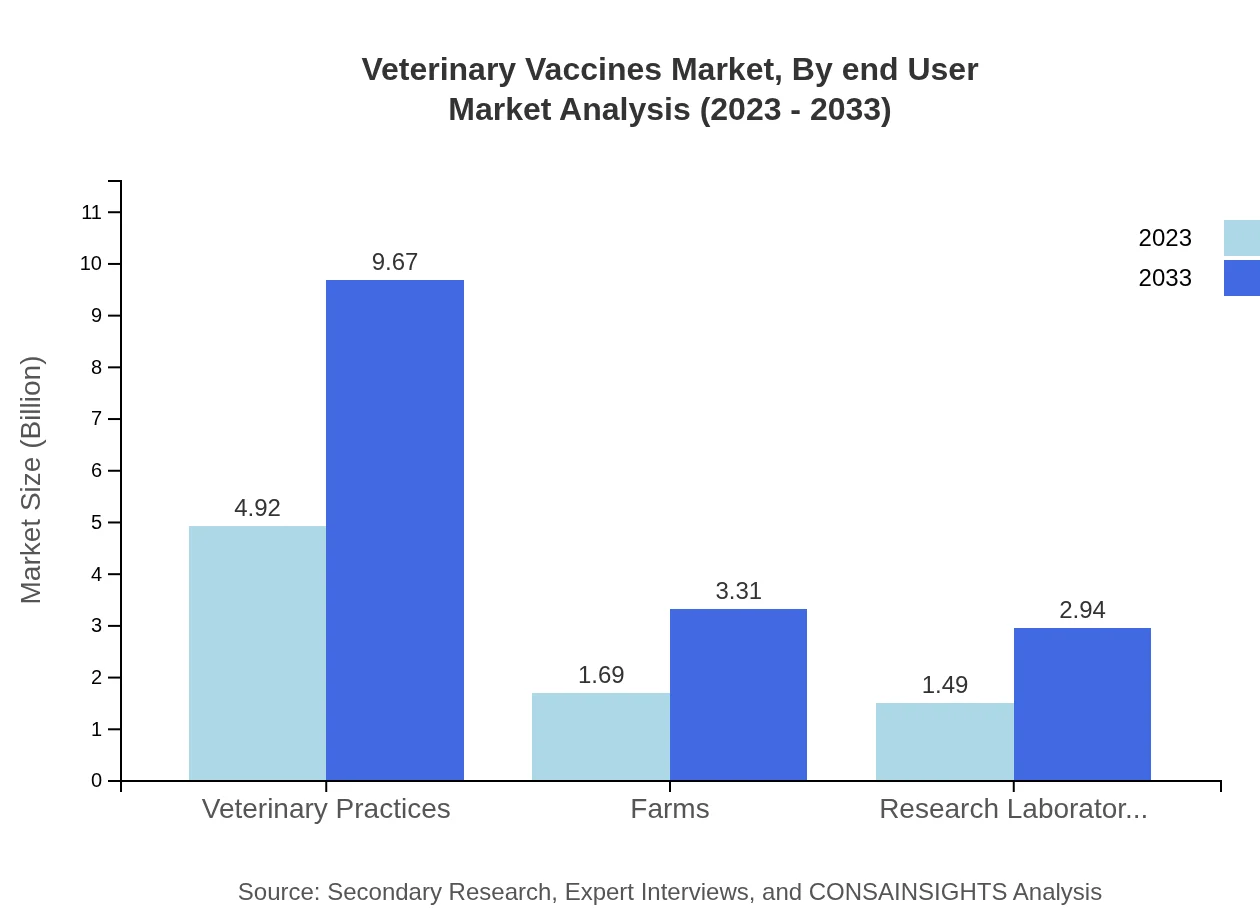
The market serves various end-users, with veterinary practices constituting the largest segment at 4.92 billion USD in 2023, expected to nearly double by 2033. Farms account for 1.69 billion USD and research laboratories 1.49 billion USD, highlighting their respective importance in the broader vaccine ecosystem.
Veterinary Vaccines Market Trends and Future Forecast
Tell us your focus area and get a customized research report.
Global Market Leaders and Top Companies in Veterinary Vaccines Industry
Zoetis:
As a leader in animal health, Zoetis is dedicated to innovative solutions including vaccines, diagnostics, and medicines that enhance the health of pets and livestock globally.Merck Animal Health:
Merck Animal Health offers a comprehensive portfolio of vaccines for various species, focusing on preventing, treating, and controlling animal diseases.Boehringer Ingelheim:
Boehringer Ingelheim is recognized for its wide range of vaccines and medications for pets and livestock, with a strong emphasis on research and development.Elanco:
Elanco specializes in innovative animal health products and data analytics, providing vaccines and medicines that ensure animal safety and productivity.Ceva Sante Animale:
Ceva Sante develops and provides vaccines focused on livestock health, and has been expanding its portfolio into companion animal products.We're grateful to work with incredible clients.









FAQs
What is the market size of the veterinary vaccines market in 2023?
The market size for 2023 is $8.10 Billion, representing the baseline value used for forecasting to 2033. This figure anchors the report’s quantitative analysis and projections.
How big will the veterinary vaccines market be in 2033?
By 2033 the market is projected to reach $15.92 Billion, reflecting growth across product types and regions based on the report’s forecasts for 2023 to 2033.
Why is North America notable in this market?
North America is identified as the largest regional market, increasing from $2.9 Billion in 2023 to $5.7 Billion in 2033, driven by strong veterinary services and companion animal care.
Is there a single fastest Growing region in the Veterinary Vaccines Market Report market?
No single fastest-growing region is stated for the Veterinary Vaccines Market Report market because the top regional implied CAGR values are within 0.15 percentage points of each other, making the ranking too close to call reliably.
Who are the leading companies featured in the analysis?
Top companies listed include Zoetis, Merck Animal Health, Boehringer Ingelheim, Elanco, and Ceva Sante Animale, noted for R&D and commercial vaccine offerings.
What is CAGR for the forecast period?
The compound annual growth rate for 2023 to 2033 is 6.8%, applied to growth projections from the 2023 base market size to the 2033 market value.
What end User segments are emphasized?
Key end users are veterinary practices, farms, and research laboratories, each highlighted for their role in routine immunization, herd health management, and product testing.
How are distribution channels characterized?
Distribution channels covered include veterinary clinics, online sales, and pharmacies, reflecting multiple routes through which vaccines reach animal health providers and owners.