
Reports >
Life Sciences
>
Ai In Cancer Treatment

Ai In Cancer Treatment
First published: 20 May 2025 | Last updated: 25 May 2026 | Report Code: ai-in-cancer-treatment
Ai In Cancer Treatment Market — USD $6.5 Billion in 2024, Growing to USD 19.31null by 2033 at 12.3% CAGR
This comprehensive report on AI in Cancer Treatment provides a detailed overview of the market landscape from 2024 to 2033. It encapsulates key insights including market sizing, growth forecasts, technological innovations, regional analysis, and competitive dynamics, offering actionable intelligence for stakeholders across healthcare, research, and technology domains.
Key Takeaways
- Market expands from $6.50 Billion in 2024 to $19.31 Billion by 2033, reflecting a 12.3% CAGR over the 2024 to 2033 period.
- North America is largest regional market, while no single fastest-growing region is stated because regional CAGR differences remain within 0.15 percentage points.
- Europe and Asia Pacific show notable increases: Europe from $1.76 Billion to $5.22 Billion, Asia Pacific from $1.35 Billion to $4.02 Billion.
- Segmentation spans Software, Hardware, Services, and applications including Diagnosis, Treatment, and Drug Discovery.
- Key participants include IBM Watson Health and Google Health, indicating strong involvement from established tech-healthcare players.
Ai In Cancer Treatment — Executive Summary
North America remains largest market by forecast-period value, while no single fastest-growing region is stated because top regional growth rates are separated by less than 0.15 percentage points. The Ai In Cancer Treatment market is undergoing sustained expansion driven by advanced analytics, imaging improvements, and increased investment in oncology-focused R&D. Growth is supported by integration of machine learning and deep learning into diagnostic imaging, therapy planning, and personalized care pathways. Hospitals, research institutions, and pharmaceutical companies are primary end users, utilizing software, hardware, and services across diagnosis, treatment, patient monitoring, and drug discovery. Regionally, North America leads in market value while Europe, Asia Pacific, Latin America, and Middle East & Africa register meaningful gains between 2024 and 2033. Competitive activity features major technology-healthcare collaborations, with IBM Watson Health and Google Health among notable companies. Regulatory adaptation and partnerships between established firms and research centers are shaping commercialization and clinical validation efforts. The report synthesizes primary interviews, company literature, and triangulated data to present actionable insights for stakeholders.
Key Growth Drivers
- Rising adoption of machine learning and deep learning in diagnostic imaging and therapy planning increases clinical utility and efficiency.
- Expanded investment in oncology research and development from private and public sources fuels product development and clinical validation.
- Collaborations between technology firms and healthcare institutions accelerate solution deployment and cross-disciplinary innovation.
- Increasing need for personalized treatment pathways boosts demand for AI-driven decision support and patient monitoring tools.
- Regulatory frameworks gradually evolving to accommodate novel AI applications, enabling broader market entry and commercialization.
| Metric | Value |
|---|---|
| Study Period | 2024 - 2033 |
| 2024 Market Size | $6.50 Billion |
| CAGR (2024-2033) | 12.3% |
| 2033 Market Size | $19.31 Billion |
| Top Companies | IBM Watson Health, Google Health |
| Published Date | 20 May 2025 |
| Last Modified Date | 25 May 2026 |
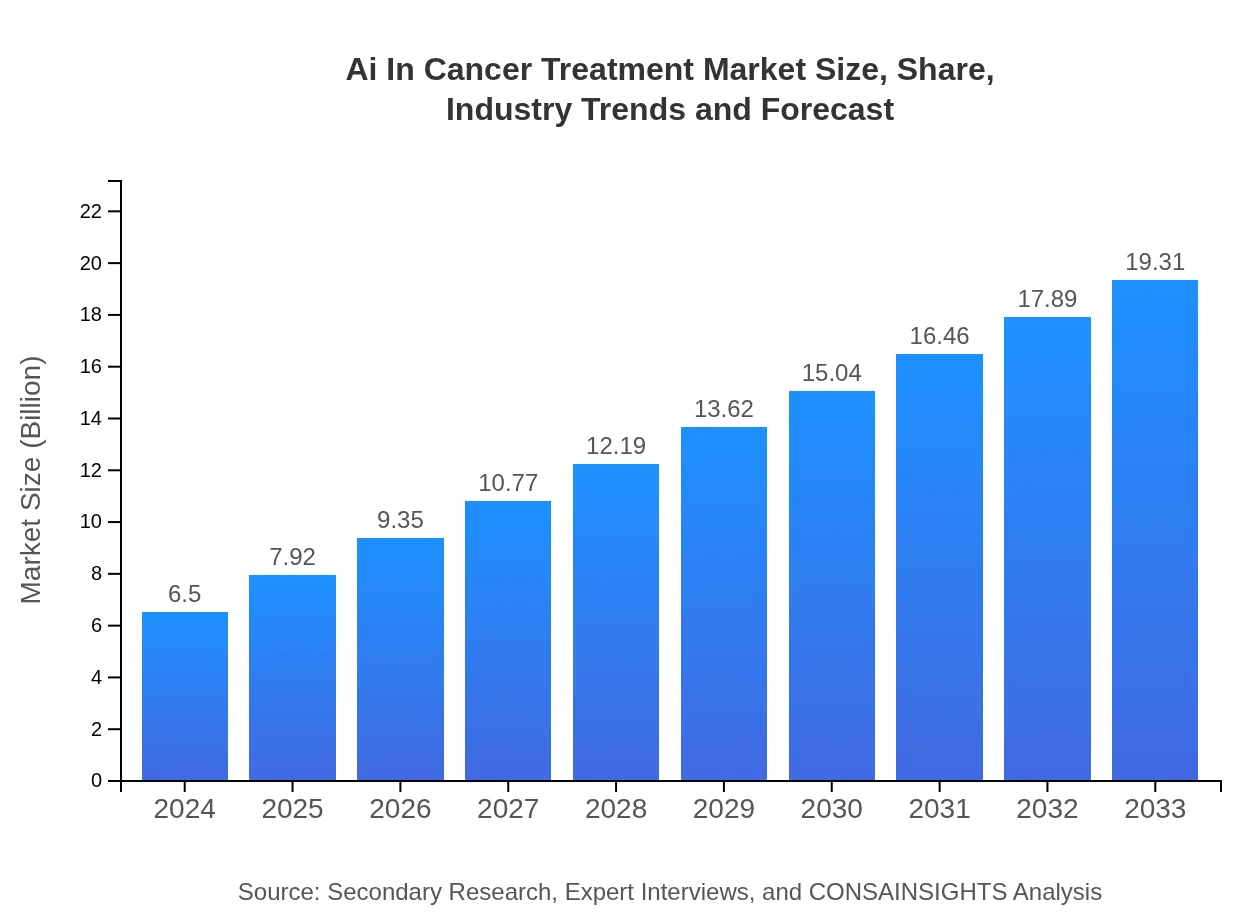
Ai In Cancer Treatment Market Overview
Customize Ai In Cancer Treatment market research report
- ✔ Get in-depth analysis of Ai In Cancer Treatment market size, growth, and forecasts.
- ✔ Understand Ai In Cancer Treatment's regional dynamics and industry-specific trends.
- ✔ Identify potential applications, end-user demand, and growth segments in Ai In Cancer Treatment
What is the Market Size & CAGR of Ai In Cancer Treatment market in 2024?
Ai In Cancer Treatment Industry Analysis
Ai In Cancer Treatment Market Segmentation and Scope
Tell us your focus area and get a customized research report.
Ai In Cancer Treatment Market Analysis Report by Region
Europe Ai In Cancer Treatment:
Europe grows from $1.76 Billion in 2024 to $5.22 Billion in 2033. Expansion is driven by increased deployment of AI in diagnostic imaging, regulatory adaptation facilitating clinical trials, and collaborations among research institutions and industry players.Asia Pacific Ai In Cancer Treatment:
Asia Pacific grows from $1.35 Billion in 2024 to $4.02 Billion in 2033. Market momentum reflects rising healthcare digitization, growing oncology research activity, and adoption of AI tools in hospitals and pharmaceutical research.North America Ai In Cancer Treatment:
North America is largest regional market, rising from $2.11 Billion in 2024 to $6.26 Billion in 2033. Regional leadership is linked to strong investments in clinical research, extensive adoption of advanced imaging and analytics, and active partnerships between tech firms and healthcare providers.South America Ai In Cancer Treatment:
Latin America grows from $0.46 Billion in 2024 to $1.38 Billion in 2033. Growth is associated with gradual uptake of digital health technologies, expanding clinical collaborations, and investment in localized research and deployment efforts.Middle East & Africa Ai In Cancer Treatment:
Middle East and Africa grows from $0.82 Billion in 2024 to $2.44 Billion in 2033. Drivers include increasing healthcare infrastructure investment, adoption of AI-enabled diagnostics, and partnerships that support regional clinical validation and solution rollouts.Tell us your focus area and get a customized research report.
Research Methodology
Ai In Cancer Treatment Market Analysis By Technology
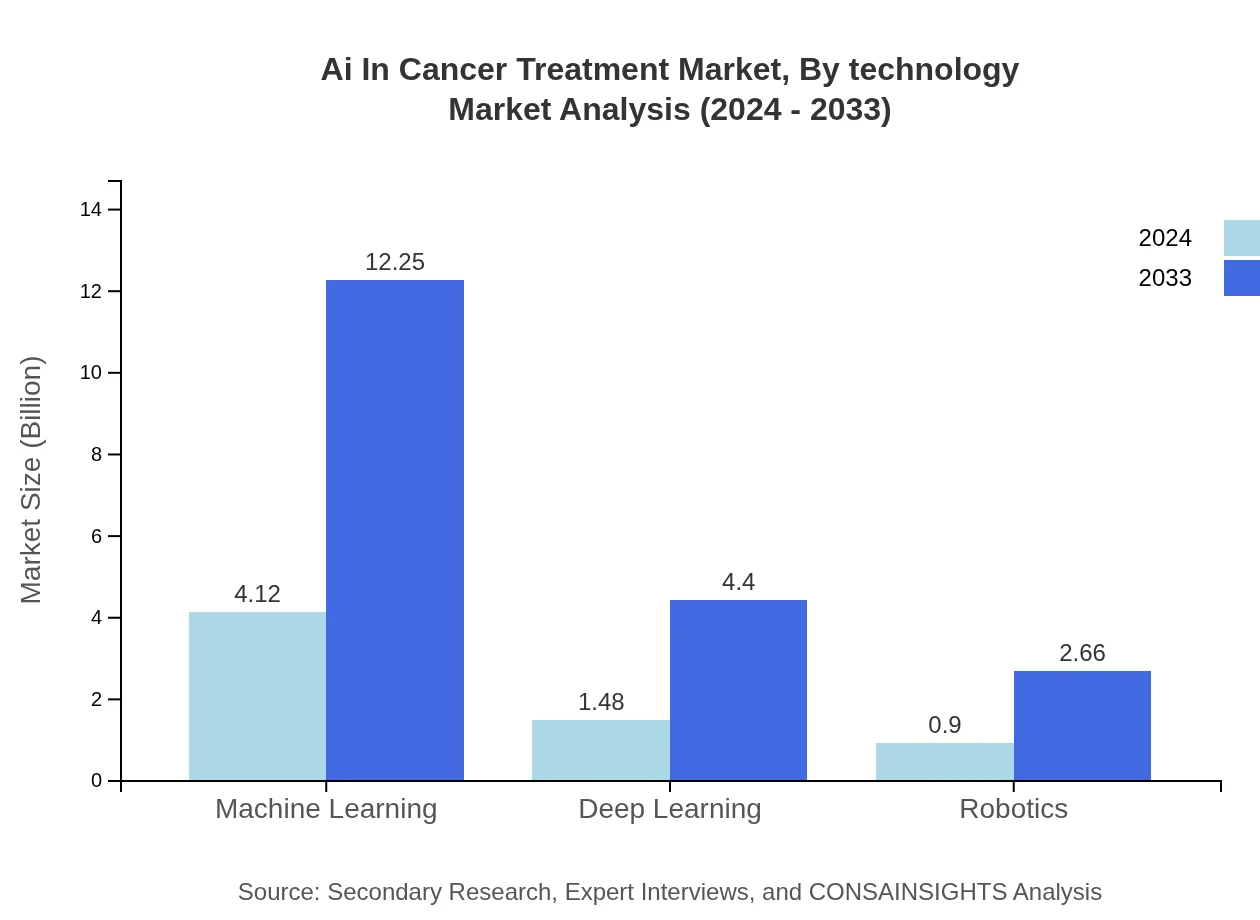
The technology segmentation highlights the vital role of machine learning, deep learning, and robotics in revolutionizing cancer treatment protocols. Machine learning algorithms are chiefly responsible for processing complex datasets and delivering personalized treatment recommendations, while deep learning models are at the forefront of imaging analysis and predictive diagnostics. Robotics is increasingly used to support minimally invasive surgeries and automated biomedical procedures, ensuring precision and enhancing patient outcomes.
Ai In Cancer Treatment Market Analysis By Application Area
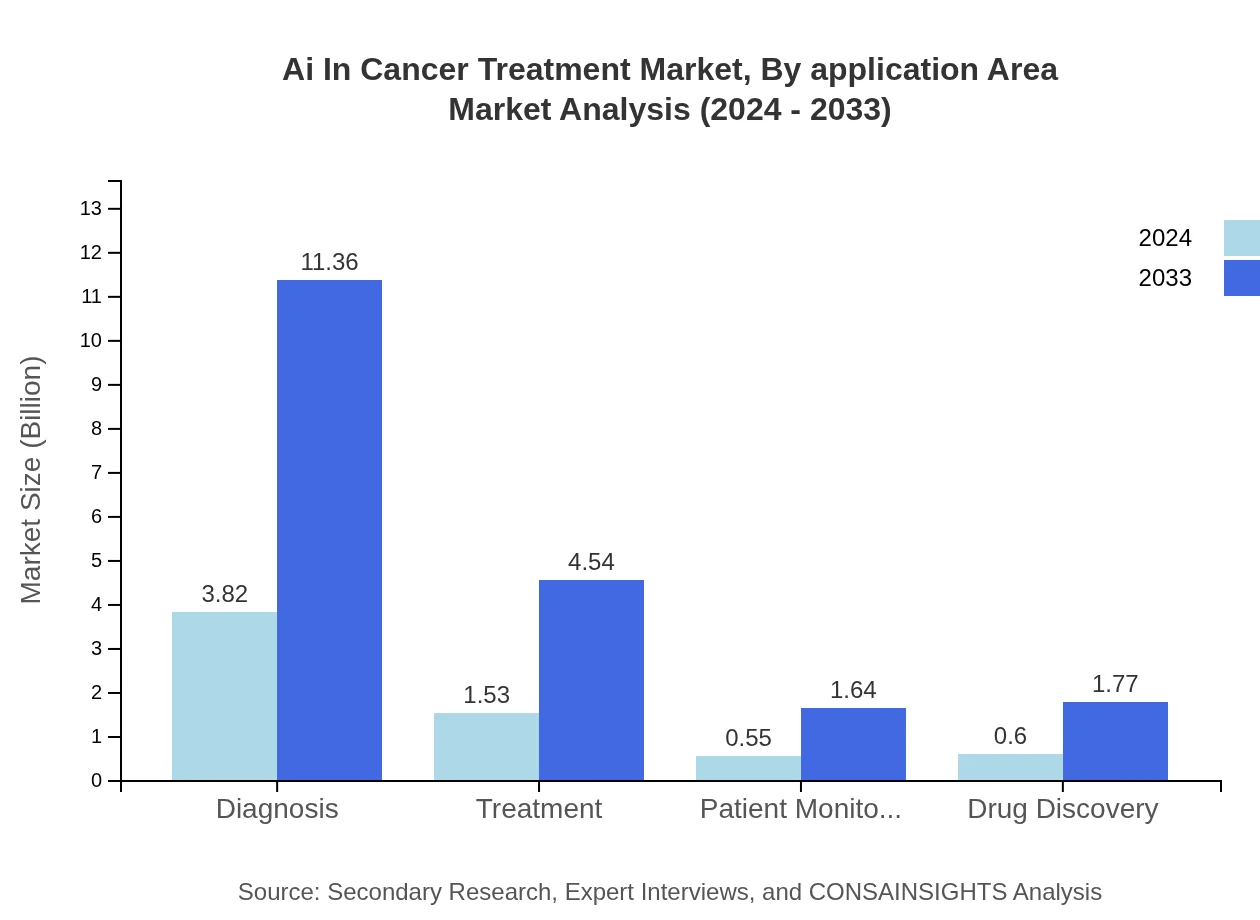
The application area segment of the AI in Cancer Treatment market covers diagnosis, treatment, patient monitoring, and drug discovery. AI tools enhance diagnostic accuracy by rapidly analyzing complex imaging data. In treatment, these technologies facilitate tailored therapeutic strategies, while patient monitoring is improved through real-time analytics and predictive maintenance of health records. Drug discovery benefits from faster, data-driven identification of potential therapeutic compounds, thereby reducing time-to-market for new treatments.
Ai In Cancer Treatment Market Analysis By End User
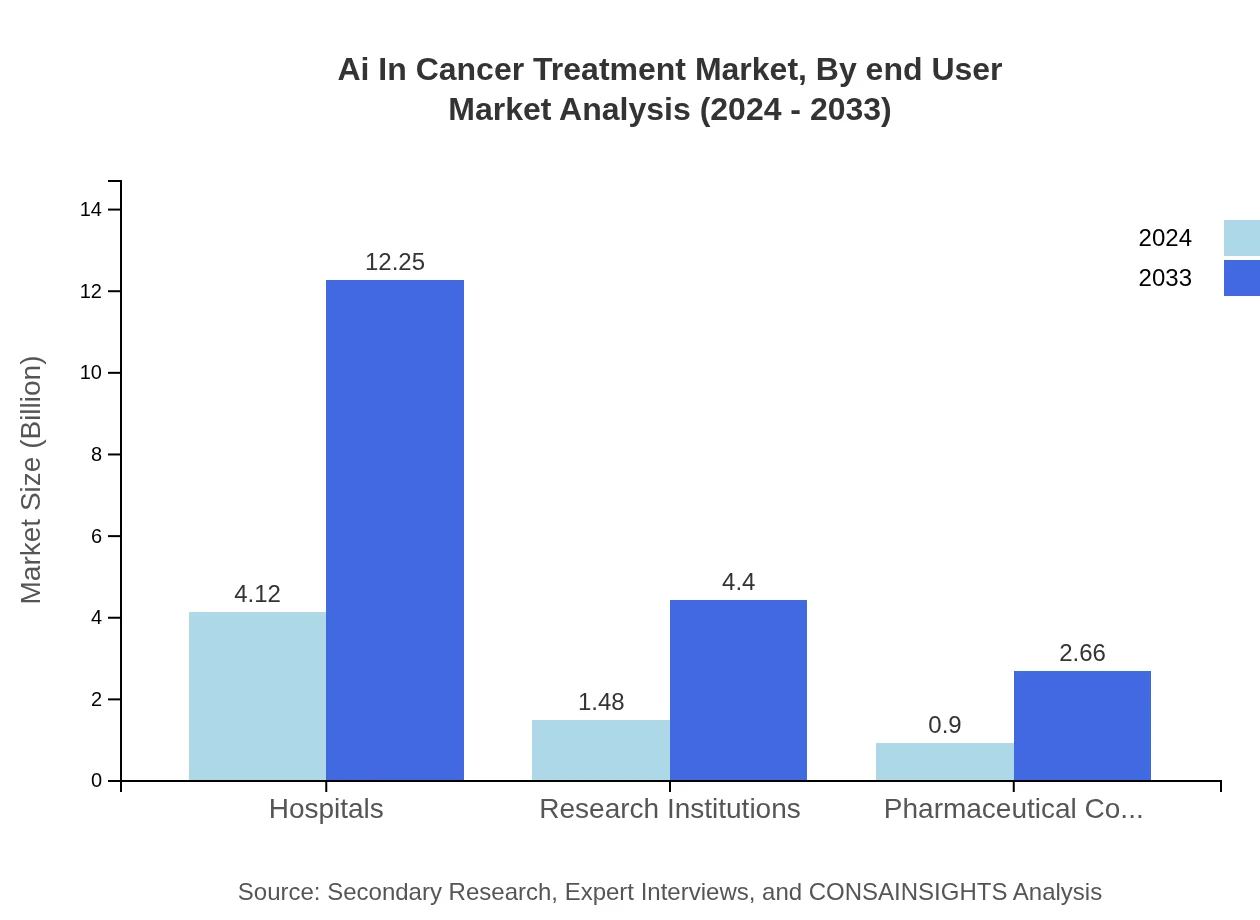
End-users such as hospitals, research institutions, and pharmaceutical companies are at the core of market implementation. Hospitals leverage AI to improve clinical decision support systems and streamline patient care. Research institutions use these technologies to drive innovation and validate emerging treatment protocols. Pharmaceutical companies adopt AI for more efficient clinical trials and to optimize drug discovery processes, ensuring that resources are allocated to the most promising candidate therapies.
Ai In Cancer Treatment Market Analysis By Solution
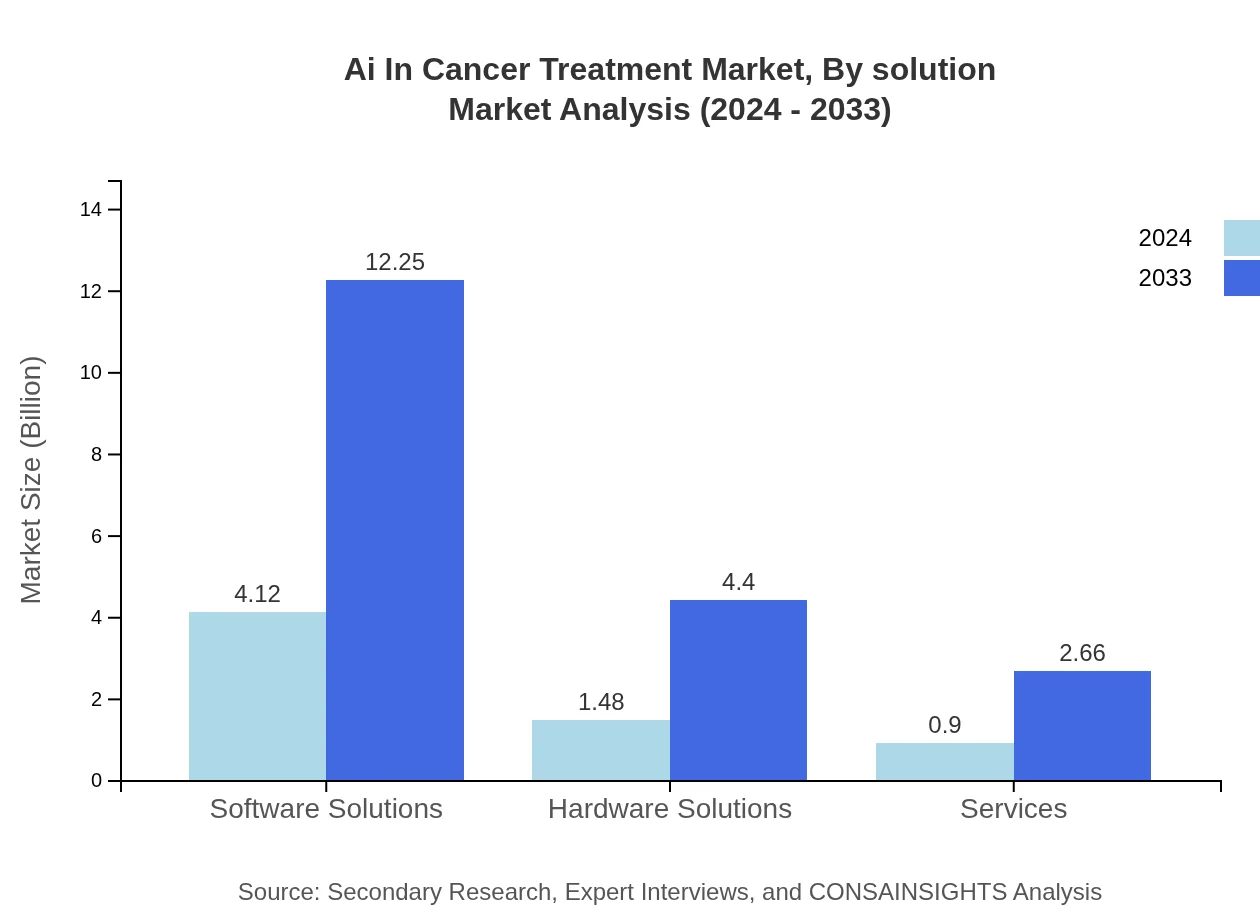
The solution segment is divided into software solutions, hardware solutions, and associated services. Software solutions predominantly encompass AI algorithms, analytics platforms, and cloud-based data management systems that support clinical decision making. Hardware solutions include advanced diagnostic devices and robotic surgical systems, while comprehensive support services provide installation, training, and maintenance to ensure effective integration of AI technologies within existing healthcare frameworks.
Ai In Cancer Treatment Market Trends and Future Forecast
Tell us your focus area and get a customized research report.
Global Market Leaders and Top Companies in Ai In Cancer Treatment Industry
IBM Watson Health:
IBM Watson Health is renowned for its pioneering work in applying AI to cancer diagnostics and treatment planning. Their systems leverage advanced natural language processing and data analytics to support clinical decisions and improve patient outcomes.Google Health:
Google Health integrates state-of-the-art machine learning models with vast datasets to improve early detection and treatment personalization in oncology. Their innovative research and technology partnerships are central to advancing AI-driven healthcare solutions.We're grateful to work with incredible clients.









FAQs
What is the current market size of Ai In Cancer Treatment?
The market size for Ai In Cancer Treatment in 2024 is $6.50 Billion, based on the provided data.
How big will the market be by 2033?
According to the input figures, the market is projected to reach $19.31 Billion in 2033.
What is CAGR of the market?
The specified compound annual growth rate for the 2024 to 2033 forecast period is 12.3%.
Is there a single fastest Growing region in the Ai In Cancer Treatment market?
No single fastest-growing region is stated for the Ai In Cancer Treatment market because the top regional implied CAGR values are within 0.15 percentage points of each other, making the ranking too close to call reliably.
Which companies are listed as key players?
The top companies provided in the input are IBM Watson Health and Google Health.
What are common application areas for AI in oncology?
Application areas specified include Diagnosis, Treatment, Patient Monitoring, and Drug Discovery within the market segmentation.
How are solutions categorized in the report?
Solutions are grouped as Software Solutions, Hardware Solutions, and Services according to the segmentation facts.
Who are the primary end users in this market?
Provided end-user sub segments include Hospitals, Research Institutions, and Pharmaceutical Companies.
What regional growth details are included?
The report supplies start and end regional values for five regions, showing the market progression between 2024 and 2033.
Why should stakeholders monitor this market?
Stakeholders are advised to track technological convergence, partnerships, and regulatory changes that affect adoption and commercialization.