

Anesthesia Gases Market Report
First published: 10 October 2024 | Last updated: 25 May 2026 | Report Code: anesthesia-gases
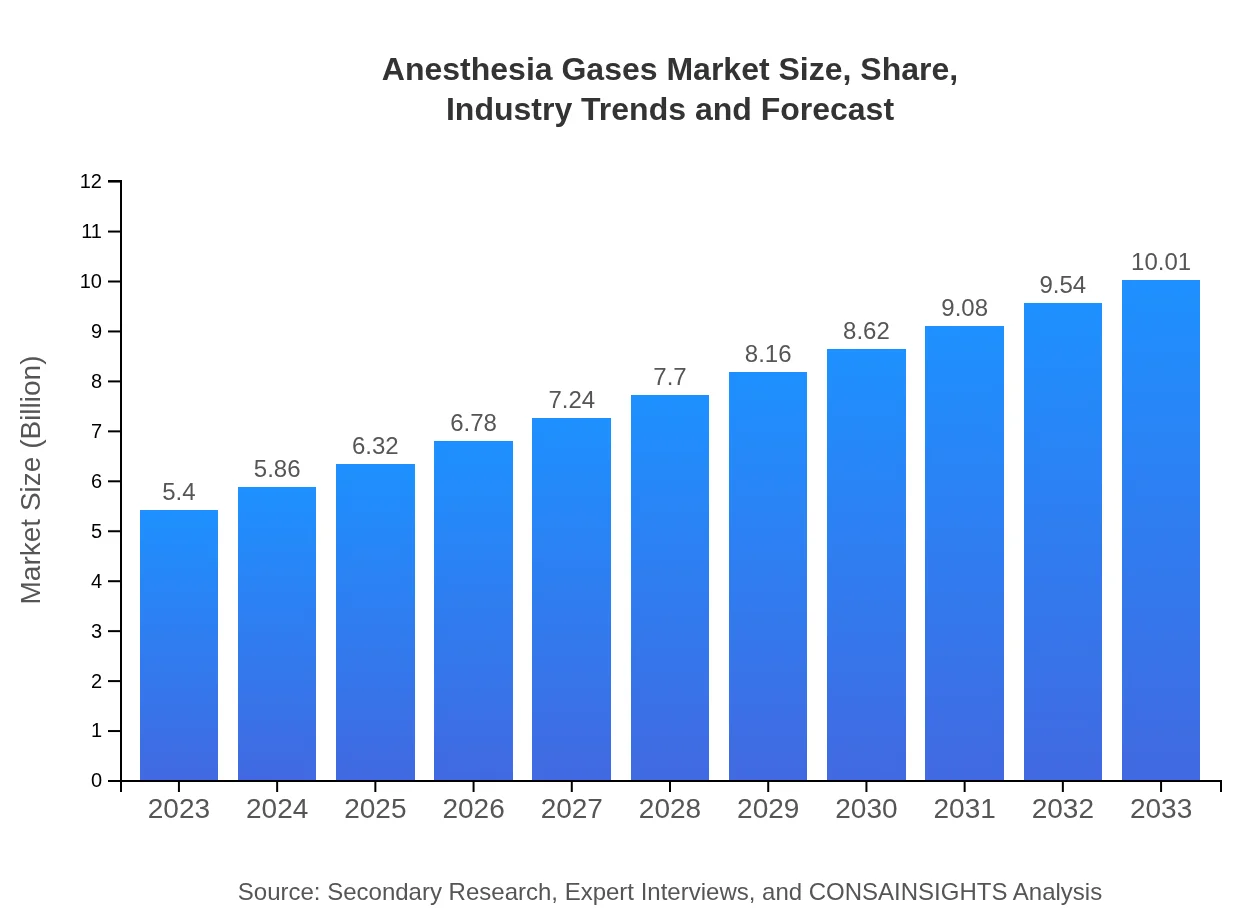
Anesthesia Gases Market — USD $5.4 Billion in 2023, Growing to USD 10.01null by 2033 at 6.2% CAGR
This report provides a comprehensive analysis of the Anesthesia Gases market, including market size, growth forecasts, industry trends, and regional insights from 2023 to 2033.
Key Takeaways
- Global market expands from $5.40 Billion in 2023 to $10.01 Billion in 2033 at a 6.2% CAGR.
- North America is largest regional market, while no single fastest-growing region is stated because regional CAGR differences remain within 0.15 percentage points.
- Europe grows from $1.83 Billion in 2023 to $3.39 Billion in 2033, reflecting strong clinical demand.
- Asia Pacific rises from $0.96 Billion in 2023 to $1.78 Billion in 2033 amid expanding healthcare capacity.
- Top players include Abbott Laboratories, Baxter International Inc., Medtronic, Fresenius Kabi, and GE Healthcare.
Anesthesia Gases Market Report — Executive Summary
North America remains largest market by forecast-period value, while no single fastest-growing region is stated because top regional growth rates are separated by less than 0.15 percentage points. This report examines the Anesthesia Gases market, valued at $5.40 Billion in 2023 and forecast to reach $10.01 Billion by 2033 at a 6.2% CAGR. Growth is supported by rising surgical procedure volumes, expanding healthcare infrastructure, and focus on patient safety and anesthetic delivery improvements. Regional dynamics show North America as the largest market, with significant contributions from Europe and Asia Pacific. The analysis covers product and usage subsegments, end-users such as hospitals and ambulatory surgical centers, and competitive positioning of firms including Abbott Laboratories, Baxter International Inc., Medtronic, Fresenius Kabi, and GE Healthcare. The report also highlights innovation trends toward safer and more efficient delivery systems and the influence of regulatory standards on product development. Market structure and future opportunities are presented alongside risks related to compliance and cost pressures.
Key Growth Drivers
- Increasing number of surgical procedures driving demand for anesthetic agents and delivery systems.
- Expansion of healthcare facilities and outpatient surgical centers boosting consumption of anesthesia gases.
- Emphasis on patient safety and improved monitoring encouraging adoption of advanced anesthetic solutions.
- Technological improvements in gas delivery and monitoring fostering market uptake.
- Regulatory focus on product efficacy prompting manufacturers to invest in compliant formulations and systems.
| Metric | Value |
|---|---|
| Study Period | 2023 - 2033 |
| 2023 Market Size | $5.40 Billion |
| CAGR (2023-2033) | 6.2% |
| 2033 Market Size | $10.01 Billion |
| Top Companies | Abbott Laboratories, Baxter International Inc., Medtronic , Fresenius Kabi, GE Healthcare |
| Published Date | 10 October 2024 |
| Last Modified Date | 25 May 2026 |
Anesthesia Gases Market Overview
Customize Anesthesia Gases Market Report market research report
- ✔ Get in-depth analysis of Anesthesia Gases market size, growth, and forecasts.
- ✔ Understand Anesthesia Gases's regional dynamics and industry-specific trends.
- ✔ Identify potential applications, end-user demand, and growth segments in Anesthesia Gases
What is the Market Size & CAGR of Anesthesia Gases Market Report market in 2023?
Anesthesia Gases Industry Analysis
Anesthesia Gases Market Segmentation and Scope
Tell us your focus area and get a customized research report.
Anesthesia Gases Market Report Market Analysis Report by Region
Europe Anesthesia Gases Market Report:
Europe grows from $1.83 Billion in 2023 to $3.39 Billion in 2033. Expansion is driven by established surgical services, regulatory standards that encourage safer anesthetic practices, and steady investment in perioperative care.Asia Pacific Anesthesia Gases Market Report:
Asia Pacific grows from $0.96 Billion in 2023 to $1.78 Billion in 2033. The region’s expansion is linked to increasing healthcare capacity, greater access to surgical care, and modernization of hospitals and outpatient facilities.North America Anesthesia Gases Market Report:
North America is largest regional market, rising from $1.87 Billion in 2023 to $3.47 Billion in 2033. This growth reflects extensive healthcare infrastructure, high procedural volumes, and adoption of advanced anesthetic technologies in clinical settings.South America Anesthesia Gases Market Report:
Latin America grows from $0.05 Billion in 2023 to $0.09 Billion in 2033. Growth stems from gradual improvements in healthcare infrastructure and rising procedural demand in select urban centers.Middle East & Africa Anesthesia Gases Market Report:
Middle East and Africa grows from $0.69 Billion in 2023 to $1.29 Billion in 2033. Drivers include investments in hospital capabilities, rising surgical activity, and the adoption of improved anesthetic delivery systems.Tell us your focus area and get a customized research report.
Research Methodology
Anesthesia Gases Market Analysis By Type
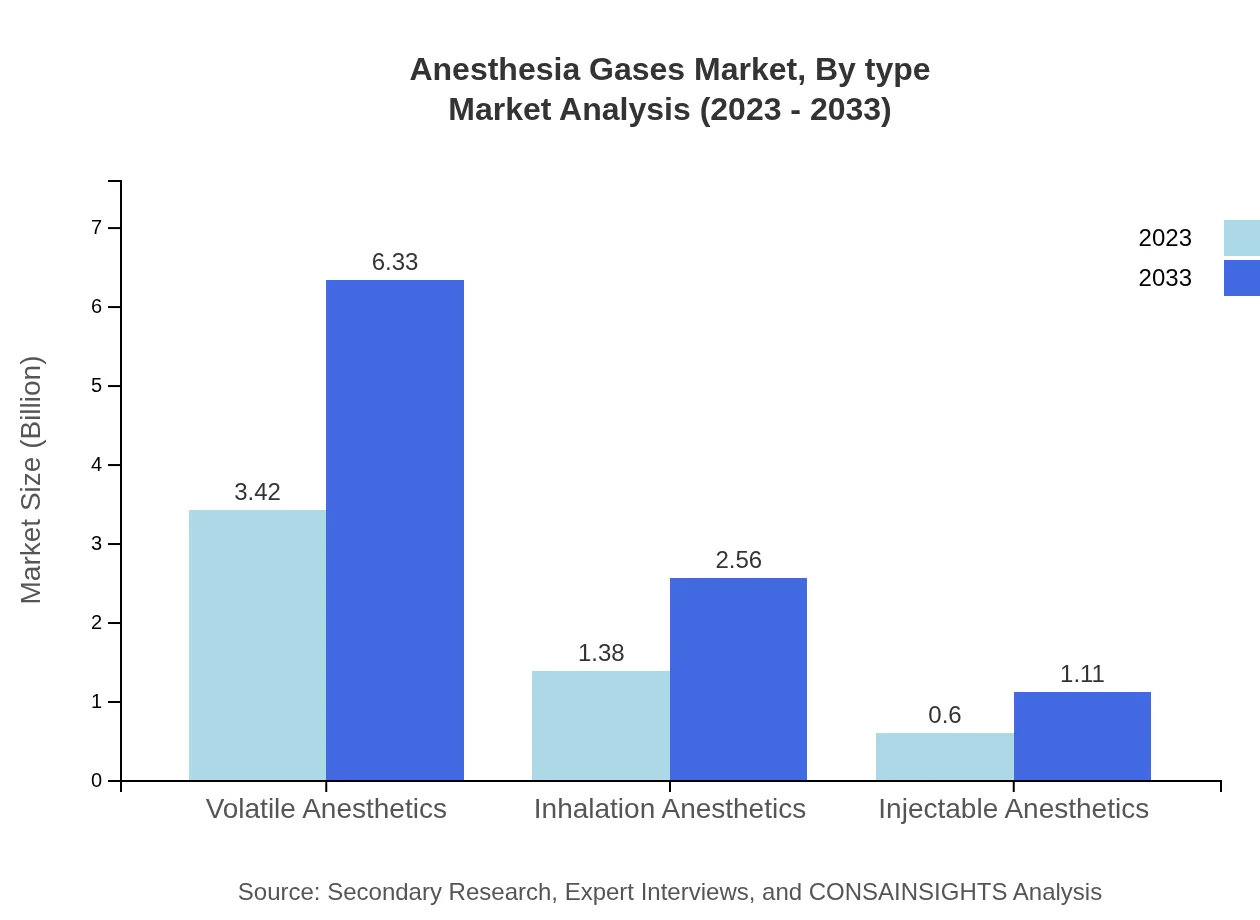
The market by type shows that volatile anesthetics dominate with a market size of $3.42 billion in 2023, expected to grow to $6.33 billion by 2033, holding a 63.29% share. Inhalation anesthetics, valued at $1.38 billion in 2023, are projected to see growth to $2.56 billion by 2033, representing a 25.59% share. Injectable anesthetics have a market size of $0.60 billion in 2023, increasing to $1.11 billion by 2033, with an 11.12% share.
Anesthesia Gases Market Analysis By Usage
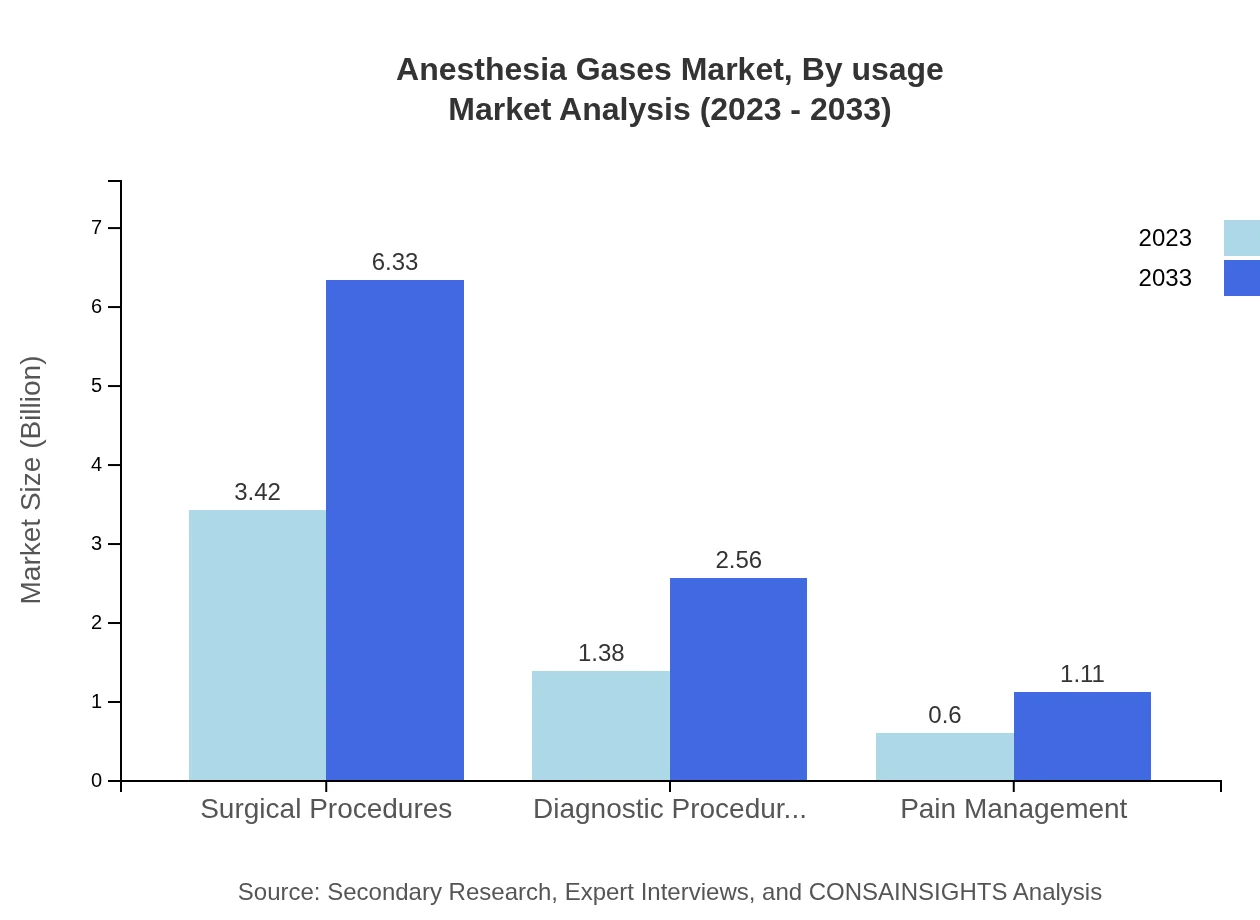
Surgical procedures account for the largest share in usage, with a market size of $3.42 billion in 2023, expected to rise to $6.33 billion by 2033, maintaining a 63.29% share. Diagnostic procedures hold a market size of $1.38 billion in 2023, growing to $2.56 billion by 2033, with a 25.59% share. Pain management represents a smaller segment with a market size of $0.60 billion in 2023 and projected to grow to $1.11 billion by 2033, equating to an 11.12% share.
Anesthesia Gases Market Analysis By End User
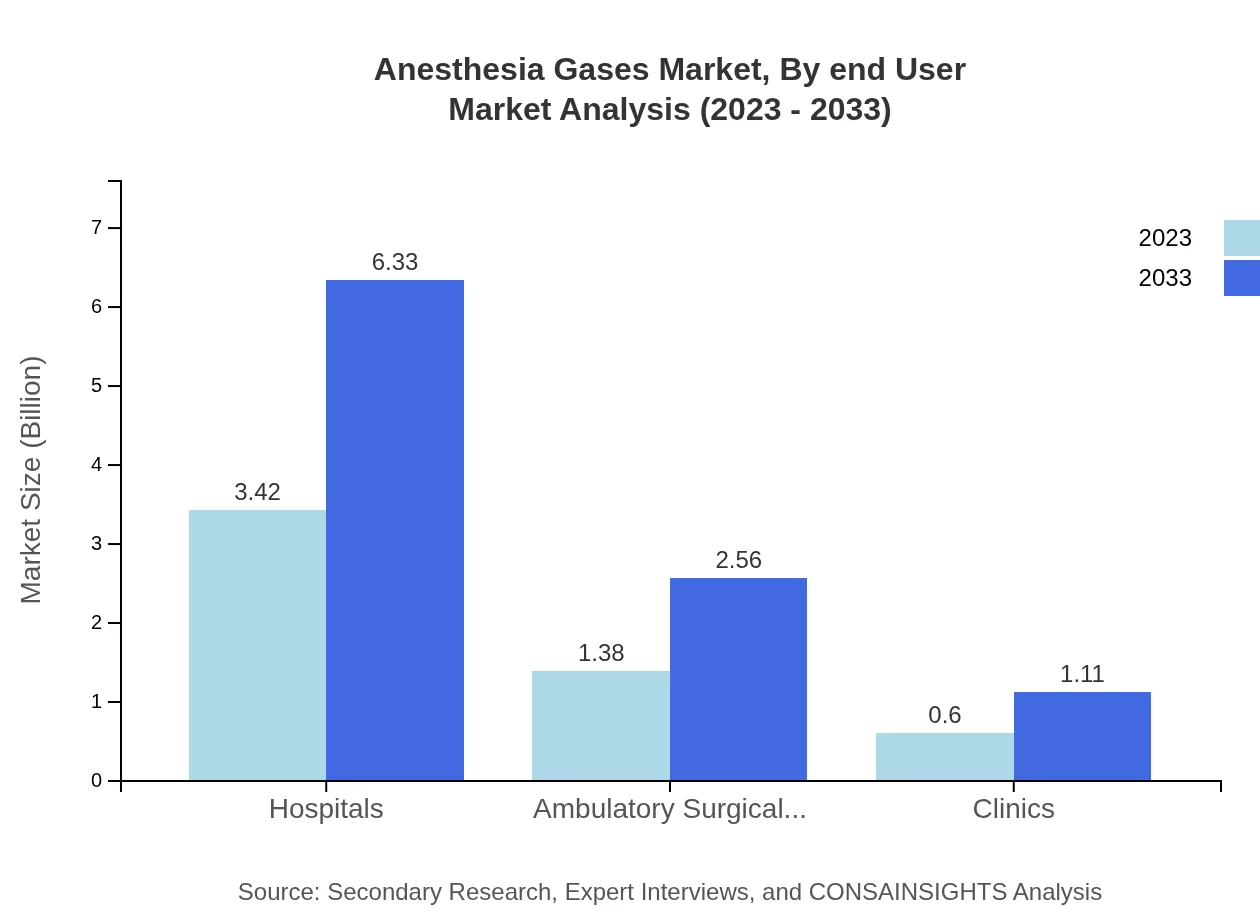
Hospitals significantly lead the end-user segment with a market size of $3.42 billion in 2023, projected to reach $6.33 billion by 2033, maintaining a 63.29% share. Ambulatory surgical centers account for $1.38 billion in 2023, expected to rise to $2.56 billion by 2033, holding a 25.59% share. Clinics represent the smallest segment with a size of $0.60 billion in 2023, increasing to $1.11 billion by 2033, at an 11.12% share.
Anesthesia Gases Market Analysis By Region
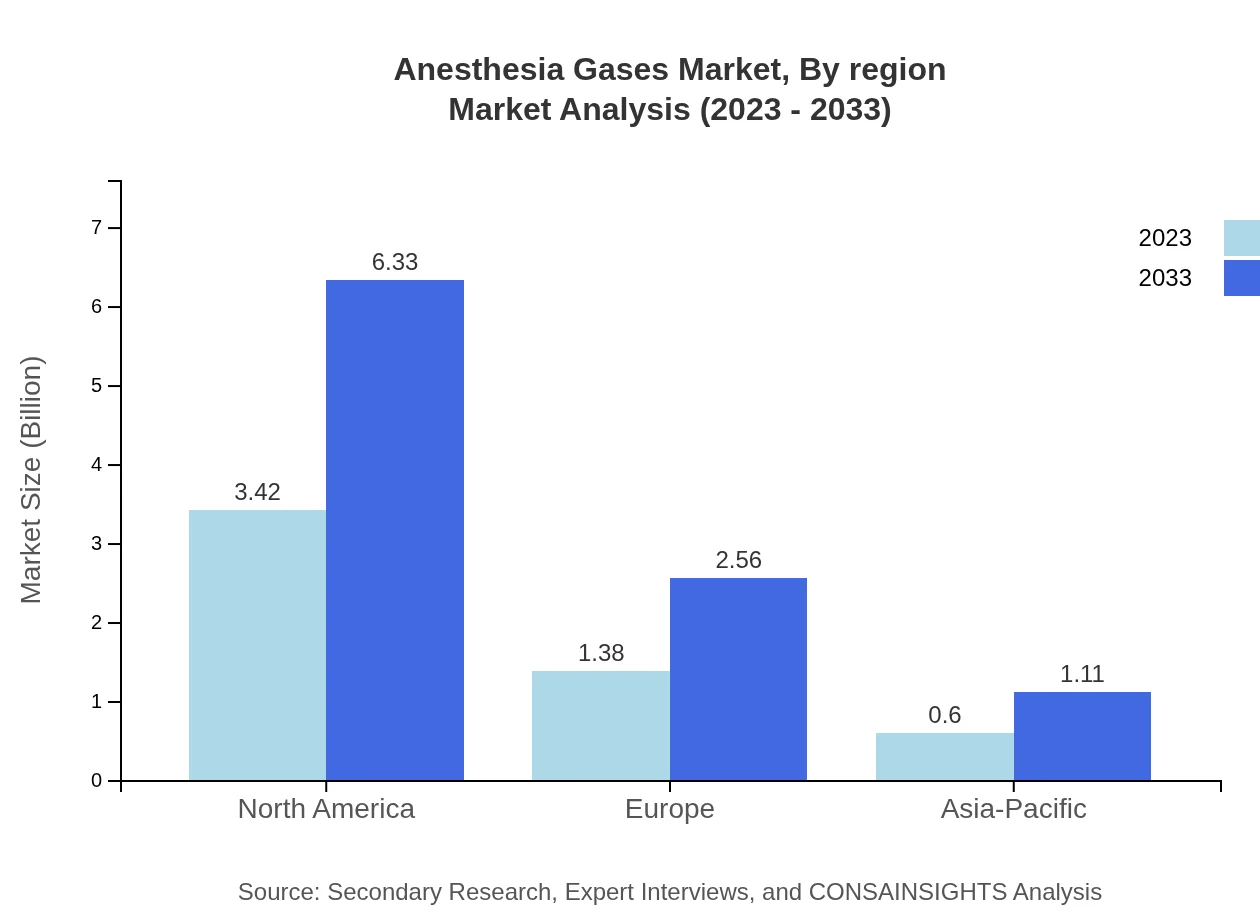
Overall, the regional distribution shows North America leading with substantial market size, followed by Europe, while Asia Pacific is rapidly growing driven by increasing healthcare investments. South America and Middle East and Africa exhibit comparatively lower but positive growth trajectories.
Anesthesia Gases Market Trends and Future Forecast
Tell us your focus area and get a customized research report.
Global Market Leaders and Top Companies in Anesthesia Gases Industry
Abbott Laboratories:
Abbott is a key player in the anesthesia gas market, providing innovative solutions and a wide range of anesthetic agents to healthcare professionals.Baxter International Inc.:
Baxter offers a variety of anesthesia delivery systems and medication, focusing on improving patient outcomes and safety in surgical settings.Medtronic :
Medtronic is recognized for its advanced medical technologies, including anesthesia monitoring and delivery systems, contributing significantly to the market.Fresenius Kabi:
Fresenius Kabi manufactures a range of anesthetic substances, emphasizing quality and efficacy, and is an established player in the global market.GE Healthcare:
GE Healthcare provides advanced imaging and anesthesia delivery systems that enhance safety and improve surgical outcomes.We're grateful to work with incredible clients.









FAQs
What is the market size of the Anesthesia Gases market in 2023?
The market size in 2023 is $5.40 Billion, as stated in the report, reflecting current consumption across clinical and surgical settings.
How big will the market be in 2033?
By 2033 the market is projected to reach $10.01 Billion according to the forecast included in the report.
What is CAGR for the forecast period?
The reported compound annual growth rate (CAGR) for 2023 to 2033 is 6.2% for the Anesthesia Gases market.
Is there a single fastest Growing region in the Anesthesia Gases Market Report market?
No single fastest-growing region is stated for the Anesthesia Gases Market Report market because the top regional implied CAGR values are within 0.15 percentage points of each other, making the ranking too close to call reliably.
Which companies lead the Anesthesia Gases market?
Top companies listed in the report include Abbott Laboratories, Baxter International Inc., Medtronic, Fresenius Kabi, and GE Healthcare.
What are key trends influencing the market?
Primary trends center on improved delivery systems, increased outpatient procedures, and emphasis on safety and sustainability in anesthetic choices.
How are regional markets performing?
Regional performance varies: Europe moves from $1.83 Billion to $3.39 Billion, Asia Pacific from $0.96 Billion to $1.78 Billion, and other regions show steady growth.
What end Users consume most anesthesia gases?
Hospitals, ambulatory surgical centers, and clinics are the main end-users cited, reflecting clinical settings where anesthesia is administered.