

Artificial Insemination Market Report
First published: 07 October 2024 | Last updated: 25 May 2026 | Report Code: artificial-insemination
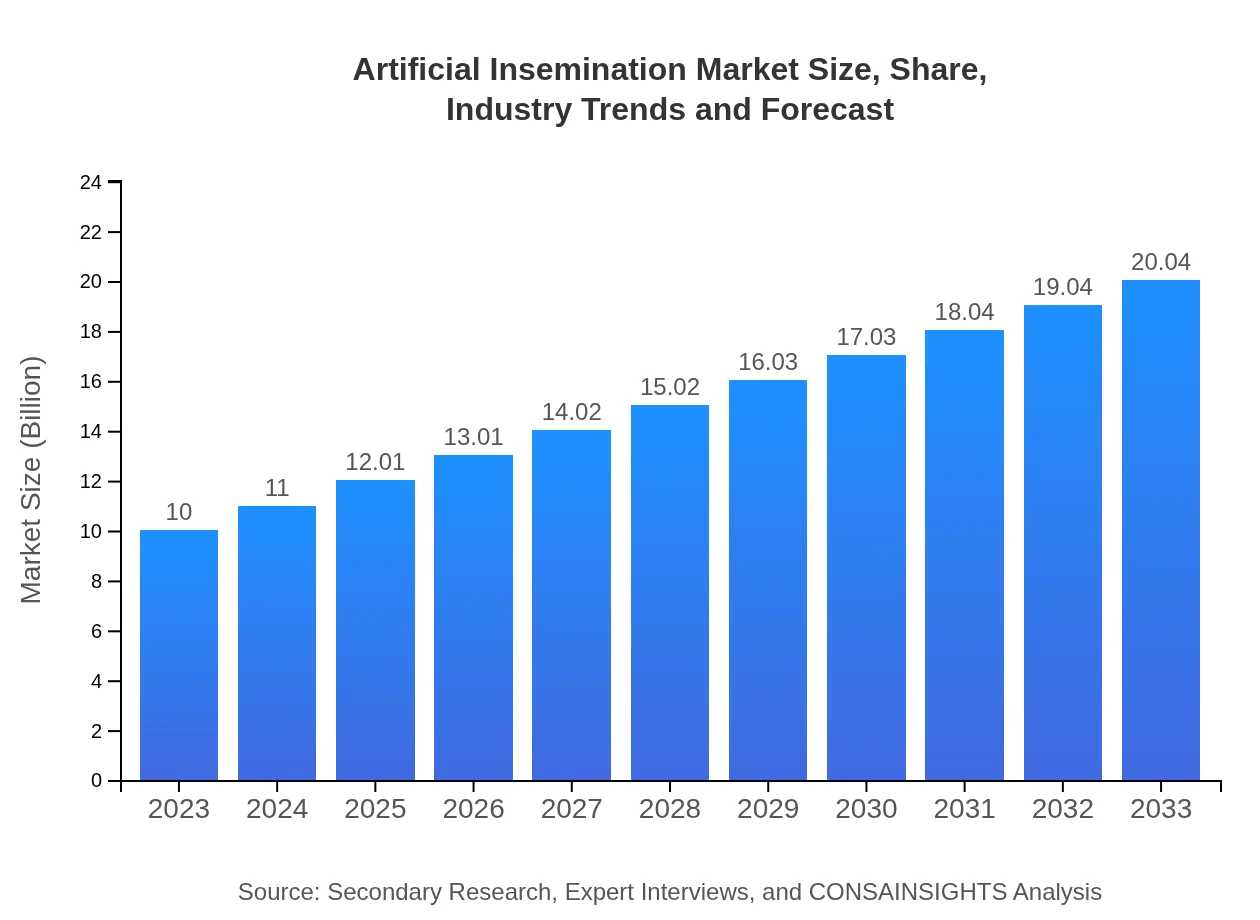
Artificial Insemination Market — USD 10 billion in 2023, Growing to USD 20.04B by 2033 at 7% CAGR
This report provides a comprehensive analysis of the Artificial Insemination market from 2023 to 2033, covering market trends, size, segmentation, and regional insights to offer a well-rounded view of industry dynamics.
Key Takeaways
- Global market expands from $10.00 Billion in 2023 to $20.04 Billion in 2033 at a 7% CAGR.
- North America is largest regional market, while no single fastest-growing region is stated because regional CAGR differences remain within 0.15 percentage points.
- North America is the largest region, increasing from $3.7 Billion in 2023 to $7.42 Billion in 2033.
- Europe grows from $3.16 Billion to $6.33 Billion between 2023 and 2033, reflecting sustained demand.
- Asia Pacific rises from $1.73 Billion in 2023 to $3.46 Billion in 2033, driven by agricultural and clinical adoption.
- Key players include Zoetis, Merck Animal Health, Genus PLC, CooperSurgical, and Dairy Farmers of America.
Artificial Insemination Market Report — Executive Summary
North America remains largest market by forecast-period value, while no single fastest-growing region is stated because top regional growth rates are separated by less than 0.15 percentage points. The report outlines market expansion from $10.00 Billion in 2023 to $20.04 Billion by 2033 at a 7% CAGR. Growth is underpinned by wider adoption of assisted reproductive services in animal husbandry and human fertility, and advances in semen handling, insemination devices, and consumables. Regional demand patterns differ, with North America identified as the largest market. Product and end-user segmentation spans semen, devices, consumables, breeding farms, clinics, and research institutes. Competitive activity is driven by established firms such as Zoetis, Merck Animal Health, Genus PLC, CooperSurgical, and Dairy Farmers of America. Ongoing innovation, regulatory support for reproductive services, and expanding clinical and agricultural applications support sustained expansion through the forecast period.
Key Growth Drivers
- Rising adoption of artificial insemination in livestock operations to improve breeding efficiency and genetic selection.
- Technological improvements in semen preservation, insemination devices, and related consumables increasing success rates.
- Expanded use of assisted reproductive techniques in veterinary clinics and research institutes enhancing service offerings.
- Regulatory and policy frameworks supporting reproductive healthcare and agricultural productivity in several regions.
- Active participation of major companies such as Zoetis and Merck Animal Health accelerating commercialization and distribution.
| Metric | Value |
|---|---|
| Study Period | 2023 - 2033 |
| 2023 Market Size | $10.00 Billion |
| CAGR (2023-2033) | 7% |
| 2033 Market Size | $20.04 Billion |
| Top Companies | Zoetis, Merck Animal Health, Genus PLC, CooperSurgical, Dairy Farmers of America |
| Published Date | 07 October 2024 |
| Last Modified Date | 25 May 2026 |
Artificial Insemination Market Overview
Customize Artificial Insemination Market Report market research report
- ✔ Get in-depth analysis of Artificial Insemination market size, growth, and forecasts.
- ✔ Understand Artificial Insemination's regional dynamics and industry-specific trends.
- ✔ Identify potential applications, end-user demand, and growth segments in Artificial Insemination
What is the Market Size & CAGR of Artificial Insemination Market Report market in 2023?
Artificial Insemination Industry Analysis
Artificial Insemination Market Segmentation and Scope
Tell us your focus area and get a customized research report.
Artificial Insemination Market Report Market Analysis Report by Region
Europe Artificial Insemination Market Report:
Europe grows from $3.16 Billion in 2023 to $6.33 Billion in 2033. Growth is supported by developed agricultural systems, investment in reproductive technologies, and active veterinary and clinical adoption of insemination devices and consumables.Asia Pacific Artificial Insemination Market Report:
Asia Pacific grows from $1.73 Billion in 2023 to $3.46 Billion in 2033. Market momentum is attributed to rising demand for improved livestock productivity, expanding veterinary services, and growing awareness of assisted reproductive techniques.North America Artificial Insemination Market Report:
North America is largest regional market, rising from $3.7 Billion in 2023 to $7.42 Billion in 2033. Regional strength reflects strong veterinary services, advanced breeding industry practices, and established clinical infrastructure supporting both agricultural and fertility applications.South America Artificial Insemination Market Report:
Latin America grows from $0.21 Billion in 2023 to $0.42 Billion in 2033. Expansion is driven by agricultural modernization, adoption of breeding technologies, and growing use of insemination services among livestock producers.Middle East & Africa Artificial Insemination Market Report:
Middle East and Africa grows from $1.21 Billion in 2023 to $2.42 Billion in 2033. Market development is fueled by targeted agricultural initiatives, increased veterinary capacity, and gradual uptake of reproductive technologies in both livestock and clinical contexts.Tell us your focus area and get a customized research report.
Research Methodology
Artificial Insemination Market Analysis By Product
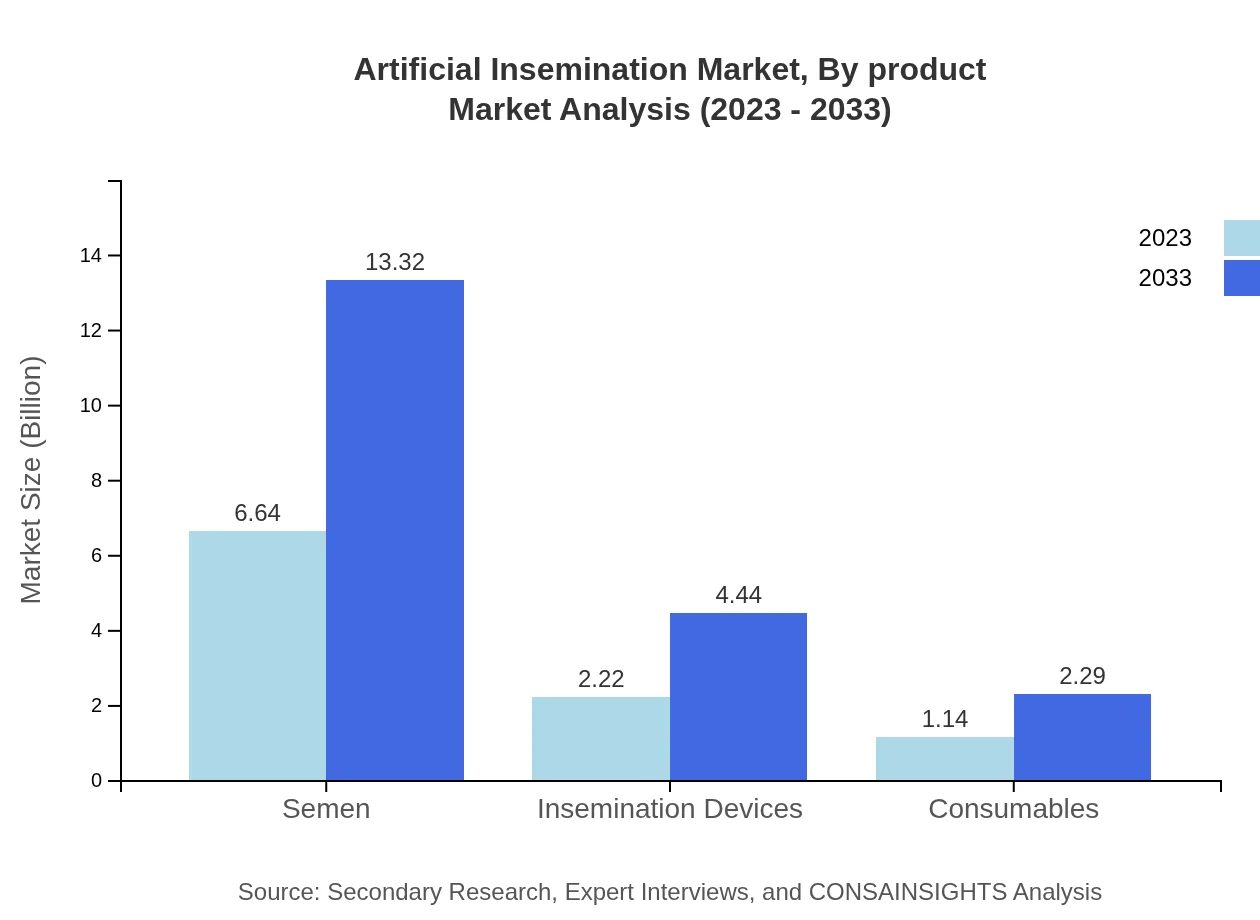
The semen segment dominates the market with a size of $6.64 billion in 2023, expected to double to $13.32 billion by 2033. Insemination devices and consumables follow with market sizes of $2.22 billion and $1.14 billion, respectively in 2023, with expected growth rates reflecting increased adoption in clinical practices.
Artificial Insemination Market Analysis By Animal Type
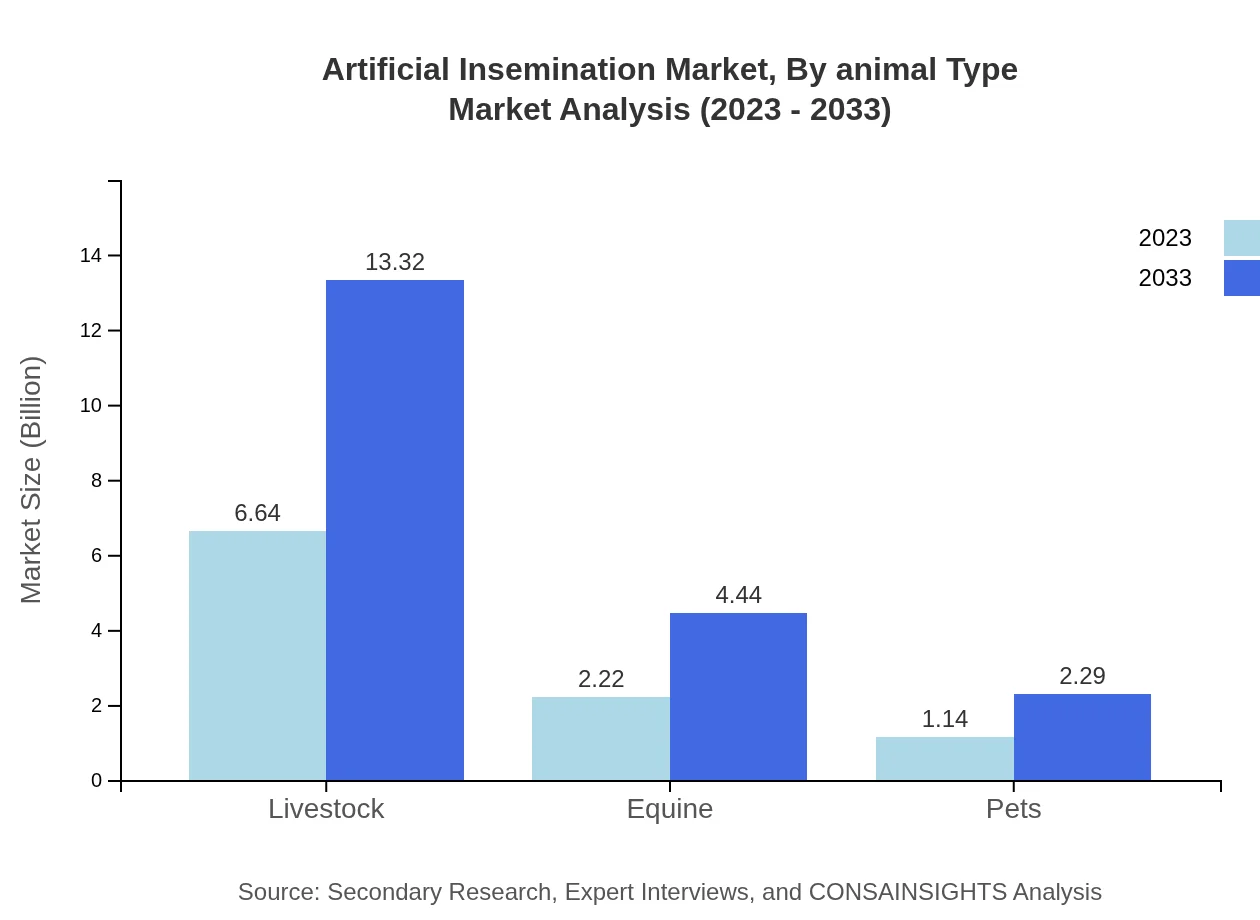
The livestock segment leads, accounting for $6.64 billion in 2023, projected to further increase to $13.32 billion by 2033. Equine and pets comprise sizes of $2.22 billion and $1.14 billion respectively, reflecting substantial investments into breeding practices across these categories.
Artificial Insemination Market Analysis By Technique
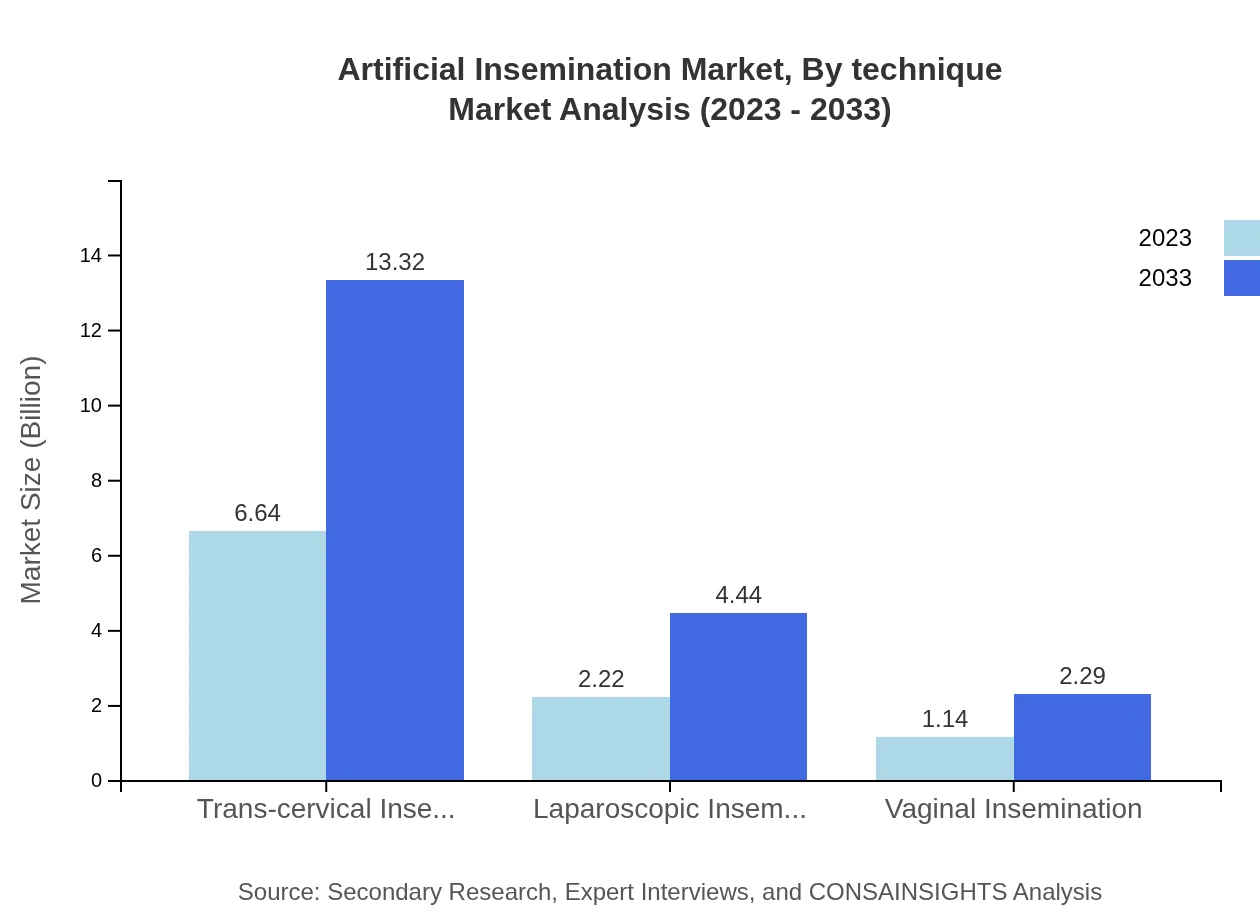
Trans-cervical insemination is the key technique, estimated to be valued at $6.64 billion in 2023. Laparoscopic and vaginal insemination hold shares of $2.22 billion and $1.14 billion, indicating varied preferences based on application and result efficacy.
Artificial Insemination Market Analysis By End User
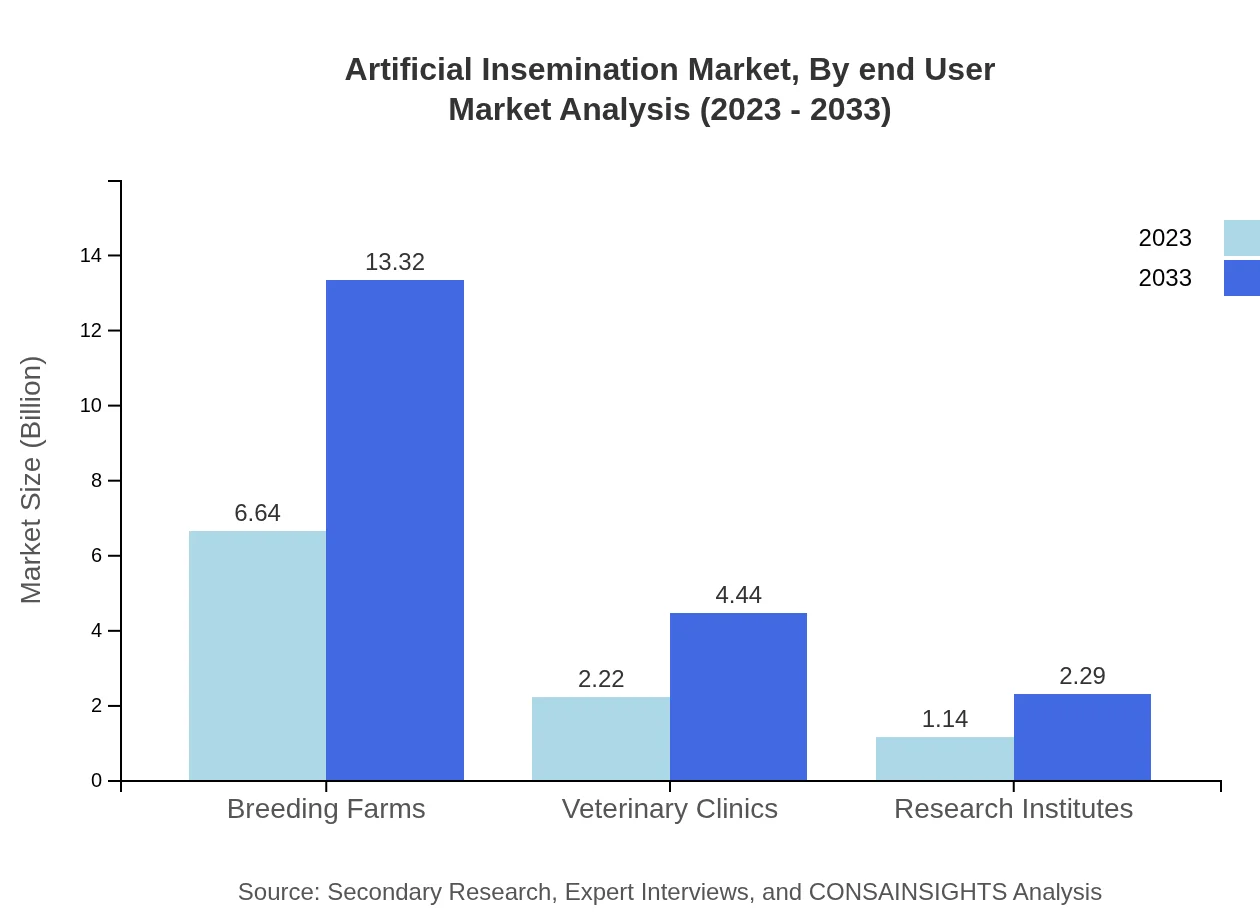
Breeding farms lead with a market size of $6.64 billion in 2023, while veterinary clinics follow closely at $2.22 billion. Research institutes remain critical, representing $1.14 billion, highlighting the significance of end users in shaping industry advances.
Artificial Insemination Market Analysis By Region Category
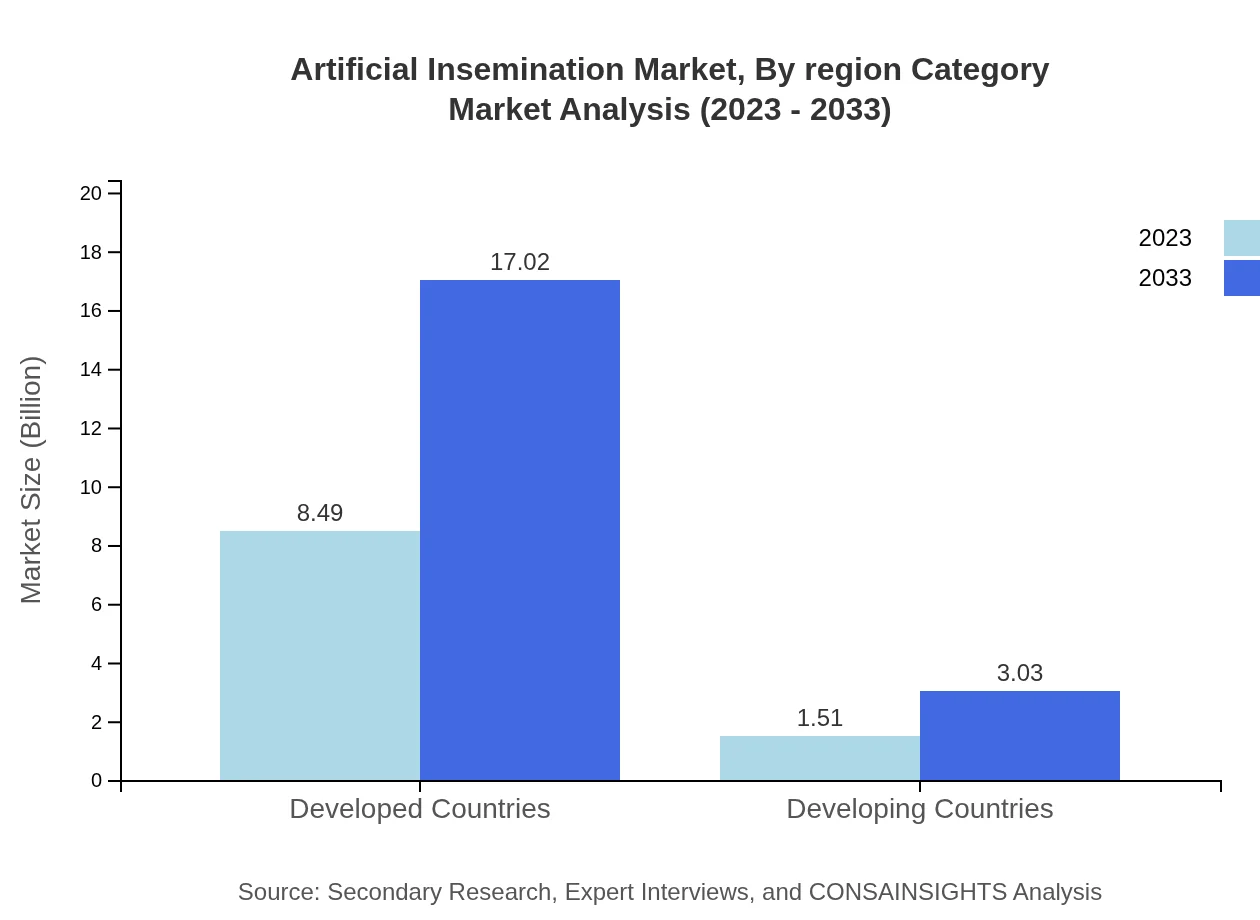
The market landscape varies significantly across regions with developed countries representing $8.49 billion in 2023 and projected to reach $17.02 billion by 2033, while developing countries capture $1.51 billion, suggesting substantial growth potential and investment opportunities.
Artificial Insemination Market Trends and Future Forecast
Tell us your focus area and get a customized research report.
Global Market Leaders and Top Companies in Artificial Insemination Industry
Zoetis:
A leading global animal health and biotechnology company focusing on innovation in reproduction and artificial insemination technologies for livestock.Merck Animal Health:
A division of Merck & Co., Inc., offering a comprehensive portfolio in animal reproduction services including artificial insemination products.Genus PLC:
A global leader in animal genetics, specializing in artificial insemination and breeding technologies for enhancing livestock production.CooperSurgical:
A prominent company in the healthcare sector with focus on reproductive health technologies including tools for assisted reproduction.Dairy Farmers of America:
A key player in dairy production, with robust breeding programs incorporating artificial insemination for improving herd genetics.We're grateful to work with incredible clients.








FAQs
What is the market size of the artificial insemination market in 2023?
The market size in 2023 is $10.00 Billion, reflecting combined demand across animal breeding, veterinary services, and related consumables and devices.
How big will the artificial insemination market be in 2033?
By 2033 the market is projected to reach $20.04 Billion, based on the reported forecast covering product, technique, end-user, and regional growth factors.
What is CAGR for the forecast period?
The market is forecast to grow at a 7% CAGR over the period 2023 to 2033, driven by technological adoption and broader clinical and agricultural use.
Is there a single fastest Growing region in the Artificial Insemination Market Report market?
No single fastest-growing region is stated for the Artificial Insemination Market Report market because the top regional implied CAGR values are within 0.15 percentage points of each other, making the ranking too close to call reliably.
Who are the leading companies in this market?
Top companies listed include Zoetis, Merck Animal Health, Genus PLC, CooperSurgical, and Dairy Farmers of America across veterinary and breeding segments.
What are the primary product segments covered?
Product segments include Semen, Insemination Devices, and Consumables, addressing handling, delivery, and supporting materials for procedures.
Why are research institutes included as end users?
Research institutes participate in method development, validation, and innovation for reproductive technologies, contributing to clinical and agricultural improvements.
What drives adoption in veterinary clinics?
Veterinary clinic uptake is propelled by demand for reproductive services, improved insemination techniques, and availability of supportive devices and consumables.