
Reports >
Life Sciences
>
Bcaa Market Report

Bcaa Market Report
First published: 11 October 2024 | Last updated: 25 May 2026 | Report Code: bcaa
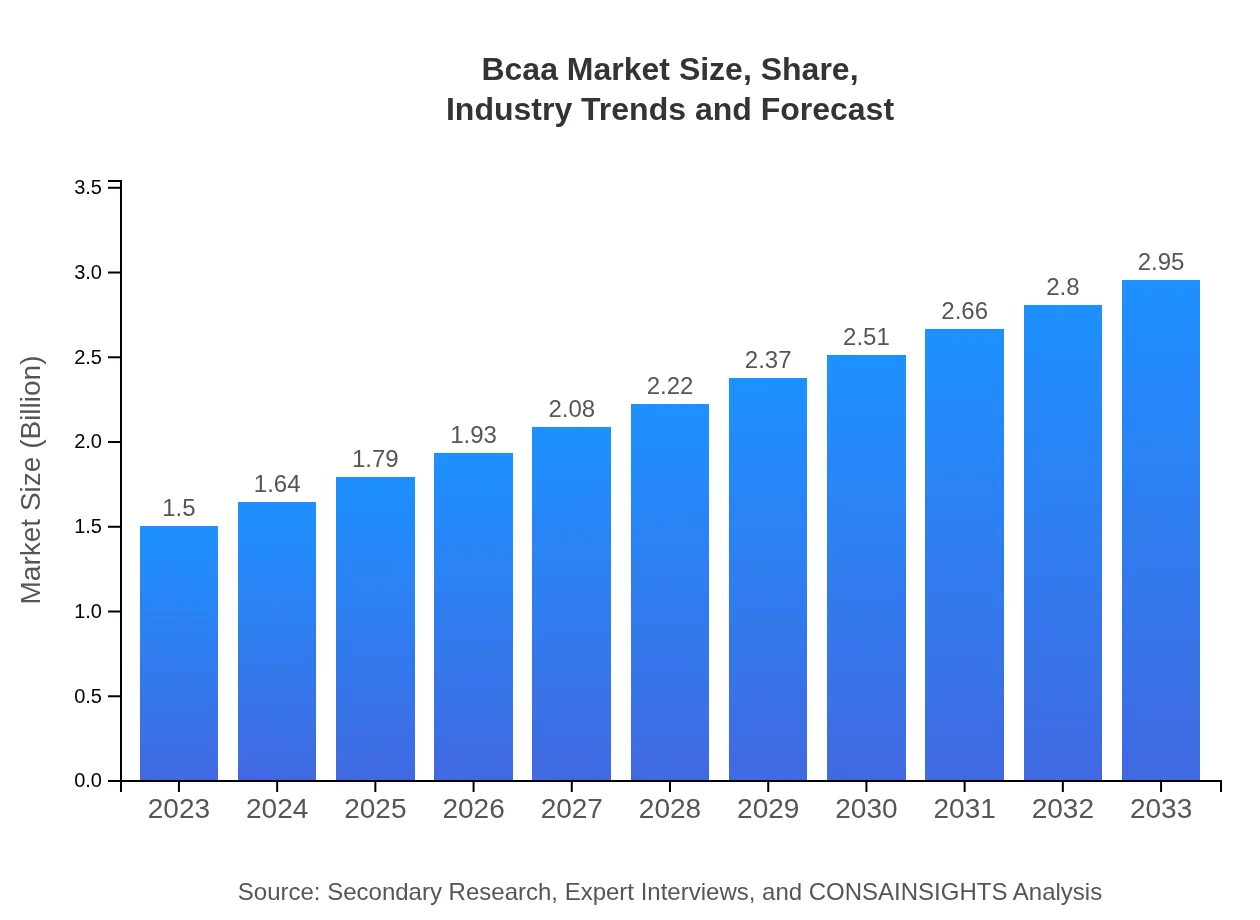
Bcaa Market — USD 1.5 billion in 2023, Growing to USD 2.95B by 2033 at 6.8% CAGR
This report covers an extensive analysis of the BCAA market, providing insights into market trends, size, segmentation, and growth forecasts from 2023 to 2033. It also examines regional dynamics and the impact of technological advancements on the industry.
Key Takeaways
- Global market grows from $1.50 Billion in 2023 to $2.95 Billion by 2033 at a 6.8% CAGR.
- North America is largest regional market, while no single fastest-growing region is stated because regional CAGR differences remain within 0.15 percentage points.
- North America is the largest region, rising from $0.49 Billion in 2023 to $0.95 Billion in 2033.
- Product formats include powders, capsules, and liquids across branded and unbranded offerings.
- Leading vendors include Optimum Nutrition, BSN, MusclePharm, Cellucor, and Dymatize Nutrition.
- Distribution is split between online and offline channels, reflecting evolving purchase behaviors.
Bcaa Market Report — Executive Summary
North America remains largest market by forecast-period value, while no single fastest-growing region is stated because top regional growth rates are separated by less than 0.15 percentage points. Demand for branched-chain amino acids is driven by growing health and fitness awareness, expanded product formats, and retail channel diversification. The market moves from $1.50 Billion in 2023 to $2.95 Billion in 2033 at a 6.8% CAGR for the 2023 to 2033 forecast period. Key trends include format innovation across powders, capsules, and liquids, rising interest in plant-based formulations, and greater availability through online platforms. North America is identified as the largest regional market, with a rise from $0.49 Billion to $0.95 Billion over the forecast period. Prominent firms such as Optimum Nutrition, BSN, MusclePharm, Cellucor, and Dymatize Nutrition shape competitive dynamics through product development and marketing. The report is structured to cover market sizing, segmentation by type, form, application, and distribution channel, regional breakdowns, and an assessment of strategic moves by vendors and channel partners.
Key Growth Drivers
- Rising participation in fitness activities increases demand for muscle recovery supplements.
- Wider consumer awareness of dietary supplementation supports expanded market adoption.
- Format innovation—powders, capsules, and liquids—broadens appeal across user preferences.
- Growth of e-commerce channels improves product accessibility and consumer reach.
- Product differentiation by branded versus unbranded offerings sustains market segmentation and choice.
| Metric | Value |
|---|---|
| Study Period | 2023 - 2033 |
| 2023 Market Size | $1.50 Billion |
| CAGR (2023-2033) | 6.8% |
| 2033 Market Size | $2.95 Billion |
| Top Companies | Optimum Nutrition, BSN, MusclePharm, Cellucor, Dymatize Nutrition |
| Published Date | 11 October 2024 |
| Last Modified Date | 25 May 2026 |
Bcaa Market Overview
Customize Bcaa Market Report market research report
- ✔ Get in-depth analysis of Bcaa market size, growth, and forecasts.
- ✔ Understand Bcaa's regional dynamics and industry-specific trends.
- ✔ Identify potential applications, end-user demand, and growth segments in Bcaa
What is the Market Size & CAGR of Bcaa Market Report market in 2023?
Bcaa Industry Analysis
Bcaa Market Segmentation and Scope
Tell us your focus area and get a customized research report.
Bcaa Market Report Market Analysis Report by Region
Europe Bcaa Market Report:
Europe grows from $0.39 Billion in 2023 to $0.77 Billion in 2033. Regional demand is influenced by expanding health consciousness, uptake of dietary supplements, and product diversification into powders, capsules, and liquid formats.Asia Pacific Bcaa Market Report:
Asia Pacific grows from $0.29 Billion in 2023 to $0.58 Billion in 2033. Market expansion reflects increasing fitness participation, greater consumer awareness of supplementation, and rising availability through online retail channels.North America Bcaa Market Report:
North America is largest regional market, rising from $0.49 Billion in 2023 to $0.95 Billion in 2033. This growth is linked to high fitness engagement, established sports nutrition channels, and significant presence of leading brands that drive product availability and innovation.South America Bcaa Market Report:
Latin America grows from $0.13 Billion in 2023 to $0.26 Billion in 2033. Growth stems from rising interest in fitness and bodybuilding supplements, expanding distribution networks, and gradual increases in consumer health spending.Middle East & Africa Bcaa Market Report:
Middle East and Africa grows from $0.2 Billion in 2023 to $0.39 Billion in 2033. Drivers include growing adoption of sports nutrition products, improved retail and e-commerce access, and heightened consumer focus on dietary support.Tell us your focus area and get a customized research report.
Research Methodology
Bcaa Market Analysis By Type
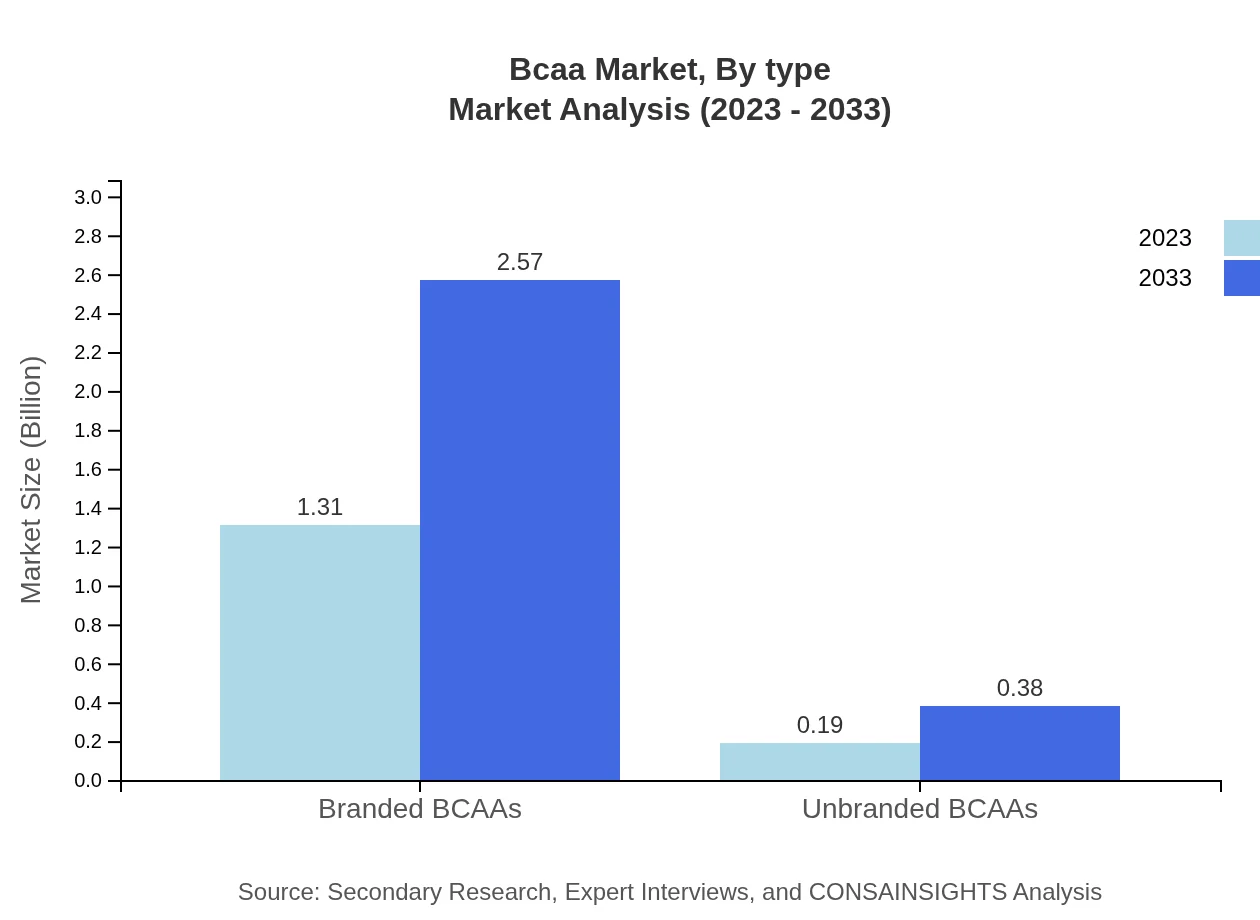
The BCAA market is primarily categorized into branded and unbranded products. In 2023, branded BCAAs accounted for $1.31 billion, with a market share of 87.18%, which is expected to grow to $2.57 billion by 2033. Unbranded BCAAs held a smaller market share at 12.82%, with a growth expectation from $0.19 billion in 2023 to $0.38 billion by 2033.
Bcaa Market Analysis By Form
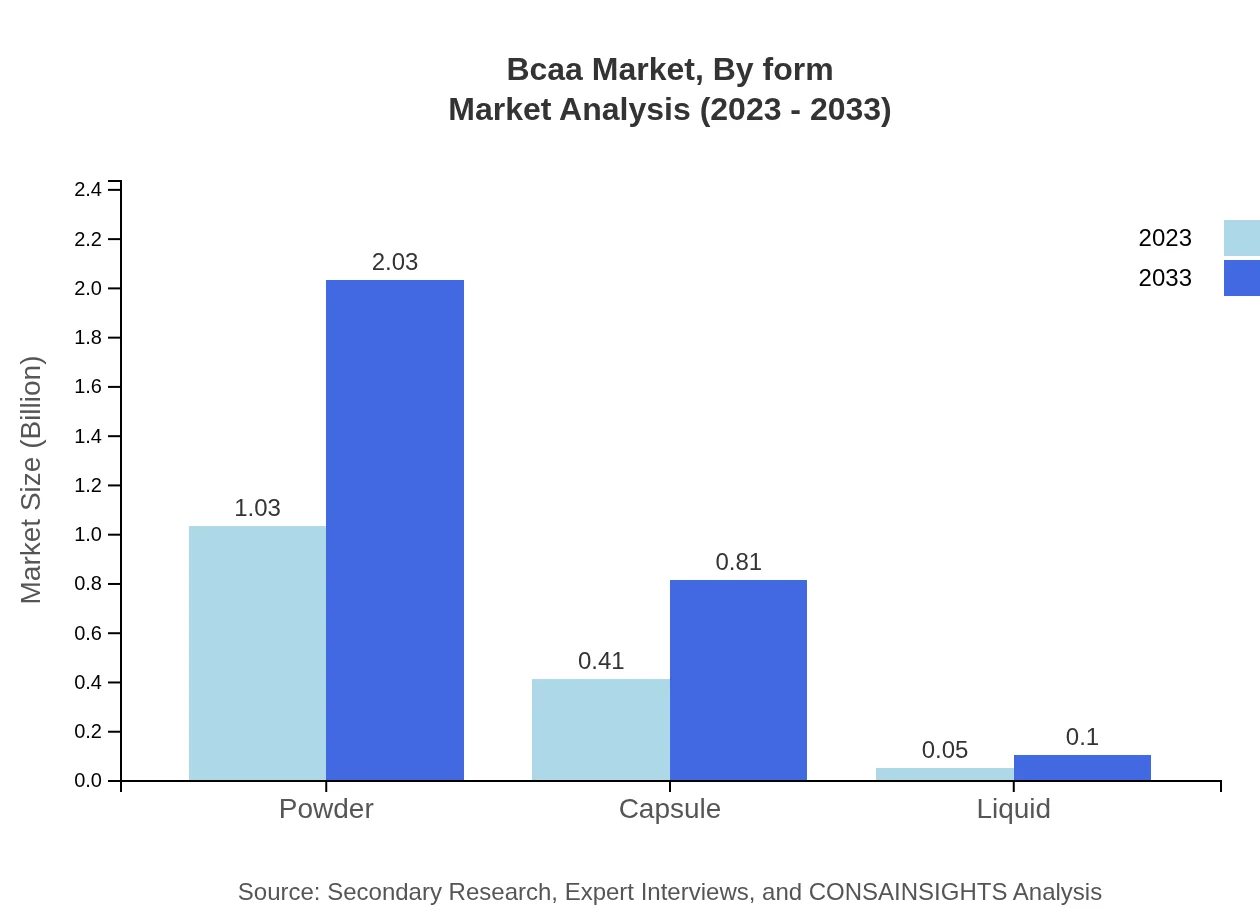
BCAA products are available in three primary forms: Powder, Capsule, and Liquid. The Powder segment is the largest, valued at $1.03 billion in 2023, and projected to reach $2.03 billion by 2033. Capsules and liquids, with initial market sizes of $0.41 billion and $0.05 billion respectively, are anticipated to grow to $0.81 billion and $0.10 billion over the same period.
Bcaa Market Analysis By Application
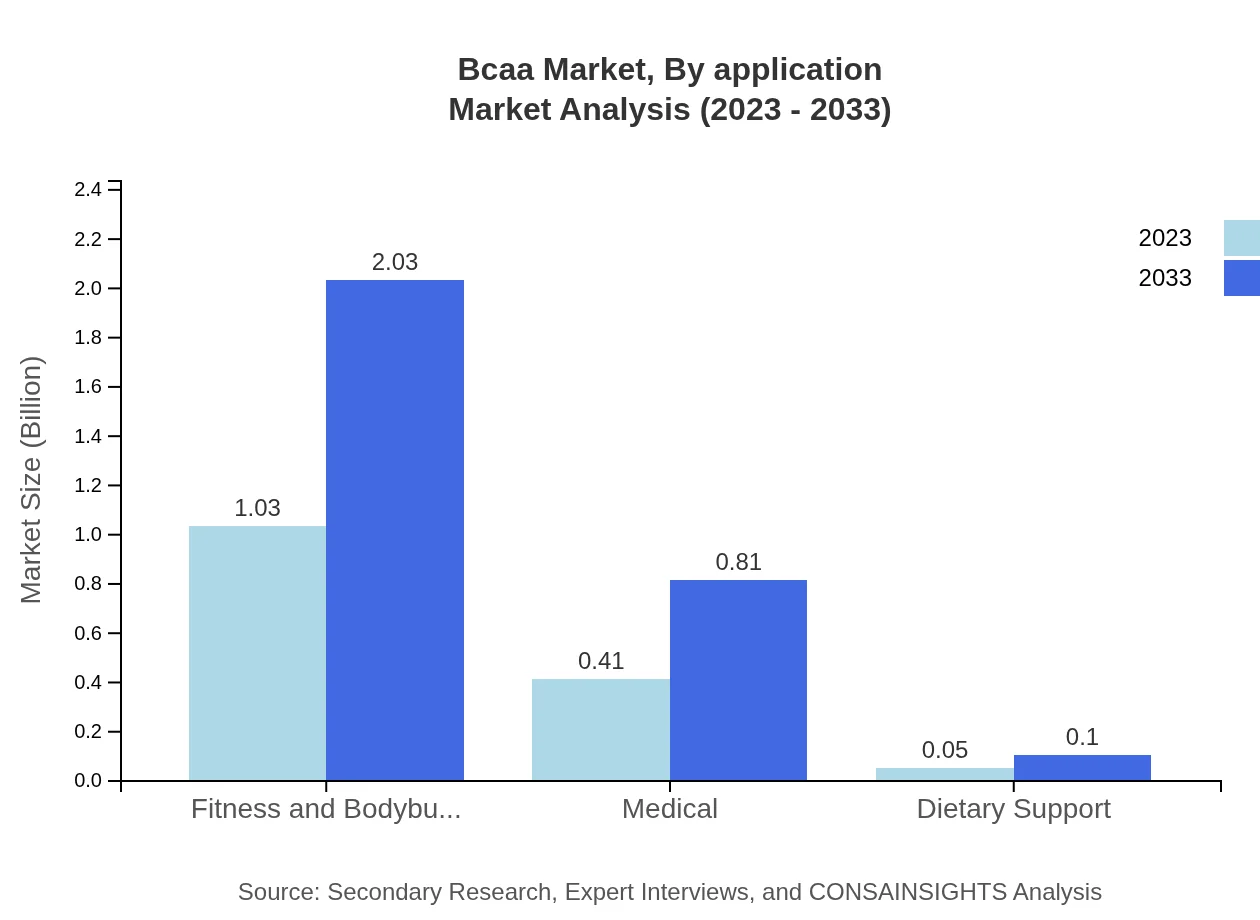
In terms of application, the Fitness and Bodybuilding segment dominates with a size of $1.03 billion in 2023, expected to double to $2.03 billion by 2033. The Medical application follows, growing from $0.41 billion to $0.81 billion, while Dietary Support currently accounts for $0.05 billion, projected to reach $0.10 billion.
Bcaa Market Analysis By Distribution Channel
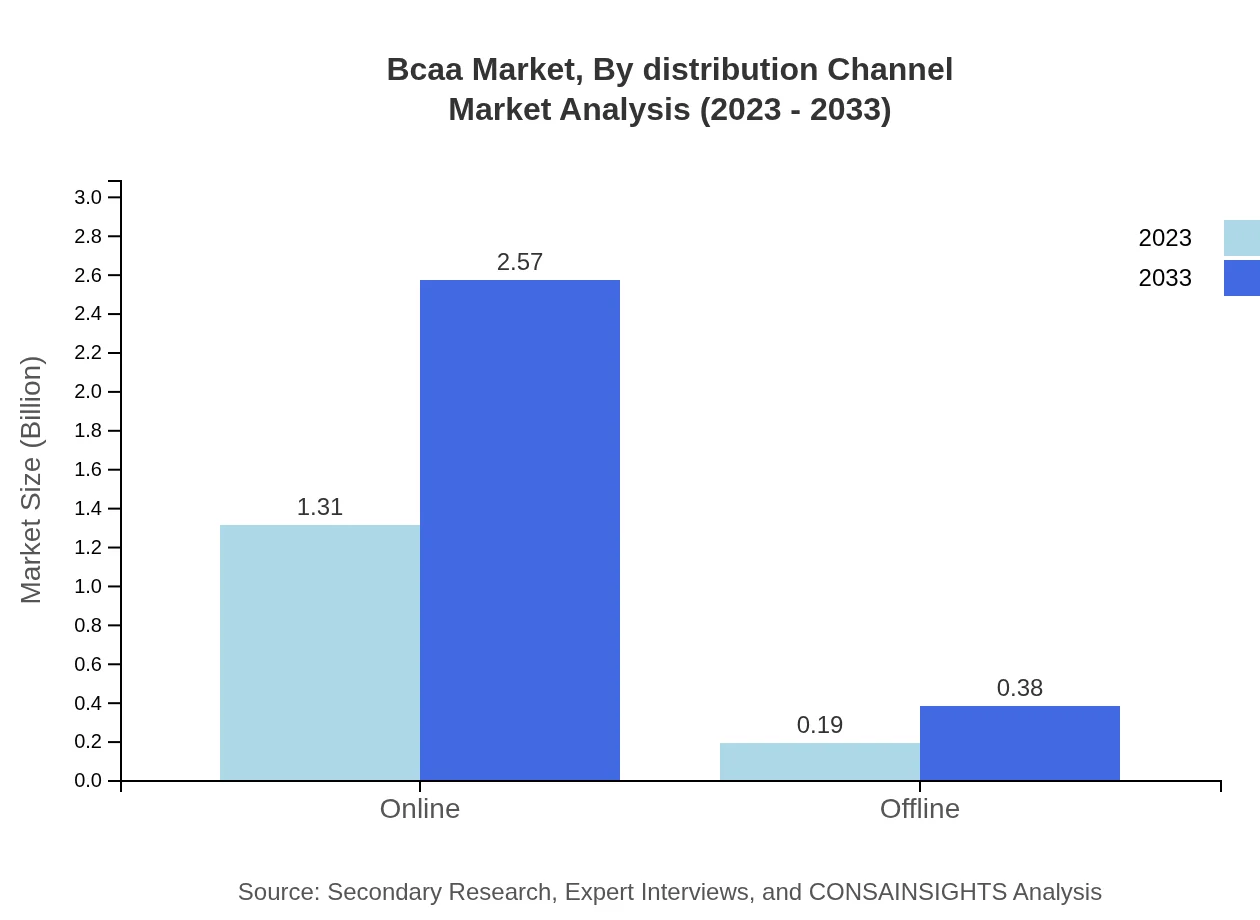
The distribution of BCAA products is bifurcated into online and offline channels. The online segment leads with $1.31 billion in 2023, projected to grow to $2.57 billion, while the offline segment, starting at $0.19 billion, is expected to reach $0.38 billion by 2033, reflecting an overall shift towards e-commerce in health product sales.
Bcaa Market Trends and Future Forecast
Tell us your focus area and get a customized research report.
Global Market Leaders and Top Companies in Bcaa Industry
Optimum Nutrition:
Optimum Nutrition is regarded as a leading name in the sports nutrition sector, offering a variety of BCAA products that focus on muscle recovery and performance enhancement.BSN:
BSN is renowned for its high-quality performance supplements, including BCAAs, and has a strong presence in fitness markets globally due to its innovative marketing strategies.MusclePharm:
MusclePharm is committed to offering science-driven, high-quality BCAA products catering to athletes and fitness enthusiasts, enhancing its reputation in the sports nutrition community.Cellucor:
Cellucor specializes in performance-enhancing supplements, with a particular focus on BCAA formulations that support muscle recovery and endurance, appealing to a diverse clientele.Dymatize Nutrition:
Dymatize is recognized for its premium BCAA products, emphasizing quality and efficacy, while consistently innovating to meet consumer demands in the health and fitness market.We're grateful to work with incredible clients.







FAQs
What is the market size of the Bcaa Market Report in 2023?
The market size for 2023 is $1.50 Billion as stated in the report, representing the baseline for the 2023 to 2033 forecast period and subsequent growth analysis.
How big will the market be in 2033?
By 2033 the market is projected to reach $2.95 Billion, reflecting growth across formats, channels, and regional demand throughout the 2023 to 2033 timeframe.
What is CAGR of the market for the forecast period?
The compound annual growth rate for the 2023 to 2033 forecast period is 6.8%, derived from the reported market values for 2023 and 2033.
Is there a single fastest Growing region in the Bcaa Market Report market?
No single fastest-growing region is stated for the Bcaa Market Report market because the top regional implied CAGR values are within 0.15 percentage points of each other, making the ranking too close to call reliably.
Which product forms are covered in the segmentation?
Segmentation includes product forms such as Powder, Capsule, and Liquid, reflecting the range of delivery formats available to consumers and athletes.
Who are the top companies in the market?
Top companies listed include Optimum Nutrition, BSN, MusclePharm, Cellucor, and Dymatize Nutrition, which influence product innovation and market outreach.
What distribution channels are analyzed?
The report evaluates Online and Offline distribution channels, indicating how e-commerce and traditional retail both contribute to product availability and sales.
How was the research conducted?
Research combined primary interviews with industry experts and secondary sources like company reports, followed by data triangulation and internal validation to ensure robust findings.