
Reports >
Life Sciences
>
Brain Computer Interface Market Report

Brain Computer Interface Market Report
First published: 11 October 2024 | Last updated: 28 May 2026 | Report Code: brain-computer-interface
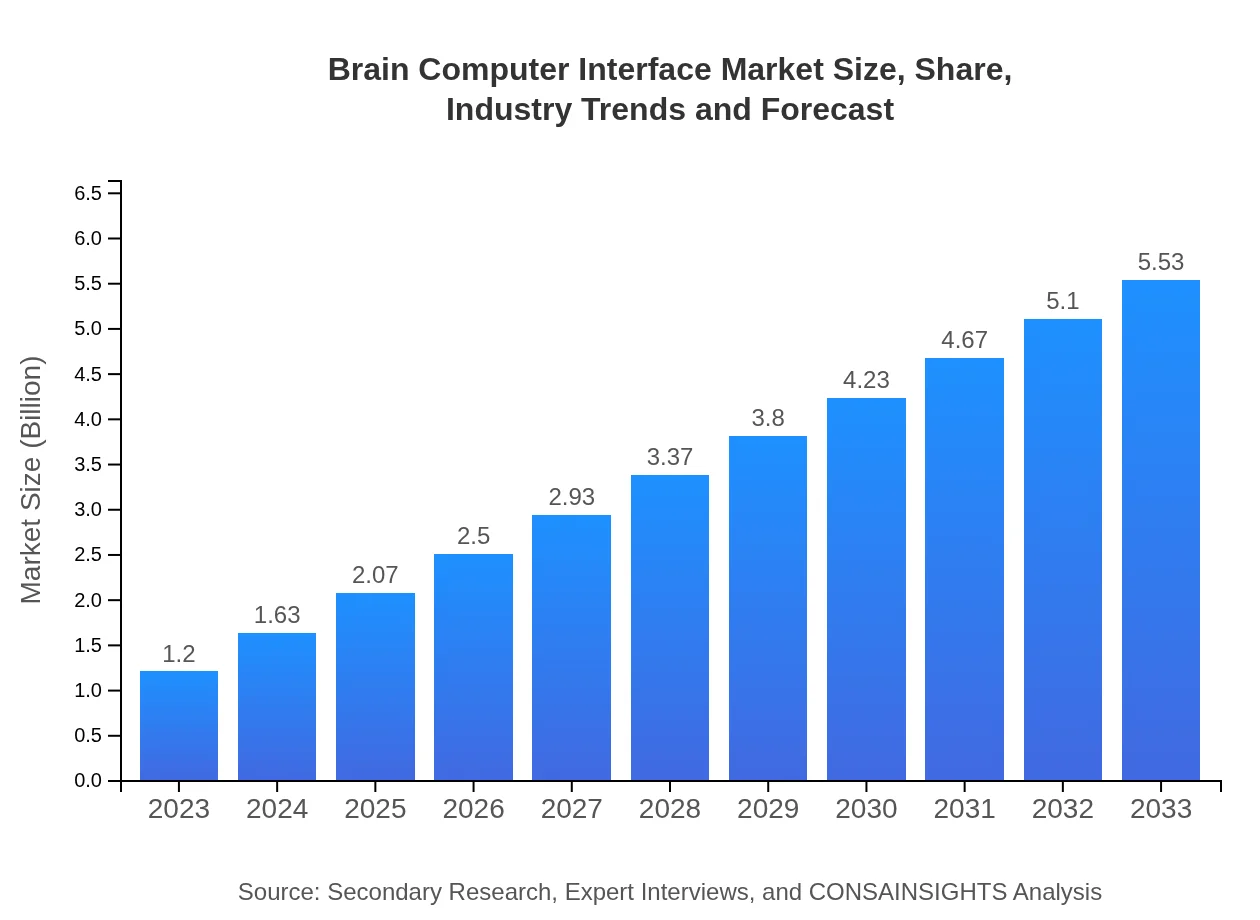
Brain Computer Interface Market — USD 1.2 billion in 2023, Growing to USD 5.53B by 2033 at 15.7% CAGR
This report provides an in-depth analysis of the Brain Computer Interface market from 2023 to 2033, highlighting key insights on market size, growth trends, regional performance, and technological advancements shaping the industry.
Key Takeaways
- Global market expands from $1.20 Billion in 2023 to $5.53 Billion in 2033 with a 15.7% CAGR over 2023 to 2033.
- North America leads regionally, rising from $0.45 Billion in 2023 to $2.06 Billion in 2033.
- North America is largest regional market; Middle East and Africa is regional market region based on implied CAGR across 2023 to 2033.
- Europe and Asia Pacific show notable growth: Europe from $0.33 Billion to $1.51 Billion; Asia Pacific from $0.23 Billion to $1.06 Billion.
- Key providers named include Neurosky, Emotiv, BrainGate, and Kernel, spanning hardware, software, and services.
Brain Computer Interface Market Report — Executive Summary
Regional analysis shows North America as largest market and Middle East and Africa as fastest-growing region by implied CAGR. This report provides a structured view of the Brain Computer Interface market, documenting expansion from $1.20 Billion in 2023 to $5.53 Billion by 2033 and an overall CAGR of 15.7% for 2023 to 2033. Growth is driven by investments in neuroscience, integration with advanced analytics, and cross-sector use cases spanning medical rehabilitation, gaming, smart home control, and defense. The market structure covers components (hardware, software, services), technologies (invasive, non-invasive, semi-invasive), and end users such as healthcare providers, educational institutions, defense agencies, game developers, and technology companies. Regional breakdown highlights North America as the largest market and the Middle East and Africa as the regional market region. Major industry participants listed include Neurosky, Emotiv, BrainGate, and Kernel. The report combines primary interviews, secondary sources, and data validation to inform strategic decisions for stakeholders focused on product development, partnerships, and regulatory navigation.
Key Growth Drivers
- Advances in neurotechnology and sensor miniaturization enabling more reliable hardware solutions.
- Increased collaboration between tech firms and healthcare providers accelerating clinical and consumer use cases.
- Rising investment in research and development supporting novel applications in rehabilitation and entertainment.
- Broadening software capabilities and analytics that improve signal processing and user interfaces.
- Growing interest from defense and space agencies and technology companies expanding deployment scenarios.
| Metric | Value |
|---|---|
| Study Period | 2023 - 2033 |
| 2023 Market Size | $1.20 Billion |
| CAGR (2023-2033) | 15.7% |
| 2033 Market Size | $5.53 Billion |
| Top Companies | Neurosky, Emotiv, BrainGate, Kernel |
| Published Date | 11 October 2024 |
| Last Modified Date | 28 May 2026 |
Brain Computer Interface Market Overview
Customize Brain Computer Interface Market Report market research report
- ✔ Get in-depth analysis of Brain Computer Interface market size, growth, and forecasts.
- ✔ Understand Brain Computer Interface's regional dynamics and industry-specific trends.
- ✔ Identify potential applications, end-user demand, and growth segments in Brain Computer Interface
What is the Market Size & CAGR of Brain Computer Interface Market Report market in 2023?
Brain Computer Interface Industry Analysis
Brain Computer Interface Market Segmentation and Scope
Tell us your focus area and get a customized research report.
Brain Computer Interface Market Report Market Analysis Report by Region
Europe Brain Computer Interface Market Report:
Europe grows from $0.33 Billion in 2023 to $1.51 Billion in 2033. Regional momentum stems from R&D activity, regulatory frameworks supportive of clinical applications, and collaborations between research institutions and commercial developers.Asia Pacific Brain Computer Interface Market Report:
Asia Pacific grows from $0.23 Billion in 2023 to $1.06 Billion in 2033. This progression is driven by growing technology company engagement, rising healthcare adoption, and expanding use cases in consumer and clinical settings.North America Brain Computer Interface Market Report:
North America is largest regional market, rising from $0.45 Billion in 2023 to $2.06 Billion in 2033. The region’s scale reflects concentrated clinical trials, industry investment, and early commercial deployment across healthcare providers and technology companies, supporting hardware and software expansion.South America Brain Computer Interface Market Report:
Latin America grows from $0.1 Billion in 2023 to $0.46 Billion in 2033. Market growth is influenced by increasing awareness of medical BCI applications, emerging technology adoption, and partnerships that bring hardware and service models to local providers.Middle East & Africa Brain Computer Interface Market Report:
Middle East and Africa is fastest-growing region by implied CAGR, increasing from $0.09 Billion in 2023 to $0.44 Billion in 2033. 09 Billion in 2023 to $0.44 Billion in 2033 and is identified as the regional growth market with an implied 17.20% CAGR. Growth drivers include targeted government and defense interest, pilot deployments, and rising investment in research infrastructure.Tell us your focus area and get a customized research report.
Research Methodology
Brain Computer Interface Market Analysis By Technology
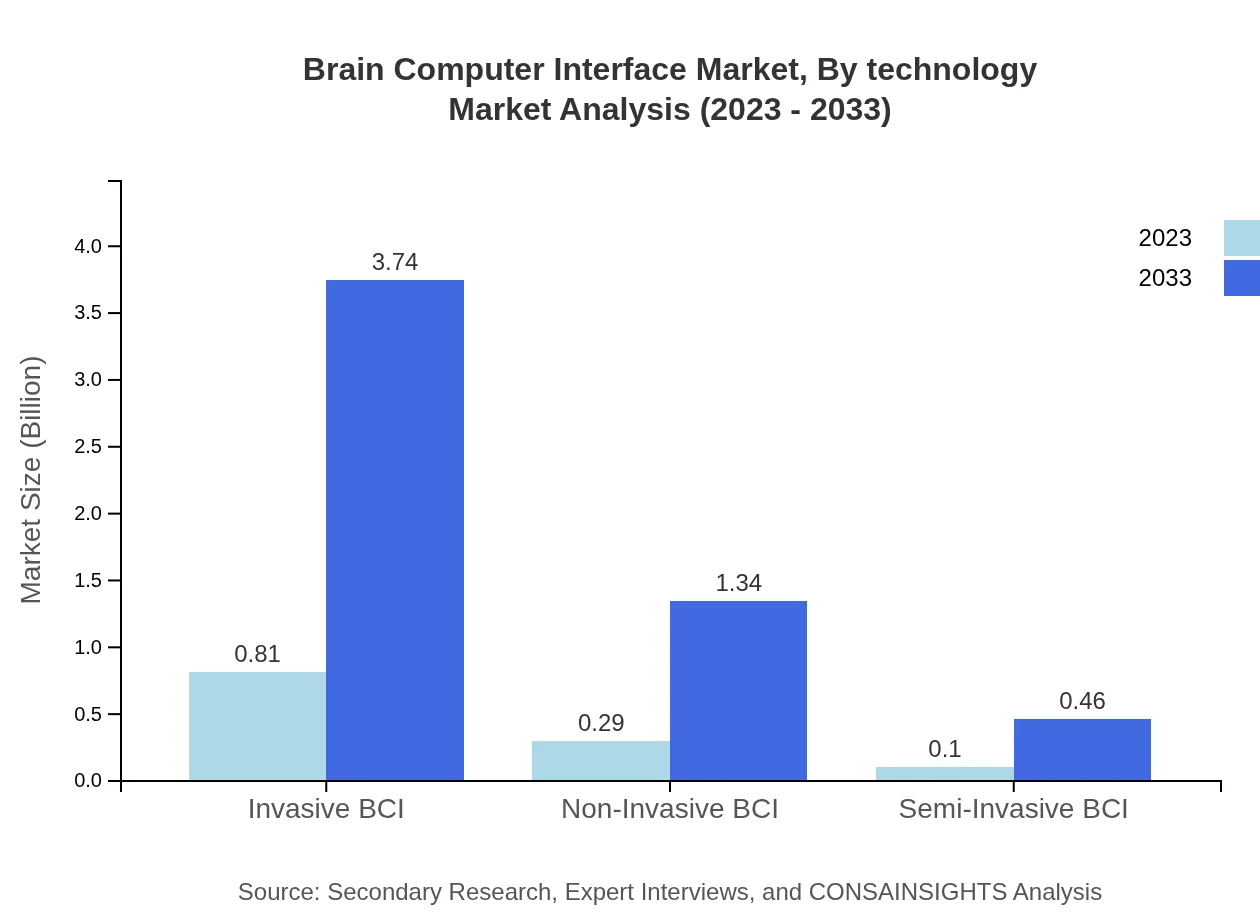
The technology segment of the Brain Computer Interface market includes invasive, non-invasive, and semi-invasive systems. Invasive BCI systems, while considered more efficient, are often less acceptable due to medical risks. Non-invasive systems dominate the market due to their safety and ease of use in applications like gaming and rehabilitation. Currently, invasive BCI holds about 67.55% of the market share and is expected to continue to drive significant revenues in medical applications, while non-invasive methods are increasingly used among consumers for gaming and recreational applications.
Brain Computer Interface Market Analysis By Application
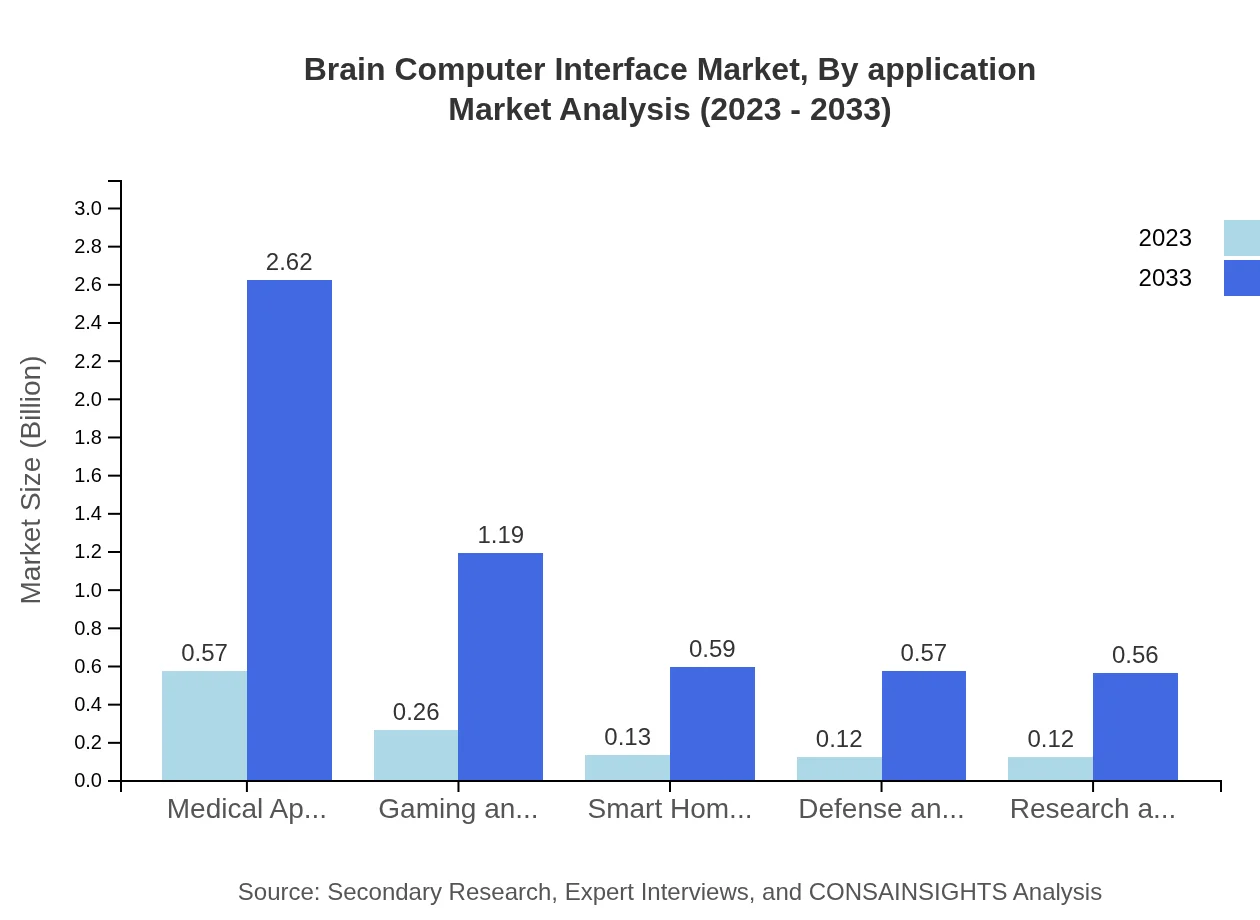
The application of BCIs spans various fields including medical, gaming, smart home control, and research & development. The medical application segment leads the market, projected to exceed $2.62 billion by 2033, primarily through advancements in neuroprosthetics and rehabilitation. The gaming sector is also on the rise, driven by innovations in immersive technologies, and expected to reach significant market sizes as consumer interest grows in interactive gaming experiences.
Brain Computer Interface Market Analysis By End User
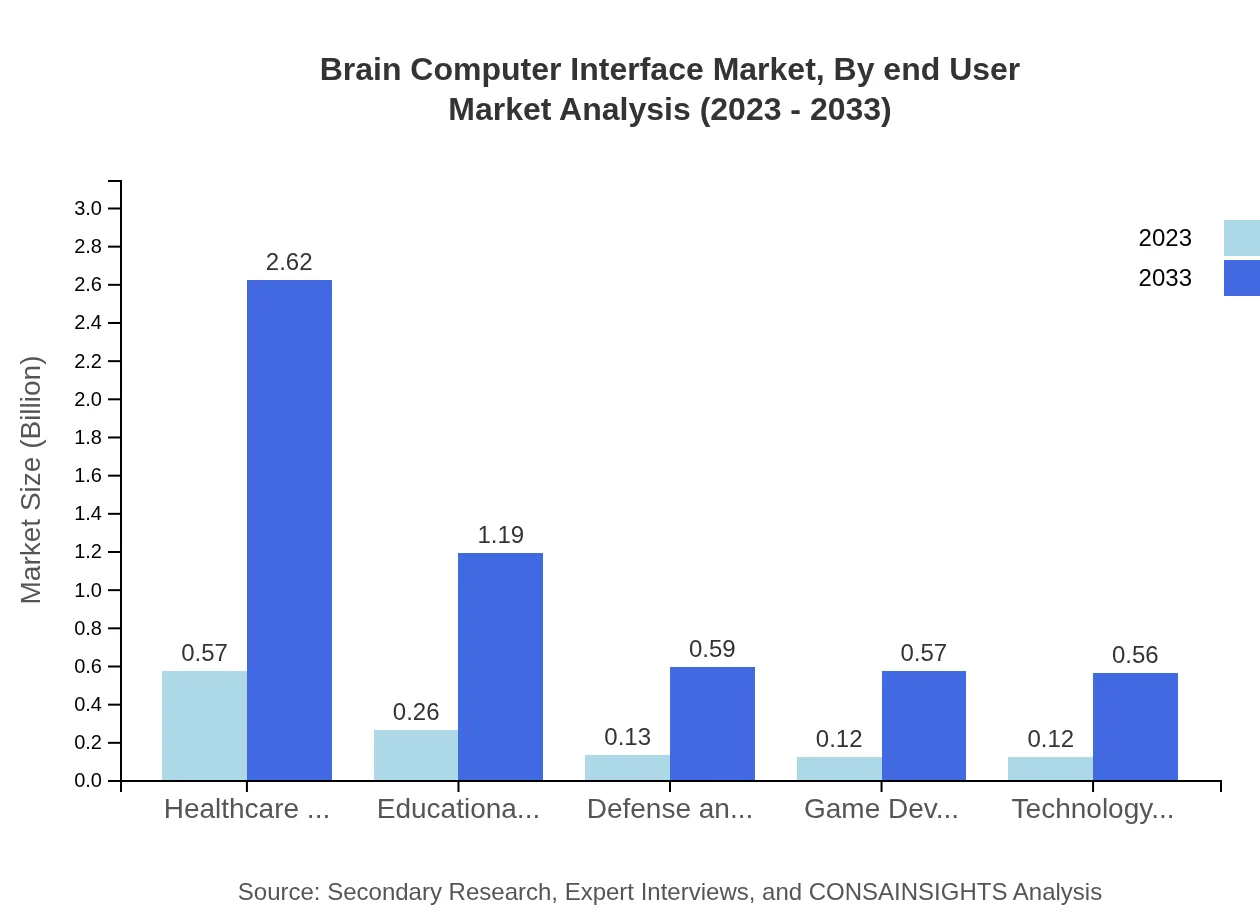
Key end-users of BCI technology include healthcare providers, educational institutions, defense agencies, and technology companies. Healthcare providers hold 47.35% of the market share, driven by an increased focus on rehabilitation technology for neurological conditions. Educational institutions represent an emerging segment, exploring BCIs for enhancing learning and cognitive training techniques.
Brain Computer Interface Market Analysis By Region
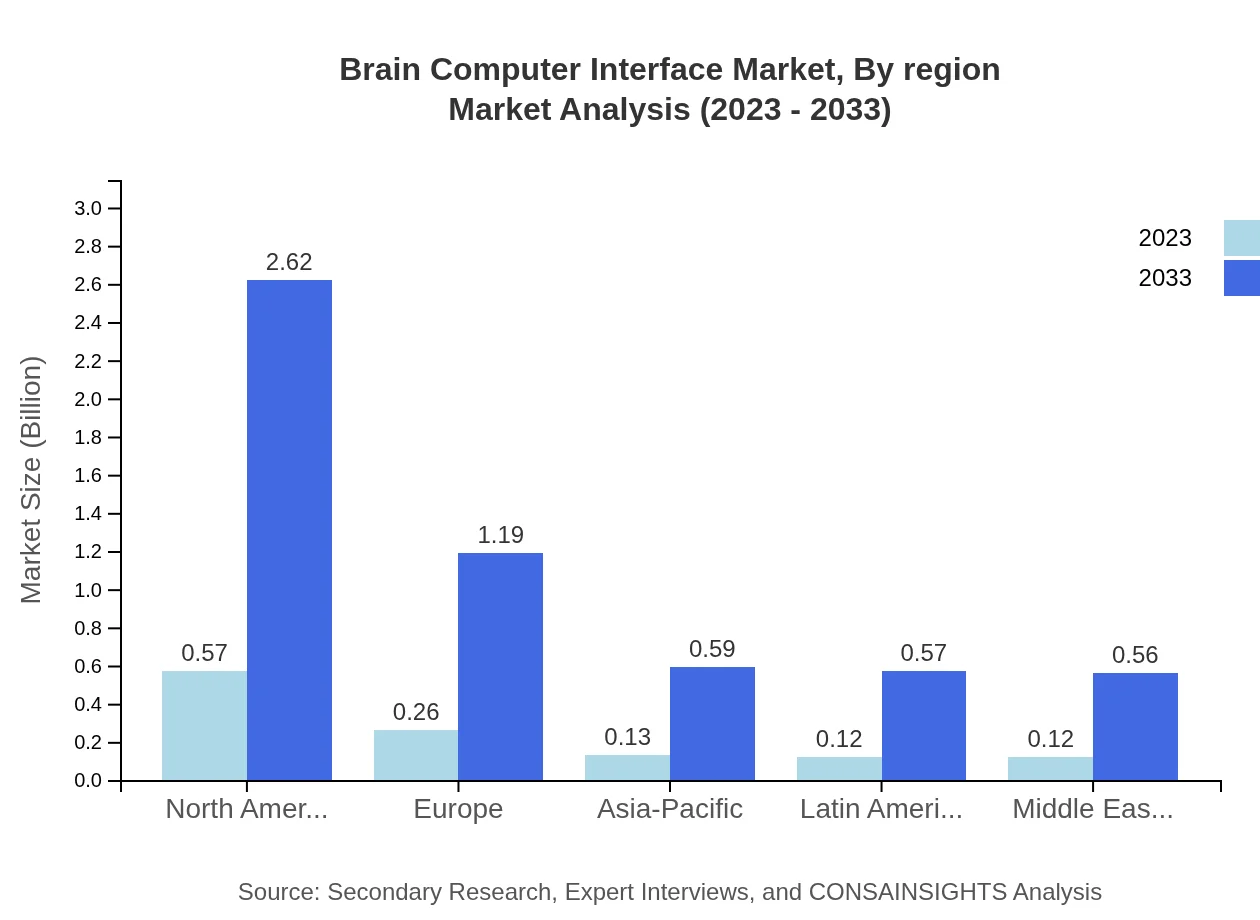
Regional variations in the BCI market reflect differences in technology adoption, government support, and investment in research. North America leads with almost half of the global market, reflecting strong technological capabilities. Meanwhile, Europe is supported by significant healthcare initiatives, and the Asia Pacific region is gradually increasing its market presence thanks to rising healthcare needs and investments in R&D.
Brain Computer Interface Market Analysis By Component
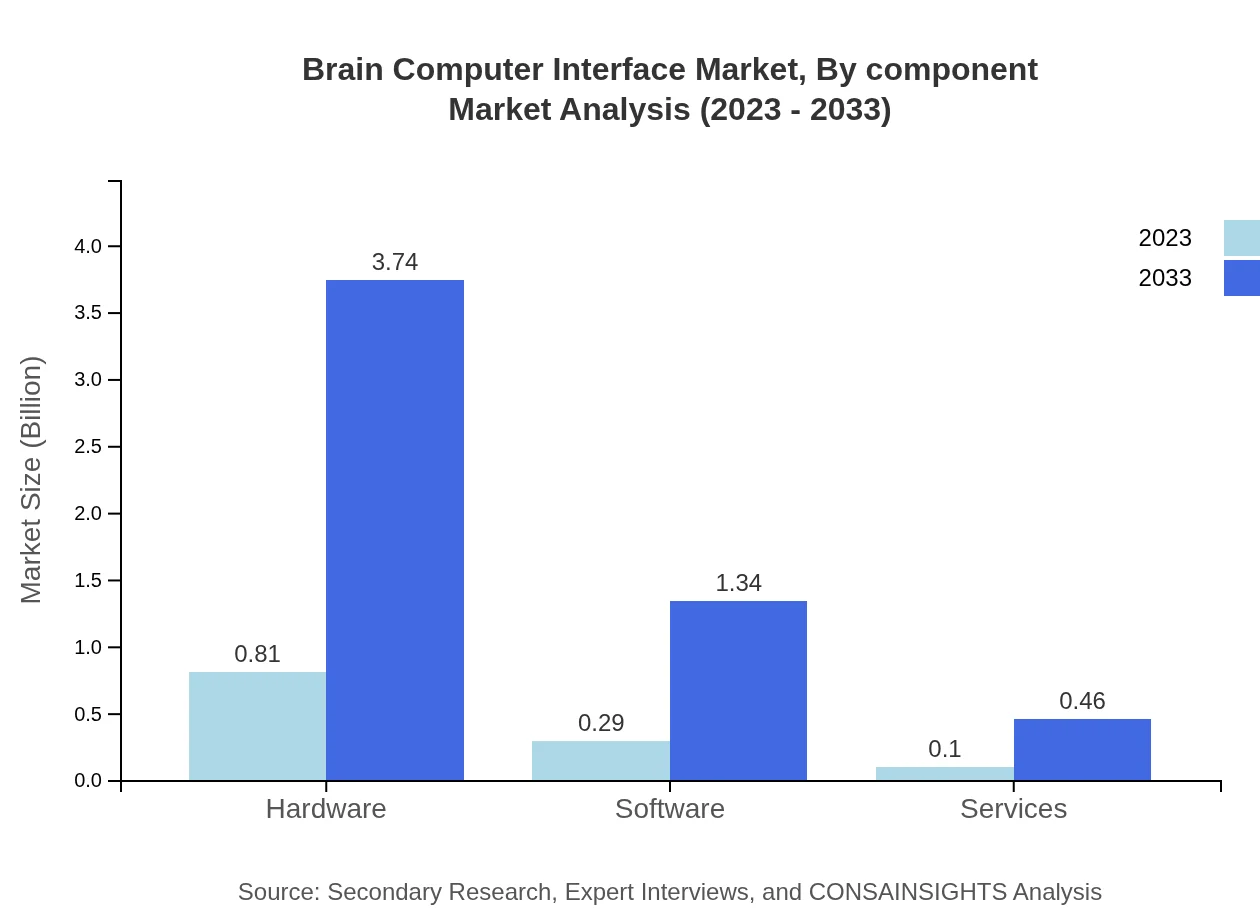
The BCI market by component is bifurcated into hardware, software, and services. Hardware significantly dominates the market, holding about 67.55% due to parts like sensors and processing units being essential. Software enables brain signal interpretation and environmental application, currently constituting 24.19% of the market. Services comprise training and maintenance, capturing about 8.26% of the total market share.
Brain Computer Interface Market Trends and Future Forecast
Tell us your focus area and get a customized research report.
Global Market Leaders and Top Companies in Brain Computer Interface Industry
Neurosky:
Neurosky is a pioneer in bio-sensor technology and develops BCI solutions tailored towards E-sports and wellness applications.Emotiv:
Emotiv focuses on consumer and research BCIs, providing a platform for brain health monitoring and cognitive performance insights.BrainGate:
BrainGate is renowned for its advanced invasive BCI technology aimed at improving the capabilities of individuals with severe disabilities.Kernel:
Kernel develops non-invasive BCI technologies aimed at cognitive enhancement and brain data analytics.We're grateful to work with incredible clients.









FAQs
What is the market size of the Brain Computer Interface market in 2023?
The market size for 2023 is $1.20 Billion as stated in the report, reflecting the baseline for the forecast period from 2023 to 2033.
How big will the Brain Computer Interface market be in 2033?
The projected market value for 2033 is $5.53 Billion, representing the report's end-point for the 2023 to 2033 forecast period.
What is CAGR of the Brain Computer Interface market?
The report specifies a compound annual growth rate of 15.7% for the forecast period spanning 2023 to 2033.
Which region is the fastest Growing in the Brain Computer Interface Market Report market?
Middle East and Africa is the fastest-growing region, projected to expand from $0.09 Billion in 2023 to $0.44 Billion in 2033, reflecting an implied 17.20% CAGR over the forecast period.
Which region is the fastest Growing for Brain Computer Interface?
The Middle East and Africa is noted as the regional market region with an implied 17.20% CAGR, rising from $0.09 Billion in 2023 to $0.44 Billion in 2033.
Who are some leading companies in the Brain Computer Interface sector?
Top companies named in the report include Neurosky, Emotiv, BrainGate, and Kernel, active across hardware, software, and services segments.
What major applications drive demand for BCI technologies?
Primary applications cited include medical treatments, gaming and entertainment, smart home control, defense and security, and research and development.
How is the market research in the report conducted?
The study uses primary interviews with experts, secondary company reports and publications, plus data triangulation and internal validation to ensure reliability.