Betamethasone Ointment Market Report
First published: 22 October 2024 | Last updated: 25 May 2026 | Report Code: betamethasone-ointment
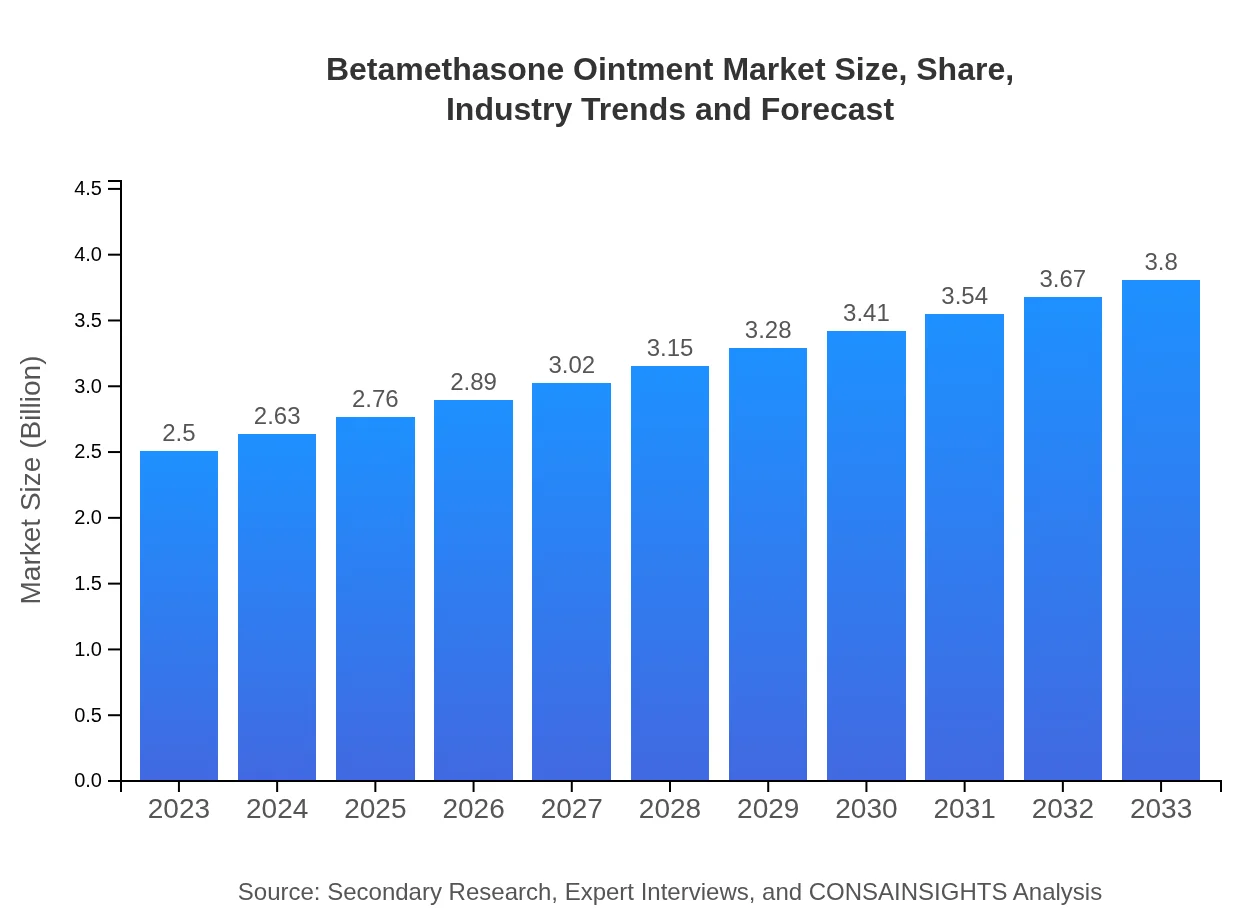
Betamethasone Ointment Market — USD 2.5 billion in 2023, Growing to USD 3.80B by 2033 at 4.2% CAGR
This report provides a comprehensive analysis of the Betamethasone Ointment market over the forecast period from 2023 to 2033. It includes market size estimates, growth rates, trends, segmentation insights, regional analyses, and key players shaping the industry.
Key Takeaways
- Global market expands from $2.50 Billion in 2023 to $3.80 Billion in 2033 at a 4.2% CAGR over 2023 to 2033.
- North America is largest regional market, while no single fastest-growing region is stated because regional CAGR differences remain within 0.15 percentage points.
- Europe and Asia Pacific show notable growth trajectories: Europe from $0.81 Billion to $1.23 Billion, Asia Pacific from $0.48 Billion to $0.72 Billion.
- Top companies include Pfizer, GlaxoSmithKline, Mylan, Sun Pharmaceutical Industries, and AbbVie, reflecting strong industry participation.
- Formulation diversity—cream, ointment, gel—along with hospitals, clinics, and home care channels support market breadth.
Betamethasone Ointment Market Report — Executive Summary
North America remains largest market by forecast-period value, while no single fastest-growing region is stated because top regional growth rates are separated by less than 0.15 percentage points. Demand for topical corticosteroids drives steady expansion in the Betamethasone Ointment market. Market value rises from $2.50 Billion in 2023 to $3.80 Billion by 2033 at a 4.2% CAGR over 2023 to 2033. Growth is supported by increasing prevalence of dermatological and inflammatory disorders, rising awareness of effective topical treatments, and continued product innovation across formulations such as creams, gels, and ointments. Distribution through pharmacies, hospitals, and direct sales enhances accessibility. Major pharmaceutical firms—Pfizer, GlaxoSmithKline, Mylan, Sun Pharmaceutical Industries, and AbbVie—remain active through product launches and distribution partnerships. Segment coverage includes formulation types, applications, end users, and regional markets, with North America identified as the largest region. Regulatory developments, R&D investment in improved delivery systems, and demographic trends such as aging populations are central to future market dynamics.
Key Growth Drivers
- Rising incidence of chronic skin conditions increases demand for topical corticosteroids.
- Product formulation advances, including creams, gels, and ointments, improve patient adherence and expand use cases.
- Expanded distribution via pharmacies, hospitals, and direct sales improves treatment accessibility.
- Active involvement by major pharmaceutical companies stimulates product launches and market outreach.
- Growing awareness of effective treatments among patients and caregivers boosts uptake.
| Metric | Value |
|---|---|
| Study Period | 2023 - 2033 |
| 2023 Market Size | $2.50 Billion |
| CAGR (2023-2033) | 4.2% |
| 2033 Market Size | $3.80 Billion |
| Top Companies | Pfizer , GlaxoSmithKline, Mylan, Sun Pharmaceutical Industries, AbbVie |
| Published Date | 22 October 2024 |
| Last Modified Date | 25 May 2026 |
Betamethasone Ointment Market Overview
Customize Betamethasone Ointment Market Report market research report
- ✔ Get in-depth analysis of Betamethasone Ointment market size, growth, and forecasts.
- ✔ Understand Betamethasone Ointment's regional dynamics and industry-specific trends.
- ✔ Identify potential applications, end-user demand, and growth segments in Betamethasone Ointment
What is the Market Size & CAGR of Betamethasone Ointment Market Report market in 2023?
Betamethasone Ointment Industry Analysis
Betamethasone Ointment Market Segmentation and Scope
Tell us your focus area and get a customized research report.
Betamethasone Ointment Market Report Market Analysis Report by Region
Europe Betamethasone Ointment Market Report:
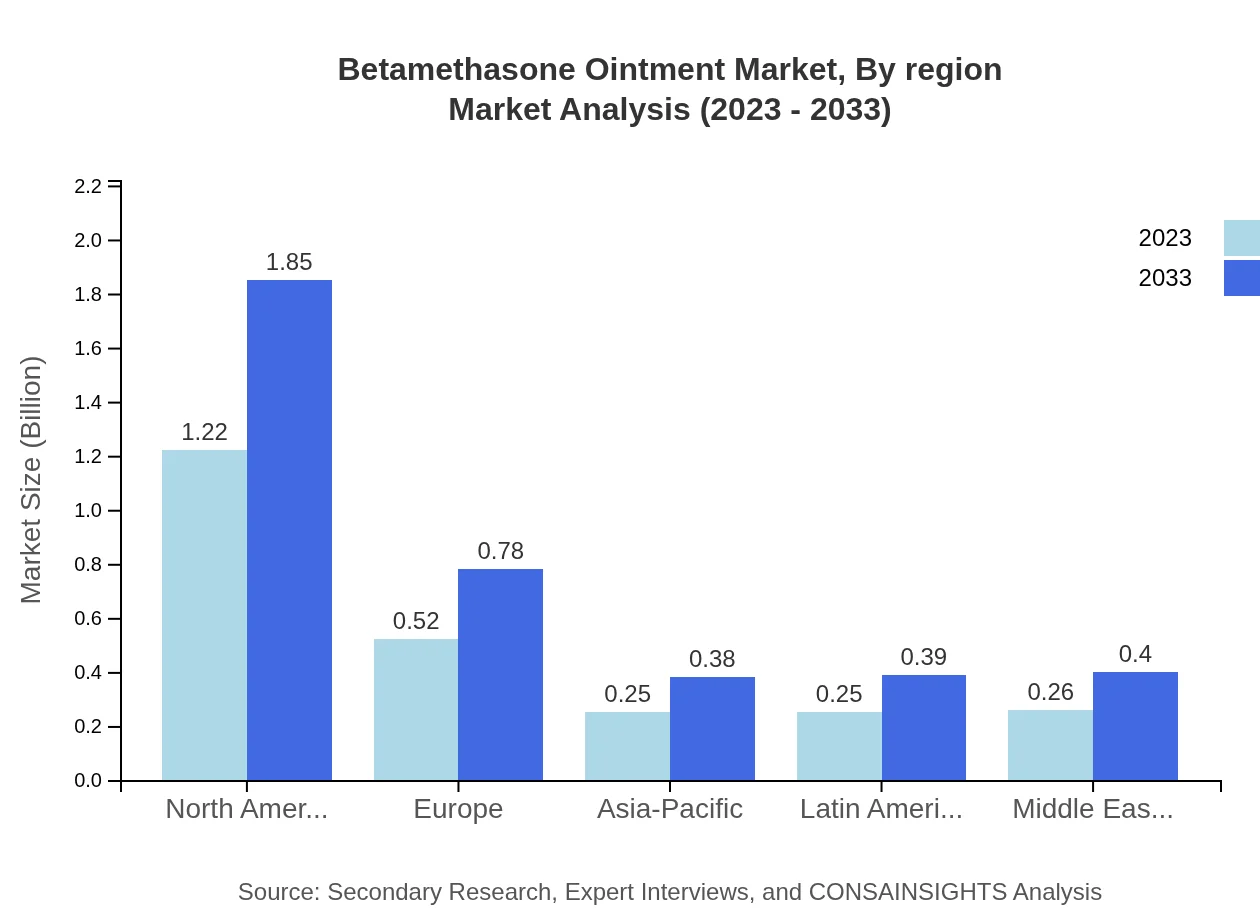
Europe grows from $0.81 Billion in 2023 to $1.23 Billion in 2033. Demand is backed by prevalence of chronic skin conditions, regulatory approvals for topical treatments, and investments in formulation improvements.Asia Pacific Betamethasone Ointment Market Report:
Asia Pacific grows from $0.48 Billion in 2023 to $0.72 Billion in 2033. Growth drivers include expanding healthcare access, higher disease awareness, and increasing availability through pharmacies and clinics.North America Betamethasone Ointment Market Report:
North America is largest regional market, rising from $0.81 Billion in 2023 to $1.24 Billion in 2033. Established healthcare infrastructure, broad hospital and pharmacy networks, and active participation from leading pharmaceutical players support continued adoption.South America Betamethasone Ointment Market Report:
Latin America grows from $0.22 Billion in 2023 to $0.34 Billion in 2033. Market expansion reflects improving healthcare distribution, growing recognition of dermatological therapies, and greater product availability.Middle East & Africa Betamethasone Ointment Market Report:
Middle East and Africa grows from $0.18 Billion in 2023 to $0.27 Billion in 2033. Incremental gains stem from expanding healthcare services, rising treatment awareness, and broader distribution reach.Tell us your focus area and get a customized research report.
Research Methodology
Betamethasone Ointment Market Analysis By Formulation
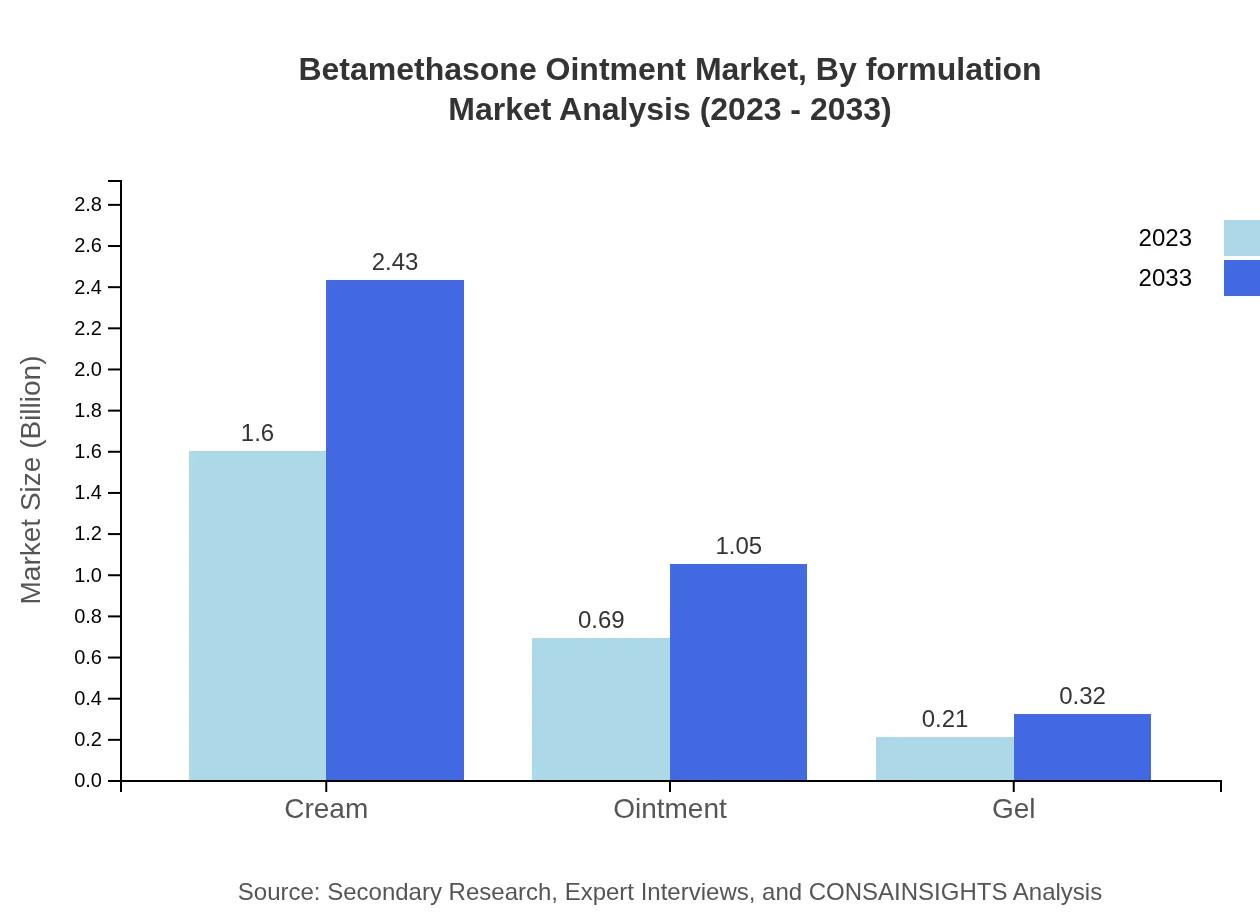
The formulation segment includes cream, ointment, and gel types. As of 2023, cream formulations dominate with a market size of $1.60 billion, expected to grow to $2.43 billion by 2033. Ointments are also significant, currently valued at $0.69 billion with an anticipated growth to $1.05 billion.
Betamethasone Ointment Market Analysis By Application
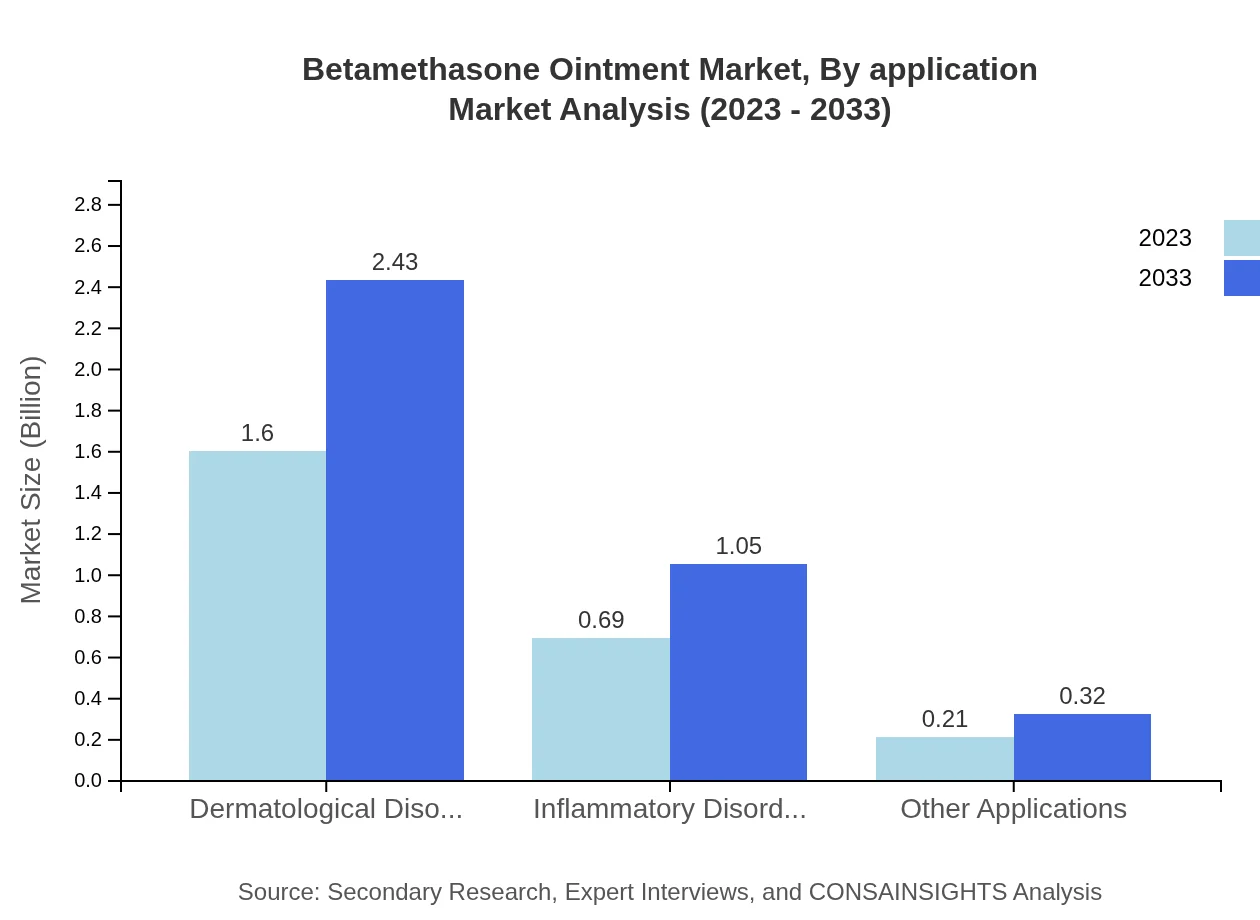
By application, the dermatological disorders segment leads with a market size of $1.60 billion in 2023, projectively growing to $2.43 billion by 2033. Inflammatory disorders follow with a $0.69 billion market size growing to $1.05 billion.
Betamethasone Ointment Market Analysis By End User
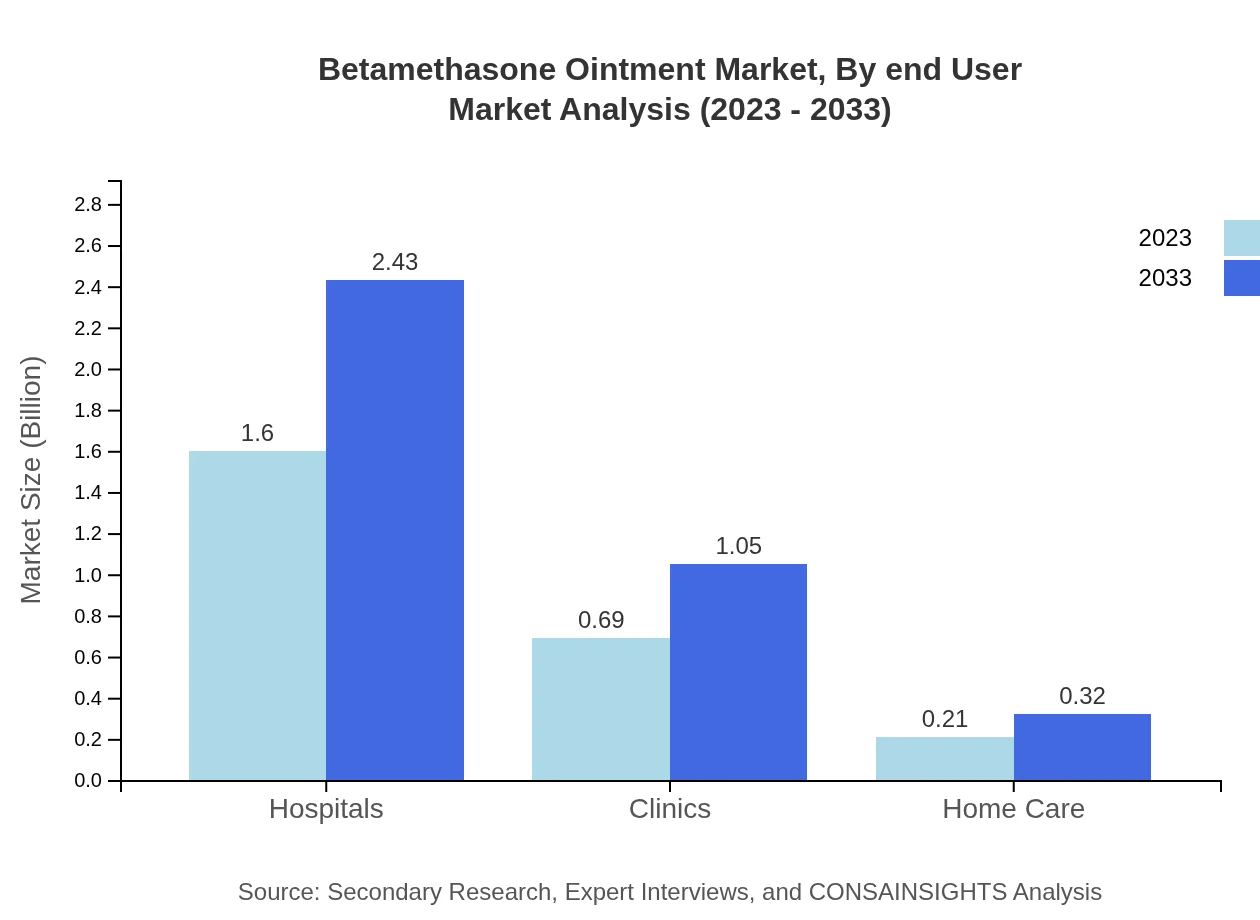
The end-user segmentation shows hospitals leading with $1.60 billion in 2023, expanding to $2.43 billion by 2033. Clinics and home care settings also contribute significantly with market sizes of $0.69 billion and $0.21 billion, respectively, in 2023.
Betamethasone Ointment Market Analysis By Distribution Channel
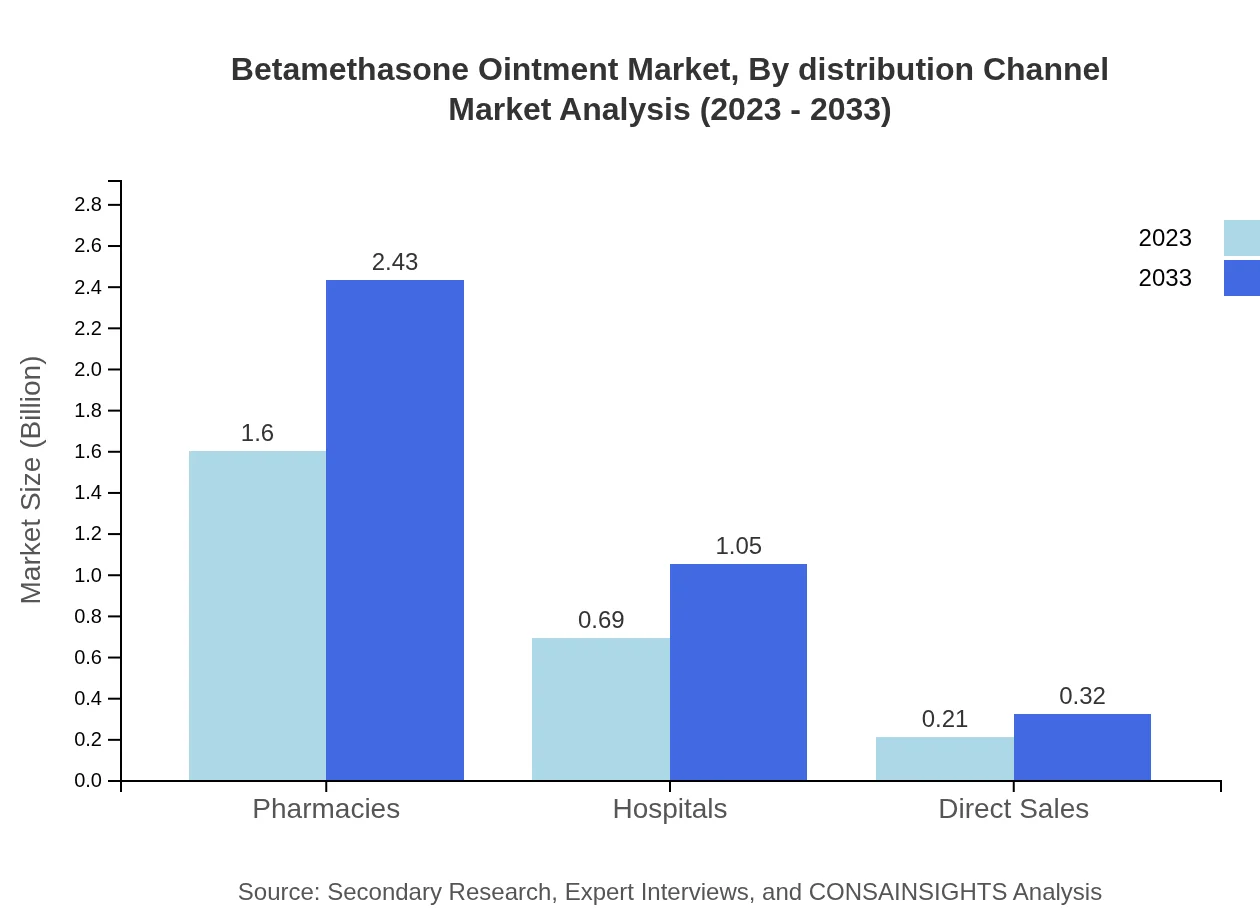
Distribution channels include pharmacies, hospitals, and direct sales. As of 2023, retail pharmacies hold a significant market share, estimated at $1.60 billion, with continuous growth projected.
Betamethasone Ointment Market Trends and Future Forecast
Tell us your focus area and get a customized research report.
Global Market Leaders and Top Companies in Betamethasone Ointment Industry
Pfizer :
A leading global biopharmaceutical company known for its extensive portfolio, including Betamethasone products.GlaxoSmithKline:
A prominent company in the healthcare sector, recognized for its commitment to developing innovative treatment solutions.Mylan:
An established player specializing in the production of generic medicines, including Betamethasone Ointment.Sun Pharmaceutical Industries:
Indian multinational pharmaceutical company known for its broad portfolio, including dermatological products.AbbVie:
A global biopharmaceutical leader with a strong presence in immunology and dermatology treatments.We're grateful to work with incredible clients.

FAQs
What is the market size of the Betamethasone Ointment Market Report in 2023?
The market size in 2023 is $2.50 Billion, as stated in the report's baseline data for the forecast period 2023 to 2033.
How big will the market be in 2033?
The projected market value for 2033 is $3.80 Billion, based on the provided forecast figures covering 2023 to 2033.
What is CAGR of the market from 2023 to 2033?
The report specifies a compound annual growth rate (CAGR) of 4.2% for the period 2023 to 2033.
Is there a single fastest Growing region in the Betamethasone Ointment Market Report market?
No single fastest-growing region is stated for the Betamethasone Ointment Market Report market because the top regional implied CAGR values are within 0.15 percentage points of each other, making the ranking too close to call reliably.
Which companies lead the Betamethasone ointment market?
Top companies listed include Pfizer, GlaxoSmithKline, Mylan, Sun Pharmaceutical Industries, and AbbVie, highlighting active industry participation.
What are the common formulations included in the market segmentation?
The report lists cream, ointment, and gel as primary formulation sub segments used across therapeutic applications and distribution channels.
How are end users categorized in the study?
End-user segmentation includes hospitals, clinics, and home care settings, covering institutional and at-home treatment environments.
What drives product innovation in this market?
Product innovation is driven by R&D into formulation efficacy, delivery systems, combination therapies, and improved patient compliance strategies.