

Biological Safety Cabinet Market Report
First published: 23 October 2024 | Last updated: 25 May 2026 | Report Code: biological-safety-cabinet
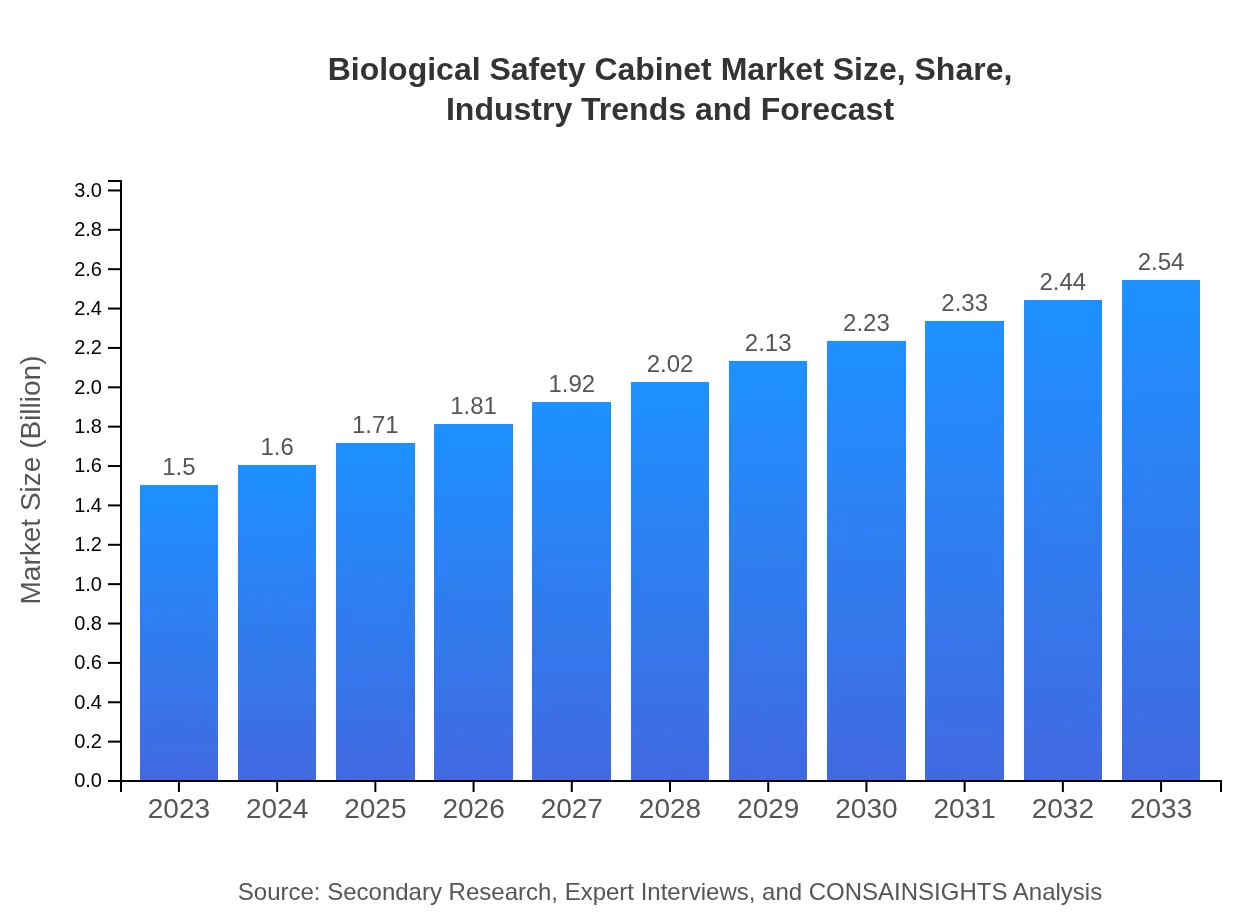
Biological Safety Cabinet Market — USD 1.5 billion in 2023, Growing to USD 2.54B by 2033 at 5.3% CAGR
This market report provides a comprehensive analysis of the Biological Safety Cabinet industry, offering insights into market trends, forecasts from 2023 to 2033, and segmentation for informed decision-making.
Key Takeaways
- Global market expands from $1.50 Billion in 2023 to $2.54 Billion in 2033 with a 5.3% CAGR across 2023 to 2033.
- North America is largest regional market, while no single fastest-growing region is stated because regional CAGR differences remain within 0.15 percentage points.
- Europe and Asia Pacific also show notable growth: Europe from $0.49 Billion to $0.83 Billion; Asia Pacific from $0.27 Billion to $0.46 Billion.
- Material and product innovation, regulatory emphasis on biosafety, and rising laboratory activity support sustained demand.
- Key vendors include Thermo Fisher Scientific, Eppendorf AG, and Labconco Corporation active in advanced cabinet offerings.
Biological Safety Cabinet Market Report — Executive Summary
North America remains largest market by forecast-period value, while no single fastest-growing region is stated because top regional growth rates are separated by less than 0.15 percentage points. The Biological Safety Cabinet market is forecast to grow from $1.50 Billion in 2023 to $2.54 Billion by 2033 at a compound annual growth rate of 5.3% during 2023 to 2033. Growth is propelled by heightened laboratory safety requirements, increasing research activity across pharmaceuticals and biotechnology, and technology upgrades in cabinet design and materials. Manufacturers are focusing on corrosion-resistant materials, energy-efficient systems, and integrated monitoring to meet stricter compliance and operational needs. The sector is segmented by product class, end user, material, and application, with Class I, II, and III units serving research institutions, biotech and pharmaceutical companies, and clinical laboratories. Regional dynamics vary: North America remains the largest market by end-period value, while Europe, Asia Pacific, Latin America, and Middle East and Africa register steady expansions. Competitive activity involves established laboratory-equipment providers such as Thermo Fisher Scientific, Eppendorf AG, and Labconco Corporation. Stakeholders should prioritize regulatory alignment, service networks, and product differentiation to capture demand driven by safety protocols and increased laboratory investments.
Key Growth Drivers
- Tighter biosafety regulations and laboratory standards increasing replacement and upgrade cycles.
- Rising research and development spending in pharmaceuticals and biotechnology expanding demand for containment solutions.
- Adoption of durable materials and energy-efficient designs improving lifecycle value for institutional buyers.
- Growing number of clinical and environmental testing activities requiring controlled workspaces.
- Presence of established suppliers strengthening distribution and aftermarket service availability.
| Metric | Value |
|---|---|
| Study Period | 2023 - 2033 |
| 2023 Market Size | $1.50 Billion |
| CAGR (2023-2033) | 5.3% |
| 2033 Market Size | $2.54 Billion |
| Top Companies | Thermo Fisher Scientific, Eppendorf AG, Labconco Corporation |
| Published Date | 23 October 2024 |
| Last Modified Date | 25 May 2026 |
Biological Safety Cabinet Market Overview
Customize Biological Safety Cabinet Market Report market research report
- ✔ Get in-depth analysis of Biological Safety Cabinet market size, growth, and forecasts.
- ✔ Understand Biological Safety Cabinet's regional dynamics and industry-specific trends.
- ✔ Identify potential applications, end-user demand, and growth segments in Biological Safety Cabinet
What is the Market Size & CAGR of Biological Safety Cabinet Market Report market in 2023?
Biological Safety Cabinet Industry Analysis
Biological Safety Cabinet Market Segmentation and Scope
Tell us your focus area and get a customized research report.
Biological Safety Cabinet Market Report Market Analysis Report by Region
Europe Biological Safety Cabinet Market Report:
Europe grows from $0.49 Billion in 2023 to $0.83 Billion in 2033. 49 Billion in 2023 to $0.83 Billion in 2033, driven by regulatory standards, investments in clinical and pharmaceutical research, and demand for durable, compliant cabinet solutions.Asia Pacific Biological Safety Cabinet Market Report:
Asia Pacific grows from $0.27 Billion in 2023 to $0.46 Billion in 2033. 27 Billion in 2023 to $0.46 Billion in 2033, underpinned by rising laboratory build-out, increasing biotech activity, and stronger focus on biosafety protocols across research and clinical settings.North America Biological Safety Cabinet Market Report:
North America is largest regional market, rising from $0.54 Billion in 2023 to $0.92 Billion in 2033. Regional growth is supported by extensive research infrastructure, regulatory emphasis on biosafety, and widespread adoption of upgraded containment systems.South America Biological Safety Cabinet Market Report:
Latin America grows from $0.12 Billion in 2023 to $0.2 Billion in 2033. 12 Billion in 2023 to $0.20 Billion in 2033, with growth linked to expanding diagnostic and research capacity and gradual adoption of standardized containment equipment.Middle East & Africa Biological Safety Cabinet Market Report:
Middle East and Africa grows from $0.08 Billion in 2023 to $0.13 Billion in 2033. 08 Billion in 2023 to $0.13 Billion in 2033, supported by expanding healthcare infrastructure, growing laboratory investments, and increasing emphasis on safety in testing environments.Tell us your focus area and get a customized research report.
Research Methodology
Biological Safety Cabinet Market Analysis By Product
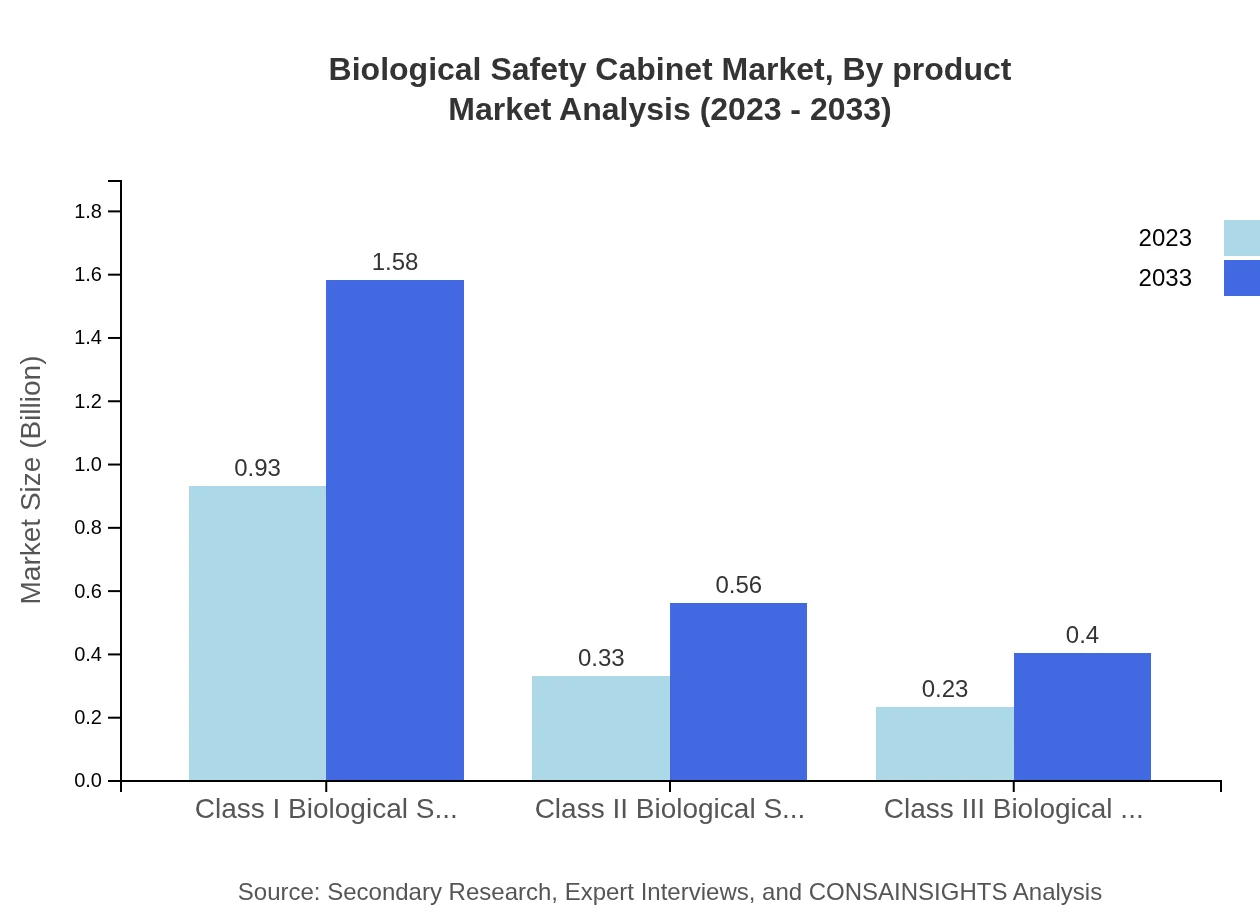
The Biological Safety Cabinet market is categorized into three main types: Class I, Class II, and Class III. In 2023, the Class I segment holds a significant portion of the market with a size of $0.93 billion and will grow to $1.58 billion by 2033. Class I cabinets focus on personnel safety and are widely utilized across various laboratory settings. Class II cabinets follow with a market size of $0.33 billion in 2023, expected to reach $0.56 billion in 2033, while Class III cabinets, offering the highest level of protection, will grow from $0.23 billion to $0.40 billion during this period.
Biological Safety Cabinet Market Analysis By Application
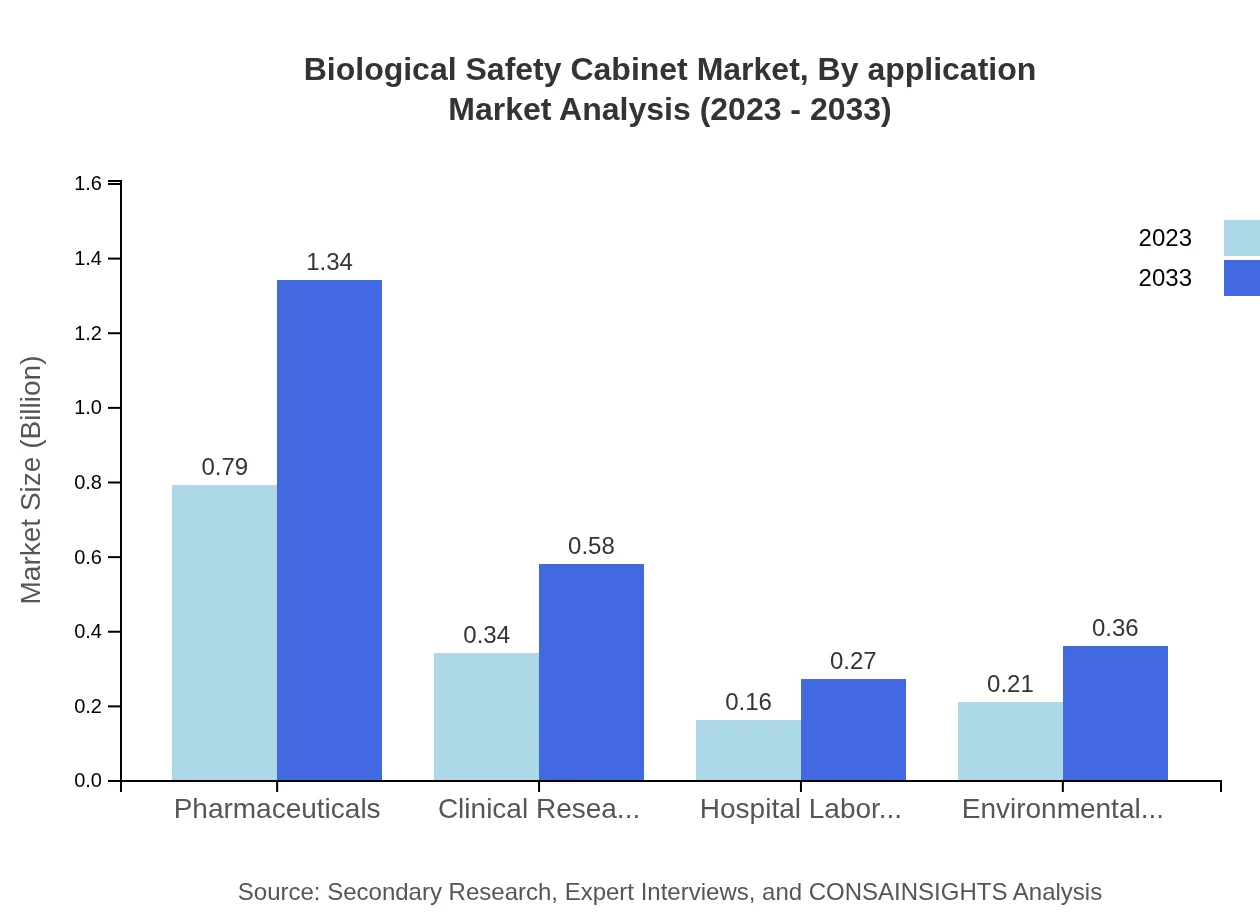
Market segmentation by application highlights Research Institutions with a market share of $0.79 billion in 2023, projected to increase to $1.34 billion by 2033. The Biotechnology segment represents $0.34 billion in 2023 and is expected to rise to $0.58 billion by 2033, while Pharmaceuticals and Clinical Research also contribute significantly, demonstrating growth potential due to rising healthcare requirements.
Biological Safety Cabinet Market Analysis By End User
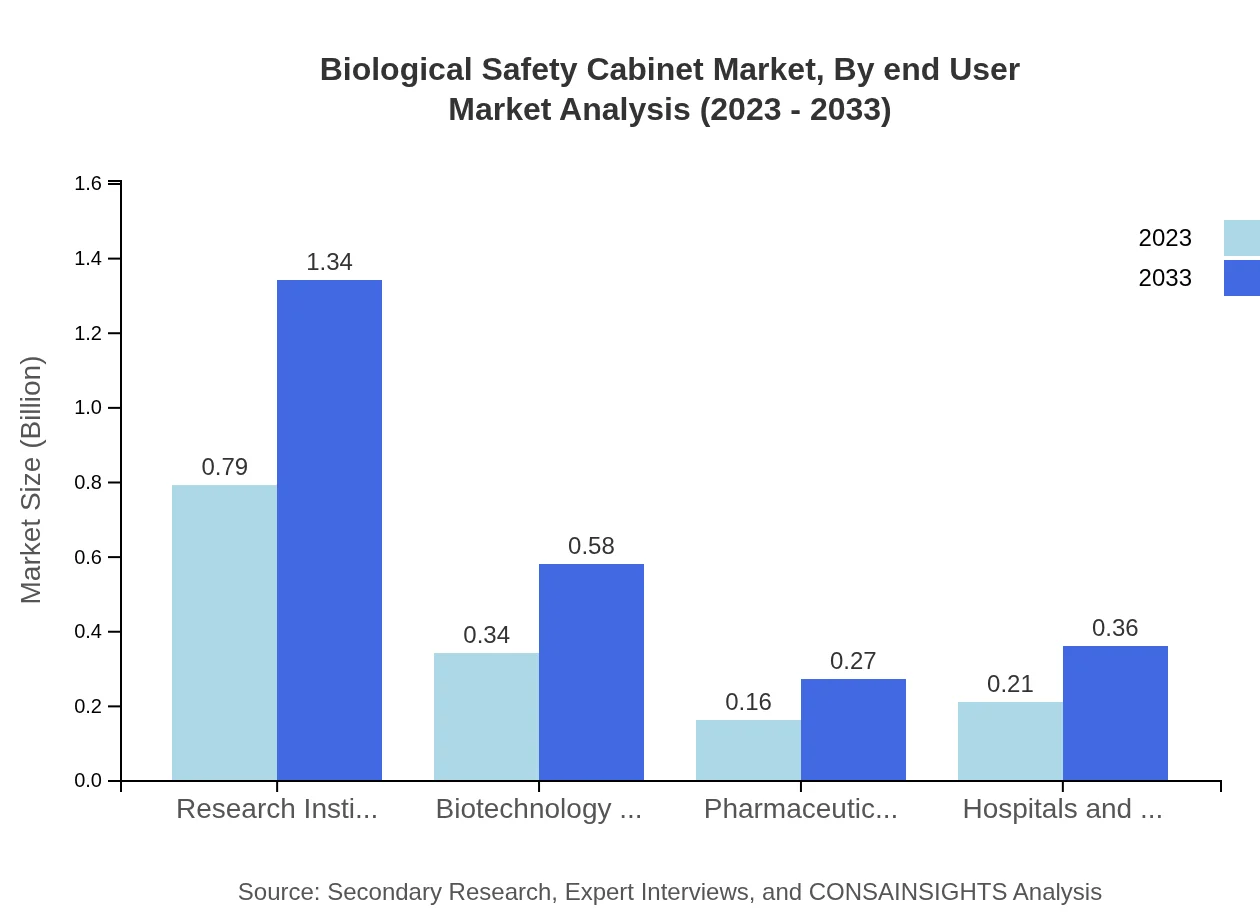
End-user segmentation reveals that Research Institutions account for 52.79% of the market, followed by Biotechnology Companies and Pharmaceutical Companies. With a market size of $0.16 billion in 2023, Hospitals and Clinics represent a notable segment, growing towards $0.36 billion by 2033.
Biological Safety Cabinet Market Analysis By Material
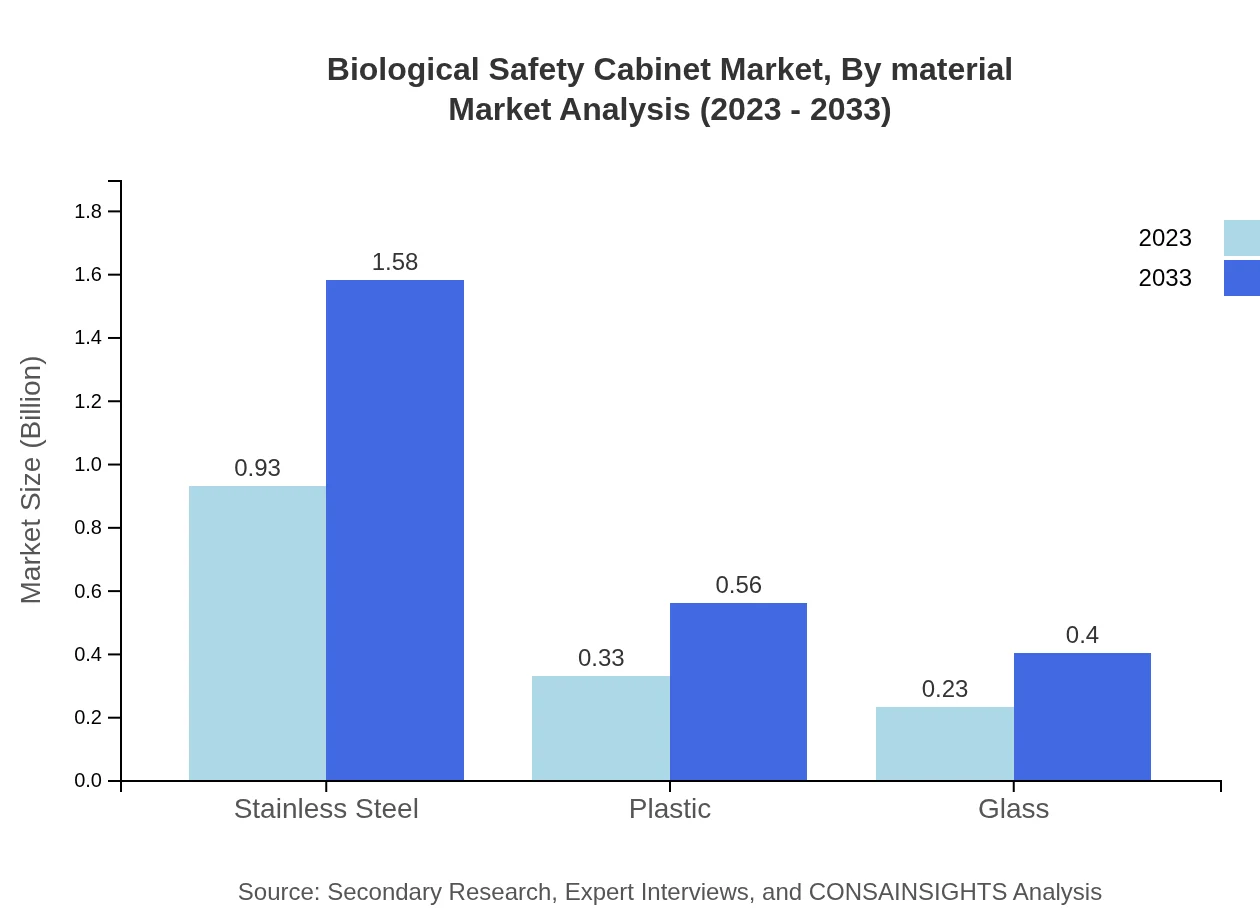
Material segmentation indicates that Stainless Steel remains dominant, capturing 62.32% of the market, growing from $0.93 billion in 2023 to $1.58 billion by 2033. Plastics and Glass also have significant shares, with respective market sizes of $0.33 billion and $0.23 billion in 2023.
Biological Safety Cabinet Market Trends and Future Forecast
Tell us your focus area and get a customized research report.
Global Market Leaders and Top Companies in Biological Safety Cabinet Industry
Thermo Fisher Scientific:
A leader in laboratory equipment, Thermo Fisher Scientific provides a wide range of Biological Safety Cabinets characterized by innovation and reliability.Eppendorf AG:
Eppendorf is known for its precision and quality in laboratory equipment including Biological Safety Cabinets, contributing significantly to safety in biological research.Labconco Corporation:
Specializing in laboratory equipment, Labconco manufactures a variety of Biological Safety Cabinets designed for enhanced safety and efficiency.We're grateful to work with incredible clients.









FAQs
What is the market size of the Biological Safety Cabinet Market Report in 2023?
$1.50 Billion is the reported market size for 2023, representing the baseline for the 2023 to 2033 forecast period.
How big will the Biological Safety Cabinet market be in 2033?
The market is projected to reach $2.54 Billion by 2033 according to the provided forecast figures for 2023 to 2033.
What is CAGR for the forecast period 2023 to 2033?
The compound annual growth rate for the 2023 to 2033 forecast is 5.3%, as stated in the report data.
Is there a single fastest Growing region in the Biological Safety Cabinet Market Report market?
No single fastest-growing region is stated for the Biological Safety Cabinet Market Report market because the top regional implied CAGR values are within 0.15 percentage points of each other, making the ranking too close to call reliably.
Which companies are named as top players?
Top companies listed include Thermo Fisher Scientific, Eppendorf AG, and Labconco Corporation among major laboratory-equipment providers.
What drives demand for different cabinet classes?
Demand for Class I, II, and III cabinets is driven by varying containment requirements across research institutions, biotech, pharmaceutical, and clinical applications.
How are material choices described in the market?
Materials cited include stainless steel, plastic, and glass, with material selection influencing durability, maintenance, and compliance considerations.
Who conducts the research behind the report?
The study is based on primary interviews with industry experts and secondary research from company reports and publications, supported by data triangulation.
What role do clinical laboratories play in market growth?
Clinical laboratories contribute through increased testing volumes and stricter sterility requirements, supporting uptake of certified containment equipment.
Why are upgrades to monitoring and energy Efficiency important?
Enhancements in monitoring and energy efficiency reduce operating costs and improve compliance, encouraging institutions to invest in modern cabinets.