

Biomaterial Wound Dressing Market Report
First published: 12 October 2024 | Last updated: 25 May 2026 | Report Code: biomaterial-wound-dressing
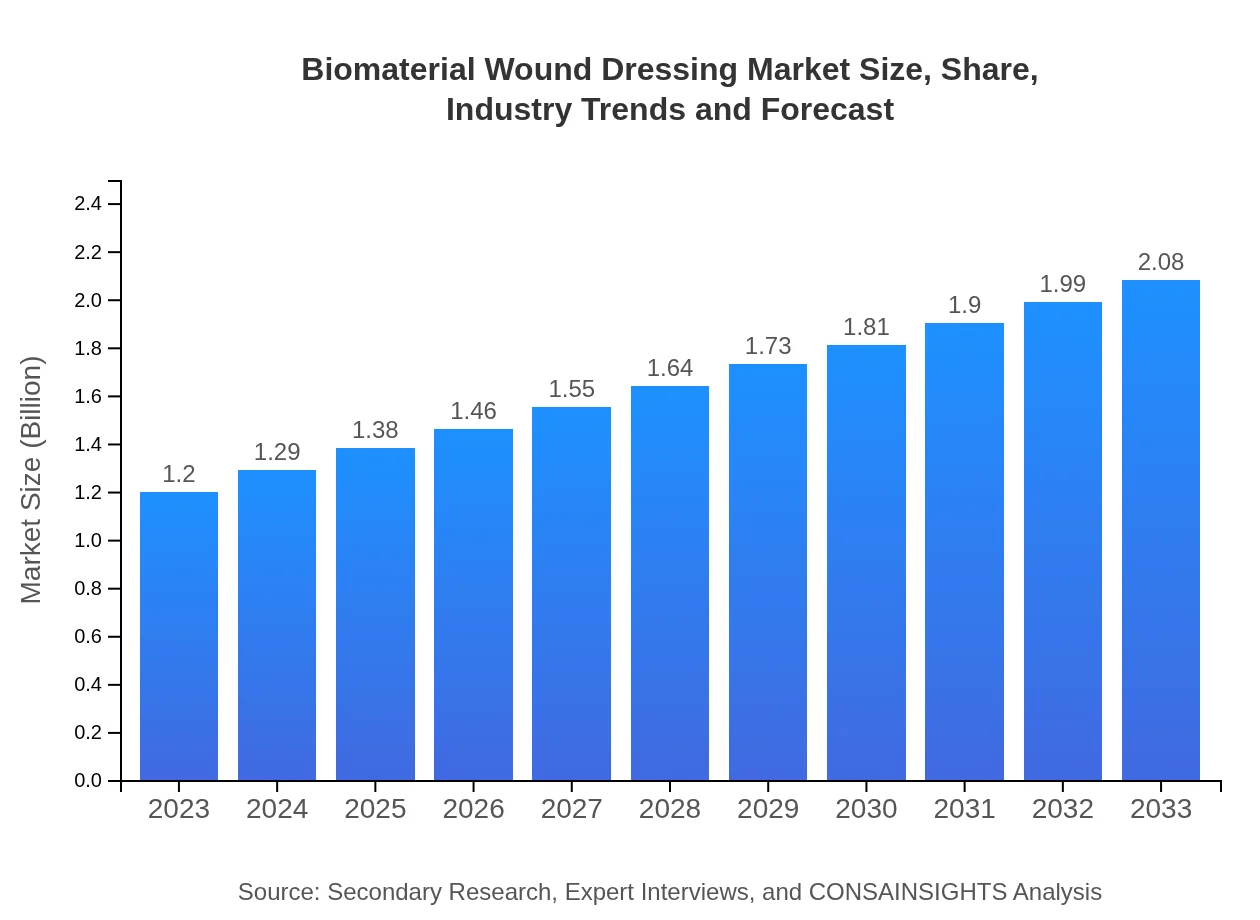
Biomaterial Wound Dressing Market — USD $1.2 Billion in 2023, Growing to USD 2.08null by 2033 at 5.5% CAGR
This report offers an extensive analysis of the Biomaterial Wound Dressing market, detailing current trends, market size, regional insights, and future forecasts from 2023 to 2033. It aims to provide stakeholders with valuable insights regarding market dynamics, segmentation, and technological advancements.
Key Takeaways
- Global market projected from $1.20 Billion in 2023 to $2.08 Billion in 2033 at a 5.5% CAGR.
- North America is largest regional market, while no single fastest-growing region is stated because regional CAGR differences remain within 0.15 percentage points.
- Material innovation and demand from hospitals and homecare settings are central growth factors.
- Major players include Smith & Nephew, Johnson & Johnson, Mölnlycke Health Care, ConvaTec Group, and 3M Health Care.
- Regulatory approvals, outpatient care trends, and rising chronic wound incidence support sustained adoption.
Biomaterial Wound Dressing Market Report — Executive Summary
North America remains largest market by forecast-period value, while no single fastest-growing region is stated because top regional growth rates are separated by less than 0.15 percentage points. The report outlines the Biomaterial Wound Dressing market trajectory from 2023 to 2033, driven by rising chronic wound cases, surgical volumes, and shifts toward outpatient and home-based care. Market value is estimated at $1.20 Billion in 2023 and expected to reach $2.08 Billion by 2033, reflecting a 5.5% CAGR. North America remains largest market by forecast-period value, while no single fastest-growing region is stated because top regional growth rates are separated by less than 0.15 percentage points.39 Billion to $0.68 Billion. The study covers segmentation by material type, application, distribution channel, and end user, emphasizing natural and synthetic polymers, composite materials, and settings such as hospitals, clinics, and homecare. Competitive dynamics feature established medical-device firms focused on product innovation, regulatory compliance, and partnerships with healthcare providers. Research includes expert interviews and secondary data to identify adoption patterns and future opportunities.
Key Growth Drivers
- Rising prevalence of chronic wounds and increased surgical procedures boosting demand for advanced dressings.
- Expansion of homecare and outpatient services increasing need for user-friendly biomaterial products.
- Ongoing material innovation—natural, synthetic, and composite solutions—enhancing healing efficacy and product differentiation.
- Investment by leading medical-device companies to advance product portfolios and distribution networks.
- Regulatory clearances and clinical validation encouraging wider hospital and clinic adoption.
| Metric | Value |
|---|---|
| Study Period | 2023 - 2033 |
| 2023 Market Size | $1.20 Billion |
| CAGR (2023-2033) | 5.5% |
| 2033 Market Size | $2.08 Billion |
| Top Companies | Smith & Nephew, Johnson & Johnson, Mölnlycke Health Care, ConvaTec Group, 3M Health Care |
| Published Date | 12 October 2024 |
| Last Modified Date | 25 May 2026 |
Biomaterial Wound Dressing Market Overview
Customize Biomaterial Wound Dressing Market Report market research report
- ✔ Get in-depth analysis of Biomaterial Wound Dressing market size, growth, and forecasts.
- ✔ Understand Biomaterial Wound Dressing's regional dynamics and industry-specific trends.
- ✔ Identify potential applications, end-user demand, and growth segments in Biomaterial Wound Dressing
What is the Market Size & CAGR of Biomaterial Wound Dressing Market Report market in 2023?
Biomaterial Wound Dressing Industry Analysis
Biomaterial Wound Dressing Market Segmentation and Scope
Tell us your focus area and get a customized research report.
Biomaterial Wound Dressing Market Report Market Analysis Report by Region
Europe Biomaterial Wound Dressing Market Report:
Europe grows from $0.32 Billion in 2023 to $0.56 Billion in 2033. The region’s trajectory reflects adoption in hospitals and clinics, regulatory frameworks supporting advanced products, and increased focus on chronic wound management.Asia Pacific Biomaterial Wound Dressing Market Report:
Asia Pacific grows from $0.23 Billion in 2023 to $0.4 Billion in 2033. Growth drivers include expanding healthcare access, rising surgical procedures, and growing awareness of advanced wound-care solutions in both institutional and homecare settings.North America Biomaterial Wound Dressing Market Report:
North America is largest regional market, rising from $0.39 Billion in 2023 to $0.68 Billion in 2033. Regional demand is shaped by advanced healthcare infrastructure, high uptake of innovative wound-care technologies, and significant hospital and homecare use.South America Biomaterial Wound Dressing Market Report:
Latin America grows from $0.09 Billion in 2023 to $0.15 Billion in 2033. Market expansion is influenced by improving healthcare delivery, growing demand for post-surgical and chronic wound treatments, and increased availability of advanced dressing options.Middle East & Africa Biomaterial Wound Dressing Market Report:
Middle East and Africa grows from $0.17 Billion in 2023 to $0.29 Billion in 2033. Growth factors include expanding clinical services, higher incidence of chronic wounds, and gradual adoption of biomaterial-based dressings in hospitals and clinics.Tell us your focus area and get a customized research report.
Research Methodology
Biomaterial Wound Dressing Market Analysis By Material Type
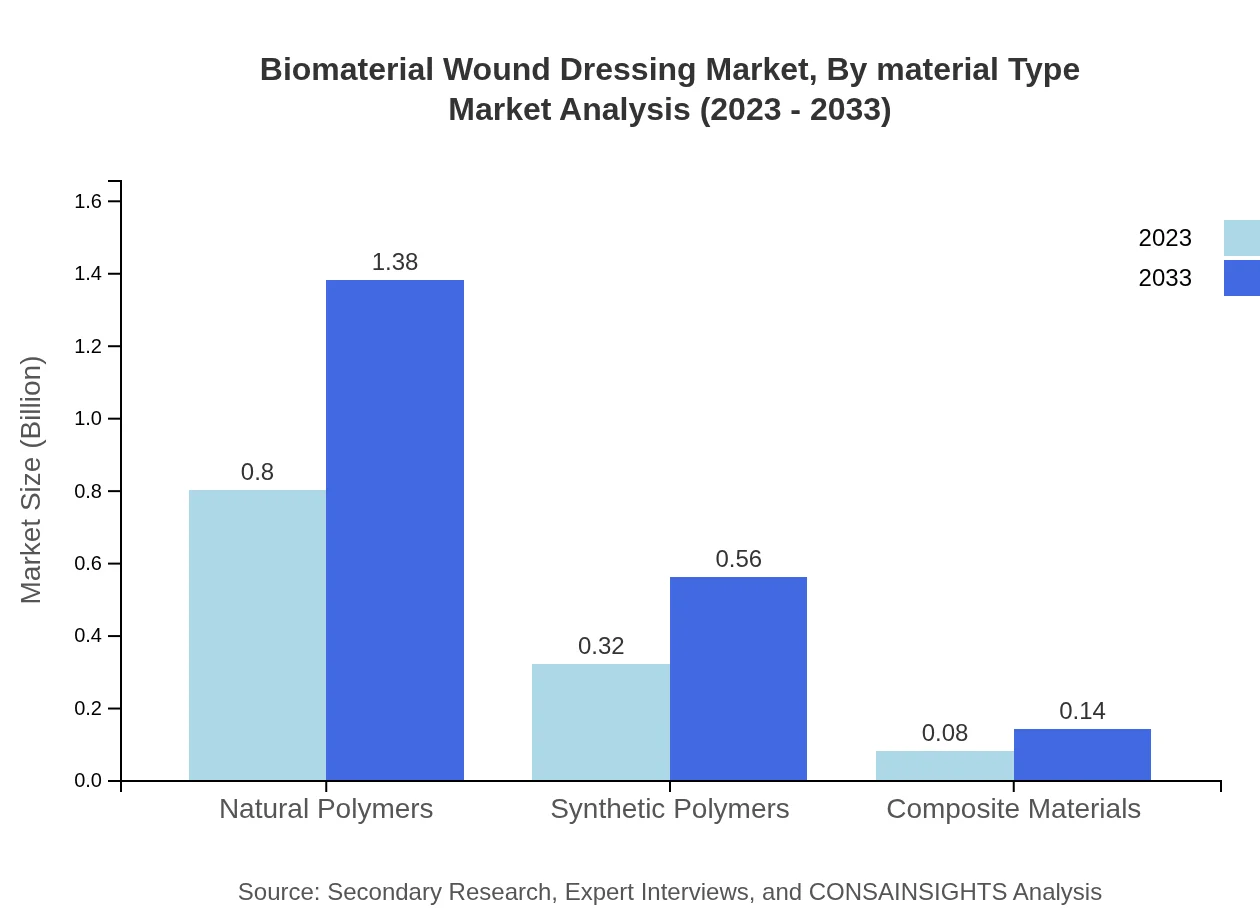
The Biomaterial Wound Dressing market segmentation by material type indicates significant prospects for natural polymers, anticipating growth from $0.80 billion in 2023 to $1.38 billion by 2033, holding a 66.52% market share. Synthetic polymers are expected to rise from $0.32 billion to $0.56 billion, maintaining a 26.78% share. Composite materials, though smaller, are projected to grow from $0.08 billion to $0.14 billion, indicating niche opportunities in specialized applications.
Biomaterial Wound Dressing Market Analysis By Application
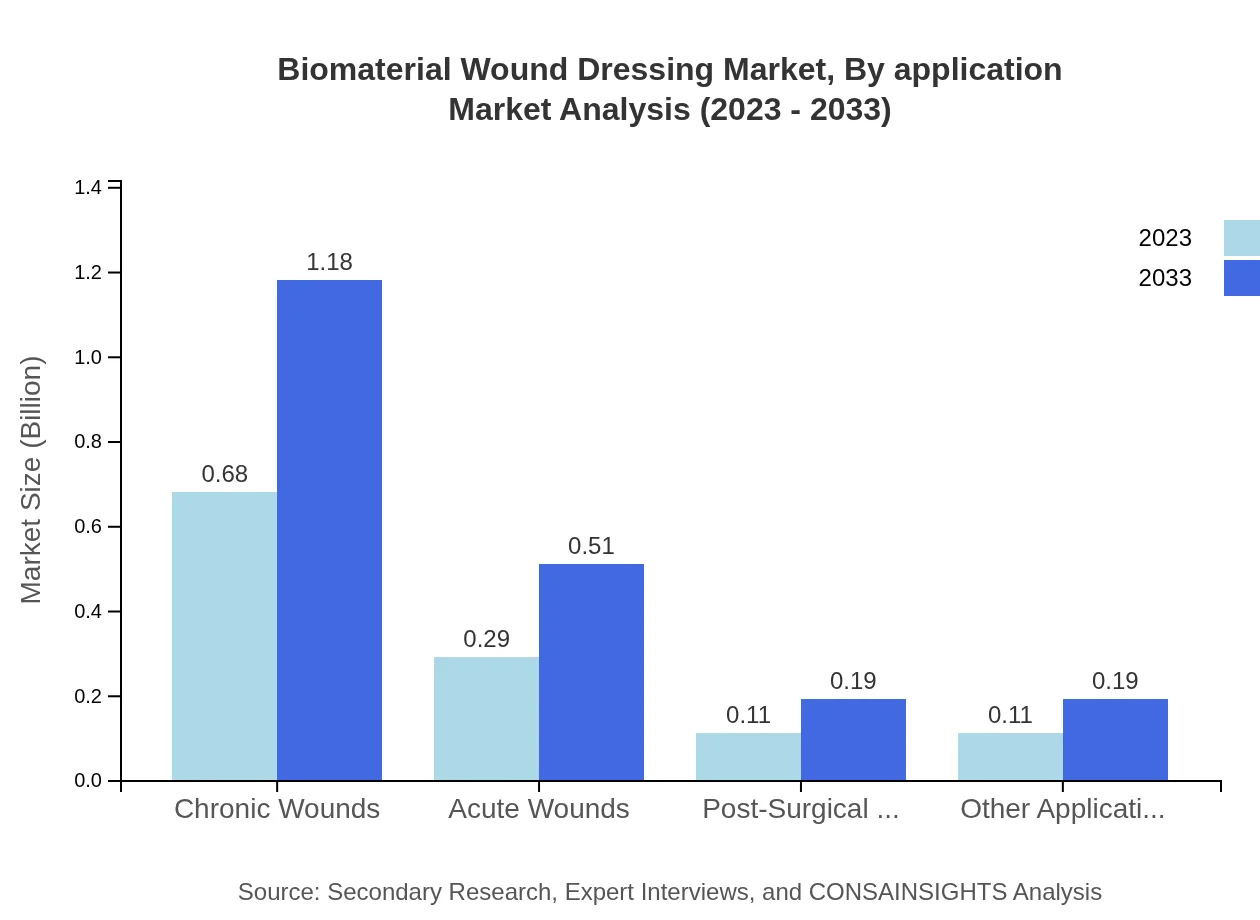
When segmented by application, chronic wounds are leading the market, slated to expand from $0.68 billion in 2023 to $1.18 billion by 2033, capturing a 56.65% share. Acute wounds and post-surgical wounds follow, with expected growth from $0.29 billion to $0.51 billion (24.58% share) and from $0.11 billion to $0.19 billion (9.39% share), respectively. Other applications demonstrate stable demand as well, supporting continued product innovation.
Biomaterial Wound Dressing Market Analysis By Distribution Channel
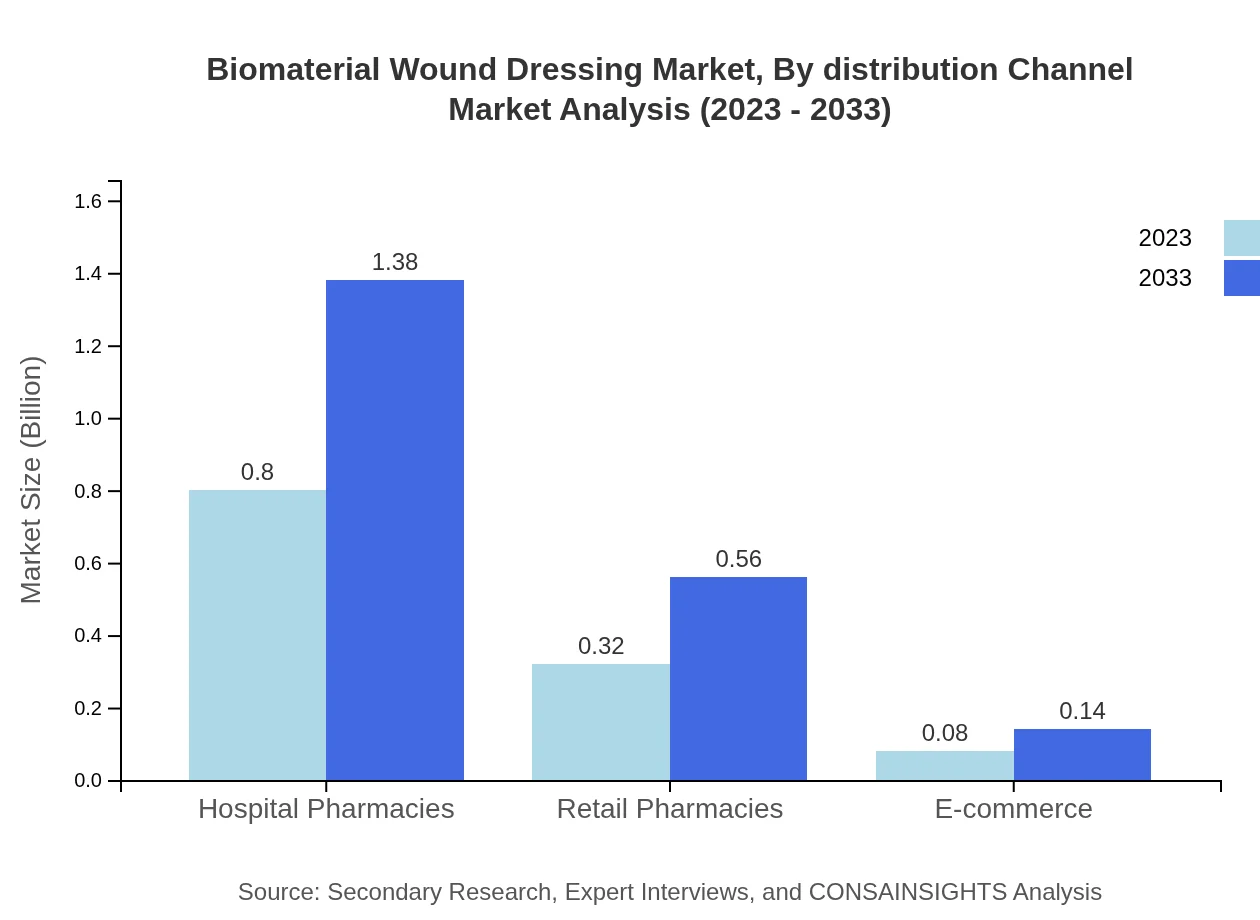
In terms of distribution channels, hospital pharmacies command the market with a robust share of 66.52%, anticipated to grow from $0.80 billion in 2023 to $1.38 billion by 2033. Retail pharmacies and e-commerce are also crucial, with retail projected to increase from $0.32 billion to $0.56 billion (26.78% share) and e-commerce from $0.08 billion to $0.14 billion (6.7% share), highlighting the diversification of sales platforms.
Biomaterial Wound Dressing Market Analysis By End User
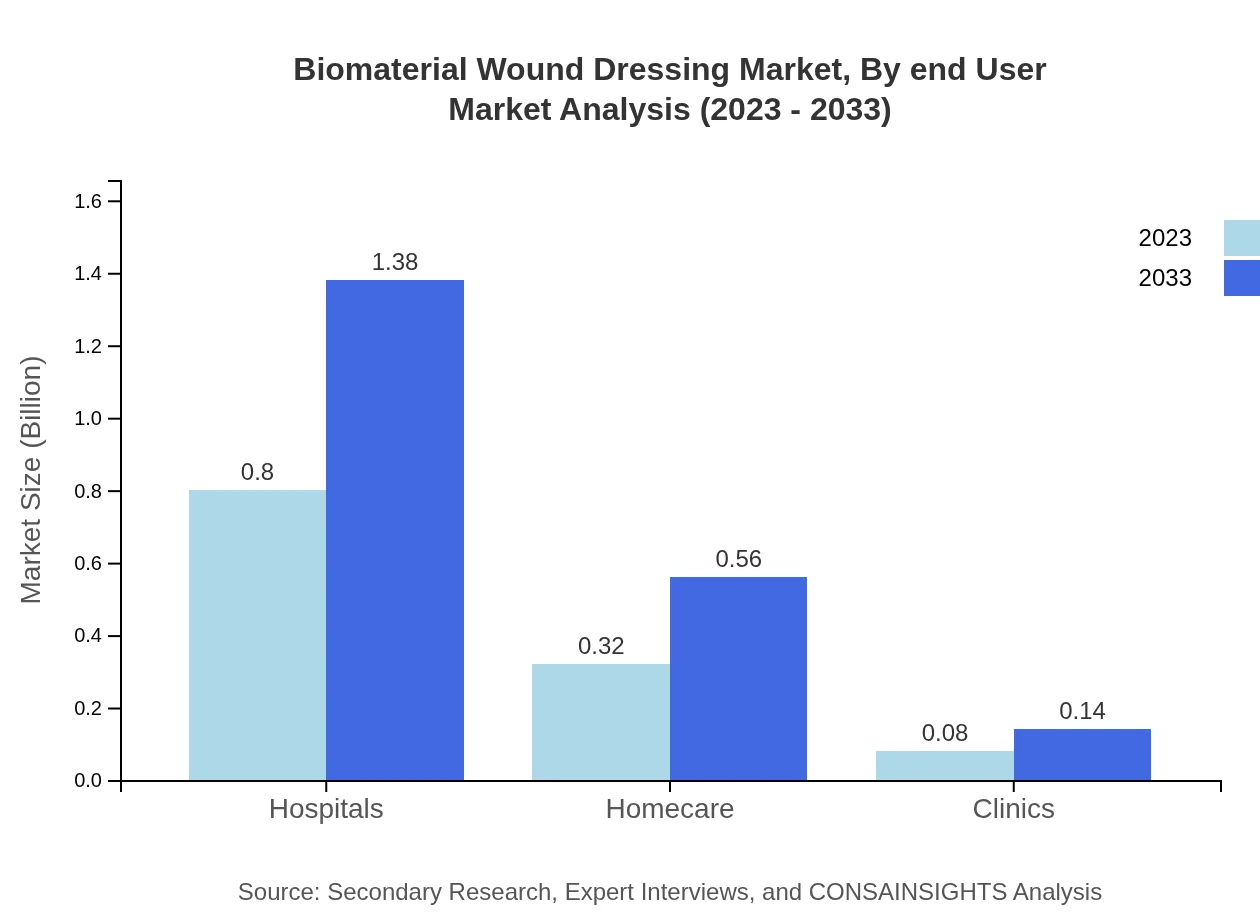
The segmentation by end-users reveals a strong inclination toward hospitals, comprising a predominant 66.52% share, anticipated to grow significantly from $0.80 billion to $1.38 billion. Homecare is also noteworthy, projecting growth from $0.32 billion to $0.56 billion (26.78% share). Clinics maintain a smaller share of 6.7%, expected to rise from $0.08 billion to $0.14 billion, indicating potential for tailored wound care products in diverse settings.
Biomaterial Wound Dressing Market Analysis By Region
Global Biomaterial Wound Dressing Market, By Region Market Analysis (2023 - 2033)
Regional analysis indicates North America leading the market by value, followed closely by Europe. Innovations and increasing healthcare needs drive robust growth in the Asia Pacific region as well. South America and the Middle East and Africa represent emerging markets with expanding potential, requiring targeted strategies for market penetration.
Biomaterial Wound Dressing Market Trends and Future Forecast
Tell us your focus area and get a customized research report.
Global Market Leaders and Top Companies in Biomaterial Wound Dressing Industry
Smith & Nephew:
A leading global medical technology company specializing in advanced wound management and biomaterial technology.Johnson & Johnson:
Offers a comprehensive range of products, focusing on innovative biomaterials for efficient wound healing and recovery.Mölnlycke Health Care:
Renowned for its wound care solutions, specializing in materials that enhance healing outcomes for patients.ConvaTec Group:
Provides advanced wound care products with a focus on biomaterials, driving successful wound healing processes.3M Health Care:
Innovative leader in health technology, focusing on quality products that cater to diverse wound care needs.We're grateful to work with incredible clients.









FAQs
What is the market size of the biomaterial wound dressing market in 2023?
The market size in 2023 is $1.20 Billion, as reported for the global biomaterial wound dressing market, forming the baseline for the 2023 to 2033 forecast period.
How big will the market be in 2033?
The market is projected to reach $2.08 Billion by 2033 based on the provided forecast figures covering 2023 to 2033.
What is CAGR for the forecast period?
The reported compound annual growth rate for 2023 to 2033 is 5.5%, reflecting the expected annualized expansion over the decade.
Is there a single fastest Growing region in the Biomaterial Wound Dressing Market Report market?
No single fastest-growing region is stated for the Biomaterial Wound Dressing Market Report market because the top regional implied CAGR values are within 0.15 percentage points of each other, making the ranking too close to call reliably.
Which companies lead the biomaterial wound dressing market?
Top companies listed include Smith & Nephew, Johnson & Johnson, Mölnlycke Health Care, ConvaTec Group, and 3M Health Care participating in product development and distribution.
What are common end User segments for these products?
Primary end-user segments include hospitals, clinics, and homecare settings, reflecting demand across institutional and home-based wound management scenarios.
What material types are covered in the market segmentation?
Segmented material types include Natural Polymers, Synthetic Polymers, and Composite Materials as distinct categories used in biomaterial dressings.
How are distribution channels organized in the report?
Distribution channels specified include Hospital Pharmacies, Retail Pharmacies, and E-commerce, covering both institutional procurement and consumer-facing supply paths.
What applications are included in the market breakdown?
Applications listed are Chronic Wounds, Acute Wounds, Post-Surgical Wounds, and Other Applications, addressing a range of clinical wound care needs.
Who provided input to the research methodology?
Primary inputs included interviews with industry experts, supplemented by company reports and publications used for secondary research and validation.