
Reports >
Life Sciences
>
Bladder Scanners Market Report

Bladder Scanners Market Report
First published: 11 October 2024 | Last updated: 28 May 2026 | Report Code: bladder-scanners
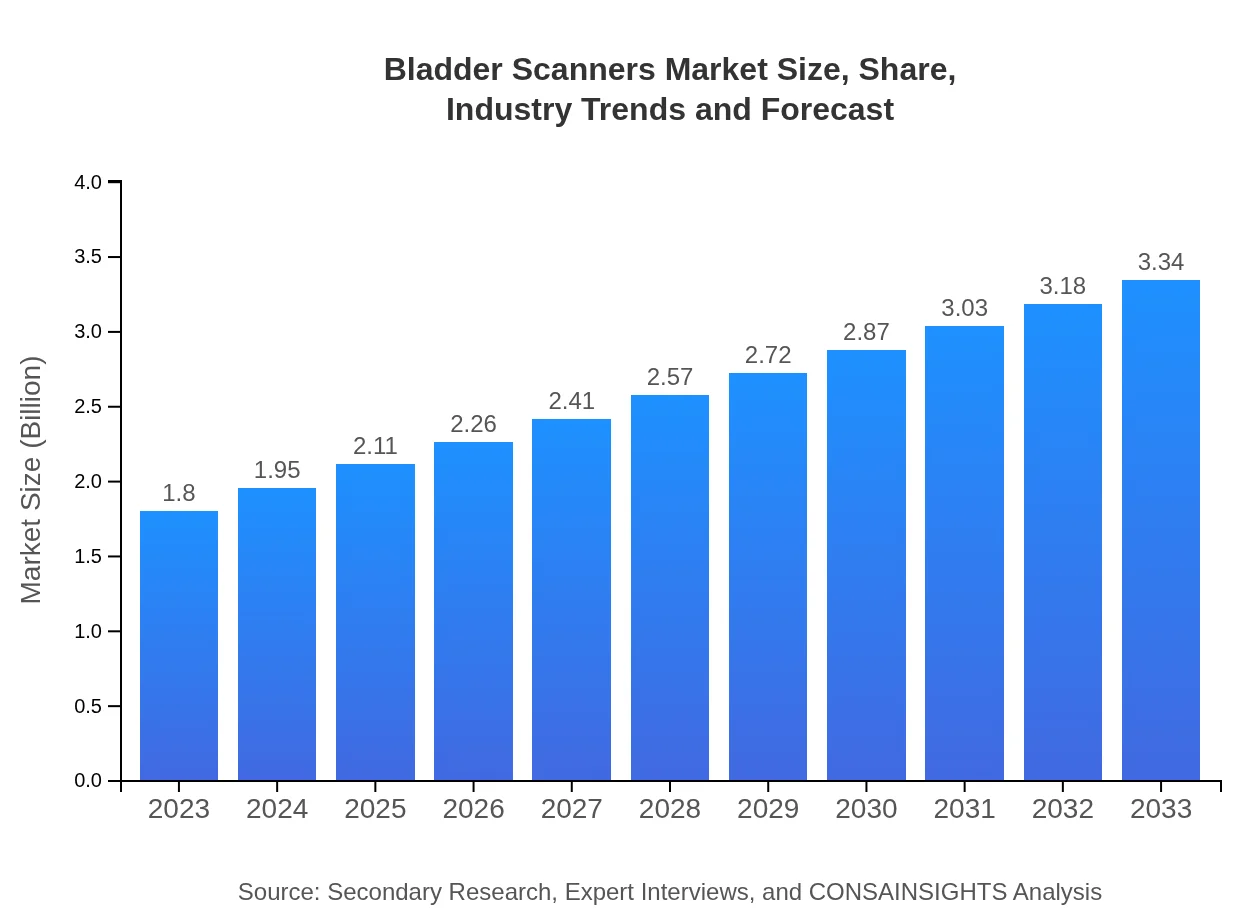
Bladder Scanners Market — USD $1.8 Billion in 2023, Growing to USD 3.34null by 2033 at 6.2% CAGR
This report provides comprehensive insights into the Bladder Scanners market, covering its growth trends, market size, segmentation, and technological advancements from 2023 to 2033. It also includes forecasts and analyses of regional markets and key players.
Key Takeaways
- Global market expands from $1.80 Billion in 2023 to $3.34 Billion in 2033, with a 6.2% CAGR over 2023 to 2033.
- North America is largest regional market; Middle East and Africa is regional market region based on implied CAGR across 2023 to 2033.
- North America leads regional value, rising from $0.65 Billion in 2023 to $1.21 Billion in 2033.
- Middle East and Africa recorded the fastest implied growth, moving from $0.14 Billion in 2023 to $0.27 Billion in 2033.
- Portable and stationary scanners are primary product types; hospitals and diagnostic centers are key end users.
- Top firms active in the market include Echolab, Rico Pharma, and SonoSite Inc.
Bladder Scanners Market Report — Executive Summary
Regional analysis shows North America as largest market and Middle East and Africa as fastest-growing region by implied CAGR. The bladder scanner market is forecasted to grow from $1.80 Billion in 2023 to $3.34 Billion by 2033 at a 6.2% CAGR for the 2023 to 2033 period. Growth is supported by rising demand for non-invasive diagnostic tools, increasing outpatient and home care services, and ongoing device innovation. Market structure includes product types such as portable and stationary scanners, applications across urology and general clinical settings, and end users like hospitals, diagnostic centers, nursing homes, and home care agencies. Regional dynamics show North America with the highest regional value, while Middle East and Africa demonstrates the fastest implied growth. Competitive activity centers on product development, clinical validation, and distribution partnerships, with established names such as Echolab, Rico Pharma, and SonoSite Inc. shaping adoption and market reach.
Key Growth Drivers
- Wider adoption of non-invasive ultrasound technologies for bladder volume assessment increases clinical use across care settings.
- Growing demand for home care and outpatient diagnostics supports deployment of portable bladder scanners.
- Rising prevalence of urinary disorders among aging populations drives need for routine bladder monitoring.
- Product innovation and improved device accuracy encourage procurement by hospitals and diagnostic centers.
- Strategic distribution and partnerships enhance market penetration in diverse regional markets.
| Metric | Value |
|---|---|
| Study Period | 2023 - 2033 |
| 2023 Market Size | $1.80 Billion |
| CAGR (2023-2033) | 6.2% |
| 2033 Market Size | $3.34 Billion |
| Top Companies | Echolab, Rico Pharma, SonoSite Inc. |
| Published Date | 11 October 2024 |
| Last Modified Date | 28 May 2026 |
Bladder Scanners Market Overview
Customize Bladder Scanners Market Report market research report
- ✔ Get in-depth analysis of Bladder Scanners market size, growth, and forecasts.
- ✔ Understand Bladder Scanners's regional dynamics and industry-specific trends.
- ✔ Identify potential applications, end-user demand, and growth segments in Bladder Scanners
What is the Market Size & CAGR of Bladder Scanners Market Report market in 2023?
Bladder Scanners Industry Analysis
Bladder Scanners Market Segmentation and Scope
Tell us your focus area and get a customized research report.
Bladder Scanners Market Report Market Analysis Report by Region
Europe Bladder Scanners Market Report:
Europe grows from $0.54 Billion in 2023 to $1 Billion in 2033. Growth in this region is supported by expanding outpatient services, rising awareness of urinary health, and the integration of non-invasive bladder monitoring in clinical workflows.Asia Pacific Bladder Scanners Market Report:
Asia Pacific grows from $0.34 Billion in 2023 to $0.63 Billion in 2033. Market expansion is driven by broader access to diagnostic care, increasing healthcare expenditure, and adoption of portable solutions for decentralized settings.North America Bladder Scanners Market Report:
North America is largest regional market, rising from $0.65 Billion in 2023 to $1.21 Billion in 2033. The region’s growth reflects strong clinical adoption, investments in healthcare infrastructure, and demand from hospitals and diagnostic centers that favor validated bladder assessment technologies.South America Bladder Scanners Market Report:
Latin America grows from $0.13 Billion in 2023 to $0.23 Billion in 2033. Uptake is aided by enhanced availability of diagnostic devices and a gradual shift toward outpatient and home-based monitoring services.Middle East & Africa Bladder Scanners Market Report:
Middle East and Africa is fastest-growing region by implied CAGR, increasing from $0.14 Billion in 2023 to $0.27 Billion in 2033. This region is noted as the fastest-growing with an implied 6.79% CAGR, helped by rising healthcare investments and expanding access to non-invasive diagnostic technologies.Tell us your focus area and get a customized research report.
Research Methodology
Bladder Scanners Market Analysis By Product Type
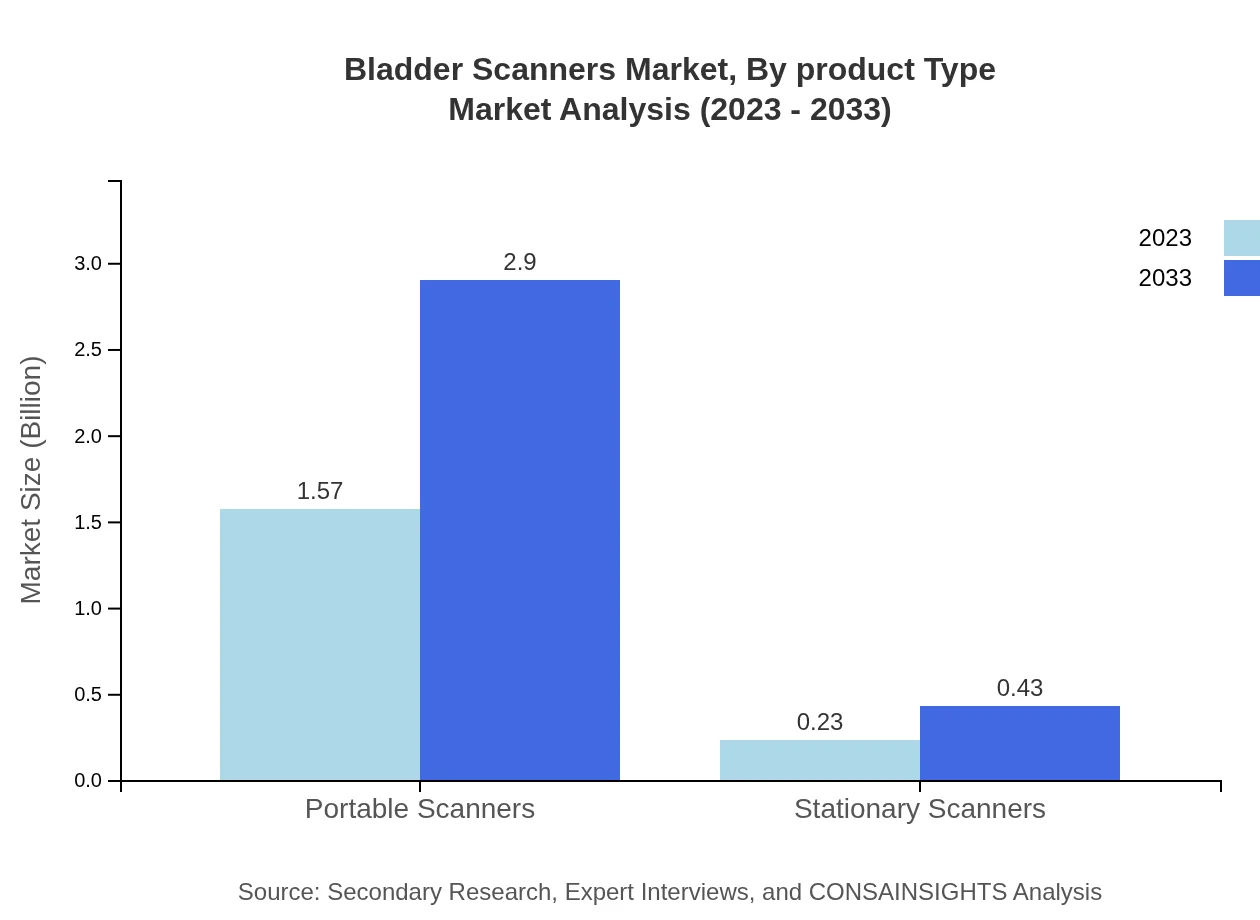
In 2023, the portable scanners segment dominates with a market size of USD 1.57 billion, expected to reach USD 2.90 billion by 2033. Portable scanners hold an 87.08% market share due to their convenience and adaptability in various healthcare environments. Stationary scanners, while less common, provide a precise and reliable assessment, growing from USD 0.23 billion in 2023 to USD 0.43 billion in 2033, accounting for 12.92% market share.
Bladder Scanners Market Analysis By Application
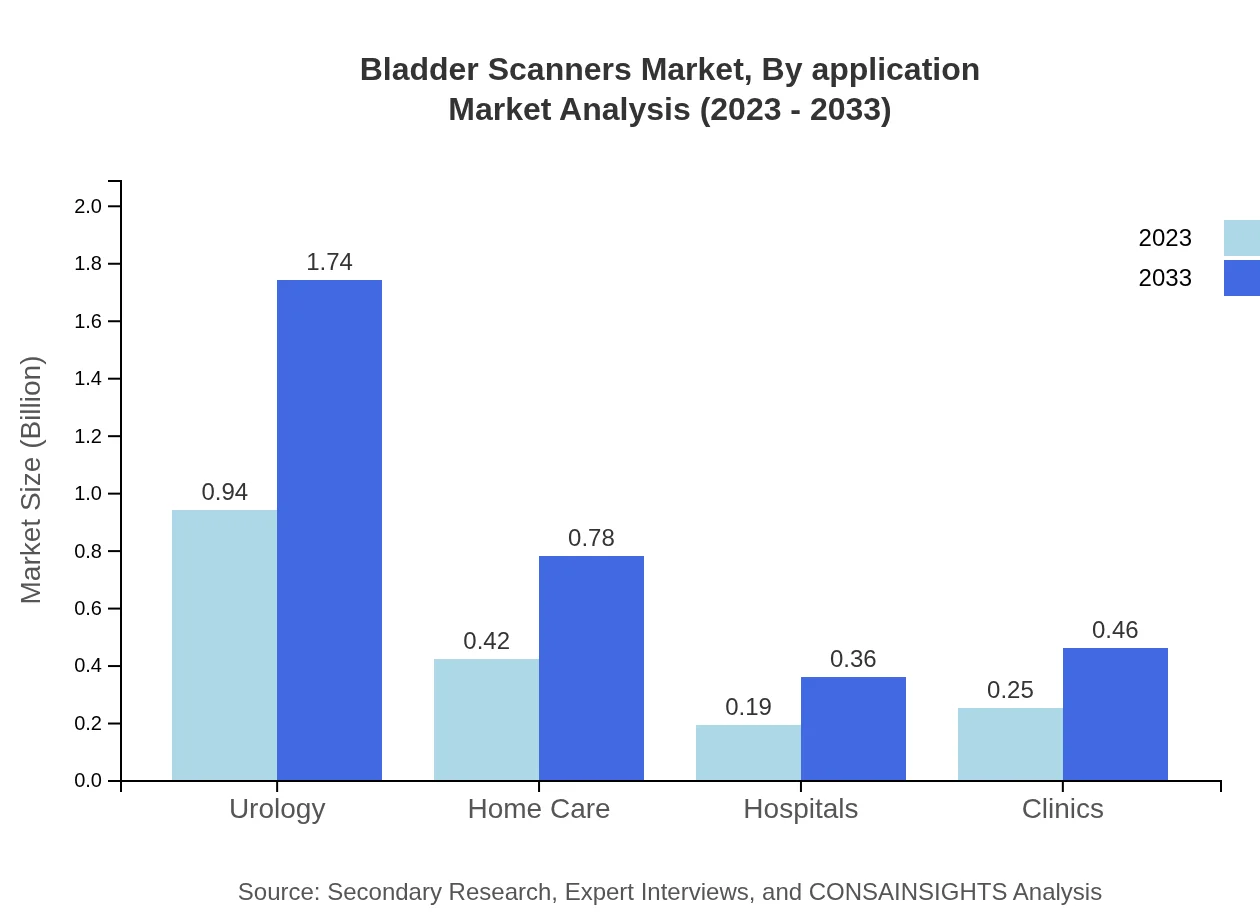
The urology application segment is anticipated to lead the market with a size of USD 0.94 billion in 2023, growing to USD 1.74 billion by 2033. This segment represents 52.07% of the market, reflecting the high demand for bladder scanners in urological assessments. General medicine also shows potential growth, driven by increasing awareness of urinary health.
Bladder Scanners Market Analysis By End User
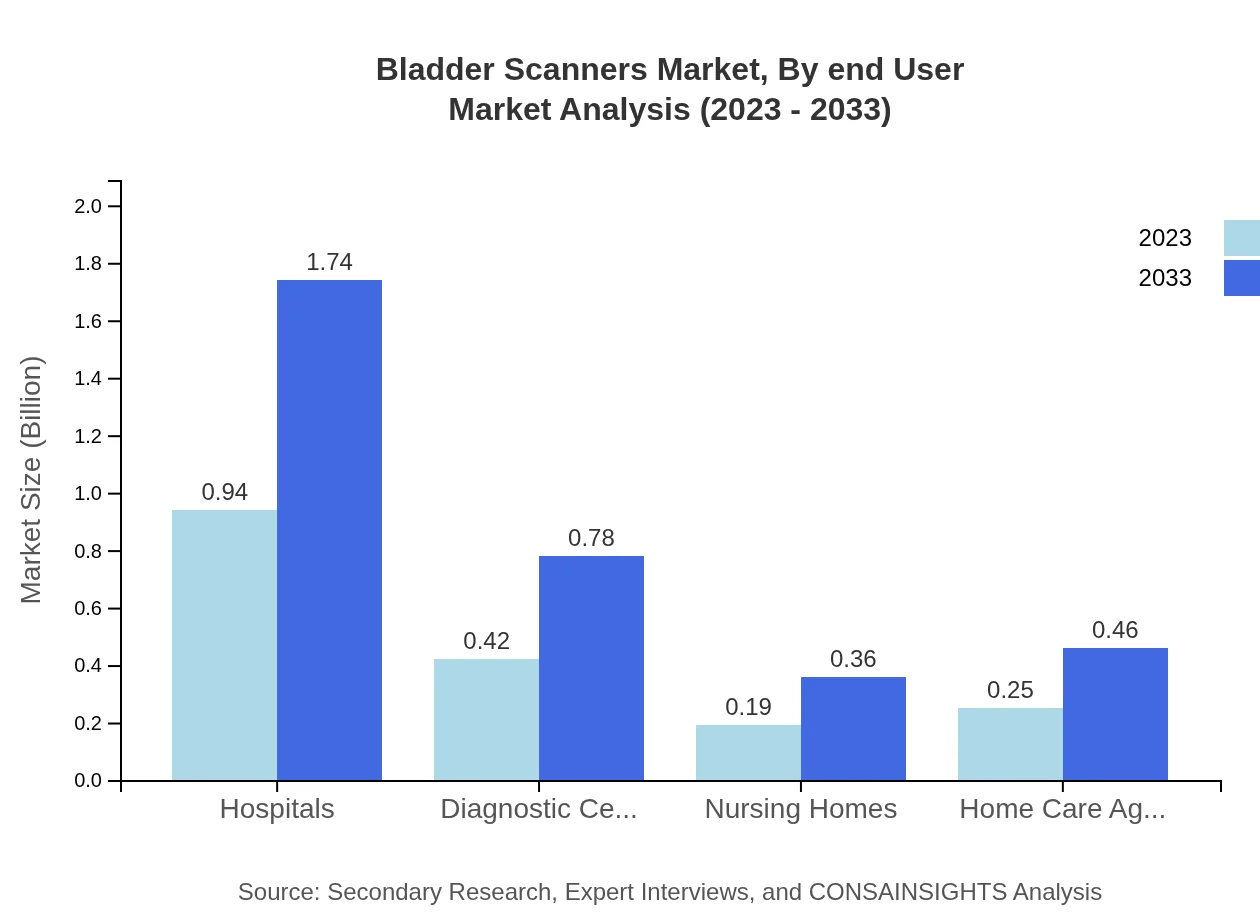
Hospitals represent the largest end-user segment, estimated at USD 0.94 billion in 2023, growing to USD 1.74 billion by 2033. Their high utilization (52.07% market share) stems from the comprehensive use of bladder scanners in patient care. Diagnostic centers and nursing homes also contribute significantly, showcasing strong growth driven by increased operational efficiencies.
Bladder Scanners Market Analysis By Distribution Channel
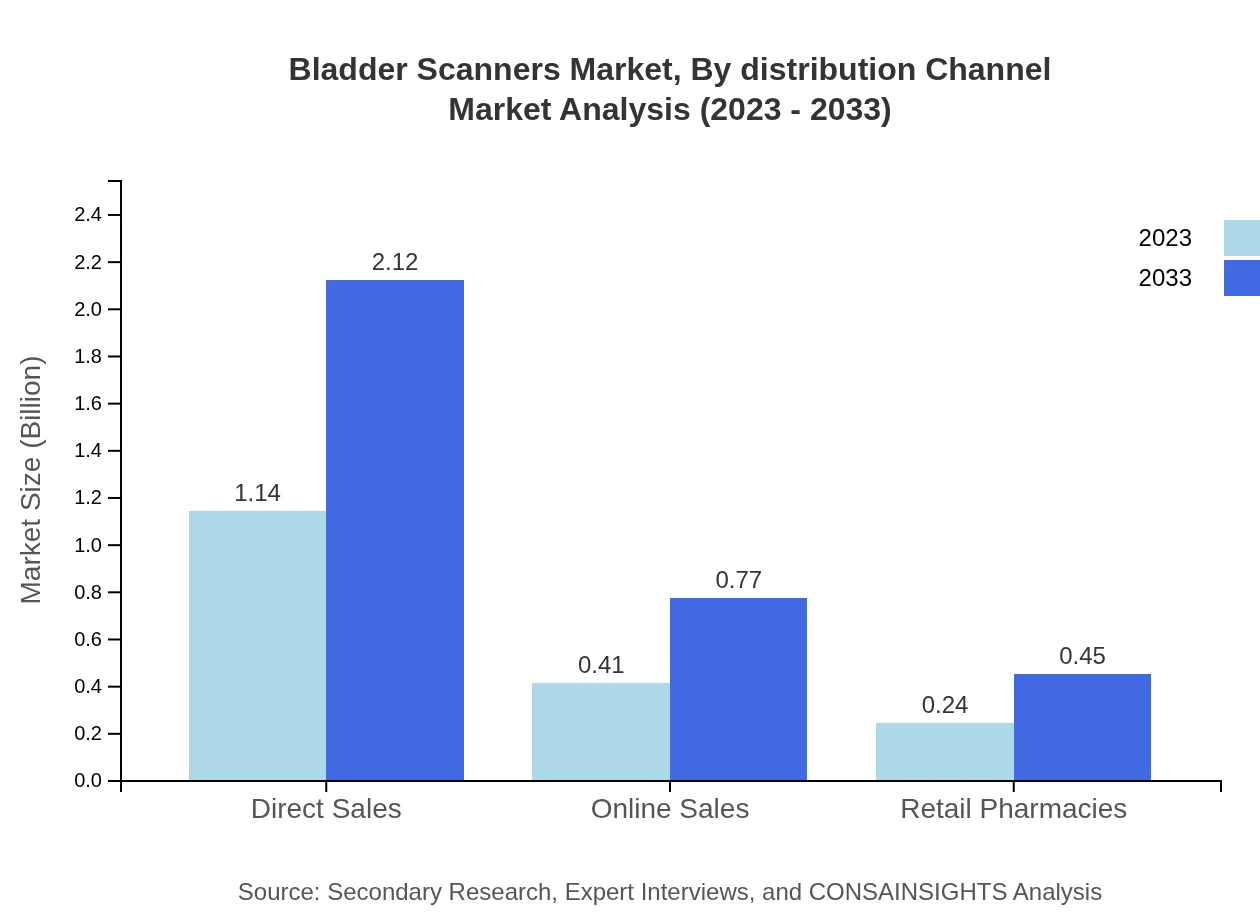
The direct sales channel dominates with an estimated market size of USD 1.14 billion in 2023, expected to grow to USD 2.12 billion by 2033, holding a 63.6% share. Online sales and retail pharmacies are also significant, predicted to reach USD 0.41 billion and USD 0.24 billion by 2033 respectively, underlining changing purchasing behaviors.
Bladder Scanners Market Trends and Future Forecast
Tell us your focus area and get a customized research report.
Global Market Leaders and Top Companies in Bladder Scanners Industry
Echolab:
Echolab is a leading provider of innovative ultrasound technologies, specializing in bladder scanner devices that enhance diagnostic capabilities in urology.Rico Pharma:
Rico Pharma manufactures portable and stationary bladder scanners, focusing on providing accurate diagnostic solutions with user-friendly designs.SonoSite Inc.:
SonoSite is renowned for its cutting-edge portable ultrasound technology, including bladder scanners favored in emergency care and point-of-care settings.We're grateful to work with incredible clients.








FAQs
What is the market size for bladder scanners in 2023?
The market size for bladder scanners in 2023 is $1.80 Billion as provided in the market data for the 2023 baseline year.
How big will the bladder scanners market be in 2033?
By 2033, the bladder scanners market is projected to reach $3.34 Billion according to the supplied forecast figures for the 2033 end year.
What is CAGR for the bladder scanners market?
The compound annual growth rate (CAGR) for the bladder scanners market is 6.2% for the 2023 to 2033 forecast period.
Which region is the fastest Growing in the Bladder Scanners Market Report market?
Middle East and Africa is the fastest-growing region, projected to expand from $0.14 Billion in 2023 to $0.27 Billion in 2033, reflecting an implied 6.79% CAGR over the forecast period.
Which region is the fastest Growing?
The Middle East and Africa, shown with an implied 6.79% CAGR and growth from $0.14 Billion in 2023 to $0.27 Billion in 2033.
Who are the leading companies active in this market?
Top companies listed in the input are Echolab, Rico Pharma, and SonoSite Inc., which are noted for product development and market presence.
What end users are included in segmentation?
End-user segments include Hospitals, Diagnostic Centers, Nursing Homes, and Home Care Agencies as specified in the segmentation details.
What product types are covered in the market?
Product-type segmentation covers Portable Scanners and Stationary Scanners as the primary device categories outlined in the data.
How are distribution channels defined?
Distribution channels identified include Direct Sales, Online Sales, and Retail Pharmacies as listed in the provided segment facts.
Why is home care important for bladder scanners?
Home care use supports demand for portable scanners and non-invasive monitoring, aligning with rising outpatient and at-home clinical services.