

Cell Culture Protein Surface Coatings Market Report
First published: 21 October 2024 | Last updated: 28 May 2026 | Report Code: cell-culture-protein-surface-coatings
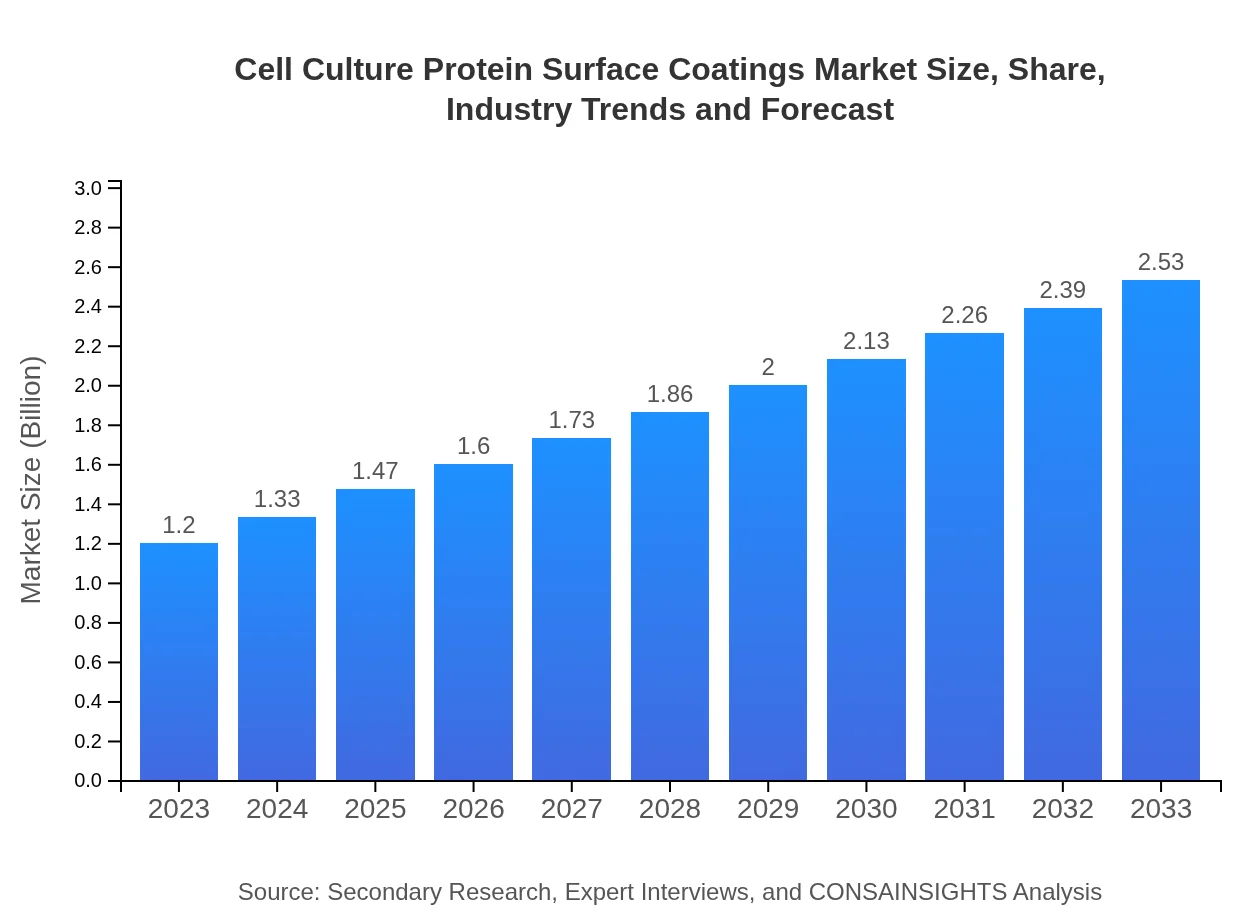
Cell Culture Protein Surface Coatings Market — USD 1.2 billion in 2023, Growing to USD 2.53B by 2033 at 7.5% CAGR
This report provides an in-depth analysis of the Cell Culture Protein Surface Coatings market, covering detailed insights into market trends, size forecasts, and competitive landscape from 2023 to 2033.
Key Takeaways
- Global market expanded from $1.20 Billion in 2023 and is expected to reach $2.53 Billion by 2033 at a 7.5% CAGR.
- North America is the largest region, increasing from $0.46 Billion in 2023 to $0.97 Billion in 2033.
- North America is largest regional market; Latin America is regional market region based on implied CAGR across 2023 to 2033.
- Europe and Asia Pacific show steady gains: Europe from $0.31 Billion to $0.65 Billion, Asia Pacific from $0.23 Billion to $0.49 Billion (2023–2033).
- Key companies active in the market include Corning Incorporated, Sigma-Aldrich (Merck Group), Thermo Fisher Scientific, and Cellgenix GmbH.
Cell Culture Protein Surface Coatings Market Report — Executive Summary
Regional analysis shows North America as largest market and Latin America as fastest-growing region by implied CAGR. The Cell Culture Protein Surface Coatings market is advancing as biotechnology and pharmaceutical research intensify. The market was valued at $1.20 Billion in 2023 and is forecast to reach $2.53 Billion by 2033, reflecting a 7.5% CAGR over the 2023 to 2033 period. Growth is driven by higher investment in R&D, increased use of coatings for cell adhesion and differentiation, and material science innovations enabling tailored surface properties. Regional dynamics vary: North America remains the largest market, while Latin America records the fastest implied growth. Product segmentation includes natural, synthetic and biomimetic coatings across applications such as tissue engineering, drug discovery, and regenerative medicine. Demand from academic research institutes, pharmaceutical firms, biotechnology companies, CROs, and clinical settings supports adoption. Prominent suppliers shaping the competitive landscape include Corning Incorporated, Sigma-Aldrich (Merck Group), Thermo Fisher Scientific and Cellgenix GmbH. The market outlook reflects sustained investment in advanced cell-culture tools and expanding application areas through 2033.
Key Growth Drivers
- Increased R&D spending by pharmaceutical and biotech firms fueling demand for specialized surface coatings.
- Advances in material science enabling coatings that better support cell adhesion, proliferation and differentiation.
- Rising application in tissue engineering, drug discovery and regenerative medicine expanding product use cases.
- Collaboration between academic institutions and industry accelerating adoption of novel coating solutions.
- Growing biopharmaceutical production requiring reliable cell-culture substrates for consistency and scalability.
| Metric | Value |
|---|---|
| Study Period | 2023 - 2033 |
| 2023 Market Size | $1.20 Billion |
| CAGR (2023-2033) | 7.5% |
| 2033 Market Size | $2.53 Billion |
| Top Companies | Corning Incorporated, Sigma-Aldrich (Merck Group), Thermo Fisher Scientific, Cellgenix GmbH |
| Published Date | 21 October 2024 |
| Last Modified Date | 28 May 2026 |
Cell Culture Protein Surface Coatings Market Overview
Customize Cell Culture Protein Surface Coatings Market Report market research report
- ✔ Get in-depth analysis of Cell Culture Protein Surface Coatings market size, growth, and forecasts.
- ✔ Understand Cell Culture Protein Surface Coatings's regional dynamics and industry-specific trends.
- ✔ Identify potential applications, end-user demand, and growth segments in Cell Culture Protein Surface Coatings
What is the Market Size & CAGR of Cell Culture Protein Surface Coatings Market Report market in 2023?
Cell Culture Protein Surface Coatings Industry Analysis
Cell Culture Protein Surface Coatings Market Segmentation and Scope
Tell us your focus area and get a customized research report.
Cell Culture Protein Surface Coatings Market Report Market Analysis Report by Region
Europe Cell Culture Protein Surface Coatings Market Report:
Europe grows from $0.31 Billion in 2023 to $0.65 Billion in 2033. Expanded research funding, translational medicine initiatives and industry-academic collaborations are driving uptake of specialized protein coatings in laboratory and manufacturing settings.Asia Pacific Cell Culture Protein Surface Coatings Market Report:
Asia Pacific grows from $0.23 Billion in 2023 to $0.49 Billion in 2033. Growing biotech investment, expanding pharmaceutical R&D and rising academic research capacity contribute to higher demand for cell-culture surface solutions.North America Cell Culture Protein Surface Coatings Market Report:
North America is largest regional market, rising from $0.46 Billion in 2023 to $0.97 Billion in 2033. Continued biotech and pharmaceutical research activity, plus demand from academic and commercial labs, supports adoption of advanced surface coatings across applications.South America Cell Culture Protein Surface Coatings Market Report:
Latin America is fastest-growing region by implied CAGR, increasing from $0.11 Billion in 2023 to $0.24 Billion in 2033. 11 Billion in 2023 to $0.24 Billion in 2033 and is identified as the regional growth market at an implied 8.11% CAGR. Strengthening research infrastructure and increasing biotechnology activity are key regional growth factors.Middle East & Africa Cell Culture Protein Surface Coatings Market Report:
Middle East and Africa grows from $0.08 Billion in 2023 to $0.17 Billion in 2033. Increasing investments in life-science research and developing clinical research capabilities support gradual market expansion for coatings.Tell us your focus area and get a customized research report.
Research Methodology
Cell Culture Protein Surface Coatings Market Analysis By Type
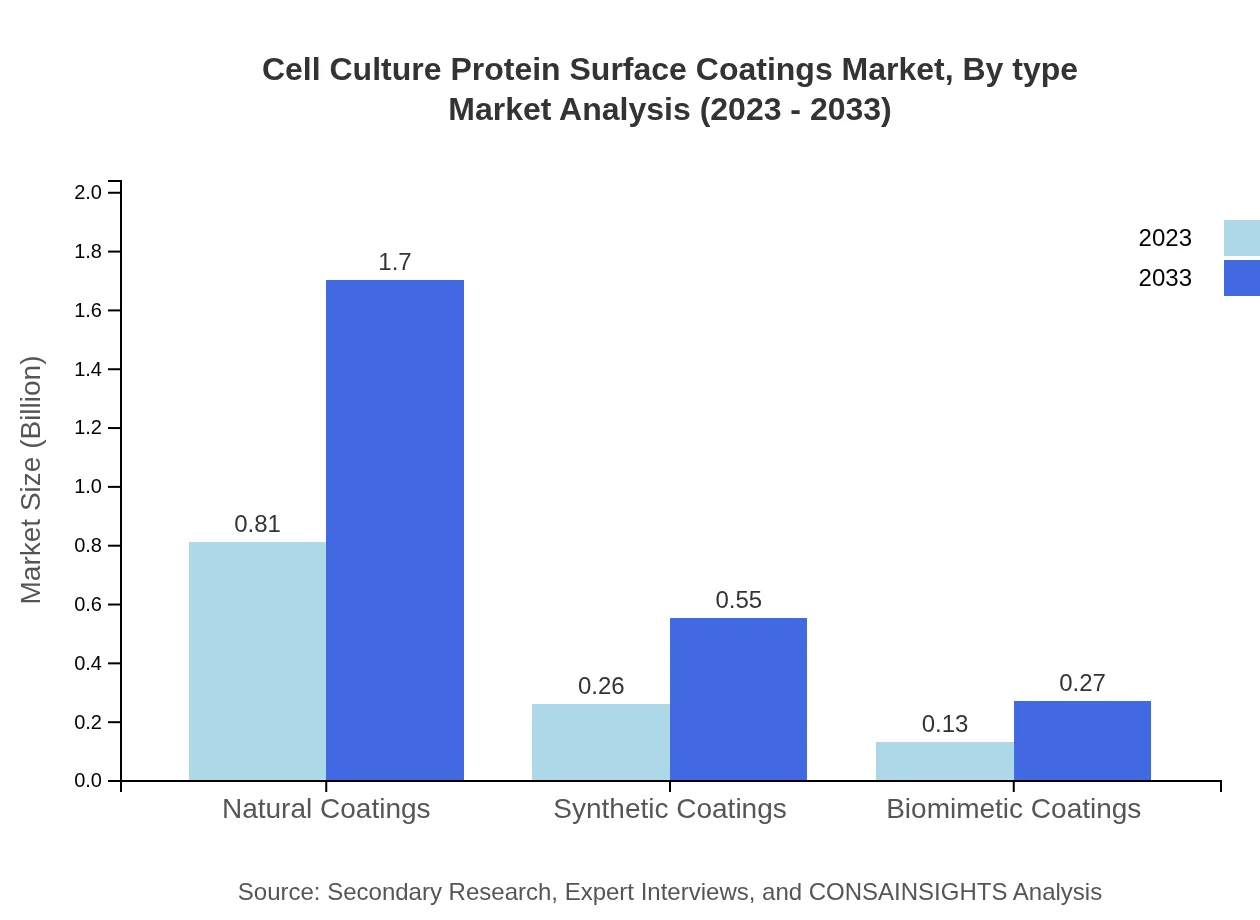
The market is divided into three primary types of coatings: Natural Coatings, Synthetic Coatings, and Biomimetic Coatings. In 2023, Natural Coatings accounted for a majority market size of $0.81 billion, expected to grow to $1.70 billion by 2033, due to their superior biocompatibility. Synthetic Coatings, amounting to $0.26 billion in 2023, will rise to $0.55 billion, while Biomimetic Coatings are projected to grow from $0.13 billion to $0.27 billion over the same period.
Cell Culture Protein Surface Coatings Market Analysis By Application
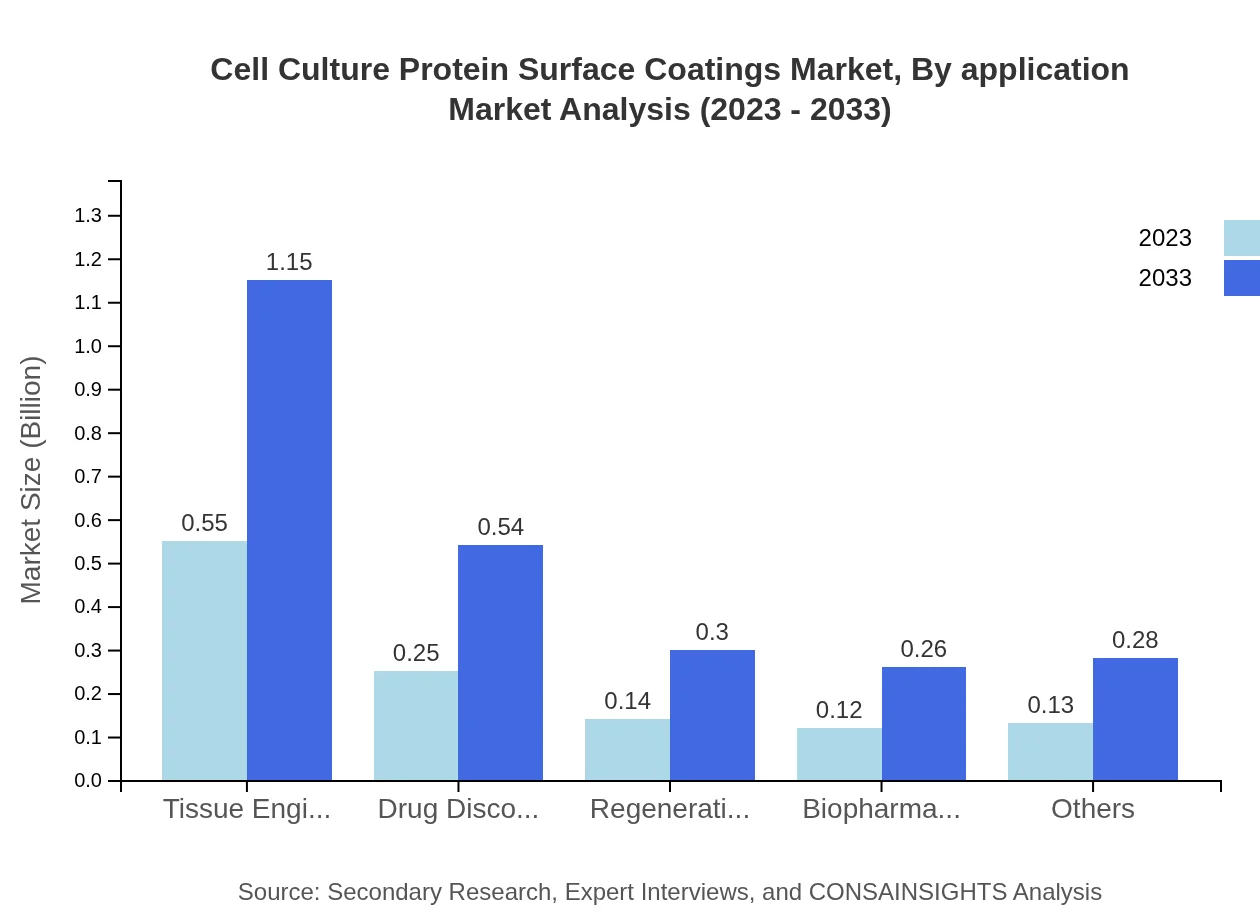
Key applications include Drug Discovery, Regenerative Medicine, and Tissue Engineering. Drug Discovery leads with a market size of $0.25 billion in 2023, rising to $0.54 billion. Regenerative Medicine and Tissue Engineering serve important functions as well, particularly in advancing medical practices and technologies.
Cell Culture Protein Surface Coatings Market Analysis By Functionalities
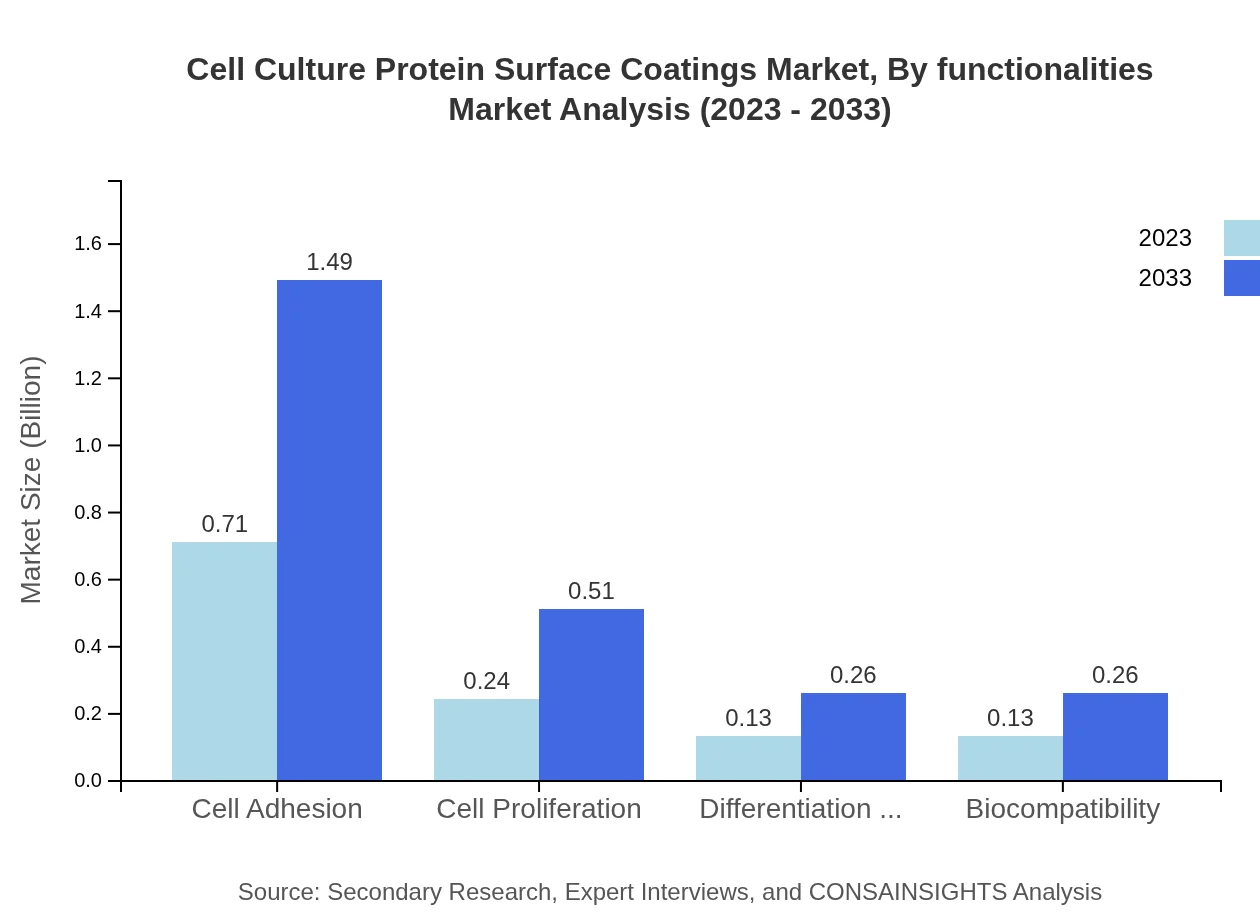
Functionalities of coatings are measured through parameters such as Cell Adhesion, Cell Proliferation, and Biocompatibility. Cell Adhesion coatings dominate the market, with sizes escalating from $0.71 billion to $1.49 billion. Biocompatibility and differentiation capabilities are also crucial, each maintaining a necessary share of the overall market.
Cell Culture Protein Surface Coatings Market Analysis By End User
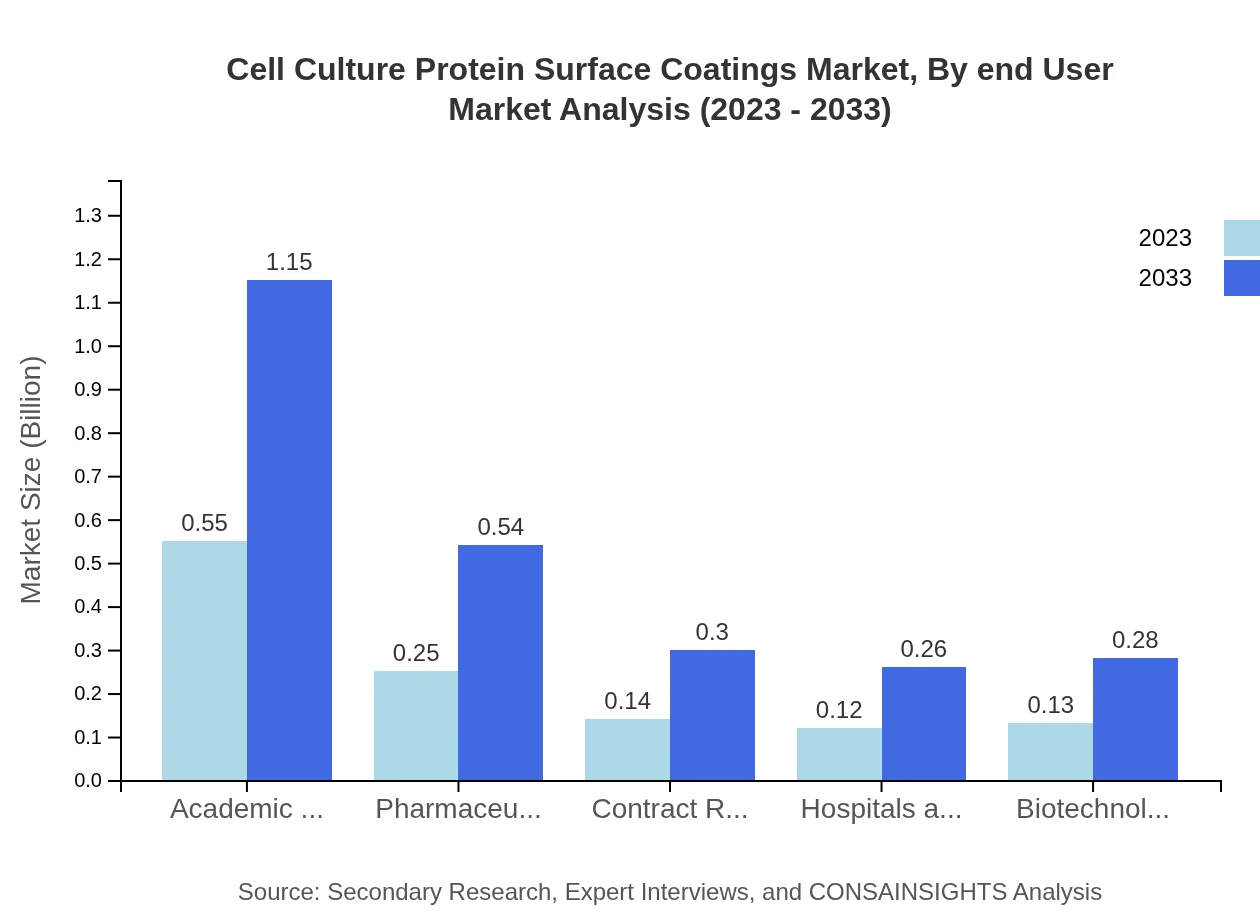
Major end-users of the coatings include Academic Research Institutes, Pharmaceutical Companies, and Contract Research Organizations, which collectively account for substantial market shares. Academic Research Institutes hold the largest segment, with a forecasted growth from $0.55 billion to $1.15 billion, emphasizing their continual investment in advanced research capabilities.
Cell Culture Protein Surface Coatings Market Analysis By Region
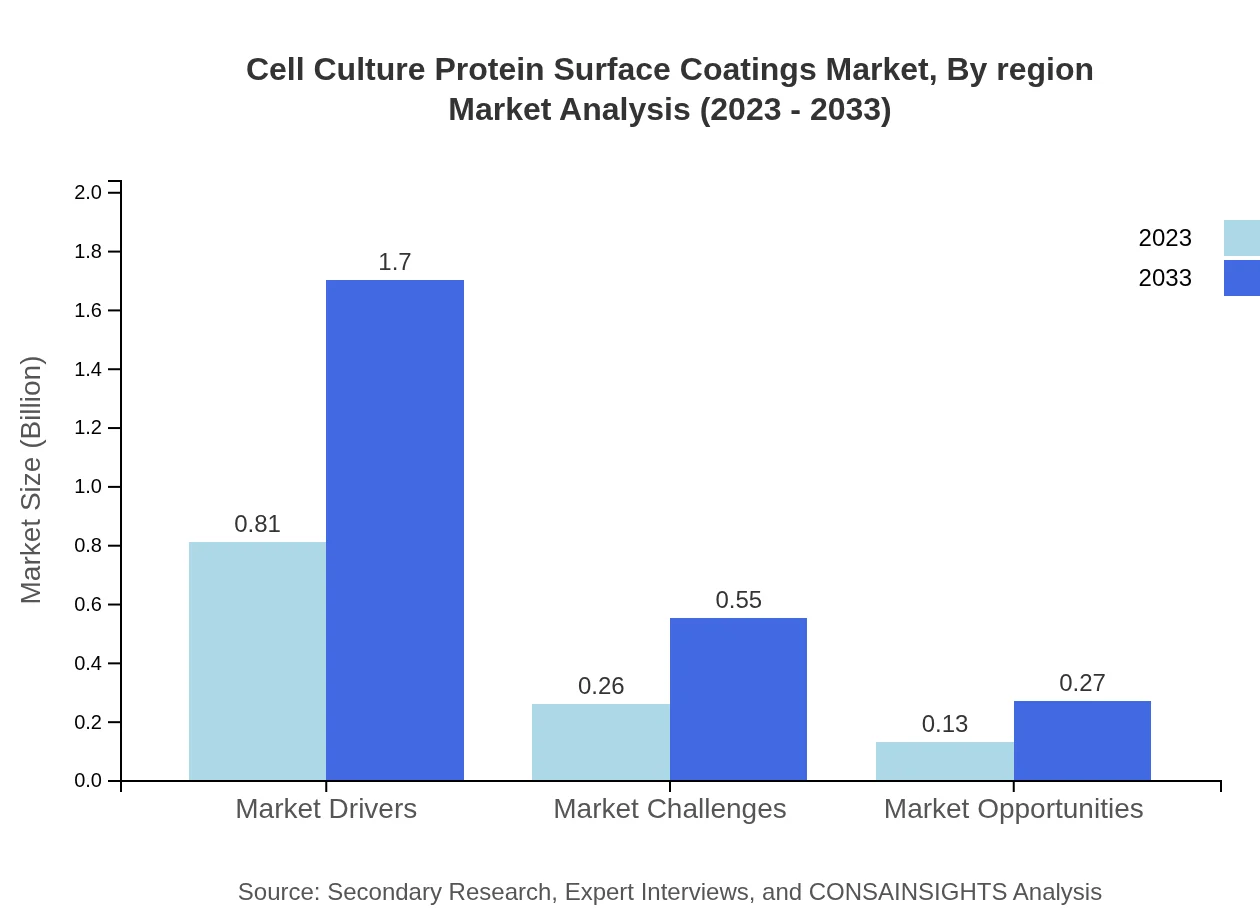
The dynamics of this market are heavily influenced by regional investments in research, the regulatory environment, and demand trends for biotechnology solutions. North America and Europe are leading the market but show competitive engagement from the Asia-Pacific region as biotechnology research flourishes.
Cell Culture Protein Surface Coatings Market Trends and Future Forecast
Tell us your focus area and get a customized research report.
Global Market Leaders and Top Companies in Cell Culture Protein Surface Coatings Industry
Corning Incorporated:
Corning is a leading innovator in material science, providing advanced cell culture products recognized for their quality and reliability.Sigma-Aldrich (Merck Group):
Merck's Sigma-Aldrich offers a diverse range of cell culture surface coatings that facilitate improved cell growth and drug discovery.Thermo Fisher Scientific:
Thermo Fisher delivers a vast portfolio of coatings designed for a variety of cell culture needs, aiming to advance scientific progress.Cellgenix GmbH:
Cellgenix specializes in cell culture media and coatings, playing a vital role in supporting stem cell and regenerative medicine research.We're grateful to work with incredible clients.









FAQs
What is the market size of the Cell Culture Protein Surface Coatings market in 2023?
The market size in 2023 is $1.20 Billion, as stated in the report, representing the baseline for the 2023 to 2033 forecast period.
How big will the market be in 2033?
The market is projected to reach $2.53 Billion by 2033 according to the provided forecast figures for the 2023 to 2033 period.
What is CAGR of the market over the forecast period?
The report specifies a compound annual growth rate of 7.5% for the 2023 to 2033 forecast window.
Which region is the fastest Growing in the Cell Culture Protein Surface Coatings Market Report market?
Latin America is the fastest-growing region, projected to expand from $0.11 Billion in 2023 to $0.24 Billion in 2033, reflecting an implied 8.11% CAGR over the forecast period.
Why is Latin America highlighted in the regional analysis?
Latin America is noted as the regional market region with an implied 8.11% CAGR, growing from $0.11 Billion in 2023 to $0.24 Billion in 2033.
Who are the top companies operating in this market?
Top companies listed include Corning Incorporated, Sigma-Aldrich (Merck Group), Thermo Fisher Scientific, and Cellgenix GmbH.
What applications drive demand for protein surface coatings?
Key applications cited are tissue engineering, drug discovery, regenerative medicine and biopharmaceutical production requiring optimized cell culture environments.
What end users adopt these coatings most frequently?
Primary end users include academic research institutes, pharmaceutical companies, contract research organizations, hospitals and clinics, and biotechnology companies.