

Connected Drug Delivery Devices Market Report
First published: 15 October 2024 | Last updated: 25 May 2026 | Report Code: connected-drug-delivery-devices
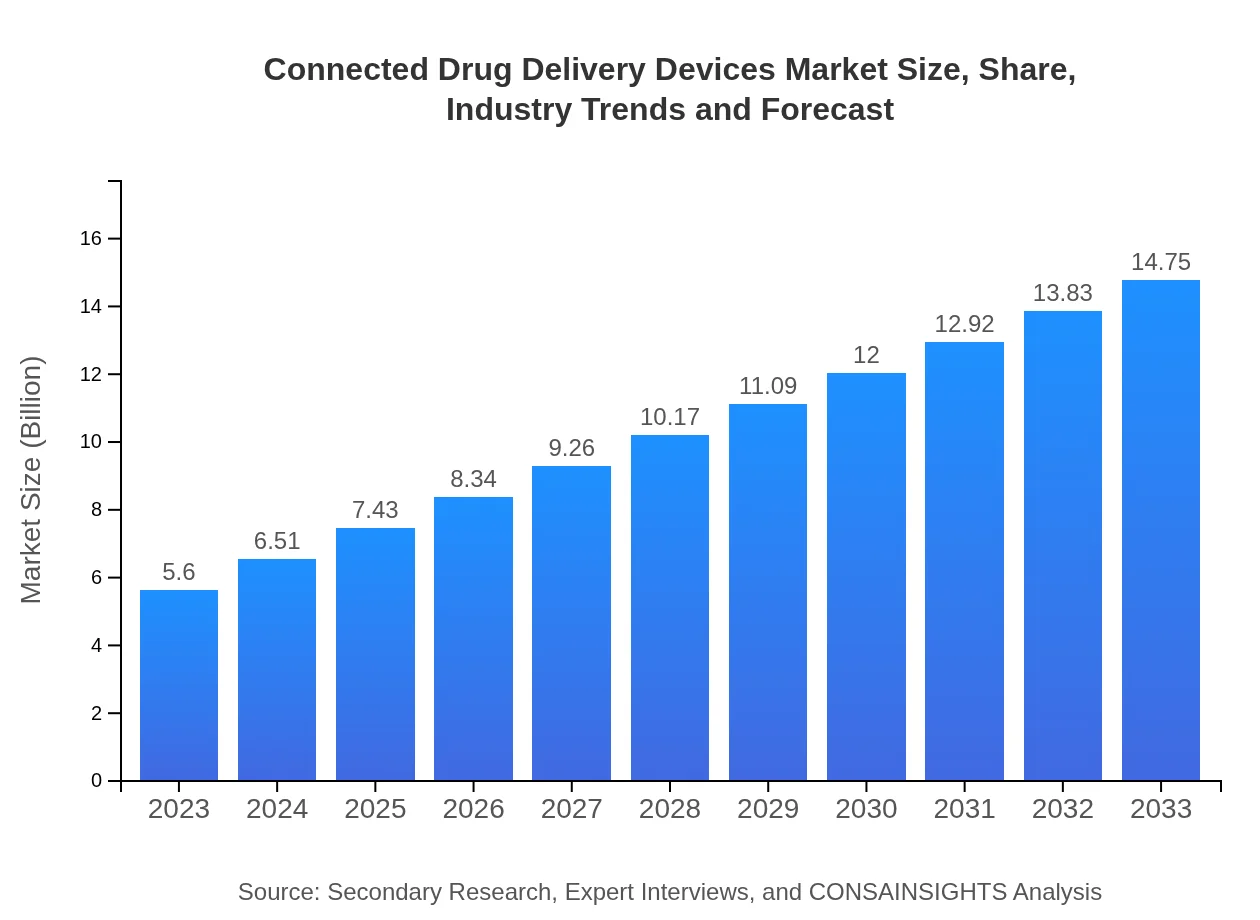
Connected Drug Delivery Devices Market — USD 5.6 billion in 2023, Growing to USD 14.75B by 2033 at 9.8% CAGR
This report provides an in-depth analysis of the Connected Drug Delivery Devices market, focusing on insights from 2023 to 2033, including market size, growth trends, and regional dynamics.
Key Takeaways
- Global market expands from $5.60 Billion in 2023 to $14.75 Billion by 2033, reflecting a 9.8% CAGR across 2023 to 2033.
- North America is largest regional market, while no single fastest-growing region is stated because regional CAGR differences remain within 0.15 percentage points.
- Europe moves from $1.37 Billion in 2023 to $3.61 Billion in 2033, while Asia Pacific grows from $1.20 Billion to $3.15 Billion.
- Device categories include injectors, inhalers, and connected patches, with Bluetooth, Wi‑Fi and cellular connectivity options.
- Top reported companies in the space include Medtronic, Sanofi, Novo Nordisk, and GlaxoSmithKline (GSK).
Connected Drug Delivery Devices Market Report — Executive Summary
North America remains largest market by forecast-period value, while no single fastest-growing region is stated because top regional growth rates are separated by less than 0.15 percentage points. This report evaluates the Connected Drug Delivery Devices market trajectory from 2023 to 2033, when the global market is projected to rise from $5.60 Billion to $14.75 Billion at a 9.8% CAGR. Drivers include expanding remote care models, sensor and connectivity improvements, and partnerships between device makers and pharmaceutical firms. Coverage spans technology platforms (Bluetooth, Wi‑Fi, cellular), product types (injectors, inhalers, connected patches), end users (hospitals, home care, pharmaceutical companies) and regional markets with North America identified as the largest by 2033. The analysis combines market sizing, segment-level observations, and a review of leading participants such as Medtronic, Sanofi, Novo Nordisk, and GlaxoSmithKline (GSK). Findings emphasize product integration, adherence monitoring, and regulatory considerations that shape commercialization strategies through 2033.
Key Growth Drivers
- Improvements in sensor and wireless technologies that enable real-time medication adherence monitoring and data transfer.
- Rising adoption of remote care and telehealth models that increase demand for connected administration devices.
- Collaborations between device manufacturers and pharmaceutical companies to embed connectivity into therapeutic delivery.
- Growing chronic disease management needs and aging populations that expand long-term device usage.
- Regulatory emphasis on device safety and interoperability, encouraging standardized, connected solutions.
| Metric | Value |
|---|---|
| Study Period | 2023 - 2033 |
| 2023 Market Size | $5.60 Billion |
| CAGR (2023-2033) | 9.8% |
| 2033 Market Size | $14.75 Billion |
| Top Companies | Medtronic , Sanofi, Novo Nordisk, GlaxoSmithKline (GSK) |
| Published Date | 15 October 2024 |
| Last Modified Date | 25 May 2026 |
Connected Drug Delivery Devices Market Overview
Customize Connected Drug Delivery Devices Market Report market research report
- ✔ Get in-depth analysis of Connected Drug Delivery Devices market size, growth, and forecasts.
- ✔ Understand Connected Drug Delivery Devices's regional dynamics and industry-specific trends.
- ✔ Identify potential applications, end-user demand, and growth segments in Connected Drug Delivery Devices
What is the Market Size & CAGR of Connected Drug Delivery Devices Market Report market in 2023?
Connected Drug Delivery Devices Industry Analysis
Connected Drug Delivery Devices Market Segmentation and Scope
Tell us your focus area and get a customized research report.
Connected Drug Delivery Devices Market Report Market Analysis Report by Region
Europe Connected Drug Delivery Devices Market Report:
Europe grows from $1.37 Billion in 2023 to $3.61 Billion in 2033. Regional growth is influenced by regulatory focus on device safety, rising digital health initiatives, and adoption of connected solutions for chronic disease management.Asia Pacific Connected Drug Delivery Devices Market Report:
Asia Pacific grows from $1.2 Billion in 2023 to $3.15 Billion in 2033. Market development is driven by increasing healthcare digitization, expanding telehealth services, and rising prevalence of chronic conditions requiring long‑term management.North America Connected Drug Delivery Devices Market Report:
North America is largest regional market, rising from $2.16 Billion in 2023 to $5.68 Billion in 2033. The region's scale reflects strong clinical adoption, investment in connected health infrastructure, and active collaboration between device makers and pharmaceutical firms.South America Connected Drug Delivery Devices Market Report:
Latin America grows from $0.48 Billion in 2023 to $1.28 Billion in 2033. Expansion is supported by gradual uptake of remote monitoring technologies, partnerships to localize device solutions, and growing focus on medication adherence.Middle East & Africa Connected Drug Delivery Devices Market Report:
Middle East and Africa grows from $0.39 Billion in 2023 to $1.02 Billion in 2033. Market momentum is linked to investments in healthcare infrastructure, pilot deployments of connected devices, and rising interest in telemedicine-enabled care models.Tell us your focus area and get a customized research report.
Research Methodology
Connected Drug Delivery Devices Market Analysis By Device Type
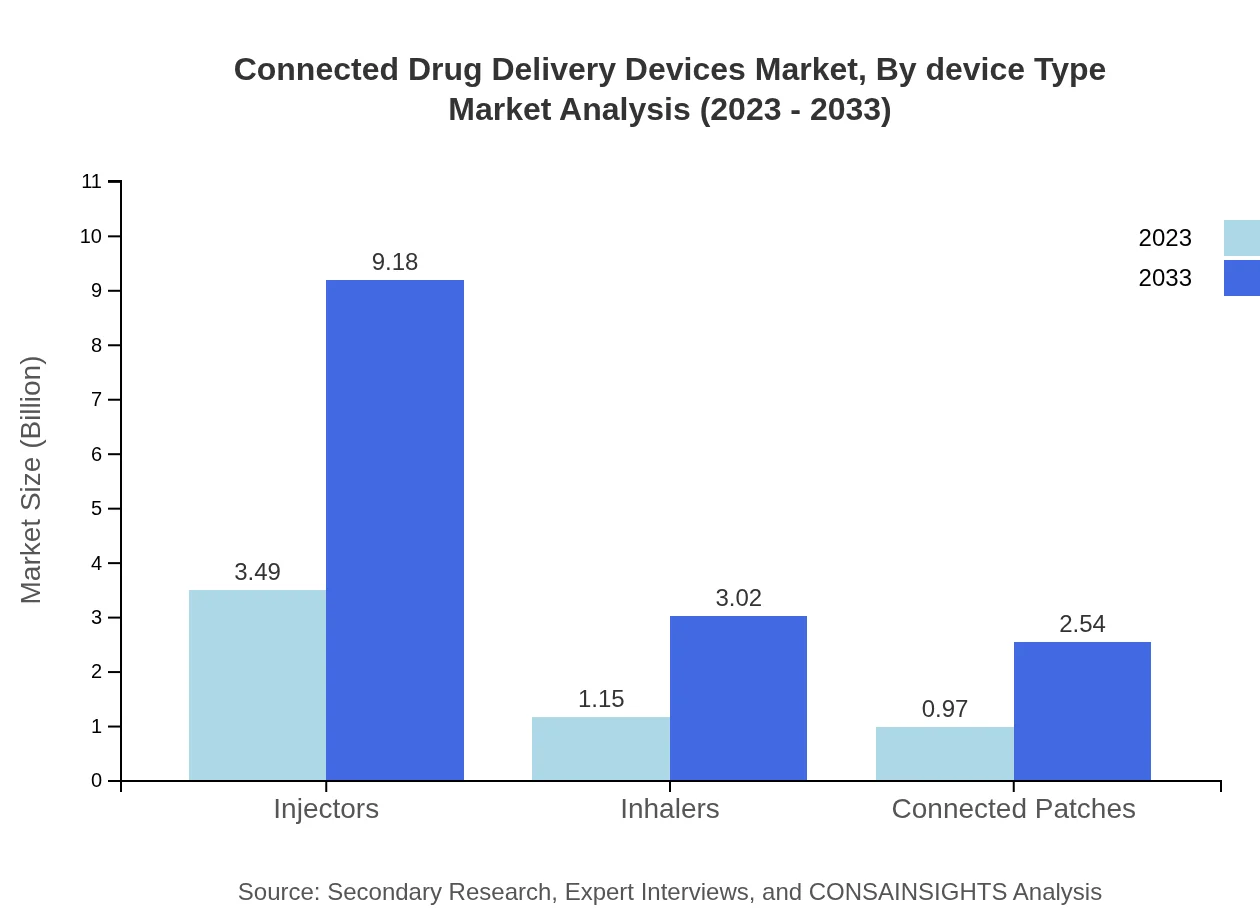
The Connected Drug Delivery Devices market, segmented by device type, includes injectors, inhalers, and connected patches. Injectors dominate the market, holding a size of $3.49 billion in 2023 and projected to grow to $9.18 billion by 2033. This segment’s significance lies in its application across diabetes management and biologics administration. Inhalers account for a sizeable portion, with a market size of $1.15 billion in 2023, expected to reach $3.02 billion by 2033. Connected patches are also gaining traction for their convenience, with a market size of $0.97 billion in 2023, projected to grow to $2.54 billion by 2033.
Connected Drug Delivery Devices Market Analysis By Technology
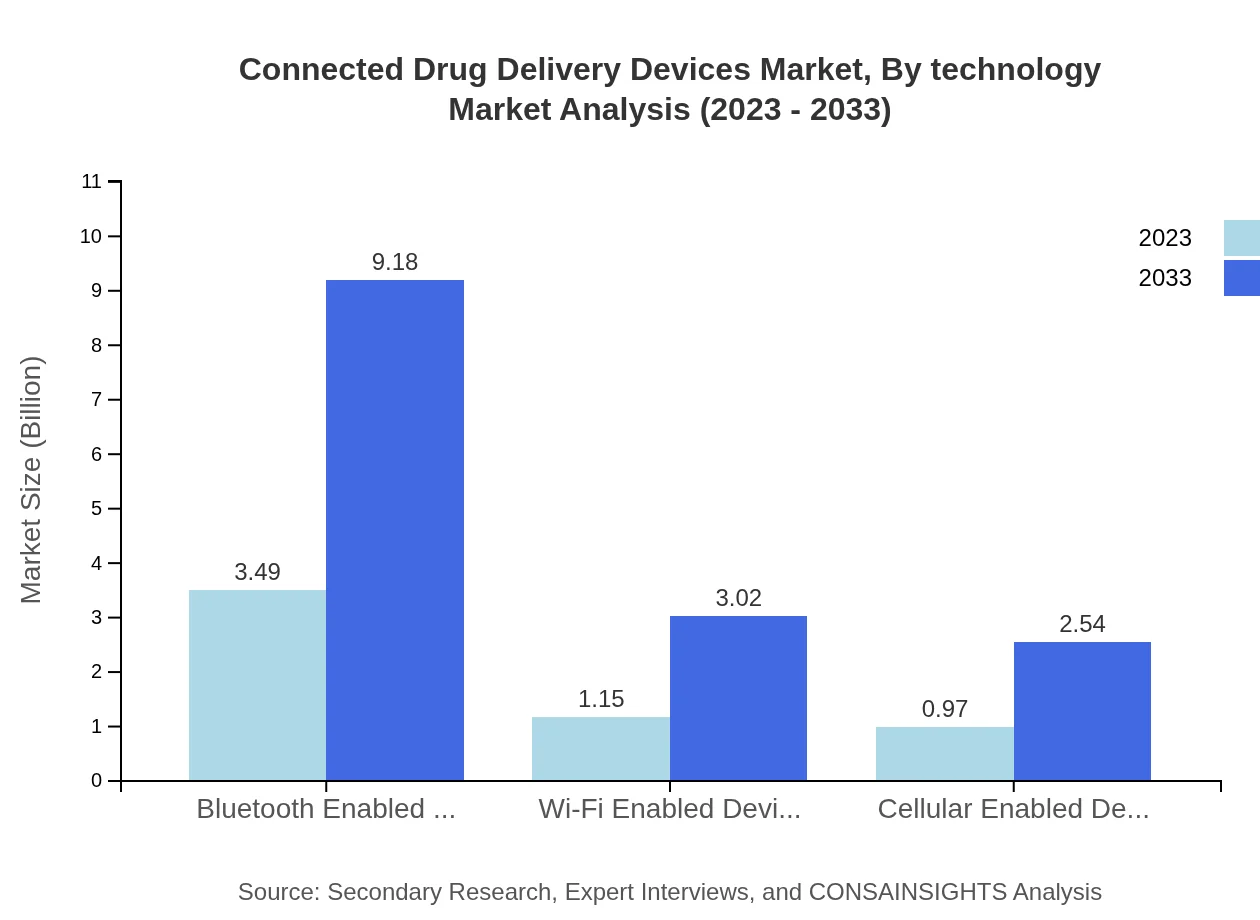
The market is also segmented by technology, encompassing Bluetooth, Wi-Fi, and Cellular-Enabled devices. Bluetooth-enabled devices lead with a market size of $3.49 billion in 2023, projected to grow to $9.18 billion by 2033, driven by their ease of connectivity with smartphones. Wi-Fi-enabled devices accounted for $1.15 billion in 2023 and are expected to grow to $3.02 billion by 2033, appealing to tech-savvy users. Cellular-enabled devices, with a market size of $0.97 billion in 2023, are projected to reach $2.54 billion by 2033.
Connected Drug Delivery Devices Market Analysis By Application
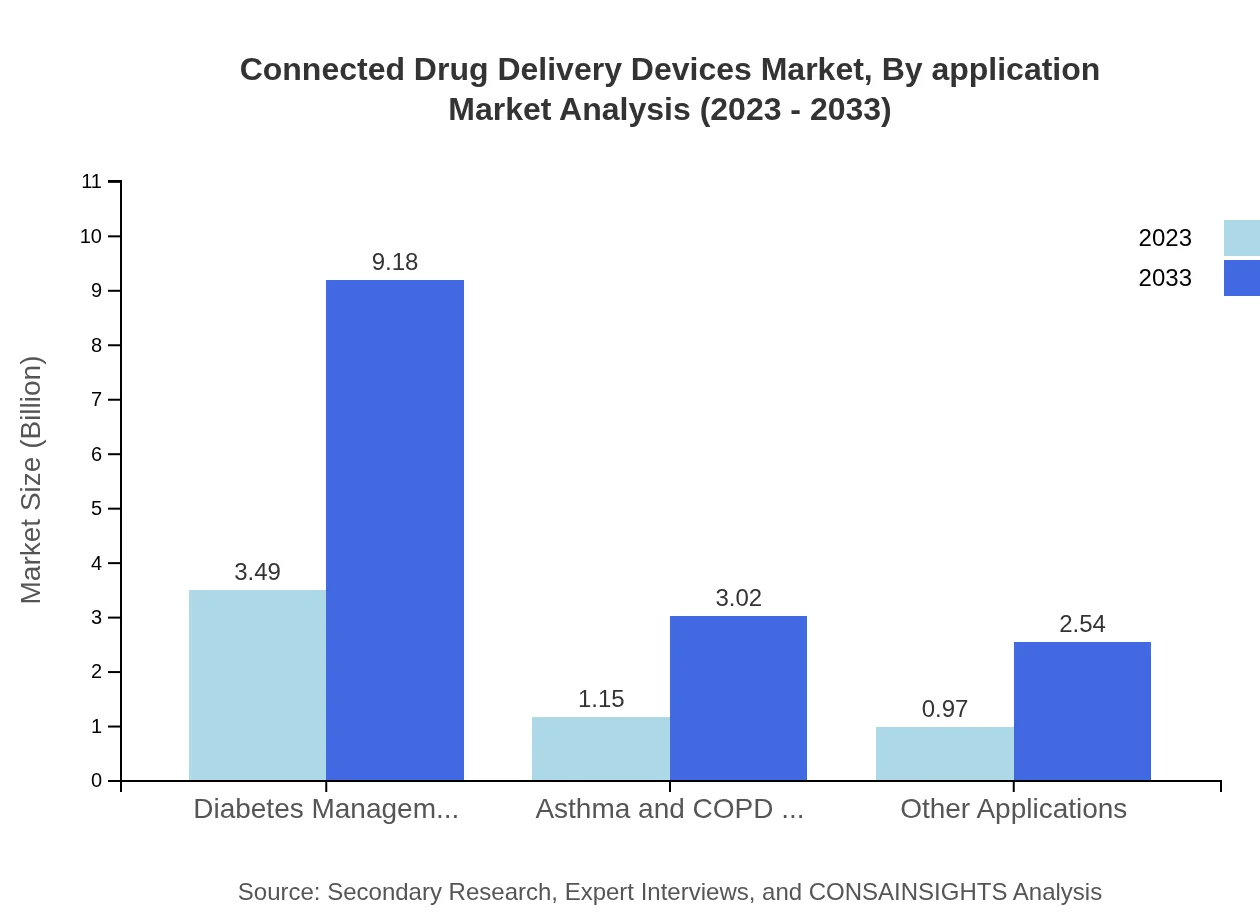
By application, the sector is divided into diabetes management, asthma and COPD management, and other applications. Diabetes management leads the share with a significant market size of $3.49 billion in 2023, estimated to grow to $9.18 billion by 2033. Asthma and COPD management follows closely at $1.15 billion in 2023, anticipated to increase to $3.02 billion by 2033, driven by rising asthma prevalence. Other applications, including connected patches for general health monitoring, will reach $0.97 billion in 2023 and $2.54 billion by 2033.
Connected Drug Delivery Devices Market Analysis By End User
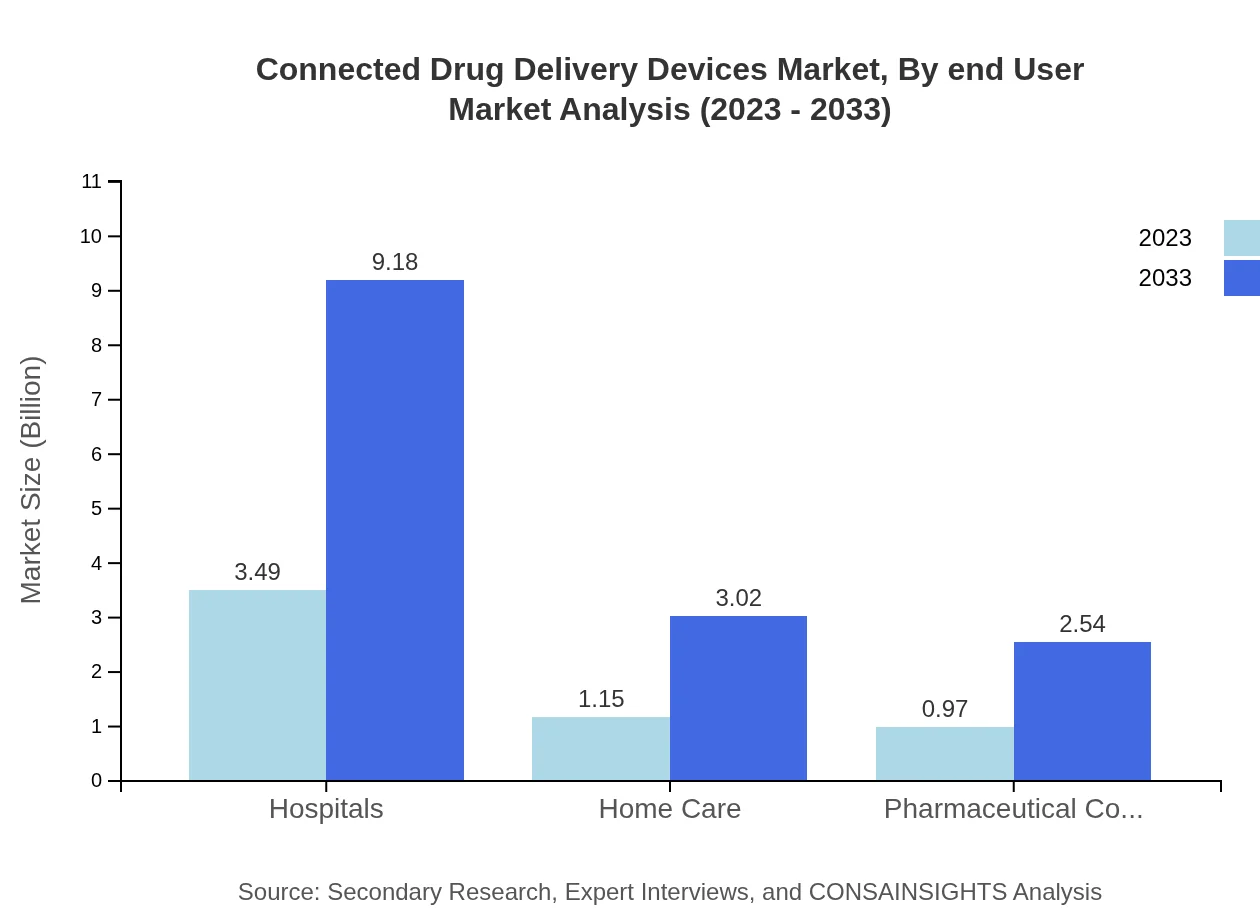
The end-user segmentation includes hospitals, home care, and pharmaceutical companies. Hospitals dominate with a market size of $3.49 billion in 2023, expected to reach $9.18 billion by 2033, highlighting their critical role in drug delivery. Home care settings are becoming increasingly relevant, growing from $1.15 billion in 2023 to $3.02 billion by 2033 due to heightened patient preferences for at-home care. Pharmaceutical companies also represent significant growth potential, expanding from $0.97 billion in 2023 to $2.54 billion by 2033 as they leverage connected devices for drug trials and monitoring.
Connected Drug Delivery Devices Market Trends and Future Forecast
Tell us your focus area and get a customized research report.
Global Market Leaders and Top Companies in Connected Drug Delivery Devices Industry
Medtronic :
Medtronic is a key player specializing in medical devices and technology. Their connected drug delivery systems enhance insulin management for diabetes patients.Sanofi:
Sanofi develops innovative combinations of pharmaceuticals and device technologies, focusing on improving patient adherence through connected solutions.Novo Nordisk:
Novo Nordisk leads in diabetes care and is known for its smart insulin pens that sync with mobile applications for patient engagement.GlaxoSmithKline (GSK):
GSK focuses on respiratory health, with connected inhalers that monitor usage patterns and improve treatment compliance.We're grateful to work with incredible clients.









FAQs
What is the market size of the Connected Drug Delivery Devices Market Report in 2023?
The market size for 2023 is $5.60 Billion, as stated in the report's baseline year figure.
How big will the market be in 2033?
By 2033 the market is projected to reach $14.75 Billion, according to the report's end‑period forecast.
What is CAGR for the forecast period?
The compound annual growth rate for 2023 to 2033 is 9.8%, as indicated in the market projections.
Is there a single fastest Growing region in the Connected Drug Delivery Devices Market Report market?
No single fastest-growing region is stated for the Connected Drug Delivery Devices Market Report market because the top regional implied CAGR values are within 0.15 percentage points of each other, making the ranking too close to call reliably.
Which companies are listed as key players?
Top companies referenced in the report include Medtronic, Sanofi, Novo Nordisk, and GlaxoSmithKline (GSK).
What are the primary device types covered?
The report covers injectors, inhalers, and connected patches as the main device types in the connected drug delivery space.
How are connectivity technologies categorized?
Connectivity in the report is categorized as Bluetooth enabled devices, Wi‑Fi enabled devices, and cellular enabled devices.
What end‑user segments are included?
End‑user segments noted are hospitals, home care, and pharmaceutical companies in the report's segmentation.
Who conducted the research for the report?
Research methodology includes primary interviews with industry experts and secondary research using company reports and publications.
Why is interoperability important for these devices?
Interoperability is highlighted due to the need for seamless data exchange between devices, clinical systems, and care platforms to support adherence and monitoring.