
Reports >
Life Sciences
>
Contrast Injector Market Report

Contrast Injector Market Report
First published: 10 October 2024 | Last updated: 25 May 2026 | Report Code: contrast-injector
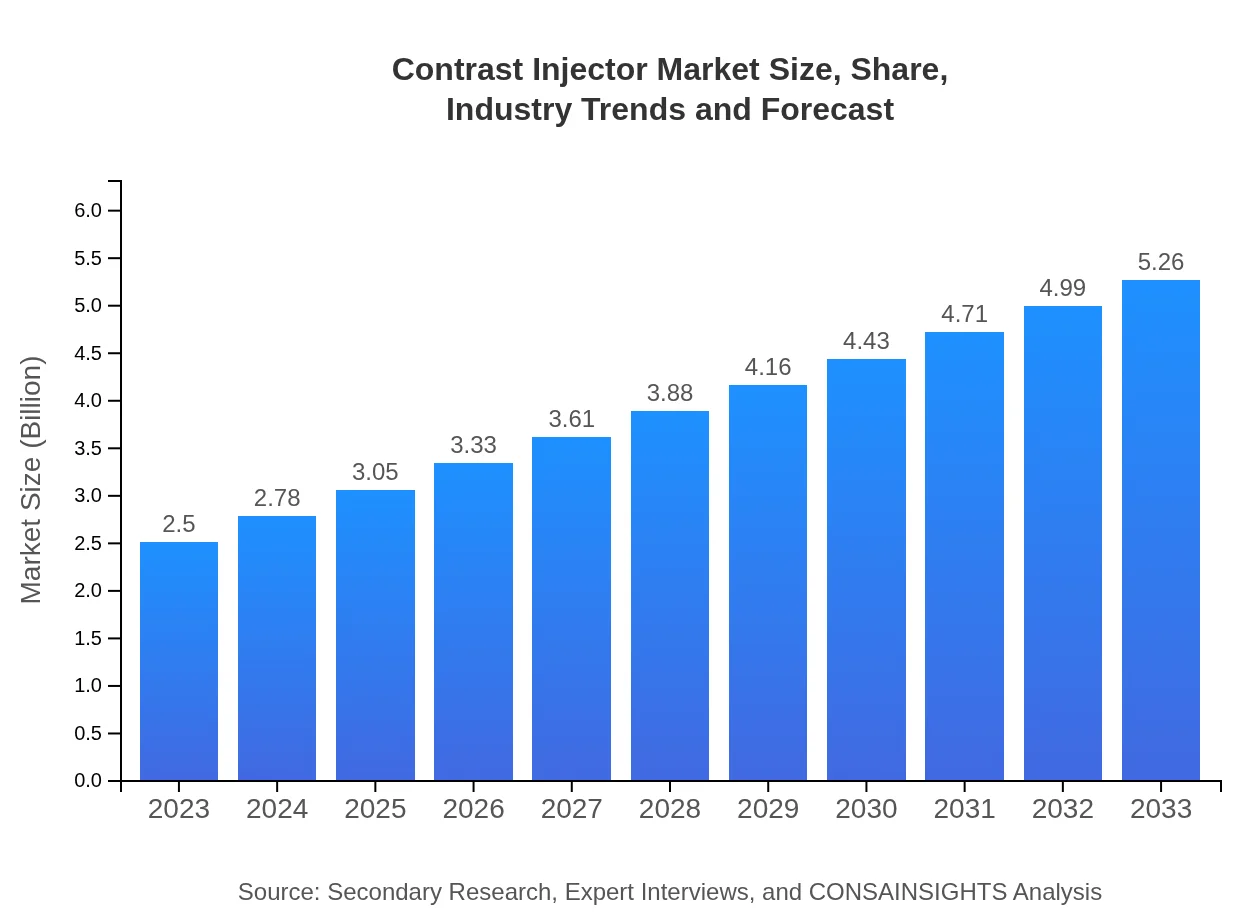
Contrast Injector Market — USD 2.5 billion in 2023, Growing to USD 5.26B by 2033 at 7.5% CAGR
This report provides an in-depth analysis of the Contrast Injector market, examining market dynamics, industry trends, regional analysis, and future forecasts for 2023 to 2033. It aims to equip stakeholders with actionable insights and comprehensive data to inform strategic decisions.
Key Takeaways
- Global market size increases from $2.50 Billion in 2023 to $5.26 Billion in 2033, reflecting a 7.5% CAGR during 2023 to 2033.
- North America is largest regional market, while no single fastest-growing region is stated because regional CAGR differences remain within 0.15 percentage points.
- North America is the largest region, rising from $0.96 Billion in 2023 to $2.02 Billion in 2033.
- Europe expands from $0.72 Billion in 2023 to $1.52 Billion in 2033, supported by advanced imaging adoption.
- Asia Pacific grows from $0.45 Billion in 2023 to $0.94 Billion in 2033, driven by rising diagnostic capacity.
- Market structure includes segments by product type, application, end user, region type and technological advancement.
- Key manufacturers include GE Healthcare, Siemens Healthineers, Bayer AG and Canon Medical Systems.
Contrast Injector Market Report — Executive Summary
North America remains largest market by forecast-period value, while no single fastest-growing region is stated because top regional growth rates are separated by less than 0.15 percentage points. The Contrast Injector market is expanding steadily as healthcare providers increase diagnostic imaging capacity and prioritize patient safety. Market value increases from $2.50 Billion in 2023 to $5.26 Billion by 2033, at a CAGR of 7.5% over 2023 to 2033. Growth is supported by technological upgrades from manual to advanced systems, stronger hospital and diagnostic center demand, and investments from established players such as GE Healthcare, Siemens Healthineers, Bayer AG and Canon Medical Systems. Regional developments vary: North America leads in absolute market value, while Europe and Asia Pacific show meaningful expansion. The report examines segmentation by product type (power and non-power injectors), application (radiology, cardiology, oncology, others), end user, region type and technological advancement, and evaluates regulatory and safety trends shaping product design and adoption.
Key Growth Drivers
- Rising diagnostic imaging volumes in hospitals and diagnostic centers boosting demand for automated contrast delivery.
- Shift from manual to advanced injector technologies improving workflow efficiency and patient safety.
- Ongoing investments by leading manufacturers to enhance product capabilities and meet regulatory standards.
- Increasing prevalence of chronic diseases and an aging population raising the need for advanced imaging procedures.
- Growth in healthcare infrastructure across regions supporting greater uptake of contrast injector systems.
| Metric | Value |
|---|---|
| Study Period | 2023 - 2033 |
| 2023 Market Size | $2.50 Billion |
| CAGR (2023-2033) | 7.5% |
| 2033 Market Size | $5.26 Billion |
| Top Companies | GE Healthcare, Siemens Healthineers, Bayer AG, Canon Medical Systems |
| Published Date | 10 October 2024 |
| Last Modified Date | 25 May 2026 |
Contrast Injector Market Overview
Customize Contrast Injector Market Report market research report
- ✔ Get in-depth analysis of Contrast Injector market size, growth, and forecasts.
- ✔ Understand Contrast Injector's regional dynamics and industry-specific trends.
- ✔ Identify potential applications, end-user demand, and growth segments in Contrast Injector
What is the Market Size & CAGR of Contrast Injector Market Report market in 2023?
Contrast Injector Industry Analysis
Contrast Injector Market Segmentation and Scope
Tell us your focus area and get a customized research report.
Contrast Injector Market Report Market Analysis Report by Region
Europe Contrast Injector Market Report:
Europe grows from $0.72 Billion in 2023 to $1.52 Billion in 2033. Adoption of advanced imaging practices, regulatory focus on safety, and hospital modernization underpin regional expansion in injector deployment.Asia Pacific Contrast Injector Market Report:
Asia Pacific grows from $0.45 Billion in 2023 to $0.94 Billion in 2033. Increased diagnostic capacity, expanding healthcare facilities and rising demand for improved imaging services are key regional growth contributors.North America Contrast Injector Market Report:
North America is largest regional market, rising from $0.96 Billion in 2023 to $2.02 Billion in 2033. This growth reflects extensive imaging infrastructure, high adoption of advanced injector systems in hospitals and diagnostic centers, and sustained investment in healthcare technology.South America Contrast Injector Market Report:
Latin America grows from $0.05 Billion in 2023 to $0.09 Billion in 2033. Growth is supported by gradual healthcare infrastructure development and rising utilization of diagnostic imaging in clinical settings.Middle East & Africa Contrast Injector Market Report:
Middle East and Africa grows from $0.33 Billion in 2023 to $0.69 Billion in 2033. Enhanced investment in healthcare facilities and growing emphasis on diagnostic capabilities are driving market expansion.Tell us your focus area and get a customized research report.
Research Methodology
Contrast Injector Market Analysis By Product Type
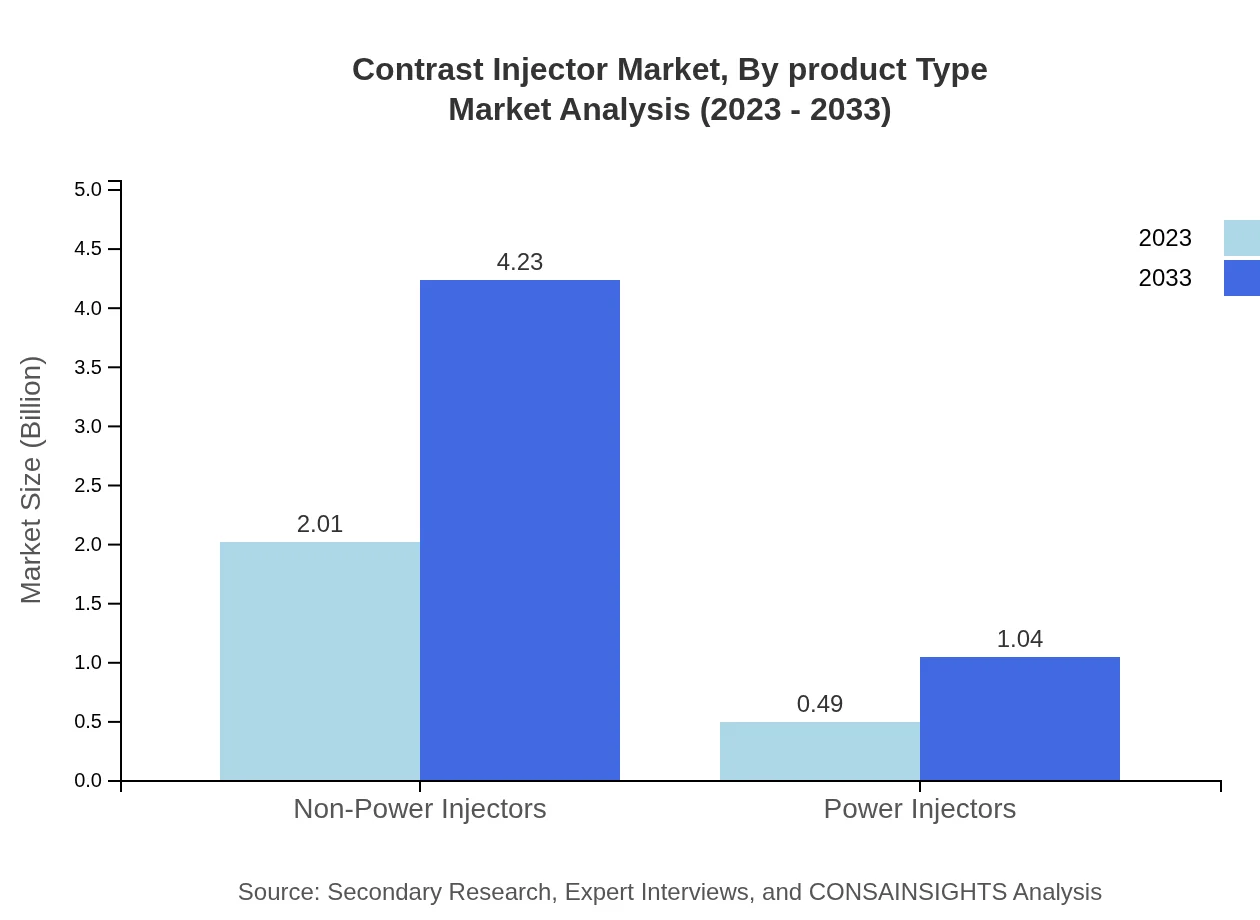
The Contrast Injector market is categorized into Power Injectors, which commanded a significant market share of 19.71% in 2023, and Non-Power Injectors, dominating with an 80.29% share. Power injectors are forecasted to grow steadily as hospitals seek efficiency in their imaging processes.
Contrast Injector Market Analysis By Application
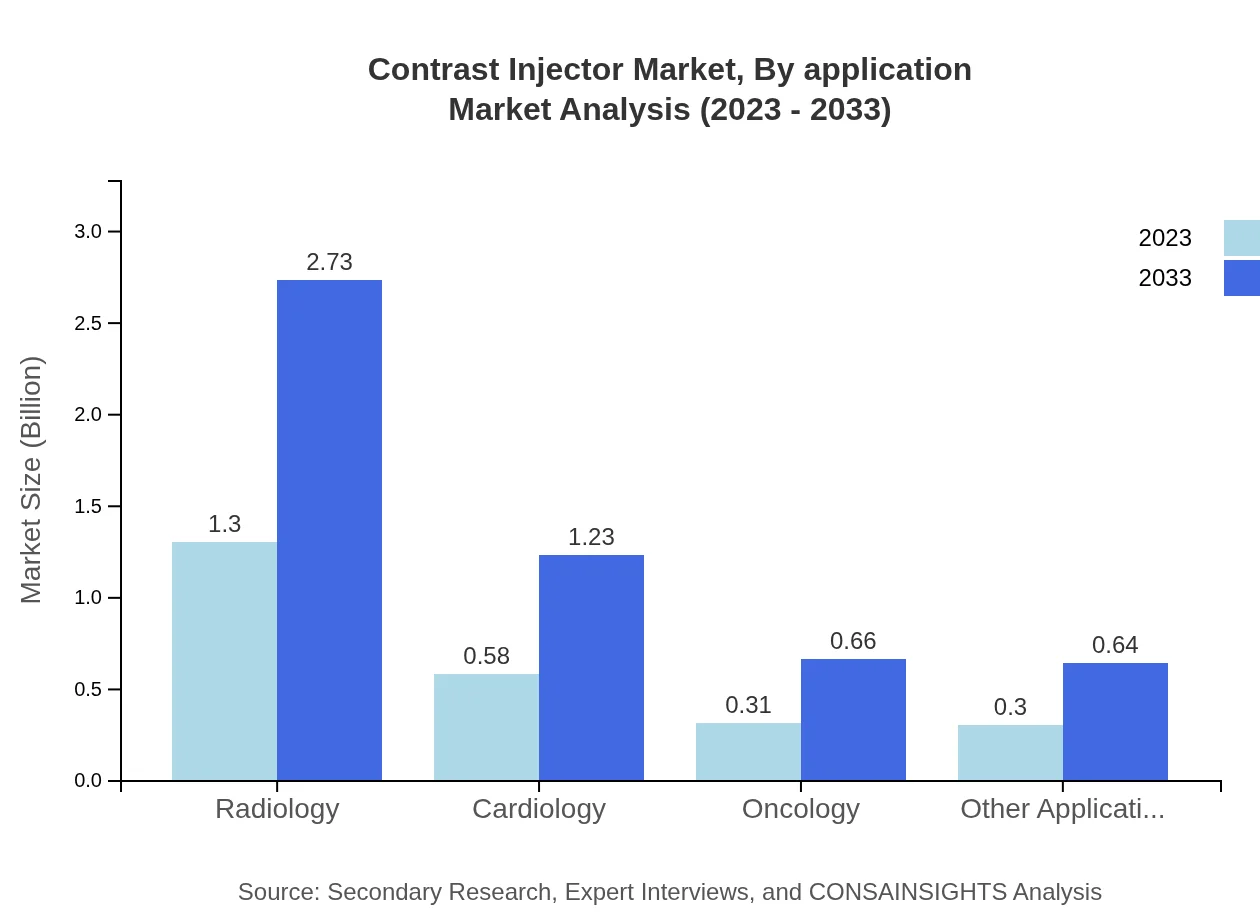
The application segment showcases Radiology as the leading application, accounting for 51.95% of the market share in 2023, driven by high demand in imaging interventions. Other applications like Cardiology and Oncology are also significant, indicating the device's versatility.
Contrast Injector Market Analysis By End User
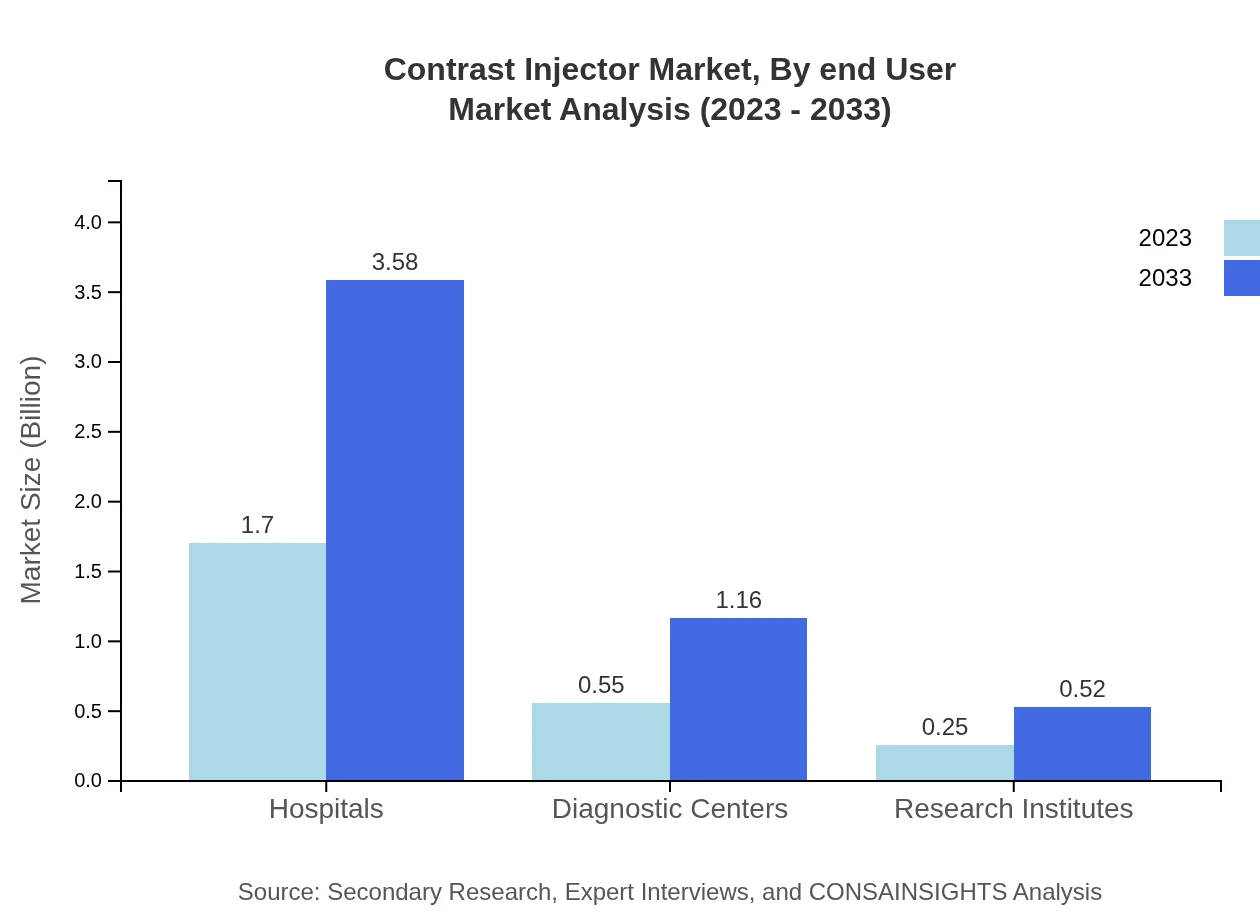
Hospitals dominate the end-user segment with a significant market share of 68.03% in 2023, attributed to the high procedural volume. Diagnostic centers follow, reflecting an increased reliance on advanced imaging solutions for routine diagnostics.
Contrast Injector Market Analysis By Region Type
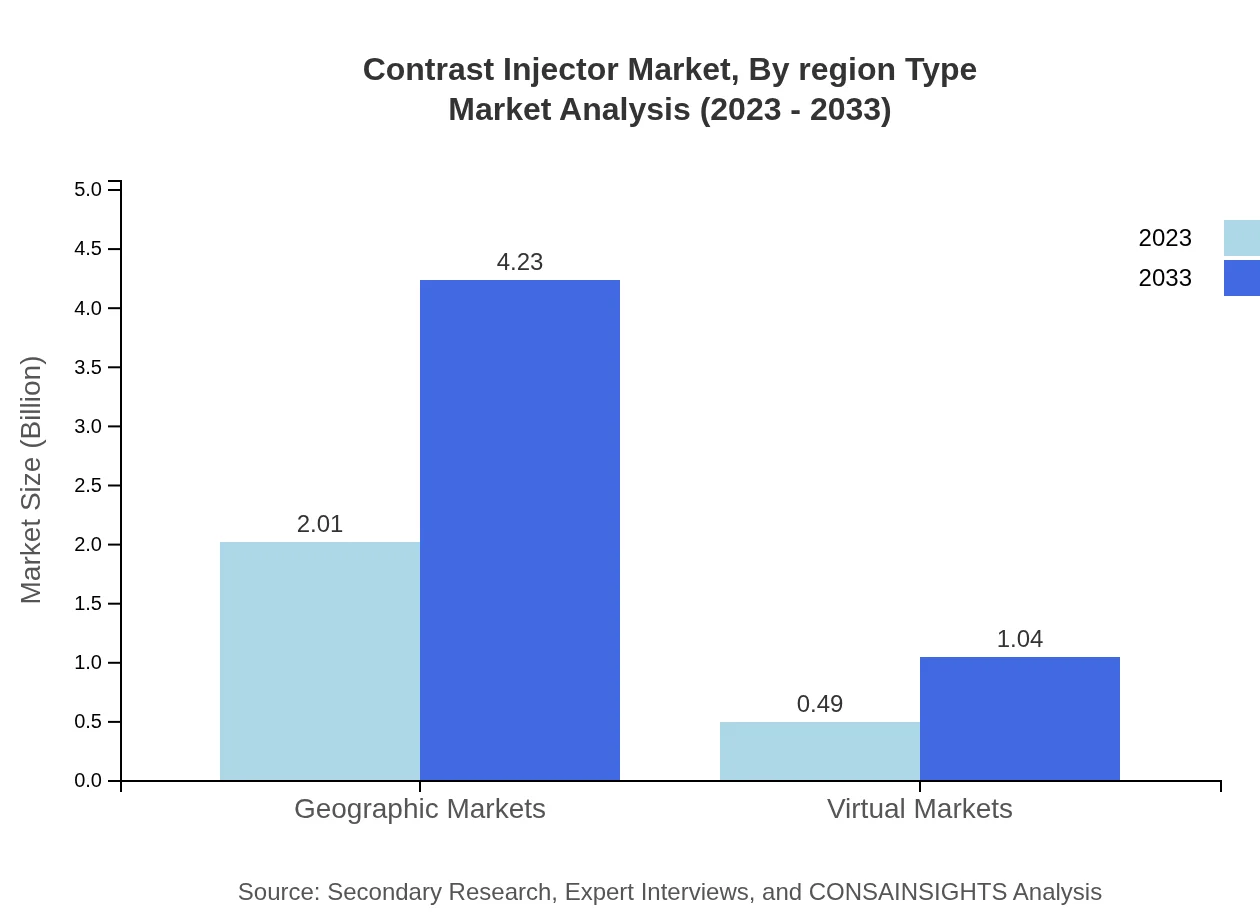
The Contrast Injector market analysis by region reveals North America as the frontrunner, while Europe and Asia Pacific are rapidly gaining ground due to advancements in healthcare technology and increasing patient populations requiring imaging diagnostics.
Contrast Injector Market Analysis By Technological Advancement
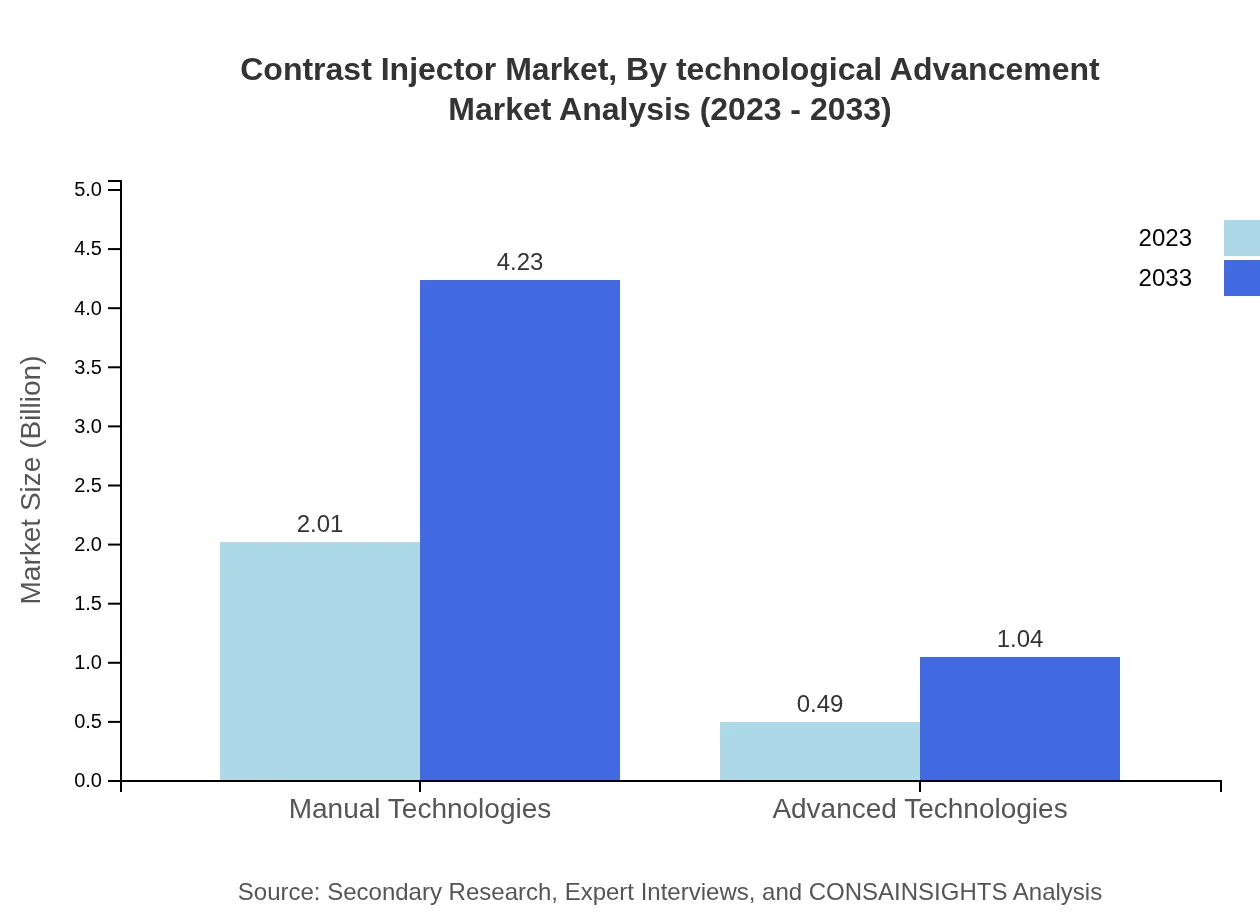
The trend towards automation and intelligent diagnostic solutions in the Contrast Injector market is becoming prevalent. Manufacturers are now focusing on the integration of smart technologies, which enhance the efficiency and accuracy of contrast delivery, thereby improving overall patient care.
Contrast Injector Market Trends and Future Forecast
Tell us your focus area and get a customized research report.
Global Market Leaders and Top Companies in Contrast Injector Industry
GE Healthcare:
A leading provider of medical technology and healthcare solutions, GE Healthcare is known for its innovative products in the imaging sector, including high-performance contrast injectors.Siemens Healthineers:
With a focus on digital transformation in medical technology, Siemens Healthineers offers a range of advanced contrast injectors that enhance imaging accuracy while prioritizing patient safety.Bayer AG:
Bayer AG is renowned for its commitment to healthcare innovations, providing advanced contrast media and injector systems that facilitate improved diagnostic processes.Canon Medical Systems:
Canon Medical is recognized for its advanced imaging technologies and systems, which include reliable contrast injector devices tailored for various imaging applications.We're grateful to work with incredible clients.









FAQs
What is the market size of the contrast injector market in 2023?
The global market size for contrast injectors in 2023 is $2.50 Billion as reported for the baseline year of the forecast period.
How big will the contrast injector market be in 2033?
By 2033 the market is projected to reach $5.26 Billion, reflecting cumulative expansion across product types and regional markets over the forecast horizon.
What is CAGR for the forecast period?
The market is estimated to grow at a compound annual growth rate (CAGR) of 7.5% during the 2023 to 2033 forecast period.
Is there a single fastest Growing region in the Contrast Injector Market Report market?
No single fastest-growing region is stated for the Contrast Injector Market Report market because the top regional implied CAGR values are within 0.15 percentage points of each other, making the ranking too close to call reliably.
Which companies lead the contrast injector market?
Key companies named in the report include GE Healthcare, Siemens Healthineers, Bayer AG and Canon Medical Systems as prominent participants in the market landscape.
What are primary applications for contrast injectors?
Primary applications include radiology, cardiology, oncology and other imaging uses where controlled contrast administration is required for diagnostic procedures.
How are products segmented by type?
Products are categorized into non-power injectors and power injectors, reflecting differing levels of automation and clinical capability for contrast delivery.
Why are technological advancements important?
Advancements from manual to advanced technologies enhance delivery precision, reduce workflow time, and support adherence to safety and regulatory expectations in clinical settings.
What is the forecast period for this report?
The forecast period covered in the report spans 2023 to 2033, during which market size and regional changes are analyzed.
Who were the sources used for the research?
Research draws from primary interviews with industry experts and secondary sources including company reports and publications, with internal validation applied to findings.