

Counterfeit Drug Detection Device Market Report
First published: 11 October 2024 | Last updated: 25 May 2026 | Report Code: counterfeit-drug-detection-device
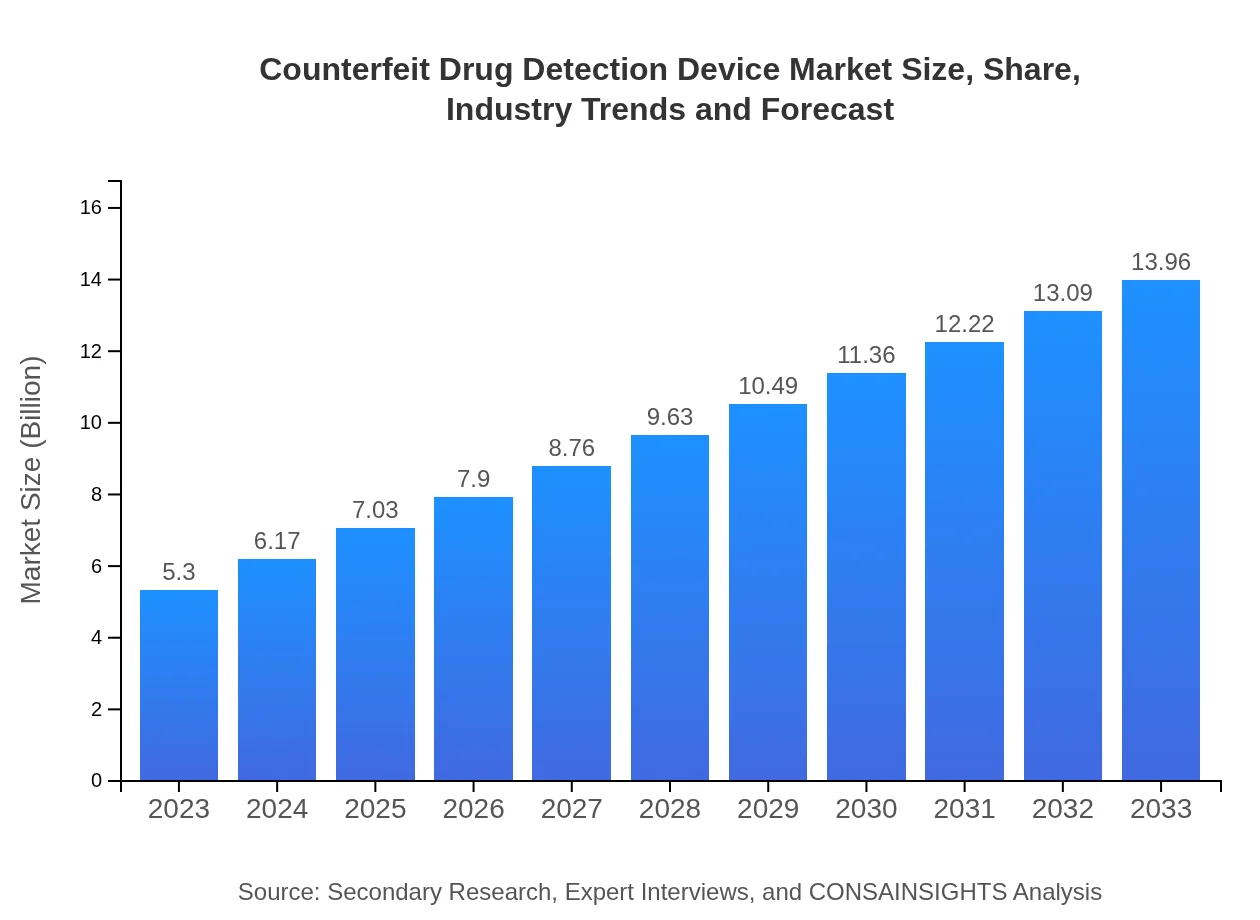
Counterfeit Drug Detection Device Market — USD 5.3 billion in 2023, Growing to USD 13.96B by 2033 at 9.8% CAGR
This report offers an in-depth analysis of the Counterfeit Drug Detection Device market from 2023 to 2033, encompassing insights on market size, trends, segmentations, and regional performances, alongside forecasts to guide stakeholders in strategic planning.
Key Takeaways
- Global market expands from $5.30 Billion in 2023 to $13.96 Billion in 2033 at a 9.8% CAGR.
- Europe is largest regional market, while no single fastest-growing region is stated because regional CAGR differences remain within 0.15 percentage points.
- Notable regional growth across North America, Asia Pacific, Latin America, and Middle East & Africa through 2033.
- Adoption across pharmaceutical companies, hospitals, clinics, and regulatory bodies supports device uptake.
- Optical and chemical technologies, plus spectroscopy and chromatography products, remain central to offerings.
Counterfeit Drug Detection Device Market Report — Executive Summary
Europe remains largest market by forecast-period value, while no single fastest-growing region is stated because top regional growth rates are separated by less than 0.15 percentage points. The Counterfeit Drug Detection Device market is witnessing sustained expansion driven by heightened regulatory emphasis on drug safety and rising incidence of counterfeit pharmaceuticals. The market size grows from $5.30 Billion in 2023 to $13.96 Billion in 2033 at a 9.8% CAGR during 2023 to 2033. Demand is being propelled by investments from pharmaceutical companies, hospitals and clinics, and increased activity by regulatory bodies. Key product families include spectroscopy, chromatography and electronic devices using optical and chemical technologies. Distribution channels span online and offline sales, while applications cover retail pharmacies, wholesalers and public-sector regulators. Leading firms such as Roche, Thermo Fisher, Agilent Technologies and Merck Group are active in product development and partnerships. Primary trends include integration of advanced detection techniques and closer collaboration between device makers and pharmaceutical stakeholders. Market participants should prioritize validation, compliance alignment and targeted deployment in healthcare and supply-chain settings to capture ongoing opportunities.
Key Growth Drivers
- Rising regulatory focus on pharmaceutical safety prompting procurement of detection equipment by public and private entities.
- Increasing incidence of counterfeit medications motivating pharmaceutical companies and hospitals to invest in verification tools.
- Technological advancements in optical and chemical detection improving device accuracy and operational usability.
- Broader application across retail pharmacies, wholesalers and regulatory bodies expanding addressable markets.
- Distribution through online and offline channels facilitating wider access to detection solutions.
| Metric | Value |
|---|---|
| Study Period | 2023 - 2033 |
| 2023 Market Size | $5.30 Billion |
| CAGR (2023-2033) | 9.8% |
| 2033 Market Size | $13.96 Billion |
| Top Companies | Roche, Thermo Fisher, Agilent Technologies, Merck Group |
| Published Date | 11 October 2024 |
| Last Modified Date | 25 May 2026 |
Counterfeit Drug Detection Device Market Overview
Customize Counterfeit Drug Detection Device Market Report market research report
- ✔ Get in-depth analysis of Counterfeit Drug Detection Device market size, growth, and forecasts.
- ✔ Understand Counterfeit Drug Detection Device's regional dynamics and industry-specific trends.
- ✔ Identify potential applications, end-user demand, and growth segments in Counterfeit Drug Detection Device
What is the Market Size & CAGR of Counterfeit Drug Detection Device Market Report market in 2023?
Counterfeit Drug Detection Device Industry Analysis
Counterfeit Drug Detection Device Market Segmentation and Scope
Tell us your focus area and get a customized research report.
Counterfeit Drug Detection Device Market Report Market Analysis Report by Region
Europe Counterfeit Drug Detection Device Market Report:
Europe is largest regional market, rising from $1.76 Billion in 2023 to $4.64 Billion in 2033. Regulatory focus on pharmaceutical safety, adoption by healthcare institutions, and supplier activity across spectroscopy and chromatography devices underpin market expansion in the region.Asia Pacific Counterfeit Drug Detection Device Market Report:
Asia Pacific grows from $1.01 Billion in 2023 to $2.65 Billion in 2033. Increasing awareness of counterfeit medicines, expanding healthcare access, and uptake by wholesalers and retail pharmacies support demand for detection systems across the region.North America Counterfeit Drug Detection Device Market Report:
North America grows from $1.75 Billion in 2023 to $4.6 Billion in 2033. Market demand is driven by strong healthcare infrastructure, investments from pharmaceutical firms, and regulatory enforcement that encourage adoption of advanced detection devices across laboratories, hospitals, and supply-chain checkpoints.South America Counterfeit Drug Detection Device Market Report:
Latin America grows from $0.49 Billion in 2023 to $1.28 Billion in 2033. Rising regulatory attention, involvement of distributors and wholesalers, and deployment in retail pharmacy networks contribute to the regional market trajectory.Middle East & Africa Counterfeit Drug Detection Device Market Report:
Middle East and Africa grows from $0.3 Billion in 2023 to $0.78 Billion in 2033. Growth is influenced by expanding regulatory efforts, hospital and clinic investments, and the need for verification tools to combat counterfeit pharmaceuticals in supply chains.Tell us your focus area and get a customized research report.
Research Methodology
Counterfeit Drug Detection Device Market Analysis By Product Type
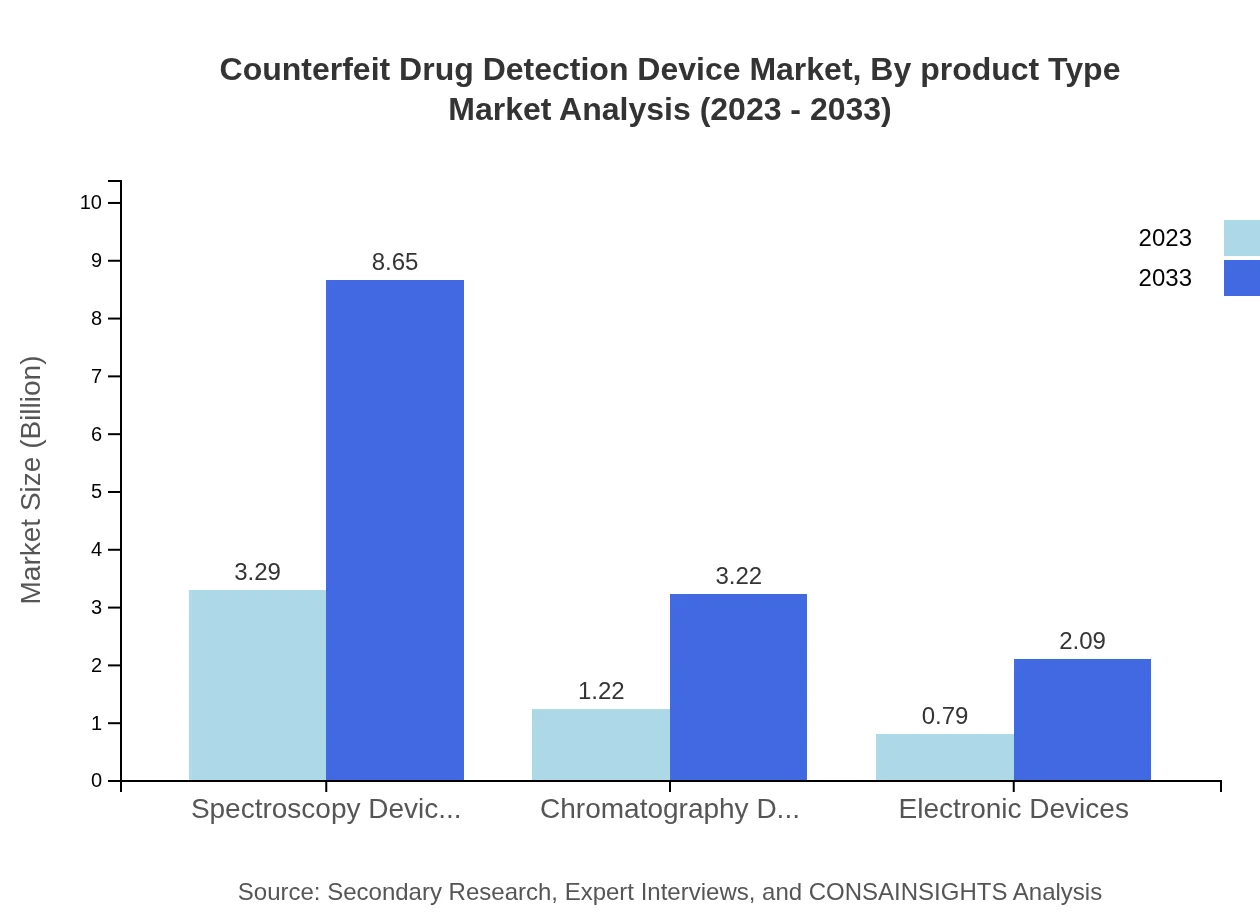
The product segmentation reveals that spectroscopy devices, listed at $3.29 billion in 2023, are the most significant contributor to the market, expected to reach $8.65 billion by 2033. Chromatography devices follow, increasing from $1.22 billion to $3.22 billion within the same timeframe. Continuous innovation in these technologies is driving their demand across pharmaceutical companies.
Counterfeit Drug Detection Device Market Analysis By Technology
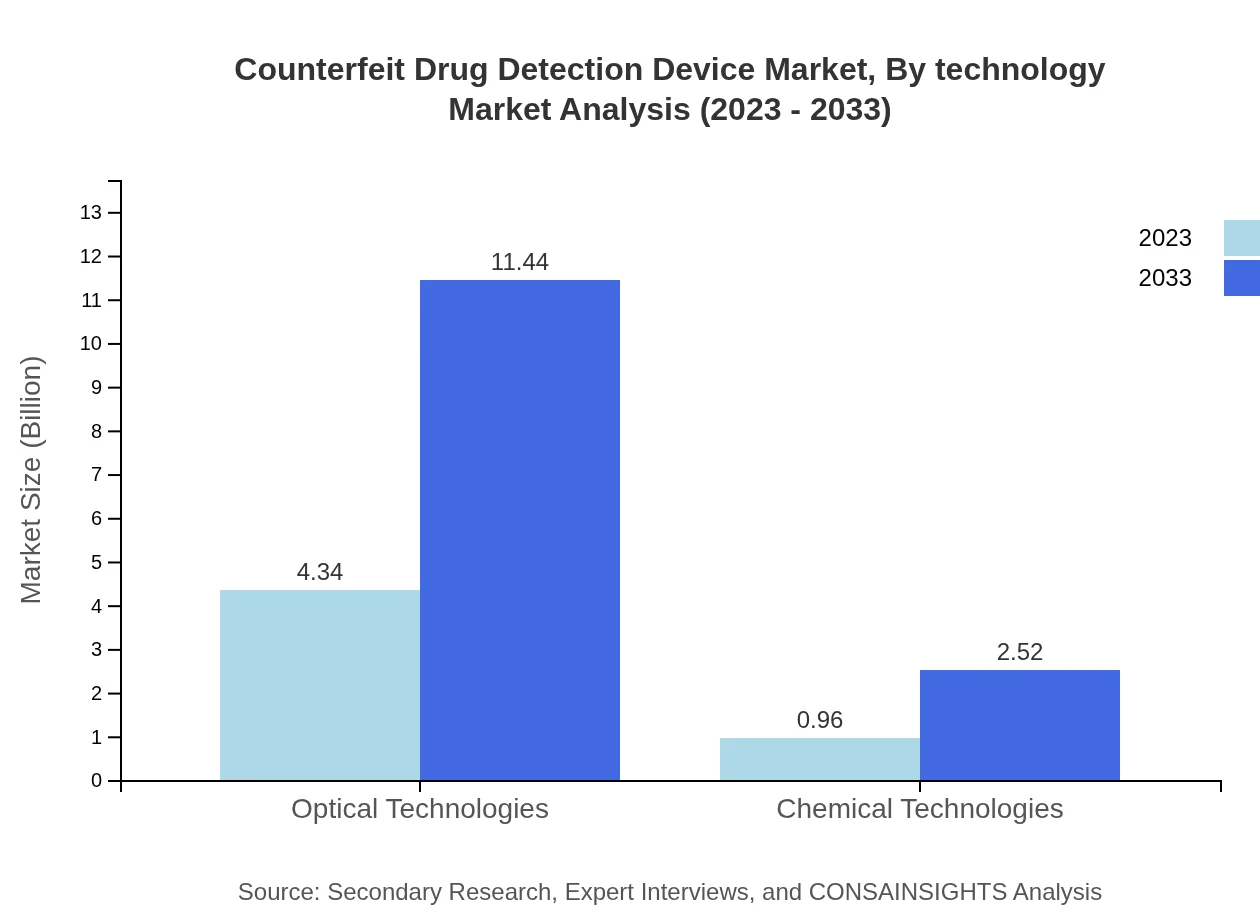
Optical technologies dominate the market, with a significant market share of 81.97%. The segment size is projected to increase from $4.34 billion in 2023 to $11.44 billion by 2033. Chemical technologies have a smaller share but are gaining traction due to new developments, expected to grow from $0.96 billion to $2.52 billion.
Counterfeit Drug Detection Device Market Analysis By End User
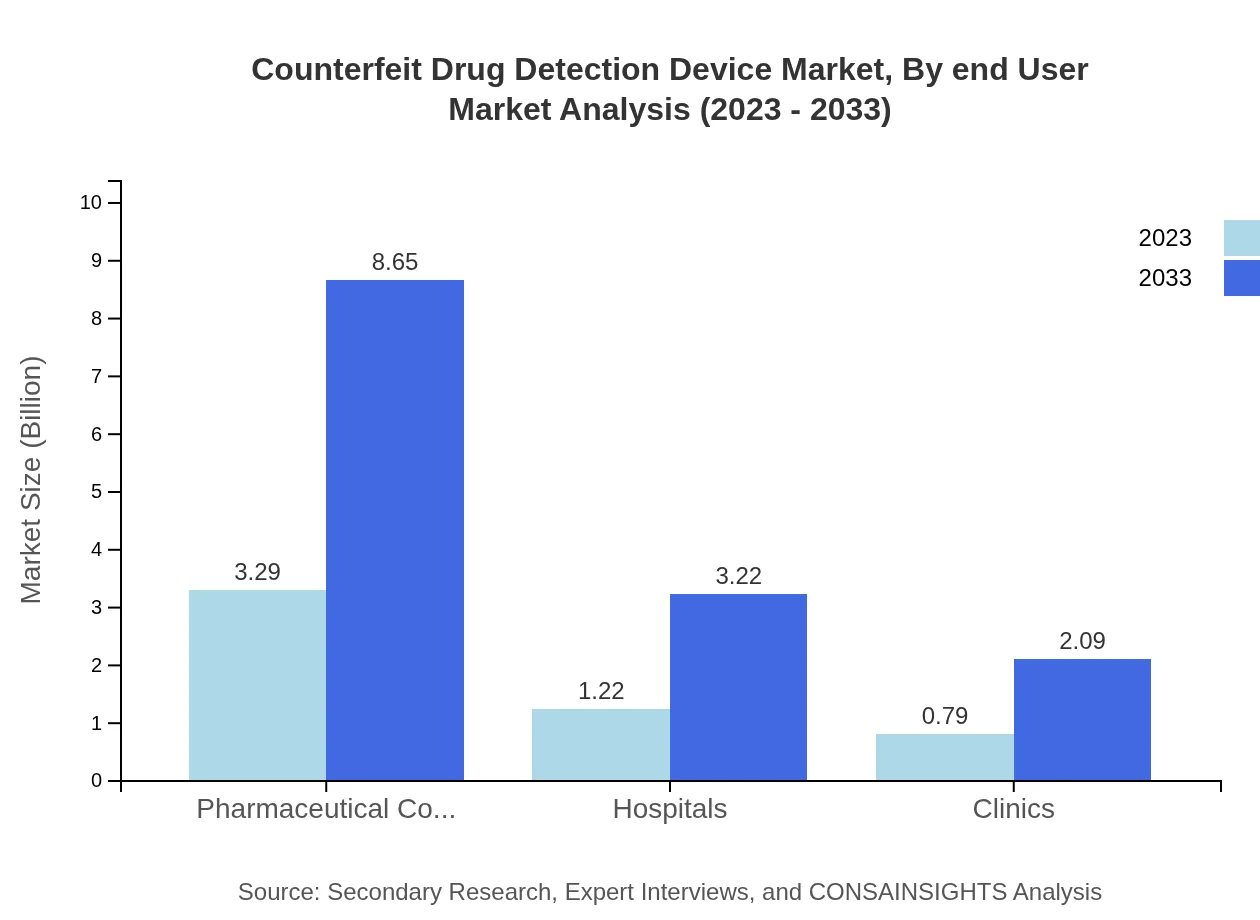
Pharmaceutical companies are leading in the adoption of detection devices, accumulating a market size of $3.29 billion in 2023 and expected to rise to $8.65 billion by 2033. Hospitals and clinics also play pivotal roles, emphasizing the necessity for robust drug verification systems to ensure patient safety.
Counterfeit Drug Detection Device Market Analysis By Distribution Channel
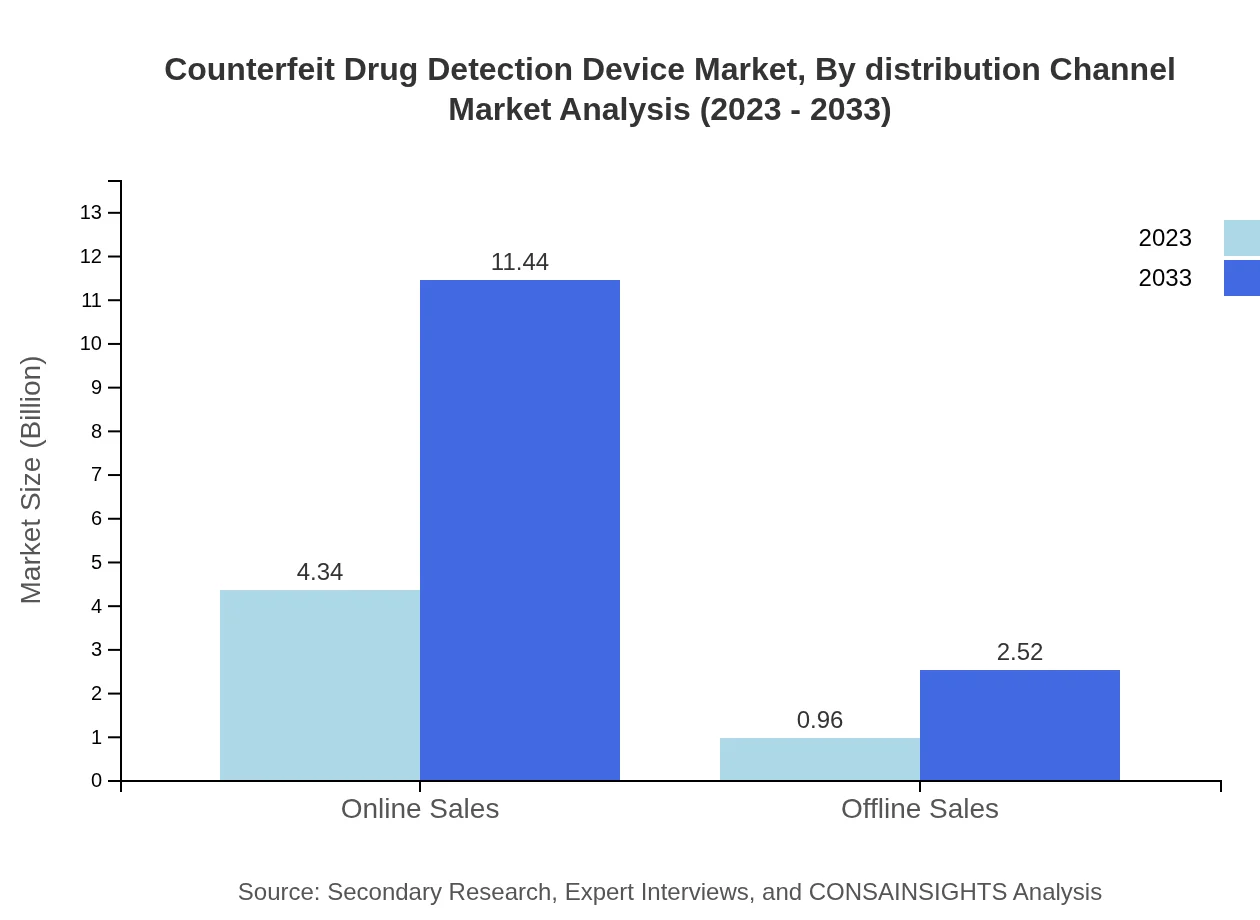
Online sales channels dominate the distribution segment, holding an 81.97% share with a projected growth from $4.34 billion to $11.44 billion. Offline channels remain significant, yet show slower growth from $0.96 billion to $2.52 billion, indicating a shift towards e-commerce in drug detection solutions.
Counterfeit Drug Detection Device Market Analysis By Application
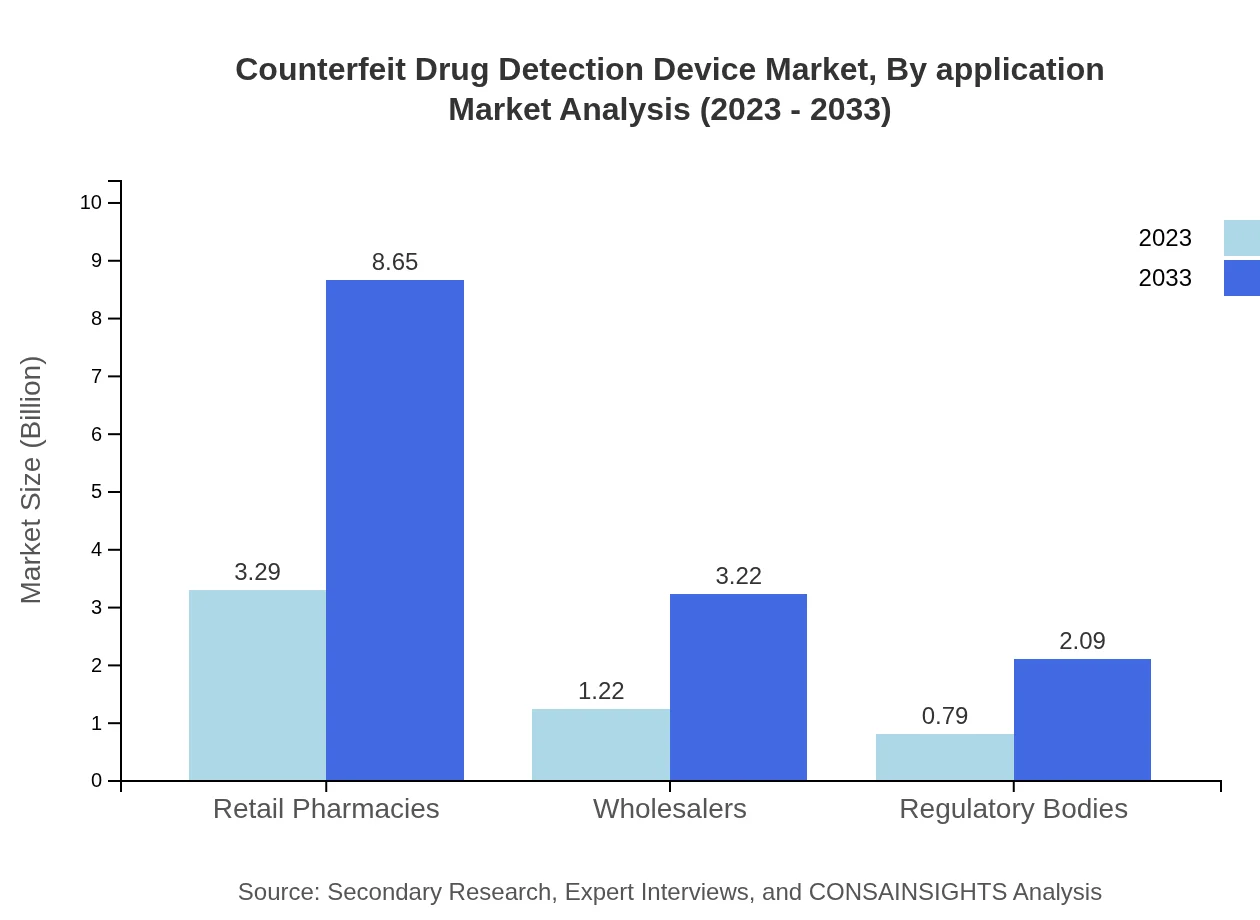
Applications in regulatory bodies and hospitals are increasingly emphasizing the need for detection devices. With market sizes expected to increase significantly by 2033, application in regulatory verification continues to drive innovation across the sector, optimizing safety protocols.
Counterfeit Drug Detection Device Market Trends and Future Forecast
Tell us your focus area and get a customized research report.
Global Market Leaders and Top Companies in Counterfeit Drug Detection Device Industry
Roche:
Roche is a leading player in the pharmaceutical industry, investing heavily in advanced detection technologies to ensure drug authenticity and efficacy.Thermo Fisher:
Thermo Fisher is renowned for its innovative laboratory solutions, providing advanced counterfeit detection systems that are widely adopted in hospitals and labs.Agilent Technologies:
Agilent Technologies specializes in analytical instruments and solutions, playing a pivotal role in developing highly efficient counterfeiting detection devices.Merck Group:
Merck Group is committed to safe healthcare practices, focusing on drug authenticity through its range of counterfeit detection solutions.We're grateful to work with incredible clients.







FAQs
What is the market size of the Counterfeit Drug Detection Device Market Report in 2023?
The market size in 2023 is $5.30 Billion as reported for the Counterfeit Drug Detection Device market.
How big will the market be in 2033?
The market is projected to reach $13.96 Billion by 2033 according to the provided forecast data.
What is CAGR for the forecast period?
The forecasted compound annual growth rate for 2023 to 2033 is 9.8% for this market.
Is there a single fastest Growing region in the Counterfeit Drug Detection Device Market Report market?
No single fastest-growing region is stated for the Counterfeit Drug Detection Device Market Report market because the top regional implied CAGR values are within 0.15 percentage points of each other, making the ranking too close to call reliably.
Which companies are listed as top participants?
Top companies named in the report include Roche, Thermo Fisher, Agilent Technologies and Merck Group.
What technologies are emphasized in the market?
The market emphasizes optical and chemical technologies, including spectroscopy and chromatography devices.
Who are the primary end users for these devices?
Primary end users include pharmaceutical companies, hospitals, clinics and regulatory bodies as specified in the segmentation.
How are the products distributed?
Distribution channels noted in the report are online sales and offline sales to reach various end users.