
Reports >
Life Sciences
>
Emollient Esters Market Report

Emollient Esters Market Report
First published: 11 October 2024 | Last updated: 28 May 2026 | Report Code: emollient-esters
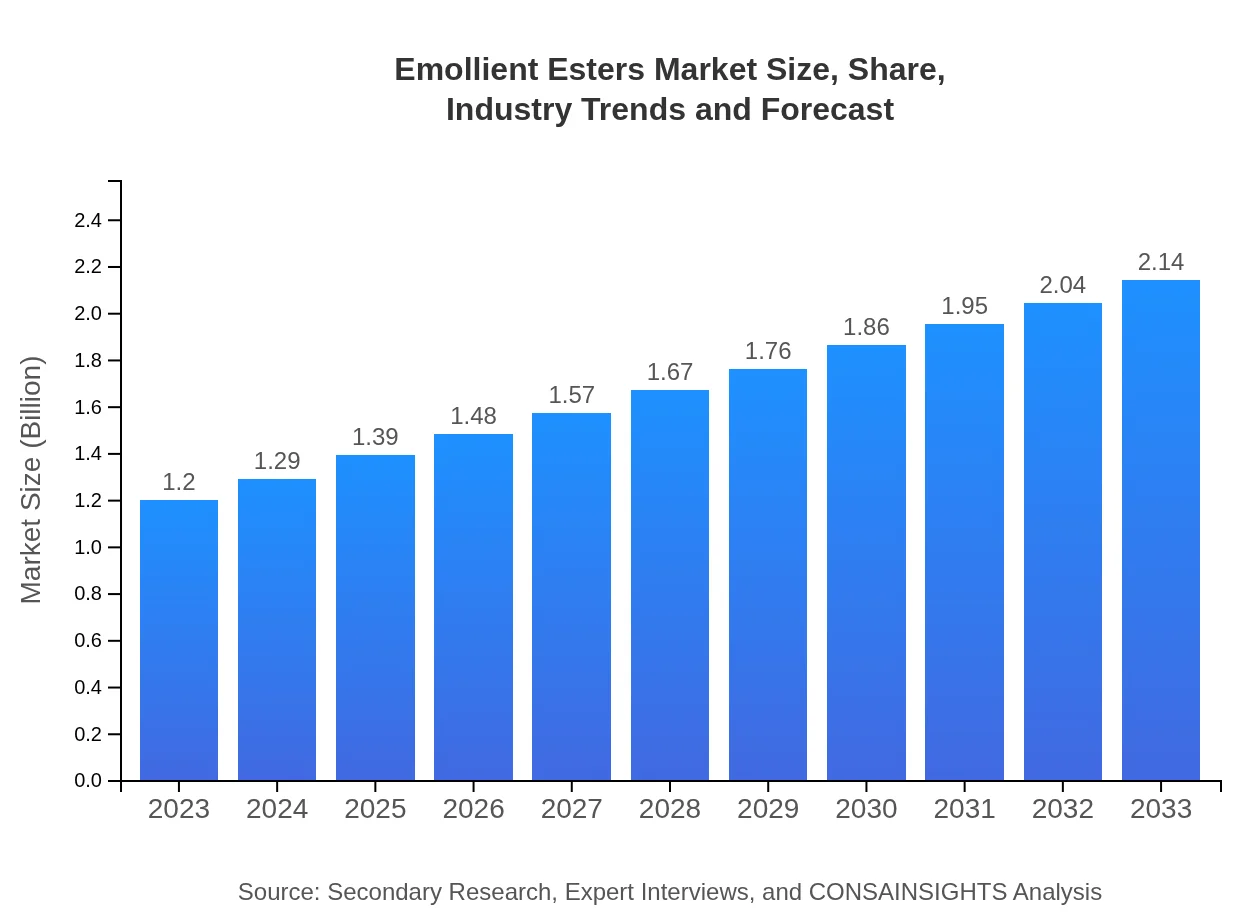
Emollient Esters Market — USD 1.2 billion in 2023, Growing to USD 2.14B by 2033 at 5.8% CAGR
This report provides an in-depth analysis of the Emollient Esters market, detailing market trends, size projections, segmentation, and key regional insights for the forecast period of 2023 to 2033.
Key Takeaways
- Global market expands from $1.20 Billion in 2023 to $2.14 Billion by 2033 at a 5.8% CAGR over 2023 to 2033.
- North America is largest regional market; Latin America is regional market region based on implied CAGR across 2023 to 2033.
- Latin America is the regional market region at an implied 6.39% CAGR, rising from $0.07 Billion in 2023 to $0.13 Billion in 2033.
- Europe increases from $0.31 Billion in 2023 to $0.55 Billion in 2033, reflecting steady demand in personal care and cosmetics.
- Key suppliers include BASF SE, Evonik Industries, Croda International, and Dow Chemical Company, supporting innovation and supply continuity.
Emollient Esters Market Report — Executive Summary
Regional analysis shows North America as largest market and Latin America as fastest-growing region by implied CAGR. The Emollient Esters market is on a sustained growth path, with value rising from $1.20 Billion in 2023 to $2.14 Billion by 2033 at a 5.8% CAGR for the forecast period of 2023 to 2033. Growth is driven by rising consumer preference for advanced skin-conditioning ingredients, broader use across personal care and cosmetics, and improved access through online retail channels. Sustainability considerations and formulation innovation are shaping product development, encouraging both synthetic and natural ester adoption. Regional dynamics vary: North America is identified as the largest market, while Latin America registers the highest implied growth rate. Established chemical suppliers and specialty ingredient manufacturers play a central role in bringing new emollient esters to market and supporting scaling for multinational cosmetic companies, independent beauty brands, pharmaceutical manufacturers, and food industry applications. The report covers segmentation by product type, end user, application, formulation type, and distribution channel to inform product strategy and market entry plans.
Key Growth Drivers
- Rising demand for skin-conditioning and moisturizing ingredients in personal care and cosmetics increases emollient ester consumption.
- Expansion of e-commerce widens product availability and supports independent beauty brands and niche suppliers.
- Sustainability and clean-label preferences boost interest in natural ester variants and greener production methods.
- Advances in formulation technology enable multifunctional esters that improve sensory profiles and stability across product types.
- Strong participation by major suppliers such as BASF SE, Evonik Industries, Croda International, and Dow Chemical Company supports product innovation and supply reliability.
| Metric | Value |
|---|---|
| Study Period | 2023 - 2033 |
| 2023 Market Size | $1.20 Billion |
| CAGR (2023-2033) | 5.8% |
| 2033 Market Size | $2.14 Billion |
| Top Companies | BASF SE, Evonik Industries, Croda International, Dow Chemical Company |
| Published Date | 11 October 2024 |
| Last Modified Date | 28 May 2026 |
Emollient Esters Market Overview
Customize Emollient Esters Market Report market research report
- ✔ Get in-depth analysis of Emollient Esters market size, growth, and forecasts.
- ✔ Understand Emollient Esters's regional dynamics and industry-specific trends.
- ✔ Identify potential applications, end-user demand, and growth segments in Emollient Esters
What is the Market Size & CAGR of Emollient Esters Market Report market in 2023?
Emollient Esters Industry Analysis
Emollient Esters Market Segmentation and Scope
Tell us your focus area and get a customized research report.
Emollient Esters Market Report Market Analysis Report by Region
Europe Emollient Esters Market Report:
Europe grows from $0.31 Billion in 2023 to $0.55 Billion in 2033. Regulatory focus on cosmetic safety, interest in sustainable ingredients, and a mature personal care sector contribute to consistent uptake of emollient esters.Asia Pacific Emollient Esters Market Report:
Asia Pacific grows from $0.24 Billion in 2023 to $0.43 Billion in 2033. Expanding personal care consumption, rising cosmetic product launches, and growing manufacturer investments drive regional market development.North America Emollient Esters Market Report:
North America is largest regional market, rising from $0.47 Billion in 2023 to $0.83 Billion in 2033. Demand in personal care and cosmetics, combined with strong supplier presence and formulation innovation, underpins regional adoption and product diversification.South America Emollient Esters Market Report:
Latin America is fastest-growing region by implied CAGR, increasing from $0.07 Billion in 2023 to $0.13 Billion in 2033. 07 Billion in 2023 to $0.13 Billion in 2033 and is noted as the regional growth market at an implied 6.39% CAGR. Growing consumer interest in personal care products and expanding distribution channels support this growth trajectory.Middle East & Africa Emollient Esters Market Report:
Middle East and Africa grows from $0.11 Billion in 2023 to $0.2 Billion in 2033. Urbanization, increased cosmetics adoption, and demand for multifunctional ingredients contribute to regional market progress.Tell us your focus area and get a customized research report.
Research Methodology
Emollient Esters Market Analysis By Product
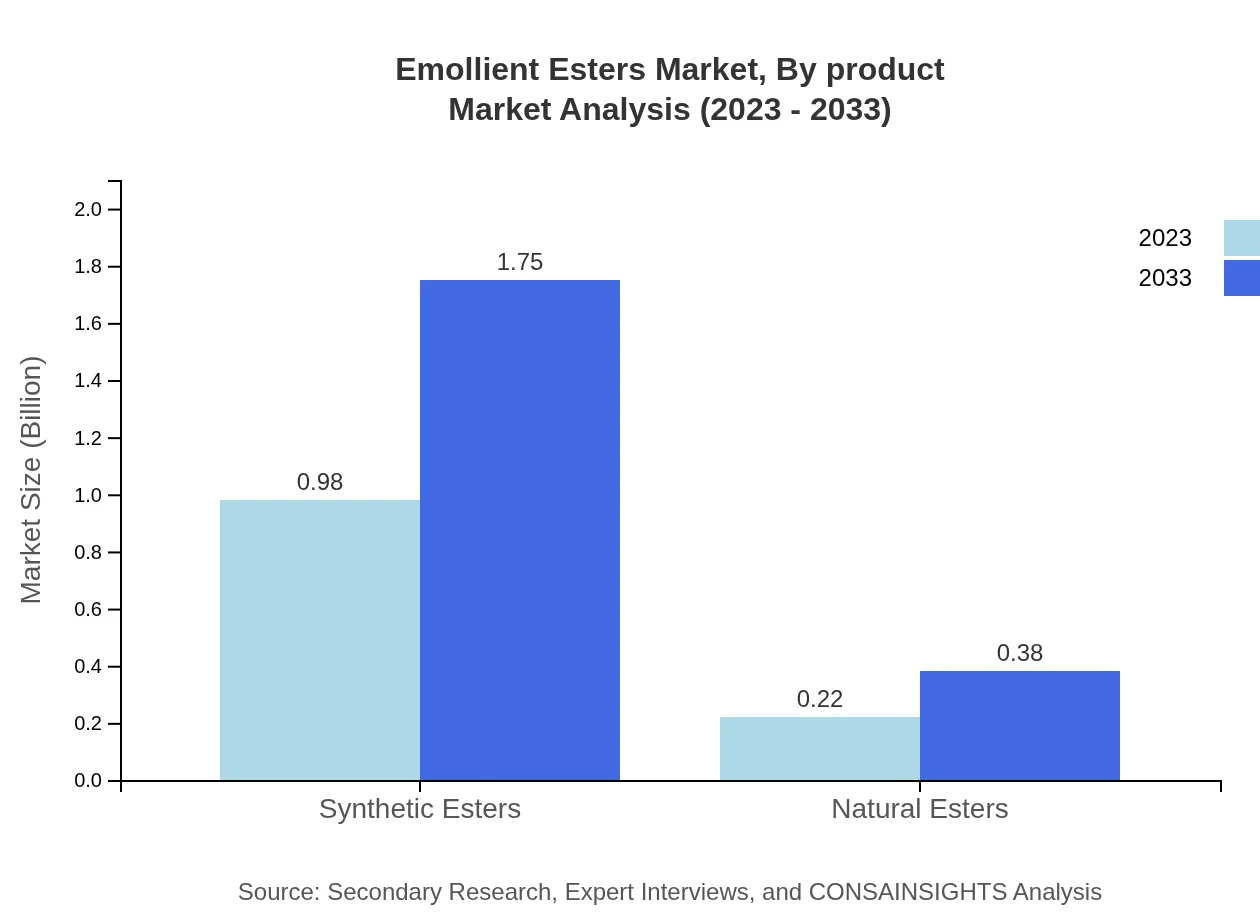
The Emollient Esters market by product is segmented primarily into synthetic esters, which account for 82.06% of the market share in 2023, expected to grow to 1.75 billion in size by 2033. In contrast, natural esters hold a smaller share at 17.94%, with a market size of 0.22 billion in 2023, projected to reach 0.38 billion by 2033.
Emollient Esters Market Analysis By Application
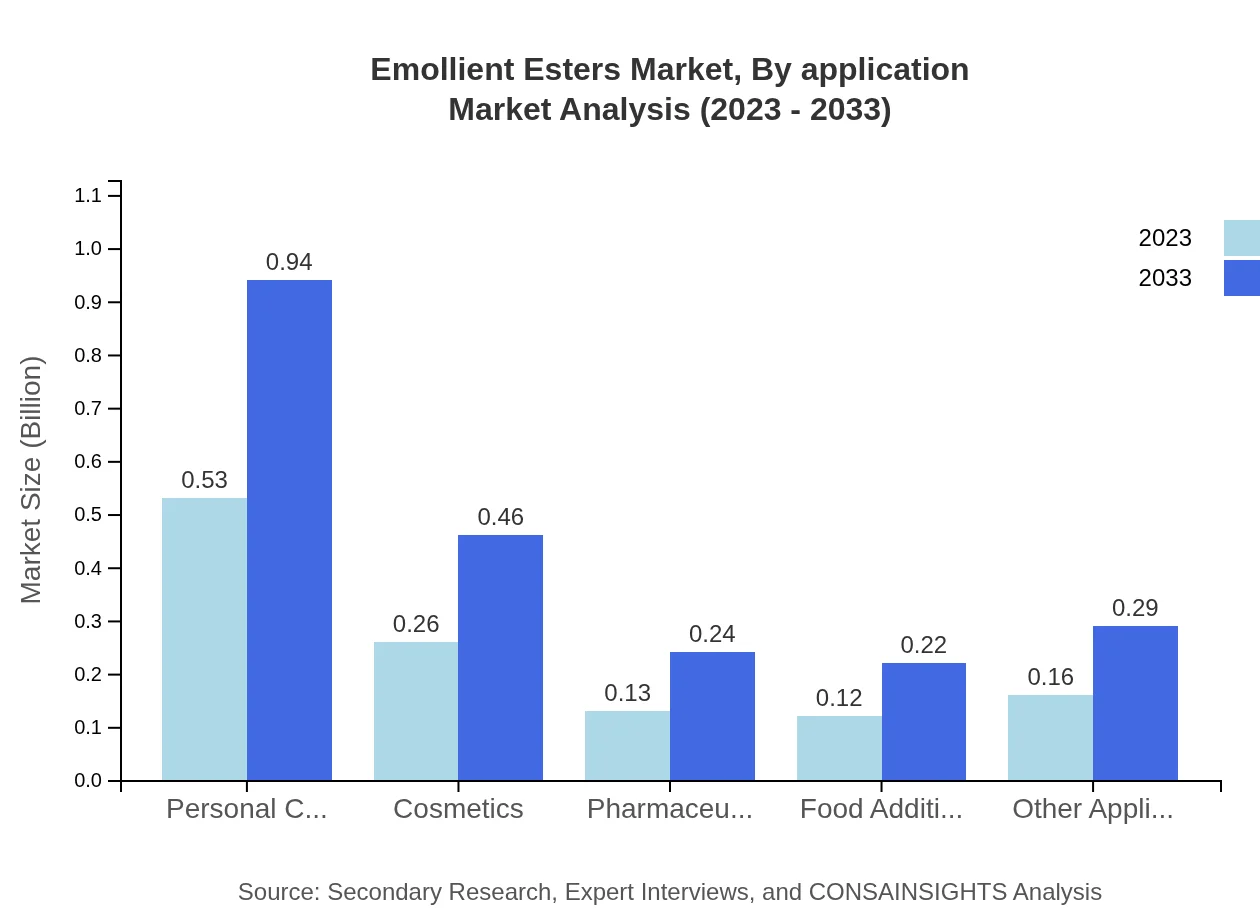
The primary applications include personal care, cosmetics, pharmaceuticals, food additives, and others. Personal care takes a significant share of 43.81% with a size of 0.53 billion in 2023, expected to grow accordingly by 2033.
Emollient Esters Market Analysis By End User
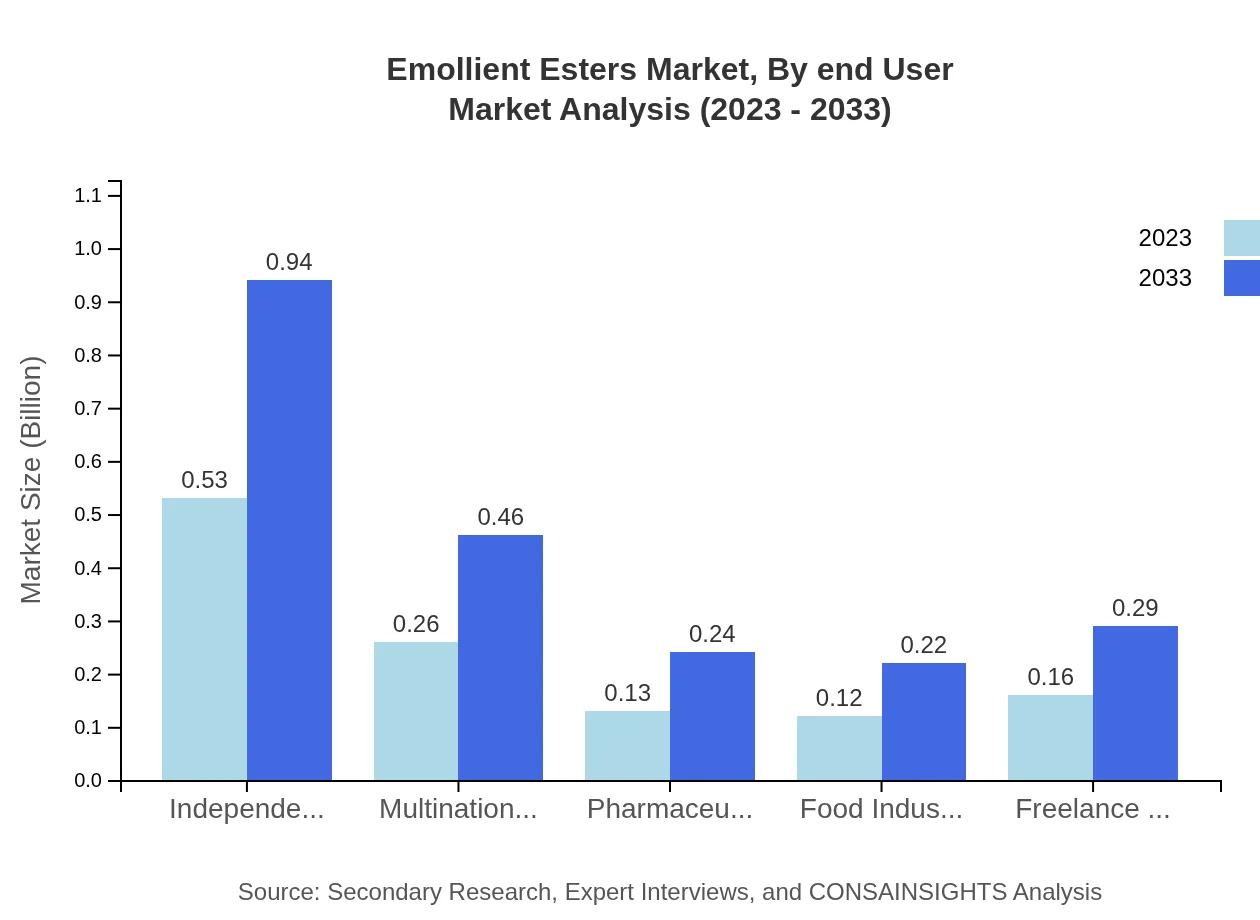
Segmentation by end-user reveals that independent beauty brands control 43.81% of the market share, indicative of the growing demand for niche products. Pharmaceutical manufacturers comprise 11.19% of the segment but show substantial growth potential by 2033.
Emollient Esters Market Analysis By Formulation Type
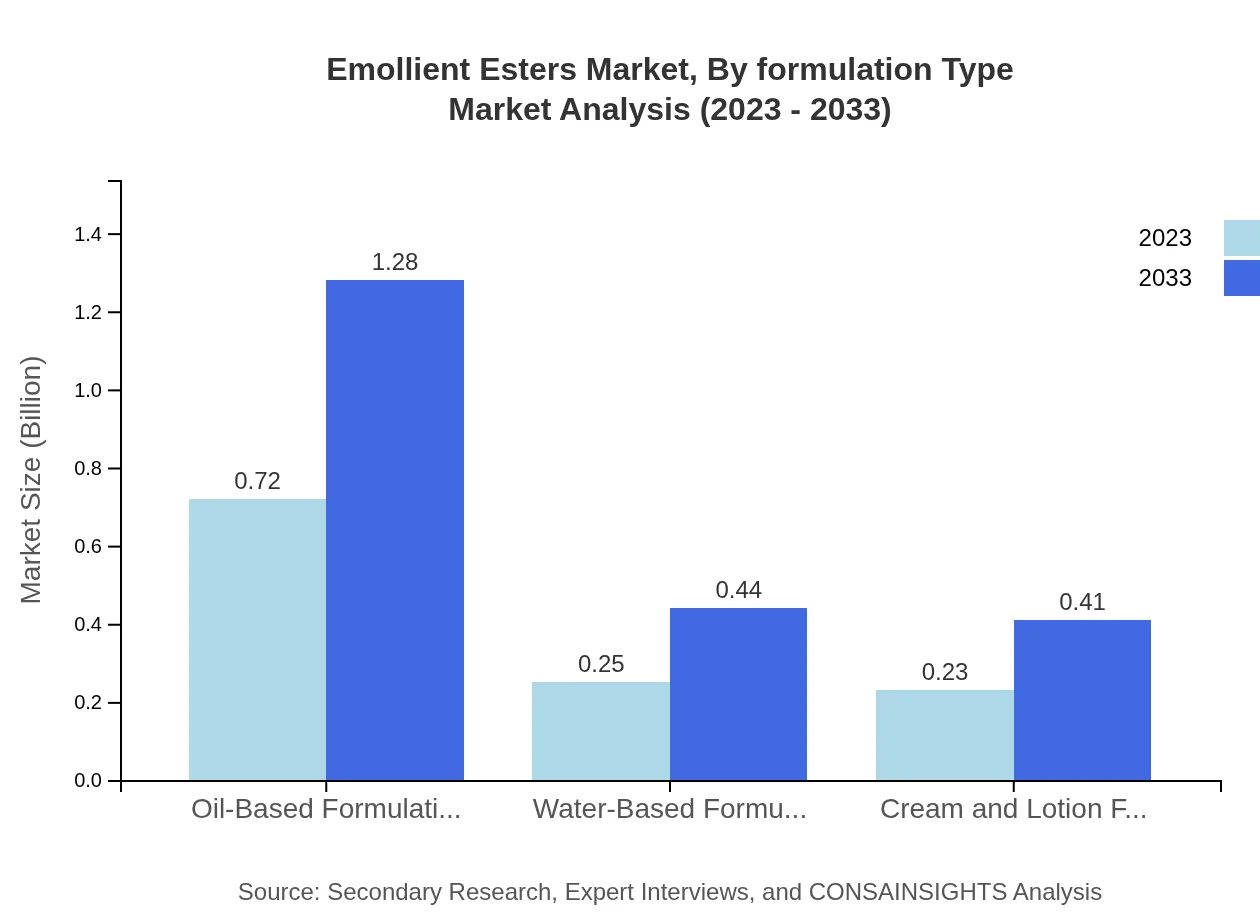
Oil-based formulations hold a significant market share of 60.08% in 2023, while water-based formulations account for 20.63%. The trend towards oil-based formulations is expected to enhance their footprint in the upcoming years.
Emollient Esters Market Trends and Future Forecast
Tell us your focus area and get a customized research report.
Global Market Leaders and Top Companies in Emollient Esters Industry
BASF SE:
BASF is a leading chemical company offering an extensive range of emollient esters known for their superior quality in cosmetic formulations.Evonik Industries:
Evonik specializes in specialty chemicals and provides innovative emollients and formulations to the cosmetic and personal care industry.Croda International:
Croda is renowned for its high-performance ingredients, focusing on sustainability and innovation in specialty chemicals including emollient esters.Dow Chemical Company:
Dow delivers a diverse portfolio of products, including emollient esters, catering to various industries from personal care to pharmaceuticals.We're grateful to work with incredible clients.









FAQs
What is the market size of the Emollient Esters Market Report in 2023?
The market size in 2023 is $1.20 Billion, representing the baseline value for the forecast period 2023 to 2033.
How big will the market be in 2033?
By 2033, the market is projected to reach $2.14 Billion according to the provided forecast figures.
What is CAGR for the forecast period?
The compound annual growth rate for 2023 to 2033 is 5.8% as stated in the report data.
Which region is the fastest Growing in the Emollient Esters Market Report market?
Latin America is the fastest-growing region, projected to expand from $0.07 Billion in 2023 to $0.13 Billion in 2033, reflecting an implied 6.39% CAGR over the forecast period.
Which region is growing fastest?
Latin America is the regional market region with an implied 6.39% CAGR, increasing from $0.07 Billion in 2023 to $0.13 Billion in 2033.
Who are the top companies in this market?
Top companies listed include BASF SE, Evonik Industries, Croda International, and Dow Chemical Company, noted for product development and supply capabilities.
What applications drive emollient ester use?
Primary applications include personal care, cosmetics, pharmaceuticals, and food additives, reflecting broad functional use as skin conditioners and texture enhancers.
How is distribution evolving for emollient esters?
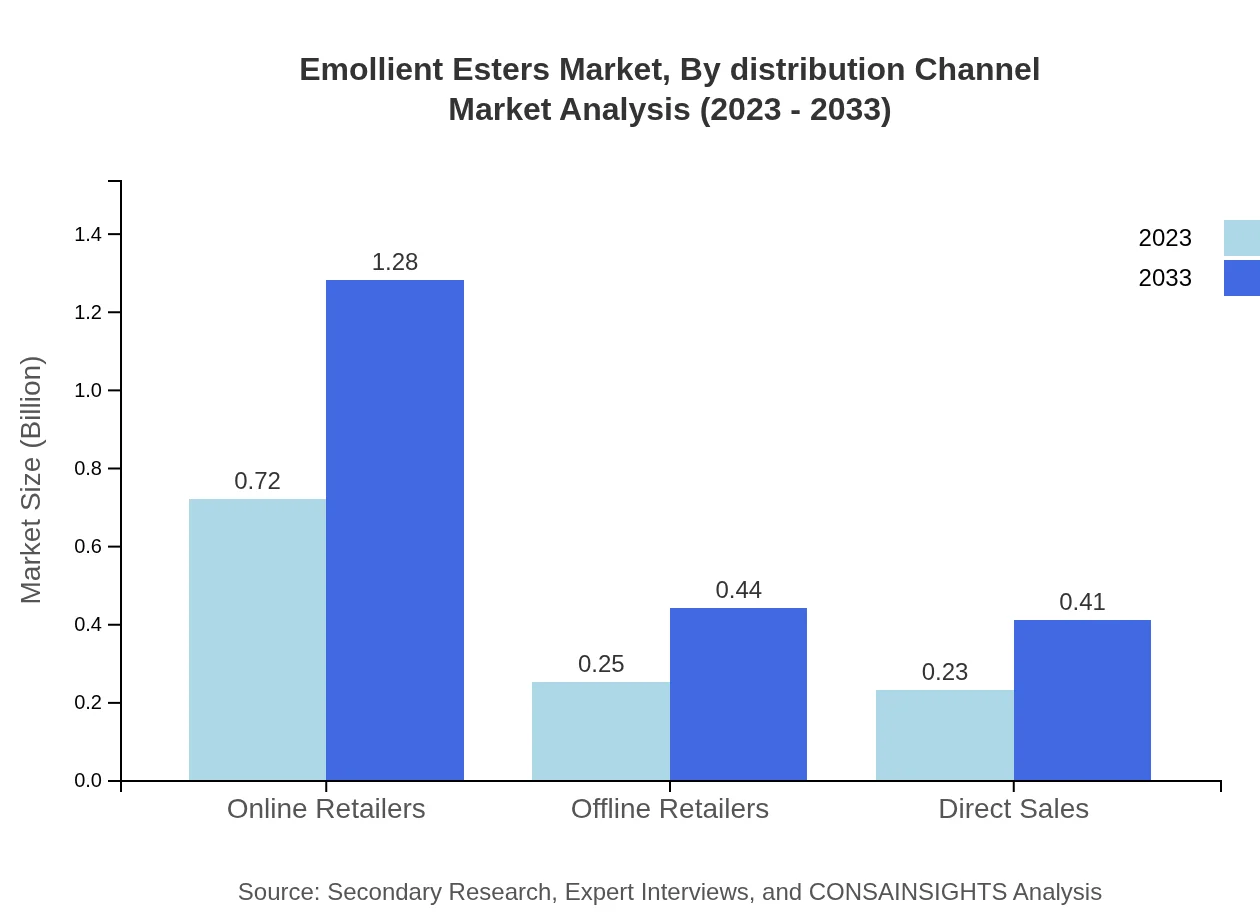
Distribution spans online retailers, offline retailers, and direct sales, with e-commerce expansion improving access for diverse buyers including independent brands.
What formulation types are covered?
Formulation types include oil-based, water-based, and cream and lotion formats, corresponding to product texture and end-use requirements.
Why are natural esters gaining attention?
Natural esters are increasingly preferred due to sustainability and clean-label trends, aligning with consumer demand for greener ingredient choices.