
Reports >
Life Sciences
>
Feed Betaine Market Report

Feed Betaine Market Report
First published: 08 October 2024 | Last updated: 25 May 2026 | Report Code: feed-betaine
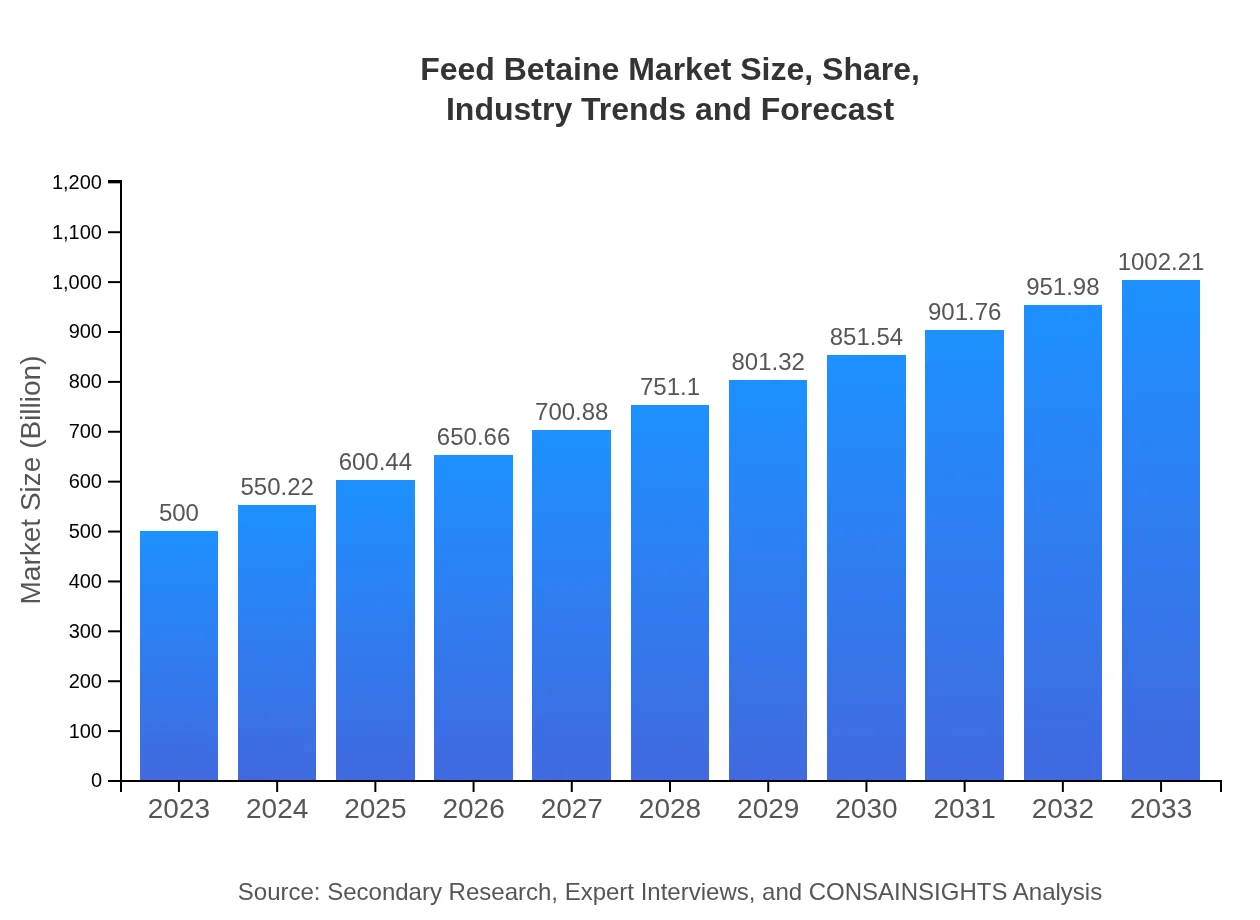
Feed Betaine Market — USD 500 million in 2023, Growing to USD 1002.21M by 2033 at 7% CAGR
This report provides a comprehensive analysis of the Feed Betaine market, including market size, growth trends, segmentation, regional insights, and industry forecasts from 2023 to 2033.
Key Takeaways
- Global market value rises from $500.00 Billion in 2023 to $1002.21 Billion by 2033, reflecting a 7% CAGR for 2023 to 2033.
- North America is largest regional market, while no single fastest-growing region is stated because regional CAGR differences remain within 0.15 percentage points.
- Europe and Asia Pacific show notable absolute growth: Europe from $166.7 Billion to $334.14 Billion; Asia Pacific from $90.15 Billion to $180.7 Billion.
- Industry supply includes major firms such as DuPont de Nemours, Inc., Evonik Industries AG, BASF SE, Nutreco N.V., and Kemin Industries, Inc.
- Segmentation spans natural and synthetic product types, multiple end users including livestock and aquaculture, and diverse applications like animal feed and nutraceuticals.
Feed Betaine Market Report — Executive Summary
North America remains largest market by forecast-period value, while no single fastest-growing region is stated because top regional growth rates are separated by less than 0.15 percentage points. This report presents a structured assessment of the Feed Betaine market, documenting expansion from $500.00 Billion in 2023 to $1002.21 Billion in 2033 at a 7% CAGR for 2023 to 2033. Growth is supported by rising demand for improved animal nutrition, increased feed quality requirements, and broader use across livestock and aquaculture. The study evaluates product splits between natural and synthetic sources, end-user categories including livestock, pets, and aquaculture, and application areas such as animal feed and nutraceuticals. Regional breakdown highlights North America as the largest market. The competitive overview profiles key participants including DuPont de Nemours, Inc., Evonik Industries AG, BASF SE, Nutreco N.V., and Kemin Industries, Inc. Research integrates primary expert interviews, company literature, and data validation to produce market forecasts and trend analysis for stakeholders considering product development, distribution, or investment.
Key Growth Drivers
- Increasing demand for enhanced feed efficiency and animal performance supporting product uptake.
- Expansion of livestock and aquaculture sectors raising volumes of formulated feed requiring Betaine additives.
- Growing interest in natural feed solutions influencing demand for natural Feed-Betaine products.
- Technological improvements in production and formulation enhancing availability and consistency of feed-grade Betaine.
- Regulatory and quality expectations prompting manufacturers to adopt validated ingredient sources and traceability.
| Metric | Value |
|---|---|
| Study Period | 2023 - 2033 |
| 2023 Market Size | $500.00 Million |
| CAGR (2023-2033) | 7% |
| 2033 Market Size | $1002.21 Million |
| Top Companies | DuPont de Nemours, Inc., Evonik Industries AG, BASF SE, Nutreco N.V., Kemin Industries, Inc. |
| Published Date | 08 October 2024 |
| Last Modified Date | 25 May 2026 |
Feed Betaine Market Overview
Customize Feed Betaine Market Report market research report
- ✔ Get in-depth analysis of Feed Betaine market size, growth, and forecasts.
- ✔ Understand Feed Betaine's regional dynamics and industry-specific trends.
- ✔ Identify potential applications, end-user demand, and growth segments in Feed Betaine
What is the Market Size & CAGR of Feed Betaine Market Report market in 2023?
Feed Betaine Industry Analysis
Feed Betaine Market Segmentation and Scope
Tell us your focus area and get a customized research report.
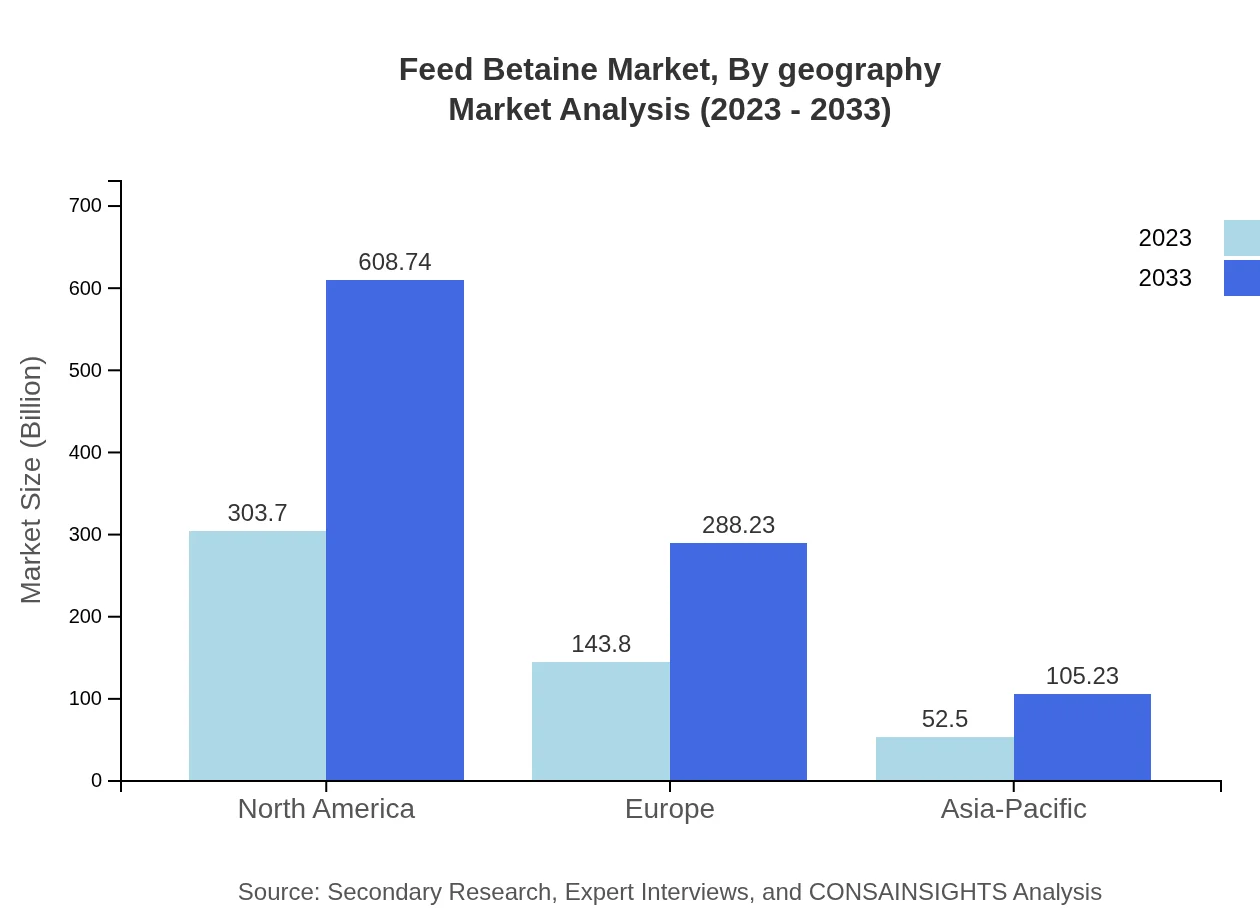
Feed Betaine Market Report Market Analysis Report by Region
Europe Feed Betaine Market Report:
Europe grows from $166.7 Billion in 2023 to $334.14 Billion in 2033. Regional drivers include emphasis on feed quality, regulatory standards, and a shift toward natural feed solutions across animal nutrition and related applications.Asia Pacific Feed Betaine Market Report:
Asia Pacific grows from $90.15 Billion in 2023 to $180.7 Billion in 2033. Growth reflects enlarging aquaculture and livestock sectors, greater feed formulation volumes, and increased awareness of nutritional additives in the region.North America Feed Betaine Market Report:
North America is largest regional market, rising from $173.1 Billion in 2023 to $346.96 Billion in 2033. Regional expansion is linked to sustained demand for high-quality feed, established livestock and aquaculture operations, and uptake of validated ingredient sources.South America Feed Betaine Market Report:
Latin America grows from $34.7 Billion in 2023 to $69.55 Billion in 2033. Market movement is associated with expansion of livestock production, growing feed demand, and adoption of additives to improve feed efficiency.Middle East & Africa Feed Betaine Market Report:
Middle East and Africa grows from $35.35 Billion in 2023 to $70.86 Billion in 2033. Local growth is tied to developing animal production systems, rising interest in feed performance, and gradual uptake of formulated nutrition solutions.Tell us your focus area and get a customized research report.
Research Methodology
Feed Betaine Market Analysis By Product
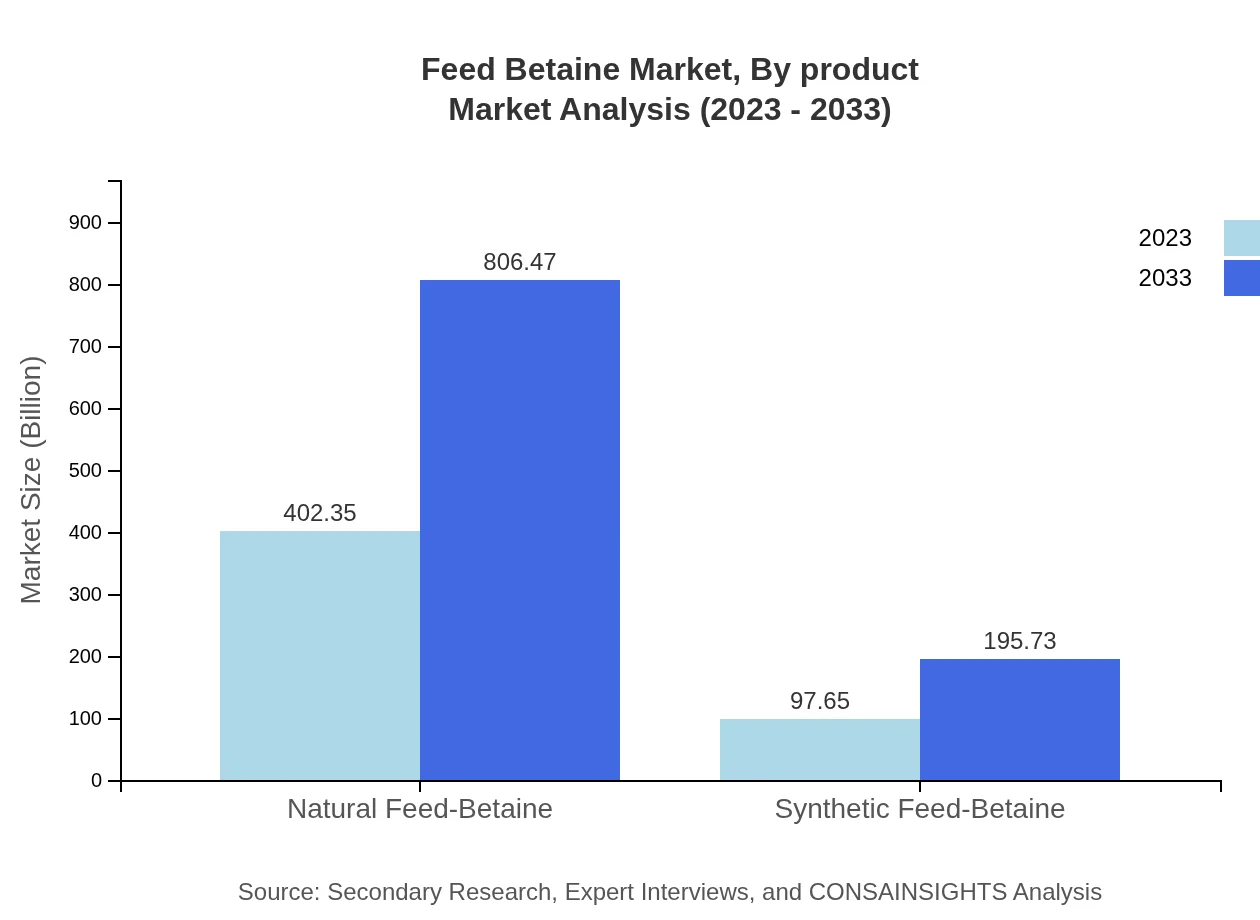
The Feed Betaine market is segmented into Natural and Synthetic types. The Natural Feed Betaine market is projected to grow significantly, reaching $806.47 million by 2033 from $402.35 million in 2023. Conversely, the Synthetic Feed Betaine segment is expected to grow from $97.65 million in 2023 to $195.73 million by 2033.
Feed Betaine Market Analysis By Application
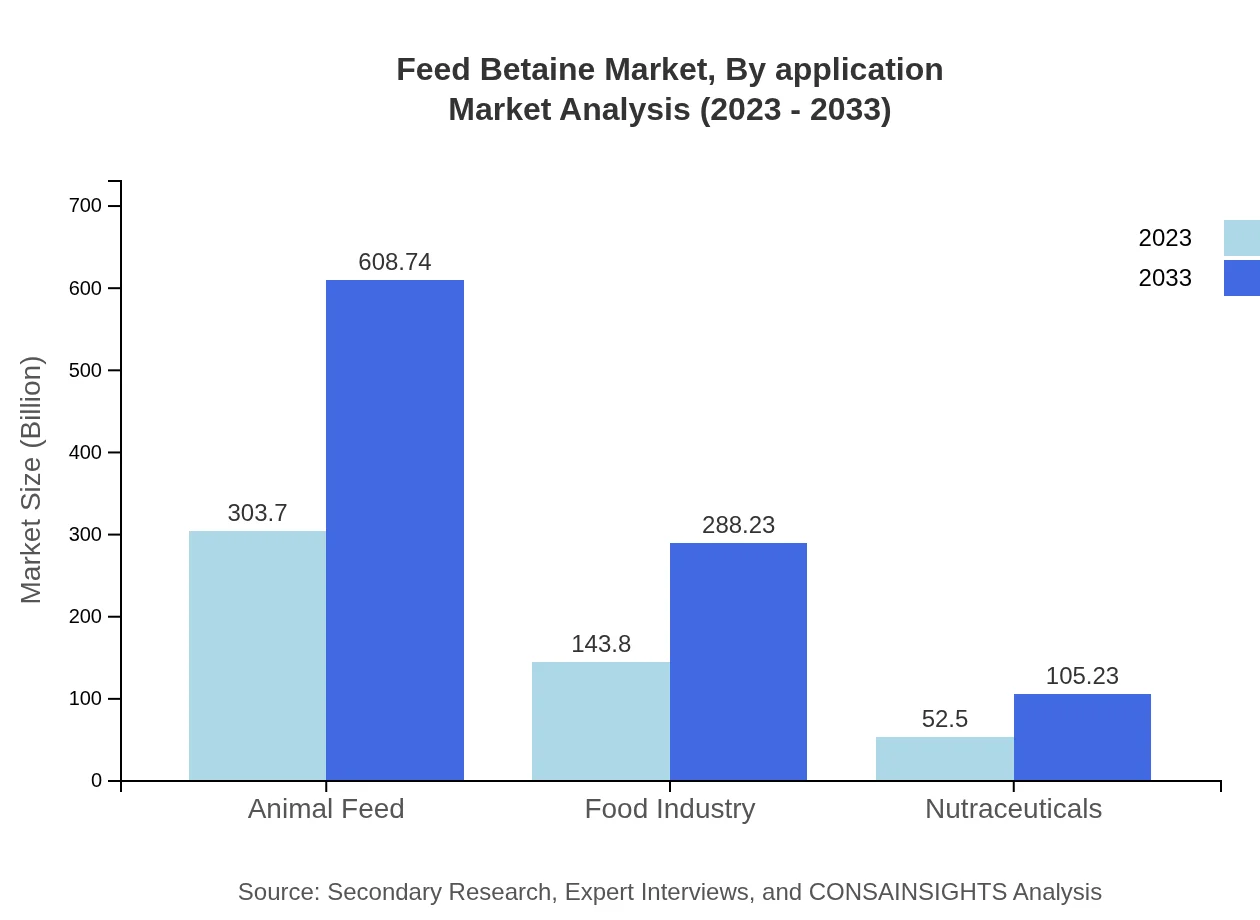
In terms of applications, the Livestock sector dominates the Feed Betaine market, with estimated values of $303.70 million in 2023 and $608.74 million by 2033. Other significant application segments include the Pet industry and Aquaculture, reflecting diverse utilization across different animal categories.
Feed Betaine Market Analysis By End User
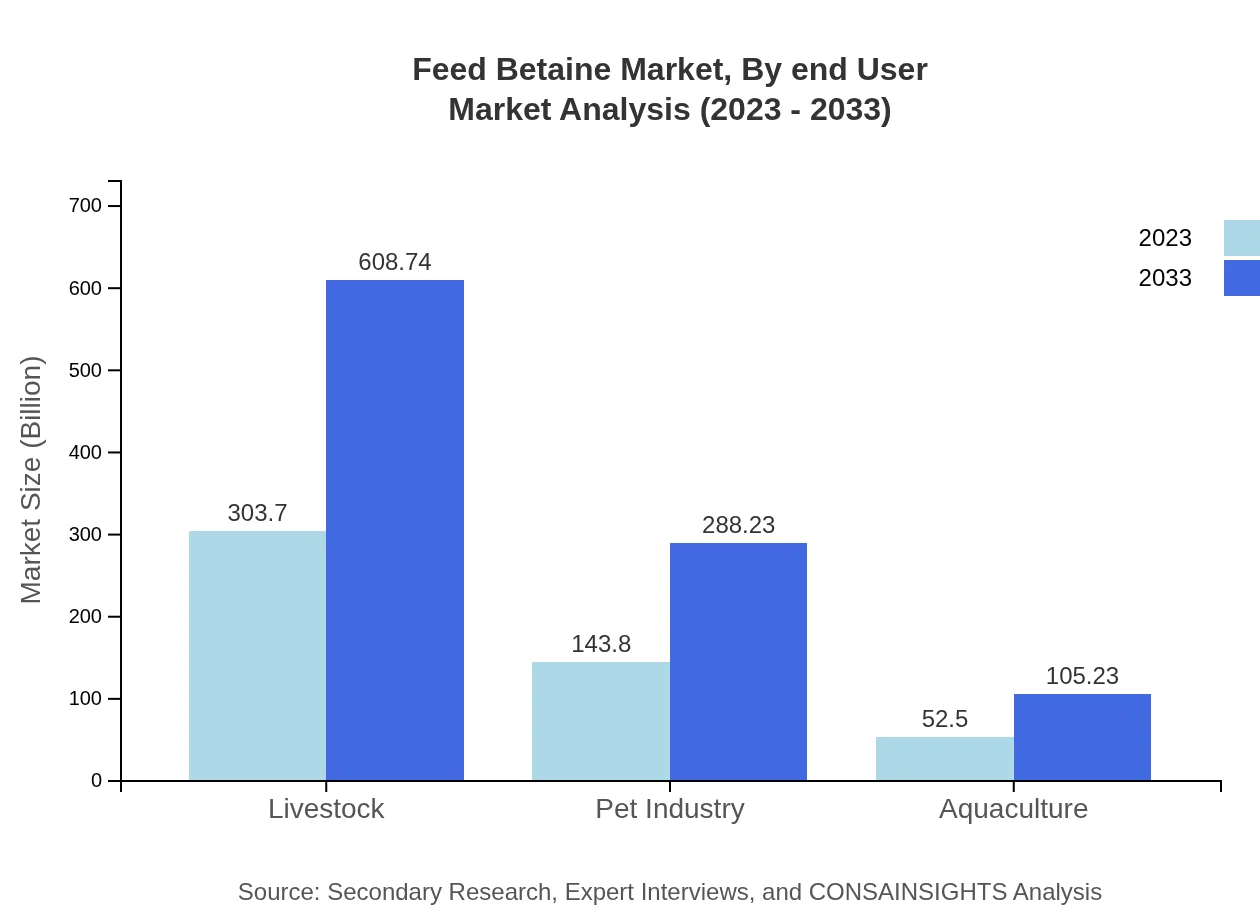
The major end-users of Feed Betaine include various segments within the agricultural and feed industries, primarily focusing on improving the health and productivity of livestock and pets.
Feed Betaine Market Trends and Future Forecast
Tell us your focus area and get a customized research report.
Global Market Leaders and Top Companies in Feed Betaine Industry
DuPont de Nemours, Inc.:
A leading producer of natural and synthetic Betaines, DuPont offers innovative animal nutrition solutions globally and invests significantly in R&D to enhance product offerings.Evonik Industries AG:
Known for its high-quality Feed Betaine products, Evonik focuses on sustainable production practices and has a strong presence in the aquaculture and livestock feed sectors.BASF SE:
BASF is a significant player in the Feed Betaine market, emphasizing innovation and responsible sourcing, catering to various global regions.Nutreco N.V.:
Specializing in animal nutrition, Nutreco offers a broad portfolio of Feed Betaine products designed to improve feed efficiency and well-being in livestock.Kemin Industries, Inc.:
Kemin focuses on high-performance Feed Betaine solutions, investing in cutting-edge technology to meet evolving market demands.We're grateful to work with incredible clients.









FAQs
What is the market size of the Feed Betaine market in 2023?
The market size for Feed Betaine in 2023 is $500.00 Billion, as reported in the input dataset.
How big is the market expected to be in 2033?
The market is projected to reach $1002.21 Billion in 2033 according to the provided figures.
What is CAGR for the forecast period?
The specified compound annual growth rate for 2023 to 2033 is 7% as provided in the input data.
Is there a single fastest Growing region in the Feed Betaine Market Report market?
No single fastest-growing region is stated for the Feed Betaine Market Report market because the top regional implied CAGR values are within 0.15 percentage points of each other, making the ranking too close to call reliably.
Which companies are listed as top players?
Top companies named in the input are DuPont de Nemours, Inc., Evonik Industries AG, BASF SE, Nutreco N.V., and Kemin Industries, Inc.
What are the primary product segments?
Product segmentation in the data lists Natural Feed-Betaine and Synthetic Feed-Betaine as the sub segments for by-product.
How is the market segmented by end user?
End-user segmentation includes Livestock, Pet Industry, and Aquaculture as the sub segments reported in the input.
What research methods were used in the report?
Research methodology includes primary interviews with industry experts, secondary research via company reports and publications, data triangulation, and internal validation.