
Reports >
Life Sciences
>
Feed Minerals Market Report

Feed Minerals Market Report
First published: 07 October 2024 | Last updated: 25 May 2026 | Report Code: feed-minerals
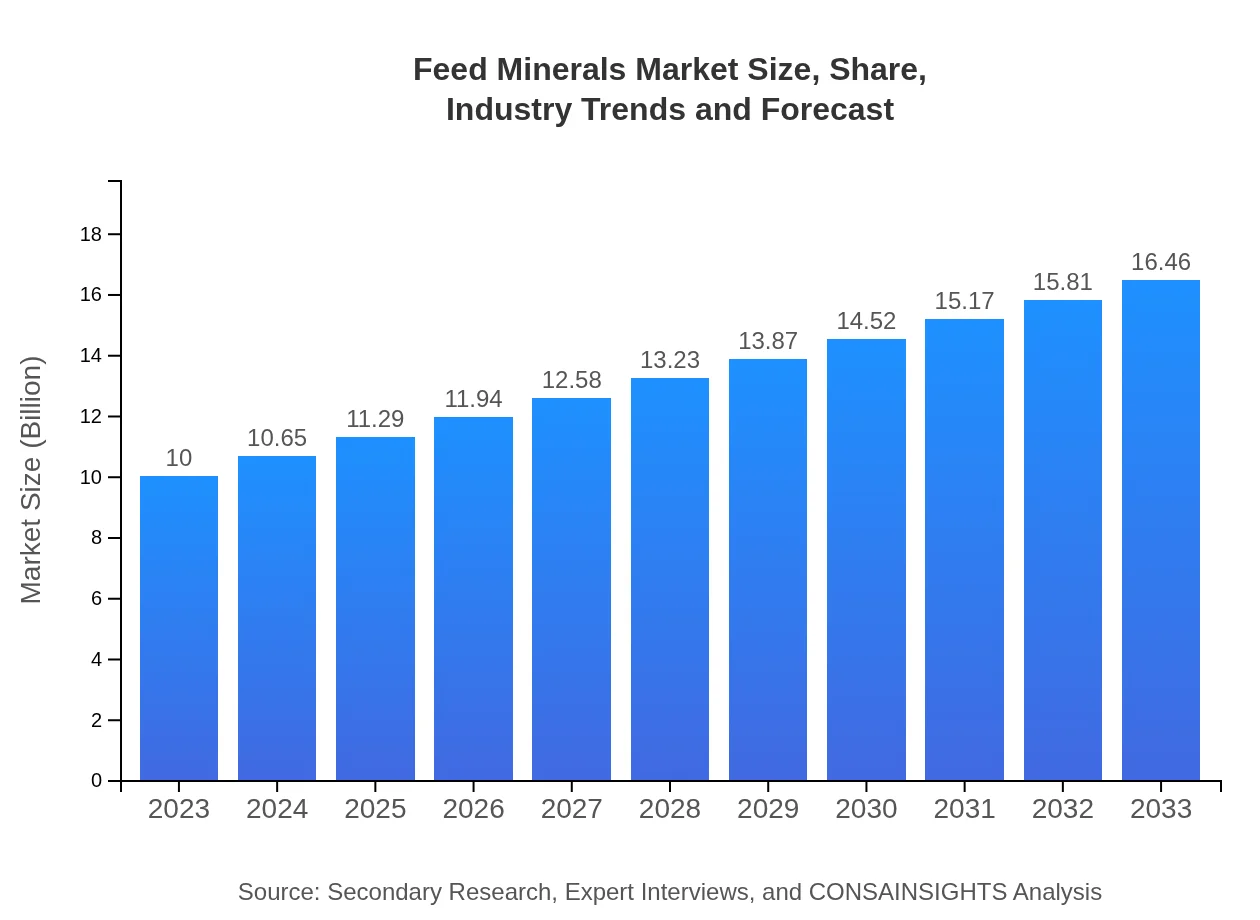
Feed Minerals Market — USD 10 billion in 2023, Growing to USD 16.46B by 2033 at 5% CAGR
This report presents a comprehensive analysis of the Feed Minerals market for the forecast period 2023-2033, highlighting key trends, regional insights, market size, and growth opportunities within the industry.
Key Takeaways
- Global market expands from $10.00 Billion in 2023 to $16.46 Billion in 2033 at a 5% CAGR.
- North America is largest regional market, while no single fastest-growing region is stated because regional CAGR differences remain within 0.15 percentage points.
- Europe rises from $3.07 Billion to $5.05 Billion across the projection window, reflecting sustained demand.
- Asia Pacific grows from $1.94 Billion to $3.19 Billion, with product innovation and animal health focus supporting uptake.
- Top industry players include Cargill, Incorporated; BASF SE; ADM Animal Nutrition; DSM Nutritional Products; Nutreco N.V.
Feed Minerals Market Report — Executive Summary
North America remains largest market by forecast-period value, while no single fastest-growing region is stated because top regional growth rates are separated by less than 0.15 percentage points. This report covers the Feed Minerals sector, outlining market size, regional performance, segmentation, and competitive activity. The market is estimated at $10.00 Billion in 2023 and is projected to reach $16.46 Billion by 2033 at a 5% CAGR. Drivers include rising demand for animal protein, stricter feed safety standards, and reformulation toward bioavailable mineral compounds. Regional breakdowns show notable expansion across North America, Europe, Asia Pacific, Latin America, and Middle East & Africa. Segmentation spans form factors (powder, liquid, granular), mineral types (macro and micro), functional roles in growth and disease prevention, animal categories (ruminants, poultry, swine, aquaculture), and distribution channels such as direct sales and online retail. The competitive landscape features established multinational suppliers that prioritize R&D and distribution networks. The analysis uses primary interviews, company disclosures, and triangulated data to present actionable insights for manufacturers, distributors, and feed formulators.
Key Growth Drivers
- Increasing global consumption of meat and dairy boosts demand for fortified feed minerals to support livestock productivity.
- Stricter regulatory and safety requirements for animal feed encourage investment in higher-quality mineral supplements and traceability.
- Technological advances in mineral chelation and formulation improve bioavailability, driving adoption among feed manufacturers.
- Expansion of intensive animal farming and professionalized husbandry practices raises the need for targeted mineral supplementation.
- Rising emphasis on animal health and disease prevention supports demand for minerals linked to immune performance and growth promotion.
| Metric | Value |
|---|---|
| Study Period | 2023 - 2033 |
| 2023 Market Size | $10.00 Billion |
| CAGR (2023-2033) | 5% |
| 2033 Market Size | $16.46 Billion |
| Top Companies | Cargill, Incorporated, BASF SE, ADM Animal Nutrition, DSM Nutritional Products, Nutreco N.V. |
| Published Date | 07 October 2024 |
| Last Modified Date | 25 May 2026 |
Feed Minerals Market Overview
Customize Feed Minerals Market Report market research report
- ✔ Get in-depth analysis of Feed Minerals market size, growth, and forecasts.
- ✔ Understand Feed Minerals's regional dynamics and industry-specific trends.
- ✔ Identify potential applications, end-user demand, and growth segments in Feed Minerals
What is the Market Size & CAGR of Feed Minerals Market Report market in 2023?
Feed Minerals Industry Analysis
Feed Minerals Market Segmentation and Scope
Tell us your focus area and get a customized research report.
Feed Minerals Market Report Market Analysis Report by Region
Europe Feed Minerals Market Report:
Europe grows from $3.07 Billion in 2023 to $5.05 Billion in 2033. Regional expansion is influenced by regulatory oversight on feed safety, demand for sustainable animal products, and product innovation focused on chelated and fortified mineral blends.Asia Pacific Feed Minerals Market Report:
Asia Pacific grows from $1.94 Billion in 2023 to $3.19 Billion in 2033. Drivers include rapid development of animal husbandry, rising protein consumption, and adoption of improved mineral supplements to support intensive farming practices.North America Feed Minerals Market Report:
North America is largest regional market, rising from $3.49 Billion in 2023 to $5.74 Billion in 2033. Growth is driven by advanced livestock production systems, stringent feed quality regulations, and investment in high-bioavailability mineral products by large feed manufacturers.South America Feed Minerals Market Report:
Latin America grows from $0.21 Billion in 2023 to $0.35 Billion in 2033. Growth factors include expanding commercial livestock operations, growing feed formulation sophistication, and greater adoption of supplemental minerals to improve herd productivity.Middle East & Africa Feed Minerals Market Report:
Middle East and Africa grows from $1.3 Billion in 2023 to $2.14 Billion in 2033. Market expansion is supported by modernization of animal farming, increased focus on animal health, and demand for reliable mineral supplements in diverse production systems.Tell us your focus area and get a customized research report.
Research Methodology
Feed Minerals Market Analysis By Type
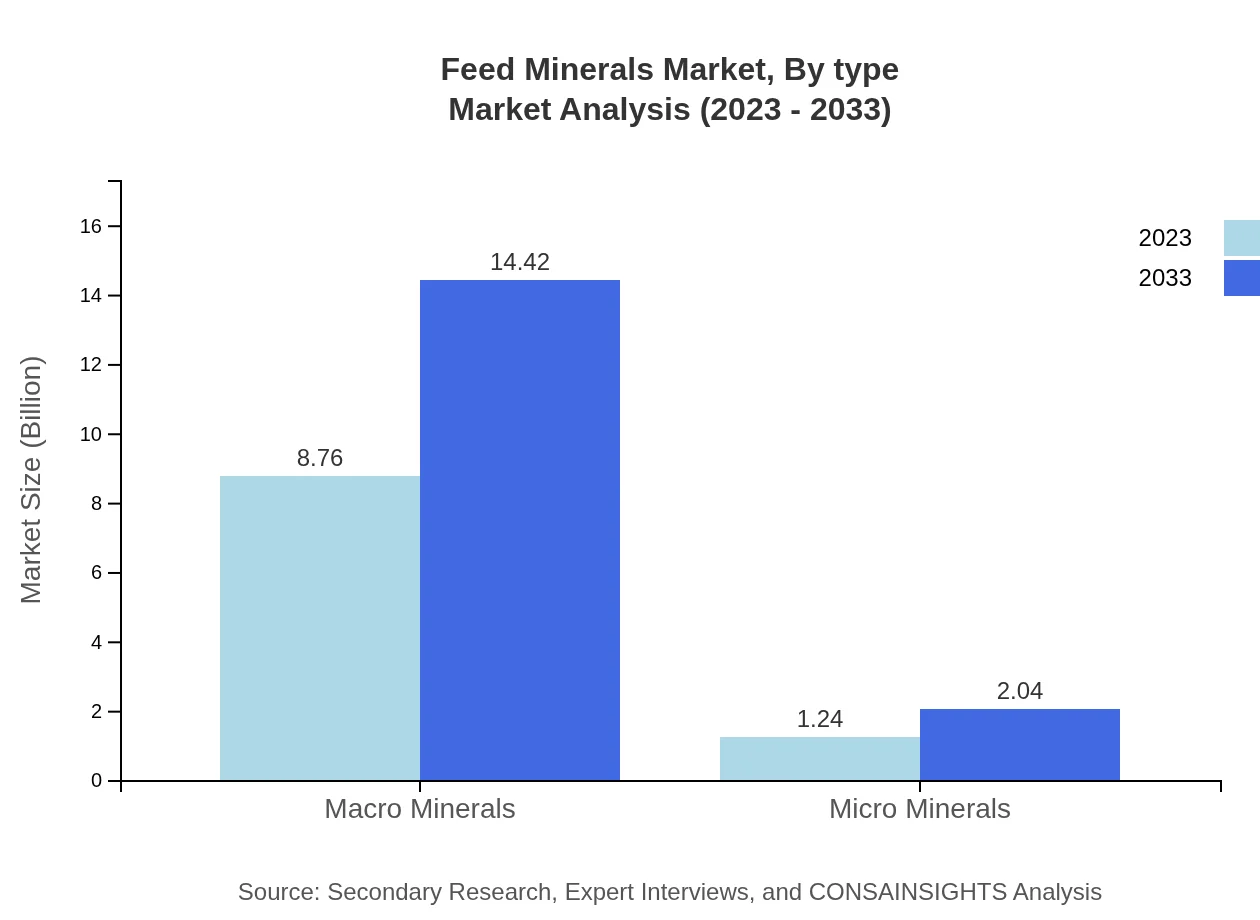
The Feed Minerals Market by Type includes Macro Minerals and Micro Minerals. Macro Minerals dominated the market with a size of $8.76 billion in 2023, set to grow to $14.42 billion by 2033. This segment highlights the foundational role of minerals like calcium, phosphorus, and potassium in animal diets. Micro Minerals, while smaller, play a critical role in health and nutrition, expected to expand from $1.24 billion in 2023 to $2.04 billion by 2033.
Feed Minerals Market Analysis By Form
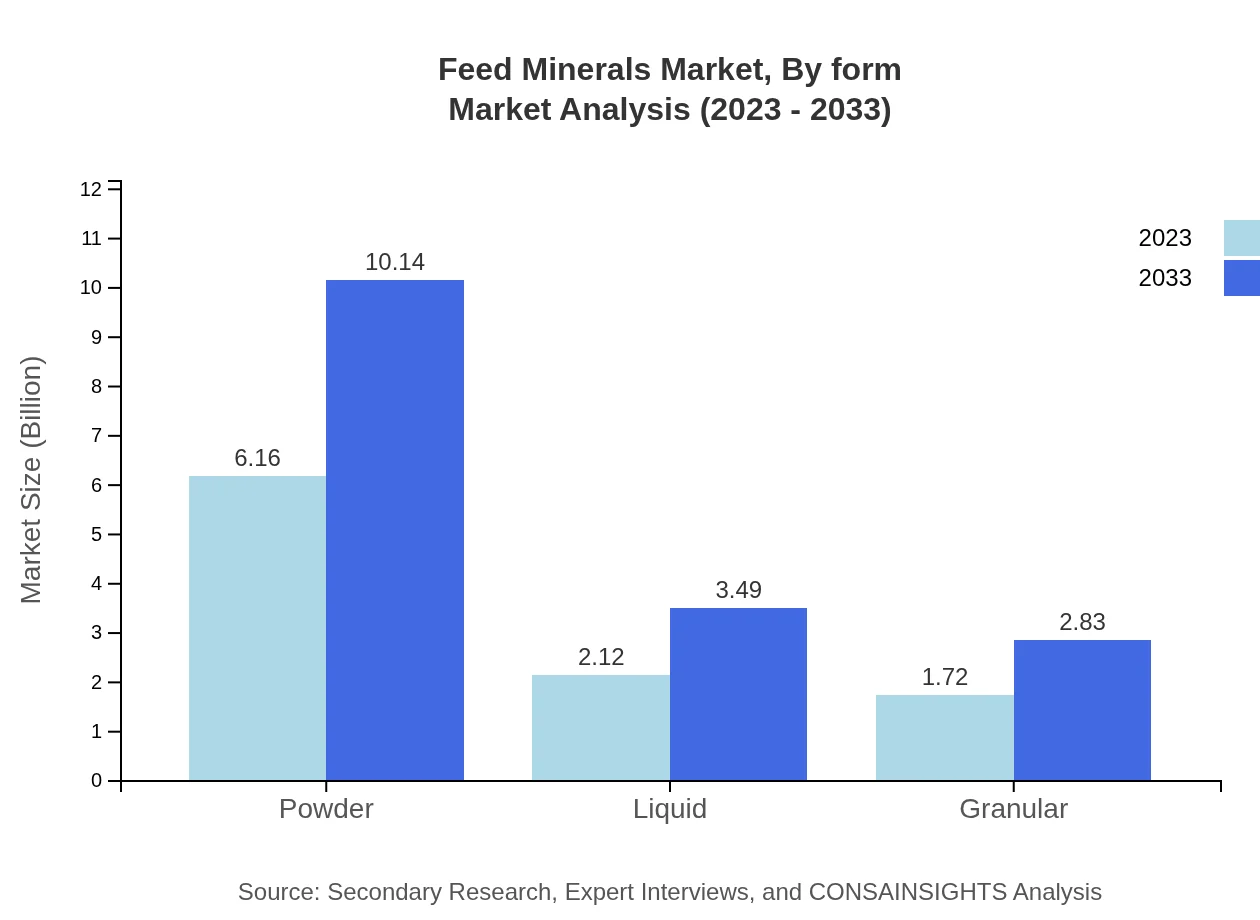
In terms of form, the Powder segment leads with a size of $6.16 billion in 2023, projected to grow to $10.14 billion by 2033. Liquid forms, valued at $2.12 billion, are anticipated to rise to $3.49 billion, while Granular forms grow from $1.72 billion to $2.83 billion over the same period. Powders are favored for their ease of mixing and higher nutrient concentration.
Feed Minerals Market Analysis By Animal Type
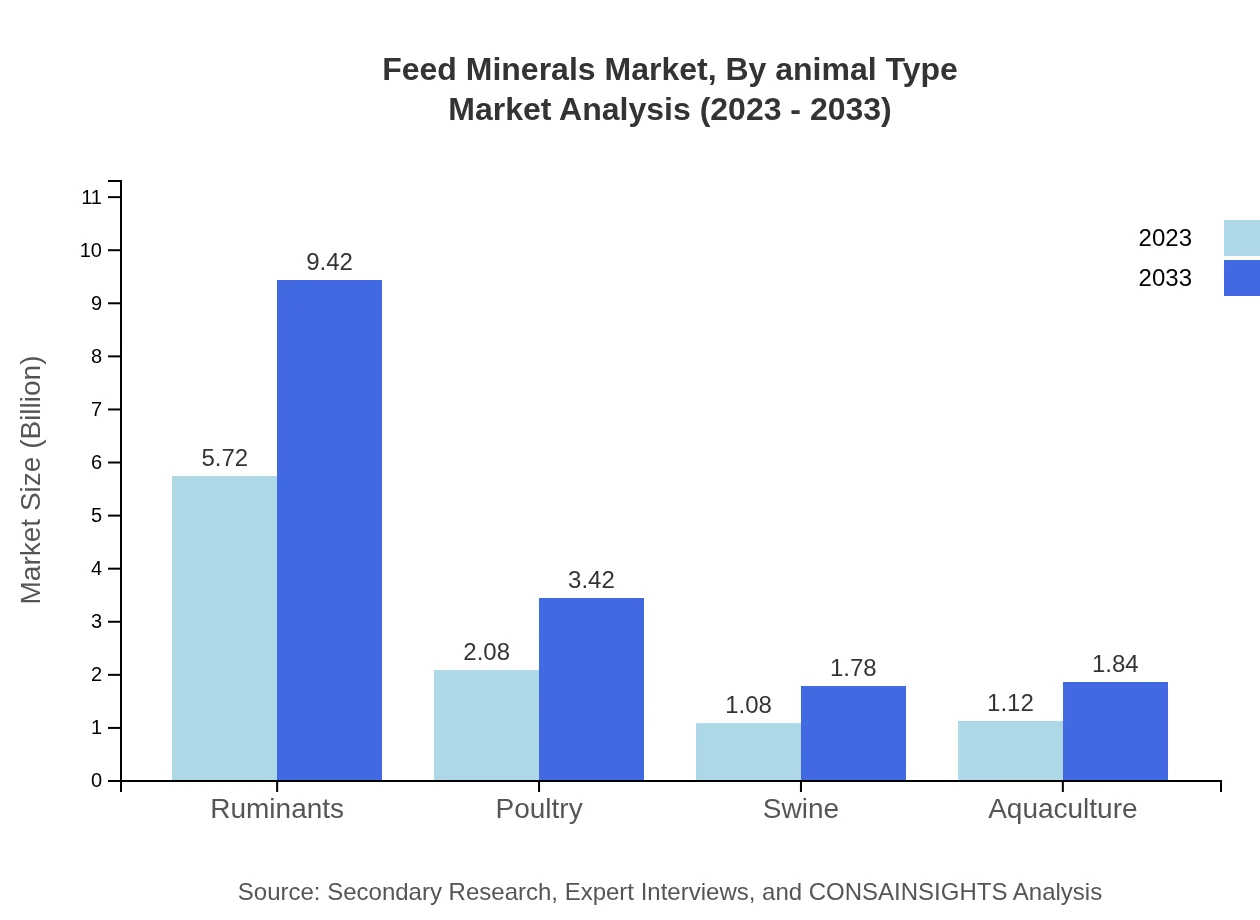
The Feed Minerals Market segmentation by animal type includes Ruminants, Poultry, Swine, and Aquaculture. Ruminants hold the largest share of $5.72 billion in 2023 and are projected to see growth up to $9.42 billion by 2033, driven by the demand for beef and dairy production. Poultry represents $2.08 billion in 2023, with continued expansion expected as global poultry meat consumption increases.
Feed Minerals Market Analysis By Function
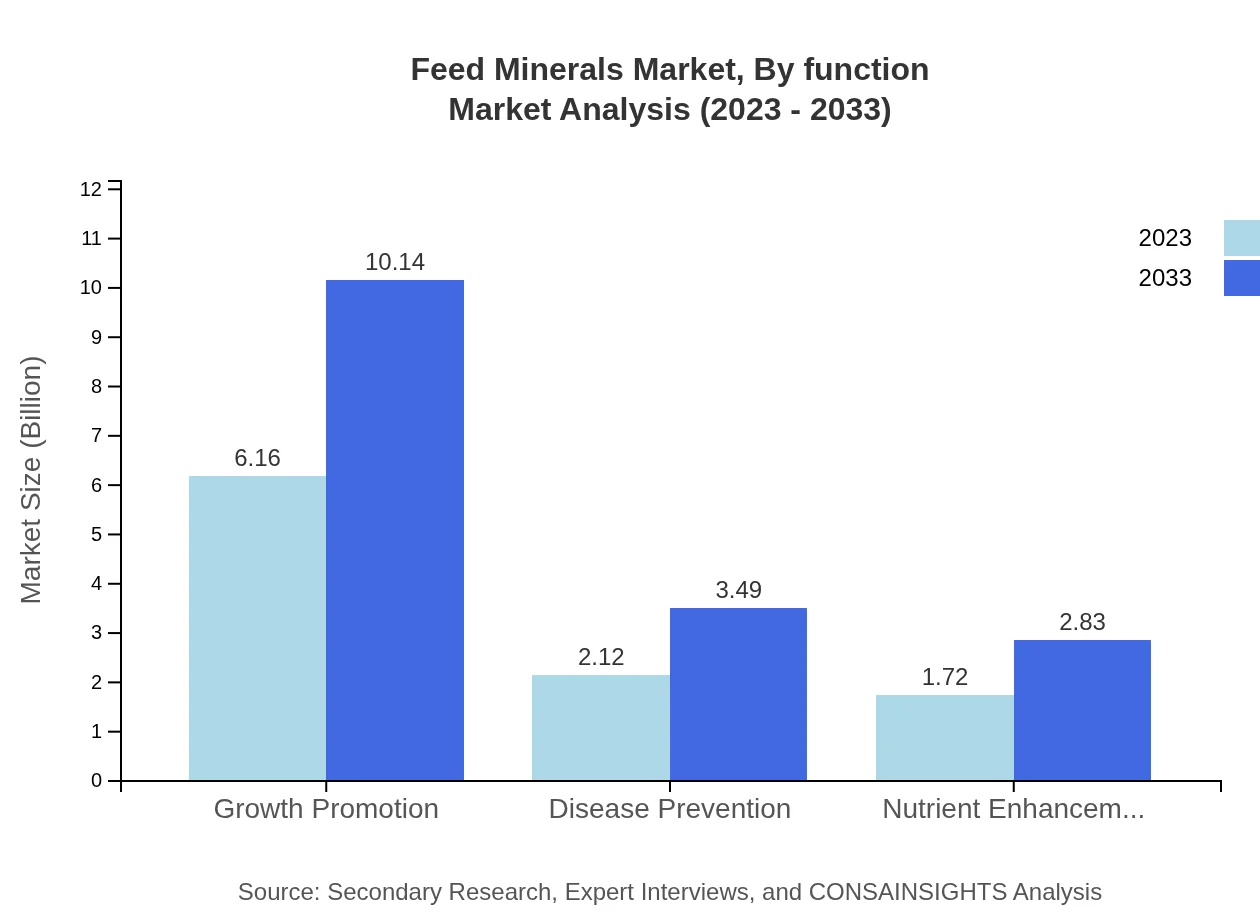
The market is segmented by function into Growth Promotion, Disease Prevention, and Nutrient Enhancement. Growth Promotion is currently the leading segment at $6.16 billion in 2023, expected to grow to $10.14 billion by 2033, reflecting the focus on improving growth rates in livestock. Disease Prevention is significant at $2.12 billion, poised to increase to $3.49 billion, emphasizing health assurance for livestock.
Feed Minerals Market Analysis By Distribution Channel
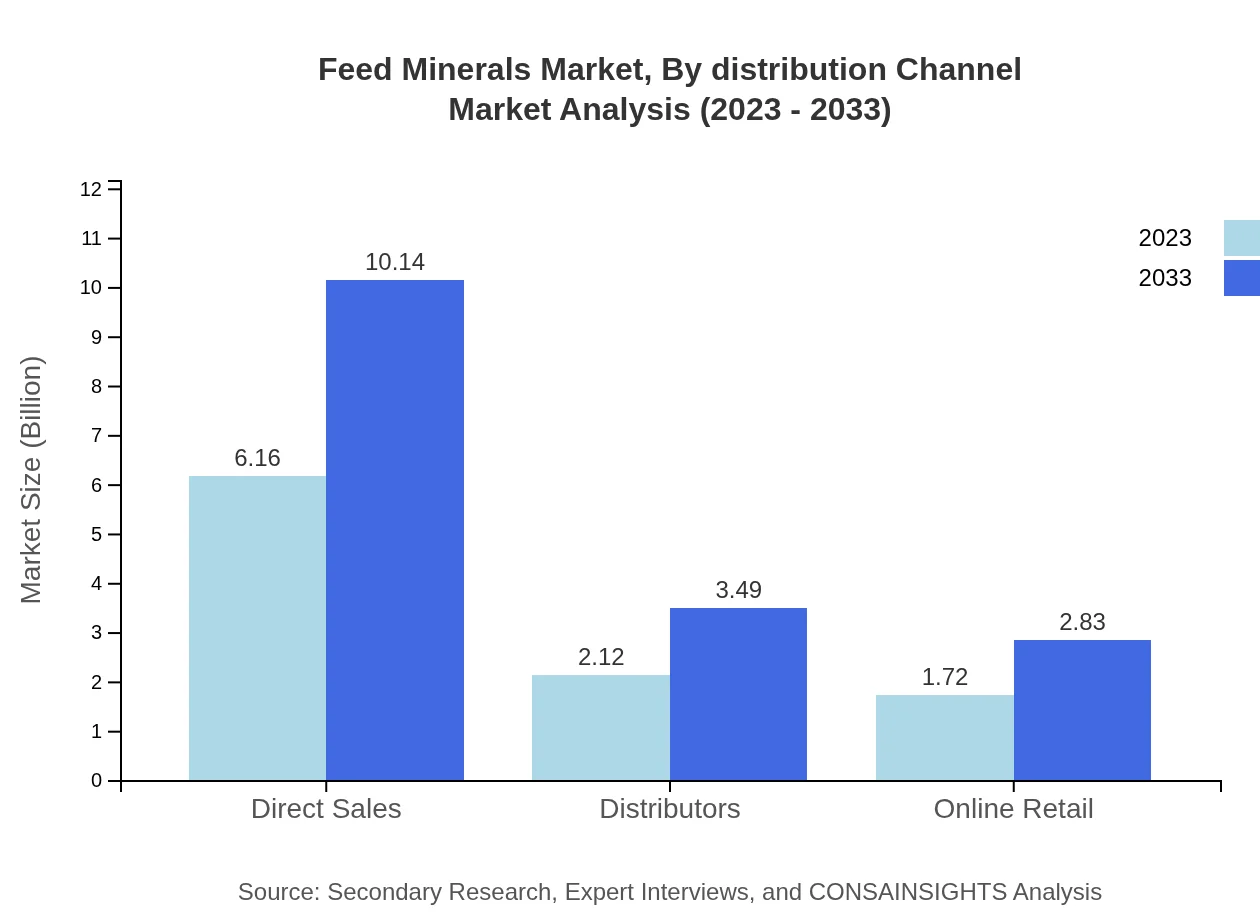
Distribution channels for Feed Minerals include Direct Sales, Distributors, and Online Retail. Direct Sales dominate with a market size of $6.16 billion in 2023, consistent with industry trends favoring relationship-driven business. Distributors stand at $2.12 billion, while Online Retail, a growing channel, is projected to reach $2.83 billion by 2033, catering to the increasing preference for e-commerce.
Feed Minerals Market Trends and Future Forecast
Tell us your focus area and get a customized research report.
Global Market Leaders and Top Companies in Feed Minerals Industry
Cargill, Incorporated:
Cargill is a multinational corporation that provides food, agriculture, financial, and industrial products and services. It is a dominant leader in animal nutrition, offering a wide range of feed additives including feed minerals.BASF SE:
BASF is one of the largest chemical producers in the world and has a strong presence in the animal nutrition market, particularly for its innovative feed mineral solutions that enhance livestock productivity.ADM Animal Nutrition:
Archer Daniels Midland Company (ADM) is a global leader in animal nutrition, offering nutrient-rich mineral blends to optimize animal health and performance.DSM Nutritional Products:
DSM Nutritional Products specializes in vitamins, carotenoids, and feed minerals, leading innovations in animal health and nutrition aimed at improving livestock productivity.Nutreco N.V.:
Nutreco is a leading global player in animal nutrition and fish feed, focusing on providing sustainable feed solutions that enhance nutrition and health in livestock.We're grateful to work with incredible clients.







FAQs
What is the market size of the Feed Minerals Market Report in 2023?
The market size is $10.00 Billion in 2023, as reported for the global feed minerals sector.
How big will the market be in 2033?
The market is projected to reach $16.46 Billion by 2033 according to the forecast provided.
What is CAGR of the forecast period?
The compound annual growth rate for the 2023 to 2033 forecast period is 5%.
Is there a single fastest Growing region in the Feed Minerals Market Report market?
No single fastest-growing region is stated for the Feed Minerals Market Report market because the top regional implied CAGR values are within 0.15 percentage points of each other, making the ranking too close to call reliably.
Why are feed minerals in higher demand?
Demand rises due to increasing animal protein consumption, regulatory focus on feed safety, and the need for improved livestock performance.
Who are the top companies in this market?
Top companies listed include Cargill, Incorporated; BASF SE; ADM Animal Nutrition; DSM Nutritional Products; Nutreco N.V.
What are common product forms in this market?
Common forms include powder, liquid, and granular presentations used across feed formulations and supplemental blends.
How is segmentation defined in the report?
Segmentation covers form, type (macro and micro minerals), function (growth promotion, disease prevention), animal type, and distribution channels.
Which distribution channels are prominent?
Prominent channels include direct sales, distributors, and online retail, reflecting diversified procurement routes for feed minerals.
What research methods supported the analysis?
The study used primary interviews, company and publication research, data triangulation, and expert-led trend evaluation.