
Reports >
Life Sciences
>
Fluidics For Preclinical Market Report

Fluidics For Preclinical Market Report
First published: 11 October 2024 | Last updated: 25 May 2026 | Report Code: fluidics-for-preclinical
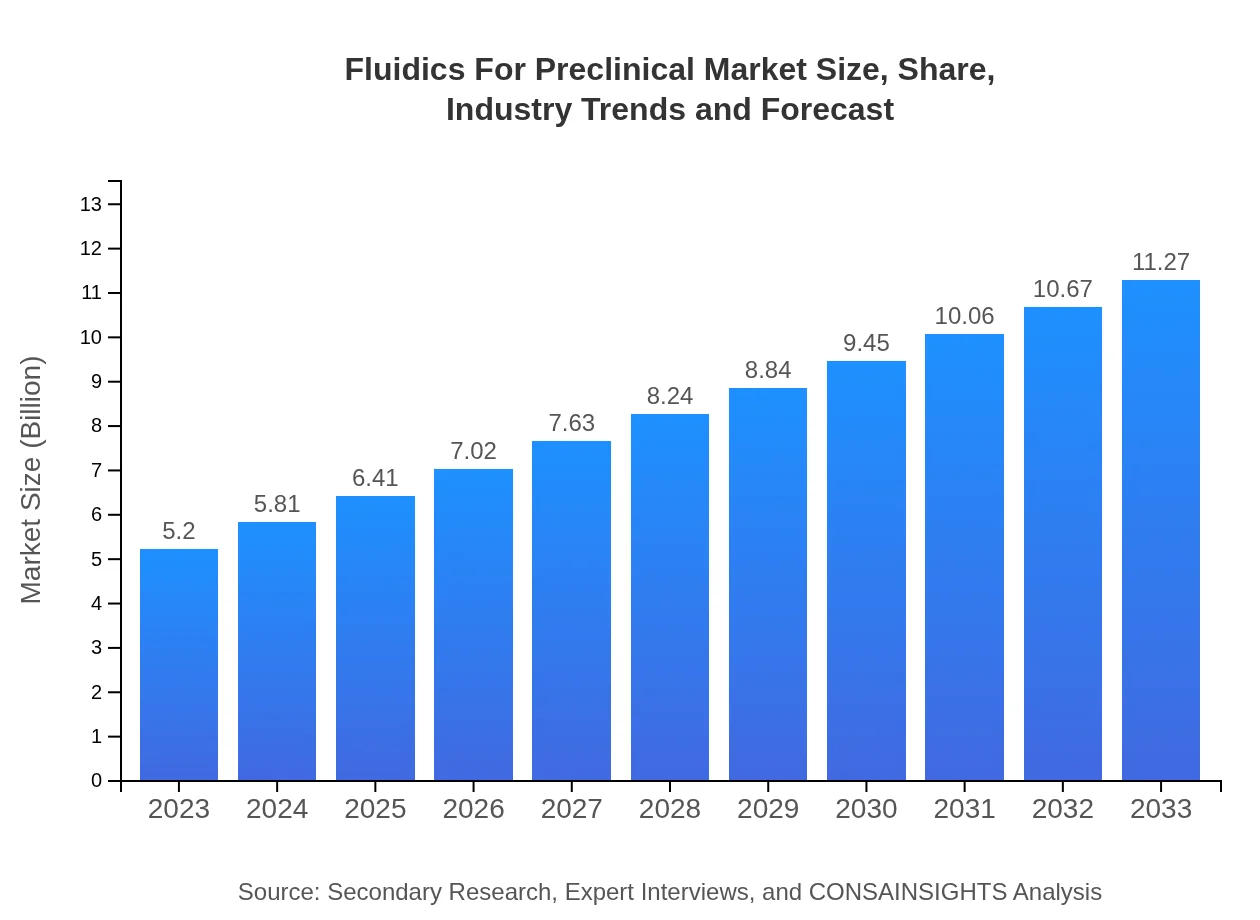
Fluidics For Preclinical Market — USD 5.2 billion in 2023, Growing to USD 11.27B by 2033 at 7.8% CAGR
This report presents an in-depth analysis of the Fluidics For Preclinical market, providing insights into market size, trends, and growth forecasts from 2023 to 2033. A comprehensive overview of market dynamics, key players, and regional performances is included to facilitate strategic planning and decision-making.
Key Takeaways
- Global market projected from $5.20 Billion in 2023 to $11.27 Billion by 2033 at a 7.8% CAGR.
- North America is largest regional market, while no single fastest-growing region is stated because regional CAGR differences remain within 0.15 percentage points.
- North America leads regional value, increasing from $1.82 Billion in 2023 to $3.94 Billion in 2033.
- Europe and Asia Pacific show notable expansion, rising to $3.21 Billion and $2.38 Billion respectively in 2033.
- Industry investment in microfluidic devices, automation, and digital integration is a primary growth catalyst.
- Major vendors include Merck Group, Thermo Fisher Scientific, Agilent Technologies, Abbott Laboratories, and Danaher Corporation.
Fluidics For Preclinical Market Report — Executive Summary
North America remains largest market by forecast-period value, while no single fastest-growing region is stated because top regional growth rates are separated by less than 0.15 percentage points. The Fluidics For Preclinical market is advancing through sustained demand for reliable preclinical testing platforms and improvements in microfluidic design. Key growth drivers include rising R&D expenditure in pharmaceuticals and biotechnology, the push for lab automation, and integration of digital data capture. Regional expansion is uneven, with North America holding the largest market value. Product innovation spans microfluidic devices, reagents, and peripherals, while end users include pharmaceutical firms, biotech companies, academic institutions, and CROs. Competitive activity is concentrated among established life-science suppliers such as Merck Group, Thermo Fisher Scientific, Agilent Technologies, Abbott Laboratories, and Danaher Corporation. Regulatory validation and connectivity requirements are shaping product roadmaps and adoption timelines across markets.
Key Growth Drivers
- Increased R&D spending by pharmaceutical and biotechnology firms driving demand for reliable preclinical fluidic platforms.
- Advances in microfluidic device design enabling miniaturized assays and higher-throughput workflows.
- Adoption of automation and digital data analytics to improve reproducibility and accelerate preclinical timelines.
- Rising need for precise sample handling and reduced reagent consumption encouraging uptake of microfluidic reagents and peripherals.
| Metric | Value |
|---|---|
| Study Period | 2023 - 2033 |
| 2023 Market Size | $5.20 Billion |
| CAGR (2023-2033) | 7.8% |
| 2033 Market Size | $11.27 Billion |
| Top Companies | Merck Group, Thermo Fisher Scientific, Agilent Technologies, Abbott Laboratories, Danaher Corporation |
| Published Date | 11 October 2024 |
| Last Modified Date | 25 May 2026 |
Fluidics For Preclinical Market Overview
Customize Fluidics For Preclinical Market Report market research report
- ✔ Get in-depth analysis of Fluidics For Preclinical market size, growth, and forecasts.
- ✔ Understand Fluidics For Preclinical's regional dynamics and industry-specific trends.
- ✔ Identify potential applications, end-user demand, and growth segments in Fluidics For Preclinical
What is the Market Size & CAGR of Fluidics For Preclinical Market Report market in 2023?
Fluidics For Preclinical Industry Analysis
Fluidics For Preclinical Market Segmentation and Scope
Tell us your focus area and get a customized research report.
Fluidics For Preclinical Market Report Market Analysis Report by Region
Europe Fluidics For Preclinical Market Report:
Europe grows from $1.48 Billion in 2023 to $3.21 Billion in 2033. 48 Billion in 2023 to $3.21 Billion in 2033, supported by expanding biotech activity, academic research collaborations, and investments in lab automation and validation for preclinical workflows.Asia Pacific Fluidics For Preclinical Market Report:
Asia Pacific grows from $1.1 Billion in 2023 to $2.38 Billion in 2033. 10 Billion in 2023 to $2.38 Billion in 2033, reflecting growing pharmaceutical and biotech R&D investments, expanding CRO services, and rising demand for cost-efficient microfluidic assays.North America Fluidics For Preclinical Market Report:
North America is largest regional market, rising from $1.82 Billion in 2023 to $3.94 Billion in 2033. Regional advantages include concentrated life-science R&D, established instrument suppliers, and strong funding that drive adoption of microfluidic platforms.South America Fluidics For Preclinical Market Report:
Latin America grows from $0.52 Billion in 2023 to $1.13 Billion in 2033. 52 Billion in 2023 to $1.13 Billion in 2033, driven by expanding research capacity, increased outsourcing to CROs, and gradual adoption of microfluidic reagents and peripheral equipment.Middle East & Africa Fluidics For Preclinical Market Report:
Middle East and Africa grows from $0.29 Billion in 2023 to $0.62 Billion in 2033. 29 Billion in 2023 to $0.62 Billion in 2033, with progress led by developing research infrastructures, targeted investments, and selective procurement of fluidic devices for preclinical testing.Tell us your focus area and get a customized research report.
Research Methodology
Fluidics For Preclinical Market Analysis By Product
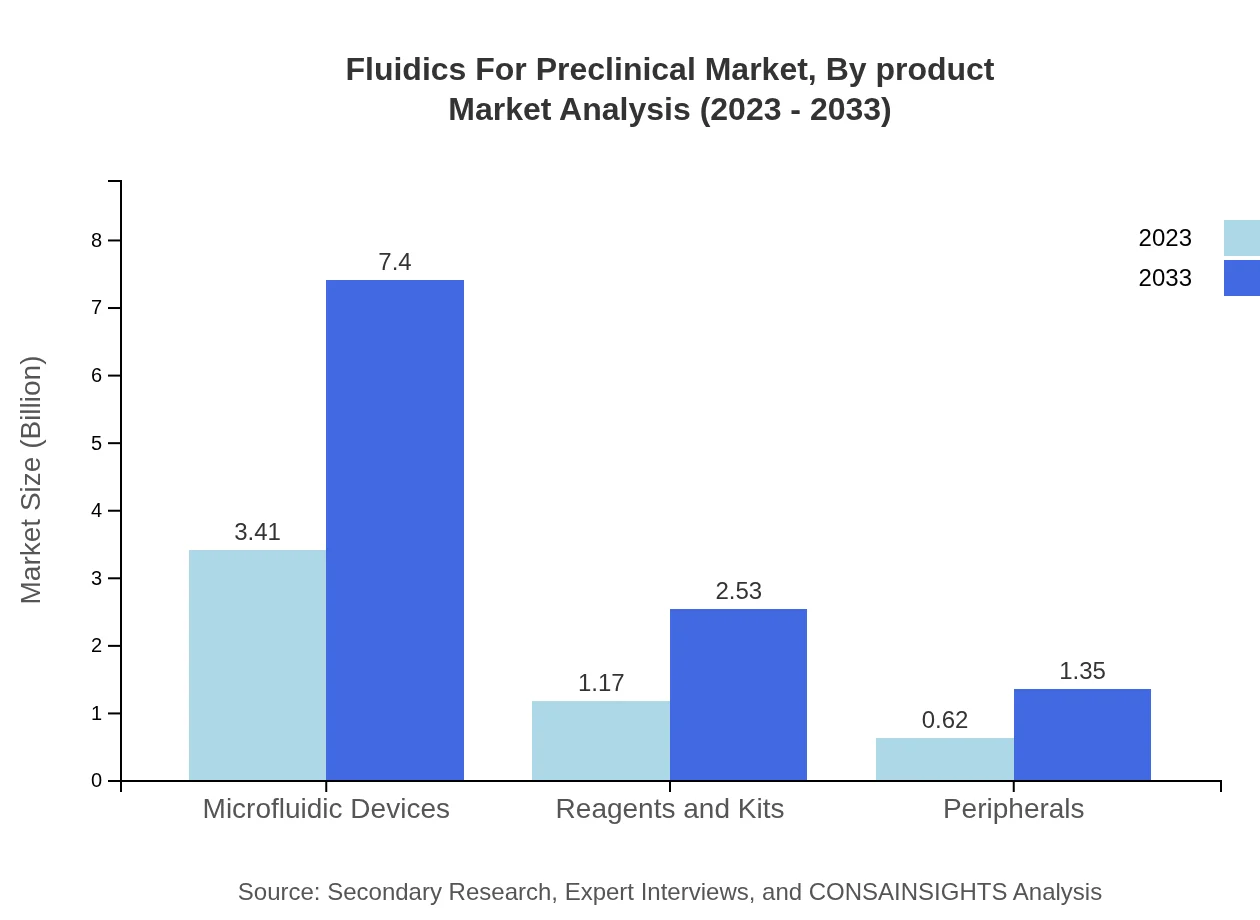
Microfluidic Devices dominate the Fluidics For Preclinical market, projected to grow from $3.41 billion in 2023 to $7.40 billion in 2033, capturing 65.63% market share. Reagents and Kits follow with a significant presence, expected to rise from $1.17 billion to $2.53 billion. Peripherals, while smaller, are also essential, expanding from $0.62 billion to $1.35 billion, contributing to a versatile product ecosystem.
Fluidics For Preclinical Market Analysis By Application
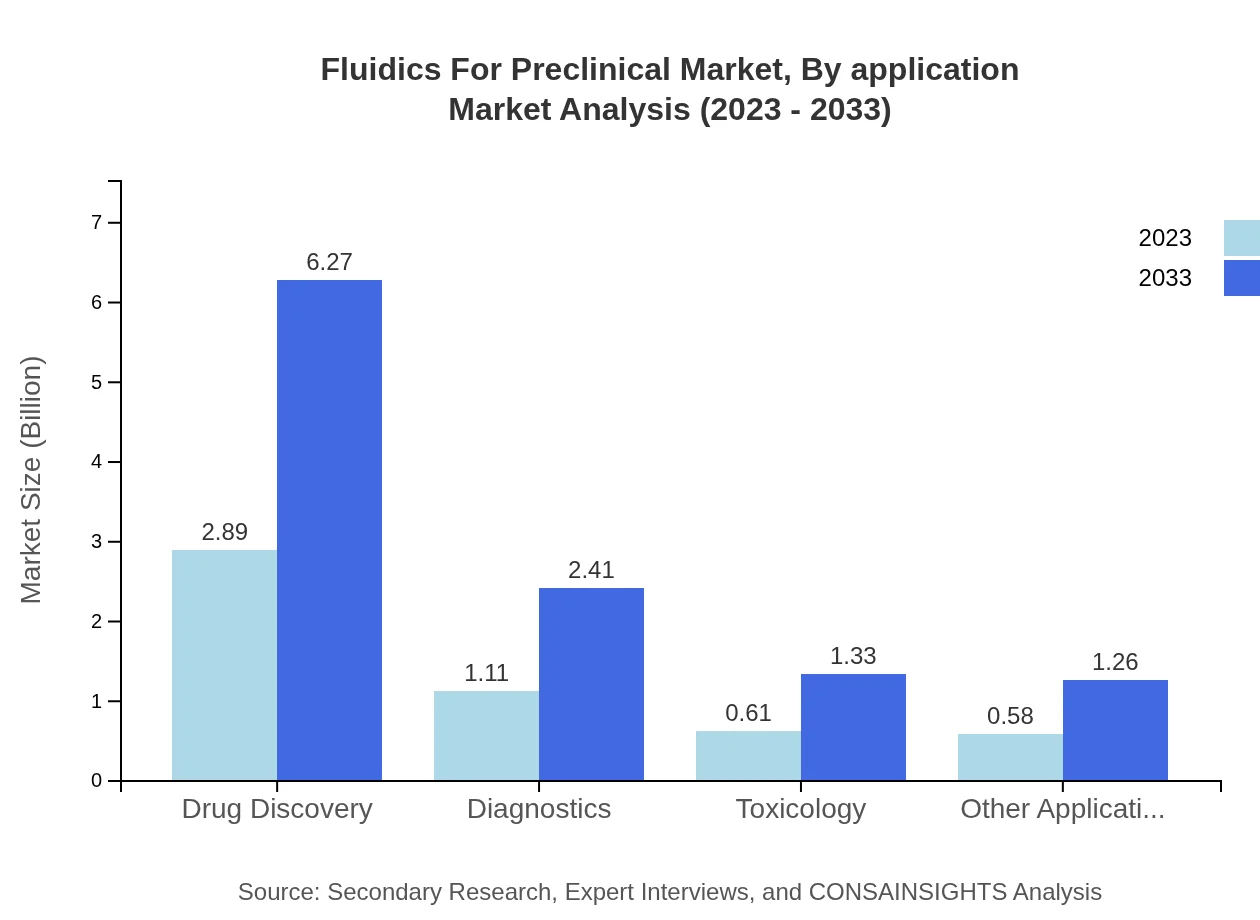
The Drug Discovery segment retains the largest market share of 55.59%, projected to grow from $2.89 billion in 2023 to $6.27 billion. Diagnostics applications follow with a market size increase from $1.11 billion to $2.41 billion. Toxicology and other applications also indicate steady growth, reflecting broad utility in preclinical settings.
Fluidics For Preclinical Market Analysis By End User
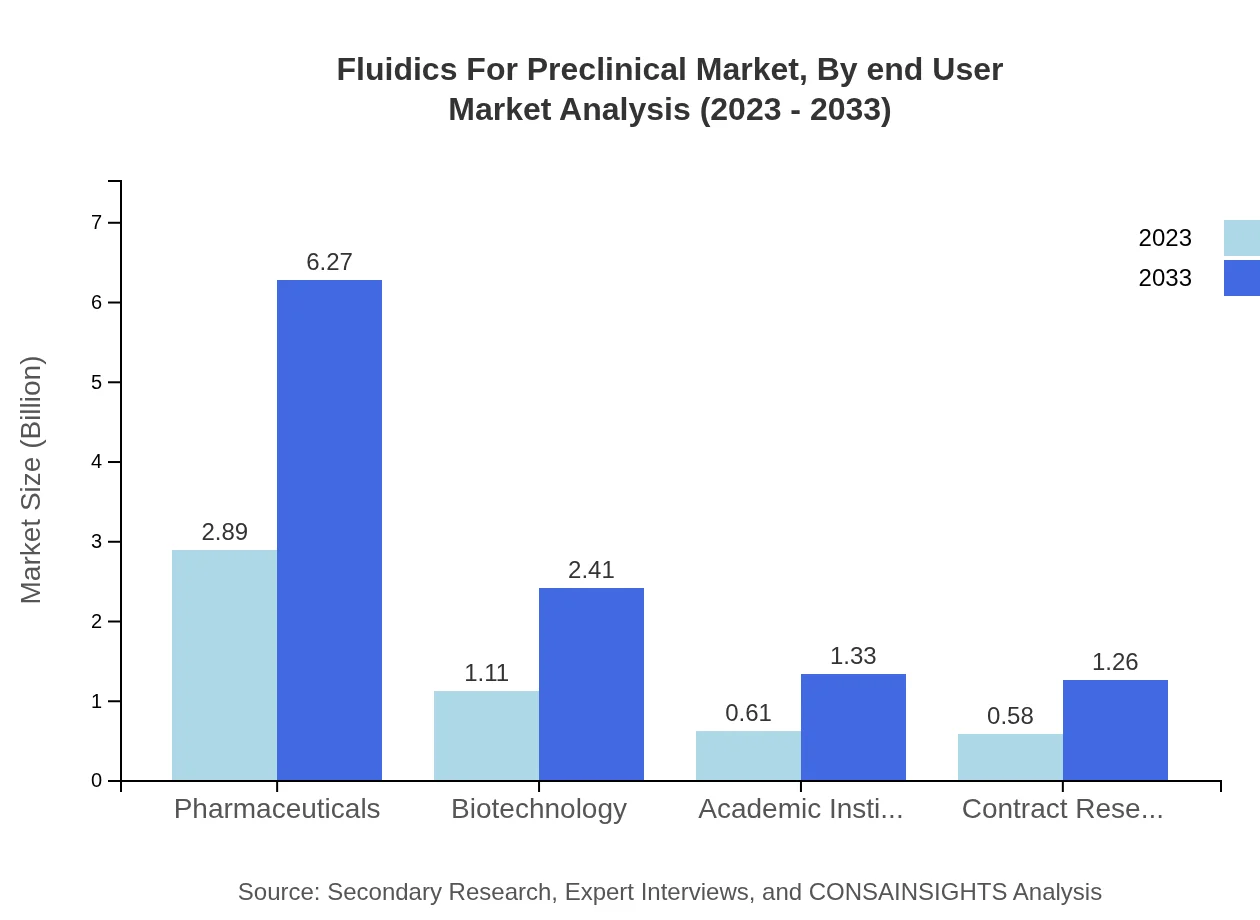
Pharmaceutical companies account for a significant market share, particularly with a size projection from $2.89 billion to $6.27 billion. Biotechnology firms and academic institutions also play pivotal roles, contributing to innovations in fluidic technologies, alongside the growing involvement of Contract Research Organizations (CROs).
Fluidics For Preclinical Market Analysis By Technologies
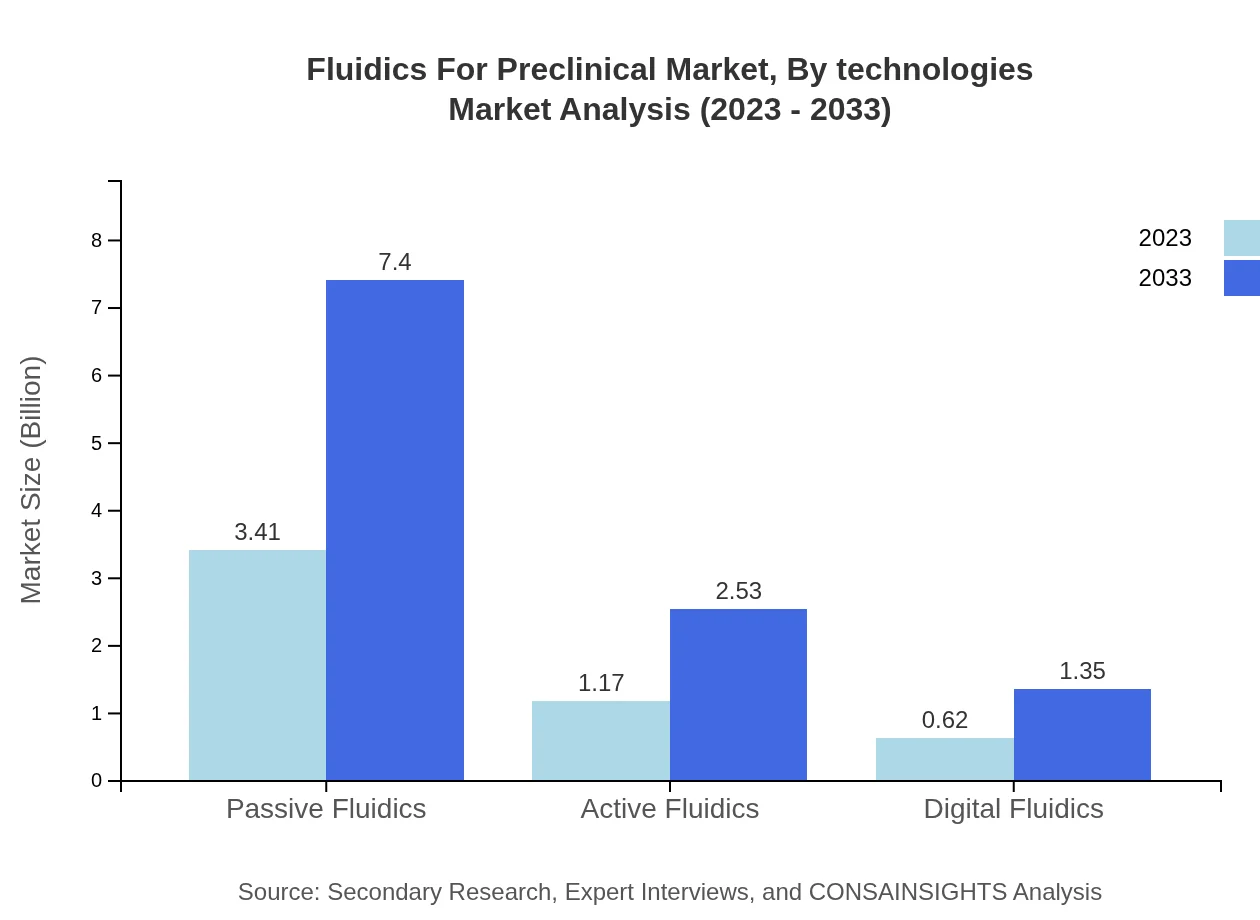
The market for Passive Fluidics leads, showing growth from $3.41 billion to $7.40 billion, while Active Fluidics and Digital Fluidics exhibit promising advancements. The preference for automated and digitalized fluidic solutions continues to rise, reflecting changing laboratory needs and technological advances.
Fluidics For Preclinical Market Trends and Future Forecast
Tell us your focus area and get a customized research report.
Global Market Leaders and Top Companies in Fluidics For Preclinical Industry
Merck Group:
Merck Group is a global leader in science and technology, with a strong portfolio in microfluidics and laboratory automation solutions.Thermo Fisher Scientific:
Thermo Fisher Scientific offers an extensive range of fluidics products, widely utilized in biopharma and academic research for preclinical solutions.Agilent Technologies:
Agilent Technologies specializes in providing innovative solutions in life sciences, including state-of-the-art fluidic devices for labs.Abbott Laboratories:
Abbott Laboratories is prominent in the diagnostics sector, integrating fluidics technology into their innovative preclinical and clinical solutions.Danaher Corporation:
Danaher Corporation operates in diagnostics and life sciences, providing advanced fluidics technologies to support preclinical research.We're grateful to work with incredible clients.









FAQs
What is the market size of the Fluidics For Preclinical market in 2023?
The market size for 2023 is $5.20 Billion, reflecting current adoption across pharmaceuticals, biotechnology, academic institutions, and CROs invested in microfluidic solutions.
How big will the market be by 2033?
By 2033 the market is projected to reach $11.27 Billion, reflecting continued expansion driven by technology integration and increased preclinical research activity.
What is CAGR for the forecast period?
The compound annual growth rate for 2023 to 2033 is 7.8%, reflecting steady expansion resulting from innovation and rising demand in preclinical workflows.
Is there a single fastest Growing region in the Fluidics For Preclinical Market Report market?
No single fastest-growing region is stated for the Fluidics For Preclinical Market Report market because the top regional implied CAGR values are within 0.15 percentage points of each other, making the ranking too close to call reliably.
Which companies are leading the market?
Leading participants identified include Merck Group, Thermo Fisher Scientific, Agilent Technologies, Abbott Laboratories, and Danaher Corporation, which are active in product development and distribution.
What end users drive demand for fluidic solutions?
Pharmaceutical companies, biotechnology firms, academic institutions, and CROs drive demand through needs for drug discovery, diagnostics, toxicology testing, and other preclinical applications.
How do technologies vary across the market?
Available technologies include passive fluidics, active fluidics, and digital fluidics, each supporting different assay types, throughput requirements, and levels of automation in preclinical labs.
What are common product segments in this market?
Product segments include microfluidic devices, reagents and kits, and peripherals, each serving specific roles in sample manipulation, assay chemistry, and instrument support.