

Functional Near Infrared Optical Brain Imaging Market Report
First published: 11 October 2024 | Last updated: 25 May 2026 | Report Code: functional-near-infrared-optical-brain-imaging
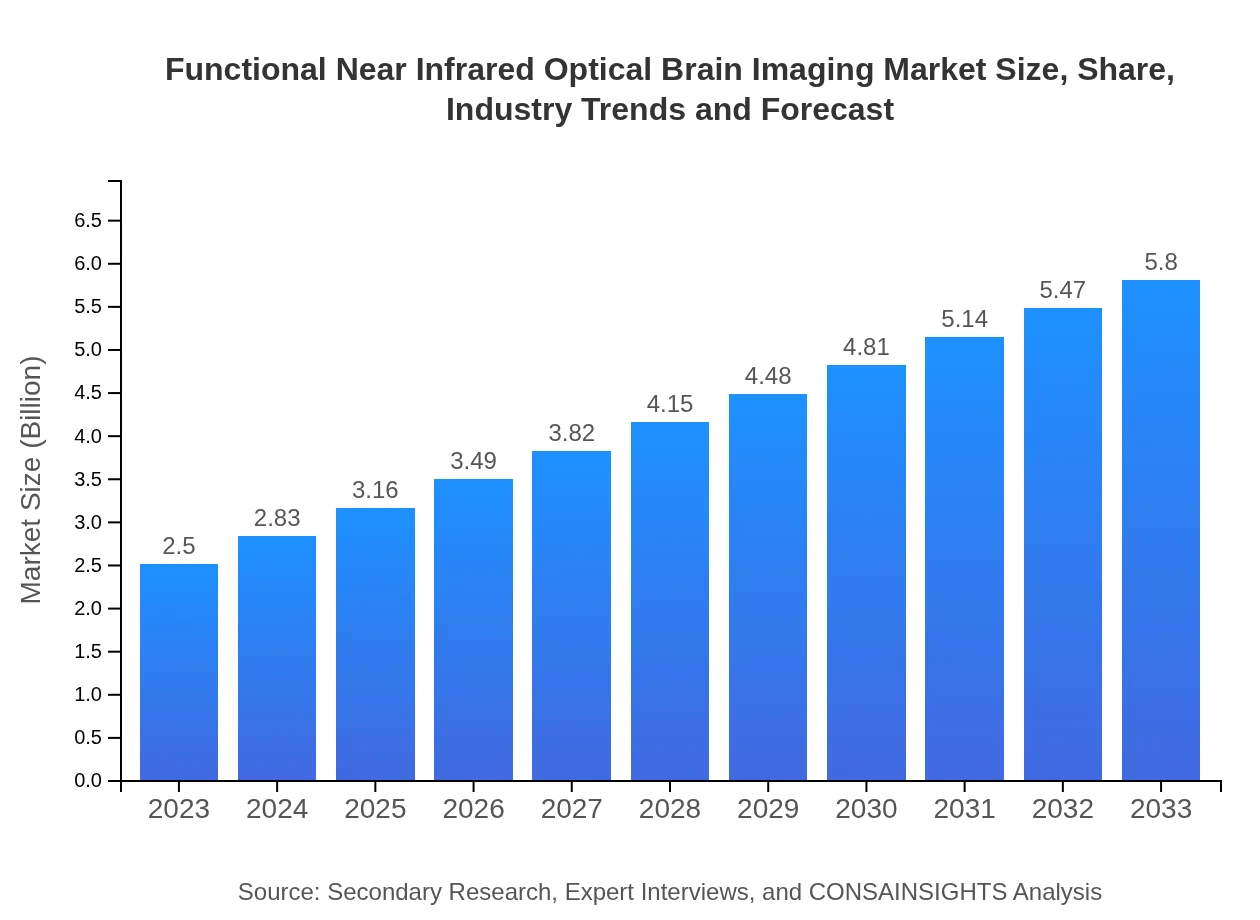
Functional Near Infrared Optical Brain Imaging Market — USD 2.5 billion in 2023, Growing to USD 5.80B by 2033 at 8.5% CAGR
This report provides an in-depth analysis of the Functional Near Infrared Optical Brain Imaging market, focusing on key insights, trends, and forecasts from 2023 to 2033. It covers market size, growth metrics, technological advancements, and regional dynamics in the industry.
Key Takeaways
- Global market expands from $2.50 Billion in 2023 to $5.80 Billion by 2033 at an 8.5% CAGR.
- North America is largest regional market, while no single fastest-growing region is stated because regional CAGR differences remain within 0.15 percentage points.
- North America is the largest region, increasing from $0.96 Billion in 2023 to $2.22 Billion in 2033.
- Europe advances from $0.68 Billion to $1.58 Billion between 2023 and 2033.
- Asia Pacific grows from $0.49 Billion in 2023 to $1.13 Billion in 2033, supporting research and clinical adoption.
- Key players include NIRx Medical Technologies, Hitachi Medical Corporation, Zebra Medical Vision, and University of California, Berkeley.
Functional Near Infrared Optical Brain Imaging Market Report — Executive Summary
North America remains largest market by forecast-period value, while no single fastest-growing region is stated because top regional growth rates are separated by less than 0.15 percentage points. The Functional Near Infrared Optical Brain Imaging market is projected to grow from $2.50 Billion in 2023 to $5.80 Billion by 2033 at a CAGR of 8.5%. Growth is supported by demand for non-invasive neurological diagnostics, expanded clinical research, and ongoing technology improvements. Adoption across hospitals, research institutes, academic institutions, and pharmaceutical companies is driving equipment and application development. Regional investments and research initiatives in North America, Europe, and Asia Pacific influence market dynamics. Notable participants include NIRx Medical Technologies, Hitachi Medical Corporation, Zebra Medical Vision, and University of California, Berkeley. The report synthesizes primary interviews and secondary sources to map market segments, regional performance, and emerging trends guiding stakeholders through the forecast period.
Key Growth Drivers
- Rising need for non-invasive brain monitoring tools in clinical diagnostics and cognitive research.
- Increased research funding and activity at hospitals, academic institutions, and research institutes.
- Technological advances in near-infrared spectroscopy and imaging protocols improving sensitivity.
- Collaboration between device makers and healthcare providers accelerating clinical deployments.
- Pharmaceutical interest in brain imaging for drug development and neurological disorder studies.
| Metric | Value |
|---|---|
| Study Period | 2023 - 2033 |
| 2023 Market Size | $2.50 Billion |
| CAGR (2023-2033) | 8.5% |
| 2033 Market Size | $5.80 Billion |
| Top Companies | NIRx Medical Technologies, Hitachi Medical Corporation, Zebra Medical Vision, University of California, Berkeley |
| Published Date | 11 October 2024 |
| Last Modified Date | 25 May 2026 |
Functional Near Infrared Optical Brain Imaging Market Overview
Customize Functional Near Infrared Optical Brain Imaging Market Report market research report
- ✔ Get in-depth analysis of Functional Near Infrared Optical Brain Imaging market size, growth, and forecasts.
- ✔ Understand Functional Near Infrared Optical Brain Imaging's regional dynamics and industry-specific trends.
- ✔ Identify potential applications, end-user demand, and growth segments in Functional Near Infrared Optical Brain Imaging
What is the Market Size & CAGR of Functional Near Infrared Optical Brain Imaging Market Report market in 2023?
Functional Near Infrared Optical Brain Imaging Industry Analysis
Functional Near Infrared Optical Brain Imaging Market Segmentation and Scope
Tell us your focus area and get a customized research report.
Functional Near Infrared Optical Brain Imaging Market Report Market Analysis Report by Region
Europe Functional Near Infrared Optical Brain Imaging Market Report:
Europe grows from $0.68 Billion in 2023 to $1.58 Billion in 2033. Growth is driven by academic research activities, hospital adoption for clinical diagnostics, and collaborative projects that advance near-infrared imaging capabilities.Asia Pacific Functional Near Infrared Optical Brain Imaging Market Report:
Asia Pacific grows from $0.49 Billion in 2023 to $1.13 Billion in 2033. Expansion reflects growing clinical research, rising healthcare investments, and increased deployment of non-invasive imaging tools in academic and medical centers.North America Functional Near Infrared Optical Brain Imaging Market Report:
North America is largest regional market, rising from $0.96 Billion in 2023 to $2.22 Billion in 2033. Regional strength is tied to concentrated research institutions, healthcare infrastructure adoption, and investment in imaging technology that supports clinical and cognitive studies.South America Functional Near Infrared Optical Brain Imaging Market Report:
Latin America grows from $0.17 Billion in 2023 to $0.39 Billion in 2033. Regional uptake is supported by expanding research collaborations and gradual integration of imaging solutions in select clinical and academic institutions.Middle East & Africa Functional Near Infrared Optical Brain Imaging Market Report:
Middle East and Africa grows from $0.21 Billion in 2023 to $0.48 Billion in 2033. Development is influenced by targeted research initiatives, emerging healthcare investments, and increasing interest in non-invasive brain monitoring technologies.Tell us your focus area and get a customized research report.
Research Methodology
Functional Near Infrared Optical Brain Imaging Market Analysis By Technology
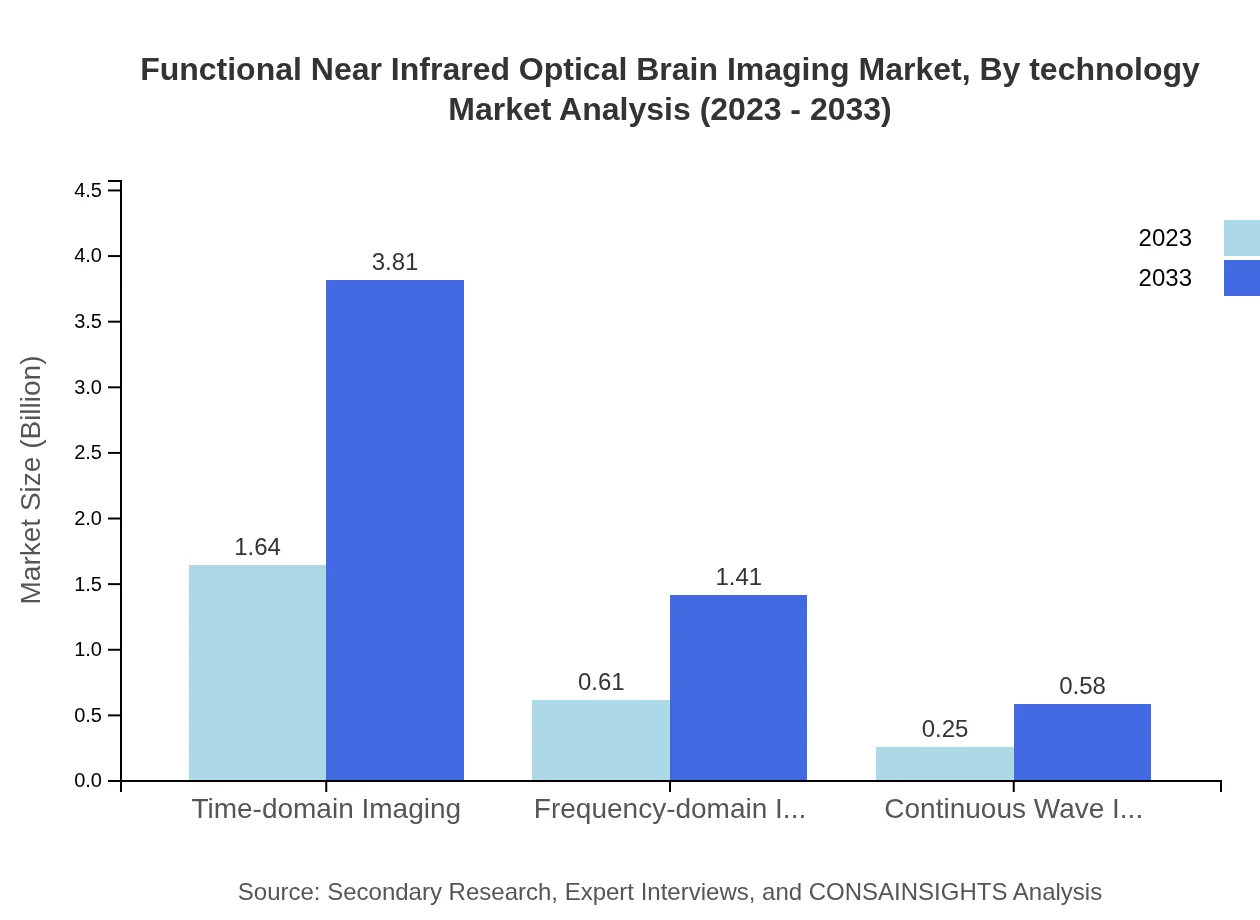
The market is segmented by technology into time-domain imaging, frequency-domain imaging, and continuous wave imaging. Time-domain imaging holds the largest share, accounting for approximately 65.63% of the market in 2023, with a size of $1.64 billion, increasing to about $3.81 billion by 2033. Frequency-domain imaging, which is gaining traction due to its accuracy in spatial resolution, is forecasted to grow as well, projected to reach $1.41 billion by 2033 from $0.61 billion in 2023. Continuous wave imaging represents the smallest segment with anticipated growth from $0.25 billion to $0.58 billion over the same period.
Functional Near Infrared Optical Brain Imaging Market Analysis By Application
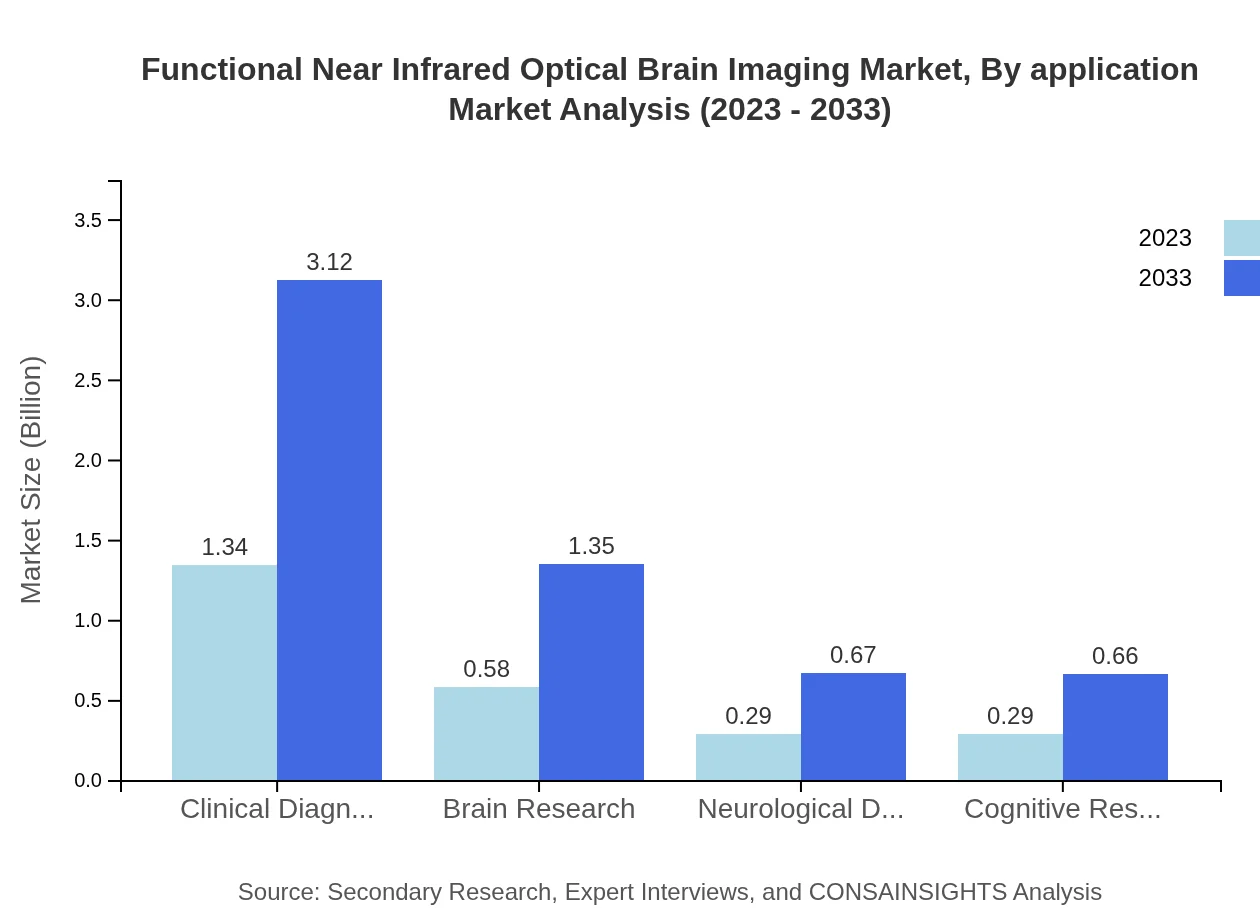
Applications are categorized into clinical diagnostics, brain research, neurological disorders, and cognitive research. Clinical diagnostics dominate, with a market size of $1.34 billion in 2023, expected to rise to $3.12 billion in 2033. Brain research follows, with its market growing from $0.58 billion in 2023 to $1.35 billion by 2033. Neurological disorders and cognitive research are also vital segments, each projected to show substantial growth, reflecting the increasing complexity and need for precise imaging technologies.
Functional Near Infrared Optical Brain Imaging Market Analysis By End User
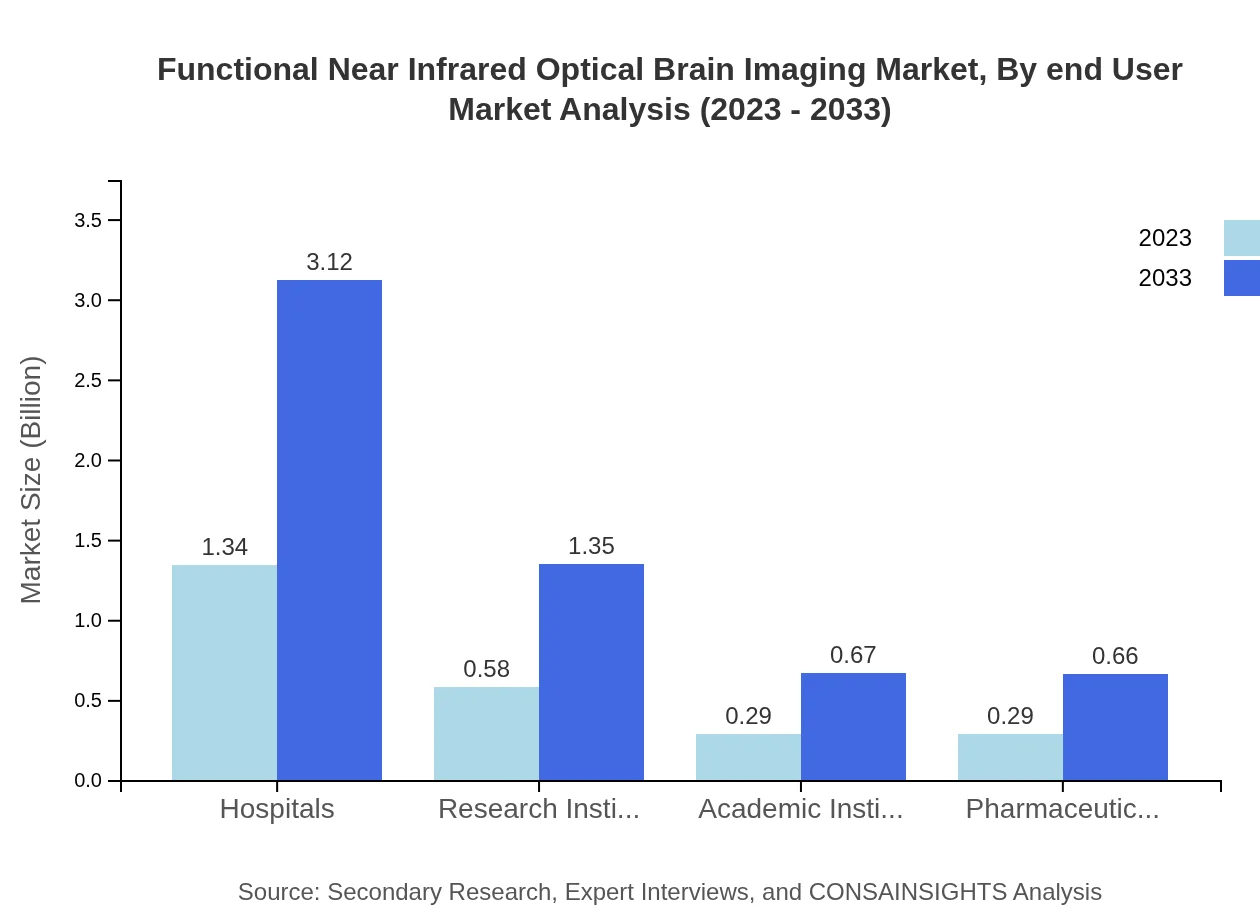
End-users of fNIRI technology include hospitals, research institutes, academic institutions, and pharmaceutical companies. Hospitals are the largest segment, showing consistent growth from $1.34 billion in 2023 to $3.12 billion by 2033. Research institutes account for a significant share as well, starting at $0.58 billion and projected to grow to $1.35 billion in the same period. Academic institutions and pharmaceutical companies are also crucial, contributing to the market through innovative research and drug development.
Functional Near Infrared Optical Brain Imaging Market Analysis By Region
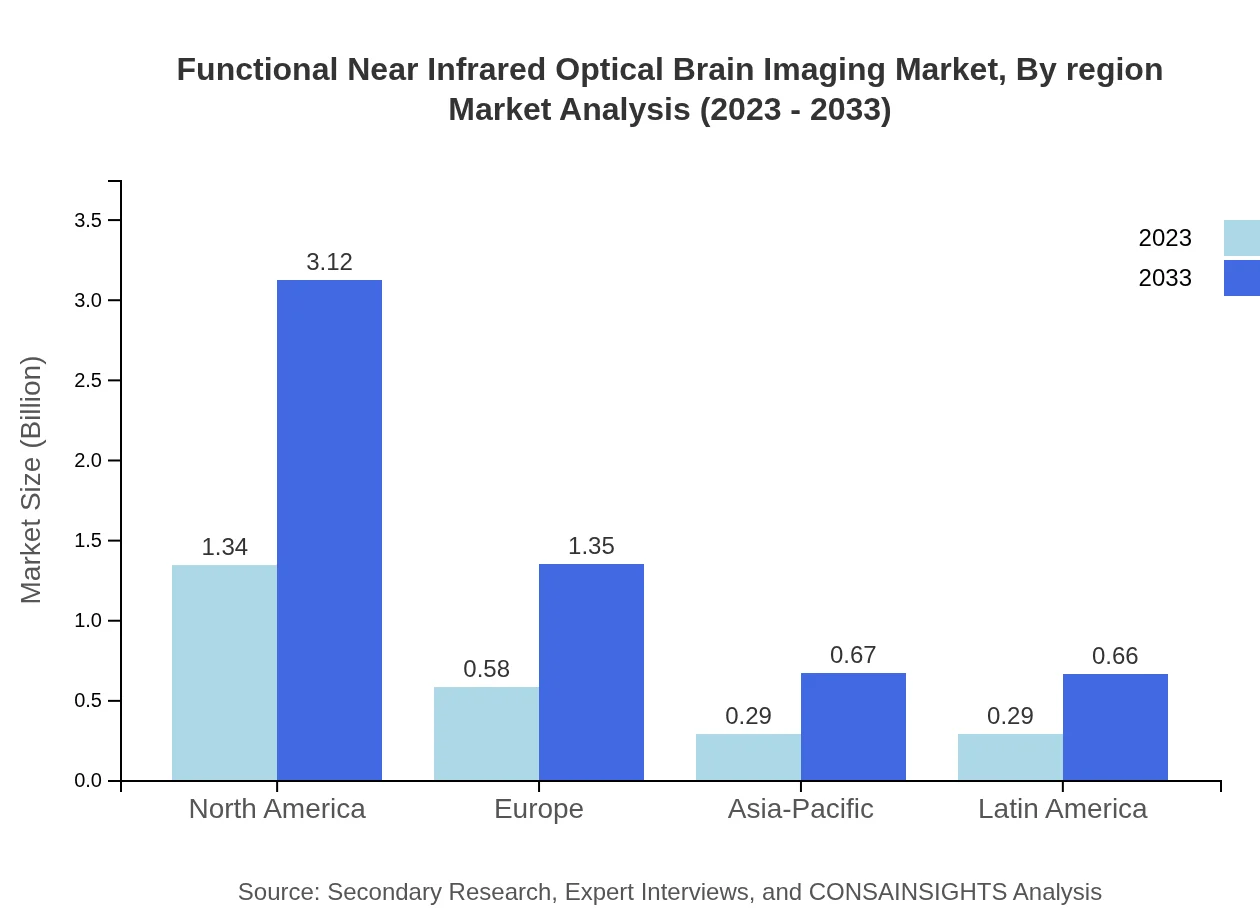
The regional analysis delves into market dynamics across five key regions: Asia Pacific, South America, North America, Europe, and the Middle East and Africa. Each region shows distinct growth potential influenced by healthcare demands, technological advancements, and governmental policies aimed at improving neurological health. North America remains the leading market, while Asia Pacific is forecasted to exhibit the fastest growth, underlining varying regional strategies in addressing brain imaging challenges.
Functional Near Infrared Optical Brain Imaging Market Trends and Future Forecast
Tell us your focus area and get a customized research report.
Global Market Leaders and Top Companies in Functional Near Infrared Optical Brain Imaging Industry
NIRx Medical Technologies:
NIRx is a chief innovator in functional near-infrared spectroscopy systems, focusing on non-invasive imaging technologies for both clinical and research applications.Hitachi Medical Corporation:
Hitachi specializes in advanced imaging modalities and is expanding its footprint in the neuroimaging sector through innovative fNIR systems.Zebra Medical Vision:
Zebra leads in AI-driven imaging solutions and is applying its technology to enhance fNIRI applications for improved diagnostics.University of California, Berkeley:
UC Berkeley is at the forefront of academic research in fNIRI technology, contributing to the advancement and application of this imaging modality.We're grateful to work with incredible clients.








FAQs
What is the market size of the Functional Near Infrared Optical Brain Imaging market in 2023?
The market size in 2023 is $2.50 Billion, as reported for the Functional Near Infrared Optical Brain Imaging market.
How big is the projected market in 2033?
By 2033 the market is projected to reach $5.80 Billion according to the provided forecast data.
What is CAGR for the forecast period?
The forecast period 2023 to 2033 carries a compound annual growth rate of 8.5% based on the supplied figures.
Is there a single fastest Growing region in the Functional Near Infrared Optical Brain Imaging Market Report market?
No single fastest-growing region is stated for the Functional Near Infrared Optical Brain Imaging Market Report market because the top regional implied CAGR values are within 0.15 percentage points of each other, making the ranking too close to call reliably.
Why is the market growing?
Growth is driven by demand for non-invasive diagnostic imaging, research expansion, and technological improvements in near-infrared imaging methods.
Who are the top companies in this market?
Top companies listed include NIRx Medical Technologies, Hitachi Medical Corporation, Zebra Medical Vision, and University of California, Berkeley.
What are the primary end users for these systems?
Primary end users include hospitals, research institutes, academic institutions, and pharmaceutical companies as specified in the segmentation.
Which technologies are included in market segmentation?
Market technologies noted in segmentation are Time-domain Imaging, Frequency-domain Imaging, and Continuous Wave Imaging.
How big is the European market in 2023 and 2033?
Europe is recorded at $0.68 Billion in 2023 and rises to $1.58 Billion in 2033 per the regional facts.
What research methods supported the report findings?
Findings are based on primary interviews with industry experts and secondary research including company reports and publications.